Categories
Archive Blogroll Ger Magazine UNDP Mongolia 1997-1999 United Nations Development Programme

Mongolian Rock and Pop Book: Mongolia Sings its Own Song

Publisher: UNDP Mongolia Communications Office/Press Institute of Mongolia

Managing Editor: David South

Editorial Advisors: Ts. Enkhbat, Mustafa Eric, David South

Author and Researcher: Peter Marsh, Indiana University

Copy Editor: N. Oyuntungalag

Production Editor: B. Bayarma

Published: 1999

ISBN 99929-5-018-8

In the Mongolian language, the book explores how Mongolia’s vibrant rock and pop music scene led on business innovation and entrepreneurship in the country during the transition years (post-1989). Written by an ethnomusicologist, it details the key moments and events in this story, while splicing the narrative with first-person interviews with the major players.

https://davidsouthconsulting.org/2020/12/17/mongolias-musical-entrepreneurs-led-way-out-of-crisis-2018/

From Ger Magazine Issue 1

Published: September 9, 1998

Mongolia Sings its Own Song

MTV is available on cable television, bootleg CDs blare from kiosks and the latest news on the Spice Girls is available in one of dozens of entertainment newspapers. Despite the flood of foreign music it is local musicians who the youth turn to to voice their new-found freedoms, dreams and angst. Pop music researcher Peter Marsh swings to the new beat of the steppe…

It is something that would have horrified the old socialist leaders. Pop singer T. Ariunaa – Mongolia’s answer to Madonna – is doing what she does best: pushing the barriers of what a performer can and can’t do. Notorious in the local press as “Mongolia’s Queen of the Erotic,” she struts onto the stage of the Non-Stop – one of the newest and trendiest disco clubs in the Mongolian capital, Ulaanbaatar – wearing a black silk robe over black lingerie bikini underwear. Jumping into her hit song, “Telephone Number”, she sings the lines,

When you begin to take off your shirt, I am happy you’re staying;

When your hot breath is near me, the lights go out,

Cheekily writhing her torso, seductively opening and closing her robe, she teases her audience. And her audience, mostly Mongolian youth from the late teens to early thirties, take it all in with good humour, smiling and giggling. Whether they like her music or not, they appreciate what she’s doing and are having fun. The message of free expression is reflective of the enormous changes in attitudes over this decade. 

“I like Ariunaa very much,” says 30-year-old Sukhbaatar, a graphic designer. Wearing a dress shirt, slacks and noticebly shiny shoes, he’s sitting with his two friends, glasses of beer in hand, watching the show. “She has a powerful voice,” he says gesticulating towards the stage. “She has a peculiar style, and this kind of style should be developed in Mongolia. 

“But we don’t admire her as a singer,” he says with a wry laugh.

Not long ago, when this landlocked Northeast Asian nation was still subject to Soviet-backed socialist rule, pop-rock musicians like Ariunaa would never have been allowed to bring such explicit expressions of ‘the erotic’ anywhere near the public stage. Ariunaa’s boldness and charisma, which have made her one of Mongolia’s most well-known and controversial young pop stars, show something of the new openness and growing diversity that characterizes the emerging popular music industry in capitalist Mongolia. There are girl bands like Spike, boy bands like Nomiin Talst and Camerton and pop divas like Saraa.

A typical concert in Ulaanbaatar, like this one at the Non-Stop – a converted public gymnasium which opened earlier this year – consists of a succession of live Mongolian bands interspersed with breaks for dancing to Western pop, disco and techno music. The styles of music in these concerts fall into what the Mongolians call pop-rock, which ranges from rock ‘n’ roll, soft rock, and heavy metal rock to techno, hip-hop and rap. Mongolian music fans today now have a wide choice of styles to choose from.

Someone who would know about this well is the ‘elder statesman’ of rock, D. Jargalsaikhan. Wearing leather cowboy boots, sequined leather pants and a leather jacket, and with his black hair streaming down over his shoulders, Jargalsaikhan sees the new diversity of groups as a positive sign of the times, as he said in a recent newspaper interview. 

“In the stores today there are maybe 10 different varieties of sausage: salted, unsalted, spiced and so on. You can then look at them all and then choose the one you want, like spiced sausage. It’s the same thing with the music business in Mongolia today. In the era of the market economy many different bands and singers have come out, and the listeners can choose the recordings of those bands and music styles that they like. … The most important thing is that the other bands or styles of singers should not be ignored. All of them have a wish to do something. Usually, those who criticize different styles or forms of music are people with too much time on their hands.”

Although turning 40 this year, Jargalsaikhan is not a man with too much time on his hands. As head of the Mongolian Singer’s Association, his many responsibilities keep him on the run. In between numerous breaks to answer calls on his cell phone, Jargalsaikhan tells me about being a rocker in the 1970s and ’80s, which he terms the “Golden Era” of rock in Mongolia, and the difficulties they faced. “Because Mongolia was ruled by one party, the Revolutionary [Socialist] Party [from 1921 to 1990], there was little foreign influence allowed into the country. Rock and pop were not to be found on the [state-controlled] radio or TV, and aside from records and cassettes brought into the country by individuals coming from Europe and Russia, people here had very little experience with the music. … It was easier for the early rock-pop musicians to take examples from folk music, which was close to them, which they had been listening to since their childhood.” Much of the early music included settings of popular folk songs and melodies in the rock genre. And the youth, eager for alternatives to the state-sponsored cultural offerings, found the music to their liking.

The popularity of this early rock-pop, or so-called folk-pop groups soon drew the attention of the socialist party, which saw opportunities to use the music for the purpose of advancing its mission in Mongolia. In exchange for the state government’s granting of musical instruments, rehearsal and performance spaces, and concert and touring opportunities, the early bands were closely watched, their actions restricted by suspicious government officials. “Everything was planned by the government, and we had to do what it had planned,” says Jargalsaikhan. “For example, when we were abroad, we couldn’t go to the discos nor arrive at the hotel late. We couldn’t go where we wanted. There were conflicts between the singers and musicians and the government representatives [sent to oversee the tour]. If I spoke to foreigners, I would be considered a spy. Who I spoke with was also controlled. At that time, the social condition in Mongolia was like that of North Korea today.”

Considered by the government to be a “capitalist art,” the direct imitation of Western rock was not allowed. Mongolian bands instead had to create a unique Mongolian style of the music that drew from traditional folk or classical musical and literary traditions. Band members were often compelled to compose songs to lyrics written by members of the powerful Mongolian Union of Writers. “It was difficult for musicians to play their own compositions, and they were often forbidden to do so,” recalls Jargalsaikhan. “For the concert programmes, our songs had to include the topics of Mongolia and the Soviet Union, as well as the Mongolian love for Nature or for Father and Mother. … The topic of love between a man and woman was considered to be too personal for the public stage, and was almost forbidden.”

But rock and pop musicians gained more and more freedoms of expression as political and social reforms were introduced in Mongolia throughout the 1980s. “The rock-pop musicians of the 1970s became more skilled and their abilities improved,” says Jargalsaikahn. “They began to compose at the level of professional composers. Also, the older generations wanted to give more artistic freedoms to the youth at the same time as the Party controls were being lifted.” And the youth, in turn, were more intent on creating traditions of music of their own generation. “The young rock-pop musicians wanted to hand-down their own music to the next generation-their own pop-rock art.

Jargalsaikhan gained fame throughout Mongolia for his 1988 song “Chinggis Khan,” when he was lead singer of the band by the same name. Making use of traditional folk music instruments alongside of the group’s electric guitars, synthesizers and drums, the song praises the 13th century Mongolian leader as a great, if historically misunderstood, man who always had in mind the good of the Mongolian nation–and this at a time when expressing such sentiments could have landed him in prison. “I had to show my civil courage to sing this song. But many of my friends and fellow composers encouraged me to write and perform it.”

His was the voice of a new generation, one seeking more freedoms to express Mongolian identity in new ways. The efforts of many musicians of his generation contributed to the popular political movements and protests that eventually led, in 1990, to the downfall of the socialist government and the introduction of democratic and market economic reforms throughout the nation.

In the new social and cultural climate of the late-1980s and early ’90s, musicians saw it as their responsibility to introduce Western rock music and popular culture to Mongolia. Besides Jargalsaikhan’s Chinggis Khan (“soft rock”), other groups came onto the popular music scene, including bands like Haranga (“heavy-metal/grunge”) and Hurd (“metal rock”).

The leader and percussionist of the group Hurd (“Speed”), D. Ganbayar, saw it as a national service to his people to introduce his group’s unique form of Western-style rock. “The Mongolian people, and especially the youth, don’t want [their bands] to imitate Western rock art. They want a pop-rock with its own specific character, music that’s different from other types of Western rock-pop, music with its own national character.” Wearing a leather jacket and black hair down to his chest, Ganbayar, moves to the edge of his chair. “No one but us will introduce this kind of music to the Mongolian people. We serve our people. It’s our duty to introduce Western music to the Mongolian people through the Mongolian language and Mongolian melodies. We want to show that Mongolian rock-pop has its own unique character.”

Nearing a decade of life, Hurd continues to experiment with new sounds and performance styles. They recently softened their driving, heavy metal style in two “Unplugged” concerts given at another new disco club in Ulaanbaatar, Top Ten, a cavernous warehouse located in a former cultural centre. This was the first time any rock group had tried such a concert idea in Mongolia. Even on acoustic guitars, however, the group, consisting of a bass, two guitars, drums, percussion and keyboards, managed to fill the club with their sound and fury. Their fans packed the house, and the lead singer, Tumurtsog, needed little effort to get them to sing along with him on many songs.

Hurd and Haranga are still very popular groups in Mongolia, but in the past years few new heavy metal or hard rock groups have come onto the pop-rock scene here. Instead, a new generation of popular singers and music groups have been working their way up and into the limelight of the concert stages. These are youths that mostly eschew the long hair and leather jackets of the older groups in favor of short, styled hair and suits and ties. The music would be recognized in the West as techno, hip-hop, and pop along the lines of the Backstreet Boys, Celene Dion and the Spice Girls, and is almost always electronically produced in recording studios and then backgrounded to the singers and dancers themselves on stage with the use of a tape player.

Mostly in their late teens and early 20s, these performers appeal to Mongolian audiences with their singing, dancing and stage presence. One of the most popular of the current crop of bands is Har Sarnai (“Black Rose”), a “hip-hop techno” male duo, famous for their dancing, nationalistic song lyrics and sometimes outrageous clothes and hair styles.

In their concerts they often come out on stage wearing specially designed silken dels (traditional Mongolian robes worn by both men and women), with sunglasses and big bushy black and gray colored wigs on their heads. As the heavy techno beat of one of their most famous songs, “Alarm,” begins, they launch into their synchronized dance routines and lyrics, which exhort Mongolians to wake up from their dreaming and set to work producing a new society. Their audiences watch from their tables-as Mongolians hardly ever dance while the bands are performing-clearly enjoying the show.

“Har Sarnai is my favorite band,” says 19-year-old Buyanbaatar, a student at the Mongolian State University. “I like how different they are. Their clothes, their behavior on stage is different. And the songs that they sing, their dances and their clothes and style are all well suited together.”

Even older youth, like Sukhbaatar, age 30, mirror these sentiments. “I like Har Sarnai because I like their style and their dancing very much. I also like their unique styles of hair.” His friend Tsooj, age 31, adds, “In America you have rap bands, like New Kids [on the Block], and they dance really well. We like dancing very much. We are not too old for this!”

To both of them, the infectiousness of the new music pop scene transcends traditional age definitions. “I started to listen to music from the Beatles and other foreign bands. But now it’s become very nice in Mongolia. It’s just impossible not to be a fan because we are young people. We don’t think we are old. We are young enough, and we are here to support our favorite bands, and we will scream and whistle with everyone else!”

How audience members of different age groups can mix together at concerts and share such similar tastes in musical genres is perhaps unique to Mongolia. “One of the reasons why even the older generations like the new bands of the younger generations,” says Norov-Aragcha, a professional artist, aged 38, “is that in their youth, when they were 18 or 20, such bands didn’t exist here. We like new things like the younger people, and this music is new to Mongolia.”

But while he appreciates the new opportunities that the new bands have to perform their music in Mongolia, Norov-Aragcha adds that something is certainly missing from their music. “I like Ariunaa, and appreciate what she does. But all these bands and singers [of the young generation], although they have their own styles, they are generally on one level. None of them stands out from the rest. Maybe because of my profession, I prefer something new, something very different from the others. Haranga and Jargalsaikhan, they are our generation. They have feelings, they are making efforts with their music, and they are honest to their music. In their time [late-1980s and early 1990s] it was very difficult, but they did it. They have real talent, real feeling in their music.”

“Now I’m looking at all these new bands and singers, but still the one that I want hasn’t appeared. … That is, something which suits today’s conditions and atmosphere. … Something very powerful, very hard. Something like a Kurt Cobain.”

While not new to Mongolia, pop-rock’s growing diversity certainly is. The general feeling these days seems to be one of celebration of its freedoms and appreciation of its diversity, without the isolation of audiences into genres that is typical in the West. Given the difficulties Mongolia’s youth now face as they struggle to adapt to a society undergoing enormous change, a Mongolian “Kurt Cobain” may be just around the corner.

Creative Commons License

This work is licensed under a
Creative Commons Attribution-Noncommercial-No Derivative Works 3.0 License.

ORCID iD: https://orcid.org/0000-0001-5311-1052.

© David South Consulting 2024
Categories
Archive Development Challenges, South-South Solutions Newsletters

Cashing in on Music in Brazil

By David SouthDevelopment Challenges, South-South Solutions

SOUTH-SOUTH CASE STUDY

Brazilian musicians have found a way to prosper and exploit the realities of music distribution in the modern age. The biggest problem for most artists – both beginners and those who are more established – is how to earn an income from their work. In the digital age, it is next to impossible to stop people freely copying your work and passing it on.

The impact of digital technology on the global music business has been earth-shattering. It’s estimated 95 percent of music digital downloads are unauthorized, with no payment to artists and producersWhile the legal digital music business grew for the sixth consecutive year in 2008, with a 25 percent increase in global sales to a trade value of US$3.7 billion, this only makes up 20 percent of total music sales (IFPI) (http://www.ifpi.org/). Even legal digital services like Apple’s iTunes have suffered (http://www.apple.com/downloads/).

An economic solution to this conundrum is critical for the growth of creative economies in the South.

The traditional music industry model from the analogue age – where copies of music are tightly controlled and royalties and profits funnel back to recording companies – has come unstuck in the digital age. With digital recordings, it is easy to copy high quality music and distribute it for free through the Internet, by audio music players like the iPod or on discs.

Many are saying a corner has been turned: free distribution is the new future and illegal copying is the new normal. The model for music making has been turned on its head: from high investment and high returns, it is now low investment and low returns. And this model chimes very well with the world most Southern musicians live in. The chances for most of emulating the champagne and jets lifestyle of the Rolling Stones or Beyonce is beyond their reality. But they can build a slower and more sustainable income with the new digital model.

A music phenomenon in Brazil’s poorer neighbourhoods, tecnobrega (brega means cheesy or corny) is a mix of electronic beats from the 1980s, mixed with found snippets of strange sounds or sound bites, combined in a so-called ‘mash-up’ (http://en.wikipedia.org/wiki/Mashups). It makes for an easy-to-dance-to mix.

“Tecnobrega is a regional music, the music that people here in (the state of) Para most enjoy,” DJ Edilson told the BBC. “The secrets are the beats which drive people crazy.”

With music becoming easier and cheaper to record to a high standard, and distribution of music less and less a money-making opportunity, musicians have turned to economic models revolving around live performance to make the bulk of their income.

“What is going on is that people, sometimes in very poor areas, are appropriating electronic instruments like computers and synthesizers to create their own music,” said Ronaldo Lemos, a professor at the respected Getulio Vargas Foundation (http://www.fgv..br/ ) and project lead for the Creative Commons Brazil (http://creativecommons.org/international/br/).

“So this is a phenomenon that is going on not only in the tecnobrega scene but with many scenes around the world like Kuduro in Angola, Kwaito in South Africa, Bubblin’ in Suriname.”

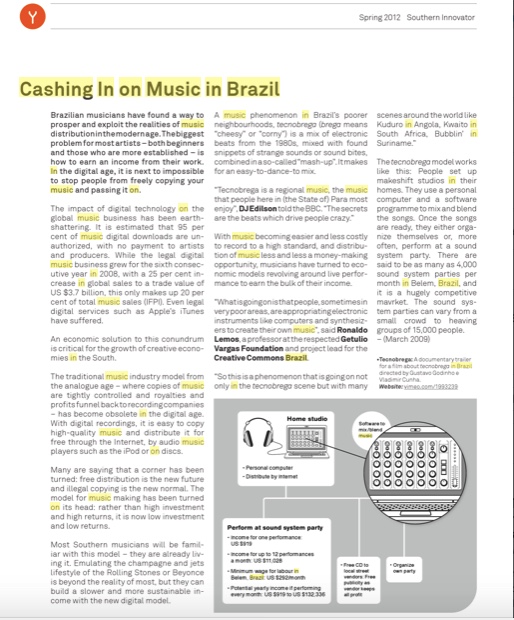
The tecnobrega model works like this: People set up makeshift studios in their homes. They use a personal computer and a software programme to mix and blend the songs. Once the songs are ready, they either organize themselves, or more often, perform at a sound system party. There are said to be as many as 4,000 sound system parties per month in Belem (http://en.wikipedia.org/wiki/Bel%C3%A9m) and it is a hugely competitive market. The sound system parties can vary from a small crowd to heaving groups of 10 to 15,000 people. 

The money for performing at these parties is good. A musician performing just once can make 2,200 realis (US $919), and can do this 12 times a month. This is a good income compared to the minimum wage in Belem: 700 realis (US $292). It is estimated it generates US $1.5 million a month in Belem.

In Brazil, where many do not have broadband Internet and thus can’t download music, fans buy pirated and cheap compact discs (CDs) in markets. Local musicians make their own CDs and give them free to local street vendors. While they make no money off the CDs that are then sold by the vendors, they do drum up publicity and profile. And they then use this to draw large paying crowds to their live gigs.

In just a few years, tecnobrega has become a multi-million dollar music business in Brazil. Once an artist has gained experience performing live at the parties, they can develop the skills to organize their own events, and boost their income accordingly.

One singer who has successfully exploited the opportunities raised by the tecnobrega phenomenon is Gaby Amarantos (http://www.youtube.com/watch?v=ZKjH__ghQa4 ). She now regularly appears on TV. 

“We have found a new way to work,” she told the BBC. “It is a new format and a new market model because we produce the music ourselves and the cost to make one song is very cheap.”

“What happens is that the musicians skip the intermediaries,” said Ronaldo Lemos.

“So the musicians do not make money from the CDs that are sold by the street vendors, they actually make money by playing live at the so-called sound system parties – the aparelhagem parties as we tecnobrega say here in Brazil – and also by selling CDs after they play live.

“No-one expects to make money from the CDs – they use it as a way to advertise the music and to advertise themselves as artists, and then their expectation is that they get invited to play at the sound system parties and clubs.

“The more their music gets distributed, the more they will make money in return.”

The furious pace of innovation in the tecnobrega scene is all about generating more revenue and more income. New styles emerge to cater to new tastes: cyber tecnobrega, brega melody, electro melody. And this passion for innovation has kept the tecnobrega entrepreneurs ahead of the traditional music business in how it uses digital technologies.

Lemos calls tecnobrega a “globoperipheral music”: it transcends rich and poor divisions and geographical boundaries.

Other examples include Argentina’s Cumbia Villera, or Brazil’s Funk Carioca.

“The number one lesson would be innovation – if you want to survive in the music industry right now you have to innovate,” said Lemos.

Published: March 2009

Resources

  • Good Copy, Bad Copy: A Danish documentary film by director Andreas Johnsen about the global explosion in movie- and music-making because of the digital revolution. Website: http://www.goodcopybadcopy.net/
  • A documentary trailer for a film about tecnobrega in Brazil directed by Gustavo Godinho e Vladimir Cunha. Website:http://www.vimeo.com/1993239

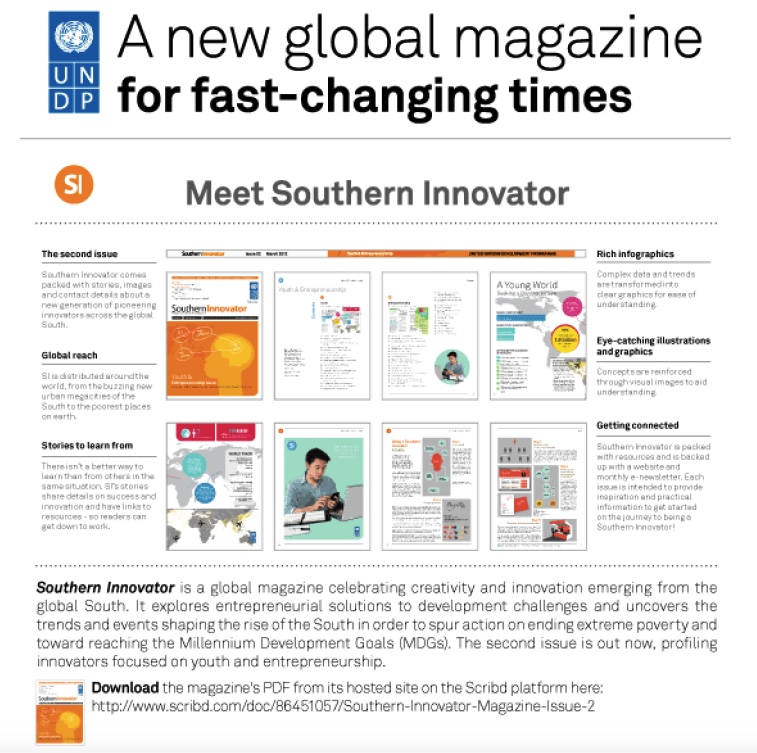
Development Challenges, South-South Solutions was launched as an e-newsletter in 2006 by UNDP’s South-South Cooperation Unit (now the United Nations Office for South-South Cooperation) based in New York, USA. It led on profiling the rise of the global South as an economic powerhouse and was one of the first regular publications to champion the global South’s innovators, entrepreneurs, and pioneers. It tracked the key trends that are now so profoundly reshaping how development is seen and done. This includes the rapid take-up of mobile phones and information technology in the global South (as profiled in the first issue of magazine Southern Innovator), the move to becoming a majority urban world, a growing global innovator culture, and the plethora of solutions being developed in the global South to tackle its problems and improve living conditions and boost human development. The success of the e-newsletter led to the launch of the magazine Southern Innovator. 

Creative Commons License

This work is licensed under a
Creative Commons Attribution-Noncommercial-No Derivative Works 3.0 License.

ORCID iD: https://orcid.org/0000-0001-5311-1052.

© David South Consulting 2023

Categories
Archive Development Challenges, South-South Solutions Newsletters Southern Innovator magazine

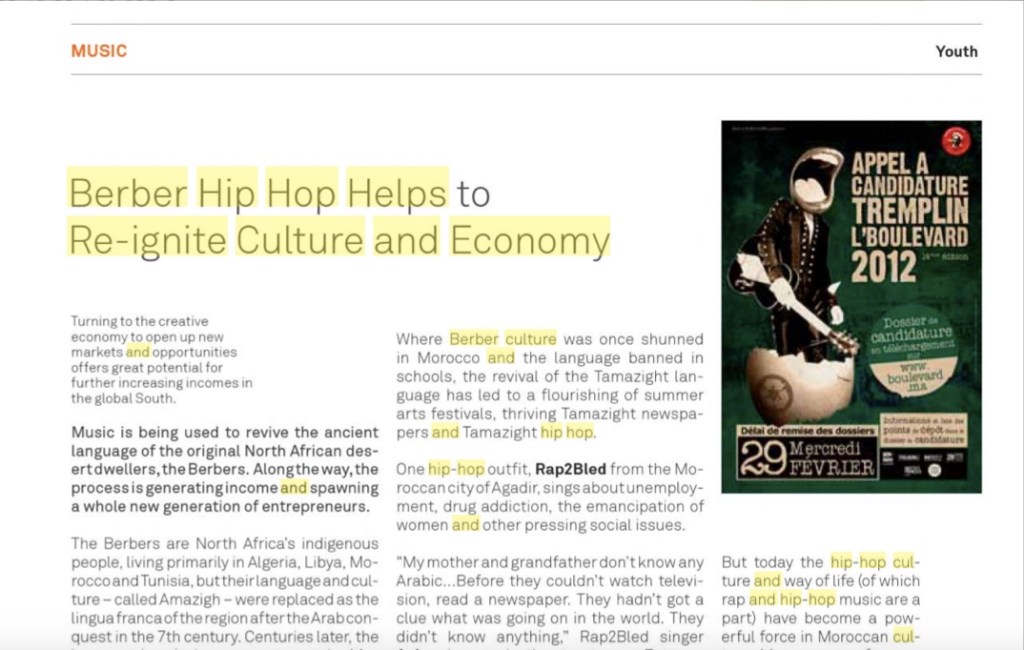
Berber Hip Hop Helps Re-ignite Culture and Economy

By David SouthDevelopment Challenges, South-South Solutions

SOUTH-SOUTH CASE STUDY

Music is being used to revive the ancient language of the original North African desert dwellers, the Berbers (http://en.wikipedia.org/wiki/Berber_people). And in the process, it is spawning a whole new generation of entrepreneurs and generating income. 

The Berbers are North Africa’s indigenous people, primarily living in Morocco, Algeria, Libya, and Tunisia, but their language and culture – called Amazigh – were replaced as the lingua franca of the region after the Arab conquest in the 7th century. But all these years later, the language is enjoying resurgence under Morocco’s king, Mohammed VI, who is helping to promote the language through television programming and a new law making teaching of the language compulsory in schools by 2010.

Amazigh people – the name means “free humans” or “free men” – total more than 50 million. Their group languages, called Tamazight, are spoken by several million people across North Africa, with the largest number in Morocco.

For young Moroccans, promoting the language is more interesting when hip hop (http://en.wikipedia.org/wiki/Hip_hop_music) is thrown into the mix. 

Where once Berber culture was shunned in Morocco and the language banned in schools, the revival of the Tamazight language has led to a flourishing of summer arts festivals, thriving Tamazight newspapers _ and Tamazight hip hop.

One hip-hop outfit, Rap2Bled from the Moroccan city of Agadir, stick to social issues, singing about unemployment, drug addiction and the emancipation of women.

“My mother and grandfather don’t know any Arabic…Before they couldn’t watch television, read a newspaper. They hadn’t got a clue what was going on in the world. They didn’t know anything,” Rap2Bled singer Aziz, who goes by the street name Fatman, told to Radio Netherlands Worldwide.

“But now there is a TV channel in our local dialect and a newspaper. But our aim is to put the language on the map by fusing it with hip hop. More than 60 per cent of young Moroccans only listen to rap and western music. So we thought why not fuse Berber with that and make it really accessible?”

Just 10 years ago, rap and hip hop were virtually unknown in Morocco, with only a small group of hip hop aficionados listening to big American stars like Dr Dre, Tupac Shakur and Notorious BIG.

But today hip hop culture and way of life (of which rap and hip hop music are a part) have become a powerful force in Moroccan culture. Moroccan rap focuses on local issues like unemployment and injustice and is ubiquitous on radio and TV.

The Casa Crew, from Casablanca, has become so successful since their beginnings in 2003 that their fan base stretches to Spain and Algeria.

“First of all, to designate rap simply as mere ‘music’ deprives it of its real impact,” Caprice from the Casa Crew (http://casa-crew-00.skyrock.com/), told the Arab Media News, Menassat. 

“Rap is a life style, and mainly a culture of convictions. The fact that rap is spreading in countries like Morocco is an excellent sign. On the one hand, it’s proof that the youth are starting to react, to think they have the right to express themselves in any way they see fit, without anyone judging them or denying them of that right. On the other hand, the development of rap means that the space for artistic freedom is growing particularly when considering that a majority of Arab rappers are dealing with subjects that we were forbidden to speak about a few years ago.”

The Amazigh revival industry centres around large music festivals. Timitar Festival in Agadir (http://www.moroccofestivals.co.uk/timitar.html) gets crowds surpassing 500,000, with more than 40 artists. Morocco’s biggest festival helps Amazigh artists meet world musicians and learn how to reach music fans outside of Morocco.

Another pioneer of Morocco’s music industry is Mohamed ‘Momo’ Merhari, a young music entrepreneur and winner of the British Council’s International Young Music Entrepreneur of the Year award in 2008 (http://www.creativeconomy.org.uk/).

Momo is a music consultant and co-founder of the “Boulevard des Jeunes Musiciens” (http://www.boulevard.ma/), the largest contemporary music festival in North Africa, featuring 50 bands over four days, and reaching a live audience of 130,000 people. The annual event showcases new talent from the worlds of hip hop, rock and jazz fusion from all over the region.

In January, Morocco’s culture minister Touriya Jabrane promised to introduce a range of measures to financially support Moroccan musicians, composers and the industry as whole.

Published: March 2009

Resources

https://davidsouthconsulting.org/2022/10/02/african-afro-beats-leads-new-music-wave-to-europe/

https://davidsouthconsulting.org/2022/11/17/cashing-in-on-music-in-brazil/

https://davidsouthconsulting.org/2022/12/18/disabled-congolese-musicians-become-world-hit/

https://davidsouthconsulting.org/2021/11/09/mauritanian-music-shop-shares-songs-and-friendship/

https://davidsouthconsulting.org/2020/12/17/mongolias-musical-entrepreneurs-led-way-out-of-crisis-2018/

https://davidsouthconsulting.org/2023/02/07/mongolian-rock-and-pop-book-mongolia-sings-its-own-song/

https://davidsouthconsulting.org/2021/11/09/ring-tones-and-mobile-phone-downloads-are-generating-income-for-local-musicians-in-africa/

https://davidsouthconsulting.org/2021/11/09/taxis-promote-african-music-beats/

https://davidsouthconsulting.org/2020/11/24/too-black/

Development Challenges, South-South Solutions was launched as an e-newsletter in 2006 by UNDP’s South-South Cooperation Unit (now the United Nations Office for South-South Cooperation) based in New York, USA. It led on profiling the rise of the global South as an economic powerhouse and was one of the first regular publications to champion the global South’s innovators, entrepreneurs, and pioneers. It tracked the key trends that are now so profoundly reshaping how development is seen and done. This includes the rapid take-up of mobile phones and information technology in the global South (as profiled in the first issue of magazine Southern Innovator), the move to becoming a majority urban world, a growing global innovator culture, and the plethora of solutions being developed in the global South to tackle its problems and improve living conditions and boost human development. The success of the e-newsletter led to the launch of the magazine Southern Innovator. 

Creative Commons License

This work is licensed under a
Creative Commons Attribution-Noncommercial-No Derivative Works 3.0 License.

ORCID iD: https://orcid.org/0000-0001-5311-1052.

© David South Consulting 2023

Categories
Archive Development Challenges, South-South Solutions Newsletters Southern Innovator magazine

Ring Tones and Mobile Phone Downloads are Generating Income for Local Musicians in Africa

By David SouthDevelopment Challenges, South-South Solutions

SOUTH-SOUTH CASE STUDY

African musicians hoping to support themselves through their recordings have always had to contend with the added burden of poor copyright control over their work. While musicians in the West are supported by a highly regulated regime of copyright protection – ensuring some to become the richest people in their respective countries – most African musicians have had to stand back and watch their work being copied, sold and exchanged with little chance of seeing any royalties. Global audiences know of the success of artists like Fela Kuti, Youssou N’Dour, Manu Dibango and Miriam Makeba, but most African musicians can look forward to scant earnings from recording their music.

Anyone who has walked through the markets of Africa will know there are plenty of pirated CDs for sale, yet it is of no use to a musician who never sees the money. Poverty is endemic amongst African musicians as a result of this loss of income. While music is a global business worth US $40 billion according to the Recording Industry Association of America, pirated music in Africa is rampant – some estimates by the Recording Industry of South Africa put it at over 80 percent of available music. How much money is being lost can be judged from the estimated daily income of a pirate music vendor in Africa, ranging between Euro 762 and Euro 2,744.

But a solution to this problem is being pioneered in Botswana in southern Africa. A partnership between mobile phone provider Orange Botswana and Small House Records/Mud Hut Studios, ensures musicians get a slice of the profit pie. Managing director Solomon Monyame of Small House Records has signed a contract with Orange to share the profits from ring tone and song downloads to mobile phone subscribers. With more than 76.8 million people currently subscribing to mobile phone services in Africa, and the number growing by about 58 percent each year for the last five years, the potential royalties market for African musicians is vast if this initiative is replicated across the continent.

In the paper “Development Goes Wireless” to be published in the spring 2007 issue of the journal of the Institute of Economic Affairs, lead researcher Karol Boudreaux of George Mason University’s Mercatus Center and Enterprise Africa!, discovered mobile phones and mobile phone companies can give artists a new way to control royalties for their work. She found that in the absence of effective copyright control mechanisms – as is the case in many African countries – the mobile phone company can step in to save the day.

“When you walk through the markets there you see so much music available on the street, but there is little intellectual property rights protection,” she said.

“In other countries, like the UK, you have strong intellectual property rights protection, but this just isn’t the case in much of Africa. The mobile phones are a very good way to get around this problem as long as cell phone providers are willing to make the contracts. Botswana is very lucky in that they have a very good contract environment, but this isn’t necessarily the case in other countries. It is a win-win for music providers and mobile companies.”

The NetTel@Africa project started by USAID and the Center to Bridge the Digital Divide, in partnership with many African and US universities, is also championing copyright protection strategies.

How important creative industries are becoming to economic development is slowly being recognized. It is now seen as an important component of modern post-industrial, knowledge-based economies, but equally also a way for economically underdeveloped countries to generate wealth. Not only are they thought to account for higher than average growth and job creation, they are also vehicles of cultural identity and play an important role in fostering cultural diversity. Initiatives like UNESCO’s Global Alliance for Cultural Diversity attempt to document this phenomenon and back it up with hard numbers.

UNESCO also has a project to establish musicians’ cooperatives across Africa. As such, the musicians are able to pool their production resources, which are individually insufficient to ensure the economic viability of a small or medium-sized business. In Burkina Faso, a co-operative is working with the International Labour Organisation. Click here for more information.

Festivals like Mali’s annual Festival in the Desert in the oasis of Essakane, 65 kilometers from Timbuktu, is an example of how African musicians are finding their own way to reach audiences. Targeted above all to promote African and Malian Music inside the continent, the Festival has also boosted international tourism to the region and almost 10 percent of last year’s 6,000 visitors came from outside of Africa.

Another initiative for African musicians is the DigiArts Africa network. It was founded by UNESCO and aims to increase communication between artists, industries and educators, make musicians self-sustainable, use the ICT industries to support and contribute to cultural activities, and better promote African musicians within and outside Africa. Click here for more information.

Well-known Senegalese musician Thione Seck is blunt about the economic effect of piracy on his income.

“Were there no piracy, I could have bought an island, seeing the number of songs that I composed in more than 30 years of my career”, he told a local newspaper.

According to Abdoul Aziz Dieng, president of the Senegal Music Works Association (AMS) and Chairman of the Board of the Senegalese Copyright Office (BSDA) (www.mali-music.com), out of 10 Senegalese artists’ CDs available on the local market, “only two are legal”. For audio cassettes, the ratio is three pirate copies out of every five sold.

Opportunities to combat piracy and generate income are also not limited to just musicians. Filmmakers in Africa are starting to learn how to exploit the opportunities thrown up by the fast-expanding mobile phone networks on the continent. Already a phenomenon in South Africa (www.filmmaker.co.za), director Aryan Kaganof is in the process of releasing SMS Sugar Man, a feature length movie shot entirely with mobile devices. The movie will be beamed to cell phones in three-minute clips over 30 days.

What are the effects of Piracy?

  • Artist
    • No royalty payments, no money to live
  • Record companies
    • No return on investments. Staff retrenchments
  • Retailers
    • Cannot compete with low prices. Staff retrenchments
  • Consumers
    • Many copies are of inferior quality. If tracks are missing or the sound quality is poor, no exchange or refunds
    • May be contributing to “organized crime” syndicates which are heavily involved in international music piracy

Source: Recording Industry of South Africa

Published: January 2007

Resources

Lively website about African musicians

BBC website on African music

Further reading from UNESCO: African music: new challenges, new vocations: Click here

https://davidsouthconsulting.org/2022/10/02/african-afro-beats-leads-new-music-wave-to-europe/

https://davidsouthconsulting.org/2022/11/11/berber-hip-hop-helps-re-ignite-culture-and-economy/

https://davidsouthconsulting.org/2022/11/17/cashing-in-on-music-in-brazil/

https://davidsouthconsulting.org/2022/12/18/disabled-congolese-musicians-become-world-hit/

https://davidsouthconsulting.org/2021/11/09/mauritanian-music-shop-shares-songs-and-friendship/

https://davidsouthconsulting.org/2023/02/07/mongolian-rock-and-pop-book-mongolia-sings-its-own-song/

https://davidsouthconsulting.org/2020/12/17/mongolias-musical-entrepreneurs-led-way-out-of-crisis-2018/

https://davidsouthconsulting.org/2021/03/05/southern-innovator-issue-1/

https://davidsouthconsulting.org/2021/03/05/southern-innovator-issue-2/

https://davidsouthconsulting.org/2021/11/09/taxis-promote-african-music-beats/

Creative Commons License

This work is licensed under a
Creative Commons Attribution-Noncommercial-No Derivative Works 3.0 License.

ORCID iD: https://orcid.org/0000-0001-5311-1052.

© David South Consulting 2023