Categories
Archive Blogroll Ger Magazine UNDP Mongolia 1997-1999 United Nations Development Programme

Mongolian Rock and Pop Book: Mongolia Sings its Own Song

Publisher: UNDP Mongolia Communications Office/Press Institute of Mongolia

Managing Editor: David South

Editorial Advisors: Ts. Enkhbat, Mustafa Eric, David South

Author and Researcher: Peter Marsh, Indiana University

Copy Editor: N. Oyuntungalag

Production Editor: B. Bayarma

Published: 1999

ISBN 99929-5-018-8

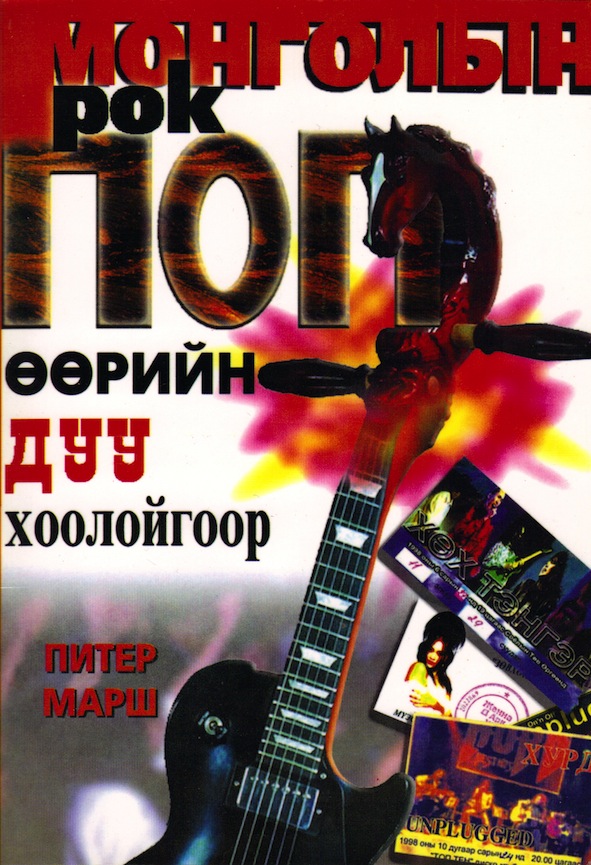
In the Mongolian language, the book explores how Mongolia’s vibrant rock and pop music scene led on business innovation and entrepreneurship in the country during the transition years (post-1989). Written by an ethnomusicologist, it details the key moments and events in this story, while splicing the narrative with first-person interviews with the major players.

https://davidsouthconsulting.org/2020/12/17/mongolias-musical-entrepreneurs-led-way-out-of-crisis-2018/

From Ger Magazine Issue 1

Published: September 9, 1998

Mongolia Sings its Own Song

MTV is available on cable television, bootleg CDs blare from kiosks and the latest news on the Spice Girls is available in one of dozens of entertainment newspapers. Despite the flood of foreign music it is local musicians who the youth turn to to voice their new-found freedoms, dreams and angst. Pop music researcher Peter Marsh swings to the new beat of the steppe…

It is something that would have horrified the old socialist leaders. Pop singer T. Ariunaa – Mongolia’s answer to Madonna – is doing what she does best: pushing the barriers of what a performer can and can’t do. Notorious in the local press as “Mongolia’s Queen of the Erotic,” she struts onto the stage of the Non-Stop – one of the newest and trendiest disco clubs in the Mongolian capital, Ulaanbaatar – wearing a black silk robe over black lingerie bikini underwear. Jumping into her hit song, “Telephone Number”, she sings the lines,

When you begin to take off your shirt, I am happy you’re staying;

When your hot breath is near me, the lights go out,

Cheekily writhing her torso, seductively opening and closing her robe, she teases her audience. And her audience, mostly Mongolian youth from the late teens to early thirties, take it all in with good humour, smiling and giggling. Whether they like her music or not, they appreciate what she’s doing and are having fun. The message of free expression is reflective of the enormous changes in attitudes over this decade. 

“I like Ariunaa very much,” says 30-year-old Sukhbaatar, a graphic designer. Wearing a dress shirt, slacks and noticebly shiny shoes, he’s sitting with his two friends, glasses of beer in hand, watching the show. “She has a powerful voice,” he says gesticulating towards the stage. “She has a peculiar style, and this kind of style should be developed in Mongolia. 

“But we don’t admire her as a singer,” he says with a wry laugh.

Not long ago, when this landlocked Northeast Asian nation was still subject to Soviet-backed socialist rule, pop-rock musicians like Ariunaa would never have been allowed to bring such explicit expressions of ‘the erotic’ anywhere near the public stage. Ariunaa’s boldness and charisma, which have made her one of Mongolia’s most well-known and controversial young pop stars, show something of the new openness and growing diversity that characterizes the emerging popular music industry in capitalist Mongolia. There are girl bands like Spike, boy bands like Nomiin Talst and Camerton and pop divas like Saraa.

A typical concert in Ulaanbaatar, like this one at the Non-Stop – a converted public gymnasium which opened earlier this year – consists of a succession of live Mongolian bands interspersed with breaks for dancing to Western pop, disco and techno music. The styles of music in these concerts fall into what the Mongolians call pop-rock, which ranges from rock ‘n’ roll, soft rock, and heavy metal rock to techno, hip-hop and rap. Mongolian music fans today now have a wide choice of styles to choose from.

Someone who would know about this well is the ‘elder statesman’ of rock, D. Jargalsaikhan. Wearing leather cowboy boots, sequined leather pants and a leather jacket, and with his black hair streaming down over his shoulders, Jargalsaikhan sees the new diversity of groups as a positive sign of the times, as he said in a recent newspaper interview. 

“In the stores today there are maybe 10 different varieties of sausage: salted, unsalted, spiced and so on. You can then look at them all and then choose the one you want, like spiced sausage. It’s the same thing with the music business in Mongolia today. In the era of the market economy many different bands and singers have come out, and the listeners can choose the recordings of those bands and music styles that they like. … The most important thing is that the other bands or styles of singers should not be ignored. All of them have a wish to do something. Usually, those who criticize different styles or forms of music are people with too much time on their hands.”

Although turning 40 this year, Jargalsaikhan is not a man with too much time on his hands. As head of the Mongolian Singer’s Association, his many responsibilities keep him on the run. In between numerous breaks to answer calls on his cell phone, Jargalsaikhan tells me about being a rocker in the 1970s and ’80s, which he terms the “Golden Era” of rock in Mongolia, and the difficulties they faced. “Because Mongolia was ruled by one party, the Revolutionary [Socialist] Party [from 1921 to 1990], there was little foreign influence allowed into the country. Rock and pop were not to be found on the [state-controlled] radio or TV, and aside from records and cassettes brought into the country by individuals coming from Europe and Russia, people here had very little experience with the music. … It was easier for the early rock-pop musicians to take examples from folk music, which was close to them, which they had been listening to since their childhood.” Much of the early music included settings of popular folk songs and melodies in the rock genre. And the youth, eager for alternatives to the state-sponsored cultural offerings, found the music to their liking.

The popularity of this early rock-pop, or so-called folk-pop groups soon drew the attention of the socialist party, which saw opportunities to use the music for the purpose of advancing its mission in Mongolia. In exchange for the state government’s granting of musical instruments, rehearsal and performance spaces, and concert and touring opportunities, the early bands were closely watched, their actions restricted by suspicious government officials. “Everything was planned by the government, and we had to do what it had planned,” says Jargalsaikhan. “For example, when we were abroad, we couldn’t go to the discos nor arrive at the hotel late. We couldn’t go where we wanted. There were conflicts between the singers and musicians and the government representatives [sent to oversee the tour]. If I spoke to foreigners, I would be considered a spy. Who I spoke with was also controlled. At that time, the social condition in Mongolia was like that of North Korea today.”

Considered by the government to be a “capitalist art,” the direct imitation of Western rock was not allowed. Mongolian bands instead had to create a unique Mongolian style of the music that drew from traditional folk or classical musical and literary traditions. Band members were often compelled to compose songs to lyrics written by members of the powerful Mongolian Union of Writers. “It was difficult for musicians to play their own compositions, and they were often forbidden to do so,” recalls Jargalsaikhan. “For the concert programmes, our songs had to include the topics of Mongolia and the Soviet Union, as well as the Mongolian love for Nature or for Father and Mother. … The topic of love between a man and woman was considered to be too personal for the public stage, and was almost forbidden.”

But rock and pop musicians gained more and more freedoms of expression as political and social reforms were introduced in Mongolia throughout the 1980s. “The rock-pop musicians of the 1970s became more skilled and their abilities improved,” says Jargalsaikahn. “They began to compose at the level of professional composers. Also, the older generations wanted to give more artistic freedoms to the youth at the same time as the Party controls were being lifted.” And the youth, in turn, were more intent on creating traditions of music of their own generation. “The young rock-pop musicians wanted to hand-down their own music to the next generation-their own pop-rock art.

Jargalsaikhan gained fame throughout Mongolia for his 1988 song “Chinggis Khan,” when he was lead singer of the band by the same name. Making use of traditional folk music instruments alongside of the group’s electric guitars, synthesizers and drums, the song praises the 13th century Mongolian leader as a great, if historically misunderstood, man who always had in mind the good of the Mongolian nation–and this at a time when expressing such sentiments could have landed him in prison. “I had to show my civil courage to sing this song. But many of my friends and fellow composers encouraged me to write and perform it.”

His was the voice of a new generation, one seeking more freedoms to express Mongolian identity in new ways. The efforts of many musicians of his generation contributed to the popular political movements and protests that eventually led, in 1990, to the downfall of the socialist government and the introduction of democratic and market economic reforms throughout the nation.

In the new social and cultural climate of the late-1980s and early ’90s, musicians saw it as their responsibility to introduce Western rock music and popular culture to Mongolia. Besides Jargalsaikhan’s Chinggis Khan (“soft rock”), other groups came onto the popular music scene, including bands like Haranga (“heavy-metal/grunge”) and Hurd (“metal rock”).

The leader and percussionist of the group Hurd (“Speed”), D. Ganbayar, saw it as a national service to his people to introduce his group’s unique form of Western-style rock. “The Mongolian people, and especially the youth, don’t want [their bands] to imitate Western rock art. They want a pop-rock with its own specific character, music that’s different from other types of Western rock-pop, music with its own national character.” Wearing a leather jacket and black hair down to his chest, Ganbayar, moves to the edge of his chair. “No one but us will introduce this kind of music to the Mongolian people. We serve our people. It’s our duty to introduce Western music to the Mongolian people through the Mongolian language and Mongolian melodies. We want to show that Mongolian rock-pop has its own unique character.”

Nearing a decade of life, Hurd continues to experiment with new sounds and performance styles. They recently softened their driving, heavy metal style in two “Unplugged” concerts given at another new disco club in Ulaanbaatar, Top Ten, a cavernous warehouse located in a former cultural centre. This was the first time any rock group had tried such a concert idea in Mongolia. Even on acoustic guitars, however, the group, consisting of a bass, two guitars, drums, percussion and keyboards, managed to fill the club with their sound and fury. Their fans packed the house, and the lead singer, Tumurtsog, needed little effort to get them to sing along with him on many songs.

Hurd and Haranga are still very popular groups in Mongolia, but in the past years few new heavy metal or hard rock groups have come onto the pop-rock scene here. Instead, a new generation of popular singers and music groups have been working their way up and into the limelight of the concert stages. These are youths that mostly eschew the long hair and leather jackets of the older groups in favor of short, styled hair and suits and ties. The music would be recognized in the West as techno, hip-hop, and pop along the lines of the Backstreet Boys, Celene Dion and the Spice Girls, and is almost always electronically produced in recording studios and then backgrounded to the singers and dancers themselves on stage with the use of a tape player.

Mostly in their late teens and early 20s, these performers appeal to Mongolian audiences with their singing, dancing and stage presence. One of the most popular of the current crop of bands is Har Sarnai (“Black Rose”), a “hip-hop techno” male duo, famous for their dancing, nationalistic song lyrics and sometimes outrageous clothes and hair styles.

In their concerts they often come out on stage wearing specially designed silken dels (traditional Mongolian robes worn by both men and women), with sunglasses and big bushy black and gray colored wigs on their heads. As the heavy techno beat of one of their most famous songs, “Alarm,” begins, they launch into their synchronized dance routines and lyrics, which exhort Mongolians to wake up from their dreaming and set to work producing a new society. Their audiences watch from their tables-as Mongolians hardly ever dance while the bands are performing-clearly enjoying the show.

“Har Sarnai is my favorite band,” says 19-year-old Buyanbaatar, a student at the Mongolian State University. “I like how different they are. Their clothes, their behavior on stage is different. And the songs that they sing, their dances and their clothes and style are all well suited together.”

Even older youth, like Sukhbaatar, age 30, mirror these sentiments. “I like Har Sarnai because I like their style and their dancing very much. I also like their unique styles of hair.” His friend Tsooj, age 31, adds, “In America you have rap bands, like New Kids [on the Block], and they dance really well. We like dancing very much. We are not too old for this!”

To both of them, the infectiousness of the new music pop scene transcends traditional age definitions. “I started to listen to music from the Beatles and other foreign bands. But now it’s become very nice in Mongolia. It’s just impossible not to be a fan because we are young people. We don’t think we are old. We are young enough, and we are here to support our favorite bands, and we will scream and whistle with everyone else!”

How audience members of different age groups can mix together at concerts and share such similar tastes in musical genres is perhaps unique to Mongolia. “One of the reasons why even the older generations like the new bands of the younger generations,” says Norov-Aragcha, a professional artist, aged 38, “is that in their youth, when they were 18 or 20, such bands didn’t exist here. We like new things like the younger people, and this music is new to Mongolia.”

But while he appreciates the new opportunities that the new bands have to perform their music in Mongolia, Norov-Aragcha adds that something is certainly missing from their music. “I like Ariunaa, and appreciate what she does. But all these bands and singers [of the young generation], although they have their own styles, they are generally on one level. None of them stands out from the rest. Maybe because of my profession, I prefer something new, something very different from the others. Haranga and Jargalsaikhan, they are our generation. They have feelings, they are making efforts with their music, and they are honest to their music. In their time [late-1980s and early 1990s] it was very difficult, but they did it. They have real talent, real feeling in their music.”

“Now I’m looking at all these new bands and singers, but still the one that I want hasn’t appeared. … That is, something which suits today’s conditions and atmosphere. … Something very powerful, very hard. Something like a Kurt Cobain.”

While not new to Mongolia, pop-rock’s growing diversity certainly is. The general feeling these days seems to be one of celebration of its freedoms and appreciation of its diversity, without the isolation of audiences into genres that is typical in the West. Given the difficulties Mongolia’s youth now face as they struggle to adapt to a society undergoing enormous change, a Mongolian “Kurt Cobain” may be just around the corner.

Creative Commons License

This work is licensed under a
Creative Commons Attribution-Noncommercial-No Derivative Works 3.0 License.

ORCID iD: https://orcid.org/0000-0001-5311-1052.

© David South Consulting 2024

Categories
Archive United Nations Development Programme

UNDP Mongolia Handbooks And Books | 1997 – 1999

Publisher: UNDP Mongolia Communications Office

UNDP Mongolia Communications Coordinator: David South

Environmental Public Awareness Handbook: Case Studies and Lessons Learned in Mongolia

Environmental Public Awareness Handbook: Case Studies and Lessons Learned in Mongolia by Robert Ferguson.

The Asian Development Bank (ADB) (2002) said: ENVIRONMENTAL PUBLIC AWARENESS AND THE ROLE OF NGOS The Dutch / UNDP – funded Environmental Public Awareness Project ( EPAP ) has been among the most interesting and possibly effective to be implemented in Mongolia.”

Mongolian Green Book

Mongolian Green Book by Robert Ferguson et al.

More books by Rob Ferguson:

The Devil And The Disappearing Sea: Or, How I Tried To Stop The World’s Worst Ecological Catastrophe (Raincoast Books).

Mongolian Rock and Pop Book

Mongolian Rock and Pop Book: Mongolia Sings its Own Song by Peter Marsh.
Pop music helps fuel Mongolia’s market economy by Oyuntungalag.
As cited in the book Collaborative Nationalism: The Politics of Friendship on China’s Mongolian Frontier by Uradyn E. Bulag (Rowman & Littlefield Publishers, 2010).

Mongolia Update 1998

Mongolia Update 1998 by David South and G. Enkhtungalug.

Other

Wild East: Travels in the New Mongolia

Wild East: Travels in the New Mongolia by Jill Lawless (ECW Press, 2000) is one of many books featuring content and resources resulting from the two-year publishing programme of the UNDP Mongolia Communications Office (1997-1999). 

Wild East: Travels in the New Mongolia by Jill Lawless.
A review of Wild East: Travels in the New Mongolia in the journal Mongolian Studies (2002) by Alicia J. Campi.
“Yet Ulaanbaatar is often ignored or downplayed in Western accounts (see, for example, Croner (1999) and Severin (1991); but see Lawless (2000) for a partial exception). Most Westerners who visit Mongolia seem anxious to get out to the countryside, to see the “real” Mongolia of nomads …” from Truth, History and Politics in Mongolia by Christopher Kaplonski (2004).

In Their Own Words: Selected Writings by Journalists on Mongolia, 1997-1999

In their own words: Selected writings by journalists on Mongolia, 1997-1999 by David South and Julie Schneiderman.

ORCID iD: https://orcid.org/0000-0001-5311-1052.

© David South Consulting 2024

Categories
Archive Blogroll UNDP Mongolia 1997-1999

CASE STUDY 4: UN + UNDP Mongolia | 1997 – 1999

Expertise: Crisis leadership, mission leadership, strategy, communications, web strategy, digital media, crisis recovery, public health, Northeast Asia, UN system.  

Location: Ulaanbaatar, Mongolia 1997 to 1999

UN/UNDP Mongolia Communications Coordinator: David South

Abstract

“The transformation of Mongolia from a largely rural nomadic society of herdsmen to a community dominated by the increasingly ultra-globalized city of Ulan Bator, where almost a third of the population lives, is nothing short of astounding. The New Mongolia: From Gold Rush to Climate Change, Association for Asian Studies, Volume 18:3 (Winter 2013): Central Asia

From 1997 to 1999, I served as the Communications Coordinator (head of communications) for the United Nations (UN)/United Nations Development Programme (UNDP) mission in Mongolia, founding and directing its UNDP Mongolia Communications Office. 

About

The question posed itself from the start of the assignment: In the middle of a major crisis, is it possible to recover quickly while simultaneously growing and modernizing the United Nations mission (this was the dawn of the digital revolution)? It was only possible by teaching and mentoring colleagues, offering leadership, vision, strategy, and practical actions to get there – all with a budget and mandate for two years.

The mission had to tackle in particular, three, severe crises: the country’s turbulent transition from Communism to free markets and democracy, the social and economic crash this caused, and, later in 1997, the Asian Financial Crisis (Pomfret 2000)– all combined with the political instability this exacerbated. Richard Pomfret said in 1994, “In 1991 Mongolia suffered one of the biggest peacetime economic collapses ever (Mongolia’s Economic Reforms: Background, Content and Prospects, Richard Pomfret, University of Adelaide, 1994).” From Curbing Corruption in Asia: A Comparative Study of Six Countries by Jon S. T. Quah: “The combined effect of these three shocks was devastating as ‘Mongolia suffered the most serious peacetime economic collapse any nation has faced during this century’. Indeed, Mongolia’s economic collapse ‘was possibly the greatest of all the (peaceful) formerly'” Communist countries.

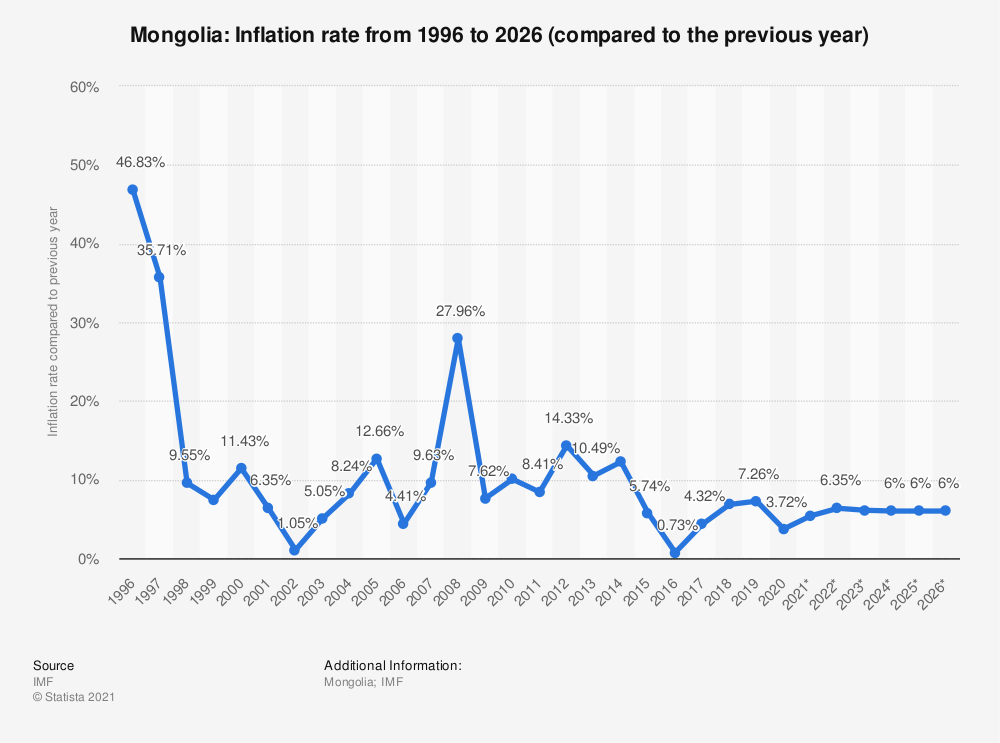
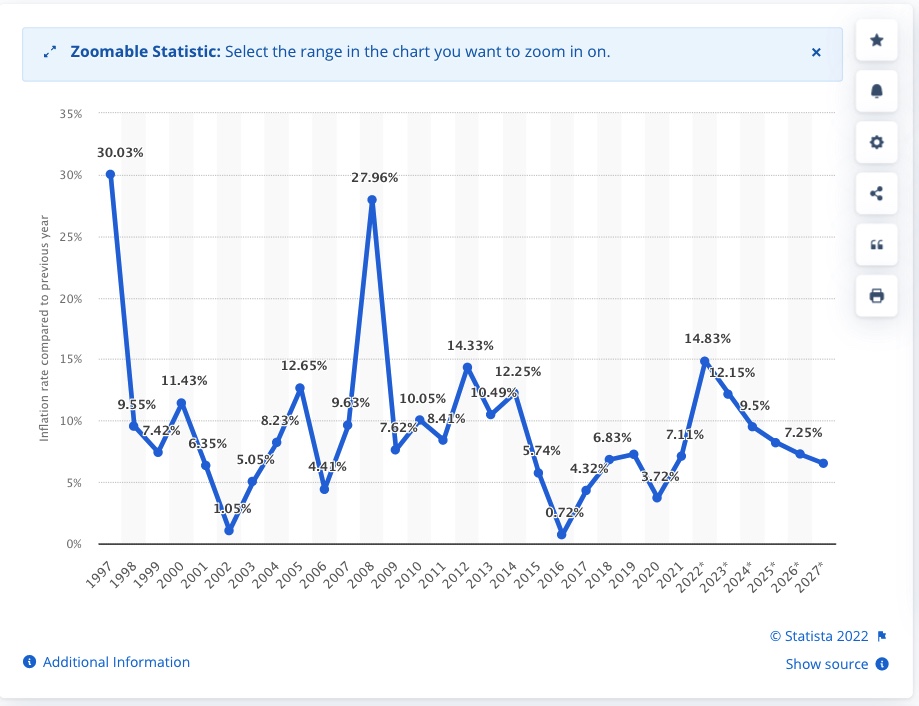
A dramatic decline in inflation paired with political and economic stabilisation allowed Mongolia to enjoy the fruits of the fast-growing economies of the 2000s. Source: Statista.

https://www.statista.com/statistics/727562/inflation-rate-in-mongolia/

https://www.statista.com/statistics/727562/inflation-rate-in-mongolia/

During the last 16 years the financial and monetary system of our country saw the worst crisis in 1991-1994, there was a recovery in 1995-1997 and another crisis in 1997-1999. However, it has entered a stable stage since 2000.

Mongolia at the Market
Dedicated to the 60th Anniversary of the School of Economic Studies
, Editors: Chuluundorzh Khashchuluun, Namsrai Batnasan, Ni︠a︡msu̇rėngiĭn Batnasan, P. Luvsandorzh, LIT Verlag, 2012.

From the World Bank: 1997: Stabilization at the heart of policy choices

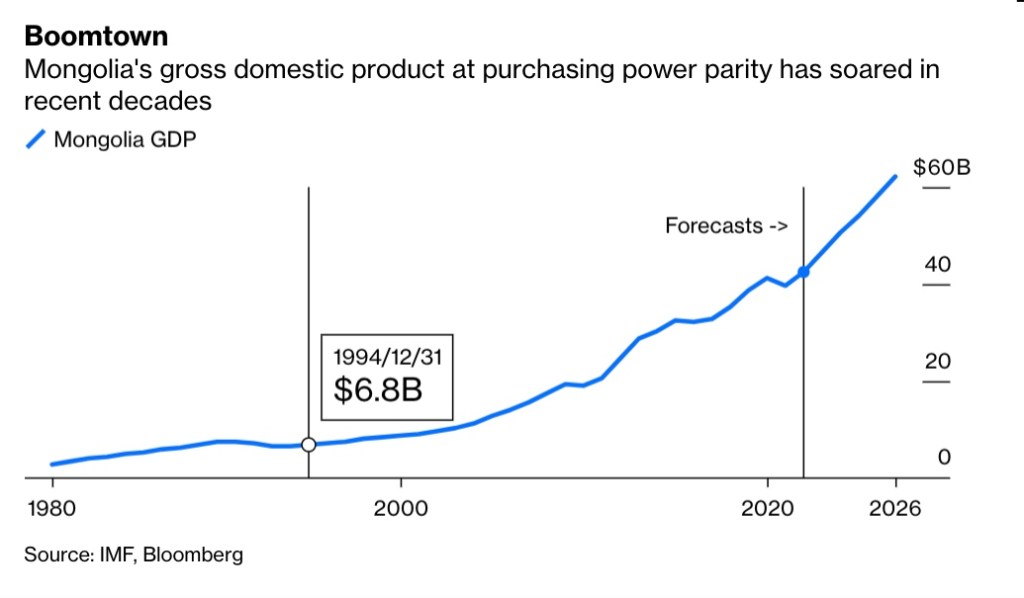
A resources “boomtown” throughout the 2000s. Source: Bloomberg. When I left in 1999, Mongolia’s PPP was US $8.8 bn; today (2021) it is US $42.4 bn.
Graph from Migration under economic transition and changing climate in Mongolia, Journal of Arid Environments, Volume 185, February 2021. “Urbanization in Mongolia accounted for over 80% of all migration, mostly into the capital city Ulaanbaatar (UB), where nearly 70% of recent population growth was from migration.”
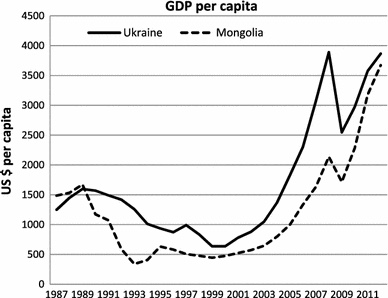
As can be seen in this chart, Mongolia’s economic growth since 2000 has benefited greatly from its proximity to China.
As this chart shows, increasing connectivity had a profound impact on living standards in Ukraine and Mongolia post-2000. The extreme turbulence Mongolia experienced in the 1990s – after the collapse of support mechanisms from the Soviet Union – calmed down as Mongolia integrated with the global economy, especially a booming China. Read about my work in Ukraine here: UN Ukraine Web Development Experience | 2000.
The Economist: “Those free-trading Mongolians” was published Apr 24th 1997. I arrived in May of 1997 to find a country on the cusp of great and turbulent change.

In this role, I pioneered innovative uses of the Internet and digital resources to communicate the UN’s work and Mongolia’s unfolding crises. The UN called this work a “role model” for the wider UN and country offices. A survey of United Nations country office websites in 2000 ranked the UN Mongolia website I launched in 1997 and oversaw for two years (1997-1999), third best in the world, saying: “A UN System site. A very nice, complete, professional site. Lots of information, easily accessible and well laid out. The information is comprehensive and up-to-date. This is a model of what a UNDP CO web site should be.” (http://www.scribd.com/doc/274319690/UNDP-Mongolia-United-Nations-2000-Survey-of-Country-Office-Websites)

“The years 1998 and 1999 have been volatile ones for Mongolia, with revolving door governments, the assassination of a minister, emerging corruption, a banking scandal, in-fighting within the ruling Democratic Coalition, frequent paralysis within the Parliament, and disputes over the Constitution. Economically, the period was unstable and rife with controversies.” Mongolia in 1998 and 1999: Past, Present, and Future at the New Millennium by Sheldon R. Severinghaus, Asian Survey, Vol. 40, No. 1, A Survey of Asia in 1999 (Jan. – Feb., 2000). pp. 130-139 (Publisher: University of California)

As part of a strategic plan to raise awareness of Mongolia’s development challenges and to spur action on meeting them, a Communications Office was established for the UN mission in 1997 – a structure that is commonplace in UN missions today. The Office also led on digital communications, marking many firsts, from the first digital photo and video library, the first online magazine, the first web portal, the first online newsletter, and many other firsts. It gathered numerous stories on resilience in a crisis, and documented in data and storytelling the country’s development challenges, while introducing a transparent way of working and communicating unprecedented for the time (the country was still recovering from the state secrecy of its years under Communism), and led on modernizing communications in the country. Acting as a strategic hub, the Communications Office and its dynamic and talented team, were able to leverage the existing budget to spur action on many fronts, including:

UN/UNDP Mongolia Development Web Portal (www.un-mongolia.mn)

I launched it in 1997 in the middle of a major crisis, and oversaw its expansion and development for two years. A pioneering digital resource, this award-winning United Nations Mongolia development web portal was singled out by UN headquarters in New York as an example of what a country office website should be like. It featured extensive resources in both Mongolian and English and also was home to the bilingual online magazine, Ger – Mongolia’s first web magazine. It can be viewed at www.archive.org and there is more at Wikipedia here: https://en.wikipedia.org/wiki/Ger_(magazine).

Media

Working with journalists and media both within Mongolia and outside, the Communications Office was able to significantly raise awareness of Mongolia and its development challenges. This was reflected in a substantial increase in media coverage of the country and in the numerous books and other publications that emerged post-1997. The book In Their Own Words: Selected Writings by Journalists on Mongolia, 1997-1999 (ISBN 99929-5-043-9) published by UNDP Mongolia archived the stories by theme.  

Ger Magazine

Ger Magazine (the Mongolian word for home and traditional tent dwelling) was published as the country’s first e-magazine in 1998. There were four issues in total from 1998 to 2000. The launch issue was on the theme of youth in the transition. Mongolia was transitioning from Communism to free markets and democracy and this had been both an exhilarating time and a wrenching time for young people. The magazine drew on talented journalists from Mongolia and the handful of international journalists based there to create a mix of content, from stories about life adapting to free markets to stories on various aspects of Mongolian culture and life.

The second issue of the magazine proved particularly effective and inspiring, with its modern life theme and cover story on a thriving Mongolian fashion scene.

Archived issues of the magazine can be found at the Wayback Machine here: https://archive.org/. Just type in the UN Mongolia website address for the years 1997 to 1999: http://www.un-mongolia.mn.

An online survey of the state of Mongolia’s media and its history (www.pressreference.com/Ma-No/Mongolia.html), had this to say: “An interesting variation from some of the other publications available is Ger Magazine (published online with guidance from the United Nations Development Program, UNDP), which is concerned with Mongolian youth in cultural transition. The name of the magazine is meant to be ironic because a ger is the Mongolian word for yurt—a yurt being traditional nomadic housing—but the magazine is about urbanization and globalization of Mongolian youth.”

Blue Sky Bulletin

The Blue Sky Bulletin newsletter was launched in 1997 initially as a simple, photocopied handout. It quickly founds its purpose and its audience, becoming a key way to communicate what was happening in the country and a crucial resource for the global development community, scholars, the media and anyone trying to figure out what was happening in a crazy and chaotic time. It eschewed the typical ‘grip and grin’ content found in many development newsletters and instead offered stories, data and insights useful to anyone seeking to understand Mongolia’s development challenges. The Blue Sky Bulletin was distributed via email and by post and proved to be a popular and oft-cited resource on the country. The quality of its production also paralleled Mongolia’s growing capacity to publish to international standards, as desktop publishing software became available and printers switched to modern print technologies. The Blue Sky Bulletin evolved from a rough, newsprint black and white publication to becoming a glossy, full-colour, bilingual newsletter distributed around Mongolia and the world. 

Archived issues can be found online here:

Blue Sky Bulletin Issue 1

Blue Sky Bulletin Issue 2

Blue Sky Bulletin Issue 3

Blue Sky Bulletin Issue 4 

Blue Sky Bulletin Issue 5

Blue Sky Bulletin Issue 6

Blue Sky Bulletin Issue 7

Blue Sky Bulletin Issue 8

Blue Sky Bulletin Issue 9

Blue Sky Bulletin Issue 10

Publishing

MHDR 1997

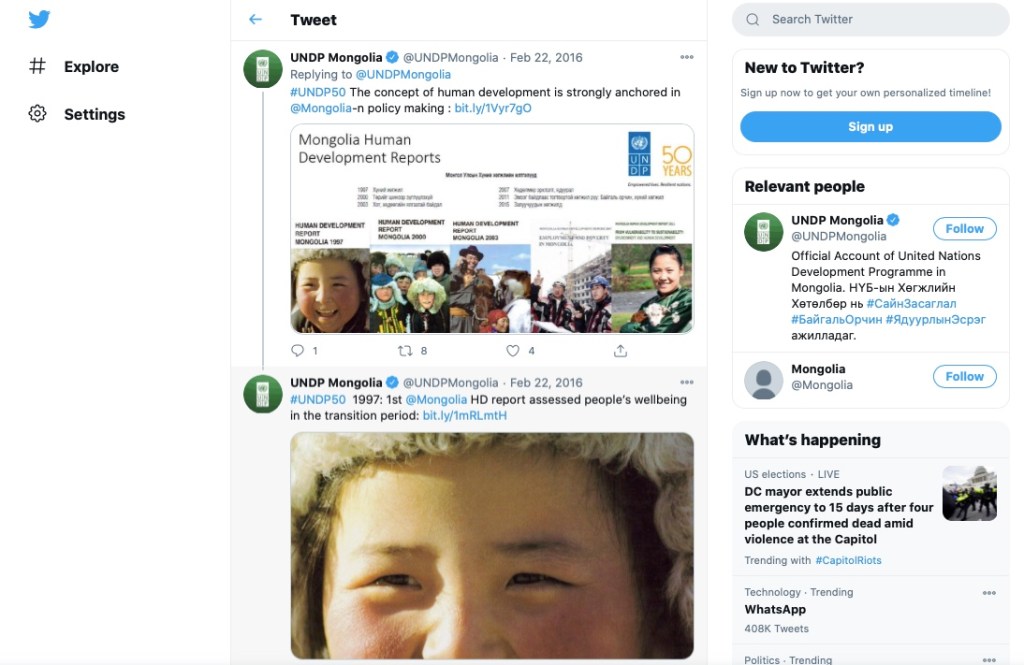
The Mongolian Human Development Report 1997 (MHDR), the country’s first, placed the story of the Mongolian people during the transition years (post-1989) at its heart, using photographs, stories and case studies to detail the bigger narrative at play.

This groundbreaking Mongolian Human Development Report – the country’s first – went beyond just chronicling Mongolia’s state of development in statistics and graphs. Designed, laid out and published in Mongolia, the report broke with the practices of many other international organisations, who would publish outside of Mongolia – denying local companies much-needed work and the opportunity to develop their skills. The report’s costs helped to kick-start a publishing boom in the country and significantly raised standards in design and layout in the Mongolia. The foundations laid down by the project producing the report ushered in a new age in publishing for Mongolia.

The report’s launch was innovative, not only being distributed for free across the country, but also part of a multimedia campaign including television programming, public posters, town hall meetings and a ‘roadshow’ featuring the report’s researchers and writers.

The initial print run of 10,000 copies was doubled as demand for the report increased. To the surprise of many, once hearing about the free report, herders would travel to the capital, Ulaanbaatar, to pick up their copy. The report proved people cared passionately about the development of their country and that development concepts are not to be the secret domain of ‘development practitioners’. The report also became an English language learning tool as readers compared the Mongolian and English-language versions.

You can read the report’s pdf here: http://www.mn.undp.org/content/mongolia/en/home/library/National-Human-Development-Reports/Mongolia-Human-Development-Report-1997.html 

1997 saw the launch of the first human development report for Mongolia.

Mongolian AIDS Bulletin

UNDP acted swiftly to address a breaking HIV/AIDS crisis in 1997, offering a key lesson for others working in public health (the Ebola Crisis and global air pollution crisis both show those lessons have still yet to be fully absorbed).

Assembled by a team of health experts after the Fourth International Congress on AIDS in Asia and the Pacific, the Mongolian AIDS Bulletin was published in 1997 in the middle of an HIV/AIDS crisis. It provided timely information and health resources in the Mongolian language and was distributed across the country.

“Mongolia’s first AIDS Bulletin marked the beginning of the UNDP Response to HIV/AIDS/STDs Project back in the autumn of 1997. Over 5,000 copies of the magazine were distributed across the country, offering accurate information on the HIV/AIDS situation. The project has been pivotal in the formulation of a national information, education and communication (IEC) strategy, bringing together NGOs, donors, UN agencies and the government.”

Source: YouandAids: The HIV/AIDS Portal for Asia Pacific

Green Book

In the Mongolian language, the Mongolian Green Book details effective ways to live in harmony with the environment while achieving development goals. Based on three years’ work in Mongolia – a Northeast Asian nation coping with desertification, mining, and climate change – the book presents tested strategies.  

EPAP Handbook

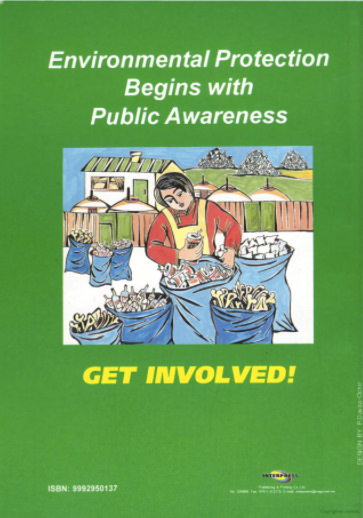
The Environmental Public Awareness Handbook was published in 1999 and features the case studies and lessons learned by UNDP’s Mongolian Environmental Public Awareness Programme (EPAP). The handbook draws on the close to 100 small environmental projects the Programme oversaw during a two-year period. These projects stretched across Mongolia, and operated in a time of great upheaval and social, economic and environmental distress. The handbook is intended for training purposes and the practice of public participation in environmental protection.

In its 2007 Needs Assessment, the Government of Mongolia found the EPAP projects “had a wide impact on limiting many environmental problems. Successful projects such as the Dutch/UNDP funded Environmental Awareness Project (EPAP), which was actually a multitude of small pilot projects (most costing less than $5,000 each) which taught local populations easily and efficiently different ways of living and working that are low-impact on the environment.”

Mongolia Updates 1997, 1998, 1999

Mongolia Update 1998 detailed how the country was coping with its hyperinflation and the Asian economic crisis.

The mission simultaneously had to deal with the 1997 Asian Crisis (http://en.wikipedia.org/wiki/1997_Asian_Financial_Crisis) and the worst peacetime economic collapse in post-WWII history (http://www.jstor.org/pss/153756).  

Mongolia Update 1998 – Political Changes

1998 proved a tumultuous year for Mongolia. The country’s existing economic crisis caused by the transition from Communism to free markets was made worse by the wider Asian Crisis. The government was destabilised, leading to an often-confusing revolving door of political figures. In order to help readers better understand the political changes in the country, a special edition of Mongolia Update was published that year.  

UNDP Mongolia: The Guide

The Guide, first published in 1997, provided a rolling update on UNDP’s programmes and projects in Mongolia during a turbulent time (1997-1999). The mission simultaneously had to deal with the 1997 Asian Crisis (http://en.wikipedia.org/wiki/1997_Asian_financial_crisis) and the worst peacetime economic collapse in post-WWII history.

Each edition came with short project and context summaries, key staff contacts, and facts and figures on how the country was changing. For the first time, any member of the public could grasp what the UN was up to in the country and be able to contact the project staff. An unusual level of transparency at the time for a UN mission.

Memoranda of Understanding

Three Memoranda of Understanding were negotiated with the Mongolian Government to help focus efforts and aid the attainment of internationally-agreed resolutions. This was affirmed by a series of youth conferences, One World, held in 1998 and 1999.

Strategy and Leadership in a Crisis

The scale and gravity of the crisis that struck Mongolia in the early 1990s was only slowly shaken off by the late 1990s. The economic and social crisis brought on by the collapse of Communism and the ending of subsidies and supports from the Soviet Union, led to a sharp rise in job losses, poverty, hunger, and family and community breakdowns.

The challenge was to find inspiring ways out of the crisis, while building confidence and hope. The sort of challenges confronted by the UNDP Mongolia Communications Office included:

1) A food crisis: agricultural production was down sharply, and the traditional nomadic herding economy, while at peak herd, was failing to get the meat to markets and to a high enough standard to restore export levels to where they once were. As a result, a cross-border trading frenzy became the solution to falling domestic food production and availability.

2) HIV/AIDS/STDs crisis.

3) A major banking crisis.

4) Both the Asian Financial Crisis and the Russia Crisis.

5) An ongoing political crisis and an inability to form stable governments.

UN Annual Reports

Editor and designer. 1998 Report called by Under-Secretary-General Nafis Sadik “a clear, well-written, attractive and colourful report.”

One of many documents from that time held in the United Nations Archives Search Engine. In this case, reporting on Mongolia’s follow-up to global conferences to then-Secretary-General Kofi A. Annan in 1999.
Mongolia’s Follow-Up To The UN Global Conferences (1999) UNDP Mongolia Communications Office, Ulaanbaatar, Mongolia.
Production/Design Supervision: David South, UNDP Communications Coordinator; Proof Reading: N. Oyuntungalag, UNDP Communications Officer/David South (1999).

Timeline 

1997: Arrive in the capital of Mongolia, Ulaanbaatar, to undertake a two-year assignment with the United Nations mission. Quickly get to work founding the UNDP Mongolia Communications Office and pursuing a strategic communications approach with a busy online and offline bilingual publishing programme. Launch award-winning UN Mongolia Development Web Portal (www.un-mongolia.mn). Launch first Human Development Report Mongolia 1997, and a Mongolian AIDS Bulletin during crisis. Assist the Government of Canada to establish the first Honorary Consul in Ulaanbaatar on December 1, 1997 and the Canada Fund Mongolia.

Canada Fund Mongolia

1998: International media tours of the country, launching of Mongolia’s first online magazine, Ger, distribute globally a regular newsletter on Mongolia’s development challenges, Blue Sky Bulletin. Open United Nations Info Shop for the public. Assist the Government of Canada to connect with Canadians working with the United Nations in Mongolia during the first official visit by a Canadian Government Minister.

1999: Launch a string of books documenting insights gleaned from the Mongolia development experience.  

Testimonials

 “Mongolia is not an easy country to live in and David [South] showed a keen ability to adapt in difficult circumstances. He was sensitive to the local habits and cultures and was highly respected by his Mongolian colleagues. … David’s journalism background served him well in his position as Director of the Communications Unit. … A major accomplishment … was the establishment of the UNDP web site. He had the artistic flare, solid writing talent and organizational skills that made this a success. … we greatly appreciated the talents and contributions of David South to the work of UNDP in Mongolia.” Douglas Gardner, UN Resident Coordinator and UNDP Resident Representative Mongolia

Impact 

Micro

  • strategic communications approach including establishing the UN/UNDP Mongolia Communications Office and team and strategic communications plan
  • led on digital transformation, including use of digitial media (photo/video archive) and digital publishing (web site, online magazine and newsletter, etc.)
  • established and ran the United Nations Info Shop – a one-stop resource open to the public with archive of development publications and current periodicals and Internet access
  • began largest bilingual online and offline publishing programme in country – led on publishing and design modernisation
  • laid down the foundations for many UN initiatives in Mongolia that are still underway. Contributed to stabilizing the country in a turbulent time. Mongolia was briefly the fastest-growing economy in the world by 2011
  • championed transparency and access to information and media freedoms
  • oversaw a period in which Transparency International found lower levels of perceived corruption
  • managing editor for country’s first Human Development Report

Macro

  • raised profile of country and its development challenges. Donor pledges rose 
  • 2 international media tours
  • strong relationship with Mongolian and international journalists
  • championed innovators in commnications
  • crisis response: AIDS, economy, political
  • country’s largest website and one of its first. Called “Godfather of the Mongolian web”
  • called a “role model” for the wider UN
  • led on new approach to UN communications in the digital age
  • design-led approach
  • transparent and timely updates
  • negotiated three Memoranda of Understanding (MOUs): youth, food security and nutrition, STDs/HIV/AIDS
  • One World youth conferences

Publications

David South Consulting Summary of Impact

Environmental Public Awareness Handbook: Case Studies and Lessons Learned in Mongolia

Ger Magazine: Modern Life Issue

Ger Magazine: Youth Issue

Human Development Report Mongolia 1997

Mongolian Green Book

Mongolia Update – Coverage of 1998 Political Changes

Mongolia Update 1998

Mongolian AIDS Bulletin

Mongolian Rock and Pop Book

Partnership for Progress: The United Nations Development Programme in Mongolia

UNDP Mongolia Online Development Portal

UNDP in Mongolia: The Guide 

Stories

Freedom of Expression: Introducing Investigative Journalism to Local Media in Mongolia

Lamas Against AIDS

Philippine Conference Tackles Asia’s AIDS Crisis

Starting from Scratch: The Challenge of Transition

UNDP Mongolia Partnership for Progress 1997 to 1999 Key Documents 

A UNDP Success Story: Grassroots Environmental Campaign Mobilizes Thousands in Mongolia

Citations

The response by the UNDP Mongolia Communications Office has been cited in numerous articles, books, publications and stories. It has also contributed to the development of the human development concept and understanding of human resilience in a crisis and innovation in a crisis. 

Book citations include:

Dateline Mongolia: An American Journalist in Nomad’s Land by Michael Kohn, RDR Books, 2006

Modern Mongolia: From Khans to Commissars to Capitalists by Morris Rossabi, University of California Press, 2005

Wild East: Travels in the New Mongolia by Jill Lawless, ECW Press, 2000

Paper citations include: 

Paula L. W. Sabloff (2020) Buying into capitalism: Mongolians’ changing perceptions of capitalism in the transition years, Central Asian Survey, 39:4, 556-577, DOI: 10.1080/02634937.2020.1823819

A more detailed list of citations can be found here: http://www.davidsouthconsulting.com/about/

For research purposes, key documents were compiled together and published online here: https://books.google.ca/books?id=K76jBgAAQBAJ&dq=undp+mongolia+key+documents&source=gbs_navlinks_s

This resource was praised for having: “Very useful references and original materials that documented UNDP Mongolia work. I needed to trace community-based development, and this book provided a valuable source.” Review on Google Books

In 2001, the UN won the Nobel Peace Prize for “their work for a better organized and more peaceful world” and its communications innovations, with work such as that in Mongolia being cited as a contributing factor to the awarding of the Prize.

The Nobel Peace Prize 2001 joint winners.

In 2000, the Millennium Development Goals (MDGs) were launched in a 15-year bid to use a focused approach to development centred around eight goals to accelerate improvements to human development. From 2000 to 2005, consulting work was undertaken in various UN missions (Mongolia, South Africa, Turkmenistan, Ukraine) to communicate the goals and to reshape communications activities around the goals.

Transition and Democracy in Mongolia by Richard Pomfret, Europe-Asia Studies, Vol. 52, No. 1 (Jan., 2000), pp. 149-160, published by Taylor & Francis, Ltd. (http://www.jstor.org/stable/153756?seq=1#page_scan_tab_contents)

The Milk of Kindness flows in a Peculiar Land A Steppe From Nowhere by Leslie Chang, The Asian Wall Street Journal, 15 August 1998

Mongolia prepares for a magazine explosion by Jill Lawless, UB Post, 08-09-98

Other Resources

Letter from Mongolia: Herding instinct by Jill Lawless, The Guardian, 9 June 1999

Connect with me on Devex here: https://www.devex.com/people/david-s-361357

ORCID iD: https://orcid.org/0000-0001-5311-1052.

© David South Consulting 2025

Categories
Archive Blogroll Blue Sky Bulletin Ger Magazine UNDP Mongolia 1997-1999

Mongolia’s Musical Entrepreneurs Led Way Out Of Crisis | 2018

Publisher: UNDP Mongolia Communications Office/Press Institute of Mongolia

Managing Editor: David South

Editorial Advisors: Ts. Enkhbat, Mustafa Eric, David South

Author and Researcher: Peter Marsh, Indiana University

Copy Editor: N. Oyuntungalag

Production Editor: B. Bayarma

Published: 1999

ISBN 99929-5-018-8

It was the late 1990s. Mongolia was still recovering from “one of the biggest peacetime economic collapses ever” (Mongolia’s Economic Reforms: Background, Content and Prospects, Richard Pomfret, University of Adelaide, 1994). But it was the country’s young musicians who were showing the way out of the crisis, setting an example for entrepreneurship in the new, free-market economy that emerged in the country after 1990.

As UNDP Communications Officer N. Oyuntungalag wrote in the Blue Sky Bulletin (BSkyB) newsletter, “A thriving pop and rock scene has emerged over the last four years. .. The energy of these musicians and singers has not gone unnoticed by the burgeoning advertising market. Pop bands are promoting many things, from face creams to beer. … [but] there has been little serious writing on the business of popular music.”  

As the book’s author, American ethnomusicologist Peter Marsh, said in an interview with UNDP’s Blue Sky Bulletin newsletter, “we thought our book would provide important ideas about the direction and nature of the nation’s development.

“My impression about Mongolian pop-rock is that it is a lively, diverse and at times innovative Mongolian art form that closely reflects many of the hopes, fears and aspirations of its primary audience, Mongolian youth.”

The book still stands as an unusual and innovative contribution to thinking around the role played by youth in development and business and in crisis recovery.   

Google Books Key Words: авдаг адил аль англи аялан байж байлаа байх байхад байхгүй бараг барууны бас бензин Бид нар бидний биз бизнес бий биш болох бөгөөд бусад бүжиг бүр бүтээлчид бүх гадаад гадаадад

Other publications by Peter K. Marsh: 

The Horse-head Fiddle and the Cosmopolitan Reimagination of Tradition in Mongolia by Peter K. Marsh, Routledge, 25 Sept. 2008.

Journal Article Review. Reviewed Works: Mongolian Bling by Benj Binx, Nubar Ghazarian; Live from UB by Lauren Knapp, Dulguun Bayasgalan. Review by Peter K. Marsh, Ethnomusicology, Vol. 62, No. 1 (Winter 2018), pp. 157-162. 

Moving the World Through Two Strings: The Horse-head Fiddle and the Cosmopolitan Reimagination of Tradition in Mongolia by Peter K. Marsh, Indiana University, 2002. 

Our generation is opening its eyes: hip-hop and youth identity in contemporary Mongolia by Peter Marsh, Central Asian Survey, Volume 29, 2010 (https://doi.org/10.1080/02634937.2010.518013).

From Culture and Customs of Mongolia by Timothy Michael May (2009).

Interviews with Peter K. Marsh: 

“Culture and art – immunity for any nation during globalization”, Baljmaa.T, The Mongol Messenger, 2020-05-13.

More on this topic here: Why Does China Have 1.4 Billion People and No Good Bands? – Mongolia rocks out while its giant neighbor slumbers.

More on the development of contemporary Mongolian music and its rising global profile: 

The Unexpected Rise Of The Hu: The Mongolian Heavy Metal Band Resurrecting Rock

With more YouTube views than Stormzy, this metal band is a surprising smash hit – and they’ve only just begun. by Eleanor Peake

More music writing by David South

“You Can’t Have A Bird If You Want To Be The Biggest Band In The World”: Oasis Has Arrogance, A Pile Of Attitude And The Best Album Of 1994

ORCID iD: https://orcid.org/0000-0001-5311-1052.

© David South Consulting 2021