Categories
Archive Development Challenges, South-South Solutions Newsletters Southern Innovator magazine

Fashion Recycling: How Southern Designers are Re-using and Making Money

By David SouthDevelopment Challenges, South-South Solutions

SOUTH-SOUTH CASE STUDY

With the rising awareness of the importance of doing fashion in an ethical and sustainable way, more and more fashion designers in the South are getting very creative. Fashion earns big money around the world: The global clothing industry is estimated to be worth US $900 billion a year.

In Paris, the Ethical Fashion Show, now in its fifth year, showcases fashion that respects people and the environment while still being glamorous, luxurious and trendy. It has attracted designers from around the world, including Mongolia, Thailand, China, Peru and Bolivia. The show demands that all participants adhere to International Labour Organization conventions – including banning forced and child labour – respect for the environment, creating local employment and working with craftspeople to ensure skills are retained and the fashion reflects the diversity of the world’s cultures.

In Abidjan, Ivory Coast, Felicite Mai is using pride in her nation’s top export commodity, cocoa (Ivory Coast is the world’s number one exporter of cocoa), to make smart fashion wear at affordable prices. She has turned the beige-coloured jute sacks used to ship cocoa beans around the world into clothes for men and women.

“Ivory Coast’s economy is based on agriculture, especially cocoa and coffee. So I decided to promote these crops by creating these fashion designs,” Mai, whose real name is Maimouna Camara Gomet, told the Reuters news agency.

“For me, it’s a way of drawing the whole world’s attention to cocoa and coffee,” she said

Mai comes from a family of cocoa planters and is a graduate of a sewing school. She works out of a studio-cum-shop in the Treichville suburb of Abidjan.

The clothes are usually beige, but some are dyed dark brown or blue. They include skirts, tops, trousers, shirts, waistcoats, caps, bags and accessories; she gets the sacks – most emblazoned with “Product of Ivory Coast, Cocoa” — from the city’s port warehouses. She cleans the jute cloth first, before creating the fashions.

“I had this idea from when I was still at sewing school in 1987. Then I opened my own workshop in 1996 and I first launched these kind of designs in 2003 during a fashion contest at Divo (in the south of Ivory Coast)” said Mai, who has several assistants at her shop.

She has been able to attract as clients local celebrities, artists and musicians and even a few from abroad.

In Brazil, it is footwear that is getting the recycled-look treatment. The brand Melissa specializes in plastic shoes that are eco-friendly and made from 100 percent recycled materials. They use a plastic called melflex made from recovered plastic. The shoes are made in injection molds and the factory is so efficient, it has next to no waste as a byproduct. It recycles all the waste and water used in the production process. And as a plus, they make a point of paying the workers well, and supporting social and environmental causes in Brazil.

Their secret to putting zing into recycled plastic shoes is to have high-profile, celebrity designers design some of the shoes. So far, they have had UK fashion mistress Vivienne Westwood, the Campana Brothers, and the UK-based, Iraqi-born architect Zaha Hadid. Hadid is a controversial figure who always stirs up debate, and her rubber shoes have brought attention to the brand.

The Chilean studio Modulab has turned to recycled rubber from the car industry to make bags. The rubber comes in sheets so it is easy to cut and shape into bags, thus reducing the amount of time and energy used to make the bags. The line is called RTA (ready to assemble) and includes three types of bags: an envelope, a handbag and a messenger bag. Each sheet of recycled rubber comes with the specific slots and pins for the consumer to put the bag together at home, without any glue or sewing involved. Energy used in the making of the entire bag is 100 percent human, except in the production of the material itself.

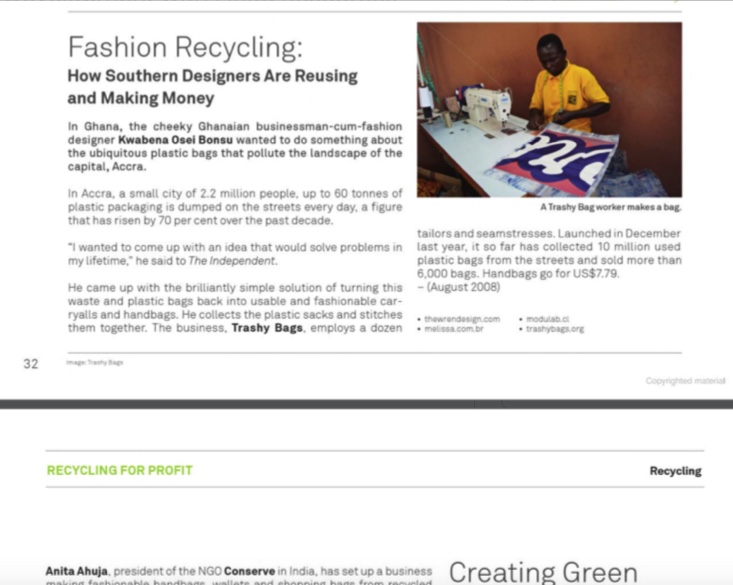
In Ghana, the cheeky Ghanaian businessman-cum-fashion designer Kwabena Osei Bonsu wanted to do something about the ubiquitous plastic bags that pollute the landscape of the capital, Accra.

In Accra, a small city of 2.2 million people, up to 60 tons of plastic packaging is dumped on the streets every day, a figure that has risen by 70 per cent over the past decade.

“I wanted to come up with an idea that would solve problems in my lifetime,” he said to the Independent.

He came up with the brilliantly simple solution of turning these wasted and damaging plastic bags back into usable and fashionable carryalls and handbags. He collects the plastic sacks and stitches them back together. The business, Trashy Bags, employs a dozen tailors and seamstresses. Launched in December last year, it so far has collected 10 million used plastic sachets from the streets, and sold more than 6,000 bags. Handbags go for US $7.79.

Ghana’s huge quantity of discarded plastic water bottles are gathered up for recycling too. A storage room overflows with more than 3 million sachets that have been collected and cleaned ready for recycling.

Bonsu’s business has turned into a source of income for local people, who receive US $3.89 for 1,000 sachets – a good return where the average yearly income is US $495

“I collect sachets because I am jobless and this gives me money,” said Hadiza Ishmael, a 55-year-old grandmother who has delivered 4,000 plastic bags. “It also makes the place look nicer.”

Published: August 2008

Resources

  • The Re: Fashion Awards show is a brand new fashion phenomenon, set to transform social and environmental standards in the fashion industry within a decade. The RE:Fashion Awards will take place in London in November 2008. The glittering event will see major faces from the fashion world come together to recognise the most significant development in the fashion industry of the 21st century. The deadline for budding fashion designers to enter their contest is August 20th.
    Website: http://www.refashionawards.org/
  • A photogallery of the cocoa fashions:
    here: Photogallery 1
    and here: Photogallery 2
    And a video of Mai making the garments here: Video
  • Ethical Fashion Show: Isabelle Quehe, who established the event, said “You almost never see designers from developing countries doing shows in Paris, so this brings together natural products, local fair labour, respect for the environment and finding sales outlets in Paris.” Potential designers and exhibitors can contact the Ethical Fashion Show by sending collection photos and a brief explanation on how the fashions contribute to the ethical fashion movement.
    Send contributions to: 4, rue Trousseau 75011 Paris
    Email: unilove@wanadoo.fr
  • Once inspired to get into the global fashion business, check out this business website for all the latest news, jobs and events.
    Website: http://us.fashionmag.com/news/index.php
  • A creative agency specialising in the promotion of African culture to the world. They organise RUNWAY AFRICA—Africa’s annual Fall Fashion Show featuring five of Africa’s most promising rising design stars on the runway.
    Website: http://inspirationafrica.org/aboutus.html
  • Green fashion must really be making an impact–the BBC, Britain’s venerable public broadcaster, has started an on-line fashion magazine. Called Thread. Fashion Without Victim, it is dedicated to bringing the “latest of eco-fabulous style”. Through a “unique mix of affordable fashion, exclusive videos, photo galleries and thought-provoking features” the site is committed to promoting all aspects of ethical fashion.
    Website: http://www.bbc.co.uk/thread/
  • Traidcraft fights poverty through trade, helping people in developing countries to transform their lives. Established in 1979 as a Christian response to poverty, we are the UK’s leading fair trade organisation.
    Website: http://www.traidcraftshop.co.uk/default.aspx

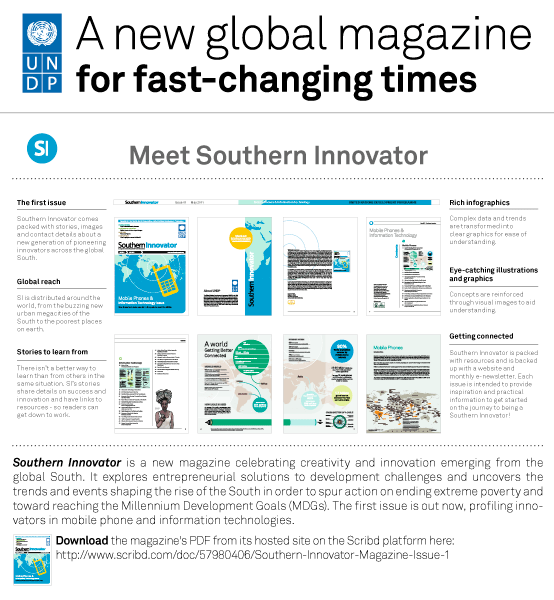
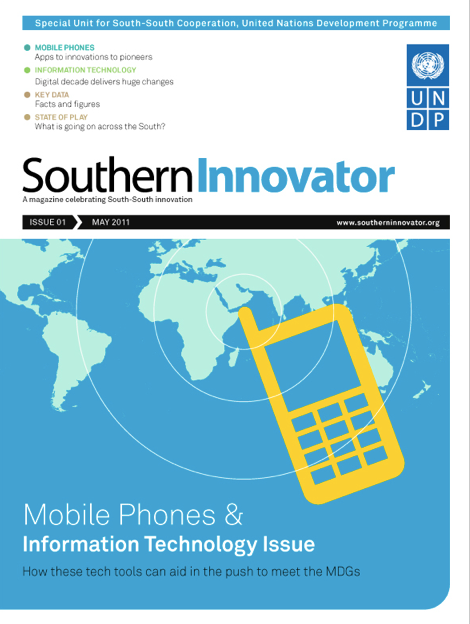
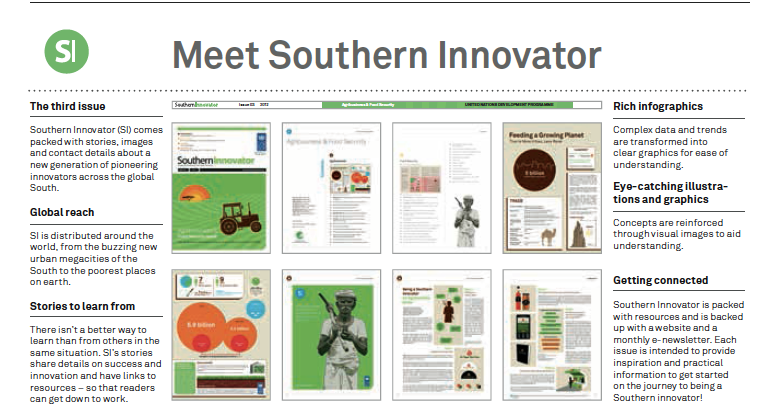
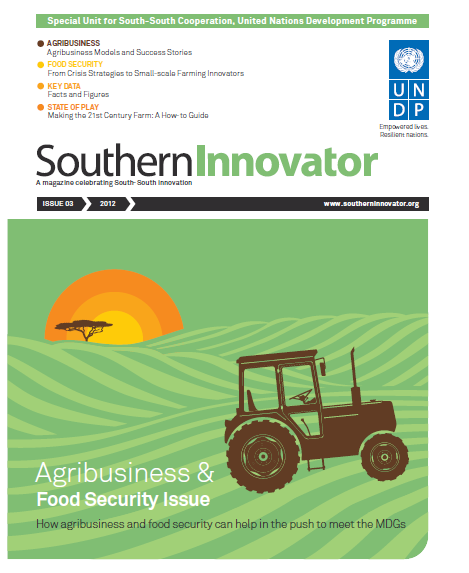
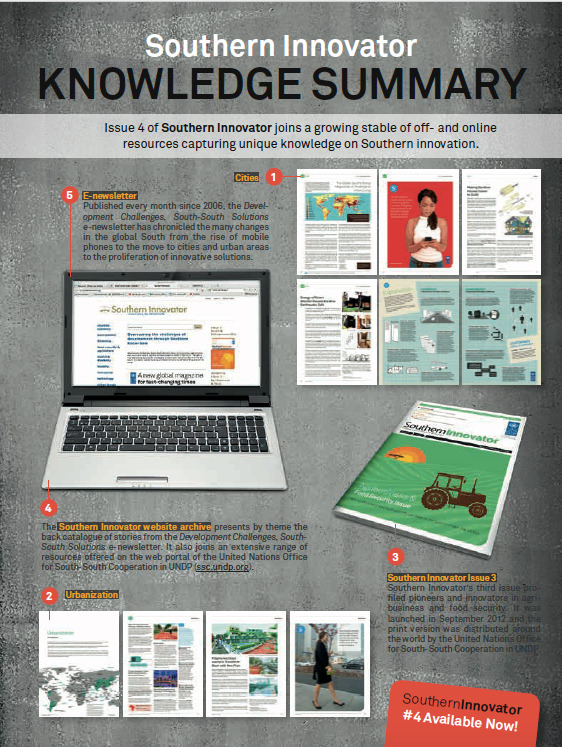
Development Challenges, South-South Solutions was launched as an e-newsletter in 2006 by UNDP’s South-South Cooperation Unit (now the United Nations Office for South-South Cooperation) based in New York, USA. It led on profiling the rise of the global South as an economic powerhouse and was one of the first regular publications to champion the global South’s innovators, entrepreneurs, and pioneers. It tracked the key trends that are now so profoundly reshaping how development is seen and done. This includes the rapid take-up of mobile phones and information technology in the global South (as profiled in the first issue of magazine Southern Innovator), the move to becoming a majority urban world, a growing global innovator culture, and the plethora of solutions being developed in the global South to tackle its problems and improve living conditions and boost human development. The success of the e-newsletter led to the launch of the magazine Southern Innovator. 

Creative Commons License

This work is licensed under a
Creative Commons Attribution-Noncommercial-No Derivative Works 3.0 License.

ORCID iD: https://orcid.org/0000-0001-5311-1052.

© David South Consulting 2023

Categories
Archive Development Challenges, South-South Solutions Newsletters Southern Innovator magazine

Wireless Internet Culture Helping Zimbabwe Economy Recover

By David SouthDevelopment Challenges, South-South Solutions

SOUTH-SOUTH CASE STUDY

Zimbabwe’s turbulent descent into hyperinflation at the beginning of the 2000s – and the food crisis it caused as prices soared and purchasing power shrank – captured the world’s attention. From refugees fleeing the country to widespread hunger and poverty, the impact of hyperinflation was stark and distressing. Since the country’s economy stabilized in 2009, various signals are showing that Zimbabwe is slowly making its way back to growth and stability.

The scale of the hyperinflation is summed up by Zimbabwe’s eye-popping inflation rate. By December 2008, inflation was estimated at 6.5 quindecillion novemdecillion percent (or 65 followed by 107 zeros — 65 million googol) (Forbes Asia).

One recovery strategy is emerging in Zimbabwe’s booming eating and drinking establishments. It seems the urge to socialize and network has become the source of economic vitality where so much else has been damaged.

The proliferation of coffee shops with wi-fi (wireless internet access) (http://en.wikipedia.org/wiki/Wi-Fi) has spawned a new, connected business culture that is flexible and entrepreneurial.

Zimbabwe’s unity government was formed in September 2008. By the beginning of 2009, the government relented on the crippling hyperinflation and allowed business to be conducted in the US dollar. This made it possible to save again and do business with greater predictability. At this time, the country had the world’s highest inflation rate and the central bank printed a 100 trillion Zimbabwe dollar note.

The economic result of greater stability has been new shopping malls opening and a boom in new eating and drinking establishments.

During the hyperinflation, eating out was the last thing on most people’s minds. Just surviving was the paramount daily task.

In the capital, Harare (http://en.wikipedia.org/wiki/Harare), the shopping mall Sam Levy’s Village (http://samlevysvillage.com), in the prosperous Borrowdale area of the northern suburbs, is full of thriving coffee shops, restaurants and pubs.

Outside of the wealthy enclaves, coffee shops have sprung up in the city’s art gallery, in sports clubs and a local supermarket chain.

While the coffees are still expensive relative to local wages, the Zimbabwe Online Hotspots (ZOL) (http://www.zol.co.zw) in the coffee shops have proved a big attraction. Most people in Zimbabwe have unreliable or non-existent electricity or, if lucky, poor-quality phone and internet dial-up in their homes.

ZOL Hotspots typically offer the first half hour of internet use for free. To surf longer, users must buy a voucher.

The damage done to the economy from hyperinflation and the political crisis means the country is still on the mend. But people have now resorted to what they call “networking,” according to Bryony Rheam in the Daily Telegraph newspaper. The functioning economy is all about making deals. And coffee shops with wi-fi are the perfect place to meet with a potential business partner.

But while the coffee shops are buzzing with people doing business, the proprietors still need to work out how to make better profits. Sales are still poor as people are mostly fixated on the wi-fi. One owner told the Telegraph: “We need to start charging people who sit here all day surfing the net.”

It is the restaurants who seem to be enjoying the boost in incomes and better spirits after the economic troubles. Zimbabwe’s black middle class are enjoying big occasions and celebrating with friends and family in restaurants.

“We went without for so long, that a lot of people almost see it as their right to spend money on eating out,” one patron told the Telegraph.

More good news has come from outside investors as well: Amstel Securities NV (http://www.amstelsec.com), based in Amsterdam, Netherlands calls Zimbabwe’s economy “the final frontier market in Africa”. It believes the country has the potential to grow its GDP (gross domestic product) to US $12 billion by 2015. The International Monetary Fund says the economy jumped from US $4.4 billion in 2009 to US $9 billion now.

In Amstel Securities’ report, it pegs the dollarization of the economy as the reason for stability: “These improvements have made Zimbabwe a much more vibrant economy with good further recovery potential.”

And these good vibes are contagious: it has been reported that the American hamburger chain McDonald’s is revisiting the idea of setting up in Zimbabwe. McDonald’s is currently present in a handful of African countries: South Africa has 132 restaurants.

Published: September 2010

Resources

Development Challenges, South-South Solutions was launched as an e-newsletter in 2006 by UNDP’s South-South Cooperation Unit (now the United Nations Office for South-South Cooperation) based in New York, USA. It led on profiling the rise of the global South as an economic powerhouse and was one of the first regular publications to champion the global South’s innovators, entrepreneurs, and pioneers. It tracked the key trends that are now so profoundly reshaping how development is seen and done. This includes the rapid take-up of mobile phones and information technology in the global South (as profiled in the first issue of magazine Southern Innovator), the move to becoming a majority urban world, a growing global innovator culture, and the plethora of solutions being developed in the global South to tackle its problems and improve living conditions and boost human development. The success of the e-newsletter led to the launch of the magazine Southern Innovator. 

Creative Commons License

This work is licensed under a
Creative Commons Attribution-Noncommercial-No Derivative Works 3.0 License.

ORCID iD: https://orcid.org/0000-0001-5311-1052.

© David South Consulting 2023

Categories
Archive

Picking Money from the Baobab Tree 

By David South, Development Challenges, South-South Solutions

SOUTH-SOUTH CASE STUDY

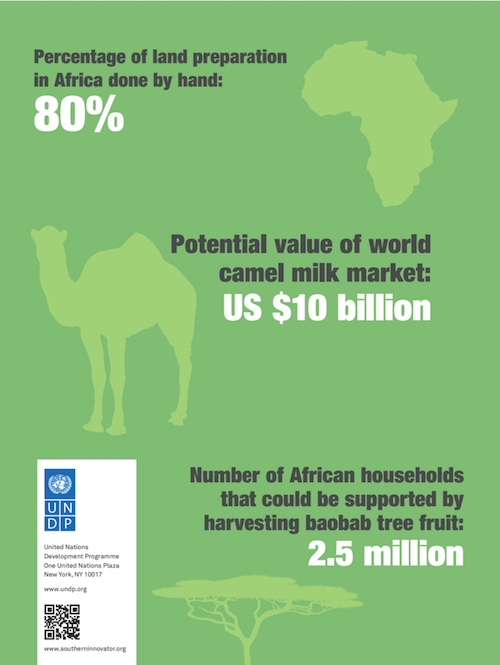
The fruit of the highly revered African baobab tree is being seen as a great new opportunity for the poor, after a recent decision by the European Commission to allow its importation. According to one study, gathering the fruit has the potential to earn an extra US $1 billion a year for Africa, and bring work and income to 2.5 million households, most of them African bush dwellers (Britain’s Natural Resources Institute).

The fruit of the African baobab tree is mostly collected in the wild from the ancient trees, which can live for 500 years, with some as old as 5,000 years. The baobob enjoys the veneration and respect traditionally accorded to age in Africa, and features in many stories and myths.

The fruit is seen as highly nutritious and a new taste option for the European market. This could be a major potential boost to Africa; the European Union is the world’s biggest trader, accounting for 20 percent of global imports and exports, and a major trading partner of most African countries. South Africa alone exports Euro 20.9 billion a year to Europe (2007).

But serious concerns have been raised about how the harvesting of the fruit will be done, and under what conditions. Getting this right is critical if the sustainability of the fruit is to be maintained, local populations are to benefit, and local use of this food source — eaten by both people and animals — does not suffer.

European food and drink companies are looking to use the fruit of the tree to flavour a large range of products, from cereal to drinks.

Baobab fruit is valued for its alleged medicinal properties in treating fevers and diarrhoea, and as a calcium supplement.

“The potential is huge … We’re quite confident that it’s going to represent significant returns for rural producers,” Dr. Lucy Welford, marketing manager of PhytoTrade Africa, a trade organisation that campaigns for the sustainable use of African natural products, told Reuters.

“I’d say it’s somewhere between grapefruit and tamarind as a kind of flavour,” said Welford, who expects baobab fruit to be used at first to flavour smoothies and cereal bars. It could also be used in juices, ice-creams and jams or bakery products.

PhytoTrade works with South African firm Afriplex, which supplies baobab fruit pulp and extracts.

A refreshing juice made from baobab fruit pulp, known as “bouye” is widely served.

“The tart flavour, the interesting vitamin and nutrition profile and the sexy story that goes with it — that it’s wild harvested from a very lovely tree — these things add value to the existing products,” said marketing economist Ben Bennet, who wrote the 2007 Natural Resources Institute’s report.

In the baobab forests around Tandene village in Senegal, local farmers said they looked forward to earning much more from the trees. Prices for a kilo of baobab fruit varied between 40 US cents and a dollar, they said.

“If people know (that European consumers will buy the product) then they’ll look after the trees better and feed them less to their animals,” said farmer Alassane Sy.

Chido Makunike, an active commentator on food and agricultural issues in Africa, raises some serious concerns about how this is handled. “Being a non-cultivated forest product, who ‘owns’ the baobab fruit? Can anybody just take a truck into the forest, collect the fruit and export it? Obviously the sudden dramatic change in the economic importance of the baobab will open up many questions that will need regulation.”

He worries the fruit will just be exported in its raw form, and processed into products in Europe – leaving Africa and Africans the ones who benefit least economically.

“Yet baobab is a dry, not-easily perishable, easy to process fruit,” he said. “It would not be difficult to have the smoothies and cereal bars that are being contemplated for its use made in Africa and exported as finished product, producing many downstream benefits and keeping more of the wealth to be generated within the continent.”

Published: October 2008

Resources

  • The Chamber of Commerce for Switzerland is specially targeting trade deals with Africa and its entrepreneurs. Website: www.swisscham-africa.ch
  • Food Safety – From the Farm to the Fork is the European Commission’s guidelines on food safety and how to prepare food for import into the European Community. Website: http://ec.europa.eu/food/international/trade/index_en.htm
  • EMN Europe is a company that organises all logistics for importing goods into Europe, including making sure all legal requirements are met.
    Website: www.eurotradeconcept.nl
  • The Baobab Fruit Company Senegal has been producing organic baobab products for the nutrition and cosmetics industries.
    Website: http://www.baobabfruitco.com/
  • The Fairtrade Labelling Organization sets the standards for fair-trade and is the place to go to receive official certification.
    Website: www.fairtrade.org.uk
  • Just Food is a web portal packed with the latest news on the global food industry and packed with events and special briefings to fill entrepreneurs in on the difficult issues and constantly shifting market demands. Websitehttp://www.just-food.com
Creative Commons License

This work is licensed under a
Creative Commons Attribution-Noncommercial-No Derivative Works 3.0 License.

ORCID iD: https://orcid.org/0000-0001-5311-1052.

© David South Consulting 2022

Categories
Archive Development Challenges, South-South Solutions Newsletters

Cooking Bag Helps Poor Households Save Time, Money

By David SouthDevelopment Challenges, South-South Solutions

SOUTH-SOUTH CASE STUDY

For millions of poor people around the world, life is lived on the economic margins and household and personal budgets are tight. There were 1.29 billion people in the world living on less than US $1.25 a day as of 2008 (World Bank), and 1.18 billion living on US $1.25 to US $2 per day. There was only a modest drop in the number of people living below US $2 per day – the average poverty line for developing countries – between 1981 and 2008, from 2.59 to 2.47 billion.

Since the global economic crisis erupted in 2008, the world’s poor have seen prices fluctuate wildly as the international financial system fights the effects of the turmoil. In 2008, this led to the Food and Agriculture Organization sounding the alarm about the harmful effects of rising food inflation.

Increasing hunger led to civil unrest and rioting that year.

Anything poor people can do to make their slim daily budgets go a little bit further means more money left over for better quality food and other expenses, like clothing, shelter, fuel and education. One clever invention from South Africa is trying to tackle household cooking costs and shave the cost of fuel required to prepare the family meal. The Wonderbag (http://nbwonderbag.com/) is a brightly coloured, puffy cooking bag that slow cooks a meal in a pot – be it a stew, curry, rice, soups – to save energy.

“The cost and savings per household are significant,” according to the Wonderbag’s inventor, Sarah Collins.

It has many other advantages, too: it is a time-saver, allowing people to spend the time doing something other than just tending the cooking pot. It can also reduce cooking accidents because less time is spent around the stove or fire.

It is an efficient cooking method that uses less water to cook meals. And it even avoids the risk of burning – and wasting – food.

“20 per cent of all staple food in Africa is burned, due to pots being placed on open fires and unregulated stove tops. With the Wonderbag, no burning happens,” confirms Collins.

To date, the Wonderbag has created 1,000 jobs and is looking to increase this to 7,000 jobs in the next five years.

Wonderbag bills itself as “eco-cooking that’s changing lives.”

Eco-cooking seeks to use every joule (http://en.wikipedia.org/wiki/Joule) of energy from the cooking fire or heat source to maximum effect. A pot is placed on the stove and brought to the temperature required for cooking the dish. Then the pot is placed in the Wonderbag. Since the bag is heavily insulated, it reflects back the existing heat in the dish and allows it to continue cooking for up to 12 hours. It can cook rice in one hour and lamb in two to three hours.

It works in four easy steps, summed up on the Wonderbag website: “boil it, bag it, stand it, serve it”.

The Wonderbag claims to use 30 per cent less energy than other cooking methods. According to cost breakdowns on the Wonderbag website, someone with a Wonderbag would use 2.4 litres a week of paraffin – a common fuel for cook stoves – compared to 4 litres without. This works out to a cost of US $2.40 a week with a Wonderbag and US $4.00 a week without.

The trade-off with the savings in money and energy is time – Wonderbag is not suitable for those looking for a quick meal. According to Wonderbag, meat that cooks in 20 minutes on the stove will take five hours in the Wonderbag.

Chicken that takes 15 minutes on the stove takes three hours in the Wonderbag. Vegetables that take five minutes on the stove will cook in an hour in the Wonderbag.

South African entrepreneur and inventor Collins originally developed the Wonderbag for people living in the townships of Durban (http://en.wikipedia.org/wiki/Durban). She found many of the residents spent up to a third of their income on fuel for cooking. They would either use paraffin or spend many hours gathering wood or dung.

These common fuel sources for cooking give off toxic fumes and are a health hazard if used for long periods. The Wonderbag means households spend less time inhaling fumes from a stove.

“The Wonderbag will always be a work in progress for me as I look to adapt the bag in line with my consumers’ feedback,” confirms Collins. “For example, we are now about to launch Wonderbag 2, which has an even more efficient insulator than polystyrene and is more readily available and easier to recycle following feedback earlier in the year.”

In South Africa, the bags sell for R170 (US $22) and there are discounts for the very poor. Collins estimates that a family of four could save US $80 a year if they used the Wonderbag two or three times a week.

Collins has used clever marketing strategies to get the Wonderbags out to the public, and 150,000 have been sold so far. One promotion gave away a Wonderbag with every purchase of boxes of curry powder.

Wonderbag has also partnered with local communities. Swartland Municipality (swartland.org.za) purchased 5,000 Wonderbags and distributed them to 4,700 of “the most indigent and deserving households – the poorest of the poor.”

It is also running a promotion in the United Kingdom where, for every Wonderbag bought, one is given to a family in the developing world.

The popularity and success of the Wonderbag prompted the multinational food company, Unilever – one of the world’s leading suppliers of fast-moving consumer goods – to purchase 5 million bags for distribution. According to the Wonderbag website, this could lead to savings of US $1.35 billion on fuel for the users.

“The partnership has also enabled us to scale up and test the Wonderbag in different markets,” explains Collins.

Wonderbag hope to expand to 12 or 15 developing countries in Africa in 2012.

The company says it plans to target developing countries with high poverty, fuel supply shortages, high incidence of health problems from air pollution, and high incidence of injuries from fuel fires.

And for Wonderbag’s success so far, Collins has this advice: “Immerse yourself in your product and the way of life of your consumers. Understand it and them inside out so you can be your best advert. Word of mouth is by far the best form of advertising and the truth out of your own mouth is a great start.”

Published: April 2012

Resources 

1) Haybox: Haybox is another variation on the concept of heat retention for efficient cooking. Website: http://haybox.co.uk/

2) How to build a clay oven. Website: http://clayoven.wordpress.com/2008/08/29/1-building-a-clay-oven-the-basics/

3) Solar ovens and cookers are another way to cut costs when making meals.This website has many designs and plans on how to build a solar cooker. Website: http://solarcooking.org/plans/

Follow @SouthSouth1

Slideshare: http://www.slideshare.net/DavidSouth1/development-challengessouthsouthsolutionsnovember2010issue

Southern Innovator Issue 1: https://books.google.co.uk/books?id=Q1O54YSE2BgC&dq=southern+innovator&source=gbs_navlinks_s

Southern Innovator Issue 2: https://books.google.co.uk/books?id=Ty0N969dcssC&dq=southern+innovator&source=gbs_navlinks_s

Southern Innovator Issue 3: https://books.google.co.uk/books?id=AQNt4YmhZagC&dq=southern+innovator&source=gbs_navlinks_s

Southern Innovator Issue 4: https://books.google.co.uk/books?id=9T_n2tA7l4EC&dq=southern+innovator&source=gbs_navlinks_s

Southern Innovator Issue 5: https://books.google.co.uk/books?id=6ILdAgAAQBAJ&dq=southern+innovator&source=gbs_navlinks_s

Creative Commons License

This work is licensed under a
Creative Commons Attribution-Noncommercial-No Derivative Works 3.0 License.

ORCID iD: https://orcid.org/0000-0001-5311-1052.

© David South Consulting 2024