Tag: Modern Mongolia

  • Ger: Mongolia’s First Web Magazine (And A Pioneering Web Project For The United Nations) | 12 January 2016

    Ger: Mongolia’s First Web Magazine (And A Pioneering Web Project For The United Nations) | 12 January 2016

    Ger Magazine was hosted on the http://www.un-mongolia.mn website from 1998.
    • Editor-in-chief: David South (1998-1999)
    • Logo design: P. Davaa-Ochir

    “The years 1998 and 1999 have been volatile ones for Mongolia, with revolving door governments, the assassination of a minister, emerging corruption, a banking scandal, in-fighting within the ruling Democratic Coalition, frequent paralysis within the Parliament, and disputes over the Constitution. Economically, the period was unstable and rife with controversies.” Mongolia in 1998 and 1999: Past, Present, and Future at the New Millennium by Sheldon R. Severinghaus, Asian Survey, Vol. 40, No. 1, A Survey of Asia in 1999 (Jan. – Feb., 2000). pp. 130-139 (Publisher: University of California)

    Ger Magazine was launched on September 9, 1998 (Ger is the Mongolian word for both the traditional tent dwelling and home). The theme of youth in the transition was explored by a combined team of Mongolian and foreign journalists. The Ger Magazine project had basically three goals: first, raise the quality of journalism in the country, secondly, introduce the country to a wider global audience and, thirdly, by being the country’s first online magazine, prove the internet was an effective way to communicate.

    Issue 1

    Issue 1 of the magazine investigated what life was like for youth during the transition years (post-1989). Stories tackled the struggle to find work in the free market, the booming pop music scene and how it is leading the way in business entrepreneurship, reproductive health, the basics on Mongolian culture, and vox pop views from Mongolian youth.

    Issue 2

    Issue 2 of the magazine investigated modern life in Mongolia during transition. The team of journalists were hitting their stride by this issue. Stories probed the proliferation of bars and the problem of alcoholism, corrupt banking practices and the loss of savings, how the young were the country’s leading entrepreneurs, Mongolia’s meat and milk diet, “girl power” and the strong role played by women, the burgeoning new media, the rise and rise of Buddhism, and Mongolia’s dynamic fashion designers (this article inspired foreign fashion designers to embrace the Mongolian ‘look’ in the next season’s designs).

    Editor-in-Chief: David South, UNDP Communications Coordinator
    EditorA. Delgermaa, UB Post newspaper
    TranslationA. Delgermaa
    Photography: N. Baigalmaa, David South
    Design and layout: B. Bayasgalan, UN Homepage Webmaster

    “This is the second issue of Ger. We have chosen the theme “Modern Life” to introduce people outside of Mongolia to the complexities of life in today’s Mongolia – the good, the bad and the ugly as a cowboy film once said. Ger is a project that draws upon the best journalists of this country. Under democracy Mongolia enjoys a flourishing free press, with over 800 officially registered newspapers for a population of 2.4 million! Ger has chosen A. Delgermaa of the UB Post newspaper to edit this issue. The UB Post is one of two English language newspapers in Mongolia and is owned by the Mongol News Company, a publisher of five newspapers, including the daily Today newspaper. Ger is a project to improve the quality of journalism in Mongolia, while introducing the people of the world to Mongolian journalists and this wonderful country. We hope you enjoy this issue of Ger. Please send us your comments. 

    Ger is not an official UNDP publication but a project to improve the quality of journalism. Opinions expressed in the magazine do not necessarily reflect the official views or policies of the United Nations Development Programme. Articles may be freely reproduced so long as credit is given and the editors are notified. Ger is published in English and Mongolian. 

    Contributors

    Ms. A Delgermaa: A reporter with the UB Post English weekly newspaper, which enjoys a good reputation among readers. Delgermaa is a young journalist and started her career in 1997, after graduating from the English Department of the Foreign Service School, Mongolian National University. She is a regular contributor to UN publications and has been published by Inter Press Service. She thinks Mongolia needs more psychologists to give courage to those many who are yearning for a better life. Like many young Mongolians she also wants to study abroad, to learn how journalism is practised in other countries.

    Ms. N. Oyunbayar: Also a reporter with the UB Post newspaper, Oyunbayar, is a graduate of Ekaterinburg University in Russia, where she qualified as a Russian language teacher. She left her pupils in Sukhbaatar aimag, where she was born, some years ago and decided to undertake a personal crusade against wrongdoing by becoming a journalist for the UB Post. She is an award-winning journalist and a member of the Mongolian Free Democratic Journalists Association. She loves to cook and enjoys learning about new cuisines. 

    Ms. T. Mandala: A historian and journalist, she is a reporter with the “Weekend” weekly newspaper. She has been a journalist for two years, has written several interesting interviews with politicians, including the Mongolian parliamentary speaker R. Gonchigdorj and MPs Da. Ganbold and E. Bat-Uul. She explores issues like life after death and she wants to be a public defender in a court one day. 

    She is a successor of her grandfather Khodoogiin Perlee, who is a famous historian in Mongolia. And studies religion, especially Buddhism and Shamanism. 

    Mr. D. Dorjjav: A psychologist and a lecturer at the Administrative Management Department of Mongolian National University, he is married and has two girls and a boy. He is currently working on his doctoral thesis. His wish is to help people to open themselves up and discover their abilities. His plan for the future is to contribute to the psychological understanding of life in Mongolia. Dorjjav’s hobby is to talk to people and exchange opinions.

    G. Enkhtuya: Born in the year of the pig (there are twelve years in the lunar calendar), a professional in marketing, trading, journalism, she is currently studying law in the Institute of Legal Studies, Mongolian National University. She is also a reporter for Odriin Sonin independent daily newspaper, once the largest state-owned newspaper until the start of 1999. She likes to cook when she is liberated from her official duties.

    Jill Lawless: An Honourary Foreign Member of the Mongolian Free Democratic Journalists Association, Jill has been the editor of the UB Post newspaper since 1997. Jill regularly contributes to Agence France-Presse, Far Eastern Economic Review, Deutsche Welle and the Canadian Broadcasting Corporation. She is happiest riding camels in the Gobi desert. 

    Michael Kohn: Michael is the editor of the Mongol Messenger and contributed to the first edition of Ger. He is a regular contributor to Associated Press and the Far Eastern Economic Review. Michael is an avid traveler and is an expert on hitchhiking across Mongolia.  

    Ms. N. Baigalmaa: Photo journalist for Onoodor (Today) newspaper, the number one independent newspaper for three years. “Photo journalism is always interesting. I really enjoy taking action photos.” She is fed up of taking photos of static photos of people standing or sitting and has devoted her life to photo journalism. One never boring thing for her is her two sons and a girl. Sometimes she loses her sports jacket to her oldest son, now taller than her.”

    Stories

    Depositors’ blues: Banks fail to reform and become solvent.In the absence of a trustworthy formal banking system, Mongolians are sticking to an elaborate informal banking system driven by pawn shops

    by G. Enkhtuya

    “Mongolia is currently in the clutches of a full-blown banking crisis. On the surface life appears normal on the streets of the capital. Workers busily renovate apartments to open as shops and restaurants, while other workers march to the many building sites throughout Ulaanbaatar. But there is no doubting the situation is serious.”

    Young Mongolian entrepreneurs lead the business revolution

    By Michael Kohn

    “Under communism, L. Bayasgalan studied fungus. Under capitalism, she’s used her scientific knowledge to build her own organic vegetable business. The 35-year-old is in the vanguard of a budding army of Mongolian entrepreneurs cashing in on the impoverished landlocked country’s nine year transformation from the world’s second oldest communist state to a free-market democracy.”

    Meat, milk and Mongolia: 
    Misunderstood and often maligned, the Mongolian diet does make sense

    By N. Oyunbayar

    “A stroll down any Mongolian residential street is usually the first introduction to a visitor of the savoury odours of the traditional meals of this country. If you are invited into somebody’s ger (or traditional tent dwelling) or apartment, you will probably have an opportunity of tasting buuz, khuushuur and bansh.

    “These Mongolian national meals are made with minced meat seasoned with garlic or onion (it can be anything from mutton to beef to camel to horse to gazelle) covered with flour and steamed in boiling water, fried in oil and boiled in water. For many visitors to the country the vast quantities of meat consumed can at first be surprising. But it is not long before a visitor finds their favourite Mongolian food, be it buuz, khuushur or a number of other treats. A Canadian living in Ulaanbaatar once told me, “the Mongolian national food contains a lot of meat, but I like the buuz.

    “The meat-dependent diet arises from the need for hearty food to stave off the cold and long winters. Traditionally nomadic herders, Mongolians have for centuries been dependent on mostly animal products for their dietary staples. Now after over nine years of transition, the traditional diet has been used as a shield against hunger and for the wealthy, subject to the influence of imported foreign foods and cuisine. When the Russians pulled the plug on Mongolia’s aid in 1991, the economy went into a severe crisis. For many Mongolians it was their first experience of serious hunger. The staple traditional diet of meat, milk and flour saw many people through this crisis, when food imports from the former Soviet Union dropped off.

    “Mongolians traditionally have turned to foods that are high in protein and minerals, relying less on more seasonable foods like vegetables and fruits. This means a diet heavy on meat and dairy products, the latter when sour in the summer time thought to clean the stomach. It isn’t just about meat though. Mongolians do also eat cereal, barley and natural fruits and plants native to the country.

    “Out of necessity Mongolians have found creative and ingenious ways to use the milk of all five of the domestic animals in the country: sheep, cattle, goats, camels and horses. Orom is the cream that forms on top of boiled milk; aaruul are dried curds and can be seen baking in the sun on top of gers in the summer; eetsgii is the dried cheese; airag is fermented milk of mares (female horses); nermel, is the home-brewed vodka that packs a punch; tarag, is the sour yogurt; shar tos, melted butter from curds and orom, and tsagaan tos, boiled orom mixed with sometimes flour, natural fruits or eesgii. The method of drying the dairy products is common in preparing them. The Mongolians prepare enough dairy products for the long winter and spring.

    “The traditions of using, producing and preparing these foods are stronger outside the main cities, where the population is more reliant on the vast herds for food. B. Baljmaa (Mongolians generally use their first names), a dietitian and nutritionist at the National Nutrition Research Centre, says there is a genetic compatability for the food.

    ‘Before 1992 there wasn’t much research in this area. But now we know from our research that Mongolians are better able to absorb foods with more acid. So, traditional food should be kept in the country.’

    “Since 1997 Mongolians have seen a substantial increase in the variety and quantity of imported foods, many of which were only thought of as exotic 10 years ago. Since the start of 1999 the Soviet-style market stalls now compete against western-style supermarkets, with trolleys and shelves proudly saying “Made in Mongolia.” In markets like Dalai Eej, Dorvon Uul, Food Land and Mercury it is possible to buy delicious prepared and canned foods, candies, biscuits, and unknown and unused before by Mongolians, products like oranges, bananas, plums and American chickens.

    “On top of the canteens and cafes serving Mongolian food, there are now many restaurants, canteens, bakeries and tea shops which serve meals from Russia, Italy, India, China, Japan, Korea, England, France, Senegal and Turkey. Most of these restaurants are located in the capital, Ulaanbaatar. Mongolians have taken to the new tastes. “I think Mongolians like roasted chicken and fish when they go to the foreign sit-down restaurants, and hot dogs and pizzas in the fast foods shops,” says I. Narantsetseg and her husband J.Battulga. Both were dining in the Seoul restaurant, and are happy they can go out for food: “it is a very good thing that there are opening a lot of restaurants where friends and family can go and enjoy food in comfort.”

    “Isobe Hiroshi, manager of Seketei, a high-end Japanese restaurant, told me “only 20 per cent of our customers are Mongolians. The vast majority of our clients are foreign, especially Japanese people who are working and traveling here. I think Mongolians have still not grown used to sushi and sashimi, the raw fish prepared in our restaurant. But I hope we will welcome more and more Mongolians in the future.”

    “The traditional diet in the cities is more changed, more european. And with comes its own dangers for Mongolians says the Nutrition Centre’s Baljmaa:

    ‘There is a big problem of importing poisonous foods and food which probably will cause the nutrition-related diseases common in more developed countries,” she continues.”While the trend around the world amongst health-conscious people is towards natural products for their food, some Mongolians use some food which can cause troubles for their health. For example, fast food made with more oil, salt and sugar are considered the biggest dangers for human health. On the plus side prices for these imported foods are higher and only the wealthiest people can afford them; the poor people can’t buy and eat it no matter how much they desire. This means their poverty is protecting their health. We should boost our efforts to raise awareness on what foods protect your health.’

    “Help in improving nutrition awareness a poster portraying a ger details the food habits of Mongolians and the nutritional value of common foods.

    “Now I want to present to you recipes of processing and preparing some Mongolian national products and meals:

    “From ancient times, Mongolians use abundant and peculiar methods of processing meat and preparing food.. One of the more popular methods of processing the meat is to prepare borts (dried meat) for use in winter. Borts is made from the meat of cows, goats and camels. Here is a recipe for camel borts presented by Dr. Sh. Tserenpuntsag who engages in the research of the meat.

    1. Separate the meat from its layer of fat, as fat will spoil in drying.
    2. Cut meat into strips about 20-30 centimeters long and two to five centimeters thick.
    3. Hang to dry in a well-ventilated room.
    4. Leave for four to five months.
    5. Cut into small strips for use in any dish you like.

    “If soaked in water, the meat will expand up to two and half times in size. It should then be cooked for 18 minutes.

    “The main method of cooking the meals of the Mongolians is boiling and steaming, considered the most healthy method in cooking by researchers the world over. Here is a recipe for buuz from the Nutrition Centre. It is considered one of the national meals of the Mongolians and is cooked by steaming and is a good fast food.”

    Girl power in Mongolia: What is the status of gender after nine years of transition?

    By D. Dorjjav

    “As American author Arthur Schlesinger once said, the main breaker of peace in our time is social differentiation. It is unfortunate that, despite developments in human civilisation, modern times have brought only new manifestations of this phenomenon, based on people’s mind, feeling, life style, goals and dreams.”

    Money may be tight, but Mongolians are still going online, booting up and sending emails

    By Jill Lawless

    “Inside Mongolia’s former Construction College, a slab of brightly painted concrete overlooking Ulaanbaatar, murals on the peeling walls still depict beefy workers engaged in heroic labour. The stern visages of Marx, Engels and Lenin loom above the central staircase.

    But students these days have neither communism nor construction on their minds. The building is now the School of Computer Science and Management of the Mongolian Technical University.”

    The real Mongolian gets the nod from Western fashion designers. Mongolia’s top fashion designer, Solyolmaa, gives Ger a quick lesson on Mongolian clothing

    By A. Delgermaa

    “Last year’s fashion runways were dominated by one influence: Mongolian traditional design. If a designer wanted to show they were boldly embracing natural fibers and furs, then the refrain ” my show is all Mongolian” would be proudly boasted to the media. The country has become a synonym for sartorial flare and rugged beauty. It also doesn’t hurt that one of Mongolia’s top exports, cashmere wool, is in vogue, from Japan to Europe to the United States. After years of being isolated from the west under the umbrella of the Soviet Union, Mongolian fashion is proudly strutting the catwalks of the world.”

    Cashmere is king but Mongolia still struggles to reap the benefit

    By A. Delgermaa

    A Mongolian cashmere designer once opined that Mongolians are lucky that most goats in the country are capable of producing fine cashmere. And while Chinese cashmere dominates the marketplace, Mongolian cashmere is by far the purest and finest.

    About 30 cashmere companies contributes tens of millions of dollars a year to the country’s wealth (though nobody is quite sure how much because most cashmere sales go unreported to the government). But the revenue isn’t what it used to be due to problems in the domestic industry and a drop in the world price. Z. Ayur, chief secretariat of the Gobi company, thinks it doesn’t have to be that way. “Unfortunately we lose half of our raw cashmere to China,” he says.” The Chinese buy cashmere at a high price, not depending on the quality. This means national manufacturers lack raw cashmere to process into garments.” He thinks raw cashmere exports should be banned or subject to a duty of 100 to 150 per cent. Mongolia’s weak infrastructure plays a part as well. It is cheaper for herders to travel to the Chinese border with cashmere than to bring it to the capital, Ulaanbaatar. Often when they are at the border with China, they are subjected to some hard bargaining by Chinese brokers, who exploit the fact herders can’t afford to walk away empty handed. 

    Cashmere has always been considered a luxury and expensive. But in the past two years it has lost its fusty image as only for old people. Trendy designs have attracted a vast market of younger cashmere consumers. “I guess in the past it was dear and expensive and designs weren’t very appealing to the younger set,” thinks Gerelmaa, the chief designer of Gobi company. 

    The Gobi company is one of the few state enterprises left over from the socialist period that still makes money (and is due for privatization this year – a prime pick for foreign investors). 

    In 1972 the United Nations funded projects to experiment with starting a cashmere garment industry in Mongolia. This innovative thinking led to a joint Japanese-Mongolian venture in 1981 to start the first cashmere manufacturer, Gobi. These days it still produces one third of the country’s cashmere products. 

    Mongolian Wool and Cashmere Federation head Tsendmaa is optimistic about the drop in the world market price.” It will soon go back up again,” she says with confidence. “The reserve of cashmere in the world will run out soon. What happened with the drop in prices is typical of any industry when it overproduces.” What worries her most is the flood of Mongolian cashmere going to China, where Chinese workers process and knit the garments and reap the job benefits.

    While cashmere is still known for its use in classic turtle, crew and v-neck jumpers, things have changed. “Before we mostly exported classic styles in off-white, brown, grey, black, bark, blue or dark red to Japan or Germany,” continues Tsendmaa. “Now Americans order more fashionable cashmere for the young. The designs of short jumpers that expose bare chests and waists are cheap to produce (less material) and suitable for young fashions.” 

    Italian, French or Belgian customers are fussier and demand greater variety in designs. These countries determine the vogue for cashmere wear and use the most high tech knitting technology.

    Contemporary cashmere fashion in France or Italy can combine fur or silk. Colours have also been revamped, with the young going for light blue, light pink, snow white, off-white and light green. Italians and Americans like metal grey with rose or pink. Mixing up the colours in sporty stripes and lines is also popular.

    Cashmere is very practical, warm and light. “It is not suitable for the office,” says Gerelmaa.” Cashmere wear is more suitable to wear for a night out or just for hanging out. But of course it is not for sport!” 

    Fashionable Mongolian cashmere is becoming a strong competitor to Chinese, Italian, Scottish or American cashmere. “The raw material is pure and the design is more fashionable.” And a happy Gerelmaa likes the sound the cash register makes in Japan: “In Japan classic Mongolian style is sold for more than US $1,200 in the Takashimaya Store, in GINZA.” Now if more of that kind of hard cash found its way back to Mongolia, the country would definitely be better off. 

    Mongolians call them mannequins, but this model has something to say and a good head on her shoulders

    Interview by A. Delgermaa

    It could be said that there is no girl who does not dream of becoming a model. Many Mongolian girls, particularly Ulaanbaatar city girls, are flocking to attend courses in modeling in the last few years. Some say models are mushrooming in Mongolia, a country known for its fresh-faced people and robust physiques. 

    Ger interviewed S. Ikhertsetseg, one of the twin top models of Mongolia.

    When did you first appear on the fashion stage?

    “When we were 15 we played piano for the state concert on International Women’s Day on March 8. The ( Best Fashion) company was in trouble and they did not have anyone to wear some leather fashions for the show in the concert. It was fortuitous that we were asked to be the models. We kept it secret from our parents until we received a prize from Mongolia’s top fashion show, Goyol (or beauty) , in 1988. That was a year after the state concert. Being a fashion model was not considered so desirable as it is now. We were busy studying at music school and our parents did not know what we were doing.”

    What do you think of today’s models?

    “In the early days of fashion shows in Mongolia in the 1980s, we did not have many competitors. These days there are many beautiful Mongolian models we have to compete with, but only a few are very good. If someone is lucky, they have the potential to compete at the world level. Personally, I don’t like models who are too trained by courses.”

    Do you think becoming famous is pure luck?

    “Of course it is luck. But that doesn’t mean it isn’t a lot of hard work. You must send photos to agencies, and then only then, will someone see your photo – that is luck.”

    What about design and fashion in Mongolia? Are Mongolians fashion sensitive?

    “I can not say Mongolians are sensitive to fashion. I think our designers should work harder. Design is not a dress or a suit. It is everything, the whole cornucopia of details. I do not think we are going to compete with Europe, which has a long history of making clothing, rich in colors or designs. There is a big difference between fashion in the West and in Mongolia.”

    Mongolia has a lively free press who sometimes step over the line when it comes to gossip and scandal reporting. These so-called “yellow” newspapers have damaged many people’s reputations. This had also happened to you. Some newspapers called the two of you the Barbie girls in Beijing, earning a lot of money.

    “Yes, they did say those bad things. We replied to them.”

    Was it before the court?

    “No, that is a personal question.”

    What was the result?

    “The newspapers didn’t do that again.”

    What do you do now?

    “Both of us keep up the fashion work and also teach piano. Music is our profession and love. We founded the Association of Models of Mongolia to protect their rights and strengthen their position in the society.”

    Impact

    The stories have been featured in many books on the country, and the magazine was recommended as a good resource by the Lonely Planet guidebook. 

    This was not only the first publication of its kind in the UN, it was also a pioneering online venture and remarkable for a country lacking the advantages of wealthier countries.

    An online survey of the state of Mongolia’s media and its history (www.pressreference.com/Ma-No/Mongolia.html), had this to say: “An interesting variation from some of the other publications available is Ger Magazine (published online with guidance from the United Nations Development Program, UNDP), which is concerned with Mongolian youth in cultural transition. The name of the magazine is meant to be ironic because a ger is the Mongolian word for yurt—a yurt being traditional nomadic housing—but the magazine is about urbanization and globalization of Mongolian youth.”

    Citations

    A Complete Guide on Celebrations, Festivals and Holidays around the World by Sarah Whelan, Asteroid Content, 2015

    Gale Directory of Publications and Broadcast Media by Jeff Summer, Gale Group, 2001

    In Search of Mongolian Barbecue by Debra McCown, Abingdon, Virginia, 2017

    Mongol Survey, Issue 8, The Society, 2001

    Mongolian Culture and Society in the Age of Globalization by Henry G. Schwarz (editor), Center for East Asian Studies, Western Washington University, 2006

    Nations in Transition: Mongolia by Jennifer L. Hanson, Infobase Publishing, 2003

    Teen Life in Asia by Judith J. Slater, Greenwood Publishing Group, 2004

    World Press Encyclopedia: A Survey of Press Systems Worldwide, Volume 1 by Amanda C. Quick, Gale Group, 2003

    Some of the team behind Ger:

    Editor-in-Chief: David South

    Logo Design: P. Davaa-Ochir

    Layout and Online: B. Bayasgalan

    Contributors: A. DelgermaaMichael KohnJill LawlessPeter Marsh, and N. Oyuntungalag.

    Read the Wikipedia entry here: en.wikipedia.org/wiki/Ger_magazine

    Read the full content by searching the www.archive.org wayback machine via the http://www.un-mongolia.mn website: https://web.archive.org/web/19990420090143/http://www.un-mongolia.mn/

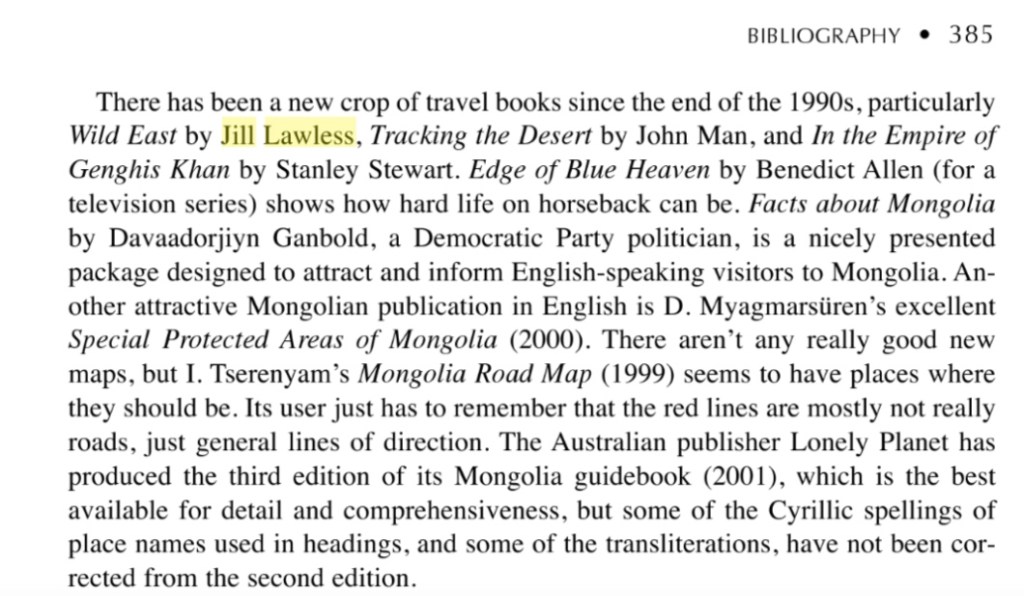
    Ger Magazine contributor Jill Lawless’ book Wild East: Travels in the New Mongolia here: https://wildeasttravelsinthenewmongolia.wordpress.com

    This work is licensed under a Creative Commons Attribution 4.0 International License.

    ORCID iD: https://orcid.org/0000-0001-5311-1052.

    © David South Consulting 2021

  • Reviews | Wild East: The New Mongolia

    Reviews | Wild East: The New Mongolia

    Jill Lawless is a Correspondent with The Associated Press based in London, UK. In 2000, her first book – Wild East: Travels in the New Mongolia – was published by ECW Press. Click through the site to read more about Jill and her book, Wild East: Travels in the New Mongolia.

    “One of the top 10 Canadian travel books of 2000.” The Globe and Mail

    Published in Canada

    • Publisher : ECW Press; Illustrated edition (1 Jan. 2000)
    • Language : English
    • Paperback : 230 pages
    • ISBN-10 : 1550224344
    • ISBN-13 : 978-1550224344
    • Dimensions : 15.24 x 1.6 x 22.86 cm
    •  Images © David South and Liz Lawless.

    Media Reviews

    “They also offered a reading recommendation, the memoir-cum-travelogue “Wild East,” by Jill Lawless, a Canadian journalist who spent a few years in Mongolia in the mid-’90s, just after seven decades of Soviet Communism fell here. Her harrowing, often hilarious, stories of expat life, which I read on the plane on the way over, surpassed even those of my friends’ holiday.” The New York Post

    “Engaging…a revealing and often amusing account of her journeys through a beautiful country awakening from a tumultuous era.” The Globe and Mail

    “Lawless introduces us to Mongolia’s tabloid press, to teenage mineworkers, sharp-eyed young hustlers, nomads whose only possessions are their livestock, Mongolian wrestlers and Mongolian horse races.” Toronto Star

    “This readable and reportorial book is the perfect antidote to … those tiresomely difficult, pointlessly dangerous, and essentially fake expeditions undertaken against the advice of local people who know better.” The Georgia Straight, Vancouver

    “Wryly funny and wide-spectrum account of Mongolia’s tumultuous rebirthing into the 21st century. Half the population lives in Soviet apartment blocks and watches satellite TV but the other half still eek a living from the exquisite, barren hills while living in nomadic felt tents. Of course, I’d much rather be in the tents… but whatever your preference, you will definitely enjoy Ms. Lawless’ writing. She was editor of an Ulaan Baator newspaper for two years, and she tells it like it is. Very highly recommended.” Mongolian Buryat Civilisation Bookstore

    “Jill Lawless trof enkele jaren terug een land aan dat veel westerser is dan zij dacht: Mongolië. In Het wilde oosten beschrijft ze hoe het land uit een eeuwenoude isolatie probeert te geraken wat tot fascinerende contrasten leidt….” de Volkskrant

    Journal Reviews

    “Jill Lawless’ book is not a scholarly tome per se, yet it is of definite value to the contemporary Mongolian scholar … Lawless’ period is 1997-1999, the heart of the tumultuous and ill-spent years of Democratic Coalition Government… a period of great hopes for democratic flowering and free market enterprise leading the nation to prosperity and progress.” Alicia J. Campi in Mongolian Studies

    Historical dictionary of Mongolia, by Alan J. K. Sanders, Scarecrow Press, 2003.

    Reader Reviews

    “Others sent me Jill Lawless’s Wild East: The New Mongolia, a compilation of pieces she wrote when she was editor of Mongolia’s English-language newspaper, the UB Post, during Mongolia’s transition from a socialist people’s republic to young democracy. With the wind shaking the frame of my ger, I lit the stove and read what these and other writers claimed to have found just outside my flapping felt walls.

    “By the time veteran journalist Jasper Becker’s Mongolia: Travels in an Untamed Land arrived, I had put aside books written since Mongolia opened up to the West in the early 1990s. Most Western travellers and writers discovered the same sights from the back of a borrowed horse. Only Lawless had investigated the place over time on its own terms. The others, full of pith and vinegar and a standard set of assumptions about what they would find, built books on flights of fancy – golfing across Mongolia, following the path of medieval monks, ‘rediscovering shamanism’ – that were flimsier even than those that had set me in motion. The books were as exciting as museum diorama, papier-mâché models of their ‘medieval’ travels and capitalist fantasies.” Three Years in Mongolia: Trying to be a Travel Writer, Luke Meinzen, Kill Your Darlings, 10 April 2012

    “I put Becker away and pulled out Wild East by Jill Lawless. She was heaps better than Becker, which wasn’t hard.” MÖRÖN TO MÖRÖN: Two Men, Two Bikes, One Mongolian Misadventure, Tom Doig, Allen & Unwin, 2013

    “Wild East is less of a travel memoir, but rather essays and shorter narratives of creative non-fiction … it provides a compelling narrative into the historical moment when Mongolia dropped its isolation and began … its journey toward modernization.” Three Works of Travel Writing to Ignite Your Imagination (while we patiently wait for the pandemic to run its course), November 10, 2020

    © David South Consulting 2021

  • CASE STUDY 4: UN + UNDP Mongolia | 1997 – 1999

    CASE STUDY 4: UN + UNDP Mongolia | 1997 – 1999

    Expertise: Crisis leadership, mission leadership, strategy, communications, web strategy, digital media, crisis recovery, public health, Northeast Asia, UN system.  

    Location: Ulaanbaatar, Mongolia 1997 to 1999

    UN/UNDP Mongolia Communications Coordinator: David South

    Abstract

    “The transformation of Mongolia from a largely rural nomadic society of herdsmen to a community dominated by the increasingly ultra-globalized city of Ulan Bator, where almost a third of the population lives, is nothing short of astounding. The New Mongolia: From Gold Rush to Climate Change, Association for Asian Studies, Volume 18:3 (Winter 2013): Central Asia

    From 1997 to 1999, I served as the Communications Coordinator (head of communications) for the United Nations (UN)/United Nations Development Programme (UNDP) mission in Mongolia, founding and directing its UNDP Mongolia Communications Office. 

    About

    The question posed itself from the start of the assignment: In the middle of a major crisis, is it possible to recover quickly while simultaneously growing and modernizing the United Nations mission (this was the dawn of the digital revolution)? It was only possible by teaching and mentoring colleagues, offering leadership, vision, strategy, and practical actions to get there – all with a budget and mandate for two years.

    The mission had to tackle in particular, three, severe crises: the country’s turbulent transition from Communism to free markets and democracy, the social and economic crash this caused, and, later in 1997, the Asian Financial Crisis (Pomfret 2000)– all combined with the political instability this exacerbated. Richard Pomfret said in 1994, “In 1991 Mongolia suffered one of the biggest peacetime economic collapses ever (Mongolia’s Economic Reforms: Background, Content and Prospects, Richard Pomfret, University of Adelaide, 1994).” From Curbing Corruption in Asia: A Comparative Study of Six Countries by Jon S. T. Quah: “The combined effect of these three shocks was devastating as ‘Mongolia suffered the most serious peacetime economic collapse any nation has faced during this century’. Indeed, Mongolia’s economic collapse ‘was possibly the greatest of all the (peaceful) formerly’” Communist countries.

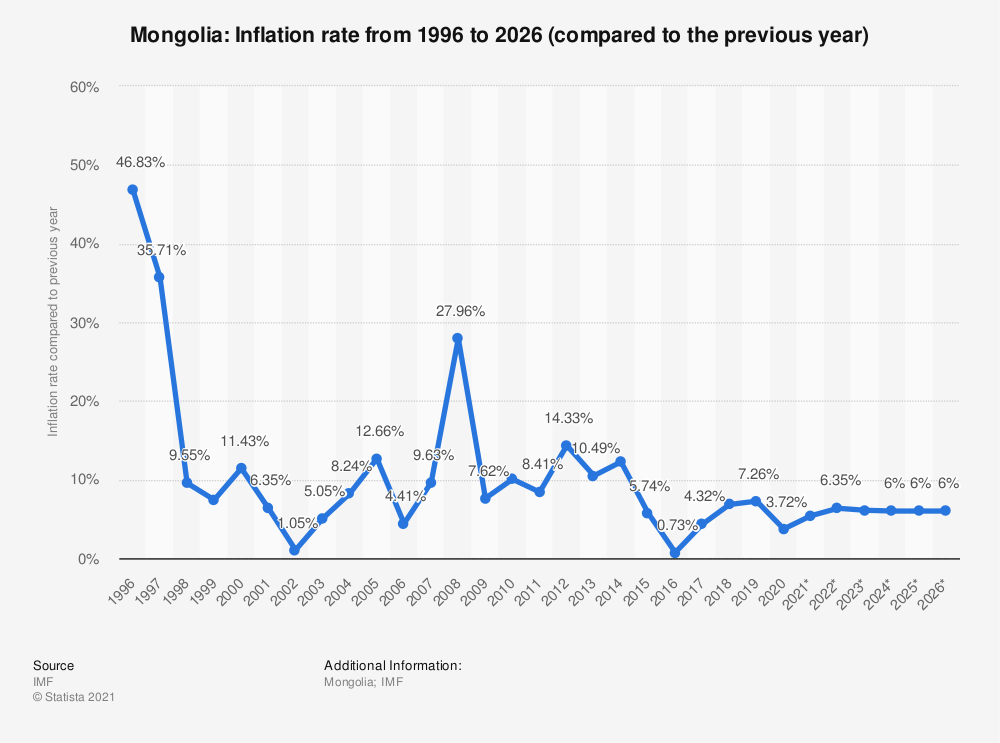
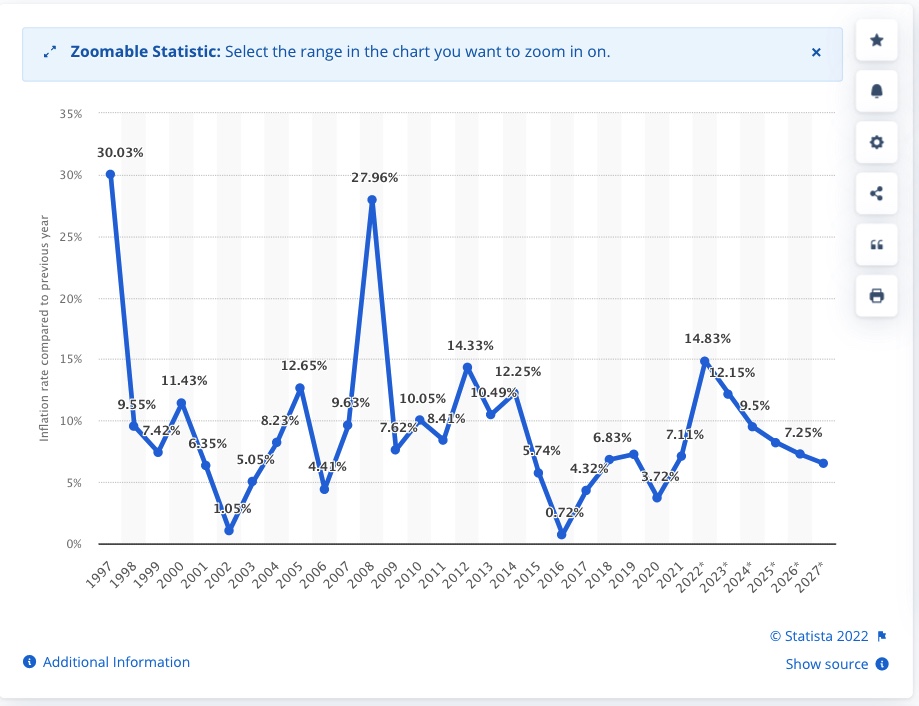
    A dramatic decline in inflation paired with political and economic stabilisation allowed Mongolia to enjoy the fruits of the fast-growing economies of the 2000s. Source: Statista.

    https://www.statista.com/statistics/727562/inflation-rate-in-mongolia/

    https://www.statista.com/statistics/727562/inflation-rate-in-mongolia/

    During the last 16 years the financial and monetary system of our country saw the worst crisis in 1991-1994, there was a recovery in 1995-1997 and another crisis in 1997-1999. However, it has entered a stable stage since 2000.

    Mongolia at the Market
    Dedicated to the 60th Anniversary of the School of Economic Studies
    , Editors: Chuluundorzh Khashchuluun, Namsrai Batnasan, Ni︠a︡msu̇rėngiĭn Batnasan, P. Luvsandorzh, LIT Verlag, 2012.

    From the World Bank: 1997: Stabilization at the heart of policy choices

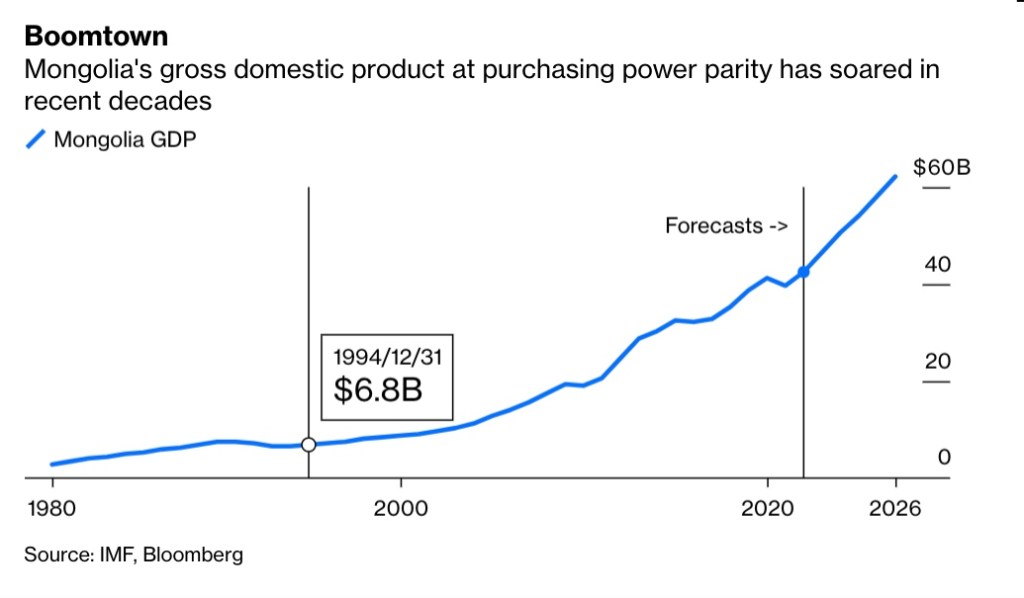
    A resources “boomtown” throughout the 2000s. Source: Bloomberg. When I left in 1999, Mongolia’s PPP was US $8.8 bn; today (2021) it is US $42.4 bn.
    Graph from Migration under economic transition and changing climate in Mongolia, Journal of Arid Environments, Volume 185, February 2021. “Urbanization in Mongolia accounted for over 80% of all migration, mostly into the capital city Ulaanbaatar (UB), where nearly 70% of recent population growth was from migration.”
    As can be seen in this chart, Mongolia’s economic growth since 2000 has benefited greatly from its proximity to China.
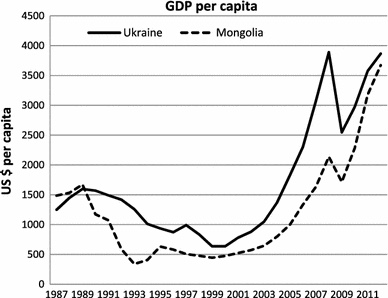
    As this chart shows, increasing connectivity had a profound impact on living standards in Ukraine and Mongolia post-2000. The extreme turbulence Mongolia experienced in the 1990s – after the collapse of support mechanisms from the Soviet Union – calmed down as Mongolia integrated with the global economy, especially a booming China. Read about my work in Ukraine here: UN Ukraine Web Development Experience | 2000.
    The Economist: “Those free-trading Mongolians” was published Apr 24th 1997. I arrived in May of 1997 to find a country on the cusp of great and turbulent change.

    In this role, I pioneered innovative uses of the Internet and digital resources to communicate the UN’s work and Mongolia’s unfolding crises. The UN called this work a “role model” for the wider UN and country offices. A survey of United Nations country office websites in 2000 ranked the UN Mongolia website I launched in 1997 and oversaw for two years (1997-1999), third best in the world, saying: “A UN System site. A very nice, complete, professional site. Lots of information, easily accessible and well laid out. The information is comprehensive and up-to-date. This is a model of what a UNDP CO web site should be.” (http://www.scribd.com/doc/274319690/UNDP-Mongolia-United-Nations-2000-Survey-of-Country-Office-Websites)

    “The years 1998 and 1999 have been volatile ones for Mongolia, with revolving door governments, the assassination of a minister, emerging corruption, a banking scandal, in-fighting within the ruling Democratic Coalition, frequent paralysis within the Parliament, and disputes over the Constitution. Economically, the period was unstable and rife with controversies.” Mongolia in 1998 and 1999: Past, Present, and Future at the New Millennium by Sheldon R. Severinghaus, Asian Survey, Vol. 40, No. 1, A Survey of Asia in 1999 (Jan. – Feb., 2000). pp. 130-139 (Publisher: University of California)

    As part of a strategic plan to raise awareness of Mongolia’s development challenges and to spur action on meeting them, a Communications Office was established for the UN mission in 1997 – a structure that is commonplace in UN missions today. The Office also led on digital communications, marking many firsts, from the first digital photo and video library, the first online magazine, the first web portal, the first online newsletter, and many other firsts. It gathered numerous stories on resilience in a crisis, and documented in data and storytelling the country’s development challenges, while introducing a transparent way of working and communicating unprecedented for the time (the country was still recovering from the state secrecy of its years under Communism), and led on modernizing communications in the country. Acting as a strategic hub, the Communications Office and its dynamic and talented team, were able to leverage the existing budget to spur action on many fronts, including:

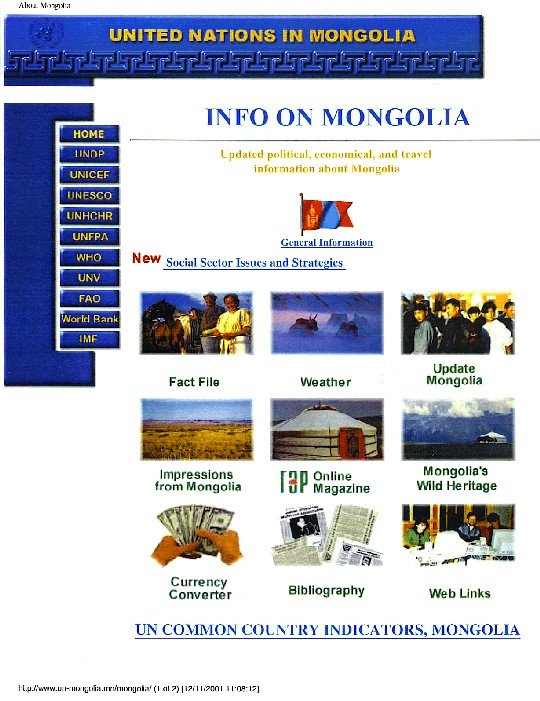
    UN/UNDP Mongolia Development Web Portal (www.un-mongolia.mn)

    I launched it in 1997 in the middle of a major crisis, and oversaw its expansion and development for two years. A pioneering digital resource, this award-winning United Nations Mongolia development web portal was singled out by UN headquarters in New York as an example of what a country office website should be like. It featured extensive resources in both Mongolian and English and also was home to the bilingual online magazine, Ger – Mongolia’s first web magazine. It can be viewed at www.archive.org and there is more at Wikipedia here: https://en.wikipedia.org/wiki/Ger_(magazine).

    Media

    Working with journalists and media both within Mongolia and outside, the Communications Office was able to significantly raise awareness of Mongolia and its development challenges. This was reflected in a substantial increase in media coverage of the country and in the numerous books and other publications that emerged post-1997. The book In Their Own Words: Selected Writings by Journalists on Mongolia, 1997-1999 (ISBN 99929-5-043-9) published by UNDP Mongolia archived the stories by theme.  

    Ger Magazine

    Ger Magazine (the Mongolian word for home and traditional tent dwelling) was published as the country’s first e-magazine in 1998. There were four issues in total from 1998 to 2000. The launch issue was on the theme of youth in the transition. Mongolia was transitioning from Communism to free markets and democracy and this had been both an exhilarating time and a wrenching time for young people. The magazine drew on talented journalists from Mongolia and the handful of international journalists based there to create a mix of content, from stories about life adapting to free markets to stories on various aspects of Mongolian culture and life.

    The second issue of the magazine proved particularly effective and inspiring, with its modern life theme and cover story on a thriving Mongolian fashion scene.

    Archived issues of the magazine can be found at the Wayback Machine here: https://archive.org/. Just type in the UN Mongolia website address for the years 1997 to 1999: http://www.un-mongolia.mn.

    An online survey of the state of Mongolia’s media and its history (www.pressreference.com/Ma-No/Mongolia.html), had this to say: “An interesting variation from some of the other publications available is Ger Magazine (published online with guidance from the United Nations Development Program, UNDP), which is concerned with Mongolian youth in cultural transition. The name of the magazine is meant to be ironic because a ger is the Mongolian word for yurt—a yurt being traditional nomadic housing—but the magazine is about urbanization and globalization of Mongolian youth.”

    Blue Sky Bulletin

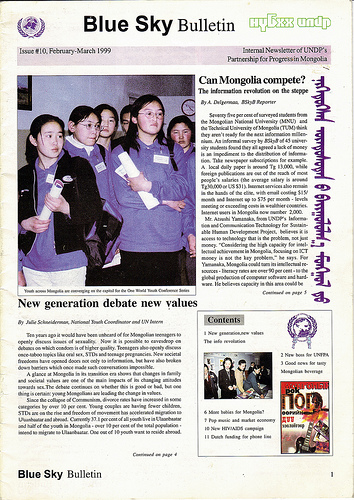
    The Blue Sky Bulletin newsletter was launched in 1997 initially as a simple, photocopied handout. It quickly founds its purpose and its audience, becoming a key way to communicate what was happening in the country and a crucial resource for the global development community, scholars, the media and anyone trying to figure out what was happening in a crazy and chaotic time. It eschewed the typical ‘grip and grin’ content found in many development newsletters and instead offered stories, data and insights useful to anyone seeking to understand Mongolia’s development challenges. The Blue Sky Bulletin was distributed via email and by post and proved to be a popular and oft-cited resource on the country. The quality of its production also paralleled Mongolia’s growing capacity to publish to international standards, as desktop publishing software became available and printers switched to modern print technologies. The Blue Sky Bulletin evolved from a rough, newsprint black and white publication to becoming a glossy, full-colour, bilingual newsletter distributed around Mongolia and the world. 

    Archived issues can be found online here:

    Blue Sky Bulletin Issue 1

    Blue Sky Bulletin Issue 2

    Blue Sky Bulletin Issue 3

    Blue Sky Bulletin Issue 4 

    Blue Sky Bulletin Issue 5

    Blue Sky Bulletin Issue 6

    Blue Sky Bulletin Issue 7

    Blue Sky Bulletin Issue 8

    Blue Sky Bulletin Issue 9

    Blue Sky Bulletin Issue 10

    Publishing

    MHDR 1997

    The Mongolian Human Development Report 1997 (MHDR), the country’s first, placed the story of the Mongolian people during the transition years (post-1989) at its heart, using photographs, stories and case studies to detail the bigger narrative at play.

    This groundbreaking Mongolian Human Development Report – the country’s first – went beyond just chronicling Mongolia’s state of development in statistics and graphs. Designed, laid out and published in Mongolia, the report broke with the practices of many other international organisations, who would publish outside of Mongolia – denying local companies much-needed work and the opportunity to develop their skills. The report’s costs helped to kick-start a publishing boom in the country and significantly raised standards in design and layout in the Mongolia. The foundations laid down by the project producing the report ushered in a new age in publishing for Mongolia.

    The report’s launch was innovative, not only being distributed for free across the country, but also part of a multimedia campaign including television programming, public posters, town hall meetings and a ‘roadshow’ featuring the report’s researchers and writers.

    The initial print run of 10,000 copies was doubled as demand for the report increased. To the surprise of many, once hearing about the free report, herders would travel to the capital, Ulaanbaatar, to pick up their copy. The report proved people cared passionately about the development of their country and that development concepts are not to be the secret domain of ‘development practitioners’. The report also became an English language learning tool as readers compared the Mongolian and English-language versions.

    You can read the report’s pdf here: http://www.mn.undp.org/content/mongolia/en/home/library/National-Human-Development-Reports/Mongolia-Human-Development-Report-1997.html 

    1997 saw the launch of the first human development report for Mongolia.

    Mongolian AIDS Bulletin

    UNDP acted swiftly to address a breaking HIV/AIDS crisis in 1997, offering a key lesson for others working in public health (the Ebola Crisis and global air pollution crisis both show those lessons have still yet to be fully absorbed).

    Assembled by a team of health experts after the Fourth International Congress on AIDS in Asia and the Pacific, the Mongolian AIDS Bulletin was published in 1997 in the middle of an HIV/AIDS crisis. It provided timely information and health resources in the Mongolian language and was distributed across the country.

    “Mongolia’s first AIDS Bulletin marked the beginning of the UNDP Response to HIV/AIDS/STDs Project back in the autumn of 1997. Over 5,000 copies of the magazine were distributed across the country, offering accurate information on the HIV/AIDS situation. The project has been pivotal in the formulation of a national information, education and communication (IEC) strategy, bringing together NGOs, donors, UN agencies and the government.”

    Source: YouandAids: The HIV/AIDS Portal for Asia Pacific

    Green Book

    In the Mongolian language, the Mongolian Green Book details effective ways to live in harmony with the environment while achieving development goals. Based on three years’ work in Mongolia – a Northeast Asian nation coping with desertification, mining, and climate change – the book presents tested strategies.  

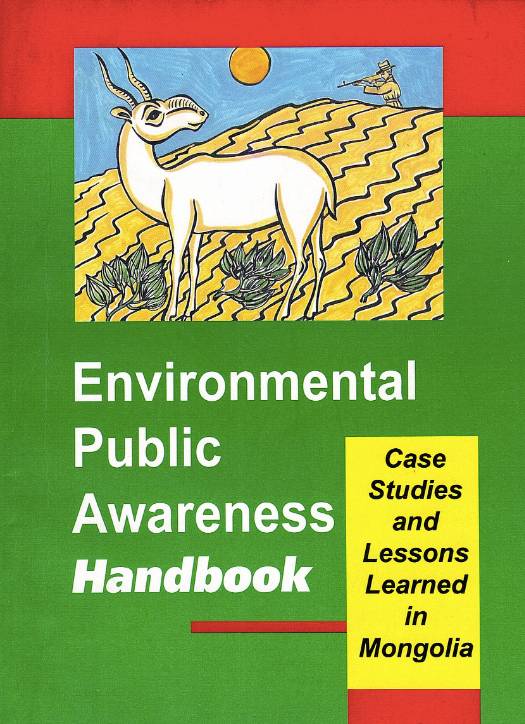
    EPAP Handbook

    The Environmental Public Awareness Handbook was published in 1999 and features the case studies and lessons learned by UNDP’s Mongolian Environmental Public Awareness Programme (EPAP). The handbook draws on the close to 100 small environmental projects the Programme oversaw during a two-year period. These projects stretched across Mongolia, and operated in a time of great upheaval and social, economic and environmental distress. The handbook is intended for training purposes and the practice of public participation in environmental protection.

    In its 2007 Needs Assessment, the Government of Mongolia found the EPAP projects “had a wide impact on limiting many environmental problems. Successful projects such as the Dutch/UNDP funded Environmental Awareness Project (EPAP), which was actually a multitude of small pilot projects (most costing less than $5,000 each) which taught local populations easily and efficiently different ways of living and working that are low-impact on the environment.”

    Mongolia Updates 1997, 1998, 1999

    Mongolia Update 1998 detailed how the country was coping with its hyperinflation and the Asian economic crisis.

    The mission simultaneously had to deal with the 1997 Asian Crisis (http://en.wikipedia.org/wiki/1997_Asian_Financial_Crisis) and the worst peacetime economic collapse in post-WWII history (http://www.jstor.org/pss/153756).  

    Mongolia Update 1998 – Political Changes

    1998 proved a tumultuous year for Mongolia. The country’s existing economic crisis caused by the transition from Communism to free markets was made worse by the wider Asian Crisis. The government was destabilised, leading to an often-confusing revolving door of political figures. In order to help readers better understand the political changes in the country, a special edition of Mongolia Update was published that year.  

    UNDP Mongolia: The Guide

    The Guide, first published in 1997, provided a rolling update on UNDP’s programmes and projects in Mongolia during a turbulent time (1997-1999). The mission simultaneously had to deal with the 1997 Asian Crisis (http://en.wikipedia.org/wiki/1997_Asian_financial_crisis) and the worst peacetime economic collapse in post-WWII history.

    Each edition came with short project and context summaries, key staff contacts, and facts and figures on how the country was changing. For the first time, any member of the public could grasp what the UN was up to in the country and be able to contact the project staff. An unusual level of transparency at the time for a UN mission.

    Memoranda of Understanding

    Three Memoranda of Understanding were negotiated with the Mongolian Government to help focus efforts and aid the attainment of internationally-agreed resolutions. This was affirmed by a series of youth conferences, One World, held in 1998 and 1999.

    Strategy and Leadership in a Crisis

    The scale and gravity of the crisis that struck Mongolia in the early 1990s was only slowly shaken off by the late 1990s. The economic and social crisis brought on by the collapse of Communism and the ending of subsidies and supports from the Soviet Union, led to a sharp rise in job losses, poverty, hunger, and family and community breakdowns.

    The challenge was to find inspiring ways out of the crisis, while building confidence and hope. The sort of challenges confronted by the UNDP Mongolia Communications Office included:

    1) A food crisis: agricultural production was down sharply, and the traditional nomadic herding economy, while at peak herd, was failing to get the meat to markets and to a high enough standard to restore export levels to where they once were. As a result, a cross-border trading frenzy became the solution to falling domestic food production and availability.

    2) HIV/AIDS/STDs crisis.

    3) A major banking crisis.

    4) Both the Asian Financial Crisis and the Russia Crisis.

    5) An ongoing political crisis and an inability to form stable governments.

    UN Annual Reports

    Editor and designer. 1998 Report called by Under-Secretary-General Nafis Sadik “a clear, well-written, attractive and colourful report.”

    One of many documents from that time held in the United Nations Archives Search Engine. In this case, reporting on Mongolia’s follow-up to global conferences to then-Secretary-General Kofi A. Annan in 1999.
    Mongolia’s Follow-Up To The UN Global Conferences (1999) UNDP Mongolia Communications Office, Ulaanbaatar, Mongolia.
    Production/Design Supervision: David South, UNDP Communications Coordinator; Proof Reading: N. Oyuntungalag, UNDP Communications Officer/David South (1999).

    Timeline 

    1997: Arrive in the capital of Mongolia, Ulaanbaatar, to undertake a two-year assignment with the United Nations mission. Quickly get to work founding the UNDP Mongolia Communications Office and pursuing a strategic communications approach with a busy online and offline bilingual publishing programme. Launch award-winning UN Mongolia Development Web Portal (www.un-mongolia.mn). Launch first Human Development Report Mongolia 1997, and a Mongolian AIDS Bulletin during crisis. Assist the Government of Canada to establish the first Honorary Consul in Ulaanbaatar on December 1, 1997 and the Canada Fund Mongolia.

    Canada Fund Mongolia

    1998: International media tours of the country, launching of Mongolia’s first online magazine, Ger, distribute globally a regular newsletter on Mongolia’s development challenges, Blue Sky Bulletin. Open United Nations Info Shop for the public. Assist the Government of Canada to connect with Canadians working with the United Nations in Mongolia during the first official visit by a Canadian Government Minister.

    1999: Launch a string of books documenting insights gleaned from the Mongolia development experience.  

    Testimonials

     “Mongolia is not an easy country to live in and David [South] showed a keen ability to adapt in difficult circumstances. He was sensitive to the local habits and cultures and was highly respected by his Mongolian colleagues. … David’s journalism background served him well in his position as Director of the Communications Unit. … A major accomplishment … was the establishment of the UNDP web site. He had the artistic flare, solid writing talent and organizational skills that made this a success. … we greatly appreciated the talents and contributions of David South to the work of UNDP in Mongolia.” Douglas Gardner, UN Resident Coordinator and UNDP Resident Representative Mongolia

    Impact 

    Micro

    • strategic communications approach including establishing the UN/UNDP Mongolia Communications Office and team and strategic communications plan
    • led on digital transformation, including use of digitial media (photo/video archive) and digital publishing (web site, online magazine and newsletter, etc.)
    • established and ran the United Nations Info Shop – a one-stop resource open to the public with archive of development publications and current periodicals and Internet access
    • began largest bilingual online and offline publishing programme in country – led on publishing and design modernisation
    • laid down the foundations for many UN initiatives in Mongolia that are still underway. Contributed to stabilizing the country in a turbulent time. Mongolia was briefly the fastest-growing economy in the world by 2011
    • championed transparency and access to information and media freedoms
    • oversaw a period in which Transparency International found lower levels of perceived corruption
    • managing editor for country’s first Human Development Report

    Macro

    • raised profile of country and its development challenges. Donor pledges rose 
    • 2 international media tours
    • strong relationship with Mongolian and international journalists
    • championed innovators in commnications
    • crisis response: AIDS, economy, political
    • country’s largest website and one of its first. Called “Godfather of the Mongolian web”
    • called a “role model” for the wider UN
    • led on new approach to UN communications in the digital age
    • design-led approach
    • transparent and timely updates
    • negotiated three Memoranda of Understanding (MOUs): youth, food security and nutrition, STDs/HIV/AIDS
    • One World youth conferences

    Publications

    David South Consulting Summary of Impact

    Environmental Public Awareness Handbook: Case Studies and Lessons Learned in Mongolia

    Ger Magazine: Modern Life Issue

    Ger Magazine: Youth Issue

    Human Development Report Mongolia 1997

    Mongolian Green Book

    Mongolia Update – Coverage of 1998 Political Changes

    Mongolia Update 1998

    Mongolian AIDS Bulletin

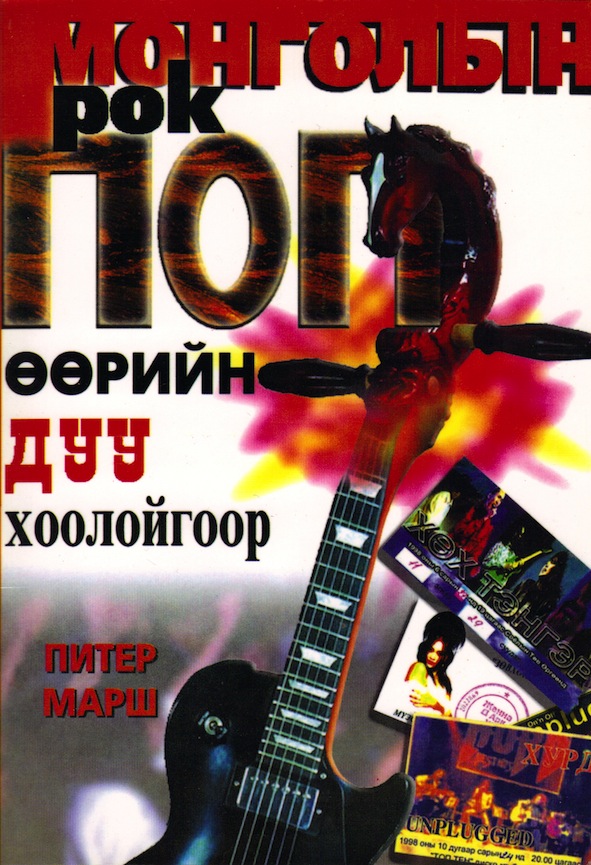
    Mongolian Rock and Pop Book

    Partnership for Progress: The United Nations Development Programme in Mongolia

    UNDP Mongolia Online Development Portal

    UNDP in Mongolia: The Guide 

    Stories

    Freedom of Expression: Introducing Investigative Journalism to Local Media in Mongolia

    Lamas Against AIDS

    Philippine Conference Tackles Asia’s AIDS Crisis

    Starting from Scratch: The Challenge of Transition

    UNDP Mongolia Partnership for Progress 1997 to 1999 Key Documents 

    A UNDP Success Story: Grassroots Environmental Campaign Mobilizes Thousands in Mongolia

    Citations

    The response by the UNDP Mongolia Communications Office has been cited in numerous articles, books, publications and stories. It has also contributed to the development of the human development concept and understanding of human resilience in a crisis and innovation in a crisis. 

    Book citations include:

    Dateline Mongolia: An American Journalist in Nomad’s Land by Michael Kohn, RDR Books, 2006

    Modern Mongolia: From Khans to Commissars to Capitalists by Morris Rossabi, University of California Press, 2005

    Wild East: Travels in the New Mongolia by Jill Lawless, ECW Press, 2000

    Paper citations include: 

    Paula L. W. Sabloff (2020) Buying into capitalism: Mongolians’ changing perceptions of capitalism in the transition years, Central Asian Survey, 39:4, 556-577, DOI: 10.1080/02634937.2020.1823819

    A more detailed list of citations can be found here: http://www.davidsouthconsulting.com/about/

    For research purposes, key documents were compiled together and published online here: https://books.google.ca/books?id=K76jBgAAQBAJ&dq=undp+mongolia+key+documents&source=gbs_navlinks_s

    This resource was praised for having: “Very useful references and original materials that documented UNDP Mongolia work. I needed to trace community-based development, and this book provided a valuable source.” Review on Google Books

    In 2001, the UN won the Nobel Peace Prize for “their work for a better organized and more peaceful world” and its communications innovations, with work such as that in Mongolia being cited as a contributing factor to the awarding of the Prize.

    The Nobel Peace Prize 2001 joint winners.

    In 2000, the Millennium Development Goals (MDGs) were launched in a 15-year bid to use a focused approach to development centred around eight goals to accelerate improvements to human development. From 2000 to 2005, consulting work was undertaken in various UN missions (Mongolia, South Africa, Turkmenistan, Ukraine) to communicate the goals and to reshape communications activities around the goals.

    Transition and Democracy in Mongolia by Richard Pomfret, Europe-Asia Studies, Vol. 52, No. 1 (Jan., 2000), pp. 149-160, published by Taylor & Francis, Ltd. (http://www.jstor.org/stable/153756?seq=1#page_scan_tab_contents)

    The Milk of Kindness flows in a Peculiar Land A Steppe From Nowhere by Leslie Chang, The Asian Wall Street Journal, 15 August 1998

    Mongolia prepares for a magazine explosion by Jill Lawless, UB Post, 08-09-98

    Other Resources

    Letter from Mongolia: Herding instinct by Jill Lawless, The Guardian, 9 June 1999

    Connect with me on Devex here: https://www.devex.com/people/david-s-361357

    ORCID iD: https://orcid.org/0000-0001-5311-1052.

    © David South Consulting 2025

  • A Partnership For Progress: UNDP In Mongolia 1997 | 19 January 2016

    A Partnership For Progress: UNDP In Mongolia 1997 | 19 January 2016

    A Partnership for Progress: The United Nations Development Programme in Mongolia

    Editor: David South

    Publisher: UNDP Mongolia Communications Office

    Published: 1997

    Background: The Partnership for Progress brochure raised the curtain on UNDP’s programme in Mongolia and my work heading UNDP Mongolia’s Communications Office. I led the Office from 1997 to 1999, garnering awards and praise for the quality of the offline and online resources.

    A Partnership for Progress

    “For years we were under the domination of foreign countries. So really, Mongolia is a new nation.” With these words, Prime Minister M. Enkhsaikhan described the enormity of the task ahead for Mongolians. While Mongolia has been an independent nation for most of this century, this has not been the case with its economy. Just as a new democratic nation was born in the 1990s, so Mongolia’s economy lost the large subsidies and trading arrangements it had in the past with the Soviet Union. The time to learn about free markets and the global economy had arrived.

    Under socialism, Mongolia was dependent on the Soviet Union. Prior to the socialist revolution in 1921, the country experienced hundreds of years under the influence of the Chinese. It is only since 1990 that Mongolia has had an opportunity to build the foundations of an independent economy and political culture. But it takes money and know-how to make the transition work. This is the kind of nation-building support the United Nations Development Programme (UNDP) specializes in. UNDP’s fifth country plan for Mongolia has come to an end, and in cooperation with the Mongolian Government the sixth – the Partnership for Progress – has begun.

    Meeting the challenges of transition

    The international community rapidly responded to Mongolia’s needs in the early 1990s. Along with the large international donors, the UN system is playing a pivotal role with UNICEF, UNFPA, WHO and UNDP to assist in the country’s social reconstruction. Other agencies now operating in Mongolia include UNESCO, UNV, UNHCHR, World Bank and the IMF. The UN’s capacity to coordinate, not only within the UN family of organizations, but also with donors and the international NGO community has proved extremely useful in mobilizing the technical assistance needed at this critical time. The goal is capacity building, or the transformation of both the human and economic resource base to fit the economic and social demands of transition.

    UNDP’s Partnership for Progress with the Government of Mongolia serves as the framework for assisting the Government to combat the worst effects of poverty and social disintegration brought on by economic transition. The programmes and projects mounted with UNDP assistance not only tackle the lack of material resources, but also the dearth of practical experience in the strategies and methodologies required to nurture open government and encourage democratic procedures, protect human rights, preserve the environment and promote the private sector.

    Mongolia is a large country with poor infrastructure. This means it is not only difficult to transport food or make a phone call, but also to develop and deliver programmes that reach the entire country. It is through the expertise of the UNDP, drawing experience from around the world, that these obstacles to a market economy and an open democracy can be overcome.

    UNDP has had a country office in Mongolia since the 1970s. UNDP’s resource mobilization target for the five year programme from 1997 to 2001 is US $27.5 million, with 45 percent to be directed to poverty alleviation, 30 percent to governance and 15 percent to environmental protection. With this material input and the goodwill it generates, the Mongolian Government can design appropriate social and political structures to support their efforts in seeking lasting solutions to the problems brought on by transition. Mongolia can then become an equal player in the global community of the 21st Century.

    UNDP in Mongolia

    The UNDP’s programmes in Mongolia follow the global principle of helping people to help themselves. Through a close working relationship with the Mongolian Government (the Partnership for Progress), UNDP personnel work with many thousands of Mongolian counterparts in government, academia and NGOs all over the country. In addition, UNDP has a large contingent of United Nations Volunteers (UNVs) deployed in Mongolia. There are over 27 international UNVs working in all UNDP programme areas and further 26 national UNVs working as community activists to foster participation in the poverty alleviation programme. Another six national UNVs are involved in the UNESCO/UNDP decentralization project.

    A peaceful transition

    The transition in the 1990s from socialism to democracy and free markets has profoundly transformed the country’s political and economic character. Mongolia is a young democracy that is also a model for bloodless political revolution. Today, this participatory democracy boasts scores of newspapers, dozens of political parties and a vigorous parliamentary system. On the economic front, a command-based economy has been replaced by free markets. But there has been a high price to pay in social disintegration and dysfunction, as the former social supports disappear and their replacements fail to “catch” everyone. As with all social upheaval, vulnerable groups – the elderly, the young, the weak – bear the brunt of the social and economic shocks as the old gives way to the new.

    The bubble bursts

    Before the 1990s, the Mongolian economy was totally dependent on subsidies from the Soviet Union. The state owned all means of production and private enterprise was foresworn. Farmers and herders were organized into cooperatives. Factories had more workers than they needed. Wages were low but no one starved. The state provided for the basics of life – health care, education, jobs and pensions. Free fuel was provided to get through the severely cold winters, and during blizzards lives were saved in stranded communities with food and medicine drops by Russian helicopters.

    The bubble burst in 1991 when the Soviet Union disintegrated and the subsidies came to an end. Prior to this, communist countries accounted for 99 percent of Mongolia’s imports and 94 percent of its exports. Mongolia’s economy suddenly lost its buttress and immediately collapsed.

    A sense of freedom

    Although the economic picture was bleak, politically Mongolians rejoiced and embraced the principles of Western parliamentary democracy. A new sense of political and personal freedom took hold. Freedom of religion ensured a revival of Buddhism. Monasteries sacked and razed under the Communists were restored and religious observance once again became part of daily life.

    Collectivization began to give way to free markets and privatization. A voucher system was used to redistribute the assets of many state-owned entities. Each citizen was issued with vouchers to the value of 10,000 tugrigs (at the time worth US $100). They could be bought and sold like shares of stock.

    Livestock was privatized and previous limitations regarding ownership of animals were lifted. As a result, the composition of herds changed and the numbers of animals soared to the highest levels in 50 years. While the collapse of the state sector has led to severe hardship, many nomadic herders who astutely manage their herds are self-sufficient in meat and milk. Many continue the old energy saving ways, including collecting dung for fuel and using their animals for transport. Some find it possible to live almost completely outside the cash economy.

    Transition shock

    The spectre of the worst aspects of market economies soon loomed for many who had known only a poor but predictable life under a command economy. Suddenly unemployment, inflation and reduced services became the norm. Previously reliable export markets in the newly constituted Commonwealth of Independent States disappeared entirely, leaving a ballooning trade deficit and a plummeting tugrig. The fall in global prices for cashmere and copper have only exacerbated an already critical situation.

    Poverty strikes

    Poverty and starvation hit with a vengeance. According to Food and Agriculture Organization (FAO) figures, a third of the population now lives at starvation levels. The demise of collectivized farming has contributed to both a shortage of food and reduction in food self-sufficiency. Thousands of homeless children work, beg or steal in the streets of the capital, Ulaan Baatar. Many descend into the sewers for warmth to escape the subzero temperatures that prevail for most of the year, while others seek refuge in the few children’s shelters in the city.

    Unemployment is high. Women are particularly vulnerable, with more than 100,000 summarily removed from the pension rolls at the beginning of 1997. The retired, whose pensions have decreased dramatically in value are also in severe distress, with almost all relying on their families, friends and neighbours. Those without such support are left to live a precarious existence.

    Poverty alleviation

    To reverse a rapidly deteriorating situation, the Government instituted a six-year National Poverty Alleviation Programme (NPAP) with the primary objective of reducing poverty by 10 percent by the year 2000. Designed with assistance from UNDP, donors and Mongolian NGOs, the NPAP is founded on new principles unseen before in Mongolia. Responsibility is decentralized, with each of the 21 aimags (provinces) having a local Poverty Alleviation Council with responsibility for identification, formulation and appraisal and approval of projects. Thus the people of the area can respond to local needs – identify them, propose solutions to problems and act to determine their own futures.

    The Mongolian National Poverty Alleviation Programme addresses a wide range of social issues, including income poverty and the crisis in the health and education sectors. Solutions to such urgent social welfare problems are a high priority for the Mongolian Government – and international assistance is critical. The introduction of fees for health and education services that were previously free has placed an unbearable financial strain on some families. School drop-out rates and truancy are problems in both urban and rural areas. The costs associated with general maintenance and heating of public buildings adds another financial burden in the transition period.

    Emphasis on women

    A US $10 million soft loan from the World Bank for the period 1996 to 1999 supports Mongolia’s efforts to follow up on the commitments of the World Summit for Social Development, the Fourth World Conference for Women and other recent global initiatives.

    The NPAP institutional framework focuses on explicit measures to alleviate poverty by attending to sustainable livelihoods, employment creation, gender equality, grassroots development and human resource capacity building. Mongolia’s historically high levels of literacy, health care and education auger well for the future of this approach, in spite of the many obstacles facing the people.

    In addition, the Women’s Development Fund and the Social Assistance Fund have mobilized national NGOs and international donors for both income generation schemes and distress relief for the vulnerable. The success of women in actively implementing projects with the help of the various funds is a testament to the strength and resilience of ordinary Mongolians.

    Working with the National Poverty Alleviation Programme initiatives, the UN System Action Plan and Strategy provides technical assistance and capacity training to realize the objectives of the national programme.

    In all, eight new projects are on the agenda for 1997, including credit provision, skills and vocational training, water and sanitation provision, urban renewal, pre-school education and one capacity building project at the institutional level.

    Freedom of information

    Under the Partnership for Progress, UNDP is working with donors and international NGOs to promote and foster a participatory democracy. A key component of good government and democracy is the free flow of information. That is why UNDP has placed a significant portion of its resources into ensuring government, NGOs and citizens have access to the state-of-the-art computer communications technology, especially the Internet and e-mail. The Governance and Economic Transition Programme will have nine new projects by the end of 1997: seven to support national reforms in government and the civil service, two to support journalists as they come to grips with their new responsibilities in a democratic society, and one in the tertiary education sector, following a series of faculty-strengthening education projects that have been ongoing since the early 1990s.

    The Consolidation of Democracy through Strengthening of Journalism project offers direct support to working journalists.

    Six journalism centres throughout the country offer hands-on training courses and access to news and information from international and Mongolian sources.

    At the aimag level, Citizen Information Service Centres will be custom tailored to the information needs of each aimag’s residents. These centres will increase the free flow of information from the capital, which is currently hampered by poor communications infrastructure.

    Decentralization, governance and economic transition

    The Government has wisely foreseen the need to engage in a fundamental shift in how Mongolia is governed. Not only should it provide institutions that can address the social and economic shocks of the 1990s, but it also must provide a stable and efficient policy to ensure a prosperous and secure future for Mongolia.

    Decentralization in government administration is a cornerstone of the Government’s policy to make managers of public services more responsive to local people’s needs. In an ambitious programme to decentralize and consolidate democracy in Mongolia, the Government has promised to devolve decision-making more and more to the local level. The UNDP plays a key role in ensuring this process continues and that local politicians acquire the skills necessary to handle these new responsibilities.

    A respect for nature

    Mongolia’s flora, fauna and unspoiled landscapes are at a watershed. Mongolians have traditionally had a respect for the natural environment as a source of food and shelter from the harsh climate. These close ties have meant that environmental preservation and respect for nature form an integral part of cultural traditions. As far back as the reign of Chingis Khan in the 13th century, Mongolia has had nature reserves. The new social and economic imperatives have put a strain both on these traditions and the environment, with a corresponding stress on Mongolians.

    Semi-nomadic herding still forms the backbone of the country, and the pressures of the 90s have only re-enforced this. Many Mongolians have turned to herding as the only guarantee of a steady supply of food and economic well-being.

    The environment is regularly challenged by natural disasters. In 1996, a rash of forest fires destroyed large swathes of land and caused extensive economic and environmental damage. Floods, heavy snowfall, extremely low temperatures, strong winds, dust storms, and earthquakes are all natural hazards for Mongolia.

    Keeping Mongolia green

    UNDP’s mandate in environmental protection and preservation is reflected in its support to the Government. As Mongolia addresses the challenge of up-holding international conventions to which it is signatory, it must sustain and preserve a decent and dignified lifestyle for all its citizens.

    In the area of disaster management, the Government is emphasizing preventative measures as much as relief. UNDP support is focused on an extensive campaign for preparedness, technical support and capacity building to deal with both natural and man-made disasters.

    The flagship programme for the environment is the Government’s Mongolia Agenda for the 21st Century (MAP 21). The Government’s continuing biodiversity programme, under the auspices of the Global Environment Fund (GEF), has already shown results, with the on-going mapping of the country’s biodiversity for future generations.

    Two new projects were initiated in 1997: the Sustainable Development Electronic Information Network reaches out to people in remote and isolated locations. The Energy Efficient Social Service Provision Project has introduced straw-bale construction, an environmentally-friendly, energy-efficient and pollution-reducing building technology. This technology uses straw for insulation within the walls of buildings. Schools and health clinics will be built with straw insulation by work crews trained by the project.

    The environmental challenges Mongolia faces are acknowledged by the world community as both requiring a global and a national commitment. UNDP acts as conduit for a number of globally-supported programmes focused on local action. The axiom “think globally, act locally” is the principle guiding the UNDP/Mongolian Partnership for Progress’ environmental activities.

    “A Partnership for Progress: The United Nations Development Programme in Mongolia”: UNDP Mongolia Communications Office, 1997

    Note: Mongolia was experiencing ‘shock therapy’ during the 1990s, as well as austerity, in response to the collapse in subsidies and state supports when trade relationships with the Soviet Union ended.

    Find in a library:

    Worldcat.org: A partnership for progress : the United Nations Development Programme in Mongolia, UNDP Mongolia Communications Office, 1997

    OCLC Number / Unique Identifier: 1248070177

    Creative Commons License
    This work is licensed under a
    Creative Commons Attribution-Noncommercial-No Derivative Works 3.0 License.

    Publications produced by the Partnership for Progress (1997-1999):

    Online media produced by the Partnership for Progress (1997-1999):

    Works citing Partnership for Progress (1997-1999):

    ORCID iD: https://orcid.org/0000-0001-5311-1052.

    © David South Consulting 2021