Categories
Archive Development Challenges, South-South Solutions Newsletters

Venezuela’s Currencies Promote Cooperation Not Competition

By David SouthDevelopment Challenges, South-South Solutions

SOUTH-SOUTH CASE STUDY

The global economic crisis has spread around the world and is bringing many problems in its wake.  As global currency markets gyrate wildly, and people find they can go from having wealth to being poor almost overnight, the question is being asked: “is there another way?”

The global economy is slowing rapidly. Even Iceland – a country recently named as having the best quality of life in the world (Human Development Index) (HDI) – has gone broke, and many other nations around the world will face serious economic crises. People will need to protect themselves from the worst effects of the fallout from various economic bubbles bursting.

Runaway inflation, as is occurring in Zimbabwe – reaching 231 million percent in October, 2008 according to official sources – shows faith in a country’s currency can be sorely tested. But do people and the poor in particular, need to be prisoners of the economy managed by a national currency?

The ‘prosumer’ movement (http://en.wikipedia.org/wiki/Prosumer), where consumers take an active role in re-shaping markets and economies to their benefit, around the world is looking for ways to bypass national currencies and make food, goods and services more affordable and stable, improving the lives of the poor. One way this is done is through alternative currencies (http://en.wikipedia.org/wiki/Alternative_currency).

Cimarrones, or the Cimarron, joins 10 other alternative currencies currently in operation across Venezuela. They are circular cardboard tokens with a picture of a runaway slave on them.

Supported by Hugo Chavez, the country’s president, the new currencies are aimed at tackling poverty and establishing new economies. The currencies can’t be exchanged for the Venezuelan currency, the bolivar.

It works like this: to be a prosumer, you must first bring something to sell before you can buy anything. The range of products for sale at prosumer markets is not vast, but that isn’t the point.

“It’s magic,” Pablo Mayayo, an Argentinian advising Venezuela on prosumer schemes, told The Economist. “ When you take away money, which is the cause of almost all the great evils in the world, people relate to each other in a different way, by cooperating, not competing.”

Argentina pioneered so-called “barter markets” in response to its economic crises, helping people avoid starvation, looting and perhaps a revolution. By the end of 2002, there were 4,500 barter markets being used by half a million people producing 600 million credits.

“They were organized geographically around church halls, car parks and baseball courts,” recalled Peter North, a Liverpool University geographer. “They offered a wide range of products and services, supplied by professionals, trades people and farmers, as well as housewives and the unemployed. Stalls attracted ‘prosumers’ in their thousands, who paid with credit coupons issued by one or more barter markets. Everyone involved was both a prosumer and a producer, since you couldn’t purchase credits or exchange them for pesos.”

In Rio Chico, a small town in the Venezuelan coastal region of Barlovento, the prosumer currency market has people happy with the prices.

“I grow coconuts,” said Angenia Hernandez. “In the shops they cost 3.5 bolivares each (US $1.63) at the official exchange rate), but we we’re going to sell them at [the equivalent of] 1.5.” She calls it an end to “commercial fascism.”

Because of global currency speculation and investment flows, national currencies are not entirely at the control of national governments. High inflation seriously hurts the poor and low-waged, and national currencies can hurt the rural poor, who become prisoners to high interest rates charged by urban lenders.

Turning to a local, alternative currency has many advantages: it stops currency speculation, stops the flow of wealth to urban areas, preserves purchasing power, keeps trading local. Avoiding the draining away of wealth to middlemen, it addresses currency scarcity, and fosters greater awareness of how economies function and the mechanisms of trade

Criticism of these schemes say it is just a re-run of regressive company currencies and feudal tokens that were used in the past to control people and force them to only buy products from the landowner or boss.

In Papua New Guinea , shells are used for money and are called Tabu.  It is an ancient currency system used by the Tolai people of East New Britain Island . Stephen Demeulenaere (www.network-economies.com), who has worked on alternative currencies around the world and helped with the re-introduction of the Tabu in Papua New Guinea , sees it playing a key role in the local economy.

“Tabu was very effective at addressing poverty,” he said, “because anything could be purchased with it, from a handful of peanuts up to a piece of land or even a car, without needing national currency.  Tabu is produced traditionally by women, so theoretically nobody would suffer from a lack of it.  The advantage over the national currency is that it has a very long history of use, and people trust it more than the national currency.

“Tabu builds wealth by facilitating the exchange of locally-produced goods and services which may not circulate in a ‘national-currency only’ economy, and values activities that may not be considered to be economically viable if the use of national currency was the only option.  In the west we see this where ‘mother’s work’, hobbies, mutual-aid and other traditional under-valued but economically important activities are not valued monetarily.

“By encouraging the exchange of locally-produced goods and services, wealth is built in the community from the ground up.”

Over 75,000 people now use the shells, usually traded in great rings.

Getting the introduction of an alternative currency right is critical. In Argentina, such currencies were criticised for being manipulated by criminal gangs and political forces.

“The main advice I have is to study the community closely, and our website at http://www.complementarycurrency.org, provides free resources for people wishing to start their system,” Demeulenaere said.

“The system must be transparent so that people trust it and participate in maintaining its health and stability; democratic, so that it can not be abused by those in power; appropriate, so that it achieves general social and economic goals and aspirations of the community; and to be complementary to the regular economy so that the system helps its members to improve their lives economically.”

At the Jai Marketplace in Thailand , all of the goods in the market can be bought entirely in the local currency called “Jai’. Jai is convertible to Thai Baht or to organic, locally made cow fertilizer, and is designed to improve the local economy and the climate for micro, small and medium enterprises through the local exchange network.

Published: January 2009

Resources

https://davidsouthconsulting.org/2022/10/26/african-trade-hub-in-china-brings-mutual-profits-2/

https://davidsouthconsulting.org/2022/10/14/cash-machines-for-the-poor/

https://davidsouthconsulting.org/2020/12/15/development-challenges-south-south-solutions-newsletter-2007-2010-2/

https://davidsouthconsulting.org/2020/12/15/development-challenges-south-south-solutions-newsletter-2011-2014-2/

https://davidsouthconsulting.org/2022/04/12/djibouti-re-shapes-itself-as-african-trade-hub/

https://davidsouthconsulting.org/2022/02/10/food-inflation-ways-to-fight-it/

https://davidsouthconsulting.org/2022/10/20/global-souths-rising-economies-gain-investor-spotlight-2/

https://davidsouthconsulting.org/2021/07/19/global-south-trade-boosted-with-increasing-china-africa-trade-in-2013/

https://davidsouthconsulting.org/2022/07/01/poorest-countries-being-harmed-by-euro-currency-crisis/

https://davidsouthconsulting.org/2022/11/17/sos-shops-keep-food-affordable-for-poor-unemployed/

https://davidsouthconsulting.org/2021/07/19/south-south-trade-helping-countries-during-economic-crisis/

https://davidsouthconsulting.org/2021/01/23/the-sweet-smell-of-failure-the-world-bank-and-the-persistence-of-poverty/

https://davidsouthconsulting.org/2022/10/20/trade-to-benefit-the-poor-up-in-2006-and-to-grow-in-2007/

https://davidsouthconsulting.org/2022/10/05/women-empowered-by-fair-trade-manufacturer/

https://davidsouthconsulting.org/2022/06/16/women-mastering-trade-rules/

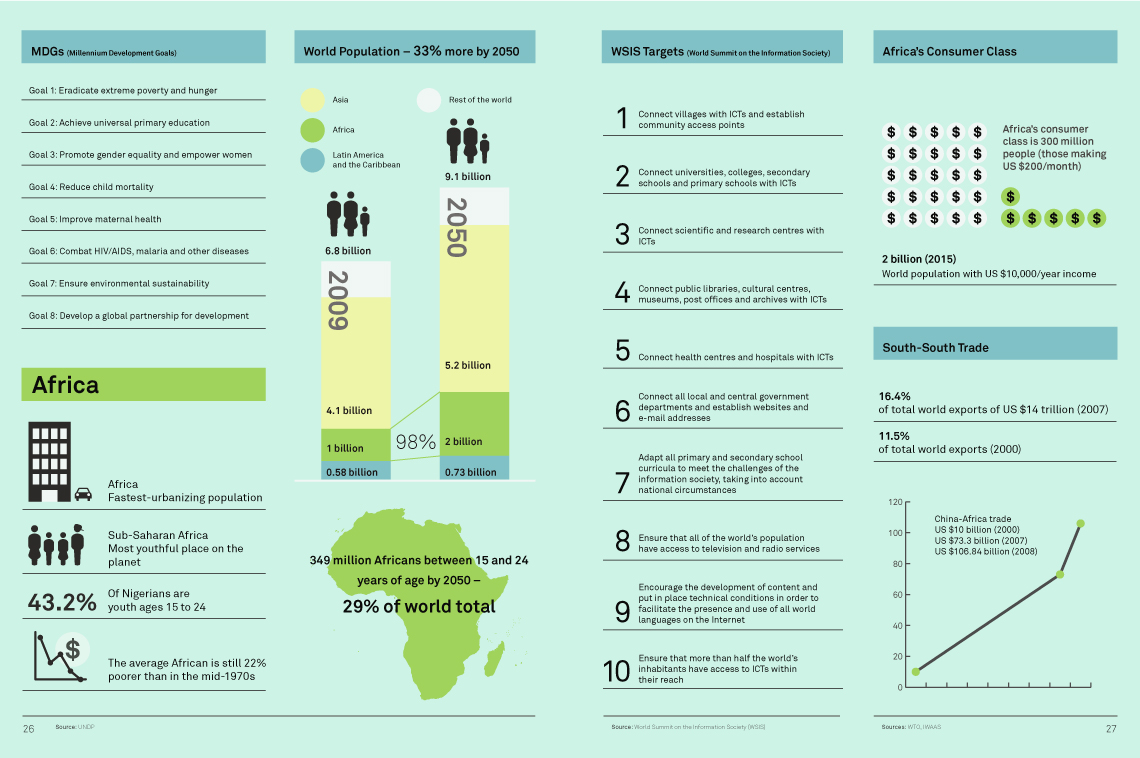
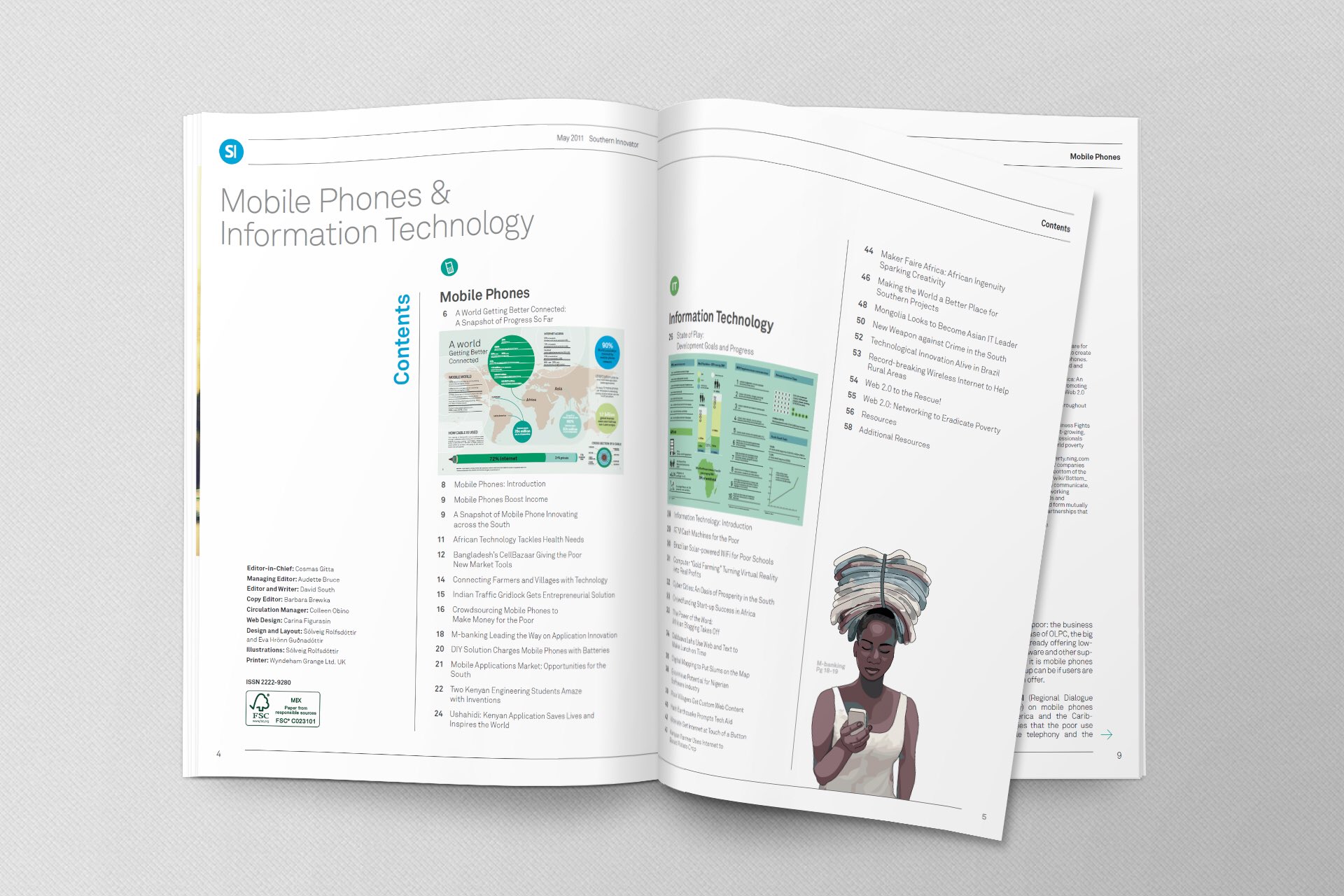
Development Challenges, South-South Solutions was launched as an e-newsletter in 2006 by UNDP’s South-South Cooperation Unit (now the United Nations Office for South-South Cooperation) based in New York, USA. It led on profiling the rise of the global South as an economic powerhouse and was one of the first regular publications to champion the global South’s innovators, entrepreneurs, and pioneers. It tracked the key trends that are now so profoundly reshaping how development is seen and done. This includes the rapid take-up of mobile phones and information technology in the global South (as profiled in the first issue of magazine Southern Innovator), the move to becoming a majority urban world, a growing global innovator culture, and the plethora of solutions being developed in the global South to tackle its problems and improve living conditions and boost human development. The success of the e-newsletter led to the launch of the magazine Southern Innovator.
https://davidsouthconsulting.org/2021/03/05/southern-innovator-issue-2/

Creative Commons License

This work is licensed under a
Creative Commons Attribution-Noncommercial-No Derivative Works 3.0 License.

ORCID iD: https://orcid.org/0000-0001-5311-1052.

© David South Consulting 2023

Categories
Archive Development Challenges, South-South Solutions Newsletters

African Culture as Big Business

By David SouthDevelopment Challenges, South-South Solutions

SOUTH-SOUTH CASE STUDY

In the last decade the world’s creative industries (including crafts, fashion and design) have gained greater respect for being the spark that drives economic development and entrepreneurship. They are seen as fast growers and good job creators, and importantly, the lynch pin in cultural identity and cultural diversity. UNESCO, through its Global Alliance for Cultural Diversity, has been in the forefront of helping African countries re-shape their policies to take this into consideration. The promotion of cultural industries also has been incorporated into the New Partnership for Africa’s Development (NEPAD).

The global clothing industry is estimated to be worth US $900 billion a year. Culture and creativity are big businesses: according to UNESCO, in 2002 the UK exported US $8.5 billion in cultural goods, the United States US $7.6 billion, and China US $5.2 billion. The UK’s Burberry fashion label alone made £157 million in 2006.

This is good news for Africa’s growing fashion industry, which is finally getting the attention and respect it deserves. Entrepreneurs are tapping into this awareness as a great way to make money. Well-known Nigerian fashion designer Alphadi says the continent’s fashion industry is “giving Africa a chance to show its true self, its solidarity, its huge generosity and its greatness.”

Africa’s fashion entrepreneurs are showing more and more confidence and striding with pride across catwalks around the world. And despite the problems faced by black models – as highlighted by supermodel Naomi Campbell in her recent press conference in Kenya – some African models have a growing international profile: these include Alek Wek from southern Sudan, and Waris Dirie from Somalia. Campbell has said she plans to set up a modelling agency in Kenya to increase opportunities.

Just as African music has fans around the world, the continent’s growing fashion scene is gaining fans and more attention. From Hollywood stars to European catwalks, African fashion designers and apparel makers are feeding the industry’s hunger for novelty and new ideas.

African entrepreneurs, from village craftsmen to ambitious and creative urbanites, are finding ways to cash in on this rising awareness.

The rising stars of South Africa were on full display at this August’s Cape Town Fashion Week. David Tlale, who produces glamorous haute couture creations, places community empowerment in his hometown of Johannesburg at the centre of his business. Tlale was joined by rising stars Thabani Mavundla, Thula Sindi, and Craig Jacobs.

Creator and founder of the Fundudzi label of Johannesburg, Jacobs presented a couture collection at Paris Fashion Week in July. A former TV presenter-turned-fashion designer, Jacobs sees a renewed pride in African creativity and a new dialogue about Africa’s place in the world. His motto is: “Africa reworked…Africa re-inspired… Africa renewed”.

Established in 2004, his clothing company for women strives to be socially and environmentally responsible: “Fundudzi is also an eco-conscious label, utilizing materials such as organic cottons, soy and bamboo as well as cashmere produced in Africa which is not harmful to the environment,” he said. “The message which we want to resonate with the rest of the world is that Africa has always been organic.”

“Our label has grown out of the desire to help change the perception of our home, Africa, by presenting clothing designed and created here which can compete on the world stage.”

Jacob benefited from support from various organizations in South Africa to get his business plans sorted out. The country’s tourism body has focused on fashion with its C’est Couture campaign. But he has also struggled with the complexities of exporting his designs and navigating global customs regulations.

“There has been a lot of interest internationally in our collection, but I am not sure what the rules and regulations are … We need an over-riding body to help assist us young entrepreneurs. My experience in Paris, in July, has been that we do have something new and fresh to say in fashion, and we can produce at the same standard as the rest of the world.

There was validation of that. But we as Africans need to follow our own signature, look internally to come up with inspiration, and show that to the rest of the world. “The global village environment, and the access that technologies such as the Internet have provided, means that we can tune into the same stimuli in terms of trends and fashion directions to ensure that we are on par with the rest of the planet. I do believe that the world, bored with the same trends they have been exposed to for so long, are looking for a new guard of inspiration – and we need to empower ourselves with the right tools to answer that call.

“Our positioning is quite simple – our label is dedicated to creating jobs in Africa, thereby reducing our dependency on aid in securing our future …I wanted to create a label which is rooted in Africa, which tells African stories, but which is not tradition or museum curio – rather, intelligent pieces which can fit seamlessly into the global firmament of fashion. The label is focused on redressing the prejudices about the “dark continent” – each collection is designed as a travelogue, informing the world about the rich tapestry of life in Africa.”

Another hub of dynamism in the African fashion scene is Nairobi, Kenya. Kikoromeo connects its catwalk fashion designs with the principle of community development. The label uses mostly Kenyan materials – cotton, silk and wool – and works with local artisans, including women’s groups. Its bags are woven with Kenyan Sisal by Machakos women’s groups, and the beadwork is done by Maasai women’s groups.

Anna Trezbinski of Nairobi, who is popular in Hollywood and has contracts to provide items to top designers like Paul Smith, employs 800 people – mostly Masai women in her workshop in the Great Rift Valley.

This new wave of African fashion designers is proving that anyone with talent, a website and a fan base can puncture the bubble of the European and New York catwalks and make a splash.

“Africa is a haven of inspiration,” says the Tanzanian-born, Nairobi-based designer and collector Lisa Christofferson, who has clothed Ralph Fiennes, Rachel Weiss and Jane Seymour. “Africa for many years now has been the flavour of fashion,” she says. “It has really opened the door for us.”

She believes the internet has expanded her business and her brand. It gives clients and boutiques around the world the ability to import her hand-painted, African-inspired cashmere sweaters, bedspreads and throws. Many are ceremonial cloths of the Kuba Kingdom in Congo.

Another designer based in Kenya, Annabelle Thom, believes changes in the last seven years are responsible: access to TV and film, music channels and a burgeoning middle class with money. “People care more about fashion and if you look around in Nairobi, the average person is beautifully dressed – people are spending money on themselves,” she said.

Ethiopia has also been identified as a bubbling fashion hot spot for its indigenous raw cotton and potential to produce other natural fibres. Ethiopian designer Guenet Fresenbet launched Ethiopia’s first fashion magazine, Gigi, to help take the lead.

Published: October 2007

Resources

  • Afromix: Great links to African fashion designers and fashion events and media.
  • Kikoromeo: Based in Nairobi, Kenya Kikoromeo’s founder and principal apparel designer trained in Rome and Milan and has been in production in Kenya since 1997.
  • South Africa’s leading fashion weeks: Johannesburg Fashion Week or Capetown Fashion Week
  • A video about Kenya’s fashion boom: Click here to view.
  • Uzuri: Premier International African Inspired Fashion Magazine: A quarterly magazine founded in 2005 and based in Texas, it is dedicated to highlighting high fashion in Africa.
  • Dobizo: An excellent website with all the resources necessary for a budding entrepreneur to get started in the fashion business, from step-by-step guides to common mistakes and how to choose a logo.
  • Fashion Nigeria: Newly launched Nigerian fashion magazine.

Development Challenges, South-South Solutions was launched as an e-newsletter in 2006 by UNDP’s South-South Cooperation Unit (now the United Nations Office for South-South Cooperation) based in New York, USA. It led on profiling the rise of the global South as an economic powerhouse and was one of the first regular publications to champion the global South’s innovators, entrepreneurs, and pioneers. It tracked the key trends that are now so profoundly reshaping how development is seen and done. This includes the rapid take-up of mobile phones and information technology in the global South (as profiled in the first issue of magazine Southern Innovator), the move to becoming a majority urban world, a growing global innovator culture, and the plethora of solutions being developed in the global South to tackle its problems and improve living conditions and boost human development. The success of the e-newsletter led to the launch of the magazine Southern Innovator.
Creative Commons License

This work is licensed under a
Creative Commons Attribution-Noncommercial-No Derivative Works 3.0 License.

ORCID iD: https://orcid.org/0000-0001-5311-1052.

© David South Consulting 2022

Categories
Archive Development Challenges, South-South Solutions Newsletters

Web 2.0: Networking to Eradicate Poverty

By David SouthDevelopment Challenges, South-South Solutions

SOUTH-SOUTH CASE STUDY

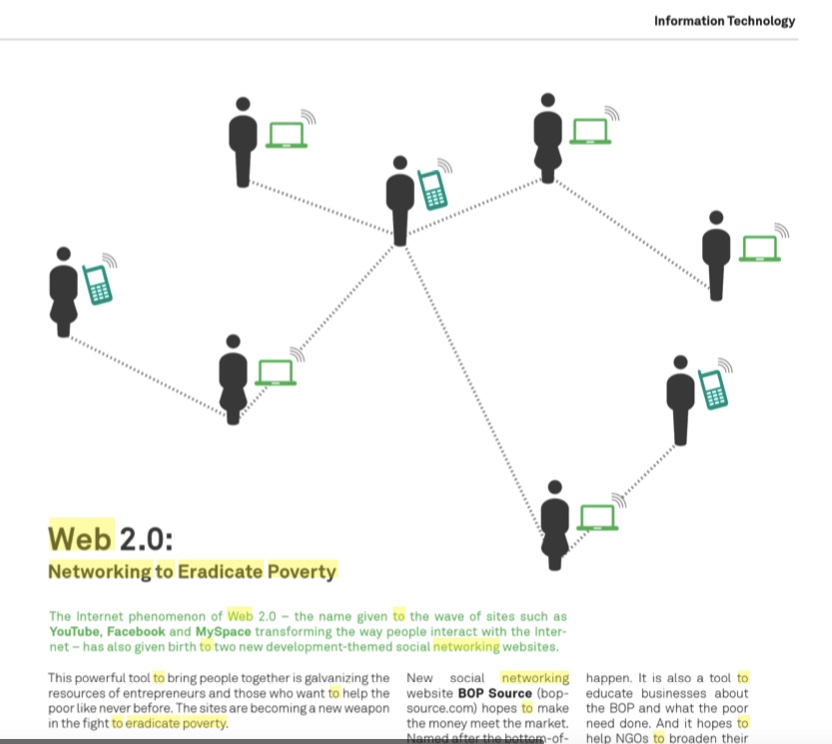
The internet phenomenon of Web 2.0 (http://en.wikipedia.org/wiki/Web_2.0) – the name given to the wave of internet businesses and websites such as YouTube (www.youtube.com), Facebook and MySpace transforming the way people interact with the ‘Net – has also given birth to two new development-themed social networking websites.

This powerful tool to bring people together is galvanizing the resources of entrepreneurs and those who want to help the poor like never before. The sites are becoming a new weapon in the fight to eradicate poverty.

Social networking websites use various tools and applications (or ‘apps’ for short) to enhance the ability of users to connect and get things done. By bringing together a community of like-minded people, they are able to shorten the time it takes to organize and kick-start events. Web 2.0 can be used to build communities and social and business networks. By being able to store vast quantities of information online, it becomes faster to work and reduces the painful delays brought on by slow connections.

All these new tools are making it easier and easier for entrepreneurs to work from home, in internet centres, or anywhere there is a wireless connection – and it is slashing the costs of managing a business. All the applications are online so there is no need to be hidebound by one operating system or hardware capability.

Two newly launched social networking sites are targetting the poverty-eradication community.

One is named after the Bottom of the Pyramid (BOP) concept as conceived by C.K. Prahalad. The BOP is the 4 billion people at the base of the global economic pyramid. As Prahalad sees it, they represent a vast market of unmet needs for entrepreneurs to tackle.

New social networking website BOP Source hopes to make the money meet the market. Started by Jenara Nerenberg, BOP Source wants to put social networking tools into the hands of the world’s poor. It is a place to post business ideas and collaborate with others to make them happen. It is also a tool to educate businesses about the BOP and what the poor need done. And it hopes to help NGOs broaden their relationships with their constituencies and companies.

While marketers can learn about the needs of the BOP, individuals can directly express their needs on the website and seek out the right people to solve problems.

Another social networking website is Business Fights Poverty. Already at 1,000 members, it is a multimedia offering, with podcasts, videos, interviews and discussions about the role of business in addressing development goals.

Published: November 2008

Resources

  • BOP Source is a platform for companies and individuals at the BOP to directly communicate, ultimately fostering close working relationships, and for NGOs and companies to dialogue and form mutually valuable public-private partnerships that serve the BOP. Website: http://bopsource.ning.com/
  • Business Fights Poverty: Business Fights Poverty is the free-to-join, fast-growing, international network for professionals passionate about fighting world poverty through good business. Website: http://businessfightspoverty.ning.com/
  • Afriville is a Web 2.0 service and an African Caribbean social network. Afriville is a community website along the lines of the famous MySpace. Users are free to message and post profiles. The difference is that the user is able to choose how closed or open the networks are. The site features a state of the art music management system which allows African and Caribbean artists to get straight in touch with their fans.
  • Both Yahoo! And Google offer extensive free online tools for entrepreneurs and businesses that integrate seamlessly with their email services.
  • Kabissa: Space for Change in Africa: An online African web community promoting and supporting the transition to Web 2.0 services in Africa. Offers lots of opportunities to meet people throughout Africa and learn more.
  • Global Voices: An initiative from the Reuters news agency to aggregate the global conversation online from countries outside the US and Western Europe.
  • Information, Knowledge and Communication: Web 2.0 in Development Cooperation Bonn, Germany, 27-28 November 2008, Gustav Heinemann Haus. Website: http://www.eadi.org/index.php?id=994
  • 3rd IEEE/ACM International Conference on Information and Communication Technologies and Development (ICTD2009). Website: http://www.ictd2009.org

https://davidsouthconsulting.org/2022/10/14/anti-bribery-website-in-india-inspires-others/

https://davidsouthconsulting.org/2022/06/24/dabbawallahs-use-web-and-text-to-make-lunch-on-time/

https://davidsouthconsulting.org/2022/03/07/david-south-consulting-ranked-in-the-top-10-million-websites/

https://davidsouthconsulting.org/2021/05/25/ger-mongolias-first-web-magazine-and-a-pioneering-web-project-for-the-united-nations-12-january-2016/

https://davidsouthconsulting.org/2022/06/25/shoes-with-sole-ethiopian-web-success-story/

https://davidsouthconsulting.org/2022/10/21/social-networking-websites-a-way-out-of-poverty/

https://davidsouthconsulting.org/2021/05/14/un-ukraine-web-development-experience-2000/

https://davidsouthconsulting.org/2022/06/16/web-2-0-to-the-rescue-using-web-and-text-to-beat-shortages-in-africa/

Development Challenges, South-South Solutions was launched as an e-newsletter in 2006 by UNDP’s South-South Cooperation Unit (now the United Nations Office for South-South Cooperation) based in New York, USA. It led on profiling the rise of the global South as an economic powerhouse and was one of the first regular publications to champion the global South’s innovators, entrepreneurs, and pioneers. It tracked the key trends that are now so profoundly reshaping how development is seen and done. This includes the rapid take-up of mobile phones and information technology in the global South (as profiled in the first issue of magazine Southern Innovator), the move to becoming a majority urban world, a growing global innovator culture, and the plethora of solutions being developed in the global South to tackle its problems and improve living conditions and boost human development. The success of the e-newsletter led to the launch of the magazine Southern Innovator. 
Southern Innovator’s online archive portal was launched in New York City, U.S.A. (home to the UN’s headquarters) in 2011 (southerninnovator.org).
Creative Commons License

This work is licensed under a
Creative Commons Attribution-Noncommercial-No Derivative Works 3.0 License.

ORCID iD: https://orcid.org/0000-0001-5311-1052.

© David South Consulting 2023

Categories
Archive Development Challenges, South-South Solutions Newsletters

African Innovators Celebrated in Prize

By David SouthDevelopment Challenges, South-South Solutions

SOUTH-SOUTH CASE STUDY

Innovation is increasingly being recognized as the key to tackling long-standing development problems in Africa, as well as across the developing and developed world. While it is easy to draw up a list of challenges facing the global South, it takes a special person to see not problems but solutions.

Innovation tends to mean fresh thinking brought to bear to old problems, or completely radical new technologies, insights and ways of doing things that are transformative.

The Oslo Manual for measuring innovation (http://www.oecd.org/innovation/inno/oslomanualguidelinesforcollectingandinterpretinginnovationdata3rdedition.htm) has defined four types of innovation: product innovation, process innovation, marketing innovation and organizational innovation (OECD).

Product innovation is a good or service that is new or significantly improved. This includes significant improvements in technical specifications, components and materials, software in the product, user friendliness or other functional characteristics. Process innovation is a new or significantly improved production or delivery method. This includes significant changes in techniques, equipment and/or software. Marketing innovation is defined as a new marketing method involving significant changes in product design or packaging, product placement, product promotion or pricing. And finally, organizational innovation is a new organizational method in business practices, workplace organization or external relations.

How quickly these can be brought to the marketplace, and the level of innovation in society, will be critical to a country’s success in the coming decade, according to the Organization for Economic Cooperation and Development (OECD). Importantly, innovation is being seen as the big driver of economic progress and well-being and the best way to deal with the plethora of challenges facing human health and the environment.

As an example, in the past decade, communications innovation has given more and more of the world’s population access to mobile phones and the Internet. This has led to the success of many new companies, from the search engine giant Google to multiple software innovations such as Kenya’s M-Pesa mobile phone banking application (http://www.safaricom.co.ke/personal/m-pesa/m-pesa-services-tariffs/relax-you-have-got-m-pesa), to small and innovative companies spreading the innovation bug such as Pico Crickets (http://www.picocricket.com/) or the Raspberry Pi (http://www.raspberrypi.org/).

As the OECD has said, “Not only has innovation moved to centre stage in economic policymaking, but there is a realization that a coordinated, coherent, ‘whole of government’ approach is required.

“Even countries that have generally refrained from active industrial policy in recent years now seek new ways to improve the environment for innovation in order to boost productivity and growth. Today, innovation performance is a crucial determinant of competitiveness and national progress.”

In the past, African innovators mostly went unacknowledged, unsupported and unrecognized. But this is changing, as new resources come online to support, finance, encourage and champion African innovators. Until very recently, people outside the continent heard little positive news about what was happening there. But the African innovator story is an inspiration to people around the world.

The Innovation Prize for Africa (http://innovationprizeforafrica.org), begun in 2011, awards US $100,000 for the top innovation that matches its criteria of marketability, originality, scalability, social impact and business potential.

The prize aims to encourage people to come up with practical solutions to the continent’s long-standing problems. This year’s prize received 900 applications from 45 countries.

The 2013 prize went to the South Africa-based AgriProtein (http://www.agriprotein.com) team for an innovation that uses waste and fly larvae to produce animal feed. The solution collects biodegradable waste and then feeds it to flies. The larvae the flies produce are then ground into a protein which is used as a feed for animals. Not only does this approach improve the nutritional quality of the feed, it also lowers the cost for African processors and farmers.

This year’s finalists offer a mixed bag of innovations, including creative ways to find new energy sources, improving access to clean water and preventing diseases.

Joining a clutch of other South African finalists, Dr. Dudley Jackson has created the SavvyLoo, a waterless toilet for use in rural areas and makeshift settlements. It separates the waste into liquids and solids to reduce the risk of disease, odour, and harm to the environment and eases waste removal.

Another South African, Professor Eugene Cloete, is the inventor of the TBag Water Filter that cleverly uses material recovered from tea bags to filter polluted water until it is completely safe to drink.

When it comes to the thorny issue of finding new energy sources for an energy-hungry continent, the prize unearthed some interesting solutions. One is Justus Nwaoga, a Nigerian finalist, who developed a way to turn a common weed into a source of renewable solar energy.

Nwaoga, a researcher from the Department of Pharmaceutical and Medicinal Chemistry at the University of Nigeria Nsukka (http://unn.edu.ng/), found the common tropical weed Mimosa pudica (http://en.wikipedia.org/wiki/Mimosa_pudica) surprisingly provides a way to tap into the sun’s energy.

The weed has leaves which fold in on themselves when touched, but spring quickly back into their normal form when exposed to daylight. The plant opens up in the morning and closes in the evening – an indicator of how sensitive it is to sunlight.

Nwaoga began to experiment with the plant, subjecting it to artificial light at night to see if the leaves would open up again. But they didn’t. He came to the conclusion there were properties in the leaves that only responded to natural, solar light. He further concluded it had something to do with electrical transmission in the leaves. He isolated the element that was making the leaves respond to solar light, finding it more sensitive than the silicon solar cell used in solar panels.

Other innovators recognized by the prize include a Tunisian research and development startup called Saphon Energy (http://www.saphonenergy.com/), which makes bladeless wind turbines, and Muna Majoud Mahoamed Ahmed from Sudan, who has created the Agroforestry Model Farm in Khartoum.

“We see a strong trend emerging of innovations that have significant social impact for Africa,” Dr.Francois Bonnici, director of the Bertha Centre for Social Innovation at the University of Cape Town’s Graduate School of Business, told Ventures Africa.

The call for applications for the 2014 Prize will be announced in July 2013.

Published: June 2013

Resources

1) Innovation Prize for Africa: Innovation Prize for Africa (IPA) is a joint initiative of the United Nations Economic Commission for Africa (ECA) and the African Innovation Foundation (AIF) started in 2011. Website: http://innovationprizeforafrica.org

2) Appfrica: Accelerating the Growth of Africa’s Tech Sector: Appfrica has launched “The Cheetah Code”, an ongoing web series documenting the African tech and creative space. The series is a collection of mini-documentaries chronicling Africa’s young entrepreneurs, creative class, and emerging technology sector. The goal is to record high-quality video content that is entertaining, educational, and inspirational all at once. You can find all of this content and more at tv.cheetahcode.com. Website: http://blog.appfrica.com/2013/05/12/a-web-series-about-africas-entrepreneurs-creatives-and-technologists/?utm_medium=twitter&utm_source=twitterfeed

3) Innovation and Growth: Rationale for an Innovation Strategy: Publisher: OECD. Website: http://www.oecd.org/science/inno/39374789.pdf

4) Reverse Innovation: Ideas from the Global South. Website: http://urbantimes.co/2012/09/reverse-innovation-ideas-from-the-global-south/

5) African Innovator Magazine: Technology insights for Africa’s decision makers. Website: http://www.africaninnovatormagazine.com/

Southern Innovator logo

London Edit

31 July 2013

Development Challenges, South-South Solutions was launched as an e-newsletter in 2006 by UNDP’s South-South Cooperation Unit (now the United Nations Office for South-South Cooperation) based in New York, USA. It led on profiling the rise of the global South as an economic powerhouse and was one of the first regular publications to champion the global South’s innovators, entrepreneurs, and pioneers. It tracked the key trends that are now so profoundly reshaping how development is seen and done. This includes the rapid take-up of mobile phones and information technology in the global South (as profiled in the first issue of magazine Southern Innovator), the move to becoming a majority urban world, a growing global innovator culture, and the plethora of solutions being developed in the global South to tackle its problems and improve living conditions and boost human development. The success of the e-newsletter led to the launch of the magazine Southern Innovator. 

Creative Commons License

This work is licensed under a
Creative Commons Attribution-Noncommercial-No Derivative Works 3.0 License.

ORCID iD: https://orcid.org/0000-0001-5311-1052.

© David South Consulting 2023