The image of Africa as a technological laggard is set to be seriously challenged as a number of developments converge in 2007. Alongside the booming African mobile phone market – itself now getting global attention for innovation – the African computer scene will soon have both the software and hardware that acknowledge the continent’s unique needs while being affordable. Further challenging stereotypes, the continent’s burgeoning and dynamic open source software movement is the subject of a new film by a Danish filmmaker, and the African-made Ubuntu, Linux-based operating system now has a new user manual to help it attract new adherents.
African technological innovation rarely makes headlines in the West. But a Danish filmmaker is changing these perceptions with his film showing the dynamism and enthusiasm behind the open source software movement in Africa. The yet-untitled film, directed by David Madie, is from Eighty Days Productions and is due for release in the spring of 2007. It follows a young computer entrepreneur, Wire Lunghabo James, from Uganda’s Linux Solutions in Africa, who has been instrumental in building the Web’s presence in the country and in East Africa.
“This film will show the characters fighting for what they believe in. This happens to be Open Source, which I think is an important agenda,” director Madie told Tactical Technology Collective ( www.tacticaltech.org), a website “demystifying technology for non-profits.”
Unlike off-the-shelf software, open source software has many advantages. It is free, and no licence fee is required, so as many copies as necessary can be made. It is fully customisable, so local languages and cultural conditions can be taken into consideration. It is a universal language (the most popular is Linux) and thus it is easier to understand how a specific application works. For developing countries, it has the advantage of empowering local programmers and dymistifying computer programming, removing it from the domain of private companies and large government agencies. In 2005 the New Partnership for African Development (NEPAD) urged African countries to embrace open source software to encourage the growth of indigenous software development.
“I think he (James) is also a role model in the sense that he combines doing a business, with doing social work. To him these things are not opposites: these are things that can perfectly work well together. You can do business in a social manner,” Madie said.
The Ubuntu software programme is a complete, free operating system that emphasizes community, support, and ease of use while refusing to compromise on speed, power, and flexibility. Ubuntu is an ancient African word meaning humanity to others, and its software version is described as Linux for human beings – designed for everyone from computer novices to experts. Ubuntu is the most in-demand Linux system in Africa, and the official guide is aimed at NGOs, home users or small businesses.
One Laptop Per Child Project (OLPC)
In another development, the One Laptop Per Child project (OLPC) has announced the release for general sale of its durable bright green and yellow laptops ready loaded with Linux-based operating systems. Customers in wealthy countries will have to buy two laptops, with the second going to a developing country. Five million will be delivered to the developing world over the summer of 2007. The eventual aim is to sell the machine to developing countries for US $100, but the current cost of the machine is about US $150. The OLPC laptop’s software has been designed to work specifically in an educational context. It has built-in wireless networking and video conferencing so that groups of children can work together. The OLPC project is working with the search engine Google, who will act as “the glue to bind all these kids together”. Google will also help the children publish their work on the internet.
The One Laptop Per Child project (http://wiki.laptop.org/go/Home) has struck its first deal with Rwanda’s president Paul Kagame to provide every school pupil with a laptop computer within the next five years. The laptops and all the support costs will be covered by OLPC.
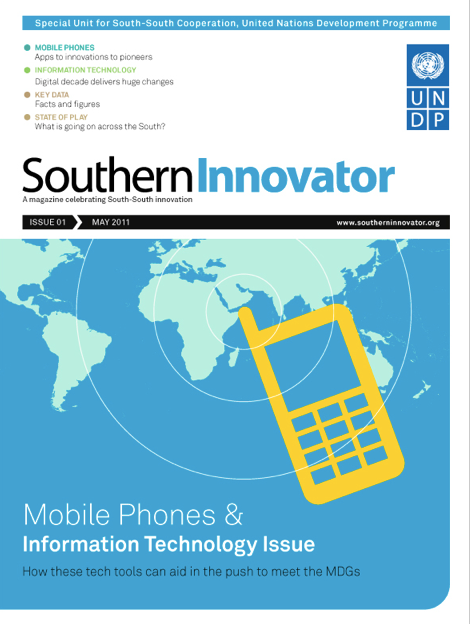
Development Challenges, South-South Solutions was launched as an e-newsletter in 2006 by UNDP’s South-South Cooperation Unit (now the United Nations Office for South-South Cooperation) based in New York, USA. It led on profiling the rise of the global South as an economic powerhouse and was one of the first regular publications to champion the global South’s innovators, entrepreneurs, and pioneers. It tracked the key trends that are now so profoundly reshaping how development is seen and done. This includes the rapid take-up of mobile phones and information technology in the global South (as profiled in the first issue of magazine Southern Innovator), the move to becoming a majority urban world, a growing global innovator culture, and the plethora of solutions being developed in the global South to tackle its problems and improve living conditions and boost human development. The success of the e-newsletter led to the launch of the magazine Southern Innovator.
Since the 1950s, science fiction has been telling the world we will soon be living with robots. While robots have emerged, they have been mostly kept to heavy industry, where machines can perform dangerous, hot and unpleasant repetitive tasks to a high standard.
But China is pioneering the move to mainstream robots in more public spheres. And the country is promising big changes in the coming decade.
Robots, strange as it may seem, can play a key role in development and fighting poverty.
If used intelligently, the rise of robots and robotics – itself a consequence of huge technological advances in information technology, the Internet, nanotechnology,artificial intelligence, and mobile communications – can free workers from boring, difficult and dangerous jobs. This can ramp up the provision of public goods like cleaning services in urban areas, or remove the need to do back-breaking farming work.
Robotics also offers a new field of high-tech employment for countries in the global South who are producing far more educated engineering and science students than they can currently employ. These students can help build the new robot economy.
China is considered to be in the early stages of competing with robot pioneers such as Japan, Switzerland, Germany, Sweden and the United States. And China still has a low penetration of industrial robots per population. In 2011 estimates placed the number of industrial robots in China at 52,290 (International Federation of Robotics) (ifr.org).
In the years ahead, China confronts a double demographic problem. It has the world’s largest elderly population, who will need care, and it also has a shrinking number of young people available to work as a result of the country’s one-child policy (http://en.wikipedia.org/wiki/One-child_policy).
Robots can help solve these problems.
China started its robotics research in the 1970s and ramped it up from 1985. It has already made significant progress manufacturing domestic robots for cleaning. The Xiamen Lilin Electronics Co., Ltd. (http://cnlilin.en.made-inchina.
For the heavy duty stuff, there is Ningbo’s Dukemen Robot, sold with the slogan “man, technology, robot”. The company manufactures arm-like robots for heavy lifting and lifting in dangerous or uncomfortable environments (dukerobot.com/ks/robot-manufacturers/).
A company called Quick specializes in making soldering equipment for manufacturing electronic components and sells robots that can do this with high accuracy and speed (quick-global.com/9-new-soldering-robot-1.html).
Other robotic advances in China include a robot dolphin that swims through the water measuring its quality.
There are also robots in development to do housework and help people who need assistance in the home like the elderly and the disabled. These robots can monitor a person’s physical condition and provide psychological counselling and search for, and deliver, requested items. One example is called UNISROBO, and is based on the Japanese robot PaPeRo robot (http://www.nec.co.jp/products/robot/en/index.html).
Even more ambitiously, China is developing robots to send to the moon.
The push to introduce robots into the workplace and wider society is receiving considerable attention in China.
The Taiwan-based technology company Foxconn – well-known for assembling products for the American company Apple, maker of the iPad and iPhone -has pledged to deploy a million robots in its Chinese factories in the coming years to improve efficiency.
Some are forecasting that if China starts building robots on the scale it has pledged, then the world’s population of manufacturing robots will grow tenfold in 10 years.
China is also broaching one of the trickiest aspects of robotics – getting robots to interact with humans.
The tricky bit in robotics is getting interaction with human beings right and to avoid the experience being intimidating or frightening. One sector that is already ahead in experimenting with this aspect of robots is the restaurant business. One robot being used in restaurants sits on a tricycle trolley laden with drinks. It cycles from table to table in endless rotation allowing customers to choose drinks when they like.
The first robot restaurant started a trial run in 2010 in Jinan (http://en.wikipedia.org/wiki/Jinan), the capital of Shandong Province. The hot pot restaurant uses six robots to help with the service. The restaurant has also given itself the perfect name for this new approach: Continental Robot Experience Pavilion. Adorned with robot posters, the restaurant is 500 square metres in size and can seat 100 diners.
Diners at the Continental Robot Experience Pavilion are greeted by two ‘female’ “beauty robot receptionists” dressed in uniforms. Inside, the six robot waiters serve the customers. There are two to deliver drinks and two to serve the small tables and two to serve the big tables.
The robot comes to the table and takes the customers’ orders for food dishes and drinks. The robots, designed with sensors to stop them moving when they sense something or someone in front of them, are able to handle 21 tables and deal with the 100 customers at a single sitting.
The robots have proven so effective, the restaurant’s staff can stay focused on administration and providing assistance. The cooking is still done by human beings.
This trial run is designed to test the concept and the novelty of having robots attracting customers, the restaurant’s manager told the People’s Daily Online.
The plan is to increase the number of robots to 40 and also to have robots do cleaning and other tasks.
“They have a better service attitude than humans,” said Li Xiaomei, 35, who was visiting the restaurant for the first time. “Humans can be temperamental or impatient, but they don’t (the robots) feel tired, they just keep working and moving round and round the restaurant all night,” Li said to China Daily.
Published: March 2012
Resources
1) The Robot Report: It boasts compiling more than 1,400 robotics-related links and is about “Tracking the business of robotics”. Website: therobotreport.com
2) The Robot Shop: Bills itself as “The world’s leading source for professional robot technology” and sells online all the parts, kits, toys, tools and equipment to get any enthusiast or small and medium enterprise working with robotics quickly. Website: robotshop.com
3) Robot App Store: Sells ‘apps’ or software applications to expand the capabilities of robots. It also operates as a store for application developers to sell their robot apps to others. Also has information and resources on how to get started making robot apps and making money from making robot apps. Website: robotappstore.com
4) Roboearth: Funded by the European Union, RoboEarth is an online, open source network where robots can communicate with each other and share information and “learn from each other about their behaviour and their environment. Bringing a new meaning to the phrase “experience is the best teacher”, the goal of RoboEarth is to allow robotic systems to benefit from the experience of other robots, paving the way for rapid advances in machine cognition and behaviour, and ultimately, for more subtle and sophisticated human-machine interaction. Website: roboearth.org
5) Robotland: A blog writing about the “visions, ideas, innovations, awards, trends and reports from leading robotics research and development places in the world”. Website: http://robotland.blogspot.co.uk/
6) China Hi-Tech Fair: Running from 16-21 November 2012, the Fair is a great way to see the latest developments in robotics in China. Website: chtf.com/english/
7) Singularity Hub: A cornucopia of robotic resources and news on “science, technology and the future of mankind”. Website: http://singularityhub.com/
Development Challenges, South-South Solutions was launched as an e-newsletter in 2006 by UNDP’s South-South Cooperation Unit (now the United Nations Office for South-South Cooperation) based in New York, USA. It led on profiling the rise of the global South as an economic powerhouse and was one of the first regular publications to champion the global South’s innovators, entrepreneurs, and pioneers. It tracked the key trends that are now so profoundly reshaping how development is seen and done. This includes the rapid take-up of mobile phones and information technology in the global South (as profiled in the first issue of magazine Southern Innovator), the move to becoming a majority urban world, a growing global innovator culture, and the plethora of solutions being developed in the global South to tackle its problems and improve living conditions and boost human development. The success of the e-newsletter led to the launch of the magazine Southern Innovator.
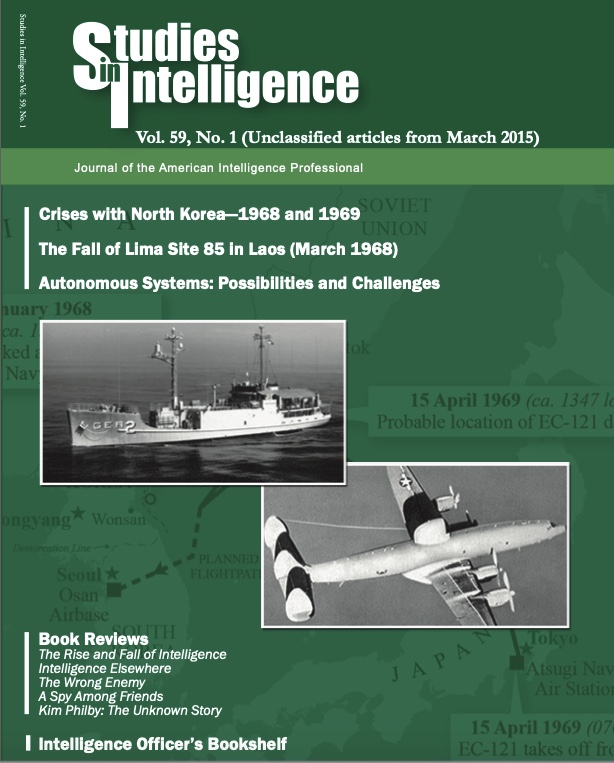
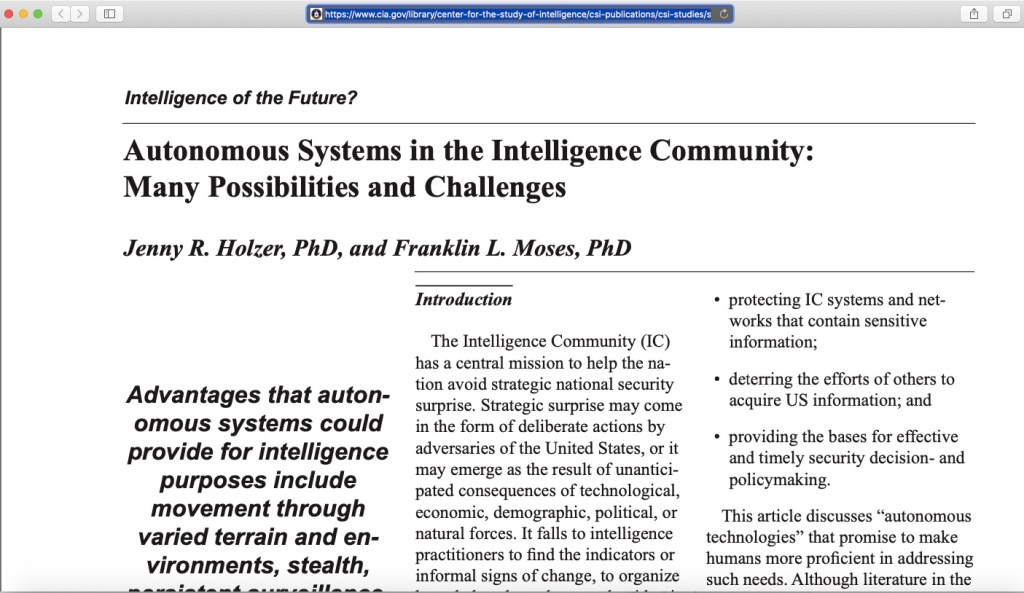
Studies in Intelligence, Vol. 59, No.1 (Unclassified articles from March 2015). Autonomous Systems in the Intelligence Community: Many Possibilities and Challenges by Jenny R. Holzer, PhD, and Franklin L. Moses, PhD in Studies in Intelligence Vol 59, No. 1 (Extracts, March 2015).Autonomous Systems in the Intelligence Community: Many Possibilities and Challenges by Jenny R. Holzer, PhD, and Franklin L. Moses, PhD in Studies in Intelligence Vol 59, No. 1 (Extracts, March 2015).Link: https://www.cia.gov/resources/csi/studies-in-intelligence/volume-59-no-1/autonomous-systems-in-the-intelligence-community-many-possibilities-and-challenges/.
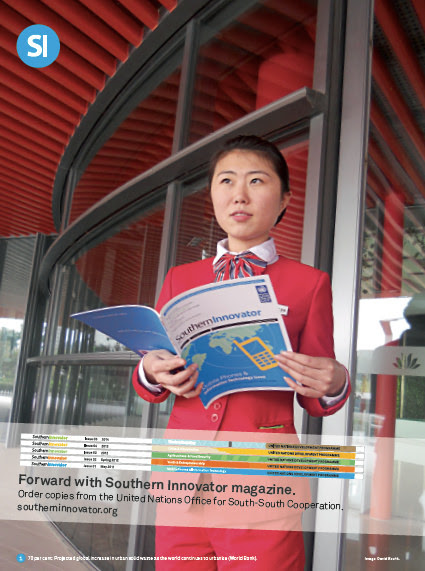
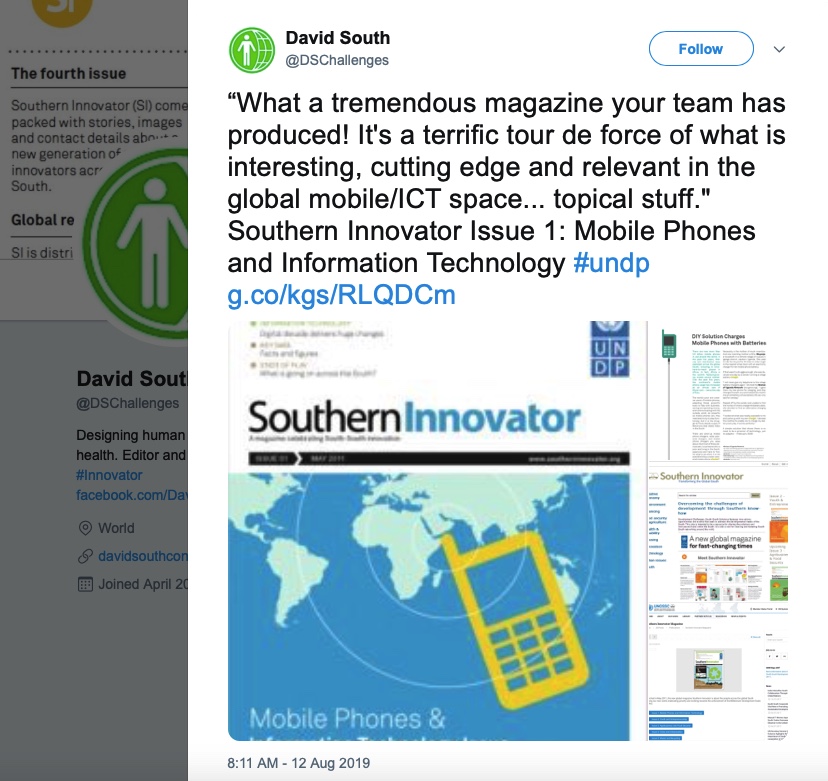
Launched in 2011, Southern Innovator’s first issue on mobile phones and information technology proved highly influential, profiling the work of a new generation of innovators. It has been cited in books, papers and strategic plans.
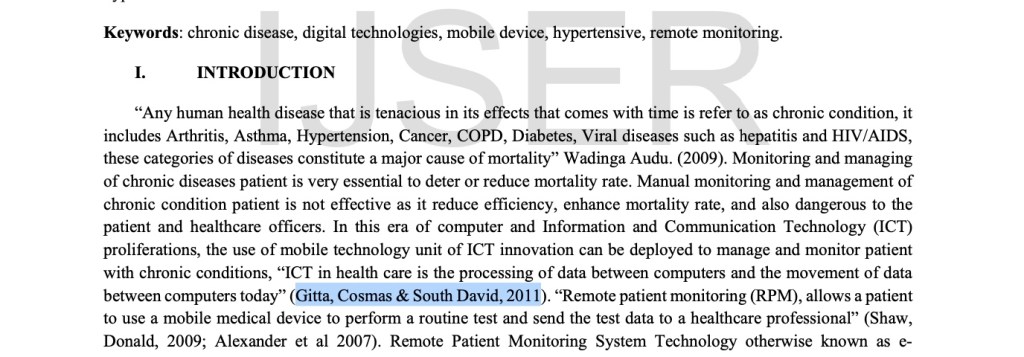
Southern Innovator Magazine Issue 1: Mobile Phones and Information TechnologyCitation in Using Mobile-Enabled Devices for Engagement and Monitoring of Patient with Chronic Disease: Hypertensive Case in the International Journal of Scientific & Engineering Research Volume 10, Issue 4, April 2019 (ISSN 2229-5518).
We were able to identify numerous trends that were at the time being overlooked or under-reported; trends that could radically re-shape international development. This included the rapid rise ofmobile phonesin the global South and their powerful impact on economic development, the rush to cities and urban areas that was turning the world into a majority urban place, and the shift to greater South-South trade, investment and contact. Whereas the past involved people always looking North for inspiration, capital and business and trade relationships, this was shifting to South-South arrangements. And there were plenty of inspirational, modern, 21st century examples of economic, social and human development achievements across the global South to report on. By consistently tracking and chronicling a quiet revolution underway in the global South, the e-newsletter was able to draw attention to a rising 21st-century global innovator culture being shaped by the use of mobile phones and information technologies. Few at the time had grasped how much this was going to reshape the international development paradigm.
To start, the e-newsletterDevelopment Challenges, South-South Solutions(begun in 2006), was used to gather together as many stories, data, trends, and contacts as possible and get this message to as wide a group as possible. Luckily, this coincided with the very moment whole swathes of the global South were coming online, either through connecting with mobile phones or through the Internet. Quickly, it became clear there was not a lack of inspiring stories and innovations and solutions to share, but a lack of resources to communicate them. One solution was to utilise a new publishing tool that emerged in 2007: crowd-powered news services. It became a great way to bypass the stranglehold on news and information held by traditional media. Read more on this here:http://www.scribd.com/doc/251968773/Southern-Innovator-Summary-of-Impact-2011-to-2012
In particular, the e-newsletter caught the eye of those looking for inspiration in the wake of the 2007/2008 global economic crisis:
“Great economic and business reporting! Very helpful for us.” Africa Renewal, Africa Section, Strategic Communications Division, United Nations Department of Public Information
“I just went over your June newsletter. It’s very well done and far reaching. Congratulations!” Violette Ruppanner, Director, 3D -> Trade – Human Rights – Equitable Economy, Geneva, Switzerland
“Just to let you know I enjoyed the newsletter a lot – it was interesting to learn about things going on that I would never otherwise find out about, and also the listing of future conferences and events proved very useful.” Ian Sanderson, Deloitte, Geneva, Switzerland
“Congratulations on another great newsletter that’s packed with fascinating information! I really enjoy getting it each month.” Whitney Harrelson, Making Cents, Washington D.C.
2008: Development work begins on the concept for a book on innovation in the global South. Attend an Africa trade-focused meeting in Switzerland just as the global crisis breaks. Witness attendees dash from the event as they get frantic calls from London and New York. Undertake Cuba study tour with the BSHF.
2009: The book concept becomes a magazine. Attend the UN Conference on the Social and Political Dimensions of the Global Crisis: Implications for Developing Countries in Geneva, Switzerland.
2010: Begin working with graphic designer and illustrator Solveig Rolfsdottir and graphic designer Eva Hronn Gudnadottir in Reykjavik, Iceland on the initial concepts for what would become Southern Innovator. The working title for the new magazine is Creative Sparks.
2014: The fifth issue ofSouthern Innovatoris launched at the Global South-South Development Expo (GSSD Expo) in Washington, D.C.. Southern Innovator has always tried to inspire others to take action and this has turned out to be the case.
“Beautiful, inspiring magazine from UNDP on South-South innovation. Heart is pumping adrenaline and admiration just reading it”
Once blazing a lonely trail, there are now many places to find stories on global South innovation (The Guardian, SciDev, Devex, Business Fights Poverty, Zunia etc.). Mainstream media have also woken up to the energy and change sweeping across the global South, disrupting its regular diet of negative news stories focused around war, disasters and failure (unfortunately, still the majority of what most people see on their TV).
“I liked your latest Southern innovator! Always inspiring.”
“Btw, I really enjoyed reading them, impressive work & a great resource. Looking forward to Issue 6. My best wishes to you & your team at SI.”
“The magazine looks fantastic, great content and a beautiful design!”
Most importantly, it is the young who have told us they ‘get’ Southern Innovator. It portrays a world they know – comfortable with new technologies, looking to solve problems, open to doing things in new ways. And it is that audience that excites us the most: the youth of the global South (Africa’s young population will be a huge contributor to the world’s working-age workforce by 2050): they are shaping the new world we live in and seeking a role in it.
On Twitter, comments included: From @CapacityPlus Nice job RT @ActevisCGroup: RT @UNDP: Great looking informative @SouthSouth1 mag on South-South Innovation; @UNDP Great looking informative @SouthSouth1 mag on South-South Innovation; @JeannineLemaire Graphically beautiful & informative @UNDP Southern Innovator mag on South-South Innov.
The phases of this project have been compiled in two e-books and published online here:
2015: In September 2015 (http://www.bbc.co.uk/news/world-asia-china-34372188), China’s President Xi Jinping announced China would spend US $2 billion on South-South cooperation initiatives. This has been called “a ‘game changer’ in international relations”(http://www.ipsnews.net/2015/11/opinion-chinas-new-south-south-funds-a-global-game-changer/).President Xi also said of South-South cooperation, it is: “a great pioneering measure uniting the developing nations together for self-improvement, is featured by equality, mutual trust, mutual benefit, win-win result, solidarity and mutual assistance and can help developing nations pave a new path for development and prosperity.”
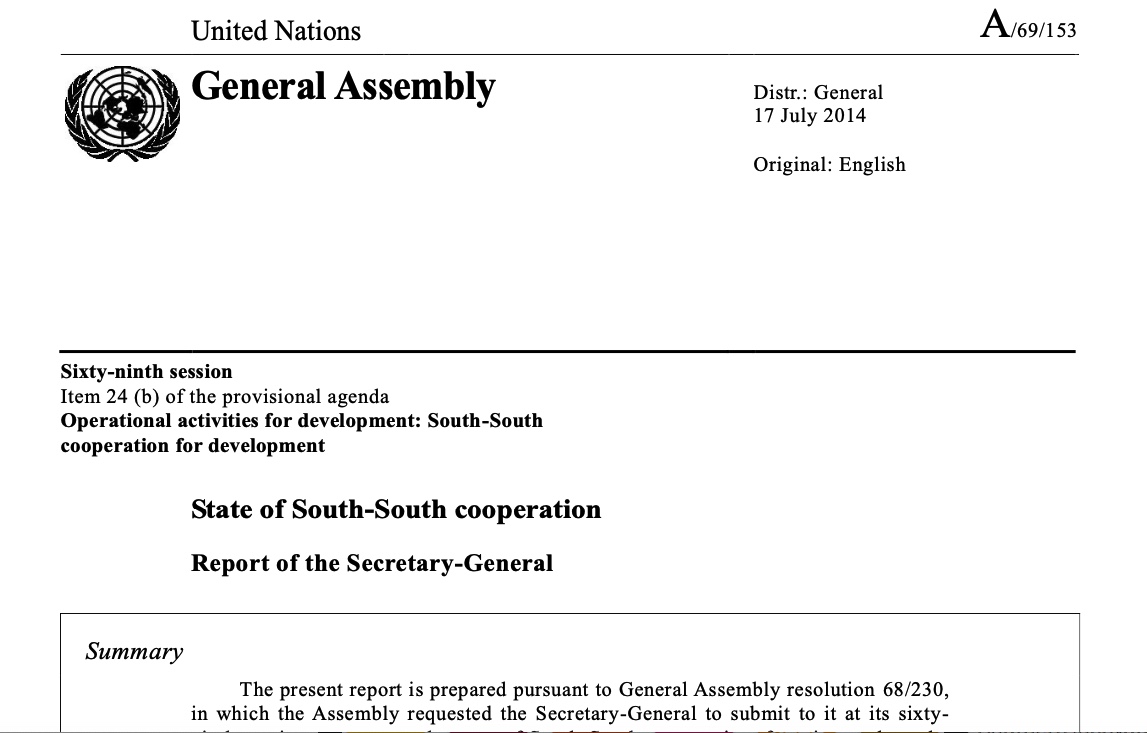
The Southern origins of sustainable development goals: Ideas, actors, aspirations by Sakiko Fukuda-Parr and Bhumika Muchhala (SDG Resource Centre).United Nations General Assembly: Sixty-ninth session, Item 24 (b) of the provisional agenda, Operational activities for development: South-South cooperation for development, 17 July 2014.The research informing Southern Innovator Magazine played a part in the formulation of the UN’s post-2015 development agenda, including the Sustainable Development Goals (SDGs).














 David South Consulting
You must be logged in to post a comment.