Information technology developments in Africa have long lagged behind those in other parts of the world. But the transformation being brought about by the widespread adoption and use of mobile phones – each one a mini-computer – and the expansion of undersea fibre optic cable connections to Africa are creating the conditions for an exciting new phase of computing growth on the continent.
Despite the global economic crisis, Africa is on course to see annual consumer spending reach US $1.4 trillion by 2020, nearly double the US $860 billion in 2008 (McKinsey). On top of this, by 2050, a projected 63 per cent of Africa’s population will be urban dwellers. With Africa’s middle class the fastest-growing in the world – doubling in less than 20 years – matching computing power with this consuming urban population could unleash a treasure trove of opportunity for information technology entrepreneurs.
These developments are creating the conditions for game-changing computing in the next years. And this is encouraging the creation of a new supercomputer (http://en.wikipedia.org/wiki/Supercomputer) for Africa in Kenya that will double the total number of supercomputers in Africa. Hugely powerful compared to personal or commercial computers, supercomputers use cutting-edge technology to carry out high-speed calculations involving vast quantities of data.
Expanded supercomputing power brings numerous advantages to both economic and human development. It will radically alter what can be accomplished in Africa – allowing mass data processing to be done, highly complex and data dense applications to be run, and very large research projects to be conducted on the continent rather than overseas.
Increasing computing power in Africa will bring in its wake, it is hoped, a surge in economic and research opportunities.
It will help African researchers and scientists to undertake globally competitive projects, rather than seeing this work done overseas. It will also open up a vast range of possibilities for African entrepreneurs and businesses to do complex data processing, modelling and research and will enable them to become more sophisticated operations.
The new supercomputer, the iHub Cluster, is being built in the Kenyan capital by one of Africa’s pioneering information technology hubs – iHub Nairobi (http://ihub.co.ke/pages/home.php) – in partnership with Internet products and services company Google and microchip maker Intel Corporation.
Africa’s first supercomputer is located in South Africa and is ranked 497 in terms of computing power on the list of 500 supercomputers in the world (http://www.top500.org/).
It is located in the “Tsessebe cluster” in Cape Town’s Centre for High Performance Computing (http://www.chpc.ac.za/).
“With mobile devices coming in multiple cores, it is important for developers to be exposed to higher performance computing; we are hoping to debut at a higher level than ‘Tsessebe cluster’,” Jimmy Gitonga, the project team leader for the iHub cluster, told Computer World.
Africa suffers from poor supercomputer capacity and this has had a knock-on affect on everything to do with economic development. The iHub supercomputer hopes to help universities and colleges to gain competitive edge and be able to undertake more complex research in the fields of media, pharmaceuticals and biomedical engineering.
“In Africa, we need to be on top of the mobile scene, its our widest used device,” Gitonga told Computer World.
Some of the practical applications for the iHub supercomputer in East Africa and the Horn of Africa include improving weather forecasting and drought prediction, increasing the ability to give advance warning of droughts and famines in the region.
“Most of the United Nations agencies and international agencies operating in the region have extensive field research on how to tackle natural disasters in the region. Imagine if they had affordable space where they can meet with developers and test resource-hungry applications,” Gitonga said.
The iHub also wants to offer the services of the supercomputer to researchers and organizations who have had to go abroad to have their data processed. The iHub supercomputer hopes to be used by mobile phone developers, gamers, universities and research institutions.
In the last two years, China had pushed the United States out of the number one spot for supercomputers. The Tianhe-1A located at the National Supercomputing Center in Tianjin (http://www.nscc-tj.gov.cn/en/), China, was the fastest computer in the world from October 2010 to June 2011.
For those looking to see how they can make the most of the growing supercomputer capability in Africa, examples from other countries offer a good idea. Supercomputers can be used for weather forecasting, climate research, oil and gas exploration, physical simulations like when testing aircraft, complex modelling for medical research, processing complex social data necessary for delivering effective social programmes or running modern health care systems.
Southern Art Hubs Grab Attention for Creative Economy Development Challenges: Regeneration – of poor neighbourhoods, districts, even whole countries after a conflict – is both a challenge and a key to transforming lives. One approach that has a track record is turning to artists and creative people to re-imagine a neighbourhood or country’s culture, and restore pride and vitality to places beaten down by life’s hardships.
Afropolitan: African Fashion Scene Bursting with EnergyDevelopment Challenges: In the face of Congo’s civil strife, a group of very fashionable gentlemen bring colour and style to the country while also pioneering a way to make money and improve standards of dress in the country. Members of “La sape,” or La Societe des Ambianceurs et Personnes Elegantes (http://fr.wikipedia.org/wiki/Société_des_ambianceurs_et_des_personnes_élégantes) — the society of tastemakers and elegant people — wear designer fashions either bought in Europe, or handmade in Congo.
Brewing Prosperity Creates Good JobsDevelopment Challenges: In the Democratic Republic of Congo – home to the world’s largest United Nations peacekeeping mission and decades of bloody civil war – a brewery has not only survived, it has thrived to become a popular brand throughout central Africa. By being a success, the Brasimba brewery has brought prosperity and high-quality jobs to Congo’s second largest city, Lubumbashi (http://en.wikipedia.org/wiki/Lubumbashi), and proven that a modern business can do well there despite the obstacles.
Digital Mapping to put Slums on the MapDevelopment Challenges: People are now turning to the growing penetration of digital technologies into slums and poor areas to find solutions. With mobile phones available across much of the global South, and plans underway to expand access to broadband internet even in poorly served Africa, it is becoming possible to develop a digital picture of a slum area and map its needs and population.
November
Innovation Villages Tackling MDGsDevelopment Challenges: The global economic crisis that began to roll across the world in September 2008 is threatening gains made against poverty and hunger all over the South. As Kevin Watkins from UNESCO’s Global Monitoring Report told the Financial Times, “With the slowdown in growth in 2009, we estimate that the average income of the 391 million Africans living on less than US $1.25 a day will take a 20 percent hit.”
New Appetite for Nutritious Traditional VegetablesDevelopment Challenges: Throughout the history of farming, around 7,000 species of plants have been domesticated. Yet everyday diets only draw on 30 percent of these plants and even this number has been going down as more people consume mass-market foods (FAO).
African Countries Re-branding for New Economic RoleDevelopment Challenges: Africa’s diverse countries have been subject to years of negative stories in the media. The effect on global audiences has left many to cast the whole continent in a bad light and to know little about the individual countries and cultures. This has damaged business confidence over the years. Just like products and people, nations need to have a strong and positive brand to do well in the global economy.
Tiny Homes to Meet Global Housing CrisisDevelopment Challenges: More than 1 billion people around the world lack decent shelter. Of these, the majority live in urban areas, usually in slums and informal settlements (UN-HABITAT). The world’s megacities – like Mumbai, India, where more than 22 million live in the metropolitan region – have to find a way to provide housing that is both affordable and does the minimum possible amount of harm to the environment.
Ending Gang Violence While Cleaning the Streets in HaitiDevelopment Challenges: The Caribbean nation of Haiti is the poorest country in the western hemisphere, with 80 percent of the population living below the poverty line (CIA World Factbook). The country had been enjoying some positive economic growth since 2005 after decades of economic and political turmoil.
Growing a Southern Brand to Global Success: The Olam StoryDevelopment Challenges: Most people haven’t heard of Olam International, but they know the brands they work for and they more than likely eat their produce. The story of Olam (www.olamonline.com) – a global food supply company in ‘agri-products’ that got its start in Nigeria – shows how a Southern brand can grow and go global, and overcome the difficulties of cross-border trade.
September
Making the World a Better Place for Southern ProjectsDevelopment Challenges: An exciting new initiative based in Germany, but already featuring hundreds of projects from across the South, is using the power of the internet to directly connect projects and donors.
Bamboo Becomes Transport Option for the SouthDevelopment Challenges: The sturdy bamboo plant (http://en.wikipedia.org/wiki/Bamboo) is enjoying a revival around the world as a building material. A strong, fast-growing and highly renewable woody plant, it is becoming increasingly popular as people seek out less environmentally wasteful alternatives to steel and other materials.
Kenyan Mobile Phone InnovationsDevelopment Challenges: A couple of enterprising Kenyan engineering students are showing how mobile phones are an inventor’s dream. Their two inventions – one a way to re-charge phones while bicycling, the other an aid for catching fish – show the potential for adapting this technology to the needs of the poor.
Info Ladies and Question Boxes: Reaching Out to the PoorDevelopment Challenges: Quick access to accurate and useful information is crucial for development. With the remarkable spread of information around the world via the Internet – one of the greatest achievements of the 21st century – more than 1.5 billion people now use the Web to boost their incomes and opportunities (Internet World Stats).
Avoiding Wasting Food and Human Potential with ICTsDevelopment Challenges: Creative use of information technology in the South is helping to address two very different kinds of waste – of food and of human and community potential.
Toilet Malls Make Going BetterDevelopment Challenges: Across the global South, clever entrepreneurs are transforming services that were bare-bones, grim and out-of-date into modern facilities packed with features that help to pay for their operation. In Kenya, an entrepreneur has used this approach to transform the poor quality of public toilets.
African Ingenuity Attracting InterestDevelopment Challenges: At this August’s Maker Faire Africa gathering (http://makerfaireafrica.com/) in Accra, Ghana, African pioneers in grassroots innovation offered inspiring inventions.
July
Crowdsourcing Mobile Phones to Make the Poor MoneyDevelopment Challenges The proliferation of mobile phones across the global South, reaching even the poorest places on the planet, has given birth to whole new ways of making money. A phenomenon called ‘crowdsourcing’ – in which the power of individuals is harvested to achieve a goal – is now being used to create networks of people earning extra income.
Tourist Passion for Quirky Holidays Helps SouthDevelopment Challenges:Conventional thinking holds that any country with a poor or non-existent reputation in the international media will not attract tourists. But this conventional thinking is wrong: The hottest tourist trend for 2009 is directly benefiting the South’s more out-of-the-way and under-appreciated countries. So says a travel expert who specializes in overlooked travel destinations.
Protecting Threatened Fruits and Nuts in Central AsiaDevelopment Challenges: Between 94,000 and 144,000 plant species — a quarter to a half of the world’s total — could die out in the coming years, according to an estimate by Scientific American (2002). Among them are vital food crops, threatened by a world in which climate change is causing more weather turbulence and diseases and viruses can spread rapidly and destroy crops.
African Theatre Becomes European SuccessDevelopment Challenges: In Britain, the country that gave the world the plays of William Shakespeare (http://en.wikipedia.org/wiki/William_Shakespeare), a new creative force has taken stages by storm: African theatre. And it is proving how economically rewarding Southern culture can be.
Southern Drink Challenges Corporate DominanceDevelopment Challenges: Across the global South, its thirsty people have long been a target market for Northern drinks companies. The ubiquity of the American soft drink Coca Cola, or even its rival Pepsi Cola, is testimony to that. Even the most remote village on the impoverished island of Haiti can offer an ice-cold Coke.
Kenyan Eco-Village Being Built by Slum-DwellersDevelopment Challenges: A Kenyan eco-village is helping slum dwellers to start new lives and increase their wealth. The community, Kaputei, is being built by former slum residents – some of whom used to beg to survive – and is providing new homes with electricity, running water and services like schools and parks. By building their own homes, with the help of affordable mortgage loans, the residents are able to make a big upgrade to their quality of life while acquiring real wealth.
Taxis Promote African Music BeatsDevelopment Challenges: South Africa’s township music is pounding its way into the global music charts. How has music made in the impoverished townships that are a hangover from decades of apartheid – the country’s former racial separation laws, which trapped millions of black South Africans in disenfranchisement and poverty – travelled around the world? By hitching a ride with the country’s ubiquitous taxi drivers.
Successful Fuel-Efficient Cookers Show the WayDevelopment Challenges: Kenyan entrepreneur has cooked up a fuel-efficient stove and oven that uses less of a precious national resource: wood from trees. Most African households using fuel-burning stoves either cannot afford clean-burning fuels like natural gas or electric stoves, or do not have access to them. They are stuck having to burn wood or other materials like animal dung – collectively called biomass – on open fires.
A New Mobile Phone Aimed at the PoorDevelopment Challenges: A low-cost Venezuelan mobile phone aimed at the South’s poor is proving that South-South technological cooperation works. Packed with features and costing no more than US $15 – making it one of the cheapest mobile handsets in the world – the phone is aimed at the fast-growing mobile market across the global South.
African Online Supermarket Set to Boost TradeDevelopment Challenges: African Online Supermarket Set to Boost Trade Online retailing and marketing strategies are revolutionizing how people around the world buy products and services – but so far they have not benefited most of Africa’s small businesses and traders. On a continent where trading for survival is the norm, very few people are reaping the benefits of selling on the Internet.
Rebuilding After Chinese Earthquake: Beautiful Bamboo HomesDevelopment Challenges: It has been a year since the May 12, 2008 Sichuan earthquake in China that killed more than 70,000 people. Getting Sichuan back to normal is critical for not only the province’s people, but for all of China. Sichuan is China’s rice bowl, growing more food than any other province. But despite the abundance of food, Sichuan remains poor and has seen its working age population move away for work. If it is to have a viable future then its communities need to get back to normal as fast as possible – and its farming economy back to full production.
SOS Shops Keep Food Affordable for Poor, UnemployedDevelopment Challenges: As the global downturn bears down on country after country, governments around the world are introducing austerity measures to try to keep their economies going. Many countries are now facing financial crisis and the need for loans and support from the International Monetary Fund (IMF). Formerly comfortable people are going from regular employment to unemployment or erratic employment, and growing numbers of people are finding it hard even to afford basics such as food.
Cleaner Stoves To Reduce Global WarmingDevelopment Challenges: The use of polluting fuel-burning stoves by half the world’s population – including 80 percent of rural households – is a documented contributor to a host of health problems. Poor households not only have to contend with the ill health effects of dirty water and poor sanitation, the fumes from burning dung, wood, coal or crop leftovers lead to the deaths of more than 1.6 million people a year from breathing toxic indoor air (WHO).
Solar Powered Village Kick-Starts Development GoalsDevelopment Challenges: More than 1.7 billion people around the world have no domestic electricity supply, of whom more than 500 million live in sub-Saharan Africa (World Bank). Without electricity, many development goals remain dreams that will never be achieved. But in a first for India, a village is now entirely powered by solar energy, kick-starting its development and reversing the decline common to many villages.
Rainforest Gum Gets Global MarketDevelopment Challenges: Mexico is home to the second largest rainforest in the Americas after the Amazon jungle. But the country’s forests face serious threats from logging, cattle ranching and agriculture. As much as 80 percent of Mexico’s original forests have already been lost. A group of Mexican farmers is now using sophisticated product marketing to preserve their income, and the 1.3 million hectares of rainforest as well.
Disabled Congolese Musicians Become World HitDevelopment Challenges: A group of Congolese musicians is using music to overcome obstacles – both economic and social – that come with being disabled in a poor country. Called Staff Benda Bilili, they are on course to be a global sensation and are looking forward to their first European tour. A remarkable achievement for anyone from a war-torn country, let alone for musicians who live as paraplegics in the slums of the Democratic Republic of Congo’s capital, Kinshasa (http://en.wikipedia.org/wiki/Kinshasa).
Camel Ice Cream Delivering Desert Dessert Development Challenges: The global food crisis is forcing people around the world to think differently about how food is produced and what new products can boost the incomes of farmers. U.N. Secretary General Ban Ki-moon has called for food production to increase 50 percent by 2030 just to meet rising demand – and right now there are 862 million people worldwide who are undernourished (FAO). The world’s over 19.4 million camels (FAO, 2003) are now being tapped for their highly nutritious, healing and tasty milk.
Finding Fortune in Traditional MedicineDevelopment Challenges:Traditional medicines and treatments could help provide the next wave of affordable drugs and medicines for the world. But a phenomenon known as ‘bio-prospecting’ – in which global companies grab a stake in these once-free medicines – has been placing traditional medicines out of reach of Southern entrepreneurs.
Accessing Global Markets Via Design SolutionsDevelopment Challenges:The power of design to improve products and the way they are manufactured is increasingly being seen as a critical component of successful economic development.
Berber Hip Hop Helps Re-ignite Culture and EconomyDevelopment Challenges: Music is being used to revive the ancient language of the original North African desert dwellers, the Berbers (http://en.wikipedia.org/wiki/Berber_people). And in the process, it is spawning a whole new generation of entrepreneurs and generating income.
Cashing in on Music in BrazilDevelopment Challenges:Brazilian musicians have found a way to prosper and exploit the realities of music distribution in the modern age. The biggest problem for most artists – both beginners and those who are more established – is how to earn an income from their work. In the digital age, it is next to impossible to stop people freely copying your work and passing it on.
Cuba’s Hurricane Recovery SolutionDevelopment Challenges: The frequency of extreme weather in the past decade has been attributed to global warming (http://tinyurl.com/5peel). Many scientists believe the future will bring even more turbulent weather events and disasters. The devastation and hardship brought by natural disasters can eradicate development gains, and destroy livelihoods and health. It is critical countries help people to get back to their normal lives as fast as possible.
Afghanistan’s Juicy Solution to Drug TradeDevelopment Challenges:Afghanistan is the world’s largest source of the illegal drugs opium and heroin (International Narcotics Control Board), both of which are derived from the bright-red flower, the poppy (http://en.wikipedia.org/wiki/Poppy).The country produced 8,200 tons of heroin in 2007, up 34 percent from the previous year.The negative consequences of the flourishing drug trade are numerous: it is destabilizing Afghanistan’s neighbours and undermining political and legal institutions, addiction rates are soaring, and addicts are spreading HIV/AIDS.
DIY Solution Charges Mobile Phones with BatteriesDevelopment Challenges: There are now more than 3.5 billion mobile phones in use around the world. In the past five years, their use and distribution has exploded across the global South, including in once hard-to-reach places in Africa. In fact, Africa is the world’s fastest growing mobile phone market. Over the past five years the continent’s mobile phone usage has increased at an annual rate of 65 percent – twice the rate of Asia.
African Bus to Tackle African RoadsDevelopment Challenges: Roads in many parts of Africa are rough at best, and hostile to vehicles designed with smooth, flat highways in mind. Even in countries like South Africa, where modern highways are common, a quick turn off the smooth highway to visit many communities will mean tackling makeshift dirt roads. In these conditions, buses imported from Western Europe are at a disadvantage when they hit the bone-jarring reality of potholed roads.
January
Debt-free Homes For the PoorDevelopment Challenges:As the population around the world’s cities grows, and slums grow larger and more prevalent, the urgent need for affordable and decent housing becomes more pressing. The world’s megacities – like Buenos Aires, Argentina, where more than 13 million live in the metropolitan region – have to find a way to provide housing that is both cheap and does the minimum possible amount of harm to the environment.
Rickshaw Drivers Prosper with New ServicesDevelopment Challenges:The rickshaw is the world’s oldest form of wheeled transportation and forms a significant part of India’s transport infrastructure. In large cities across Asia, 1 million three-wheeled auto-rickshaws form an important means of daily transportation and a vital source of income for their drivers. There are 8 million cycle rickshaws on the streets of India, the government says. They perform many tasks: as taxis, as couriers, as goods movers. And the Indian government promotes cycle rickshaws as a non-polluting alternative.
Venezuela’s Currencies Promote Cooperation Not CompetitionDevelopment Challenges: The global economic crisis has spread around the world and is bringing many problems in its wake. As global currency markets gyrate wildly, and people find they can go from having wealth to being poor almost overnight, the question is being asked: “is there another way?”
Kenyan Bank Helps the Poor and Gets RichDevelopment Challenges: Good quality banking services are a basic building block to rising incomes. Yet the poor across the South are often overlooked and denied access to savings accounts and loans. Many low-income people are openly discriminated against as ‘bad risks’ by banks, and denied the sort of banking services middle and higher income people take for granted. Yet it is a myth that the poor do not have money or do not wish to save and invest for their future or for business.
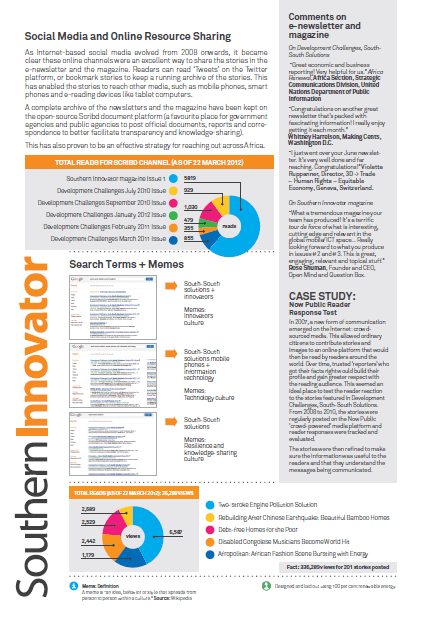
Development Challenges, South-South Solutions was launched as an e-newsletter in 2006 by UNDP’s South-South Cooperation Unit (now the United Nations Office for South-South Cooperation) based in New York, USA. It led on profiling the rise of the global South as an economic powerhouse and was one of the first regular publications to champion the global South’s innovators, entrepreneurs, and pioneers. It tracked the key trends that are now so profoundly reshaping how development is seen and done. This includes the rapid take-up of mobile phones and information technology in the global South (as profiled in the first issue of magazine Southern Innovator), the move to becoming a majority urban world, a growing global innovator culture, and the plethora of solutions being developed in the global South to tackle its problems and improve living conditions and boost human development. The success of the e-newsletter led to the launch of the magazine Southern Innovator.
Technology is fuelling unprecedented growth in productivity in Asia, with sub-Saharan Africa languishing behind (International Labour Organization). But the growth in mobile phones could help close this gap, as home-grown entrepreneurs are stepping up to exploit this new opportunity.
Mobile phone applications are proving a boon to small businesses and entrepreneurs. They are now putting power in the hands of individuals, making it easier to invent new ways of doing things, transfer money, organise business accounts, provide services, sell things, and keep in touch and up-to-date.
Technology has been the common factor in increases in productivity around the world, and with the rapid rise in mobile phone use, especially in Africa, it looks as if this handy device augers in the next wave of innovation.
And technology and mobile phones in particular, are creating a whole new route to wealth: “The switch.. frees people from geography,” Gregory Clark, an economic historian at the University of California, Davis told The Christian Science Monitor. “Singapore can be as rich as Canada, even though Singapore has no land.”
Technology is seen to be opening a new phase in economic competition in services, embracing a wide range of fields, from banking to tourism to healthcare. And it is entrepreneurs who will be at the forefront of making this happen. The majority (59 per cent) of the world’s 2.4 billion mobile phone users live in developing countries (MIT) – making it the first telecommunications technology in history to have more users there than in the developed world. The number of African mobile phone users passed 200 million at the beginning of this year (www.ovum.com), making it the fastest growing mobile phone market. It has increased at an annual rate of 65 per cent – twice the global average (MIT Media Laboratory).
In Kenya in 2005, the government’s Economic Survey found the small business sector, which employs the majority of workers in the nation of 32 million people, created 437,900 jobs – mostly down to the boom in mobile phones. According to the Massachusetts Institute of Technology (MIT), adding an additional 10 mobile phones per 100 people boosts a typical developing country’s GDP growth by 0.6 per cent. The boost comes from the innovative use of mobile phone technology by local entrepreneurs.
At the University of Nairobi, the SMS Boot Camp (SMS is the text messaging system on mobile phones) is breeding the next generation of African technology entrepreneurs. Working in partnership with MIT, the student entrepreneurs are working on an impressive list of projects, which can be found online at eprom.mit.edu. The projects are varied, and include perfecting prototype ways to collect medical data on mobiles, accurately tracking phone user’s profiles (habits, friend networks etc.), improving communication between Kenyan hospitals and the centralised blood banks in the country, and quick ways to install applications on all of Kenya’s mobile phone SIM cards.
One graduate, Mohammed Temam Ali in Addis Ababa, is now working on a project for the Ethiopian Telecommunications Company. Another is working for Kenyan mobile phone download service, Cellulant.
Nathan Eagle, a visiting lecturer at the University of Nairobi, has been working with the students on the projects: “Phones are starting to be used as a surrogate for all sorts of technology we take for granted in the West. Credit cards, TVs, radios, computers, etc… In the small Kenyan village where I’m writing this email, I can pay for the taxi ride home with my mobile — we’re even scheduled to be getting a Wimax network (wireless internet) here next year. Talk about leapfrog…”
“I’m also advising a small group of newly graduated Rwandan hackers who are building an SMS-based payment system for electricity.”
But Eagle says the obstacles can still be huge: “Government corruption and red-tape. SMS is illegal in Ethiopia… it is pretty frustrating when you go over to teach an ‘sms bootcamp’ class.”
In India, where there are 185 million mobile phone subscribers, computer science doctoral student and founder of Ekgaon Technologies, Tapan Parikh, has founded a business specifically targeting developing mobile phone-based information systems for small businesses in the developing world. Working in rural India, the applications are designed to make it easier for business owners to manage their own operations in an efficient and transparent way, and also to build strong connections both with established financial institutions and their customers. By making it easier to access finance, and also to get a better price, these businesses will stand a better chance of flourishing, it is believed.
One of his applications is called Cam (named after the phone’s camera). It is a toolkit that makes it simple to use phones to capture images and scan documents, enter and process data, and run interactive audio and video.
Parikh is also using these applications to improve micro-finance. Targeting Indian self-help groups (15 to 20 people who pool their capital together, usually women), the application (called SHG MIS – self-help group management and information system) uses the phone’s camera to enter data, uploading it to online databases, and a package of Web-based software for managing data and reporting to the institution that lent the money.
“In these groups, things are often done in a somewhat ad hoc manner, using informal documentation,” Parikh says, “which can lead to instability and impermanence and contribute to the kinds of tensions that lead small groups to fall apart.” The software gives groups a more systematic method of documenting decisions, tracking financial performance over time, and collecting information on loan effectiveness. Parikh has developed his applications around the needs and behaviour of the users.
This next wave of entrepreneurs will be joining a growing list of made-in-the-South mobile phone innovators like ARYTY, G-Cash and Smart Money in the Philippines; WIZZITand MTN Mobile Money in South Africa; M-Pesa in Kenya; Celpay in Zambia and the Democratic Republic of Congo.
Published: September 2007
Resources
Key Indicators of the Labour Market, 2007: www.ilo.org
The Massachusetts Institute of Technology and the University of Nairobi are training the next generation of mobile phone entrepreneurs with their “SMS Boot Camp”, focused on developing applications for African phone users: eprom.mit.edu.
Development Challenges, South-South Solutions was launched as an e-newsletter in 2006 by UNDP’s South-South Cooperation Unit (now the United Nations Office for South-South Cooperation) based in New York, USA. It led on profiling the rise of the global South as an economic powerhouse and was one of the first regular publications to champion the global South’s innovators, entrepreneurs, and pioneers. It tracked the key trends that are now so profoundly reshaping how development is seen and done. This includes the rapid take-up of mobile phones and information technology in the global South (as profiled in the first issue of magazine Southern Innovator), the move to becoming a majority urban world, a growing global innovator culture, and the plethora of solutions being developed in the global South to tackle its problems and improve living conditions and boost human development. The success of the e-newsletter led to the launch of the magazine Southern Innovator.
Informa Telecoms and Media estimates mobile networks now cover 90 per cent of the world’s population – 40 per cent of whom are covered but not connected.
The rapid growth in take-up has made mobile phones the big success story of the 21st century. With such reach, finding new applications for mobile phones that are relevant to the world’s poor and to developing countries is a huge growth area. It is estimated that by 2015, the global mobile phone content market could be worth over US $1 trillion: relegating basic voice phone calls to just 10 per cent of how people use mobile phones.
Leonard Waverman of the London Business School has estimated that an extra 10 mobile phones per 100 people in a typical developing country, leads to an extra half a percentage point of growth in GDP per person.
The experience of the US $100 laptops from the One Laptop Per Child Project (OLPC) offers an important lesson on making technology work for the poor: the business model has to come first. In the case of OLPC, the big computer manufacturers are already offering low-cost laptops with extensive software and other support: and out-selling OLPC. And it is mobile phones that are proving how fast take-up can be if users are willing to pay for the service on offer.
A new report by the DIRSI (Regional Dialogue on the Information Society) on mobile phones and poverty in Latin America and the Caribbean, unearths the strategies the poor use to access and use mobile telephony, and the main barriers to increasing usage. It also looks at how mobile phones have improved the lives of the poor.
The poor use them to strengthen social ties, increase personal security, and improve business and employment opportunities. Few share their phones and most own them. The only exceptions are Colombia and Peru, where the incentive is to share ownership. Most importantly, the study found that mobile phones are not a luxury good, but the most cost-effective solution to many problems.
Some 250 million Indians today have mobile phones. Many of them are people who make just US $2 or US $3 a day. More and more are getting access to computers and the internet, even in villages.
India’s Mapunity is pioneering ways to reduce the stress and anguish of the daily commute to work – something that seriously erodes people’s quality of life and affects their health. Owner Madhav Pai is using SMS technology to improve transportation in Bangalore by providing the Bangalore Traffic System’s information on bus routes, locations and congestion – all in real time – to mobile phones. The service is free for subscribers to Airtel, and at a small cost for others.
The service works by collecting information on cell phone signal density to build up a map of congestion at different intersections in the city. Tracking congestion has had two benefits: it not only shows where the trouble spots are, it has also enabled mobile phone companies to know where to place extra relay towers to boost capacity and reduce network overload.
This technology effectively turns the mobile phone into a GPS (global positioning system) mapper, with real-time updates.
In Nairobi, Kenya computer science graduate Billy Odero’s MoSoko uses an SMS text bulletin board system for buying and selling via mobile phones. He got the idea when he had to move out of his university dormitory and needed to sell things to the other students. He was also interested in finding an apartment to share with other newly graduated students somewhere downtown. Tired of sifting through irrelevant ads on bulletin boards, Billy developed an SMS bulletin board system to help connect buyers and sellers in Nairobi. Sellers text into the MoSoko SMS gateway with information regarding the type of item they would like to sell (a bicycle, TV, couch), their location, and the asking price for the item. This information is stored in a database and can be easily accessed via SMS by potential buyers.
More ingenuity can be found in Fultola, Bangladesh. A modest internet café with just four workstations it may be, but remarkably all four can access the internet: through just one mobile phone. This is all possible because of something called an EDGE-enabled (Enhanced Data Rates for GSM Evolution) mobile phone. One of the computers acts as a web server, while the other three workstations are connected to a small device no larger than a cigarette packet. All of this is wireless and possible because of the EDGE-enabled Motorola clamshell mobile phone using a USB cable connection to the server. The project is being supported by the Ndiyo Project, Grameen Phone and Grameen Telecom.
People use the internet centre to keep in touch with relatives, check market prices, and seek job opportunities or access government websites. The project was co-ordinated by a team working for the GSM Association, the global confederation of mobile phone operators. The aim was to explore the extent to which mobile networks could provide Internet connectivity in developing countries, and to demonstrate the extent to which mobile telephony can increase access to online resources.
In Ghana, mPedigree uses mobiles to fight counterfeit drugs. The plague of counterfeit medicines in Africa kill thousands, and it is estimated between 10 and 25 per cent of all drugs sold in the developing world are fakes (BASCAP – Business Action to Stop Counterfeiting and Piracy). And in Africa, this may be over 50 per cent (USFDA).
mPedigree founder Ashifi Gogo started his company to use mobile phones to protect people against counterfeit drugs and vaccines. “Buying medicine here is like Russian roulette,” said Gogo. “I don’t want people to have to choose between a drug that’s safe and more expensive and a drug that’s cheap and not genuine. Those choices shouldn’t be there.”
Ghanaian Gogo (also a graduate of Dartmouth’s Thayer School of Engineering), lets consumers send an SMS to mPedigree to verify if a drug is legitimate while they are thinking about buying it in the drug store or the street market. The consumer types in the serial number found on the drug’s packet to a short code (a five-digit number similar to the ones used to top-up mobile phone credits). The consumer then receives an SMS response verifying the drug’s authenticity.
To publicise the service, mPedigree advertises in parallel with existing drug promotion campaigns by legitimate pharmaceutical companies. It is also getting publicity help from the local mobile phone provider, Mobile Content in Ghana.
Gogo hopes to expand the service to Nigeria and Mozambique – and eventually the rest of Africa.
Gogo is really enjoying the whole experience of setting up this business: “It’s fun!” he said. “It just feels so good doing this work.”
Published: December 2007
Resources
IdeaMamaClub: This online invention and business start-up incubator connects inventors and social entrepreneurs with investors, creative support and global business networks.
Stockholm Challenge Awards 2008: An initiative of the Global Knowledge Partnership (GKP), it has four categories and looks for innovative projects in ICT.
Terranet: A Swedish company, it has developed a way to make calls between a network of cellphones in a geographically close area, free. A powerful development for entrepreneurs in the South looking for free calls. They are piloting this technology in Ecuador.
SME Toolkit: A free online resource aimed at the South to help entrepreneurs and small businesses access business information, tools, and training services to be able to implement sustainable business practices.
Entrepreneurial Programming and Research on Mobiles: EPROM, part of the Program for Developmental Entrepreneurship within the MIT Design Laboratory, aims to foster mobile phone-related research and entrepreneurship. Key activities include: development of new applications for mobile phone users worldwide.
David South Consulting first launched in Toronto, Canada in 1991. In 2010 it had a brand re-launch, with a new logo and website developed in Reykjavik, Iceland using 100% renewable energy.
Development Challenges, South-South Solutions was launched as an e-newsletter in 2006 by UNDP’s South-South Cooperation Unit (now the United Nations Office for South-South Cooperation) based in New York, USA. It led on profiling the rise of the global South as an economic powerhouse and was one of the first regular publications to champion the global South’s innovators, entrepreneurs, and pioneers. It tracked the key trends that are now so profoundly reshaping how development is seen and done. This includes the rapid take-up of mobile phones and information technology in the global South (as profiled in the first issue of magazine Southern Innovator), the move to becoming a majority urban world, a growing global innovator culture, and the plethora of solutions being developed in the global South to tackle its problems and improve living conditions and boost human development. The success of the e-newsletter led to the launch of the magazine Southern Innovator.





 David South Consulting
You must be logged in to post a comment.