Tag: Mobile Phones and Information Technology

  • CASE STUDY 7: UNOSSC + UNDP | 2007 – 2016

    CASE STUDY 7: UNOSSC + UNDP | 2007 – 2016

    Expertise: Innovation, innovators, human development, South-South development, United Nations, policy and policy innovation, South-South cooperation, South-South trade, global trends, strategy, online content, global memes, Internet, mobile phones, information technology, global South, resilience strategies, crisis response. 

    Locations: London, UK and New York, U.S.A. 2007 to 2016

    Consultant, Editor, Writer: David South

    Abstract 

    Since the start of 2007, global international development and media consultancy David South Consulting (DSC)/David South International (DSI) has been working with the UNDP-associated United Nations Office for South-South Cooperation (UNOSSC) (formerly the Special Unit for South-South Cooperation) to raise the profile of South-South cooperation and the global South in global development through its innovators, as well as influencing the switch to an innovation-led approach to how development is delivered at the United Nations and at the country level. Based in London, UK and with a design studio in Reykjavik, Iceland, DSC/DSI did this with two highly influential media: the monthly e-newsletter Development Challenges, South-South Solutions, and its sister magazine Southern Innovator. 

    About

    With the global economic crisis unfolding in 2007, we asked “what would inspire people?” What is going on in the global South that would improve human development under these circumstances and make people more resilient?

    In 2007, discussing the global South, or solutions from the South, had a far lower profile in international development, the media and with the general public. Being one of the first sources to regularly chronicle the 21st-century world emerging from the crisis, the two publications (e-newsletter Development Challenges, South-South Solutions and its sister magazine Southern Innovator) were able to open up a space for greater coverage of the global South, while drawing attention to a new generation of development innovators. 

    “Great economic and business reporting! Very helpful for us.” Africa RenewalAfrica Section, Strategic Communications Division, United Nations Department of Public Information

    “I just went over your June newsletter. It’s very well done and far reaching. Congratulations!” Violette Ruppanner, Director, 3D -> Trade – Human Rights – Equitable Economy, Geneva, Switzerland

    “Just to let you know I enjoyed the newsletter a lot – it was interesting to learn about things going on that I would never otherwise find out about, and also the listing of future conferences and events proved very useful.” Ian Sanderson, Deloitte, Geneva, Switzerland

    “Congratulations on another great newsletter that’s packed with fascinating information! I really enjoy getting it each month.” Whitney Harrelson, Making Cents, Washington D.C.

    By adopting a strategy to exploit developments in online and digital media (and the space opened up by the global economic crisis), the reach of the e-newsletter and magazine was far greater than would have been possible just a year prior, back in 2006. This proved useful for reaching the growing number of people in the global South who were being digitally connected either through mobile phones or the Internet, or both. 

    The e-newsletter was not only distributed every month to subscribers, it was also simultaneously posted online in many platforms to reach as wide an audience as possible. It was kept simple in its design so as to be easy to access by readers with low bandwidth or high data costs. It exploited new online services to reach an as wide as possible audience.

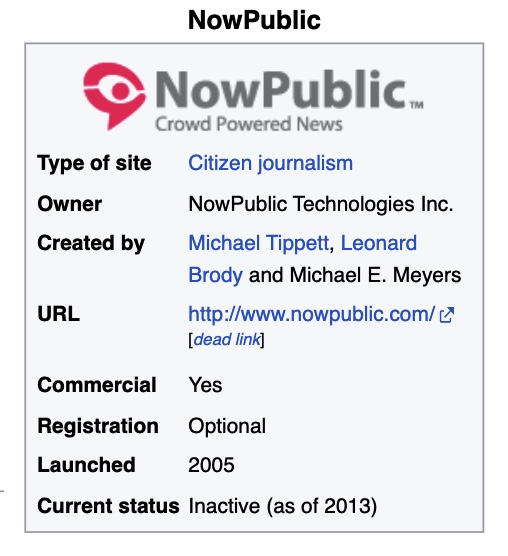
    As an example, the arrival of ‘crowd-powered’ media in 2007 allowed for posting of stories to a global audience to test responses and reactions in real time. An experiment from 2008 to 2010 on the innovative Vancouver, Canada-based NowPublic platform proved very effective in developing the right tone for the stories. Many of these stories have been cited in publications and online (please see below for citations).

    With 201 Development Challenges, South-South Solutions stories posted on the NowPublic platform, a total of 336,289 views by 2012 had occurred, according to the NowPublic counter. 

    Various websites offering publishing and archiving services (Scribd for example) meant it was easy to access the stories from any place, device or platform, bypassing firewalls and censors – a very serious concern in many countries of the global South. And social media such as Twitter made it easy to spread the word to the right people. 

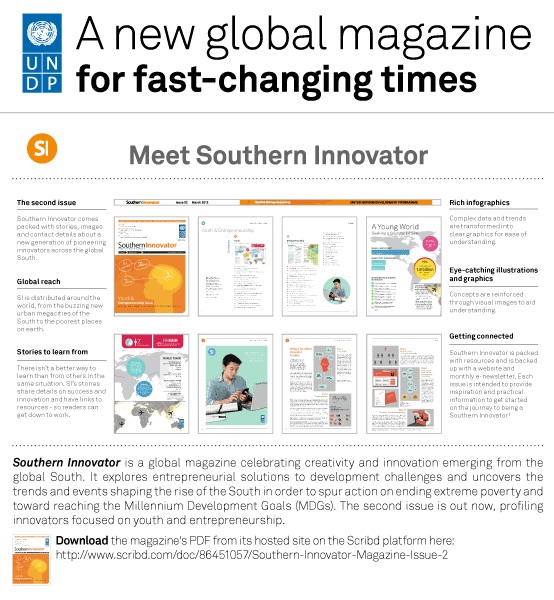
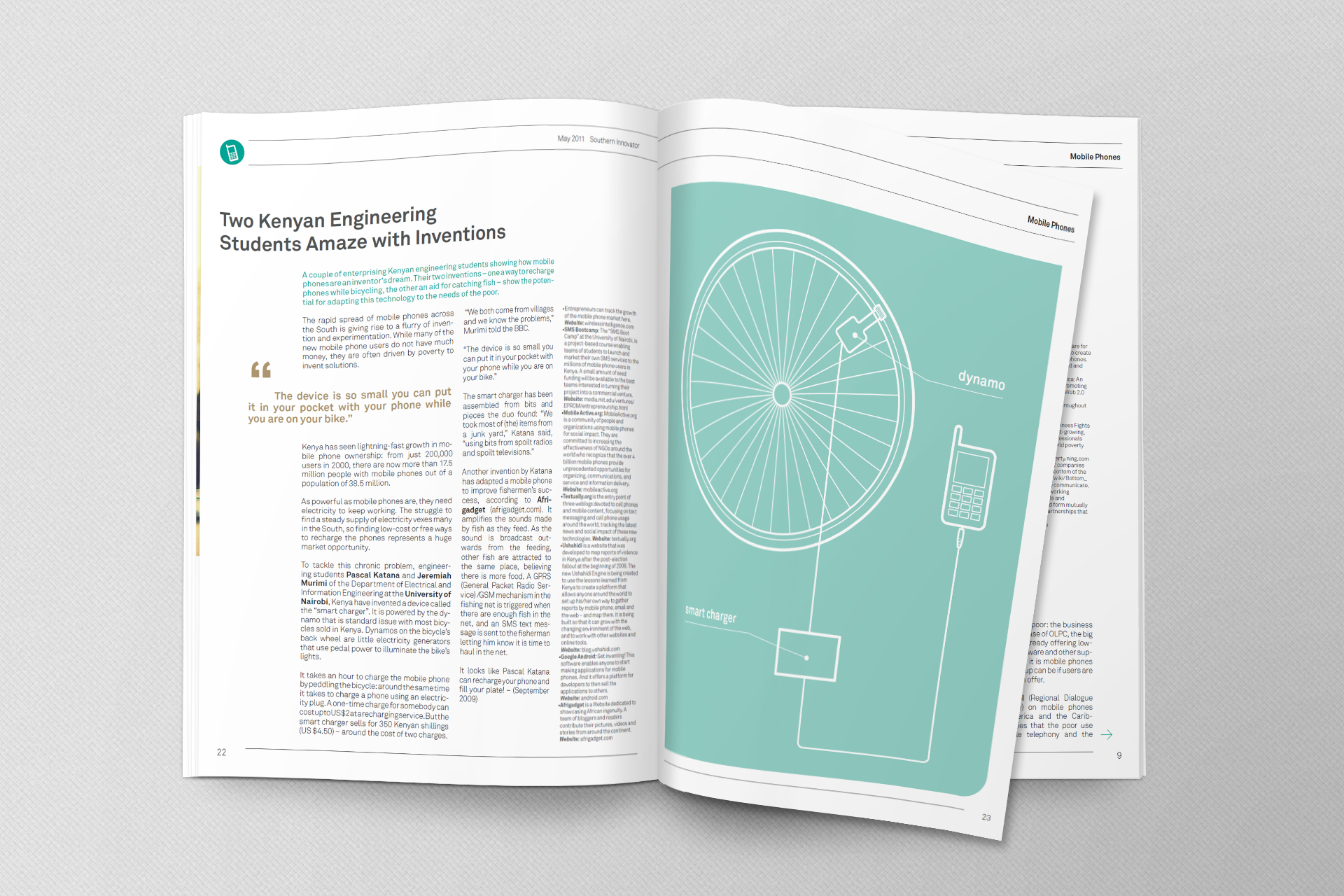
    The two publications proved influential on a number of fronts, being early to draw attention to the following: the rising use of mobile phones and information technology in development, the world becoming an urban place, innovative food solutions including the nascent insect food sector (now a big thing), altering perspectives on what is possible in Africa, the use of data science to innovate development, and tracking the growing number of technology hubs and the fast-growing start-up culture in the global South. The publications were cited for shaping the new strategic direction adopted by the United Nations Development Programme (UNDP) (the UN’s leading development organisation) and its first youth strategy, and the development of the Sustainable Development Goals (SDGs). As the world’s first global innovator magazine, Southern Innovator’s design had to be appropriate for a diverse audience. It has drawn praise for being both “beautiful” and “inspiring”, while its use of sharp, modern graphic design and infographics inspired others in the UN to up their game when it comes to design. 

    Today, there are many sources for sharing stories on solutions from the global South; in fact, it could be called ‘cool’. South-South cooperation and innovation have now become the key methodology for the UN’s delivery of its programmes and projects. In 2015, China pledged US $2 billion to “support South-South cooperation” and called for the international community to “deepen South-South and tripartite cooperation”. In development parlance, they have been “Mainstreaming South-South and Triangular Cooperation” in their plans.

    The current policy vogue for innovation in developing and developed countries can trace its roots back to some of the early work done by these two publications (and which was further amplified by the annual Global South-South Development Expo, which often would feature innovators from the two publications, spreading the innovation message around the world). Both publications had set out to inspire and “champion a global 21st century innovator culture”. And they have done this, as can be seen from concrete evidence and anecdotal responses from individuals and organizations alike.

    Crucial to success has been integrity. As was disclosed in arrests made by the Federal Bureau of Investigation (FBI) in October 2015, a news service claiming to be associated with the United Nations (South-South News) had not followed either the letter or the spirit of the UN’s Global Compact. It had received substantial funding from a Macau casino owner featured in a 2010 investigation by International Risk Ltd., which found he “is characterized in the media as a ‘Macau Crime Lord’ and a kingpin of the international slave prostitution trade”. To date, a number of his co-conspirators have been found guilty of various charges and sentenced. He was convicted 28 July 2017 on six counts “for his role in a scheme to bribe United Nations ambassadors to obtain support to build a conference center in Macau that would host, among other events, the annual United Nations Global South-South Development Expo“. He used the news service as a “conduit for bribery and money laundering” at the United Nations, according to the FBI, something admitted to by the various co-conspirators in court and under oath. Read more on this case here: http://www.reuters.com/article/us-un-corruption-idUSKCN0XH2DL. And the conviction here: Chairman of a Macau Real Estate Development Company Convicted on All Counts for Role in Scheme to Bribe United Nations Ambassadors to Build a Multi-Billion Dollar Conference Center

    The case of South-South News points to the dangers of cutting corners and the importance of approach and methodology; to not just mouth support for the UN Global Compact but to embrace its letter and spirit as well. As can be seen from this particular case, the reputational damage can be severe if the wrong strategy is pursued. Clients need to be very aware of whom they are working with and conduct due diligence for service provider credentials and also investigate the credentials of potential donors and funders. 

    Southern Innovator needed to be true to its ethos of championing genuine innovation that improves human development in the global South. It had to be free to pursue its search without interference. 

    To avoid censorship and interference, its editorial operations were based in London, UK and its design studio was based in Reykjavik, Iceland (a high-ranking country in the World Press Freedom rankings and a former top place holder in the UNDP Human Development Index). Using a women-led design studio, it developed a design vision that could communicate across borders using clear graphic design and high-quality images. For example, when it launched in 2011, infographics were rare in development publications and at the UN; now they are commonplace. It also tried to be as a ‘green’ as possible. The studio was powered on 100 per cent renewable energy (in particular, geothermal energy); the hard copy of the magazine is printed on paper from renewable forests. 

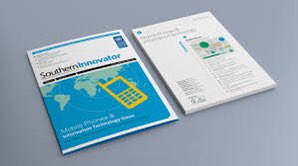
    To date, five issues of Southern Innovator have been published on key themes identified by the United Nations: mobile phones and information technology, youth and entrepreneurship, agribusiness and food security, cities and urbanization and waste and recycling.

    All of the issues collate and explain the trends, innovations and innovators for a large, global audience spanning many countries and regions.

    Timeline 

    2007: David South Consulting begins work on the e-newsletter Development Challenges, South-South Solutions for the Special Unit for South-South Cooperation at the United Nations.

    2008: Reader response experiment begins with crowd-powered news website NowPublic. Initial proposal for the development of book or magazine on innovation. Awarded grant for Cuba study tour by BSHF. 
    2009: Adjust e-newsletter content based on reader responses. Begin posting content on Twitter platform.

    2010: Begin development of initial concepts for innovator magazine and assemble creative team with Icelandic graphic designer and illustrator Solveig Rolfsdottir and graphic designer Eva Hronn Gudnadottir. 

    2011: Attend Global South-South Development Expo in Rome, Italy. Launch first issue of Southern Innovator magazine on mobile phones and information technology. It is called “a terrific tour de force of what is interesting, cutting edge and relevant in the global mobile/ICT space…”. Launch www.southerninnovator.org website and social media including Twitter account @SouthSouth1. 

    2012: Attend Global South-South Development Expo in Vienna, Austria. Launch issues 2 (youth and entrepreneurship) and 3 (agribusiness and food security) of Southern Innovator magazine. Called a “Beautiful, inspiring magazine from UNDP on South-South innovation.”

    2013: Attend Global South-South Development Expo in Nairobi, Kenya. Launch issue 4 of Southern Innovator magazine (cities and urbanization). Called “fantastic, great content and a beautiful design!” and “Always inspiring.”. 

    2014: Attend Global South-South Development Expo in Washington, D.C., U.S.A. Launch issue 5 of Southern Innovator magazine (waste and recycling). The Twitter account @SouthSouth1 called “ one of the best sources out there for news and info on #solutions to #SouthSouth challenges.” Final issues of e-newsletter Development Challenges, South-South Solutions published.  

    Testimonials 

    “The e-newsletter Development Challenges, South-South Solutions proved to be a timely and prescient resource on the fast-changing global South, tracking the rise of an innovator culture driven by the rapid adoption of mobile phones and information technology … 

    “In 2010, work began on the development of the world’s first magazine dedicated to the 21st-century innovator culture of the global South. My goal was to create a magazine that would reach across countries and cultures, meet the UN’s standards, and inspire action. Southern Innovator was the result. Mr. [David] South played a vital role in the magazine’s development from its early conception, through its various design prototypes, to its final global launch and distribution.  

    “Both the e-newsletter and magazine raised the profile of South-South cooperation and have been cited by readers for inspiring innovators, academics, policy makers and development practitioners in the United Nations and beyond.  

    “I highly recommend Mr. [David] South as a thoughtful, insightful, analytical, creative and very amicable person who has the unique ability to not only grasp complex problems but also to formulate a vision and strategy that gets things done. … ”  Cosmas Gitta, Former Assistant Director, Policy and United Nations Affairs at United Nations Office for South-South Cooperation (UNOSSC) in UNDP 

    “I think you [David South] and the designer [Solveig Rolfsdottir] do great work and I enjoy Southern Innovator very much!” Ines Tofalo, Programme Specialist, United Nations Office for South-South Cooperation

    Southern Innovator Issue 5 

    “@SouthSouth1 is one of the best sources out there for news and info on #solutions to #SouthSouth challenges.” Adam Rogers, Assistant Director, Regional Representative, Europe, United Nations Office for South-South Cooperation (UNOSSC) 

    “Btw, I really enjoyed reading them, impressive work & a great resource. Looking forward to Issue 6. My best wishes to you & your team at SI.” 

    “… great magazine, nice design.” 

    Southern Innovator Issue 4 

    “I liked your latest Southern innovator! Always inspiring.” Joana Breidenbach, betterplace.org, Berlin, Germany 

    “The magazine looks fantastic, great content and a beautiful design!” 

    Southern Innovator Issue 2 

    “Thank you David – Your insight into the issues facing us a[s] [a] “global Village” is made real in the detail of your article – 10 out of 10 from the moladi team.” Moladi, South Africa (http://www.moladi.net/index.htm

    Southern Innovator Issue 1 

    “What a tremendous magazine your team has produced! It’s a terrific tour de force of what is interesting, cutting edge and relevant in the global mobile/ICT space… Really looking forward to what you produce in issues #2 and #3. This is great, engaging, relevant and topical stuff.” Rose Shuman, Founder & CEO, Open Mind and Question Box 

    “Looks great. Congratulations. It’s Brill’s Content for the 21st century!” Conan Tobias, Managing Editor, Canadian Business 

    What they are saying about SI on Twitter: From @CapacityPlus Nice job RT @ActevisCGroup: RT @UNDP: Great looking informative @SouthSouth1 mag on South-South Innovation; @UNDP Great looking informative @SouthSouth1 mag on South-South Innovation; @JeannineLemaire Graphically beautiful & informative @UNDP Southern Innovator mag on South-South Innov.  

    And on Pinterest:

    Peggy Lee • 1 year ago

    “Beautiful, inspiring magazine from UNDP on South-South innovation. Heart is pumping adrenaline and admiration just reading it”

    Impact 

    Micro 

    • developed content for highly influential UN e-newsletter Development Challenges, South-South Solutions from 2007 to 2014. The monthly briefing is distributed across the UN and to subscribers
    • developed and launched world’s first global innovator magazine for the United Nations, Southern Innovator
    • contacted and networked with innovators around the world to raise the profile of their work
    • attended global events to champion power of 21st century global innovator culture. Visited United Nations agency headquarters around the world to share the innovator message and distribute the publications
    • cited as a key resource on trends in the global South 

    Macro

    • significantly raised profile of global South innovators and 21st century global innovator culture
    • cited as contributor to new strategic plans for UNDP and its switch to an innovation and South-South focus

    Citations 

    Autonomous Systems in the Intelligence Community: Many Possibilities and Challenges by Jenny R. Holzer, PhD, and Franklin L. Moses, PhD, Studies in Intelligence Vol 59, No. 1 (Extracts, March 2015) 

    Beyond Gated Communities edited by Samer Bagaeen and Ola Uduku (Routledge: 2015)

    Chile in Transition: Prospects and Challenges for Latin America’s Forerunner of Development by Roland Benedikter and Katja Siepmann (Springer: 2015) 

    Decoding the Brand DNA: A Design Methodology Applied to Favela Fashion by Magali Olhats, Universidade Federal de Santa Catarina Florianopolis, 2012 

    Edible Insects and the Future of Food: A Foresight Scenario Exercise on Entomophagy and Global Food Security by Dominic Glover and Alexandra Sexton, Institute of Development Studies, King’s College London, Evidence Report No 149, September 2015 

    High-level Committee on South-South Cooperation Seventeenth Session: Framework of operational guidelines on United Nations support to South-South and triangular cooperation: Note by the Secretary-General22-25 May 2012, New York 

    Innovation Africa: Emerging Hubs of Excellence edited by Olugbenga Adesida, Geci Karuri-Sebina and João Resende-Santos (Emerald Group Publishing: 2016) 

    New Directions in Children’s and Adolescents’ Information Behavior Research edited by Dania Bilal and Jamshid Beheshti (Emerald Group Publishing: 2014) 

    Propagating Gender Struggles Through Nollywood: Towards a Transformative Approach by Nita Byack George Iruobe, Geonita Initiative for Women and Child Development, 17 July 2015

    Recasting ‘truisms’ of low carbon technology cooperation through innovation systems: insights from the developing world by Alexandra Mallett, Innovation and Development, 5:2, 297-311, DOI: 10.1080/2157930X.2015.1049851, Routledge Taylor & Francis Group, 2015

    A Sociological Approach to Health Determinants by Toni Schofield (Cambridge University Press: 2015)  

    Strategic Framework of the United Nations Office for South-South Cooperation, 2014-2017Executive Board of the United Nations Development Programme, the United Nations Population Fund and the United Nations Office for Project Services, 27 to 31 January 2014, New York

    Wearing Your Map on Your Sleeve: Practices of Identification in the Creation and Consumption of Philippine Map T-shirts by Pamela Gloria Cajilig, paper presented at the 6th Global Conference (2014): Fashion: Exploring Critical Issues, Mansfield College, Oxford, United Kingdom, 15th to 18th September 2014

    Youth Empowered as Catalysts for Sustainable Human Development: UNDP Youth Strategy 2014-2017United Nations Development Programme, Bureau for Development Policy

    DSC web address in green_mini (1)

    ORCID iD: https://orcid.org/0000-0001-5311-1052.

    © David South Consulting 2025

  • New Weapon Against Crime in the South

    New Weapon Against Crime in the South

    By David SouthDevelopment Challenges, South-South Solutions

    SOUTH-SOUTH CASE STUDY

    Crime in the South’s fast-growing cities has a negative affect on economic development and social and community harmony. In Africa, with one fifth of the world’s population, for example, data is very poor on crime and its victims. The absence of good data means prevention and detection of crime is poor, and resources to fight it can’t be allocated effectively.

    Over 900 million people – almost a sixth of the world’s population – now live in urban slums (UN) – high-tension places that offer a fertile environment for crime to flourish. In developing countries 43 per cent of urban dwellers live in slums – and in the least-developed countries the figure is 78 per cent. Keeping these areas safe is a serious challenge, especially when trust in police and local authorities is low. People are often afraid of how police will react to reporting of crime. Many rightly believe they will be asked for a bribe, or that reporting a crime somehow singles them out as a troublemaker.

    Harnessing the power of people organizing together offers one way of fighting back against crime, and combating the paralysis of feeling there is nothing that can be done. An initiative in Brazil is turning to the powerful collaborative potential of Web 2.0 to track crime and help to solve it. And for the first time in history, Brazilians can now see in more or less real time what crime there is and where it is happening in their country.

    Wikicrimes, the brainchild of Professor Vasco Furtado of the University of Fortaleza’s Knowledge Engineering Research Group, is inspired by the very popular user-contributed encyclopaedia Wikipedia, and germinated in his mind while on an academic sabbatical at Stanford University in California in 2006.

    Victims of crime can simply map and report crimes using the website, which uses brightly coloured drawing pins to indicate where a cluster of crimes has taken place. Site users answer a series of questions on suspects and witnesses. Anyone planning a journey can then easily zoom in on the places where they will go, and see the crime profile of that area – and perhaps be more cautious and aware to avoid becoming victims themselves.

    Brazil’s crime problem is huge: Films like City of God – where gangs fight deadly battles in the slums or favelas – shows how vicious it is.

    Wikicrimes, whose motto is “Share crime information, Keep safe!”, began development in April 2006, and went ‘live’ with a launch at the end of 2007. Starting with just two employees, it has now grown to a team of 10.

    Furtado was frustrated with police hoarding crime statistics in Brazil, and not letting people know where crimes were taking place: he also believes the police, as in many other countries, manipulate statistics for various political purposes. “The traditional mechanism of data-gathering for which police are responsible ends up giving them a monopoly over the handling of information on criminal occurrences,” Furtado said. And that “is not always in keeping with the precept of transparency and public availability of information required by a democratic system.”

    Furtado believes transparent crime statistics are vital to a well-functioning democracy.

    “We are still facing very big challenges,” he said. “Cultural change is one of them. We don’t have in Brazil the culture of sharing information for benefiting others. People need to realize that when they register a crime they are helping others, and that should be the reason others will act in the same fashion.”

    He tried to get the police involved in the project, by contributing data, but with no luck. Brazil’s police argue their monopoly over crime statistics exists for some very serious reasons. “We are very worried about revealing police data which may restrict the work of the police,” Antenor Martins of Rio’s Civil Police Department told the BBC. “Also we don’t want a feeling of insecurity for the people – they don’t deserve that here or anywhere else in the world.”

    Many also worry about a crime profile of an area dragging that area down, scaring people away. The police also worry about inaccurate information. “When people walk into a police station, you sign an incident report. If you give information which isn’t true, you have to respond to charges of giving false evidence,” said Martins.

    But Furtado believes trust between citizens and the police is so low, it is hurting the fight against crime.

    “The police suffer a lack of credibility among the populace which, in turn, contributes toward the low rate of reporting such occurrences: the so-called underreporting effect,” he said. “Research conducted with victims of crime in several Brazilian states has shown that underreporting may, in densely-populated areas, reach up to 50 per cent for certain types of crimes.”

    Furtado believes a better picture of crime will lead to better public policies and policing: “The result of this can be disastrous in terms of formulation of public policies and especially in the planning of police actions, in view of the fact that the official criminal mapping may reflect a trend that is quite unlike what is actually occurring in real life.

    “WikiCrimes intends to change the traditional logic of handling information on crimes that have already occurred, and considers that such a change is up to the citizens themselves. It is based on the principle that with adequate support, citizens will be capable of deciding how and when historical information on criminal occurrences can be publicized as well as for what purpose.”

    Sao-Paulo-based NGO Sou de Paz works to reduce violence in Brazil, and is a big supporter of Wikicrimes. “If we develop Wikicrimes, we can look at things like domestic violence or information on drug trafficking – things that affect communities but that people don’t report either because of shame or fear,” the group’s Denis Mizne told the BBC. “If you can get access to this information or publicise it together with Wikicrimes, it could help in areas that suffer most from violent crime.”

    Wisely, Wikicrimes is acting to address police concerns over accurate reporting of crimes.

    “Technically the big challenge is to define mechanisms to identify false registering,” Furtado said. “We are creating fields in WikiCrimes for the user to provide further information that brings more reliability to the crime information registered — links to newspapers, for instance. We are also defining algorithms to compute the reputation of the informants.”

    And Wikicrimes is not just for Brazil: they want people from around the world to add to the site and help build up the crime profile of all countries.

    Furtado said responses from the general public have largely been positive. “The best I could ever hope,” he said. “The project is for the citizen and I feel that they realize this. Every day, I receive messages from people offering support and giving congratulations.”

    “I had no idea of similar projects before doing Wikicrimes, but, recently, I have received some messages of similar initiatives even though with a local scope in Brazil, Argentina and USA,” he added.

    “In terms of crime it would be nice if this would show that it’s necessary to publish the crime data that we have in law authorities and institutions,” he said. “If this is a success, I am sure that all the crime data will be available for people, because they will realize there is no way that the authorities can keep it all to themselves.”

    Furtado keeps a rolling report on progress with Wikicrimes on his blog.

    Published: May 2008

    Resources

    https://davidsouthconsulting.org/2020/12/04/big-data-can-transform-the-global-souths-growing-cities/

    https://davidsouthconsulting.org/2020/12/11/cyber-cities-an-oasis-of-prosperity-in-the-south/

    https://davidsouthconsulting.org/2020/12/04/data-surge-across-global-south-promises-to-re-shape-the-internet/

    https://davidsouthconsulting.org/2021/03/04/indian-id-project-is-foundation-for-future-economic-progress/

    Development Challenges, South-South Solutions was launched as an e-newsletter in 2006 by UNDP’s South-South Cooperation Unit (now the United Nations Office for South-South Cooperation) based in New York, USA. It led on profiling the rise of the global South as an economic powerhouse and was one of the first regular publications to champion the global South’s innovators, entrepreneurs, and pioneers. It tracked the key trends that are now so profoundly reshaping how development is seen and done. This includes the rapid take-up of mobile phones and information technology in the global South (as profiled in the first issue of magazine Southern Innovator), the move to becoming a majority urban world, a growing global innovator culture, and the plethora of solutions being developed in the global South to tackle its problems and improve living conditions and boost human development. The success of the e-newsletter led to the launch of the magazine Southern Innovator.  

    Follow @SouthSouth1

    Google Books: https://books.google.co.uk/books?id=p03–n51i44C&dq=development+challenges+april+2008&source=gbs_navlinks_s

    Slideshare: http://www.slideshare.net/DavidSouth1/development-challengessouthsouthsolutionsapril2008issue

    Southern Innovator Issue 1: https://books.google.co.uk/books?id=Q1O54YSE2BgC&dq=southern+innovator&source=gbs_navlinks_s

    Southern Innovator Issue 2: https://books.google.co.uk/books?id=Ty0N969dcssC&dq=southern+innovator&source=gbs_navlinks_s

    Southern Innovator Issue 3: https://books.google.co.uk/books?id=AQNt4YmhZagC&dq=southern+innovator&source=gbs_navlinks_s

    Southern Innovator Issue 4: https://books.google.co.uk/books?id=9T_n2tA7l4EC&dq=southern+innovator&source=gbs_navlinks_s

    Southern Innovator Issue 5: https://books.google.co.uk/books?id=6ILdAgAAQBAJ&dq=southern+innovator&source=gbs_navlinks_s

    Read online: https://drive.google.com/file/d/0B-buqyoV0jpSZWcyNWQ5ZTY4OG8/view?resourcekey=0-1b7ZdQH3iBhSTAiACr7HVA.

    https://davidsouthconsulting.org/2021/03/05/southern-innovator-issue-1/

    Creative Commons License

    This work is licensed under a
    Creative Commons Attribution-Noncommercial-No Derivative Works 3.0 License.

    ORCID iD: https://orcid.org/0000-0001-5311-1052.

    © David South Consulting 2023

  • Computer ‘Gold Farming’ Turning Virtual Reality Into Real Profits

    Computer ‘Gold Farming’ Turning Virtual Reality Into Real Profits

    ByDavid South,Development Challenges, South-South Solutions

    SOUTH-SOUTH CASE STUDY

    The rapid spread of the internet around the global South is bringing with it new forms of work. One of these trends is so-called “gold farming”: making money in the virtual world of computer gaming by trading in virtual money, prizes and goods for busy gamers who don’t have time to do it themselves. This work now employs 400,000 people – mostly men and mostly in China, but also elsewhere in the South, according to new report.

    Working out of internet centres where they can get access to high-speed or broadband internet connections, “gold farmers” use the global trade in virtual goods for online computer games in the same way stockbrokers trade shares on the world’s stock exchanges. The trade operates similarly to the stock market, with prices fluctuating based on demand and changing by the minute.

    And as the report discovered, this trade is acting as a gateway into the world of information technology employment, where computer-literate young men are able to earn an income they could not have done otherwise.

    It is a trade that can provide gold farmers with US $145 a month in income. They are often given free food and accommodation to do it, and many have few other economic choices.

    “You can probably think of two models,” said the report’s author, Professor Richard Heeks of Manchester University’s Development Informatics Group. “They could play as an individual at a local cybercafe doing their own in-game farming and then selling to one of the trading sites (that buy from farmers at one price, then sell on to player-buyers at a higher price). Or they could be organized into a small/medium enterprise by an owner, all working together in a room full of computers.”

    There is a dark side to gold farming too: there have been reports of youths forced to gold farm by gangs who make them work 12 hour days. Crime gangs sometimes become involved and scams proliferate.

    Heeks says the downside is the result of governmental ignorance. “The main problem is a lack of understanding about ICT and ICT enterprise generally in some governments in developing countries and in particular a relative lack of understanding about the spread and implications of computer games.”

    Supporters see gold farming as a flourishing Southern economy that is worth hundreds of millions of dollars, and exposes participants both to information technology skills and the wide horizons of the virtual computing world. Its defenders say it shows that those who dismiss the expansion of IT infrastructure as a waste of time are missing the emerging economic opportunities it is creating.

    Heeks said we still know too little about this fast-evolving sector, but that “gold farming does seem to be providing income/livelihood for young men who would otherwise be unemployed. There are claims that it has helped mop up youths who had otherwise been involved in crime, but we don’t yet know how generalized such claims are.”

    The number of players engaged in online gaming has grown by 80 percent per year, and Heeks sees the rise in gold farming as linked to a bigger trend: “in both North and South, we will spend increasing amounts of work and leisure time in cyberspace. Couple that with the growing penetration of ICTs into developing countries, including into poor communities, and there will be growing opportunities for this kind of ‘virtual outsourcing.’”

    Currently, more than 300 million people worldwide have access to the internet through fast broadband connections (mostly in developed countries, although this is changing quickly), and more than 1.1 billion of the world’s estimated 6.6 billion people are online.

    China is working hard to capture the economic power of the internet. The country’s economic boom has helped create an affluent urban middle class clamouring for the social aspects of internet access like chat rooms, while the government has been driving the roll-out of internet access in rural areas.

    The country’s largest Cyber Park is under construction inWujin New and High-tech Development Zone of Changzhou. It will be a technology incubator, a research and development centre, and a place for small and medium-sized enterprises to innovate.

    China’s most ambitious digital media industry development is the Beijing Cyber Recreation District (CRD), a collection of digital media academies and company incubators spread over 100 square kilometres, creating the world’s largest virtual world development. It is already home to more than 200 game and multimedia content producers in western Beijing.

    And even in Africa, where broadband penetration rates are very poor, countries are now looking to the mobile phone companies to provide their populations with access to the internet, as they struggle to find a place at the digital table.

    Mauritius, an island in the Indian Ocean strategically close to Africa and better known for tourism and luxury hotels, wants to become the world’s “cyber island”, and Africa’s e-gateway. Armed with the first 3G network in Africa (the third generation of mobile phone technology – offering high-speed internet access and video telephony), Mauritius is moving fast to make good on this advantage. And it is even moving to the next level of mobile-phone speed, High-speed Download Packet Access (HSDPA) – allowing even greater quantities of information to be exchanged.

    Mauritius joins a select few countries, including Japan and South Korea, at the forefront of access to 3G. Wireless – or wi-fi – computer access is available in three-quarters of the island.

    Published: September 2008

    https://davidsouthconsulting.org/2022/11/21/asia/

    https://davidsouthconsulting.org/2022/10/20/china-consumer-market-asian-perspective-helps/

    https://davidsouthconsulting.org/2020/12/10/china-sets-sights-on-dominating-global-smartphone-market/

    https://davidsouthconsulting.org/2020/12/11/cyber-cities-an-oasis-of-prosperity-in-the-south/

    https://davidsouthconsulting.org/2021/01/26/designed-in-china-to-rival-made-in-china/

    https://davidsouthconsulting.org/2022/10/04/popular-chinese-social-media-chase-new-markets/

    https://davidsouthconsulting.org/2020/04/17/virtual-supermarket-shopping-takes-off-in-china/

    Development Challenges, South-South Solutionswas launched as an e-newsletter in 2006 by UNDP’s South-South Cooperation Unit (now the United Nations Office for South-South Cooperation) based in New York, USA. It led on profiling the rise of the global South as an economic powerhouse and was one of the first regular publications to champion the global South’s innovators, entrepreneurs, and pioneers. It tracked the key trends that are now so profoundly reshaping how development is seen and done. This includes the rapid take-up of mobile phones and information technology in the global South (as profiled in the first issue of magazine Southern Innovator), the move to becoming a majority urban world, a growing global innovator culture, and the plethora of solutions being developed in the global South to tackle its problems and improve living conditions and boost human development. The success of the e-newsletter led to the launch of the magazine Southern Innovator.

    Follow@SouthSouth1

    Archive.org:https://archive.org/details/Httpwww.slideshare.netDavidSouth1development-challengessouthsouthsolutionsseptember2008issue

    Slideshare:http://www.slideshare.net/DavidSouth1/development-challengessouthsouthsolutionsseptember2008issue

    Southern Innovator Issue 1:https://books.google.co.uk/books?id=Q1O54YSE2BgC&dq=southern+innovator&source=gbs_navlinks_s

    Southern InnovatorIssue 2: https://books.google.co.uk/books?id=Ty0N969dcssC&dq=southern+innovator&source=gbs_navlinks_s

    Southern Innovator Issue 3:https://books.google.co.uk/books?id=AQNt4YmhZagC&dq=southern+innovator&source=gbs_navlinks_s

    Southern Innovator Issue 4:https://books.google.co.uk/books?id=9T_n2tA7l4EC&dq=southern+innovator&source=gbs_navlinks_s

    Southern Innovator Issue 5:https://books.google.co.uk/books?id=6ILdAgAAQBAJ&dq=southern+innovator&source=gbs_navlinks_s

    Creative Commons License
    This work is licensed under a
    Creative Commons Attribution-Noncommercial-No Derivative Works 3.0 License.

    ORCID iD:https://orcid.org/0000-0001-5311-1052.

    © David South Consulting 2025

  • Texting For Cheaper Marketplace Food With SokoText

    Texting For Cheaper Marketplace Food With SokoText

    By David SouthDevelopment Challenges, South-South Solutions

    SOUTH-SOUTH CASE STUDY

    An international group of graduate-social entrepreneurs from the London School of Economics (LSE) is pioneering a way to reduce food prices in Kenya using mobile phones.

    Answering a call to action to address global food insecurity by the Hult Prize (hultprize.org), the team members looked at how they could make food cheaper for urban slum dwellers.

    The Hult Prize, funded by Swedish educational entrepreneur and billionaire, Bertil Hult, is a start-up accelerator for budding young social entrepreneurs emerging from the world’s universities. The winner receives US $1 million and mentorship to make their idea become real.

    SokoText (sokotext.com) (soko means market in Swahili) uses SMS (short message service) messages from mobile phones to empower vegetable sellers and kiosk owners in slums when it comes to bargaining the price for wholesale fresh produce. SokoText makes it possible for them to benefit from bulk prices by pooling their orders together every day. Usually vendors lack the funds to buy in bulk and have to make numerous time-consuming trips to the centre of Nairobi to buy stock.

    SokoText reduces the price of fresh produce by 20 per cent for kiosk owners by buying the produce earlier in the supply chain. SokoText then delivers the food to a wholesale outlet at the entrance to the slum.

    This approach makes available a wider range of produce and reduces the price. And best of all, it will knock down prices for the poorest people and enable them to buy more food and better quality food.

    The team behind SokoText come from a variety of countries – Colombia, Canada, Kenya, Britain and Germany.

    Hatched at the LSE, the enterprise prototyped its service in Mathare Valley, Nairobi, Kenya for four weeks during the summer of 2013 with 27 users and began the second phase of testing in November 2013, working with a local NGO, Community Transformers (https://www.facebook.com/pages/Community-Transformers-kenya/119937408165671).

    According to SokoText, slum dwellers spend on average 60 per cent of their daily budget on food.

    Mobile phones can be transformative since they are now a common communications tool, even in slums.

    On the SokoText website, respected blogger and commentator on technology in Africa, Erik Hersman (http://whiteafrican.com/about/), calls it “a fantastic low-tech approach that could really scale for decreasing the inefficiencies in urban slum markets.”

    SokoText’s 21-year-old co-founder and chief executive, Suraj Gudka, explained the genesis of the project to news and technology in Africa website, 140Friday.com.

    “From our research, the Mama Mboga (small-scale vegetable retailers) spend between 150 and 200 Kenyan shillings (US $1.70 and US $2.3) daily, about 25 per cent of her revenue, to buy her stock, and since they do not buy in bulk they [she] get their goods at a higher price.”

    Getting the market traders to cooperate is very difficult, Gudka found, because competition is fierce and trust is low. SokoText sees itself as a solution to this situation. By encouraging bulk buying by way of the SMS text service, there is no need to build trust between the traders before the produce is purchased.

    “To use our service, the interested retailers would be required to send us an SMS every evening detailing what they need,” said Gudka, “and then we will source the produce and they come pick it up from us the next morning. In this way they do not have to incur the additional costs of transporting their goods and it also saves them time.”

    SokoText is being incubated at the Nailab (nailab.co.ke) in Nairobi, a startup accelerator that offers a three to 12 month entrepreneurship program, with a focus on growing innovative technology-driven ideas.

    SokoText’s summer pilot test confirmed taking the orders can work but found getting the product to the market in time was difficult.

    The next step will be to set up a presence in the Mathare slum.

    “We will be selling about seven to 10 different kinds of produce, and from our calculations, according to our projections for how much the Mama Mbogas buy every day, we hope to get  40-50 customers within three months,” Gudka said.

    Published: December 2013

    Resources

    1) SokoText: The website explains further how the service works. Website: sokotext.com

    2) Hult Prize: The Hult Prize Foundation is a not-for-profit organization dedicated to launching the world’s next wave of social entrepreneurs. It encourages the world’s brightest business minds to compete in teams to solve the planet’s biggest challenges with innovative ideas for sustainable start-up enterprises. Annual Hult Prize winners can make their ideas reality with the help of US $1 million in seed funding. Website: hultprize.org

    3) White African: Where Africa and Technology Collide! Website: http://whiteafrican.com/about/

    4) Nailab: Nailab (Nairobi Incubation Lab) is a startup accelerator that offers an entrepreneurship program focusing on growing innovative technology driven ideas. This is done through providing business advice, technical training and support, professional mentoring and coaching, giving access to market and fostering strategic partnerships as well as linking them to investors. Website: nailab.co.ke

    https://davidsouthconsulting.org/2020/04/30/crowdsourcing-mobile-phones-to-make-the-poor-money/

    https://davidsouthconsulting.org/2022/06/24/dabbawallahs-use-web-and-text-to-make-lunch-on-time/

    https://davidsouthconsulting.org/2022/11/01/innovative-mobile-phone-applications-storm-south/

    https://davidsouthconsulting.org/2022/10/27/kenyan-mobile-phone-innovations/

    https://davidsouthconsulting.org/2021/09/06/microwork-pioneer-transforms-prospects-for-poor-vulnerable/

    https://davidsouthconsulting.org/2020/12/20/mobile-phones-engineering-souths-next-generation-of-entrepreneurs/

    https://davidsouthconsulting.org/2020/12/12/mobile-phones-new-market-tools-for-the-poor/

    https://davidsouthconsulting.org/2022/06/16/web-2-0-to-the-rescue-using-web-and-text-to-beat-shortages-in-africa/

    Development Challenges, South-South Solutions was launched as an e-newsletter in 2006 by UNDP’s South-South Cooperation Unit (now the United Nations Office for South-South Cooperation) based in New York, USA. It led on profiling the rise of the global South as an economic powerhouse and was one of the first regular publications to champion the global South’s innovators, entrepreneurs, and pioneers. It tracked the key trends that are now so profoundly reshaping how development is seen and done. This includes the rapid take-up of mobile phones and information technology in the global South (as profiled in the first issue of magazine Southern Innovator), the move to becoming a majority urban world, a growing global innovator culture, and the plethora of solutions being developed in the global South to tackle its problems and improve living conditions and boost human development. The success of the e-newsletter led to the launch of the magazine Southern Innovator.  

    Follow @SouthSouth1

    Google Books: https://books.google.co.uk/books?id=hPNcAwAAQBAJ&dq=development+challenges+december+2013&source=gbs_navlinks_s

    Slideshare: http://www.slideshare.net/DavidSouth1/development-challenges-december-2013-issue

    Southern Innovator Issue 1: https://books.google.co.uk/books?id=Q1O54YSE2BgC&dq=southern+innovator&source=gbs_navlinks_s

    Southern Innovator Issue 2: https://books.google.co.uk/books?id=Ty0N969dcssC&dq=southern+innovator&source=gbs_navlinks_s

    Southern Innovator Issue 3: https://books.google.co.uk/books?id=AQNt4YmhZagC&dq=southern+innovator&source=gbs_navlinks_s

    Southern Innovator Issue 4: https://books.google.co.uk/books?id=9T_n2tA7l4EC&dq=southern+innovator&source=gbs_navlinks_s

    Southern Innovator Issue 5: https://books.google.co.uk/books?id=6ILdAgAAQBAJ&dq=southern+innovator&source=gbs_navlinks_s

    SokoText co-founder Sofia Zab (left). She oversees SokoText’s marketing strategy and manages SokoText’s technology products.

    Development Challenges, South-South Solutions was launched as an e-newsletter in 2006 by UNDP’s South-South Cooperation Unit (now the United Nations Office for South-South Cooperation) based in New York, USA. It led on profiling the rise of the global South as an economic powerhouse and was one of the first regular publications to champion the global South’s innovators, entrepreneurs, and pioneers. It tracked the key trends that are now so profoundly reshaping how development is seen and done. This includes the rapid take-up of mobile phones and information technology in the global South (as profiled in the first issue of magazine Southern Innovator), the move to becoming a majority urban world, a growing global innovator culture, and the plethora of solutions being developed in the global South to tackle its problems and improve living conditions and boost human development. The success of the e-newsletter led to the launch of the magazine Southern Innovator.

    https://davidsouthconsulting.org/2021/03/05/southern-innovator-issue-1/

    https://davidsouthconsulting.org/2021/03/05/southern-innovator-issue-5/

    Creative Commons License

    This work is licensed under a
    Creative Commons Attribution-Noncommercial-No Derivative Works 3.0 License.

    ORCID iD: https://orcid.org/0000-0001-5311-1052.

    © David South Consulting 2023