With mobile phones becoming ubiquitous across the global South, the opportunity to make money – and possible fortunes – by providing ‘apps’ for these devices is now a reality.
Apps (http://en.wikipedia.org/wiki/Application_software) – applications which allow users of new mobile phones to do everything from running a business to banking to navigating chaotic cities – have quickly become a very creative space and a dynamic market for innovators and entrepreneurs. Because they are pieces of software and are relatively inexpensive to create, requiring only time and hard work, an individual working out of their home can develop an app, introduce it to the online marketplace and see if it will succeed.
The only limit is the imagination.
They are also a great way to solve people’s problems and possibly make some money in the process. As economies and cities grow across the South, many everyday difficulties can be tackled with these apps.
Apps are revolutionary because they solve the problem of how to view websites on mobile phones and smartphones (http://en.wikipedia.org/wiki/Smartphone). Apps are designed for a small screen and have simple functionality and design. They often can function without any constant connection to the Internet, updating themselves sporadically when the phone can connect with phone networks or the Internet. They are also either free or inexpensive, using micro-payments to make a profit. The essence of the micro-payment business model is to charge a small amount and turn this into a large amount by having large numbers of people download the app. It is a successful business formula that has made many vast fortunes throughout the age of the mass consumer market, which began in the late 19th century.
Bart Decrem, co-founder of Tapulous, a maker of apps for the iPhone (http://tapulous.com), told The Economist: “Apps are nuggets of magic.”
Apps are sold in online stores run by companies like Apple (http://itunes.apple.com/us/genre/ios/id36?mt=8), Google, Sweden’s GetJar (http://www.getjar.com), and South Korea’s SK Telecom. Apple’s store has over 425,000 apps and Google’s Android Market has more than 250,000. Other stores include Mobihand, PocketGear, Mobango, Handango, Blackberry App World and Handster (http://www.handster.com).
Research firm Gartner (http://www.gartner.com/technology/home.jsp) estimated that 18 billion apps have been downloaded since Apple opened its first app store in 2008. Remarkably, it forecasts this number could rise to 49 billion by 2013. The most popular topics include games, weather forecasts, social networks, maps, music and news.
The dynamic documented so far for apps seems to follow the way music charts work. A few apps, out of the many on offer, become big sellers and popular favourites, getting the most users. Partly this reflects the difficulty of quickly searching through all the apps available in the world to find the right one, a process that favours well-marketed apps.
The recent TechSparks 2011 App4India (http://www.facebook.com/techspark) contest showcased the creative thinking about apps now happening in India.
One Indian success story is the 1000Lookz (http://www.vdime.com/pro1.htm) app, developed by Vasan Sowriraj (http://www.vdime.com/about.htm), which helps women perform a virtual beauty makeover. A woman can check what shades work best for her skin tone by using her own photos uploaded to the app. The user adds features like foundation, blush, gloss, eye-shadow, eye-liner and lipstick. The app uses facial recognition and skin tone detection technology to assist the virtual makeover. It was developed by VDime Innovative Works headquarterd in Atlanta, Georgia, with its technology developed by its Indian division.
1000Lookz’ mission is to create “innovative products that bring cheer to consumers’ faces.”
Sowriraj got his experience from working as a key member of the team developing special image processing for the Indian Space and Research Organisation (http://www.isro.org).
The same team has also developed another service enabling users to transform standard emoticons – those cartoons used in electronic communications to convey emotions – into emoticons using your own face image. It is called Humecons (http://www.humecons.com), and its slogan is “Emote Yourself”.
The India TV Guide, based in Bangalore, India’s software hub (http://en.wikipedia.org/wiki/International_Tech_Park,_Bangalore), is a mobile phone application developed by Jini Labs (http://www.jinilabs.com) offering programme listings for 150 television channels broadcast in India, and allows viewers to save reminders for favourite shows and build favourites lists.
Jini Labs also makes Jini Books (http://itunes.apple.com/in/app/jinibooks/id404988026?mt=8), a clever app to display books, magazines and journals that are hard to find in conventional shops. It is free and promises to have “indie book authors and publishers – including small size, mid-size independent publishers, university presses, e-book publishers, and self-published authors.”
A very useful app improving people’s lives is the Indian Railway Lite app. India’s railways are a critical part of the country’s economy, and the world’s largest railway system. The complexity of trying to work out the train schedule has been made easier with the app.
Founded by Srinath Reddy, the app’s chief technology officer at RSG Software Services (http://www.rsgss.com), the app enables users to discover train connections between stations, and find which trains pass through stations, while navigating the Indian Railways website. It is a good example of how an app can quickly become a big hit. It became the second most popular on the Apple India app store and is downloaded more than 1,000 times a day.
One of the advantages of the app is its ability to function without access to the Internet. It draws on its own database of information and offers a friendlier user interface than the Indian State Railways website.
“This feature has proved to be very popular as users can access train information even while they are travelling and are out of network range,” Reddy told Yourstory.in. “We update the app at regular intervals and the user has to download a new version of the app to get updated information. Trains are generally added once in a few months and the timetable does not change significantly, so the user can use the same version until the next one is released.”
The app’s creators initially found it difficult to get information and updates from Indian Railways.
“We took around four to five months to build the app,” Reddy said. “Significant effort went into compiling the train and station data as this was not easily available. Refining the UI (user interface) took quite some time as well.”
The company saw a market for the app because there were so many iPhone (http://en.wikipedia.org/wiki/IPhone) users in India. The app was downloaded 45,000 times between June and September, and other versions, including one for Google Android (www.android.com) are in the works to broaden access to people without an iPhone.
The company has its headquarters in Ranchi, India and has four development centers in India located in Delhi, Pune, Ranchi and Hyderabad. Currently, the company has approximately 250 employees with core competencies in Apple, Filemaker and Open Source technologies.
The Tuk Tuk 2 app is a clever and practical application for users of India’s ubiquitous motorized and bicycle rickshaws. They are an important part of the country’s transport infrastructure – but a journey in one can be a stressful experience for many reasons. This app seeks to lesson the stress.
Tuk Tuk 2 app (https://market.android.com/details?id=com.mindhelix.tuktuk2&hl=en) is designed to introduce fairness to the auto rickshaw marketplace. It empowers travellers to track where they are on a journey, check the fare and find the distance covered. It helps to reduce exploitation of travellers and makes sure they know where they are at all times: a powerful resource in crowded, busy and confusing cities.
It was developed by Mind Helix Technologies (http://www.mindhelix.com), founded in 2009 as a dedicated application development company with a mission to empower people with its apps. And that is really what apps are all about!
2) Mobile Active: MobileActive.org connects people, organizations, and resources using mobile technology for social change. Website:http://mobileactive.org/
3) Teams of motorcyclists with mobile phones in Lagos, Nigeria take pictures of traffic gridlock and open road, send it to central control, who grade it “slow”, “moving” or “free” and in turn send the message to subscribers. Website:http://www.traffic.com.ng
Quick access to information is crucial for development. The remarkable spread of information around the world via the internet has been one of the greatest achievements of the 21st century. The astounding take-up of mobile phones is another. For those who can afford it or get access to a computer and electricity, the new technology is a powerful tool for economic and social advancement. But what about people who are caught in the technology gap, or who are illiterate?
What about those who have a mobile phone, but are too poor to own a computer – or live in a village without electricity? Or those who can’t read or write? In India, there are 42 million Internet users, 3.7 per cent of the population. But the country is also home to the largest number of illiterate people in the world: 304.11 million (Human Development Report).
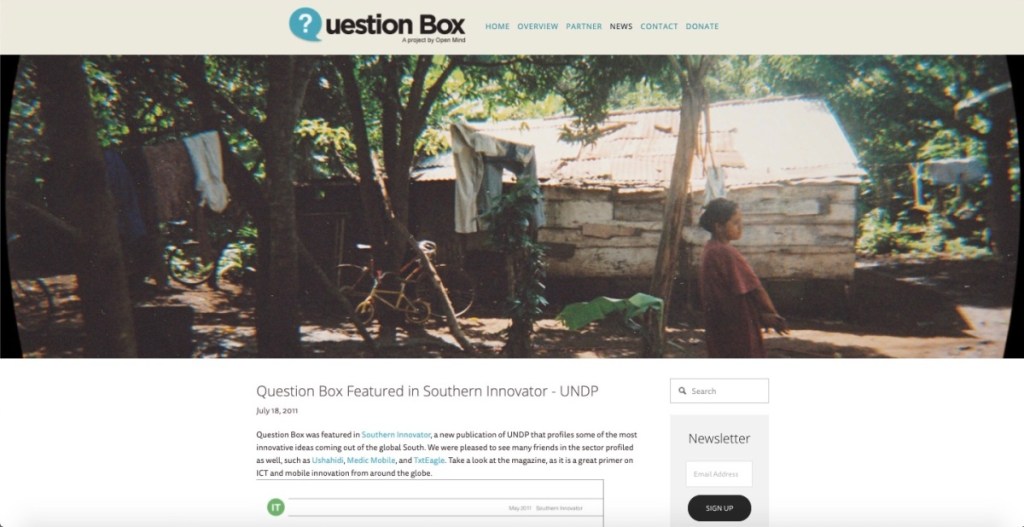
A unique solution in rural India is developing a way to connect the illiterate to the internet. The Open Mind Programme’s Question Box Project, opened its first Box in the village of Phoolpur in September 2007.
The idea is brilliantly simple. An intercom-like white tin box with a phone inside is placed in a village’s public areas. Using the existing phone networks, the user just has to hit a simple button to get an operator at the other end. The operator sits in front of an internet-enabled computer. The user just asks their question, and the operator turns these questions into search queries. When the computer’s search engine gives back answers, the operator selects the best one and then replies in the user’s native language and in layman’s terms.
The operator’s role goes beyond simply typing questions into Google – the operators use intelligent software that aggregates frequently asked questions (FAQs) to speed up time. FAQs include: school scores, job opportunities, football/cricket scores, and definitions and terms. Operators will also send emails for the users.
The service also has a role to play for the literate who lack Internet access. Students once had to travel to get their exam results, but now they can just ask the Question Box.
The Question Box operates in normal business hours for now. A second Question Box was put into operation at the beginning of 2008 in the village of Ethida, several hours’ drive from New Delhi, and there are plans to expand the Question Box to 30 units connected to 20 operators.
At present, organizers are looking into raising revenue for the service by advertising and sponsorship. Operators are typically homeworkers and well-educated. Mostly female, their parents are happy to have them work from home.
During this first phase, the project team analyzed the results and refined the structure of the service. They are also exploring viable business models to be able to take the service across India and keep it sustainable.
Professor of Psychology Ritu Dangwal from the NIIT Institute, is in charge of working with the villagers to monitor the project. She is also involved in a start-up called Hole in the Wall, which provides internet kiosks to rural villagers. Dangwal’s research has starkly correlated the relationship between distance from a big city and decreasing quality of education, a graphic example of the damage done by being cut off from good information resources.
The Question Box is based on an idea from Rose Shuman, a business and international development consultant. Shuman had become frustrated that with all the clever people and vast sums of money going into information technology, few were developing low-cost ways to take the power of computers to the people.
“The best thing about this project is that it’s very tangible,” she told the Daily Telegraph newspaper. “It’s not a big infrastructure. You have a box you can see and touch, and a call log of every question.”
Published: April 2008
Resources
Photographs of the project launch and the Question Box: www.flickr.com
The Internet has revolutionized retail sales in many developed countries – and nowhere more so than for booksellers. The ability to offer an almost unlimited supply of books through a website is revolutionizing the way people shop and giving life to books long out of print or by unknown authors.
Kenya has recently gained a reputation for doing things differently in Africa and making great strides when it comes to using information technologies. And the next development in this story is the launch of a Kenyan online book shop modelled on the successful U.S. online bookseller Amazon (amazon.com).
A book boom is well underway across the global South. Literary festivals continue to expand, from Colombia in South America to India to Nigeria in West Africa, and so do sales of books, newspapers and magazines. While the publishing industries in developed countries despair at the impact of digital media on their profits, in the global South, rising prosperity and literacy are fuelling greater interest in reading and a growing print publishing industry. For example, India is experiencing 15-per-cent-a-year growth for its publishing industry, which is valued at nearly US $2 billion (Frankfurt Book Fair).
Kenya’s Text Book Centre (TCB) (textbookcentre.com), considered one of the country’s most reputable booksellers, has launched its own online book selling portal and its “eBook web store”. It is targeting readers across East Africa and sells books in 14 categories. Being Kenyan, it is taking an innovative approach that recognizes the large numbers of people who are doing all their transactions over mobile phones. The book portal allows customers to make purchases with their mobile phones using mobile money. This system uses the Kopo Kopo (kopokopo.com) software platform, which allows small and medium sized businesses to accept mobile phone payments.
Kopo Kopo was first developed in Sierra Leone in 2011, before being further prototyped in Kenya. Kopo Kopo wanted to develop an effective mobile platform to help small and medium sized businesses to better interact with their customers. The Kopo Kopo service was officially launched in February 2012 and is partnered with Safaricom, using its M-PESA Buy Goods service. It is being currently used by hundreds of businesses, from “salons to restaurants to office supply stores”, according to Kopo Kopo’s website.
As an added benefit, the Kenyan online book platform is joined by a new marketplace for thousands of African ebooks. This part of the service is called eKitabu (ekitabu.com).
EKitabu will be a big boost to the continent’s authors and also open up new opportunities for budding authors who previously would have struggled to get published and distribute their work. If the ebook web store follows the dynamic of online booksellers in more developed markets, then this ability to gain exposure for author’s work and find an audience could also attract bigger publishers and spark interest in international book deals for formerly obscure writers.
The Text Book Centre was founded in 1964 by two Indian business partners in Kenya, Mr. SV Shah and Mr. MJ Rughani, and is now considered the leading bookstore in Kenya, specializing in leisure and educational books, according to its website.
Headquartered in Nairobi’s central business district, it focuses on providing books for the educational sector and strives to be “East Africa’s leading leisure and educational bookstore and office support resource centre”. It also supplies to customers in Uganda, Sudan, Somalia, Malawi, Zanzibar and Tanzania.
Published: March 2013
Resources
1) Tara Books: Based in Chennai, India, the book publisher is a co-operative and has published 200,000 hand-made books since its founding in 1994. Website: http://www.tarabooks.com/
4) African Publishers Network (APNET): APNET’s vision is the transformation of African peoples through books. APNET’s mission is to strengthen African publishing through networking, training, trade promotion, Intellectual Property (IP) and advocacy, in partnership with other stakeholders, to fully meet Africa’s need for quality, relevant books. Website: http://www.african-publishers.net/






















 David South Consulting
You must be logged in to post a comment.