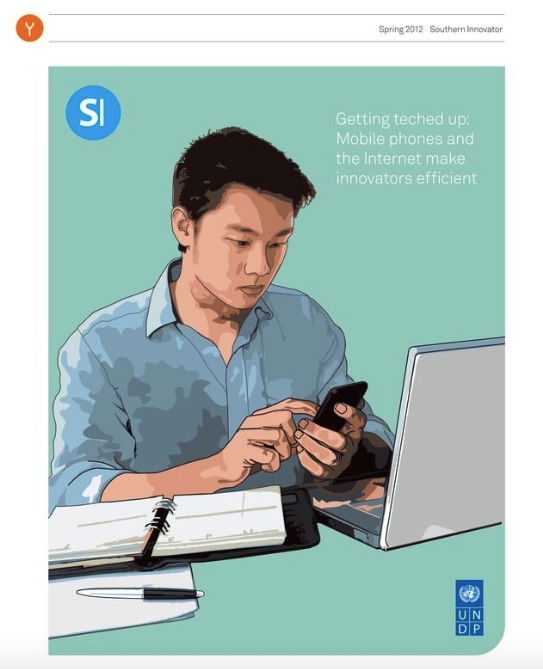
Tag: Mobile Phones and Information Technology

  • Popular Chinese Social Media Chase New Markets

    Popular Chinese Social Media Chase New Markets

    By David SouthDevelopment Challenges, South-South Solutions

    SOUTH-SOUTH CASE STUDY

    China has a vast and growing market for the Internet and mobile devices. Over the past decade that market has been largely confined to China –  most businesses have had enough domestic demand and opportunities inside the country to keep them busy.

    But now companies in China’s dynamic Internet and mobile sector are seeking out new markets outside the country. Both online shopping service Alibaba (alibaba.com) and Weibo (weibo.com), the Chinese version of Twitter (twitter.com), are seeking to list on the New York Stock Exchange. The excitement this news has generated shows how many people want to get a piece of the large Chinese market for technology, social networks and online shopping. It is also sending a chill through America’s Silicon Valley – home to the country’s innovative high technology sector – that they are missing out on China’s fast-growing marketplace. Many American services are banned from operating in China. Even more worrying for Silicon Valley, these home-grown Chinese companies, with the market sewn up at home, are now set to compete globally for customers using their increasingly deep pockets.

    One example is Tencent (http://www.tencent.com/en-us/index.shtml), owner of popular Chinese social messaging application (app) Weixin (weixin.qq.com), known as WeChat (wechat.com) outside China. Used on mobile phones and smartphones, Weixin has gained 300 million users in just three years, becoming the dominant social messaging service in the world’s largest smartphone market. Its has been so successful that many rivals are trying to chip away at its customer base.

    Weixin, pronounced way-shin, allows smartphone users to send messages and share news, photos, videos and web links with friends. One of its selling points is its claim to not store messages on its servers.

    Building on its success in social networking in China, it is looking to expand in other markets, including Southeast Asia, Europe and Latin America. It also wants to grow its offerings in online payment and e-commerce.

    One factor in Weixin’s success is the ability to send messages by recording a voice message rather than just typing in characters: very useful for non-Latin script users, and especially for Chinese-language users, who use thousands of characters in everyday communication.

    One ambitious forecast claims Weixin could reach 400 million users and make US $500 million revenue within a year.

    Cosmetics marketer Jenny Zhao, who uses an iPhone 5, told The New York Times: “I’m probably on Weixin six hours a day. A lot of what I do revolves around it.”

    “I use Weixin every day,” said Zhang Shoufeng, a food and drinks seller. “My friends are on it and my boss is on it. We are talking about where to eat, where to hang out and where to meet for company conferences. This is how we communicate.”

    Analysts believe Weixin has benefitted from not having to compete with banned-in-China American company Facebook (facebook.com).

    “Even if Facebook had permission, it’s probably too late,” said Wang Xiaofeng, an analyst at Forrester Research. “Weixin has all the functionality of Facebook and Twitter, and Chinese have already gotten used to it.”

    Tencent is an example of a wider trend: As Chinese companies and offerings have become stronger, wealthier and more innovative, they increasingly look to build their customer base outside China.

    Founded in November, 1998, Tencent, Inc. has grown into China’s largest and most used Internet service portal. Its most popular services include QQ (QQ Instant Messenger), WeChat, QQ.com, QQ Games, Qzone, 3g.QQ.com, SoSo, PaiPai and Tenpay, as well as Weixin.

    The company claims to put innovation at the heart of its business, with more than half of its employees devoted to research and development. The Tencent Research Institute, established in 2007 with RMB 100 million (US $16 million), calls itself “China’s first Internet research institute, with campuses in Beijing, Shanghai, and Shenzhen.” It has patents for technologies it has developed for instant messaging, e-commerce, online payment services, search, information security, and gaming.

    Tencent was driven to innovate by a fear it could quickly become irrelevant in the information technology space. Weixin is also pioneering ways to book taxis, hotels and airline flights through the service and even ways to control home appliances.

    “Chinese Internet companies are no longer behind,” said William Bao Bean, a managing director at the venture capital firm SingTel Innov8 (http://innov8.singtel.com/). “Now in some areas, they’re leading the way.”

    Published: April 2014

    Resources

    1) Weibo: Sina Weibo is a Chinese microblogging (weibo) website. Akin to a hybrid of Twitter and Facebook, it is one of the most popular sites in China, in use by well over 30 per cent of Internet users, with a market penetration similar to what Twitter has established in the USA. Website: weibo.com

    2) Laiwang: A variation on the WeChat service, its biggest competitor. Website: laiwang.com

    3) WhatsApp: WhatsApp Messenger is a cross-platform mobile messaging app which allows you to exchange messages without having to pay for SMS. Website: whatsapp.com

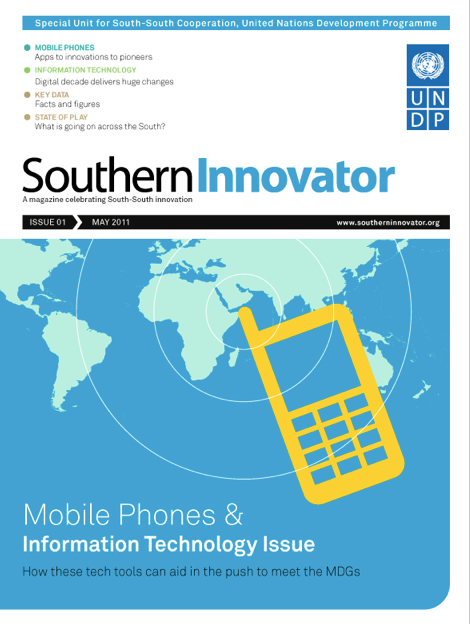
    4) Southern Innovator Issue 1: Mobile Phones and Information Technology: Pioneering and innovative ways to deploy mobile phones and information technology to tackle poverty. Website: http://www.scribd.com/doc/57980406/Southern-Innovator-Magazine-Issue-1 and here: http://tinyurl.com/q6bfnpz
    https://davidsouthconsulting.org/2022/10/20/china-consumer-market-asian-perspective-helps/

    https://davidsouthconsulting.org/2020/12/10/china-sets-sights-on-dominating-global-smartphone-market/

    https://davidsouthconsulting.org/2021/03/20/computer-gold-farming-turning-virtual-reality-into-real-profits/

    https://davidsouthconsulting.org/2021/01/26/designed-in-china-to-rival-made-in-china/

    https://davidsouthconsulting.org/2022/10/26/tackling-chinas-air-pollution-crisis-an-innovative-solution/

    https://davidsouthconsulting.org/2020/04/17/virtual-supermarket-shopping-takes-off-in-china/

    Citation

    Qianyu, Ji (2014) “Exploring the Concept of QR Code and the Benefits of Using QR Code for Companies,” Lapland University of Applied Sciences, School of Business and Culture Degree Programme in Business Information Technology, 2014.

    Development Challenges, South-South Solutions was launched as an e-newsletter in 2006 by UNDP’s South-South Cooperation Unit (now the United Nations Office for South-South Cooperation) based in New York, USA. It led on profiling the rise of the global South as an economic powerhouse and was one of the first regular publications to champion the global South’s innovators, entrepreneurs, and pioneers. It tracked the key trends that are now so profoundly reshaping how development is seen and done. This includes the rapid take-up of mobile phones and information technology in the global South (as profiled in the first issue of magazine Southern Innovator), the move to becoming a majority urban world, a growing global innovator culture, and the plethora of solutions being developed in the global South to tackle its problems and improve living conditions and boost human development. The success of the e-newsletter led to the launch of the magazine Southern Innovator.  

    Creative Commons License

    This work is licensed under a
    Creative Commons Attribution-Noncommercial-No Derivative Works 3.0 License.

    ORCID iD: https://orcid.org/0000-0001-5311-1052.

    © David South Consulting 2025
  • The BRCK: Kenyan-Developed Solution to Boost Internet Access 

    The BRCK: Kenyan-Developed Solution to Boost Internet Access 

    By David SouthDevelopment Challenges, South-South Solutions

    SOUTH-SOUTH CASE STUDY

    Using the Internet in Africa has its challenges, as anyone who has worked there knows. Issues can include weak Wi-Fi signals, slow Internet service providers, electricity outages and power surges that can damage or destroy sensitive electronic devices.

    Power surges (http://electronics.howstuffworks.com/everyday-tech/surge-protector3.htm) can occur for a variety of reasons but are usually a sudden surge in the current flowing to the wall outlet from the power mains. They are common in developing countries, and can be tragic for electronic devices.
    Most electronic devices are designed for use in developed countries where people can take the power supply, and ubiquitous Internet access, for granted. This affects the way devices are made. Designers will assume many things are available to users and build the electronic devices accordingly. But for users in Africa and across the global South, what seems easy in the developed world is fraught with frustration and wasted time.

    This is a big obstacle to economic development and places people in Africa at a disadvantage in the modern world of fast communications.

    One initiative is out to transform this experience for the better with a made-in-Africa solution that is being modified based on real-world experience and user feedback.

    The BRCK (brck.com) bills itself as “your backup generator for the Internet” and is intended to address the problems of finding a reliable Internet connection, staying online in a power blackout and saving devices from destruction when there is a power surge.

    Anyone who has tried to use a laptop computer to upload some photographs in Africa will know the frustration felt when the Wi-Fi signal drops away. The BRCK hunts around for the strongest signal and grabs it so the user can carry on working.

    Built to be robust and take knocks and bruises, it is a sleek, black plastic brick-shaped device with the letters BRCK elegantly embossed on the side.
    The BRCK can function as a hub for up to 20 devices, with a built-in Wi-Fi signal able to cover multiple rooms (so a team can work off a single Internet connection), a battery that can last eight hours, a 16-gigabyte on board memory hard drive, and software to allow for remote management  by apps on other devices such as smartphones. While it is not able to speed up an already poor connection or increase low bandwidth, it can “scavenge” around to find the strongest signal and hop to it right away. It can work with Ethernet, Wi-Fi, and 3G and 4G networks.

    If a blackout occurs, it quickly switches to the onboard battery without forcing a re-boot of the computer.

    It has been developed in Nairobi, Kenya and the first plastic prototype of the BRCK device was milled at the Fab Lab Nairobi (http://fablab.uonbi.or.ke/) using a 3D fabricator machine.

    The BRCK’s makers describe it as a tool “trying to create ubiquitous Internet” and an “enabler of the Internet of things.” The BRCK is designed around the changing way people work and access the Internet, frequently moving from place to place. People now don’t just rely on one device but have many – a mobile phone or smartphone, a laptop, a tablet, an iPod or other device.

    A Kickstarter fundraising campaign (https://www.kickstarter.com/projects/1776324009/brck-your-backup-generator-for-the-internet) gives more details on the origins of the project and offers many ways to support the different stages of development, right up to mass manufacturing of the BRCK.

    One application of the BRCK is for research. It could be deployed to gather data at a field site, then connect via the Cloud (http://en.wikipedia.org/wiki/Cloud_computing) to pass data back to a lab at a university in another country for analysis.

    The BRCK is being built by Ushahidi (ushahidi.com), a non-profit technology company that makes open source software and made its name with the crowdsourced mapping platform it built during the post-election violence in Kenya in 2008. The Ushahidi platform has been deployed around the world since in many crisis situations.

    Founded by David Kobia, Juliana Rotich and Erik Hersman, the Ushahidi team is focused on “building tools that improve the way information flows in the world.” It is about making tools to help people communicate in the most difficult places.

    BRCK comes with a visually appealing website that makes excellent use of the BRCK’s ebony good looks.

    The website boasts: “If it works in Africa, it’ll work anywhere”.

    The ongoing development of the BRCK can be followed on the website’s blog: http://www.brck.com/2014/01/they-case-for-engineering-brck-in-africa-part-1/.

    “The idea is to build a company around the product rather than just do a one-off product – and to gradually improve the product through new versions,” said BRCKs chief technology officer Reg Orton.

    “Our engineers are based in Kenya now – we are not based in China, we are not based in the (Silicon) Valley. What that means for us we are able to go out there and (be) able to see the problems directly.”

    The BRCK can be ordered online and will be available for sale soon, according to the website.

    Published: April 2014

    Resources

    1) Momax iPower Milk External Battery:  Inspired from daily life, the creative iPower Milk looks like a cute and fresh milk carton. It fulfills your daily energy need just as pure milk. iPower Milk comes in a variety of cheerful candy colors, so choose one which suits your taste. The tiny and delicate iPower Milk has 1.5A USB output, which is compatible with most digital devices, including tablets. Website: http://shop.brando.com/Momax-iPower-Milk-External-Battery-2600mAh_p09700c1595d003.html

    2) Southern Innovator Issue 1: Mobile Phones and Information Technology: Pioneering and innovative ways to deploy mobile phones and information technology to tackle poverty. Website: http://www.scribd.com/doc/57980406/Southern-Innovator-Magazine-Issue-1 and here: http://tinyurl.com/q6bfnpz
    3) iHub Nairobi: Nairobi’s Innovation Hub for the technology community is an open space for the technologists, investors, tech companies and hackers in the area. This space is a tech community facility with a focus on young entrepreneurs, web and mobile phone programmers, designers and researchers. It is part open community workspace (co-working), part vector for investors and VCs (venture capitalists) and part incubator. Website: ihub.co.ke

    4) Fab Lab Nairobi: Fablab (fabrication laboratory or “fabulous laboratory”) is a workshop with an array of computer controlled tools with the aim to make “almost anything”. Fab labs provide widespread access to modern means for invention. They began as an outreach project from MIT’s Center for Bits and Atoms (CBA). CBA assembled millions of dollars in machines for research in digital fabrication, ultimately aiming at developing programmable molecular assemblers that will be able to make almost anything. Fab labs fall between these extremes, comprising roughly fifty thousand dollars in equipment and materials that can be used today to do what will be possible with tomorrow’s personal fabricators. Website: http://fablab.uonbi.or.ke/

    https://davidsouthconsulting.org/2021/03/20/accessing-global-markets-via-design-solutions/

    https://davidsouthconsulting.org/2022/10/26/africa-to-get-own-internet-domain/

    https://davidsouthconsulting.org/2022/10/24/brazilian-solar-powered-wifi-for-poor-schools/

    https://davidsouthconsulting.org/2020/04/30/crowdsourcing-mobile-phones-to-make-the-poor-money/

    https://davidsouthconsulting.org/2020/05/01/diy-solution-charges-mobile-phones-with-batteries/

    https://davidsouthconsulting.org/2022/10/17/east-africa-to-get-its-first-dedicated-technology-city/

    https://davidsouthconsulting.org/2020/12/20/kenya-reaches-mobile-phone-banking-landmark/

    https://davidsouthconsulting.org/2022/11/23/kenyan-farmer-uses-internet-to-boost-potato-farm/

    https://davidsouthconsulting.org/2020/12/20/mobile-phones-bring-the-next-wave-of-new-ideas-from-the-south/

    https://davidsouthconsulting.org/2021/03/20/texting-for-cheaper-marketplace-food-with-sokotext/

    https://davidsouthconsulting.org/2022/10/10/wireless-internet-culture-helping-zimbabwe-economy-recover/

    Development Challenges, South-South Solutions was launched as an e-newsletter in 2006 by UNDP’s South-South Cooperation Unit (now the United Nations Office for South-South Cooperation) based in New York, USA. It led on profiling the rise of the global South as an economic powerhouse and was one of the first regular publications to champion the global South’s innovators, entrepreneurs, and pioneers. It tracked the key trends that are now so profoundly reshaping how development is seen and done. This includes the rapid take-up of mobile phones and information technology in the global South (as profiled in the first issue of magazine Southern Innovator), the move to becoming a majority urban world, a growing global innovator culture, and the plethora of solutions being developed in the global South to tackle its problems and improve living conditions and boost human development. The success of the e-newsletter led to the launch of the magazine Southern Innovator.  

    https://davidsouthconsulting.org/2021/03/05/southern-innovator-issue-1/

    Creative Commons License

    This work is licensed under a
    Creative Commons Attribution-Noncommercial-No Derivative Works 3.0 License.

    ORCID iD: https://orcid.org/0000-0001-5311-1052.

    © David South Consulting 2023

  • The Battle for India’s Coffee Drinkers in Buzzing Economy

    The Battle for India’s Coffee Drinkers in Buzzing Economy

    By David SouthDevelopment Challenges, South-South Solutions

    SOUTH-SOUTH CASE STUDY

    A showdown in India over coffee is creating new opportunities. It is also demonstrating how the country is changing, with rising incomes in some places and great disparities in others.

    Finding the right place to have a coffee and meet with friends for a chat is important to many urban Indians. And the fight is on for these customers.

    Older establishments like the legendary College Street Coffee House in Kolkata (http://en.wikipedia.org/wiki/College_Street_Coffee_House) – owned by a cooperative society – compete with new rivals modelled on the popular American chain Starbucks (http://www.starbucks.com/). This fierce competition takes place in an economic environment of rising food inflation of up to 16 percent this year and economic growth surpassing seven percent.

    Coffee is the second most popular drink in India after tea. Its consumption has been steadily growing over the years, rising from 50,000 metric tonnes (MT) in 1995 to 94,400 MT in 2008 (Coffee Board of India). Once mainly drunk in the south of India, the taste for coffee has spread around the country with the rise of fast-paced modern lifestyles. The caffeine (http://en.wikipedia.org/wiki/Caffeine) jolt of a cup of coffee is attractive to people on the move and working hard.

    India also holds its own as a coffee growing and exporting nation, accounting for about 4.5 percent of world coffee production and the industry provides employment to 600,000 people. The state of Karnataka accounts for 70 percent of country’s total coffee production followed by Kerala (22 percent) and Tamil Nadu (7 percent).

    India has the domestic demand, and it has the product. And now a bitter battle for the nation’s coffee drinkers is underway. The difference between what is on offer at the cooperative-run coffee houses and the newer establishments is stark: at the older places, service is old-fashioned – waiters in white suits deliver coffee and food to tables – with a no-frills menu on offer. Coffee comes in simple forms: black, white, cold, hot for eight rupees (US 0.18 cents). At newer establishments, coffees come in many varieties and permutations, flavoured and with added extras. Menus also can be varied and establishments can include things like internet access.

    The appeal of the older establishments is price.

    “It’s good here because it’s cheap,” College Street Coffee House customer Arindam Chouwdhry, 19, told The Guardian newspaper. “We can’t go to these new places. We are from the middle class only.”

    And turnover is brisk, according to manager, Deepak Gupta. “We serve up to 1,500 cups a day. Business is good.”

    Owned by the India Coffee House chain (http://en.wikipedia.org/wiki/Indian_Coffee_House), a worker’s cooperative society with 400 outlets across the country, the Coffee House was established in the 1950s with the mandate to serve cheap food and drink and act as a meeting place. It attracts workers, intellectuals and political activists. But with the huge economic changes in India over the past decade, traditional coffee houses are facing fierce competition.

    In the state of Kerala, home to avid coffee drinkers, 15 of the cooperative’s 50 branches are now losing money. In the capital, Delhi, a further 10 coffee houses have closed. Things are so bad for these traditional coffee houses that the most famous branch of the Indian Coffee House has not paid its rent for years and is waiting to be closed by the municipality.

    “The younger crowd seems to go elsewhere,” said its resigned manager, Janak Raj.

    In many countries, coffee houses have become essential tools for economic development. They not only offer a stimulating drink, but a place to hang out, meet friends and business partners, catch up on news and access the internet. This role in economic development can be found as far back as the coffee houses of Europe during the beginning of the industrial revolution: deals were struck and people could meet the like-minded to hatch business ideas.

    Coffee houses and cafes also reflect the economic and social changes in Indian society. They have come to be status symbols, showing what economic power you have achieved. And as services and quality change, they show how the level of prosperity changes.

    New competitors to the cooperative coffee houses’ are offering a more modern environment to lure in a trendier crowd. Café Coffee Day (http://www.cafecoffeeday.com/index.php), which claims to be India’s largest chain coffee shop, with the motto “where the young at heart unwind”, has air conditioning, mirrors, comfortable chairs and posters on the walls for decoration. And the price is different as well: choco-frappes go for 95 rupees (US $2.11).This price means the customers need higher incomes to afford to go there.

    “McDonald’s is the cheapest hangout and everyone can go there,” said a customer, Sima. “This is much nicer and only a bit more expensive so we come here. But only a few people can go to Barista’s.”

    The chain Barista’s (http://www.barista.co.in/users/index.aspx) is 10 years old with 230 outlets. It is growing fast with 65 more new outlets opening this year. According to its head of marketing, Vishal Kapoor, Barista’s does not simply offer coffee, but “an overall experience.”

    They bill themselves as “crème” cafes: places where salads and smoothies are on offer beside the coffee.

    “It’s very exciting what is happening in India,” Kapoor said. “The classic coffee houses are part of an era that is ending.”

    “People use the cafes as places to meet for privacy. “It is a kind of private space,” says Ruchika, a bank worker.

    Nonetheless, despite its success, Barista’s is still too expensive for most Indians.

    Published: April 2010

    Resources

    1) 48 innovations in coffee culture: This eclectic mix of innovations, trends and tit bits on global coffee culture is sure to inspire any budding coffee entrepreneur. Website: http://www.trendhunter.com/trends/coffee-innovation

    2) Watch a video report from the coffee houses. Website: http://www.guardian.co.uk/travel/video/2010/apr/01/india-coffee-house-kerala

    3) Coffee Board of India: The Board focuses on research, development, extension, quality upgrades, market information, and the domestic and external promotion of Coffees of India. Website: http://www.indiacoffee.org/login.php

    4) Practical advice and contacts on how to start a coffee shop. Website: http://www.howtostartacoffeeshop.co.uk/

    Development Challenges, South-South Solutions was launched as an e-newsletter in 2006 by UNDP’s South-South Cooperation Unit (now the United Nations Office for South-South Cooperation) based in New York, USA. It led on profiling the rise of the global South as an economic powerhouse and was one of the first regular publications to champion the global South’s innovators, entrepreneurs, and pioneers. It tracked the key trends that are now so profoundly reshaping how development is seen and done. This includes the rapid take-up of mobile phones and information technology in the global South (as profiled in the first issue of magazine Southern Innovator), the move to becoming a majority urban world, a growing global innovator culture, and the plethora of solutions being developed in the global South to tackle its problems and improve living conditions and boost human development. The success of the e-newsletter led to the launch of the magazine Southern Innovator.  

    Creative Commons License

    This work is licensed under a
    Creative Commons Attribution-Noncommercial-No Derivative Works 3.0 License

    ORCID iD: https://orcid.org/0000-0001-5311-1052.

    © David South Consulting 2023

  • Cheap Indian Tablet Seeks to Bridge Digital Divide

    Cheap Indian Tablet Seeks to Bridge Digital Divide

    By David SouthDevelopment Challenges, South-South Solutions

    SOUTH-SOUTH CASE STUDY

    India has had many false starts in innovating in information technology. While the country and its talented army of software engineers have a global reputation for innovation, the fits and starts that have accompanied attempts to create new hardware and devices have drawn a range of emotions, from amusement to frustration.

    India faces an urgent problem: the country is falling behind others in the global South in access to the Internet. Based on 2009 data, there are 5.1 Internet users for every 100 Indians. This compares poorly with Brazil at 39.2 per 100 and China at 28.5.

    The challenge is to find inexpensive devices that allow people to access the Internet through mobile phone networks. With 37 percent of India’s 1.21 billion people living below the official poverty line – and some estimates placing the number at up to 77 percent – cheap devices are urgently needed to reach the poor. A study developed by the Oxford Poverty and Human Development Initiative (OPHI),  found eight Indian states account for more poor people than the 26 poorest African countries combined. The Indian states had 421 million “poor” people, compared to 410 million poor in the poorest African countries, it concluded.

    The World Bank recently criticised India for lacklustre results in addressing poverty levels.

    Five years ago, the Indian government launched a competitive search for an inexpensive device for the masses. The government has been supporting the development of these devices through its National Mission on Education through Information and Communication Technology (Sakshat) (http://www.sakshat.ac.in). It aims to link 25,000 colleges and 400 universities in India in an e-learning program.

    The motivation behind these attempts is a good one: to try and find an affordable device to bridge the digital divide (http://en.wikipedia.org/wiki/Digital_divide) and reach the majority of the population living on less than US $2 a day.

    But the search has had mixed results.

    Low points included a failed attempt to make a rival to the One Laptop Per Child (http://www.onelaptop.org) computer from MIT (Massachusetts Institute for Technology) with an Indian version selling for US $10. What was offered instead in 2009 was a device with no screen or keyboard, requiring an additional laptop and paper to access its stored files. It was also made in Taiwan, rather than India.

    Another first stab at making a US $35 tablet computer was launched in 2010 with much fanfare, but by January 2011 the Indian government had dropped manufacturers HCL Technologies for failing to honour its 600 million rupee (US $13 million) contract.

    What these first steps show is the complexity of hardware development and how challenging it is to get the user experience right for customers while keeping the price affordable.

    But India recently relaunched what it is calling the world’s cheapest tablet computer, selling for US $35. It is called Aakash (http://www.akashslate.com) (http://www.aakashcomputer.co.in), meaning “sky” in the Sanskrit language, and is being sold as an e-learning tool to bridge the digital divide in the country.

    The utility of tablets (http://en.wikipedia.org/wiki/Tablet_personal_computer) and e-readers (http://en.wikipedia.org/wiki/Comparison_of_e-book_readers) for people in the global South is clear: they can enable people to bypass the lack of local library facilities to store vast personal archives of books. This is a powerful educational tool: imagine a village doctor with easy access to thousands of medical texts and papers, or a child preparing for university exams no longer having to worry they can find study texts. It also is a cost-effective way to publish in many local languages and break the stranglehold English-language publishing has had on delivering e-books.

    Aakash will be sold for US $35 to educational institutions and marketed for private sale for US $61 under the UbiSlate brand name (http://www.ubisurfer.com). It is also hoped the tablet can be sold in the UK and the USA.

    Jointly developed by engineers in India, Canada and the UK, it will be assembled at DataWind’s manufacturing plant in Hyderabad, India (http://datawind.com/products.html). Datawind also makes other low-cost, portable devices like the PocketSurfer3 (http://www.pocketsurfer.co.uk).

    The project is run by two Indian-born Canadians, DataWind chief executive officer Suneet Singh Tuli and his brother Raja Singh Tuli.

    Based in Montreal, Canada, DataWind bills itself as “a leading developer of wireless web access products and services.”

    Suneet Singh Tuli wants to sell 1 million tablets a month. The first 100,000 tablets are being bought by the Indian government and then sold to university students.

    The Aakash uses the Google Android operating system (http://www.android.com) and has a WiFi capability, 17.78 centimetre wide screen, two USB ports (http://en.wikipedia.org/wiki/USB) and battery that can last three hours. It can stream high-definition videos, read e-books and run Microsoft Windows Office applications.

    The components in the device are a mix, including parts DataWind has designed itself to save costs.

    “This is not a one-time opportunity,” Suneet Singh Tuli told the Toronto Star newspaper. “There are 2½ to 3 million students entering university every year, as well as 80 million students in Grades 9 to 12, and the government is very serious about making mobile products available to this age group.

    “I could tell you a romantic story about two Indian brothers who arrive in Montreal to get a great Canadian education, become citizens, and then go back to India to bring Internet to the masses,” says Tuli.

    “But the reality is, this is all about profit – my investors and board wouldn’t want it any other way.”

    To compare, the Amazon Kindle Fire device (http://www.amazon.com/Kindle-Fire-Color/dp/B0051VVOB2), which launched recently, sells for US $199 and has fewer features.

    “The rich have access to the digital world; the poor and ordinary have been excluded. Aakash will end that digital divide,” Kapil Sibal, India’s education minister told the Financial Times.

    India’s initiatives are heating up competition with the One Laptop Per Child project set up by MIT professor Nicholas Negroponte (http://one.laptop.org). The colourful OLPC laptop sells for around US $200, and 2 million have been distributed to Latin America, Africa elsewhere.

    While many companies and entrepreneurs are developing products for the poor and the bottom of the pyramid (BOP) markets, it is still a difficult thing to get right. A big issue is aspiration: consumers are still attracted to products they perceive as aspirational and quality, despite a higher price.

    “(Aakash) might suffer the Nano syndrome,” Shashi Bhusan, technology analyst at brokerage Prabhudas Lilladher, told the Financial Times, referring to the cheap made-in-India car that failed to catch on (http://tatanano.inservices.tatamotors.com/tatamotors). “It is always difficult to predict the market’s reaction to a product, but what we have learnt from the Nano is that people don’t want to buy the ‘car-like’ product, they want the real thing … I feel the same will probably happen with this ‘laptop-like’ product.”

    And others strongly disagree that gadgets can transcend the deep-seated social problems that need radical change.

    “It is charity of a very superficial nature,” said George Mathew, director of Delhi’s Institute of Social Sciences. “It has nothing to do with the structure and permanency of our society and our system – you have to work for systemic change.”

    Earlier this year an Indian company produced a rival to Amazon’s Kindle (http://www.amazon.co.uk/Kindle-Store/b?ie=UTF8&node=341677031). The Wink (http://www.thewinkstore.com/ereader/index) is designed to accommodate 15 common Indian languages, comes in an eye-catching design and is complemented by a sleek website stuffed with e-books ready for download. The entire package is very well-thought-out and marketed.

    The Wink was developed and built by EC Media International and retails, according to its website, for Rs 8,999 (US $200). It looks similar to the Kindle, but where the Kindle is grey the Wink is white. This Indian rival has some impressive capabilities: it can not only support 15 Indian languages, it can also access an online library of more than 200,000 book titles. They range from arts and entertainment to biography, newspapers and science topics. There is also a large archive of free books for download.

    But it has come in for criticism for its price, which some say is far too high for the Indian market.

    As has been shown by the information technology experience in other countries, it is constant innovation and trial and error which will eventually create successes. But with persistence, this is one space to keep watching.

    Published: October 2011

    Resources

    1) How to build your own personal computer: This guide helps to demystify computing hardware and shows how to build a computer at home. Website: http://www.buildeasypc.com/

    2) Hardware design and architecture: An archive of free e-books on all aspects of computer hardware and architecture design. An outstanding resource to get anyone started in computer engineering. Website: http://www.e-booksdirectory.com/listing.php?category=38

    3) Jonathan Ive is the man behind the highly successful and user-friendly modern design that has turned the Apple computer brand into such a global success story. He provides tips on how to design usable computer hardware and shares the secrets of his success. Website: http://www.wired.com/culture/design/news/2003/06/59381

    Development Challenges, South-South Solutions was launched as an e-newsletter in 2006 by UNDP’s South-South Cooperation Unit (now the United Nations Office for South-South Cooperation) based in New York, USA. It led on profiling the rise of the global South as an economic powerhouse and was one of the first regular publications to champion the global South’s innovators, entrepreneurs, and pioneers. It tracked the key trends that are now so profoundly reshaping how development is seen and done. This includes the rapid take-up of mobile phones and information technology in the global South (as profiled in the first issue of magazine Southern Innovator), the move to becoming a majority urban world, a growing global innovator culture, and the plethora of solutions being developed in the global South to tackle its problems and improve living conditions and boost human development. The success of the e-newsletter led to the launch of the magazine Southern Innovator.  

    Creative Commons License

    This work is licensed under a
    Creative Commons Attribution-Noncommercial-No Derivative Works 3.0 License

    ORCID iD: https://orcid.org/0000-0001-5311-1052.

    © David South Consulting 2023