“I think you [David South] and the designer [Solveig Rolfsdottir] do great work and I enjoy Southern Innovator very much!”
Ines Tofalo, Programme Specialist, United Nations Office for South-South Cooperation
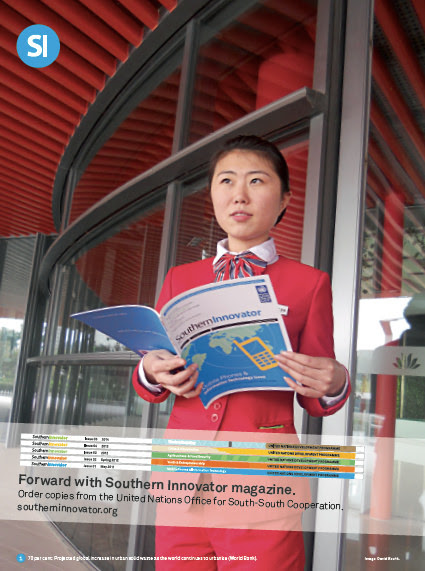
Southern Innovator in Tianjin, China.Issue 5 of Southern Innovator at the Global South-South Development Expo (GSSD Expo) 2014 held in Washington, D.C.Volunteers in Nairobi, Kenya pose with Southern Innovator Issue 4 at the Global South-South Development Expo (GSSD Expo) in 2013.Southern Innovator Editor and Writer David South in Australia.Southern Innovator Graphic Designer and Illustrator Sólveig Rolfsdóttir in Iceland.
Some comments that have come in so far about SI’s first issue:
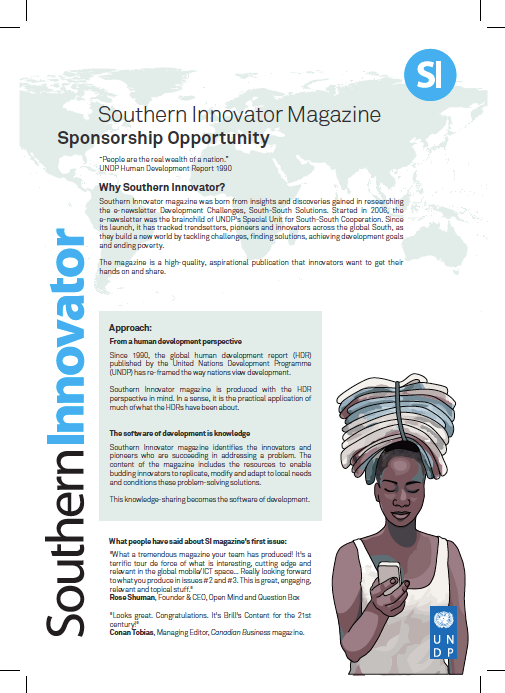
“What a tremendous magazine your team has produced! It’s a terrific tour de force of what is interesting, cutting edge and relevant in the global mobile/ICT space… Really looking forward to what you produce in issues #2 and #3. This is great, engaging, relevant and topical stuff.”, to “Looks great. Congratulations. It’s Brill’s Content for the 21st century!”
What they are saying about SI on Twitter: From @CapacityPlus Nice job RT @ActevisCGroup: RT @UNDP: Great looking informative@SouthSouth1 mag on South-South Innovation; @UNDP Great looking informative @SouthSouth1 mag on South-South Innovation; @JeannineLemaireGraphically beautiful & informative @UNDP Southern Innovator mag on South-South Innov.
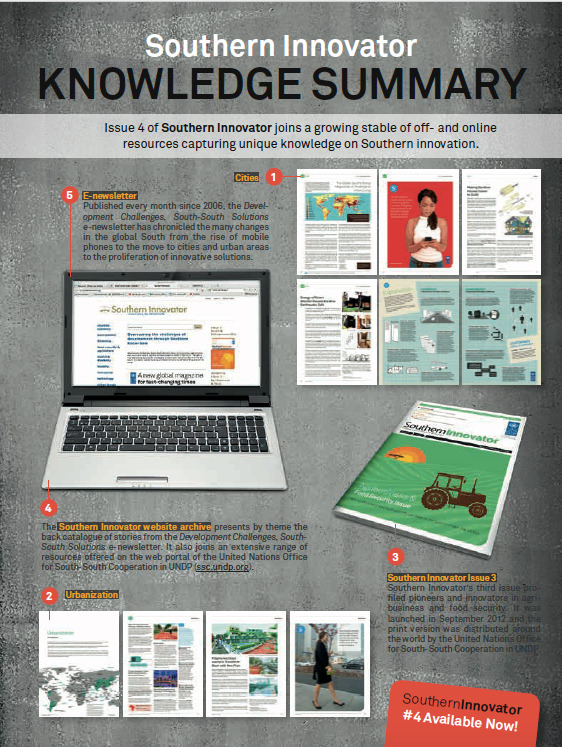
Development Challenges, South-South Solutions was launched as an e-newsletter in 2006 by UNDP’s South-South Cooperation Unit (now the United Nations Office for South-South Cooperation) based in New York, USA. It led on profiling the rise of the global South as an economic powerhouse and was one of the first regular publications to champion the global South’s innovators, entrepreneurs, and pioneers. It tracked the key trends that are now so profoundly reshaping how development is seen and done. This includes the rapid take-up of mobile phones and information technology in the global South (as profiled in the first issue of magazine Southern Innovator), the move to becoming a majority urban world, a growing global innovator culture, and the plethora of solutions being developed in the global South to tackle its problems and improve living conditions and boost human development. The success of the e-newsletter led to the launch of the magazine Southern Innovator.
A couple of enterprising Kenyan engineering students are showing how mobile phones are an inventor’s dream. Their two inventions – one a way to re-charge phones while bicycling, the other an aid for catching fish – show the potential for adapting this technology to the needs of the poor.
The rapid spread of mobile phones across the South is giving rise to a flurry of invention and experimentation. While many of the new mobile phone-users do not have much money, they are often driven by poverty to invent solutions – and in so doing prove the phones offer many ways to generate income.
According to the International Telecommunications Union (ITU), Africa is the world’s fastest-growing mobile phone market, and the number of subscribers surpassed 300 million in 2008. The number of mobile phone users in the world passed 4 billion in 2008, and the fastest growth was in the South (ITU). The trend towards increasing development of inexpensive handsets means more phones will be reaching even more poor people in the future.
Kenya has seen blistering growth in mobile phone ownership: from just 200,000 users in 2000, there are now more than 17.5 million people with mobile phones out of a population of 38.5 million
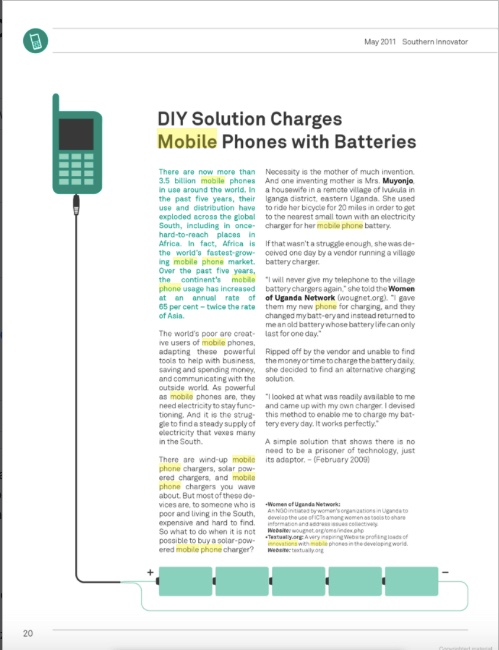
As powerful as mobile phones are, they need electricity to keep working. The struggle to find a steady supply of electricity vexes many in the South, so finding cheap or free ways to recharge the phones represents a huge market opportunity.
While mobile phone recharging has become a business in its own right across the South, it is costly as well as time-consuming. Some people spend hours just getting to recharging stations.
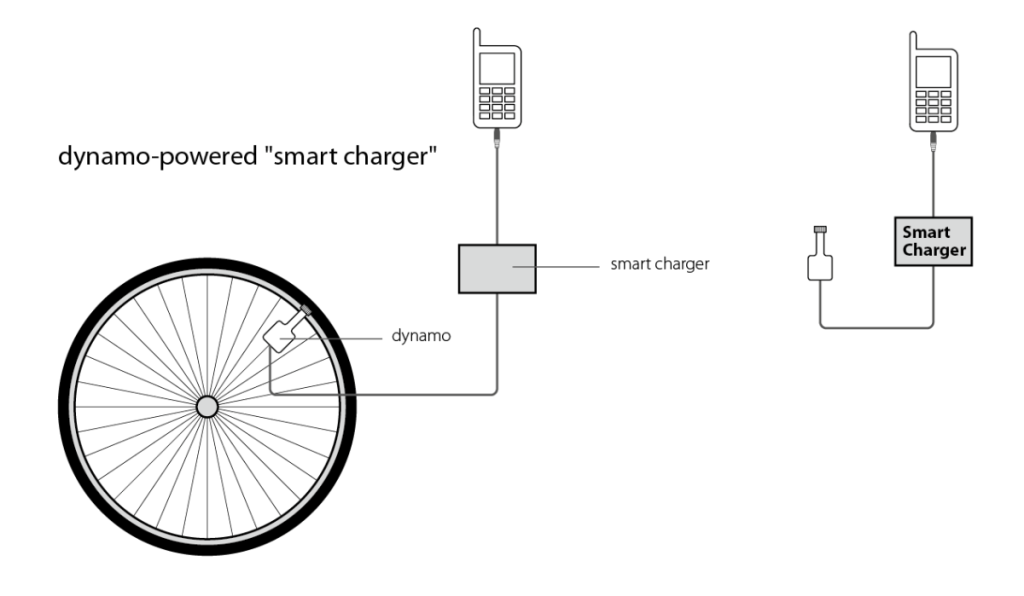
To tackle this chronic problem, Engineering students Pascal Katana and Jeremiah Murimi of the Department of Electrical and Information Engineering at the University of Nairobi, Kenya (http://uonbi.ac.ke/departments/index.php?dept_code=HE&fac_code=32) have invented a device called the “smart charger.” It is powered by the dynamo that is standard issue with most bicycles sold in Kenya. Dynamos on the bicycle’s back wheel are little electricity generators that use pedal power to illuminate the bike’s lights.
It takes an hour to charge the mobile phone by peddling the bicycle: around the same time it takes to charge a phone using an electricity plug. A one-time charge for somebody can cost up to US $2 at a recharging service. But the smart charger sells for 350 Kenyan shillings (US $4.50) – around the cost of two charges.
“We both come from villages and we know the problems,” Murimi told the BBC.
“The device is so small you can put it in your pocket with your phone while you are on your bike.”
The smart charger has been assembled from bits and pieces the duo found: “We took most of (the) items from a junk yard,” Katana said. “Using bits from spoilt radios and spoilt televisions.”
To test the experimental device, workers at the university campus were recruited to have a go.
“I use a bicycle especially when I’m at home in the rural areas, where we travel a lot,” said campus security guard David Nyangoro. “It’s very expensive nowadays charging a phone. With the new charger I hope it will be more economical, as once you have bought it, things will be easier for you and no more expenses.”
Kenya’s National Council for Science and Technology (http://www.ncst.go.ke/) has now backed the project and the students are exploring ways to mass-produce the smart charger.
Another invention by Katana has adapted a mobile phone to improve fishermen’s success, according to Afrigadget (www.afrigadget.com). It amplifies the sounds made by fish as they feed. As the sound is broadcast outwards from the feeding, other fish are attracted to the same place, believing there is more food. A GPRS/GSM (http://en.wikipedia.org/wiki/General_Packet_Radio_Service) mechanism in the fishing net is triggered when there is enough fish in the net, and an SMS text message is sent to the fisherman letting him know it is time to haul in the net.
It looks like Pascal Katana can re-charge your phone and fill your plate!
2) SMS Bootcamp: The “SMS Boot Camp” at the University of Nairobi, is a project-based course enabling teams of students to launch and market their own SMS services to the millions of mobile phone users in Kenya. A small amount of seed funding will be available to the best teams interested in turning their project into a commercial venture. Website: http://eprom.mit.edu/entrepreneurship.html
3) Mobile Active.org: MobileActive.org is a community of people and organizations using mobile phones for social impact. They are committed to increasing the effectiveness of NGOs around the world who recognize that the over 4 billion mobile phones provide unprecedented opportunities for organizing, communications, and service and information delivery. Website:www.mobileactive.org
4) Textually.org: is the entry point of three weblogs devoted to cell phones and mobile content, focusing on text messaging and cell phone usage around the world, tracking the latest news and social impact of these new technologies. Website:http://www.textually.org/
5) Ushahidi: is a website that was developed to map reports of violence in Kenya after the post-election fallout at the beginning of 2008. The new Ushahidi Engine is being created to use the lessons learned from Kenya to create a platform that allows anyone around the world to set up their own way to gather reports by mobile phone, email and the web – and map them. It is being built so that it can grow with the changing environment of the web, and to work with other websites and online tools. Website: http://blog.ushahidi.com/
6) Google Android: Get inventing! This software enables anyone to start making applications for mobile phones. And it offers a platform for developers to then sell the applications to others. Website:www.android.com/
7) Afrigadget: is a website dedicated to showcasing African ingenuity. A team of bloggers and readers contribute their pictures, videos and stories from around the continent. Website:http://www.afrigadget.com
Development Challenges, South-South Solutions was launched as an e-newsletter in 2006 by UNDP’s South-South Cooperation Unit (now the United Nations Office for South-South Cooperation) based in New York, USA. It led on profiling the rise of the global South as an economic powerhouse and was one of the first regular publications to champion the global South’s innovators, entrepreneurs, and pioneers. It tracked the key trends that are now so profoundly reshaping how development is seen and done. This includes the rapid take-up of mobile phones and information technology in the global South (as profiled in the first issue of magazine Southern Innovator), the move to becoming a majority urban world, a growing global innovator culture, and the plethora of solutions being developed in the global South to tackle its problems and improve living conditions and boost human development. The success of the e-newsletter led to the launch of the magazine Southern Innovator.
A pioneering tool for gathering health data now being used in Kenya could herald a revolution in the way diseases are tracked and defeated around the world. It uses mobile phones to better connect patients with medical and health personnel, and allows data to be gathered in real-time and used to track health and improve the delivery of services, especially to remote and under-serviced areas.
In the past couple of years, Kenya has become a hotbed of mobile phone and information technology innovation. The now-famous Ushahidi crisis-mapping platform (www.ushahidi.com) is just one example. Social enterprise Data Dyne (www.datadyne.org) – with offices in Washington DC and Nairobi, Kenya – is offering its EpiSurveyor application (www.episurveyor.org) free to all to aid health data collection. It bills itself as “the first cloud-computing application for international development and global health … Think of it as like Gmail, but for data collection!”
EpiSurveyor claims to have more than 2,600 users around the world and is currently being upgraded to a second version.
“With the touch of a button I can see what’s going on across the country in real time,” Kenyan civil servant Yusuf Ibrahim told Britain’s Daily Telegraph newspaper. “It is amazing.”
Ibrahim works in Nairobi as the Kenyan Ministry of Health liaison to Data Dyne.
He uses maps and charts on mobile phones to track deadly disease outbreaks and vulnerable pregnancies.
The EpiSurveyor application works simply: A user logs into the website and builds and creates the sort of form they want. They then download it to a phone and start collecting data straight away.
Ibrahim gathers this data from mobile phones used by health care workers across the country.
“It used to take days, weeks or even a couple of months to find out about an outbreak of polio on the other side of the country,” he said. “Now we know almost instantly. The speed with which we can now collect information has catapulted healthcare and prevention to another level. It has completely changed healthcare and saved countless lives.”
He proudly points out Kenya’s mobile phone data collection system is “probably better than what they’ve got in the West.”
“Although we are a third world country, I’m pretty sure we’ve done this before
Western countries. While they are still collecting information in hard copy on clipboards, we are getting it instantly.”
Packed with data processing power, mobile phones are capable of an immense range of tasks and applications. Some see phones as key to a revolution in how healthcare is provided: the mobile phone becomes one-part clinic, another part mobile hospital dispensing advice and transmitting vital information back to healthcare professionals and scientists in hospitals and labs.
Despite dramatic improvements to the quality of hospitals in Africa and the number of qualified doctors, the continent’s healthcare services are still a patchwork, with rural and slum dwellers poorly served and the stresses of treating patients with contagious diseases like HIV/AIDS and malaria pushing resources to the limit.
The United Nations has a number of initiatives partnering with mobile phone manufacturers, networks and software developers as part of a global campaign to reduce HIV/AIDS, malaria and deaths in childbirth.
EpiSurveyor is being used by more than 15 countries’ ministries of health and is the adopted standard for the World Health Organization (www.who.int) (WHO) for electronic health data collection.
It began as a partnership with the United Nations Foundation, The Vodafone Group Foundation, WHO and the ministries of health of Kenya and Zambia in 2006 to pilot test the software for EpiSurveyor.
At the United Nations Foundation (www.unfoundation.org), chief executive Kathy Calvin equates the impact of mobile phones on global healthcare to the discovery of the antibiotic penicillin.
“Instead of building clinics and roads to remote towns and villages so that people can access healthcare, we are bringing healthcare directly to the people via mobile phones. You get a lot more healthcare for your money,” Calvin told the Telegraph.
Development Challenges, South-South Solutions was launched as an e-newsletter in 2006 by UNDP’s South-South Cooperation Unit (now the United Nations Office for South-South Cooperation) based in New York, USA. It led on profiling the rise of the global South as an economic powerhouse and was one of the first regular publications to champion the global South’s innovators, entrepreneurs, and pioneers. It tracked the key trends that are now so profoundly reshaping how development is seen and done. This includes the rapid take-up of mobile phones and information technology in the global South (as profiled in the first issue of magazine Southern Innovator), the move to becoming a majority urban world, a growing global innovator culture, and the plethora of solutions being developed in the global South to tackle its problems and improve living conditions and boost human development. The success of the e-newsletter led to the launch of the magazine Southern Innovator.
Expertise: Innovation, innovators, human development, South-South development, United Nations, policy and policy innovation, South-South cooperation, South-South trade, global trends, strategy, online content, global memes, Internet, mobile phones, information technology, global South, resilience strategies, crisis response.
Locations: London, UK and New York, U.S.A. 2007 to 2016
Since the start of 2007, global international development and media consultancy David South Consulting (DSC)/David South International (DSI) has been working with the UNDP-associated United Nations Office for South-South Cooperation (UNOSSC) (formerly the Special Unit for South-South Cooperation) to raise the profile of South-South cooperation and the global South in global development through its innovators, as well as influencing the switch to an innovation-led approach to how development is delivered at the United Nations and at the country level. Based in London, UK and with a design studio in Reykjavik, Iceland, DSC/DSI did this with two highly influential media: the monthly e-newsletter Development Challenges, South-South Solutions, and its sister magazine Southern Innovator.
About
With the global economic crisis unfolding in 2007, we asked “what would inspire people?” What is going on in the global South that would improve human development under these circumstances and make people more resilient?
In 2007, discussing the global South, or solutions from the South, had a far lower profile in international development, the media and with the general public. Being one of the first sources to regularly chronicle the 21st-century world emerging from the crisis, the two publications (e-newsletter Development Challenges, South-South Solutions and its sister magazine Southern Innovator) were able to open up a space for greater coverage of the global South, while drawing attention to a new generation of development innovators.
“Great economic and business reporting! Very helpful for us.” Africa Renewal, Africa Section, Strategic Communications Division, United Nations Department of Public Information
“I just went over your June newsletter. It’s very well done and far reaching. Congratulations!” Violette Ruppanner, Director, 3D -> Trade – Human Rights – Equitable Economy, Geneva, Switzerland
“Just to let you know I enjoyed the newsletter a lot – it was interesting to learn about things going on that I would never otherwise find out about, and also the listing of future conferences and events proved very useful.” Ian Sanderson, Deloitte, Geneva, Switzerland
“Congratulations on another great newsletter that’s packed with fascinating information! I really enjoy getting it each month.” Whitney Harrelson, Making Cents, Washington D.C.
By adopting a strategy to exploit developments in online and digital media (and the space opened up by the global economic crisis), the reach of the e-newsletter and magazine was far greater than would have been possible just a year prior, back in 2006. This proved useful for reaching the growing number of people in the global South who were being digitally connected either through mobile phones or the Internet, or both.
The e-newsletter was not only distributed every month to subscribers, it was also simultaneously posted online in many platforms to reach as wide an audience as possible. It was kept simple in its design so as to be easy to access by readers with low bandwidth or high data costs. It exploited new online services to reach an as wide as possible audience.
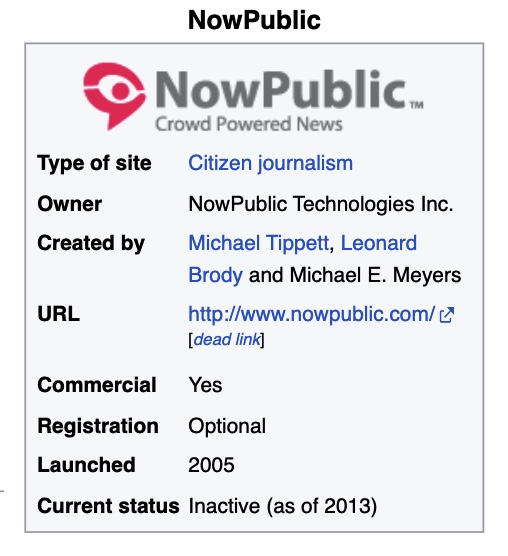
As an example, the arrival of ‘crowd-powered’ media in 2007 allowed for posting of stories to a global audience to test responses and reactions in real time. An experiment from 2008 to 2010 on the innovative Vancouver, Canada-based NowPublic platform proved very effective in developing the right tone for the stories. Many of these stories have been cited in publications and online (please see below for citations).
With 201 Development Challenges, South-South Solutions stories posted on the NowPublic platform, a total of 336,289 views by 2012 had occurred, according to the NowPublic counter.
Various websites offering publishing and archiving services (Scribd for example) meant it was easy to access the stories from any place, device or platform, bypassing firewalls and censors – a very serious concern in many countries of the global South. And social media such as Twitter made it easy to spread the word to the right people.
The two publications proved influential on a number of fronts, being early to draw attention to the following: the rising use of mobile phones and information technology in development, the world becoming an urban place, innovative food solutions including the nascent insect food sector (now a big thing), altering perspectives on what is possible in Africa, the use of data science to innovate development, and tracking the growing number of technology hubs and the fast-growing start-up culture in the global South. The publications were cited for shaping the new strategic direction adopted by the United Nations Development Programme (UNDP) (the UN’s leading development organisation) and its first youth strategy, and the development of the Sustainable Development Goals (SDGs). As the world’s first global innovator magazine, Southern Innovator’s design had to be appropriate for a diverse audience. It has drawn praise for being both “beautiful” and “inspiring”, while its use of sharp, modern graphic design and infographics inspired others in the UN to up their game when it comes to design.
Today, there are many sources for sharing stories on solutions from the global South; in fact, it could be called ‘cool’. South-South cooperation and innovation have now become the key methodology for the UN’s delivery of its programmes and projects. In 2015, China pledged US $2 billion to “support South-South cooperation” and called for the international community to “deepen South-South and tripartite cooperation”. In development parlance, they have been “Mainstreaming South-South and Triangular Cooperation” in their plans.
The current policy vogue for innovation in developing and developed countries can trace its roots back to some of the early work done by these two publications (and which was further amplified by the annual Global South-South Development Expo, which often would feature innovators from the two publications, spreading the innovation message around the world). Both publications had set out to inspire and “champion a global 21st century innovator culture”. And they have done this, as can be seen from concrete evidence and anecdotal responses from individuals and organizations alike.
Crucial to success has been integrity. As was disclosed in arrests made by the Federal Bureau of Investigation (FBI) in October 2015, a news service claiming to be associated with the United Nations (South-South News) had not followed either the letter or the spirit of the UN’s Global Compact. It had received substantial funding from a Macau casino owner featured in a 2010 investigation by International Risk Ltd., which found he “is characterized in the media as a ‘Macau Crime Lord’ and a kingpin of the international slave prostitution trade”. To date, a number of his co-conspirators have been found guilty of various charges and sentenced. He was convicted 28 July 2017 on six counts “for his role in a scheme to bribe United Nations ambassadors to obtain support to build a conference center in Macau that would host, among other events, the annual United Nations Global South-South Development Expo“. He used the news service as a “conduit for bribery and money laundering” at the United Nations, according to the FBI, something admitted to by the various co-conspirators in court and under oath. Read more on this case here: http://www.reuters.com/article/us-un-corruption-idUSKCN0XH2DL. And the conviction here: Chairman of a Macau Real Estate Development Company Convicted on All Counts for Role in Scheme to Bribe United Nations Ambassadors to Build a Multi-Billion Dollar Conference Center
The case of South-South News points to the dangers of cutting corners and the importance of approach and methodology; to not just mouth support for the UN Global Compact but to embrace its letter and spirit as well. As can be seen from this particular case, the reputational damage can be severe if the wrong strategy is pursued. Clients need to be very aware of whom they are working with and conduct due diligence for service provider credentials and also investigate the credentials of potential donors and funders.
Southern Innovator needed to be true to its ethos of championing genuine innovation that improves human development in the global South. It had to be free to pursue its search without interference.
To avoid censorship and interference, its editorial operations were based in London, UK and its design studio was based in Reykjavik, Iceland (a high-ranking country in the World Press Freedom rankings and a former top place holder in the UNDP Human Development Index). Using a women-led design studio, it developed a design vision that could communicate across borders using clear graphic design and high-quality images. For example, when it launched in 2011, infographics were rare in development publications and at the UN; now they are commonplace. It also tried to be as a ‘green’ as possible. The studio was powered on 100 per cent renewable energy (in particular, geothermal energy); the hard copy of the magazine is printed on paper from renewable forests.
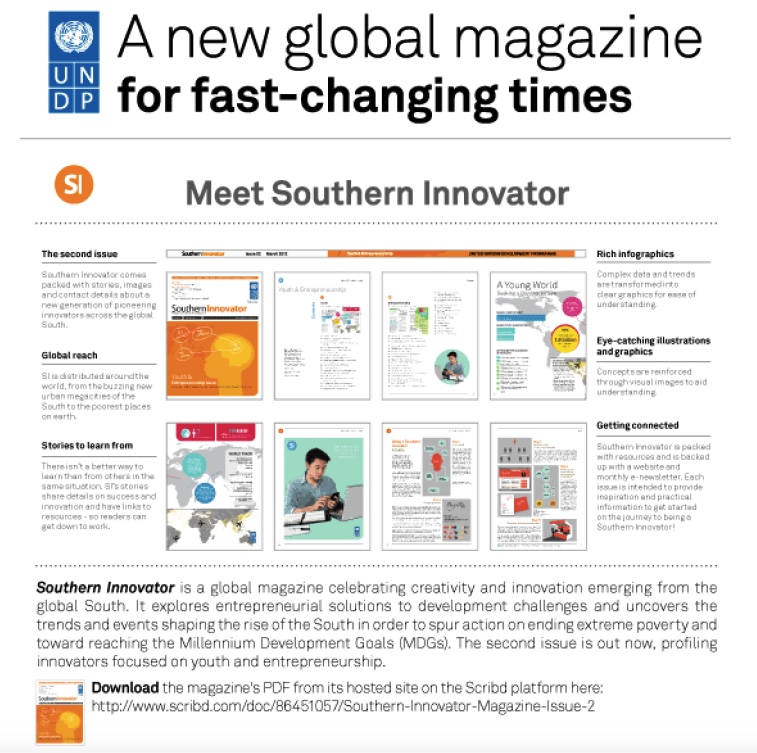
To date, five issues of Southern Innovator have been published on key themes identified by the United Nations: mobile phones and information technology, youth and entrepreneurship, agribusiness and food security, cities and urbanization and waste and recycling.
All of the issues collate and explain the trends, innovations and innovators for a large, global audience spanning many countries and regions.
Timeline
2007: David South Consulting begins work on the e-newsletter Development Challenges, South-South Solutions for the Special Unit for South-South Cooperation at the United Nations.
2009: Adjust e-newsletter content based on reader responses. Begin posting content on Twitter platform.
2010: Begin development of initial concepts for innovator magazine and assemble creative team with Icelandic graphic designer and illustrator Solveig Rolfsdottir and graphic designer Eva Hronn Gudnadottir.
2011: Attend Global South-South Development Expo in Rome, Italy. Launch first issue of Southern Innovator magazine on mobile phones and information technology. It is called “a terrific tour de force of what is interesting, cutting edge and relevant in the global mobile/ICT space…”. Launch www.southerninnovator.org website and social media including Twitter account @SouthSouth1.
2012: Attend Global South-South Development Expo in Vienna, Austria. Launch issues 2 (youth and entrepreneurship) and 3 (agribusiness and food security) of Southern Innovator magazine. Called a “Beautiful, inspiring magazine from UNDP on South-South innovation.”
2013: Attend Global South-South Development Expo in Nairobi, Kenya. Launch issue 4 of Southern Innovator magazine (cities and urbanization). Called “fantastic, great content and a beautiful design!” and “Always inspiring.”.
2014: Attend Global South-South Development Expo in Washington, D.C., U.S.A. Launch issue 5 of Southern Innovator magazine (waste and recycling). The Twitter account @SouthSouth1 called “ one of the best sources out there for news and info on #solutions to #SouthSouth challenges.” Final issues of e-newsletter Development Challenges, South-South Solutions published.
Testimonials
“The e-newsletter Development Challenges, South-South Solutions proved to be a timely and prescient resource on the fast-changing global South, tracking the rise of an innovator culture driven by the rapid adoption of mobile phones and information technology …
“In 2010, work began on the development of the world’s first magazine dedicated to the 21st-century innovator culture of the global South. My goal was to create a magazine that would reach across countries and cultures, meet the UN’s standards, and inspire action. Southern Innovator was the result. Mr. [David] South played a vital role in the magazine’s development from its early conception, through its various design prototypes, to its final global launch and distribution.
“Both the e-newsletter and magazine raised the profile of South-South cooperation and have been cited by readers for inspiring innovators, academics, policy makers and development practitioners in the United Nations and beyond.
“I highly recommend Mr. [David] South as a thoughtful, insightful, analytical, creative and very amicable person who has the unique ability to not only grasp complex problems but also to formulate a vision and strategy that gets things done. … ” Cosmas Gitta, Former Assistant Director, Policy and United Nations Affairs at United Nations Office for South-South Cooperation (UNOSSC) in UNDP
“I think you [David South] and the designer [Solveig Rolfsdottir] do great work and I enjoy Southern Innovator very much!” Ines Tofalo, Programme Specialist, United Nations Office for South-South Cooperation
Southern Innovator Issue 5
“@SouthSouth1 is one of the best sources out there for news and info on #solutions to #SouthSouth challenges.” Adam Rogers, Assistant Director, Regional Representative, Europe, United Nations Office for South-South Cooperation (UNOSSC)
“Btw, I really enjoyed reading them, impressive work & a great resource. Looking forward to Issue 6. My best wishes to you & your team at SI.”
“The magazine looks fantastic, great content and a beautiful design!”
Southern Innovator Issue 2
“Thank you David – Your insight into the issues facing us a[s] [a] “global Village” is made real in the detail of your article – 10 out of 10 from the moladi team.” Moladi, South Africa (http://www.moladi.net/index.htm)
Southern Innovator Issue 1
“What a tremendous magazine your team has produced! It’s a terrific tour de force of what is interesting, cutting edge and relevant in the global mobile/ICT space… Really looking forward to what you produce in issues #2 and #3. This is great, engaging, relevant and topical stuff.” Rose Shuman, Founder & CEO, Open Mind and Question Box
“Looks great. Congratulations. It’s Brill’s Content for the 21st century!” Conan Tobias, Managing Editor, Canadian Business
What they are saying about SI on Twitter: From @CapacityPlus Nice job RT @ActevisCGroup: RT @UNDP: Great looking informative @SouthSouth1 mag on South-South Innovation; @UNDP Great looking informative @SouthSouth1 mag on South-South Innovation; @JeannineLemaireGraphically beautiful & informative @UNDP Southern Innovator mag on South-South Innov.
“Beautiful, inspiring magazine from UNDP on South-South innovation. Heart is pumping adrenaline and admiration just reading it”
Impact
Micro
developed content for highly influential UN e-newsletter Development Challenges, South-South Solutions from 2007 to 2014. The monthly briefing is distributed across the UN and to subscribers
developed and launched world’s first global innovator magazine for the United Nations, Southern Innovator
contacted and networked with innovators around the world to raise the profile of their work
attended global events to champion power of 21st century global innovator culture. Visited United Nations agency headquarters around the world to share the innovator message and distribute the publications
cited as a key resource on trends in the global South
Macro
significantly raised profile of global South innovators and 21st century global innovator culture
cited as contributor to new strategic plans for UNDP and its switch to an innovation and South-South focus














 David South Consulting
You must be logged in to post a comment.