Categories
Archive Development Challenges, South-South Solutions Newsletters Southern Innovator magazine

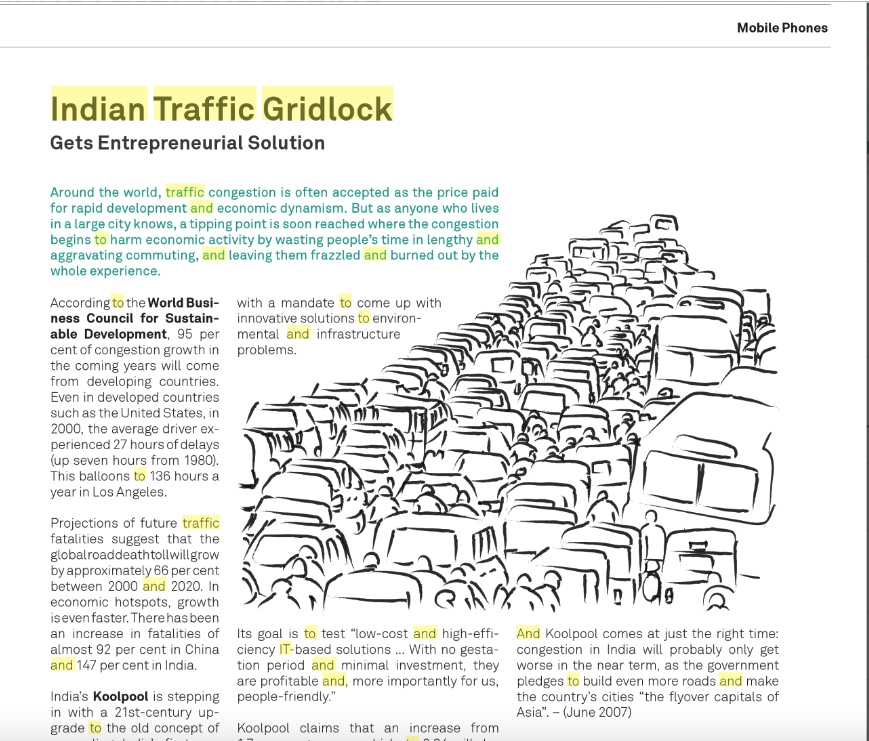
Entrepreneurs Use Mobiles and IT to Tackle Indian Traffic Gridlock

By David SouthDevelopment Challenges, South-South Solutions

SOUTH-SOUTH CASE STUDY

Around the world, traffic congestion is often accepted as the price paid for rapid development and economic dynamism. But as anyone who lives in a large city knows, a tipping point is soon reached where the congestion begins to harm economic activity by wasting people’s time in lengthy and aggravating commuting, and leaving them frazzled and burned out by the whole experience. According to the World Business Council for Sustainable Development, 95 percent of congestion growth in the coming years will come from developing countries. Even in developed countries like the United States, in 2000, the average driver experienced 27 hours of delays (up seven hours from 1980) (MIT Press). This balloons to 136 hours in Los Angeles.

Developing countries are growing their vehicle numbers by between 10 and 30 percent per year (World Bank). In economic hotspots, growth is even faster. In India, the cities of Delhi, Mumbai, Kolkata and Bangalore account for five percent of the nation’s population but have 14 percent of the total registered vehicles. In the Islamic Republic of Iran, Kenya, Mexico and Chile, 50 percent of cars are in the capital cities (www.peopleandplanet.net).

India’s Koolpool is stepping in with a 21st century upgrade to the old concept of carpooling. India’s first carpooling service (in which drivers share rides to reduce congestion and save money) uses the power of the country’s mobile phone network to link up people by SMS (short message service) text. Already launched in Mumbai, it is being rolled out in other cities as well.

Koolpool surveyed Indian drivers and found that the average car only had two passengers. Koolpool is an idea from the Mumbai Environmental Social Network (MESN), a registered charity with the mandate to come up with innovative solutions to environmental and infrastructure problems. Its goal is to prove “low-cost and high efficiency IT-based solutions are the way of the future. With no gestation period and minimal investment, they are profitable and more importantly for us, people friendly.” Koolpool claims that an increase from 1.7 passengers per vehicle to 2.04 will decrease travel time and pollution levels by 25 percent. It also claims to be the first carpooling service to combine SMS text messaging and IT.

Ride-givers send a text message to Koolpool just before going down a major road. Koolpool then sends a list of ride seekers on the route, their membership identifications, the designated stopping point for pick-up, number of riders and login time. If there are no ride givers on that route, then ride seekers are pooled together to get a taxi and share the costs. Members of Koolpool pay an annual membership fee and exchange credits by mobile phone between ride seekers and ride givers, which are then redeemed at gas stations for petrol.

And Koopool comes at just the right time: congestion in India will probably only get worse in the near term, as the government pledges to build even more roads and make the country’s cities “the flyover capital of Asia”.

In Kolkata, says Sudarsanam Padam, former director of the Central Institute of Road Transport in the city of Pune, the average speed during peak hours in the central business district (CBD) area is as low as seven km/hr. Bangalore currently has average speeds of about 13-15 km/hr in its CBD, but this is expected to go down to three to eight km/hr in the next 15 years, according to the city’s police traffic commissioner, M N Reddi.

Published: June 2007

Resources

  • Mobility 2001: World Mobility at the End of the Twentieth Century and its Sustainability published by the World Business Council for Sustainable Development.
  • Another Indian car pooling business allows people to post requests for rides on an internet bulletin board, Car Sales India.
  • Another solution to traffic congestion has been the motorcycle taxi. Beginning in Thailand, motorcycle taxis can now be found in Cambodia, India and the UK. Read more at here.
  • SENSEable City: A project at the Massachusetts Institute of Technology’s SENSEable City Laboratory to use the new generation of sensors and hand-held electronics to change how cities are understood and navigated. This includes creating real-time maps of cities that can then be used to help with avoiding traffic congestion and other problems.
  • Read more about India’s traffic congestion problem by India’s only science and environment biweekly online newsletter, Down to Earth.

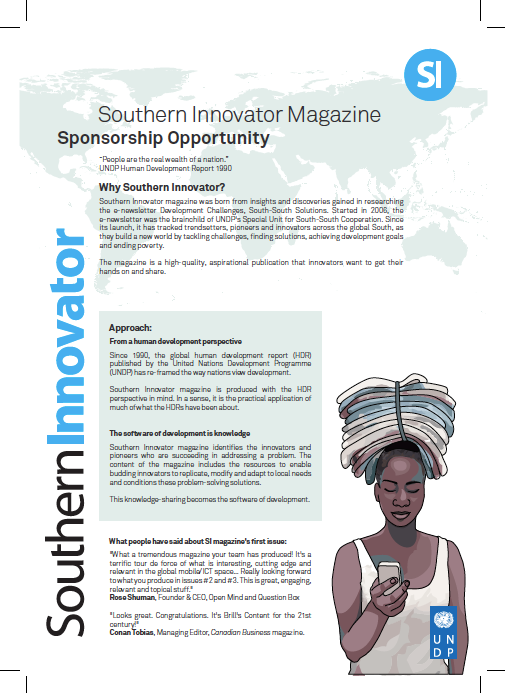
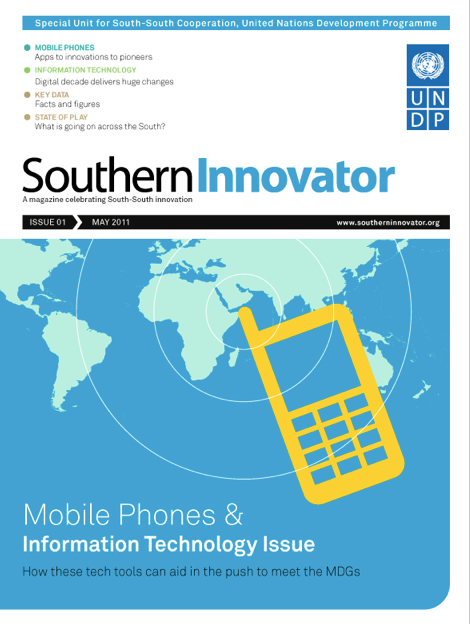
Development Challenges, South-South Solutions was launched as an e-newsletter in 2006 by UNDP’s South-South Cooperation Unit (now the United Nations Office for South-South Cooperation) based in New York, USA. It led on profiling the rise of the global South as an economic powerhouse and was one of the first regular publications to champion the global South’s innovators, entrepreneurs, and pioneers. It tracked the key trends that are now so profoundly reshaping how development is seen and done. This includes the rapid take-up of mobile phones and information technology in the global South (as profiled in the first issue of magazine Southern Innovator), the move to becoming a majority urban world, a growing global innovator culture, and the plethora of solutions being developed in the global South to tackle its problems and improve living conditions and boost human development. The success of the e-newsletter led to the launch of the magazine Southern Innovator.  

Creative Commons License

This work is licensed under a
Creative Commons Attribution-Noncommercial-No Derivative Works 3.0 License.

ORCID iD: https://orcid.org/0000-0001-5311-1052.

© David South Consulting 2022
Categories
Archive

Combating Counterfeit Drugs

By David SouthDevelopment Challenges, South-South Solutions

SOUTH-SOUTH CASE STUDY

Access to good quality drugs is a serious problem across the South. The International Narcotics Control Board estimates that up to 15 per cent of all drugs sold around the world are fake or counterfeit, and in parts of Africa and Asia this figure jumps to 50 per cent. The US Food and Drug Administration estimates counterfeit drugs make up 10 per cent of the global medicine market. The US Centre for Medicines in the Public Interest predicts counterfeit drug sales will reach US $75 billion globally in 2010, an increase of more than 90 per cent from 2005.

Fake drugs are a major cause of unnecessary death and destroy public confidence in medicines and health services. While counterfeit drugs have been on the rise, there is little co-ordinated or effective action to counter this menace afflicted on the sick.

But in Ghana, a solution has emerged that shows a way to guarantee that quality drugs get to the sick who need them. CareShop Ghana uses the franchise model – where licenses are sold to approved vendors who adhere to strict guidelines – to ensure that the quality, accessibility and affordability of essential medicines in and around Accra is guaranteed. CareShop has made deals with close to 300 franchisee pharmacies – often modest operations – who sell over-the-counter drugs.

In Ghana, preventable and curable illnesses like malaria and diarrhoeal diseases are among the leading causes of death. Their treatment pushes many people to financial despair; they can ill afford the extra burden of worrying about counterfeit drugs and the harm they do. Like many countries in the South, Ghana’s public healthcare system is unable to meet these needs and so most people turn to the private sector for help.

An estimated 65 per cent of people turn to licensed pharmacies. But many of these operate haphazard businesses, dispensing expired or counterfeit drugs.

The Ghana Social Marketing Foundation Enterprises Limited (GSMFEL) founded CareShop in 2002, hoping to battle common infectious diseases in poor areas by making sure good drugs get through to the sick.

GSMFEL makes a small profit as the franchisor by selling high-quality drugs to the franchisees. The key to CareShop’s success is imposing standardization on franchisees, so they have to stick to common diagnosis, quality and pricing. They make more money when they adhere to these rules than when they break them. To ensure there is no tampering with the drugs, they are delivered straight to the vendor’s doorsteps, and it is all backed up with health and business training support and branded materials.

The tide can be turned around on fake drugs: in 2002, the WHO reported that 70 per cent of drugs in Nigeria were fake or substandard: by 2004 that figure had fallen to 48 per cent.

Stimulating private sector solutions to African healthcare problems is now receiving an additional boost from a new fund established by the World Bank’s private sector arm, the International Finance Corporation. Launched in 2007, it offers cash and loans totalling US $500 million to commercial healthcare projects in Africa. According to its own statistics, 60 per cent of health expenditure in sub-Saharan Africa is privately funded, and the market, excluding South Africa, is worth US $19 billion.

Published: May 2008

Resources

  • SafeMedicines.org is a website offering the latest reports on fake medicines and is a good place to report incidences.
    Website: http://safemedicines.org/in_the_news/
  • A paper on the global threat of counterfeit drugs: Click here.

Development Challenges, South-South Solutions was launched as an e-newsletter in 2006 by UNDP’s South-South Cooperation Unit (now the United Nations Office for South-South Cooperation) based in New York, USA. It led on profiling the rise of the global South as an economic powerhouse and was one of the first regular publications to champion the global South’s innovators, entrepreneurs, and pioneers. It tracked the key trends that are now so profoundly reshaping how development is seen and done. This includes the rapid take-up of mobile phones and information technology in the global South (as profiled in the first issue of magazine Southern Innovator), the move to becoming a majority urban world, a growing global innovator culture, and the plethora of solutions being developed in the global South to tackle its problems and improve living conditions and boost human development. The success of the e-newsletter led to the launch of the magazine Southern Innovator.  

Creative Commons License

This work is licensed under a
Creative Commons Attribution-Noncommercial-No Derivative Works 3.0 License.

ORCID iD: https://orcid.org/0000-0001-5311-1052.

© David South Consulting 2022

Categories
Archive Development Challenges, South-South Solutions Newsletters

African Innovation Eco-system Taking Shape

By David SouthDevelopment Challenges, South-South Solutions

SOUTH-SOUTH CASE STUDY

How to increase the rate of innovation in Africa? And specifically, innovation that actually improves people’s lives and reduces poverty. It is a hard question to answer, but some are putting in place the building blocks of a 21st century innovation culture by riding the information technology revolution as it rolls across Africa.

The transformative story of mobile phones in Africa has captured the attention of the world. Technologies like mobile phone payment systems developed in Africa are now being rolled out around the globe.

But there is more to come as undersea cables increase the communications links between African nations and the rest of the world. New undersea cables including TEAMs, Seacom and Eastern Africa Submarine Cable System (EASSy) (eassy.org) are vastly increasing the continent’s Internet capacity and bandwidth (http://en.wikipedia.org/wiki/Bandwidth_%28computing%29).

These communications links will revolutionize the type and scale of innovation that can happen in Africa.

As websites like AfriGadget (afrigadget.com) amply prove, there is already an entrenched do-it-yourself innovation culture hard-wired into daily life on the continent. While impressively resourceful and able to make the most of often very little, this innovation culture is often confined to a narrow geographical area. And this is the difference the new information technologies will make: They will allow this energetic and resourceful innovators’ culture to develop businesses and business models that can reach beyond narrow geographical parameters.

New technologies will also accelerate the spread of new ideas and solutions.

Across the continent, ways and means are being stitched together that enable people to transcend borders and old divisions and obstacles to connect with like-minded collaborators, seek out funding and take ideas from dreams to schemes and eventually to continent- and world-straddling levels.

According to the Deloitte 2011 East Africa Private Equity Confidence Survey: Promising 2012, “Many investors see East Africa’s strong growth potential as a driver of better investment performance than in South Africa: This is a huge shift in private equity attitudes toward Africa, which have been historically focused on South Africa. East African investment potential is seen as roughly on par with West Africa, where similar growth dynamics are at play.”

Identifying the elements that are making this innovation culture flourish came under analysis in a recent post on the Afrinnovator website (afrinnovator.com). Afrinnovator is dedicated to “telling the stories of African startups, African innovation, African made technology, African tech entrepreneurship and entrepreneurs.”

While it is well known that new infrastructure, better governance, new policies, and new services like mobile phones and mobile money have made a big difference in shifting perceptions of Africa from despair to optimism, Afrinnovator found there were other key ingredients to this innovation renaissance.

Afrinnovator argues there are four elements that have come together to change circumstances for innovators on the continent: education, mentoring and incubators, funding, and showcase events.

Afrinnovator found education was critical to the quality of emerging technological innovations. Information and communication technology (ICT) education has moved from just computer science courses to a vast array of options, from bachelors degrees to masters programmes.

For mentoring and incubators, Afrinnovator found hubs and incubators are providing places for young educated people to go to and get down to work.

Examples include iHub (http://ihub.co.ke/pages/home.php), mLab East Africa (http://mlab.co.ke/pages/home.php), ccHub (Co-Creation Hub Nigeria) (http://cchubnigeria.com/about-cchub/), Lusaka, Zambia’s Bongohive (bongohive.com), iLab Africa (http://ilabafrica.ac.ke/) NaiLab (http://nailab.co.ke/) iBid Labs (http://ibidlabs.com/) and Uganda’s HiveColab (http://hivecolab.org/), among others. These places offer like-minded fellowship and access to mentors to take them on the journey from “idea to viable profitable business.”

According to Business Daily Africa, “There are more than 3,000 software developers who have come up with both mobile and personal computer-based software applications that are changing lives across the continent.”

A transformation in funding access has seen a renaissance in new thinking that is transforming tech start-ups into viable businesses. Kenya has the Kenya ICT Board (http://www.ict.go.ke/) and it awards US $50,000 through its Tandaa grant programme (https://sites.google.com/a/ict.go.ke/tandaa/).

Because of this enthusiastic local support, the World Bank is now committing a US $55 million grant targeting Kenya’s technology innovators to be distributed through the Kenya ICT Board.

East Africa also saw 16 new investor funds launch in 2011 alone. They include early-stage investor funds like eVentures Fund Africa (eVA) (http://www.eva-fund.com/), which calls itself “the first venture capital firm investing in African SME’s active in digital media.” Another is Kenya-based 88mph (http://www.humanipo.com/88mph), with its “focus on startups targeting the East African mobile and web market.”

In Kenya, the World Bank money will be used to help technology developers bring to market simple solutions in health and education.

According to the World Bank (http://tinyurl.com/cm3g2rf), “Kenya has put in place the second-fastest broadband on the continent (after Ghana), which has reduced the wholesale internet capacity prices by over 90% and increased internet penetration from 3% to 37% of the population in the past decade. Today, about 90% of Kenyan adults have or have the use of a mobile phone.”

And the final game-changer, according to Afrinnovator, is “showcase events.”

These events give investors and potential partners the opportunity to meet start-ups and explore their new ideas.

Examples include DEMO (http://www.demo.com/ehome/index.php?eventid=29414&amp😉 – which connects the idea people with the money people – and Pivot East in East Africa (http://pivoteast.com/). Pivot East provides 25 technology entrepreneurs with the opportunity to make a pitch in front of investors. DEMO is working with USAID, Microsoft, Nokia and others to launch DEMO Africa in Nairobi, Kenya from 21 to 22 October 2012.

Afrinnovator concludes: “This is the last virgin tech landscape left on the planet. The best time to become a player in the African technology innovation ecosystem is now.”

Published: July 2012

Resources

1) Read more about Africa’s evolving innovation system. Website: http://afrinnovator.com/blog/2012/06/13/the-innovation-ecosystem-in-eastafrica/

2) Southern Innovator: Youth and Entrepreneurship Issue. Website: http://www.scribd.com/doc/86451057/Southern-Innovator-Magazine-Issue-2

3) Southern Innovator: Mobile Phones and Information Technology Issue. Website: http://www.scribd.com/doc/57980406/Southern-Innovator-

Magazine-Issue-1

4) Notes from ‘Understanding Broadband Demand in Africa: Internet Going Mobile’. Website: http://www.oafrica.com/mobile/notes-from-understanding-broadband-demandin-africa-internet-going-mobile/

5) Deloitte Private Equity Survey 2012. Website: deloitte.com

Development Challenges, South-South Solutions was launched as an e-newsletter in 2006 by UNDP’s South-South Cooperation Unit (now the United Nations Office for South-South Cooperation) based in New York, USA. It led on profiling the rise of the global South as an economic powerhouse and was one of the first regular publications to champion the global South’s innovators, entrepreneurs, and pioneers. It tracked the key trends that are now so profoundly reshaping how development is seen and done. This includes the rapid take-up of mobile phones and information technology in the global South (as profiled in the first issue of magazine Southern Innovator), the move to becoming a majority urban world, a growing global innovator culture, and the plethora of solutions being developed in the global South to tackle its problems and improve living conditions and boost human development. The success of the e-newsletter led to the launch of the magazine Southern Innovator.  

Creative Commons License

This work is licensed under a
Creative Commons Attribution-Noncommercial-No Derivative Works 3.0 License.

ORCID iD: https://orcid.org/0000-0001-5311-1052.

© David South Consulting 2023

Categories
Archive data Development Challenges, South-South Solutions Newsletters Southern Innovator magazine

The BRCK: Kenyan-Developed Solution to Boost Internet Access 

By David SouthDevelopment Challenges, South-South Solutions

SOUTH-SOUTH CASE STUDY

Using the Internet in Africa has its challenges, as anyone who has worked there knows. Issues can include weak Wi-Fi signals, slow Internet service providers, electricity outages and power surges that can damage or destroy sensitive electronic devices.

Power surges (http://electronics.howstuffworks.com/everyday-tech/surge-protector3.htm) can occur for a variety of reasons but are usually a sudden surge in the current flowing to the wall outlet from the power mains. They are common in developing countries, and can be tragic for electronic devices.
Most electronic devices are designed for use in developed countries where people can take the power supply, and ubiquitous Internet access, for granted. This affects the way devices are made. Designers will assume many things are available to users and build the electronic devices accordingly. But for users in Africa and across the global South, what seems easy in the developed world is fraught with frustration and wasted time.

This is a big obstacle to economic development and places people in Africa at a disadvantage in the modern world of fast communications.

One initiative is out to transform this experience for the better with a made-in-Africa solution that is being modified based on real-world experience and user feedback.

The BRCK (brck.com) bills itself as “your backup generator for the Internet” and is intended to address the problems of finding a reliable Internet connection, staying online in a power blackout and saving devices from destruction when there is a power surge.

Anyone who has tried to use a laptop computer to upload some photographs in Africa will know the frustration felt when the Wi-Fi signal drops away. The BRCK hunts around for the strongest signal and grabs it so the user can carry on working.

Built to be robust and take knocks and bruises, it is a sleek, black plastic brick-shaped device with the letters BRCK elegantly embossed on the side.
The BRCK can function as a hub for up to 20 devices, with a built-in Wi-Fi signal able to cover multiple rooms (so a team can work off a single Internet connection), a battery that can last eight hours, a 16-gigabyte on board memory hard drive, and software to allow for remote management  by apps on other devices such as smartphones. While it is not able to speed up an already poor connection or increase low bandwidth, it can “scavenge” around to find the strongest signal and hop to it right away. It can work with Ethernet, Wi-Fi, and 3G and 4G networks.

If a blackout occurs, it quickly switches to the onboard battery without forcing a re-boot of the computer.

It has been developed in Nairobi, Kenya and the first plastic prototype of the BRCK device was milled at the Fab Lab Nairobi (http://fablab.uonbi.or.ke/) using a 3D fabricator machine.

The BRCK’s makers describe it as a tool “trying to create ubiquitous Internet” and an “enabler of the Internet of things.” The BRCK is designed around the changing way people work and access the Internet, frequently moving from place to place. People now don’t just rely on one device but have many – a mobile phone or smartphone, a laptop, a tablet, an iPod or other device.

A Kickstarter fundraising campaign (https://www.kickstarter.com/projects/1776324009/brck-your-backup-generator-for-the-internet) gives more details on the origins of the project and offers many ways to support the different stages of development, right up to mass manufacturing of the BRCK.

One application of the BRCK is for research. It could be deployed to gather data at a field site, then connect via the Cloud (http://en.wikipedia.org/wiki/Cloud_computing) to pass data back to a lab at a university in another country for analysis.

The BRCK is being built by Ushahidi (ushahidi.com), a non-profit technology company that makes open source software and made its name with the crowdsourced mapping platform it built during the post-election violence in Kenya in 2008. The Ushahidi platform has been deployed around the world since in many crisis situations.

Founded by David Kobia, Juliana Rotich and Erik Hersman, the Ushahidi team is focused on “building tools that improve the way information flows in the world.” It is about making tools to help people communicate in the most difficult places.

BRCK comes with a visually appealing website that makes excellent use of the BRCK’s ebony good looks.

The website boasts: “If it works in Africa, it’ll work anywhere”.

The ongoing development of the BRCK can be followed on the website’s blog: http://www.brck.com/2014/01/they-case-for-engineering-brck-in-africa-part-1/.

“The idea is to build a company around the product rather than just do a one-off product – and to gradually improve the product through new versions,” said BRCKs chief technology officer Reg Orton.

“Our engineers are based in Kenya now – we are not based in China, we are not based in the (Silicon) Valley. What that means for us we are able to go out there and (be) able to see the problems directly.”

The BRCK can be ordered online and will be available for sale soon, according to the website.

Published: April 2014

Resources

1) Momax iPower Milk External Battery:  Inspired from daily life, the creative iPower Milk looks like a cute and fresh milk carton. It fulfills your daily energy need just as pure milk. iPower Milk comes in a variety of cheerful candy colors, so choose one which suits your taste. The tiny and delicate iPower Milk has 1.5A USB output, which is compatible with most digital devices, including tablets. Website: http://shop.brando.com/Momax-iPower-Milk-External-Battery-2600mAh_p09700c1595d003.html

2) Southern Innovator Issue 1: Mobile Phones and Information Technology: Pioneering and innovative ways to deploy mobile phones and information technology to tackle poverty. Website: http://www.scribd.com/doc/57980406/Southern-Innovator-Magazine-Issue-1 and here: http://tinyurl.com/q6bfnpz
3) iHub Nairobi: Nairobi’s Innovation Hub for the technology community is an open space for the technologists, investors, tech companies and hackers in the area. This space is a tech community facility with a focus on young entrepreneurs, web and mobile phone programmers, designers and researchers. It is part open community workspace (co-working), part vector for investors and VCs (venture capitalists) and part incubator. Website: ihub.co.ke

4) Fab Lab Nairobi: Fablab (fabrication laboratory or “fabulous laboratory”) is a workshop with an array of computer controlled tools with the aim to make “almost anything”. Fab labs provide widespread access to modern means for invention. They began as an outreach project from MIT’s Center for Bits and Atoms (CBA). CBA assembled millions of dollars in machines for research in digital fabrication, ultimately aiming at developing programmable molecular assemblers that will be able to make almost anything. Fab labs fall between these extremes, comprising roughly fifty thousand dollars in equipment and materials that can be used today to do what will be possible with tomorrow’s personal fabricators. Website: http://fablab.uonbi.or.ke/

https://davidsouthconsulting.org/2021/03/20/accessing-global-markets-via-design-solutions/

https://davidsouthconsulting.org/2022/10/26/africa-to-get-own-internet-domain/

https://davidsouthconsulting.org/2022/10/24/brazilian-solar-powered-wifi-for-poor-schools/

https://davidsouthconsulting.org/2020/04/30/crowdsourcing-mobile-phones-to-make-the-poor-money/

https://davidsouthconsulting.org/2020/05/01/diy-solution-charges-mobile-phones-with-batteries/

https://davidsouthconsulting.org/2022/10/17/east-africa-to-get-its-first-dedicated-technology-city/

https://davidsouthconsulting.org/2020/12/20/kenya-reaches-mobile-phone-banking-landmark/

https://davidsouthconsulting.org/2022/11/23/kenyan-farmer-uses-internet-to-boost-potato-farm/

https://davidsouthconsulting.org/2020/12/20/mobile-phones-bring-the-next-wave-of-new-ideas-from-the-south/

https://davidsouthconsulting.org/2021/03/20/texting-for-cheaper-marketplace-food-with-sokotext/

https://davidsouthconsulting.org/2022/10/10/wireless-internet-culture-helping-zimbabwe-economy-recover/

Development Challenges, South-South Solutions was launched as an e-newsletter in 2006 by UNDP’s South-South Cooperation Unit (now the United Nations Office for South-South Cooperation) based in New York, USA. It led on profiling the rise of the global South as an economic powerhouse and was one of the first regular publications to champion the global South’s innovators, entrepreneurs, and pioneers. It tracked the key trends that are now so profoundly reshaping how development is seen and done. This includes the rapid take-up of mobile phones and information technology in the global South (as profiled in the first issue of magazine Southern Innovator), the move to becoming a majority urban world, a growing global innovator culture, and the plethora of solutions being developed in the global South to tackle its problems and improve living conditions and boost human development. The success of the e-newsletter led to the launch of the magazine Southern Innovator.  

https://davidsouthconsulting.org/2021/03/05/southern-innovator-issue-1/

Creative Commons License

This work is licensed under a
Creative Commons Attribution-Noncommercial-No Derivative Works 3.0 License.

ORCID iD: https://orcid.org/0000-0001-5311-1052.

© David South Consulting 2023