Categories
Archive Development Challenges, South-South Solutions Newsletters

African Breakthroughs To Make Life Better

By David SouthDevelopment Challenges, South-South Solutions

SOUTH-SOUTH CASE STUDY

In the last 50 years, the domestication of high technology – bringing cheaper access to everything from personal computers to digital cameras and applications like global positioning systems (GPS) – has transformed millions of lives and the way business is done. In the next 50 years, biotechnology is set to do the same.

One aspect of biotechnology, genetic engineering (GE), has been lambasted by protest groups for being “unnatural” and driven by profit and the privatisation of nature. It has been seen as the domain of the big and powerful and remote from everyday needs. But now Africa is pioneering new approaches that are rooted in the real challenges faced by African people – and proving world-class scientific research can take place in Africa.

One initiative in South Africa aims to help small and medium sized farmers save their maize (corn) crops. The Food and Agriculture Foundation estimates that 854 million people in the world do not have sufficient food for an active and healthy life, and food security is a serious issue in Africa.

Maize streak viruses (MSV) are geminiviruses that destroy maize crops, and are a big problem throughout sub-Saharan Africa and the Indian Ocean islands. It leaves characteristic yellow-white streaks across the plant’s leaves, and produces deformed corn cobs, often severely dwarfed. Over half of the food supply for people in sub-Saharan Africa comes from maize, but MSV can wipe out an entire farmer’s crop.

Scientists at the University of Cape Town (www.uct.ac.za), South Africa, and the South African seed company PANNAR Pty Ltd have developed a resistant variety of maize that they hope will alleviate food shortages as well as promote the reputation of genetically engineered (GE) foods in Africa.

The MSV-resistant maize is the first GE crop developed and tested solely by Africans. Field trials will soon begin to make sure there are no unintended consequences on the environment and animal life dependent on maize.

Maize arrived in Africa in the 1500s from Mexico, and quickly displaced native food crops like sorghum and millet. Maize streak virus is an endemic pathogen of native African grasses, and is passed on to maize plants by leaf hopping insects.

The technology being developed can also be applied to other geminiviruses, like Wheat dwarf virus (WDV), sugarcane streak virus, barley, oats and millet. The scientists hope this development will prove the safety of GE foods, and address the criticism it is only a profit-driven technology by selling the seeds for minimal profit to subsistence farmers.

“If the GE maize turns out to be as hardy in the field as in the greenhouse,” said Dr Dionne Shepherd, who leads the research, “it could have a great impact on small and medium sized farmers. These are the farmers who need it the most, since they can’t afford preventative measures such as insecticides to control the leafhopper which transmits the disease. When small scale farmers lose 100 per cent of their crop (which they often do) due to maize streak disease, they not only lose any income they would have obtained selling their excess maize, but they also lose a massive chunk of their annual food supply.”

Other African institutions are working on GE crops with international partners, but, Shepherd, says, “The reason the MSV-resistant maize could improve the reputation of GE in Africa, is that international biotech partners, especially in the private sector, are generally not interested in solving problems that are unique to Africa, and Africans are therefore suspicious of their motives when they try to sell or even give away GE food.”

“MSV is endemic to sub-Saharan Africa, and our MSV-resistant maize was developed by Africans for Africa with no ulterior motives, which will hopefully make Africans accept the technology.”

“I think it should attract more funding, because once international funders see that world-class research can happen in Africa, they may be more willing to commit funds.”

In another development, African science is tackling the scourge of malaria on the continent. Caused by a parasite carried by mosquitoes, it kills more than a million people a year and makes 300 million more seriously ill (World Health Organisation). Ninety per cent of the deaths are in Africa south of the Sahara, and most are children.

While bed nets, insecticides and anti-malarial drugs are effective, the disease has become resistant to some drugs and work on a vaccine is slow.

Research in Kenya has found an effective way to both provide food and destroy mosquito larvae. The Nile tilapia – a highly nutritious fish – has long been known to feed on mosquito larvae. But nobody has made the connection between this fact and the fight against malaria. Francois Omlin, a researcher at the International Centre of Insect Physiology and Ecology in Nairobi, Kenya (www.icipe.org), has conducted the first field tests to prove this approach.

“The tilapia species was never tested in the field for its ability to eat mosquito larvae,” he told Reuters.

Ten days after introducing the tilapia to a pond, they had destroyed most of the larvae and after 41 weeks the number of mosquitoes fell by 94 per cent, according to Omlin.

This means two important goals can be served by harvesting tilapia fish: greater access for Africans to the nutritious fish, and a dramatic reduction in mosquito-borne malaria.

Published: September 2007

Resources

Development Challenges, South-South Solutions was launched as an e-newsletter in 2006 by UNDP’s South-South Cooperation Unit (now the United Nations Office for South-South Cooperation) based in New York, USA. It led on profiling the rise of the global South as an economic powerhouse and was one of the first regular publications to champion the global South’s innovators, entrepreneurs, and pioneers. It tracked the key trends that are now so profoundly reshaping how development is seen and done. This includes the rapid take-up of mobile phones and information technology in the global South (as profiled in the first issue of magazine Southern Innovator), the move to becoming a majority urban world, a growing global innovator culture, and the plethora of solutions being developed in the global South to tackle its problems and improve living conditions and boost human development. The success of the e-newsletter led to the launch of the magazine Southern Innovator. 

Creative Commons License

This work is licensed under a
Creative Commons Attribution-Noncommercial-No Derivative Works 3.0 License.

ORCID iD: https://orcid.org/0000-0001-5311-1052.

© David South Consulting 2023

Categories
Archive Development Challenges, South-South Solutions Newsletters

Indonesian Food Company Helps Itself by Making Farmers More Efficient

By David SouthDevelopment Challenges, South-South Solutions

SOUTH-SOUTH CASE STUDY

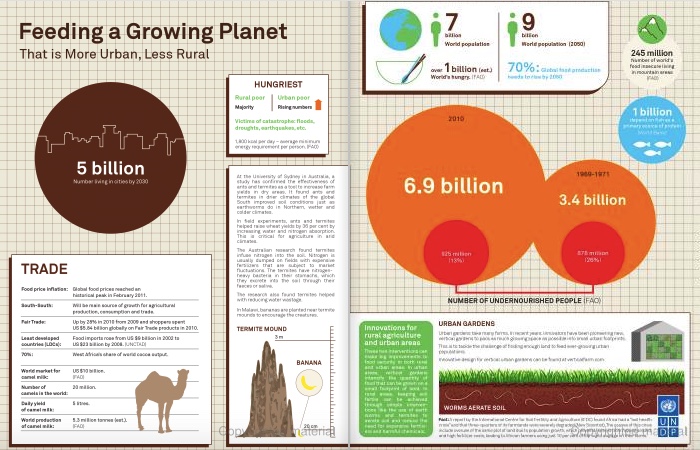
The current global economic crisis is taking place at the same time as a global food crisis. Food inflation took off at the beginning of 2011. This is having a devastating affect on countries dependent on food imports and experiencing decreasing domestic production capabilities. The least developed countries (LDCs) saw food imports rise from US $9 billion in 2002, to US $23 billion by 2008 (UNCTAD), prompting Supachai Panitchpakdi, secretary general of UNCTAD, to say “the import dependence has become quite devastating.”

Garuda Food (www.garudafood.com), one of Indonesia’s leading snack food and drink manufacturers, has been boosting its own productivity by investing in improving the productivity of domestic small-scale farmers. This led to a doubling of crop purchases from peanut farmers between 2007 and 2009. By stabilising the market for peanuts and better guaranteeing income, it has attracted more people into becoming peanut farmers in the region.

This is crucial for the future of feeding the planet: we need more farmers.

Indonesia is the world’s fourth most populous country, with a population of over 238 million, spread out over a network of islands. Peanut farmers in West Nusa Tenggara (http://en.wikipedia.org/wiki/West_Nusa_Tenggara) (one of Indonesia’s poorest places) are a key part of the region’s wealth. Peanuts are the area’s third largest crop after rice, maize and soybeans, and the region supplies six percent of the country’s peanut production and 10 percent of Garuda Food’s needs.

Garuda Food says investing in farmers has raised its own productivity by a third. Turning past practices on its head, this large agri-food company is supporting small-scale farmers and helping them to boost their productivity and incomes. Conventional wisdom had been to view small-scale farmers as an inefficient hold-over from the past – the quicker they were driven out of business, the better.

The Indonesian peanut farmers were using traditional farming methods and local seeds. Knowledge of more sustainable farming methods and land management techniques was poor. The farmers were also beholden to the whims of local buyers and fluctuating market prices.

Then Garuda Food stepped in. The company’s field staff offer the farmers training, and through its subsidiary PT Bumi Mekar Tani, it spreads knowledge about new agricultural practices and provides the farmers with quality seeds and farming equipment.

The company buys crops directly from the farmers, rather than from middlemen, increasing the amount the farmer makes. A premium is also paid if the farmer achieves better quality for their crop.

“We receive substantial supply from peanut farmers in NTB (West Nusa Tenggara) and we hope the arrangement will continue,” Garuda Food’s managing director Hartono Atmadja told the Enchanting Lombok website.

Garuda Food’s initiative, with support from the World Bank’s International Finance Corporation and AusAID, through the Australia Indonesia Partnership, has raised the productivity for 8,000 small-scale farmers by 30 percent: an income boost for the farmers of 3.9 million Indonesian rupiah (US $456) per hectare annually.

Peanut farmer H. Sajidin told the IFC (International Finance Corporation): “My farm’s productivity doubled, my income improved significantly, and I can sleep peacefully at night knowing that Garuda Food will buy my crops at agreed prices.”

Raj Patel, author of Stuffed and Starved: Markets, Power and the Hidden Battle for the World Food System (http://stuffedandstarved.org/drupal/frontpage), has grappled with the conundrum of how to feed a rapidly growing planet. He finds the world is not lacking in food, but distributes its bounty very poorly and wastefully, leaving a planet where some people are literally ‘stuffed’ with too much food (the well-documented global obesity crisis) and others left to starve.

He finds the solution is often local.

“It turns out that if you’re keen to make the world’s poorest people better off, it’s smarter to invest in their farms and workplaces than to send them packing to the cities,” Patel wrote recently in Foreign Policy. “In its 2008 World Development Report, the World Bank found that, indeed, investment in peasants was among the most efficient and effective ways of raising people out of poverty and hunger.”

Patel uses the example of the southern African nation of Malawi, where “according to one estimate, the marginal cost of importing a ton of food-aid maize is $400, versus $200 a ton to import it commercially, and only $50 to source it domestically using fertilizers.”

Published: May 2011

Resources

1) Emprapa: The Brazilian Agricultural Research Corporation’s mission is to provide feasible solutions for the sustainable development of Brazilian agribusiness through knowledge and technology generation and transfer. Website: http://www.embrapa.br/english

2) Divine Chocolate: The highly successful global chocolate brand from the Kuapa Kokoo farmers’ cooperative in Ghana, West Africa. Website: http://www.divinechocolateshop.com

3) Olam: The highly successful global food product supplier brand which got its start in Nigeria, West Africa. Website: http://www.olamonline.com

4) Insects as food: Tapping the world’s vast insect population offers many ways to supplement world food sources. Website: http://ssc.undp.org/other/e-news/newsletters/april-2008/

5) Cooperhaf: The Brazilian farmers’ cooperative Cooperhaf: Cooperativa de Habitacao dos Agricultores Familiares, has put together what it calls a “social technology”, combining housing and farm diversification to support family farmers. Website: http://www.cooperhaf.org.br

Development Challenges, South-South Solutions was launched as an e-newsletter in 2006 by UNDP’s South-South Cooperation Unit (now the United Nations Office for South-South Cooperation) based in New York, USA. It led on profiling the rise of the global South as an economic powerhouse and was one of the first regular publications to champion the global South’s innovators, entrepreneurs, and pioneers. It tracked the key trends that are now so profoundly reshaping how development is seen and done. This includes the rapid take-up of mobile phones and information technology in the global South (as profiled in the first issue of magazine Southern Innovator), the move to becoming a majority urban world, a growing global innovator culture, and the plethora of solutions being developed in the global South to tackle its problems and improve living conditions and boost human development. The success of the e-newsletter led to the launch of the magazine Southern Innovator. 

Creative Commons License

This work is licensed under a
Creative Commons Attribution-Noncommercial-No Derivative Works 3.0 License.

ORCID iD: https://orcid.org/0000-0001-5311-1052.

© David South Consulting 2023

Categories
Archive Blogroll Southern Innovator magazine Special Unit for South-South Cooperation United Nations Development Programme United Nations Office for South-South Cooperation

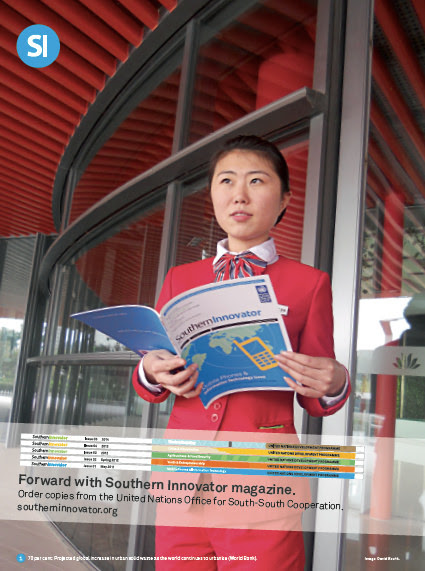
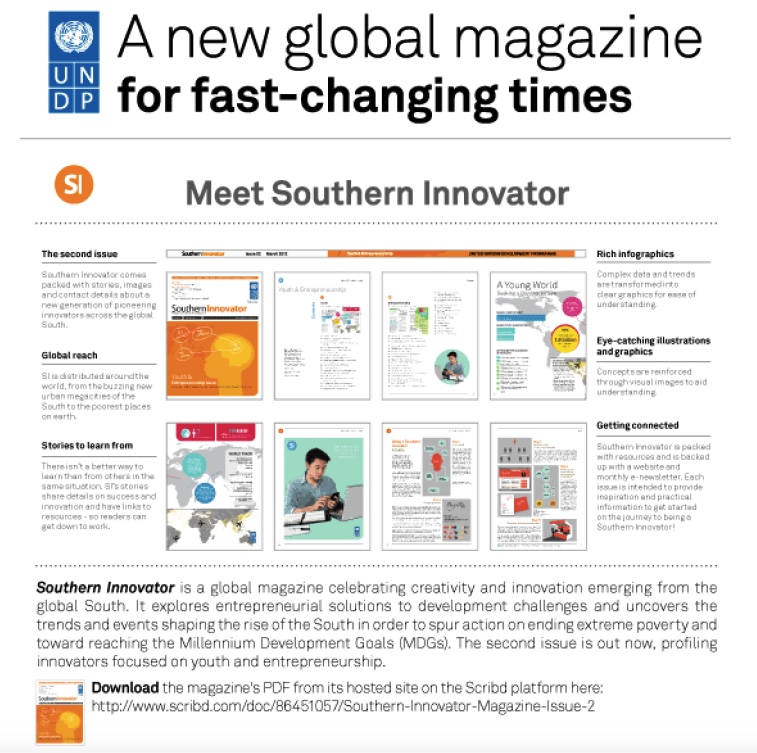
Southern Innovator Magazine | 2010 – 2014 

By David South

“I think you [David South] and the designer [Solveig Rolfsdottir] do great work and I enjoy Southern Innovator very much!” 

Ines Tofalo, Programme Specialist, United Nations Office for South-South Cooperation
Southern Innovator in Tianjin, China.
Issue 5 of Southern Innovator at the Global South-South Development Expo (GSSD Expo) 2014 held in Washington, D.C.
Volunteers in Nairobi, Kenya pose with Southern Innovator Issue 4 at the Global South-South Development Expo (GSSD Expo) in 2013.
Southern Innovator Editor and Writer David South in Australia.
Southern Innovator Graphic Designer and Illustrator Sólveig Rolfsdóttir in Iceland.

Some comments that have come in so far about SI’s first issue:

“What a tremendous magazine your team has produced! It’s a terrific tour de force of what is interesting, cutting edge and relevant in the global mobile/ICT space… Really looking forward to what you produce in issues #2 and #3. This is great, engaging, relevant and topical stuff.”, to “Looks great. Congratulations. It’s Brill’s Content for the 21st century!”

What they are saying about SI on Twitter: From @CapacityPlus Nice job RT @ActevisCGroup: RT @UNDP: Great looking informative @SouthSouth1 mag on South-South Innovation; @UNDP Great looking informative @SouthSouth1 mag on South-South Innovation; @JeannineLemaireGraphically beautiful & informative @UNDP Southern Innovator mag on South-South Innov. 

And on Pinterest:

Peggy Lee • 1 year ago 

“Beautiful, inspiring magazine from UNDP on South-South innovation. Heart is pumping adrenaline and admiration just reading it”

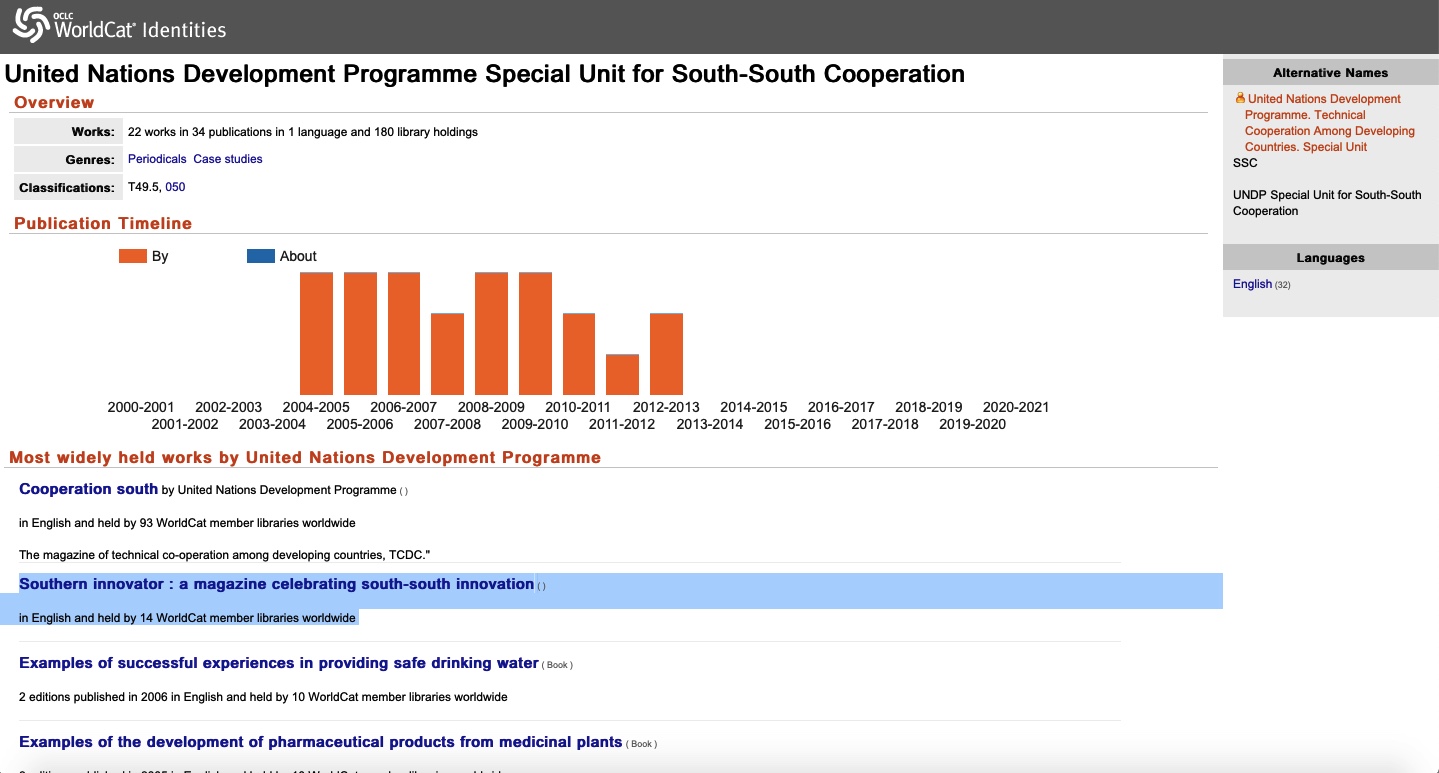
Southern Innovator Magazine can be found in libraries around the world.

Development Challenges, South-South Solutions was launched as an e-newsletter in 2006 by UNDP’s South-South Cooperation Unit (now the United Nations Office for South-South Cooperation) based in New York, USA. It led on profiling the rise of the global South as an economic powerhouse and was one of the first regular publications to champion the global South’s innovators, entrepreneurs, and pioneers. It tracked the key trends that are now so profoundly reshaping how development is seen and done. This includes the rapid take-up of mobile phones and information technology in the global South (as profiled in the first issue of magazine Southern Innovator), the move to becoming a majority urban world, a growing global innovator culture, and the plethora of solutions being developed in the global South to tackle its problems and improve living conditions and boost human development. The success of the e-newsletter led to the launch of the magazine Southern Innovator. 

https://davidsouthconsulting.org/southern-innovator-scale-up-fundraiser/

Creative Commons License

This work is licensed under a
Creative Commons Attribution-Noncommercial-No Derivative Works 3.0 License.

ORCID iD: https://orcid.org/0000-0001-5311-1052.

© David South Consulting 2022

Categories
Archive Development Challenges, South-South Solutions Newsletters

Innovative Mobile Phone Applications Storm South

By David SouthDevelopment Challenges, South-South Solutions

SOUTH-SOUTH CASE STUDY

The pace of change in information technology in the South is impressive, and nowhere has it been more rapid than in the take-up of mobile phones. In the past three years China has become the world’s largest exporter of information and communications technology (ICT), and home to the same number of mobile-phone users (500 million) as the whole of Europe. According to India’s telecoms regulator, half of all urban dwellers now have mobile- or fixed-telephone subscriptions and the number is growing by eight million a month. In Tanzania, mobile phone use grew by 1,600 percent between 2002 and 2008. In Nigeria it grew by almost 7,000 percent over six years, from 5 percent of the population 140 million in 2002, to a predicted 34.3 percent by the first quarter of this year.

But it is the Philippines that has become a global leader in mobile phone commerce. A whole panoply of banking tasks can now be done by mobile phone: transferring funds from one person to another, making small purchases, or paying fees.

“The most significant lesson learned so far,” said Shawn Mendes, lead author on a report titled The Innovative Use of Mobile Applications in the Philippines Lessons for Africa. “Is that m-Banking, rather than more altruistic applications such as m-Health and m-Education, has delivered the greatest benefits to people in developing countries.”

Access to basic banking services is vital for the world’s poor: The Consultative Group to Assist the Poor (CGAP) found that over 3 billion poor people lack access to even the most minimal banking services to manage their lives.

But mobile phones have come to the rescue as the fastest growing consumer product in history. Portio Research estimates that between 2007 and 2012 the number of mobile subscribers will grow by another 1.8 billion, mostly in emerging economies like India and China.

The Philippines is not alone in introducing so-called m-Banking (mobile phone banking) Africa’s leaders include the Democratic Republic of the Congo (CelPay), Kenya (M-PESA), South Africa (MTN MobileBanking and WIZZIT) and Zambia (CelPay).

“Safari-Com’s M-Pesa in Kenya has grown rapidly from start-up in early 2007 to well over 1 million accounts today,” said Mendes, the report author. “In May of this year Vodacom launched M-Pesa in Tanzania for their 4 million subscribers in that country. I expect very rapid growth of this service in Tanzania where less than 10 per cent of the adult population have conventional bank accounts. There are numerous other examples such as CelPay in Zambia and the Congo but I have been watching the success of M-Pesa in East Africa most closely.”

But the Philippines has taken m-Banking the furthest, with two great models for other countries: G-Cash and Smart Money. And the country has shown that it is possible to make these services attractive to the poor, not just the wealthy.

A combination of a good regulatory environment and an atmosphere of innovation brought mobile phone costs down, and made this possible. The mobile phone innovations were also successful because they mimicked existing consumer habits of the poor, piggy-backing on the extensive retail network of small village shops or “sari sari” stores. Poor Filipinos usually buy “tingi” or “sachets” of products like shampoo, fish sauce or soap. And it is in these shops that credit top-up centres were set up and prepaid phone cards sold.

Cleverly, mobile phone operators in the Philippines at first offered free SMS (short message service) text messaging. This was key to how m-Banking took off. As Smart Money’s Napoleon Nazareno said: “there must be an existing SMS habit.”

This should bode well for Africa, where an SMS habit has taken hold because it is so much cheaper than voice calls. Another important habit was prepayment. People learned how to use prepay cards, call numbers and how to enter codes into phones to purchase credits. They learned how to check their credit balance and to electronically load credit on to their phone. This habit made m-Commerce much easier and fuelled its growth.

In South Africa, m-Banking services are revolutionizing daily life. Hair salon owner Andile Mbatha in Soweto used to have to travel for two hours by minibus to a bank to send money to his relatives. But by setting up a bank account with a service called Wizzit, he no longer needs to keep stacks of cash in his salon (and risk robbery), can send money to his sister in Cape Town by phone, and receive payment for hair cuts by phone from his customers. “This has taken out a lot of stress,” said Mr Mbatha.

For Southern entrepreneurs looking to get the most from mobile phones, another recent development will help. Mobile phone companies are following developments with computers and turning away from using only proprietary software, to allowing open source software. Over the next six months, this will mean small-scale entrepreneurs can get in on making applications for mobile phones on a massive scale. Two software companies are now involved: Symbian, which provides the operating system for most of the new generation mobile phones with web access, and Google’s Android open source operating system for mobiles. In Sub-Saharan Africa and East Africa, these applications will help to bypass the lack of internet bandwidth.

In India, poor rural farmers are using mobile phone text messaging to get an advantage over the commodity markets. With so-called “agflation” and “rising prices for food ” it is crucial farmers keep on top of fluctuating commodity prices. Over 250 million Indians rely on farming for survival. But the pressure on farmers is severe and suicide rates are high.

Banana farmer Kapil Jachak is using a text messaging service to get the latest on the weather and daily market prices. The service, Reuters Market Light, costs a dollar a month. It’s a for-profit business venture by the global business news service, but helps farmers make money too. It already has 15,000 customers signed up.

This market knowledge gives the farmers a huge advantage when they compete with the traders in the wholesale markets of the city of Pune. “By getting the weather reports we can see exactly how much water our banana plants need,” said Kapil to the BBC. “I keep my cost down, and get the best crop I can.”

“This has increased my profit. I don’t have to make some headache, and go to any market, any shopkeepers, and wholesalers. I can do my marketing easily and get more and more money.” The service has already armed him with the knowledge to fight off banana stem weevils when they were attacking crops. The text recommended a pesticide.

Published: July 2008

Resources

Development Challenges, South-South Solutions was launched as an e-newsletter in 2006 by UNDP’s South-South Cooperation Unit (now the United Nations Office for South-South Cooperation) based in New York, USA. It led on profiling the rise of the global South as an economic powerhouse and was one of the first regular publications to champion the global South’s innovators, entrepreneurs, and pioneers. It tracked the key trends that are now so profoundly reshaping how development is seen and done. This includes the rapid take-up of mobile phones and information technology in the global South (as profiled in the first issue of magazine Southern Innovator), the move to becoming a majority urban world, a growing global innovator culture, and the plethora of solutions being developed in the global South to tackle its problems and improve living conditions and boost human development. The success of the e-newsletter led to the launch of the magazine Southern Innovator. 

Creative Commons License

This work is licensed under a
Creative Commons Attribution-Noncommercial-No Derivative Works 3.0 License.

ORCID iD: https://orcid.org/0000-0001-5311-1052.

© David South Consulting 2022