Categories
Blogroll

COVID-19 Timeline

This timeline is an aid to decision-making during the recovery from the pandemic and how to better prepare for outbreaks in the post-COVID-19 pandemic policy environment.

2015

2016

Domestic Resource Mobilization in
Global Health Security

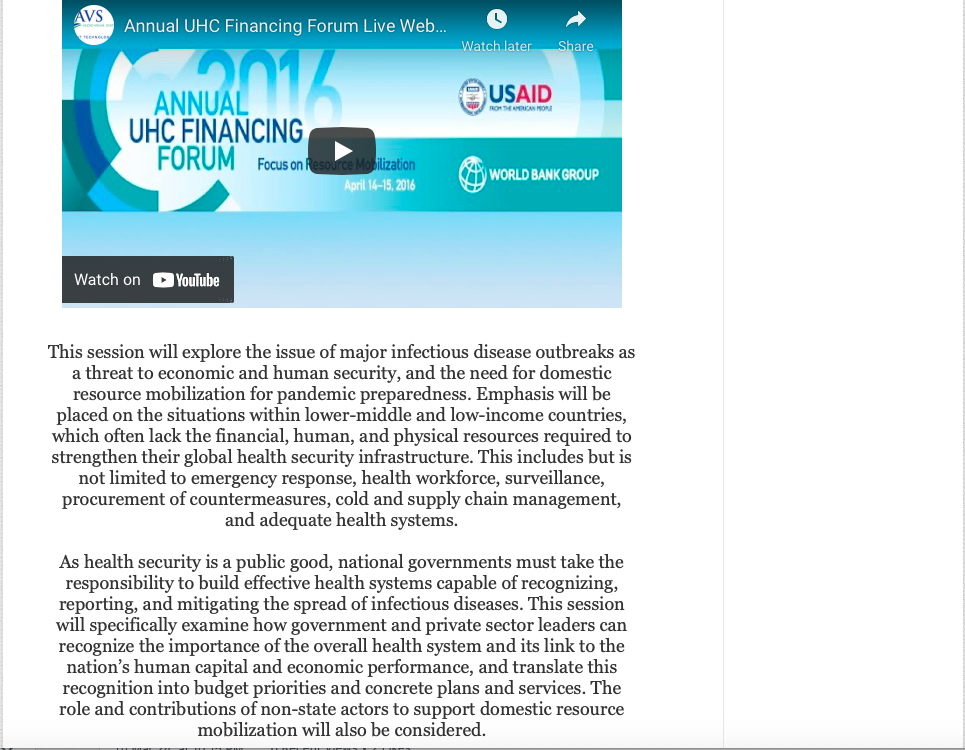
This session will explore the issue of major infectious disease outbreaks as a threat to economic and human security, and the need for domestic resource mobilization for pandemic preparedness. Emphasis will be placed on the situations within lower-middle and low-income countries, which often lack the financial, human, and physical resources required to strengthen their global health security infrastructure. This includes but is not limited to emergency response, health workforce, surveillance, procurement of countermeasures, cold and supply chain management, and adequate health systems.”
2019

October

Event 201: The Johns Hopkins Center for Health Security in partnership with the World Economic Forum and the Bill and Melinda Gates Foundation hosted Event 201, a high-level pandemic exercise on October 18, 2019, in New York, NY.

“The exercise illustrated areas where public/private partnerships will be necessary during the response to a severe pandemic in order to diminish large-scale economic and societal consequences.

Statement about nCoV and our pandemic exercise

In recent years, the world has seen a growing number of epidemic events, amounting to approximately 200 events annually. These events are increasing, and they are disruptive to health, economies, and society. Managing these events already strains global capacity, even absent a pandemic threat. Experts agree that it is only a matter of time before one of these epidemics becomes global—a pandemic with potentially catastrophic consequences. A severe pandemic, which becomes “Event 201,” would require reliable cooperation among several industries, national governments, and key international institutions.”

Human Extinction and the Pandemic Imaginary by Christos Lynteris is published on 8 October 2019 in London (ISBN 9780429322051).

“This book develops an examination and critique of human extinction as a result of the ‘next #pandemic’ and turns attention towards the role of pandemic catastrophe in the renegotiation of what it means to be human.”

The Times: En suite loos, wi-fi and showers . . . but our trains can’t keep up with China’s

“Anyone with a real interest in business and global trade will have been in London last week. To look on as the government tried to enact Brexit legislation? No — to attend the World Chinese Entrepreneurs Convention.”

“… It is 30 years old, but came to Europe for the first time only last week. …

3,000 delegates from Chinese-owned businesses representing a large part of world trade were at the ExCel centre in Docklands for three days.

“What’s a girl to do when she gets an invitation to the key dinner for this event?.”

November

Johns Hopkins University: Pandemic simulation exercise spotlights massive preparedness gap: Event 201, hosted by the Johns Hopkins Center for Health Security, envisions a fast-spreading coronavirus with a devastating impact

“ONCE YOU’RE IN THE MIDST OF A SEVERE PANDEMIC, YOUR OPTIONS ARE VERY LIMITED. THE GREATEST GOOD CAN HAPPEN WITH PRE-PLANNING.” Eric Toner, Senior scholar, Johns Hopkins Center for Health Security

2020

Nature: Two decades of pandemic war games failed to account for Donald Trump

The scenarios foresaw leaky travel bans, a scramble for vaccines and disputes between state and federal leaders, but none could anticipate the current levels of dysfunction in the United States.

January

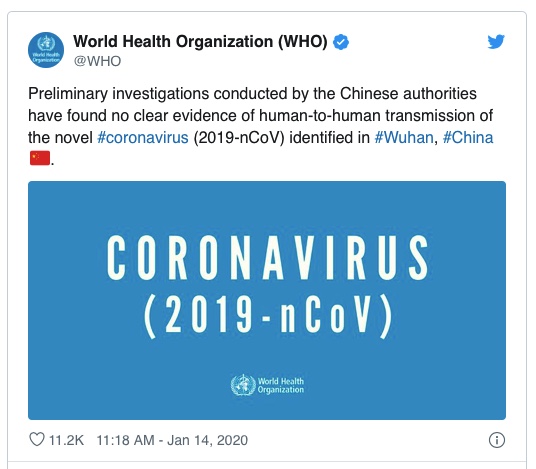
On January 20, 2020, CDC received a clinical specimen collected from the first reported U.S. patient infected with SARS-CoV-2. CDC immediately placed the specimen into cell culture to grow a sufficient amount of virus for study.

February

March

The ‘doctor’ prescribes Covid-19 and war in Ukraine? for the world economy, this cover image seems to suggest (The Economist, March 2020).

Independent: Coronavirus: Scientists isolate virus responsible for deadly Covid-19 outbreak: Canadian research team says work will help inform global response to worsening pandemic

“A Canadian team of scientists has successfully isolated a strain of the coronavirus and grown samples in a lab to help study the pathogen responsible for the deadly global pandemic.

“Researchers from Sunnybrook Research Institute, McMaster University and the University of Toronto, all in Canada, isolated the virus from two specimens and then cultivated it in a secure containment facility.”

December

Reuters: Fact check: The virus that causes COVID-19 has been isolated, and is the basis for the vaccines currently in development

2021

Bulletin of the Atomic Scientists: The origin of COVID: Did people or nature open Pandora’s box at Wuhan?

December

What the Wuhan ‘lab leak’ tells us about the future of biowarfare

As it’s declared ‘more likely than not’ Covid came from a lab leak, what are the implications for those seeking to use viruses as weapons

June

CBC: ‘Wake-up call for Canada’: Security experts say case of 2 fired scientists could point to espionage

Couple shared information, virus samples from high-security lab with Chinese institute

“It appears that what you might well call Chinese agents infiltrated one of the highest prized national security elements when it comes to biosecurity and biodefence,” said Christian Leuprecht, a security expert and professor at the Royal Military College and Queen’s University.

2022

February

Maclean’s: A brilliant scientist was mysteriously fired from a Winnipeg virus lab. No one knows why.

She was escorted away by the RCMP more than two years ago, sparking international controversy. What really happened to Xiangguo Qiu?

Further Reading:

Global health and the new world order: Historical and anthropological approaches to a changing regime of governance Edited by Jean-Paul Gaudillière, Claire Beaudevin, Christoph Gradmann, Anne M. Lovell and Laurent Pordié

“The phrase ‘global health’ appears ubiquitously in contemporary medical spheres, from academic research programs to websites of pharmaceutical companies. In its most visible manifestation, global health refers to strategies addressing major epidemics and endemic conditions through philanthropy, and multilateral, private-public partnerships. This book explores the origins of global health, a new regime of health intervention in countries of the global South born around 1990, examining its assemblages of knowledge, practices and policies.

The volume proposes an encompassing view of the transition from international public health to global health, bringing together historians and anthropologists to analyse why new modes of “interventions on the life of others” recently appeared and how they blur the classical divides between North and South. The contributors argue that not only does the global health enterprise signal a significant departure from the postwar targets and modes of operations typical of international public health, but that new configurations of action have moved global health beyond concerns with infectious diseases and state-based programs.

The book will appeal to academics, students and health professionals interested in new discussions about the transnational circulation of drugs, bugs, therapies, biomedical technologies and people in the context of the “neo-liberal turn” in development practices.”

Global health and the new world order: Historical and anthropological approaches to a changing regime of governance Edited by Jean-Paul Gaudillière, Claire Beaudevin, Christoph Gradmann, Anne M. Lovell and Laurent Pordié

My background:

CASE STUDY 7: UNOSSC + UNDP | 2007 – 2016

CASE STUDY 5: GOSH/ICH Child Health Portal | 2001 – 2003

CASE STUDY 4: UN + UNDP Mongolia | 1997 – 1999

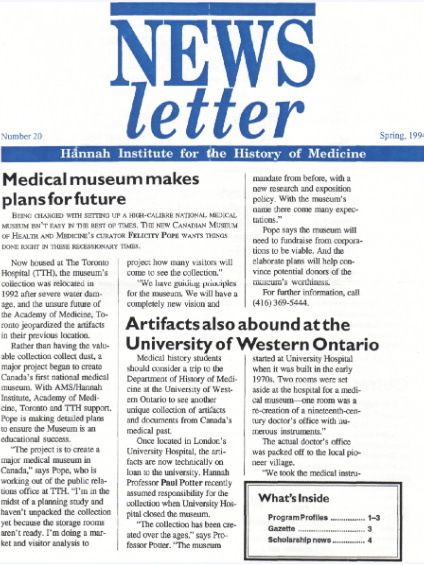
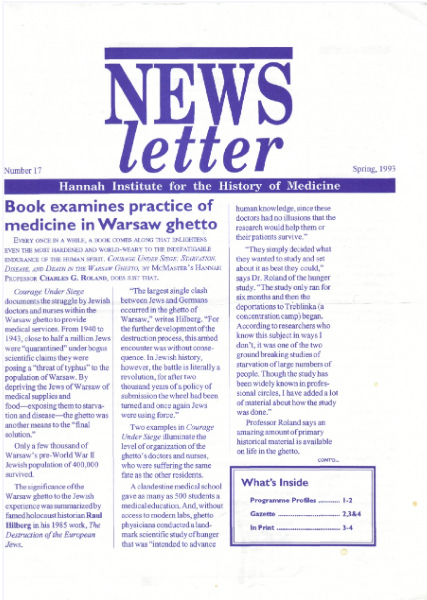
Hannah Institute For The History Of Medicine | 1992 – 1994

Lamas Against AIDS

Mongolian AIDS Bulletin

Philippine Conference Tackles Asia’s AIDS Crisis

Taking Medicine To The People: Four Innovators In Community Health

Take Two Big Doses Of Humanity And Call Me In The Morning

Women scientists prove potency of Mongolian beverage

ORCID iD: https://orcid.org/0000-0001-5311-1052.

© David South Consulting 2023
Categories
Archive

The Dawn Of The Genetics Revolution | 2001 – 2003

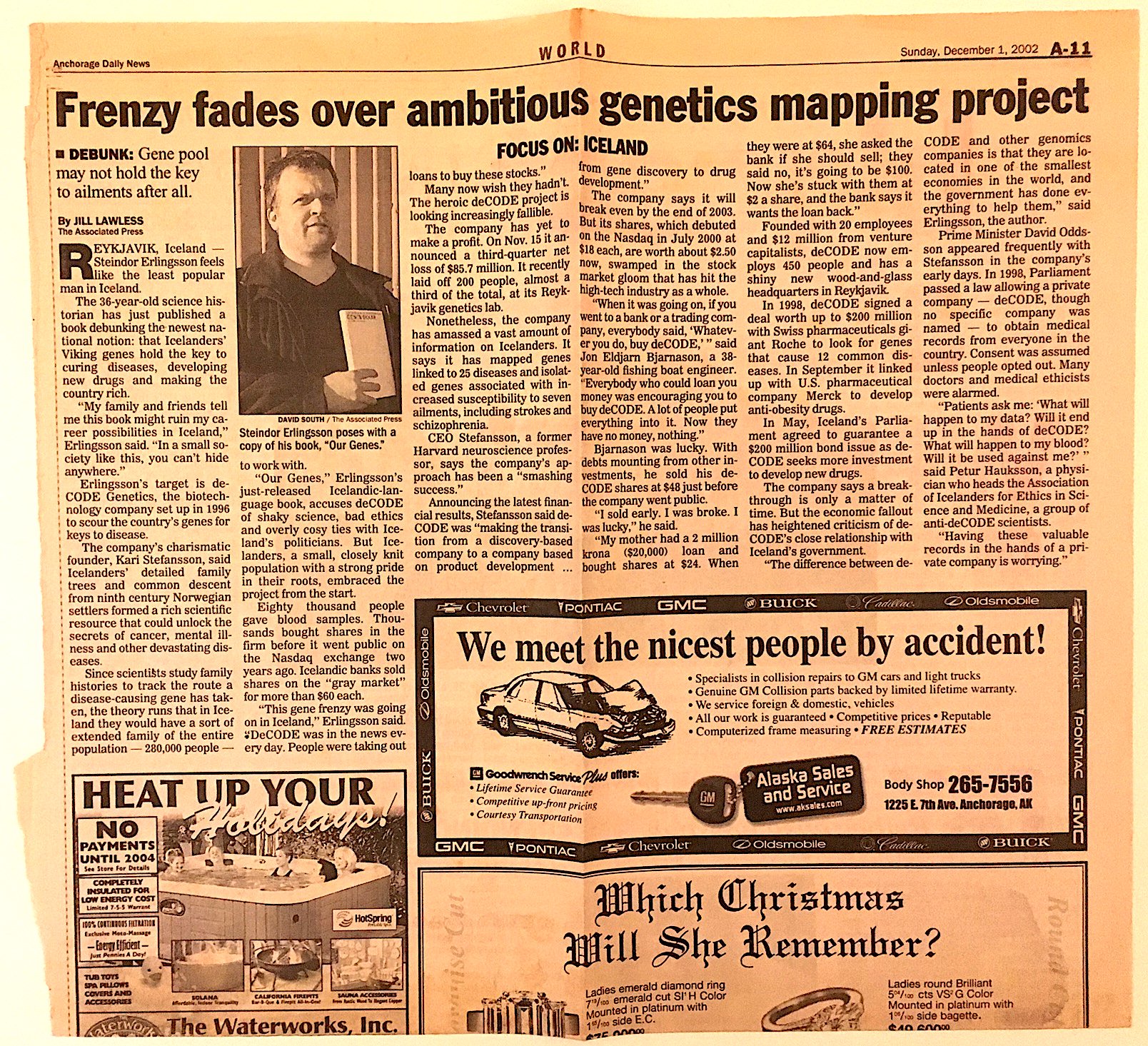
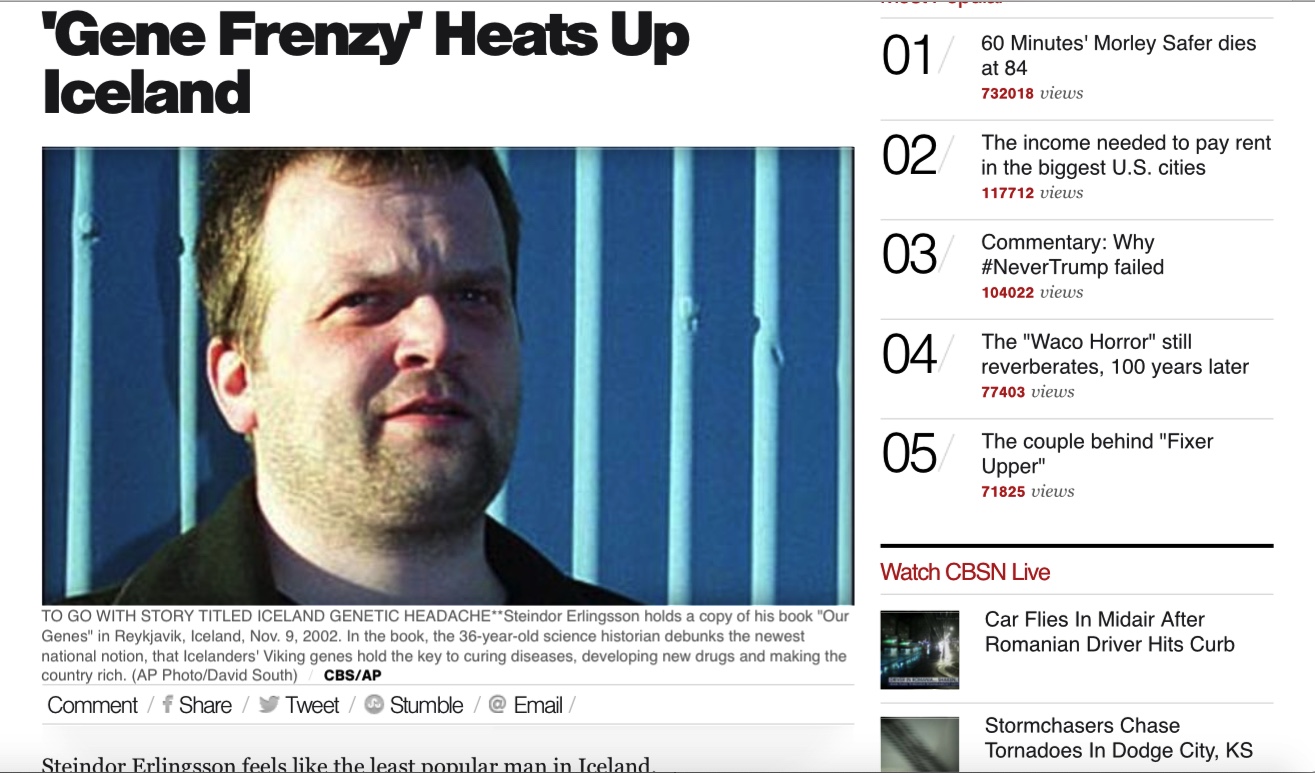
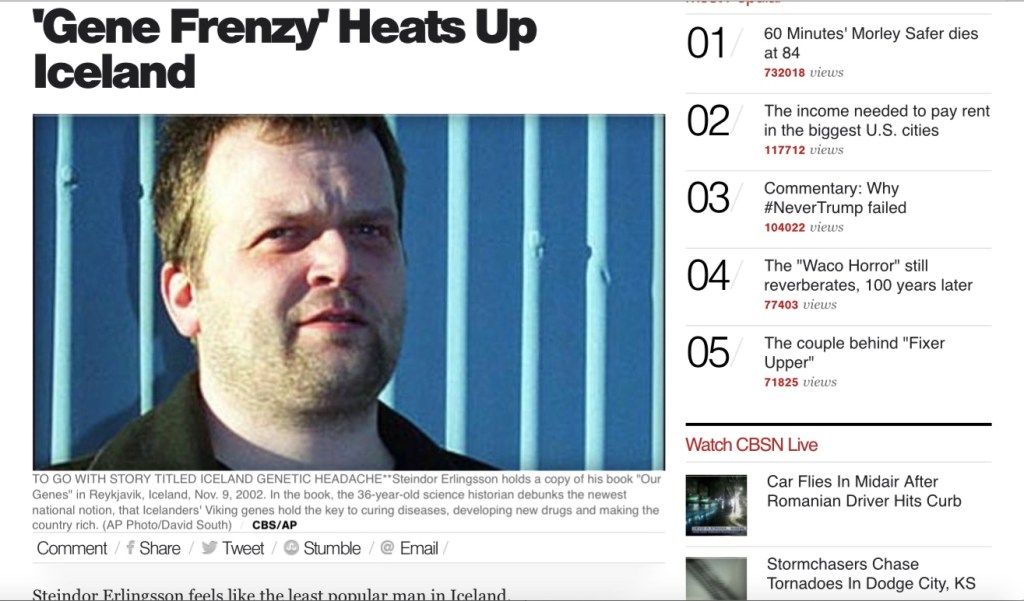
“Steindor Erlingsson holds a copy of his book “Our Genes” in Reykjavik, Iceland, Nov. 9, 2002. In the book, the 36-year-old science historian debunks the newest national notion, that Icelanders’ Viking genes hold the key to curing diseases, developing new drugs and making the country rich. (AP Photo/David South/ CBS/AP.”

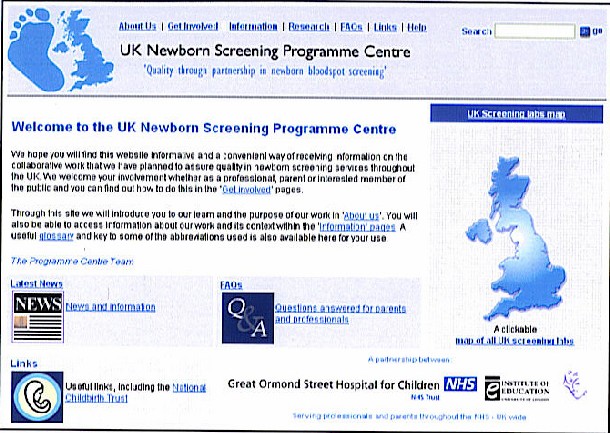
The Human Genome Project (HGP) was officially declared complete in 2003. A rough draft of the human genome sequencing carried out by the HGP was formally announced in 2000 and the completed sequence was announced in 2003. This breakthrough spawned many initiatives, including Iceland’s deCode (below), and was reflected in the work I was called upon to undertake for the GOSH Child Health Portal at the time, such as designing websites for the London IDEAS Genetics Knowledge Park and the UK Newborn Screening Programme Centre (at bottom). I photographed the author of Our Genes, Steindor Erlingsson, in Reykjavik, Iceland for The Associated Press in 2002.

“Frenzy fades over ambitious genetics mapping project” by Jill Lawless, Associated Press, December 1, 2002.

From CBS News: ‘Gene Frenzy’ Heats Up Iceland by Jill Lawless, Associated Press, December 2, 2002.

From Tulsa World: Path of Iceland’s genetics mapping questioned by Jill Lawless, December 1, 2002.

UK Newborn Screening Programme Centre website screen grab.

Read a story I did for the UNDP e-newsletter Development Challenges, South-South Solutions here: China Pushing Frontiers of Medical Researc.

https://davidsouthconsulting.org/2020/04/25/china-pushing-frontiers-of-medical-research

My background:

CASE STUDY 5: GOSH/ICH Child Health Portal | 2001 – 2003

https://davidsouthconsulting.org/2021/06/02/case-study-5-gosh-ich-child-health-portal-2001-2003

Hannah Institute For The History Of Medicine | 1992 – 1994

Creative Commons License

This work is licensed under a
Creative Commons Attribution-Noncommercial-No Derivative Works 3.0 License.

ORCID iD: https://orcid.org/0000-0001-5311-1052.

© David South Consulting 2024

Categories
Archive Blogroll Today's Seniors

Private Firms Thrive As NDP ‘Reinvents’ Medicare

By David South

Today’s Seniors (Canada), August 1993

Many of today’s seniors fought for Canada’s internationally-admired public health system. But more and more people are becoming worried that the combination of health care reform, funding cutbacks and free trade is fuelling the growth of a second tier of private medical services serving the well off. 

The provincial government sees things differently, arguing Ontarians no longer expect government to pay for everything and rather than eroding medicare, the NDP is reinventing it. 

Whichever way one looks at it, private insurance companies, homecare providers, labs and other services designed to make money are becoming more and more involved in the health care business. 

Operating in the territory outside the guidelines of the 1984 Canada Health Act – which sets out the principles of medicare for the federal government to enforce – the private sector has room to expand, at the same time as OHIP coverage is scaled back from more and more services. 

Janet Maher, whose Ontario Health Coaltion (OHC) represents doctors, nurses and other health care workers, worries for the future of medicare. 

“A number of things like accommodation services – laundry, food services – are in the grey area of the Canada Health Act,” says Maher. “So with all these fees that are being introduced, by the strict letter of the law, there is no way to stop them. But as far as we are concerned the spirit of the Act isn’t being observed.”

In its current reforms, the government of Ontario is emphasizing paramedical professions like midwives who fall outside the CHA and aren’t covered by OHIP. The turn to community-based services means that people have to rely more on services and providers that aren’t covered under the CHA. 

Maher says privatizing accommodation services is a recent phenomenon, the result of hospitals finding creative ways to trim their budgets. 

“It’s a new area that hospitals are taking bids on,” she says. “The other thing around the accommodation services is that because they are not categorized, strictly speaking, as health care services, none of this is exempted in the Free Trade Agreement from U.S. competition.”

A recent report by two British Columbia researchers tries to put together this complex puzzle. Jackie Henwood and Colleen Fuller of the 7,500-member Health Sciences Association of British Columbia recently charged that a combination of free trade and budget-slashing governments is eroding the universality of medicare and ushering in a two-tier system. 

Fuller and Henwood identify the Free Trade Agreement as the culprit. While the health care industry created more jobs than any other sector of the Canadian economy between 1984 and 1991, they point out the job growth has been concentrated in the private sector since free trade was implemented in 1989. And they expect worse under the proposed North American Free Trade Agreement (NAFTA). 

“NAFTA will accelerate trends towards a privatized, non-union and corporate-dominated system of health care in Canada.”

One provision of the Free Trade Agreement has also made it possible for U.S. companies to compete against Canadian firms in health care. Chapter 14, “health-care facilities management services”, allows wide-open competition. 

Under NAFTA, provisions will bind all levels of government to consider for-profit health care companies on both sides of the border on equal footing with public providers when bidding for services, and entitles them to compensation if they can prove to an arbitration board they’ve been wronged. 

“That represents a substantial encroachment on the democratic right of local, provincial and federal governments to make decisions,” says Cathleen Connors, who chairs the national wing of OHC, the Canadian Health Coalition. 

It’s this plus health care cutbacks – federal and provincial – that’s resulting in service and job cuts and bed closures in the public sector and an increase in privatization, say Henwood and Fuller. These opportunities have not gone unnoticed by private companies south of the border. 

One such company is American Medical Security Inc. (AMS) of Green Bay Wisconsin. After hiring Canadian pollsters Angus Reid to do a survey, AMS saw a profitable market in offering American hospital insurance to frustrated Canadians awaiting surgery. Sixteen per cent of those polled said they wanted this service; that was enough for AMS. 

“One thing that comes across loud and clear is that Canadians for the most part are happy,” says spokesperson Carrie Galbraith. “They know they are taken care of during an emergency. But they are willing to pay a little extra if they need care.”

So far, AMS offers its plan to Ontario, B.C. and Manitoba, with Toronto its best market. Galbraith says plans are in the works to expand to all of Canada except the territories. 

Unfortunately, like most private health plans, AMS cuts its losses by avoiding what Galbraith calls “adverse selection” – anybody with a known serious health problem need not apply. 

Here in Ontario, private for-profit home care services take in close to half of all OHIP billings. Many clients pay out of their own pockets for additional services. 

The Ontario health ministry doesn’t keep statistics on the extent of the private home health care sector, says spokesperson Layne Verbeek. But the Ontario Home Health Care Providers’ Association, a trade group, estimates private homecare companies now employ 20,000 and serve more than 100,000. 

“It’s a market situation,” says Henwood. “If the services aren’t available to people within the public sector, they will go outside of it. We’ve seen this in other countries like England, where they had a public system and now have a parallel private system. If you erode a system enough that people get angry, they are going to start to look for alternatives, and the people with the greatest liberty are those with money.”

But in a recent interview, health minister Ruth Grier was adamant this scenario wouldn’t be allowed to take place in Ontario. She strongly disagreed that medicare is being weakened due to recent changes, and said the government has actually “reaffirmed its commitment to medicare.”  

More from Canada’s Today’s Seniors

Feds Call For AIDS, Blood System Inquiry: Some Seniors Infected

Government Urged To Limit Free Drugs For Seniors

Health Care On The Cutting Block: Ministry Hopes For Efficiency With Search And Destroy Tactics

New Seniors’ Group Boosts ‘Grey Power’: Grey Panthers Chapter Opens With A Canadian Touch

Seniors Falling Through The Health Care Cost Cracks

My background: 

CASE STUDY 7: UNOSSC + UNDP | 2007 – 2016

CASE STUDY 5: GOSH/ICH Child Health Portal | 2001 – 2003

CASE STUDY 4: UN + UNDP Mongolia | 1997 – 1999

Hannah Institute For The History Of Medicine | 1992 – 1994

Taking Medicine To The People: Four Innovators In Community Health

Take Two Big Doses Of Humanity And Call Me In The Morning

Like our content? Help contribute to the costs of keeping it online.

Scan code with your phone and help us out.

ORCID iD: https://orcid.org/0000-0001-5311-1052.

© David South Consulting 2021

Categories
Archive Blogroll Today's Seniors

Health Care On The Cutting Block: Ministry Hopes For Efficiency With Search And Destroy Tactics

By David South

Today’s Seniors (Canada), August 1993

It’s search and destroy time at Ontario’s ministry of health: search out savings and destroy inefficiency and waste. But many remain apprehensive that not all the cuts are going to be logical and fear the province’s health and well-being will be affected. 

As part of the social contract deal, the Ontario Medical Association must find $20 million in cuts from the list of services covered by OHIP. The OMA and the provincial government are currently haggling over which procedures and examinations will be cut. 

“We look at services that aren’t medically necessary,” says health ministry spokesperson Layne Verbeek. “Because we were wealthier in the past, we were able to cover some services. We aren’t in that position now. But I don’t see how eliminating medically unnecessary treatments will affect the population.”

The fallout of the Rae government’s attempts to reign in costs and recover lost revenues may take years to unfold, but it is already apparent that Ontarians will be paying more. 

“Access to necessary treatment should not depend on a person’s ability to pay,” says health policy critic Carol Kushner. “What disturbs me about any delisting program is that virtually every medical service could be termed medially necessary. There are very few services that are an out-and-out waste of time.

“We often point to the fact that Ontario spends $200 million a year treating the common cold. Well, most of that is a waste of time. But delisting even that kind of service would be a detriment to the public’s health, because a small group of patients really do need to see a doctor when they have a cold.”

OMA spokesperson Jean Chow says it’s too early to pin down the exact cuts that will be made. “It’s a little premature to try and speculate what the final list will be.”

The newly-created Non-Tax Revenue Group is hard at work finding fees, fines and penalities the government can add or hike to boost revenue from this source from $5 billion to $10 billion a year. 

The spring budget saw the first hit, with the addition of $240 million in non-tax revenue. 

A radical reshaping of medicare is taking place. Private sector services – for which consumers pay directly or through insurance companies – now make up 34 per cent of Ontario’s health care funding, compared to 42 per cent in the United States, according to a recent study by the Canadian Medical Association. 

Health minister Ruth Grier has also floated the idea of widespread hospital closures. Both the Toronto and Windsor district health councils (DHCs) are carrying out feasibility studies on “reconfiguration.” The ministry is remaining tight-lipped about which hospitals will get the chop. 

“One suspects there’s room for efficiency – there are a lot of empty beds in a number of different places,” says ministry spokesperson Verbeek. 

“All hospitals are being reviewed, with a view to closing one or two hospitals,” says health planner Lisa Paolatto, who is working on a feasibility study on “reconfiguration” for the Essex County District Health Council, along with Toronto’s DHC. 

Closing hospitals could present a serious political hot potato for the government. In Britain, the Conservative government is still recovering from the bad feelings surrounding proposals to close world-renowned hospitals in the London area. The public feels great loyalty to local hospitals, a feeling that has been further fostered by hospital charities that raise millions a year from the communities’ good will. 

“This is going to open up new discussions of money between doctors and patients,” says Kushner. “Seniors are a unique group in Canada because they remember what it was like before medicare – what it was like not to be able to pay for the doctor, to forgo treatment that they thought was necessary. They understand the financial hardship that could occur if they were unlucky enough to have a family member who needs expensive medical treatment.” 

All Posts

More from Canada’s Today’s Seniors

Feds Call For AIDS, Blood System Inquiry: Some Seniors Infected

Government Urged To Limit Free Drugs For Seniors

Health Care On The Cutting Block: Ministry Hopes For Efficiency With Search And Destroy Tactics

New Seniors’ Group Boosts ‘Grey Power’: Grey Panthers Chapter Opens With A Canadian Touch

Seniors Falling Through The Health Care Cost Cracks

ORCID iD: https://orcid.org/0000-0001-5311-1052.

© David South Consulting 2021