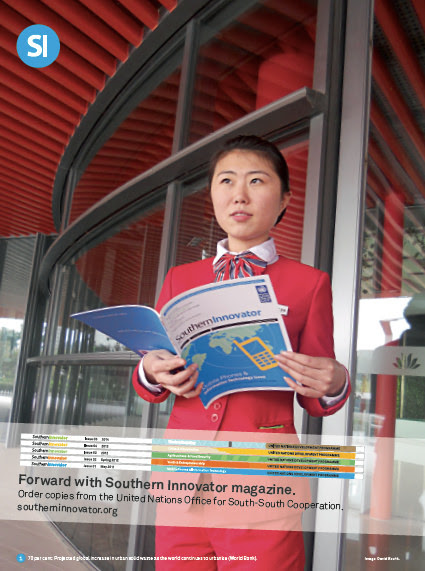
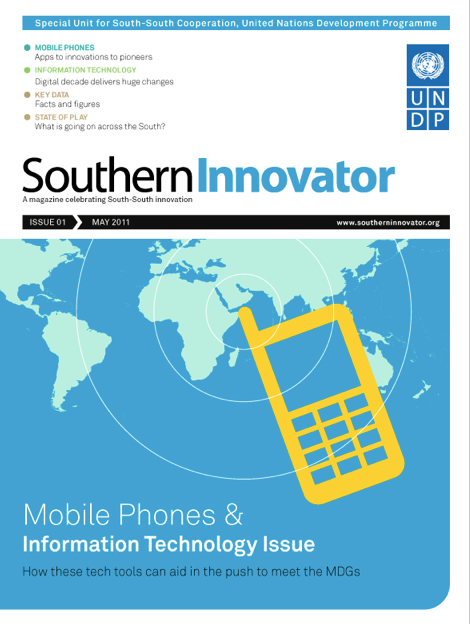
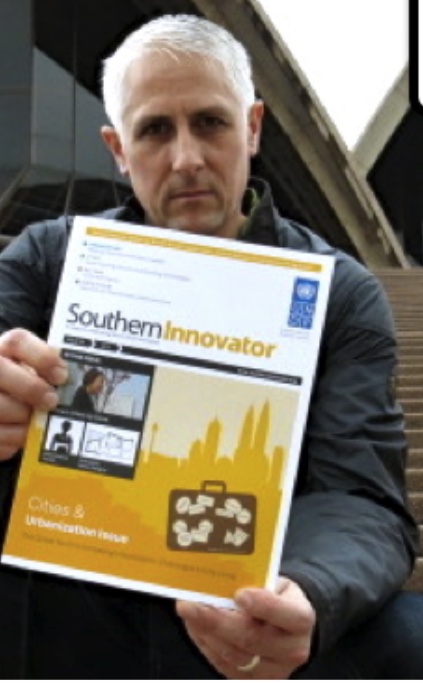
Launched in May 2011, the new global magazine Southern Innovator (ISSN 2222-9280) is about the people across the global South shaping our new world, eradicating poverty and working towards the achievement of the Millennium Development Goals (MDGs).
Work began in 2010 to develop what became the United Nations magazine Southern Innovator. A highly talented global team of international development and design professionals based in New York and London collaborated with an Icelandic studio to create an innovation media brand showcasing global South innovators inspired by the mobile and information technology revolutions. It was launched in 2011 at the UN General Assembly in New York.
“Dr. Cosmas Gitta is a senior UN consultant and the former Assistant Director for Policy and UN Affairs at the UN Office for South-South Cooperation, where he oversaw the convening of various intergovernmental and interagency forums as well as the preparation of related reports and studies, including the biennial reports of the Secretary-General on the state of South-South cooperation. He was Editor-in-Chief of the magazine Southern Innovator and an e-newsletter, Development Challenges, South-South Solutions, both of which are media to share information on development related innovations with partners around the world. He was for many years Managing Editor of Cooperation South, a print and electronic development journal promoting collaboration among developing countries. Mr. Gitta holds a PhD in international and comparative education from Columbia University and he has lectured on human rights education at his alma mater, and on a range of other subjects at various campuses of the City University of New York.” (From Integral Leadership Review)
David South is the founder and senior partner for David South International and David South Consulting. He has worked around the world for the United Nations and has led a number of groundbreaking projects for major institutions. Clients have included the United Nations Office for South-South Cooperation (UNOSSC), the United Nations Development Programme (UNDP), the Great Ormond Street Hospital for Children (GOSH)/Institute of Child Health (ICH)/National Health Service (NHS), Harvard Institute for International Development, UNICEF, World Bank, USAID, and the Hannah Institute for the History of Medicine, among others.
He has worked for, or side-by-side, with many high-level senior professionals and executives. These experienced professionals had roles under close public scrutiny and needed to show the impact of their work to a tight deadline.
He has been the editor for the United Nations magazine Southern Innovator since 2010. He also researched and wrote the influential United Nations e-newsletter Development Challenges, South-South Solutions (2007-2014). He has over two decades’ experience in media and journalism (developing strong relationships with many top journalists and media professionals), health and human development, and the role innovation plays in transforming major organisations while getting the most from people tackling complex problems in challenging environments.
Launched in May 2011, the new global magazine Southern Innovator (ISSN 2222-9280) is about the people across the global South shaping our new world, eradicating poverty and working towards the achievement of the Millennium Development Goals (MDGs).
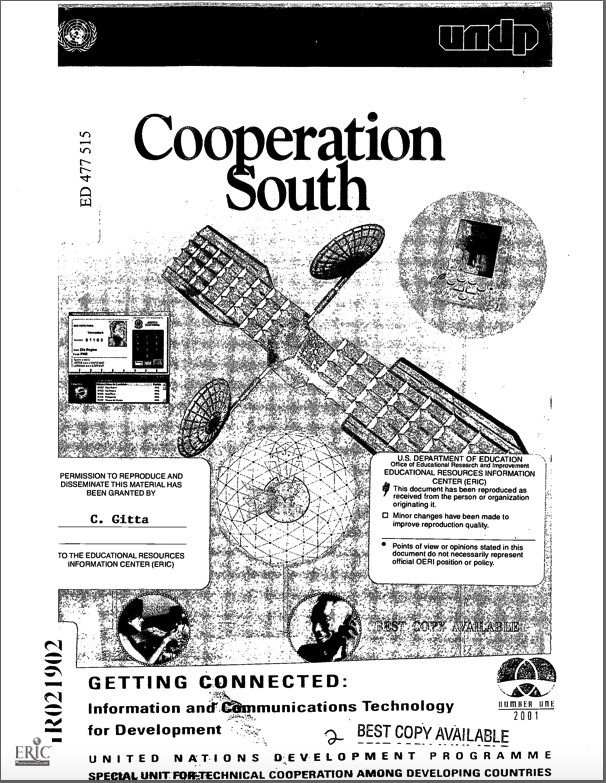
Cooperation South, Getting Connected: Information and Communications Technology for Development, Number 1, 2001, United Nations Development Programme, ISSN-0259-3882. The team behind Cooperation South joined up with a team from Canada/UK/Iceland to create Southern Innovator Magazine (ISSN 2222-9280). Both publications highlighted the innovators behind the global South’s connectivity revolution.
African youth need to play more according to a new landmark study published in the UK’s leading medical journal, The Lancet. The study tackles the high rates of illiteracy and educational under-achievement in Africa and finds that malnourishment and lack of stimulation are leaving millions unable to benefit from schooling. It found projects that encouraged learning through play led to children boosting their IQs and getting better reading skills. And it comes up with a very simple and low-cost solution – but excellent opportunity for entrepreneurs – toys and play.
“These are not high tech interventions,” said team leader for the study, Professor Sally McGregor of the Institute of Child Health of University College London. “Research over decades in Jamaica (and other countries) has shown that women with only primary school-level education and a few home made toys can be trained to make a significant difference in the education, intelligence and mental health of disadvantaged children. The Millennium Goal of universal primary education for all cannot be met unless these children’s poor development is tackled.”
The paper – Strategies to Avoid the Loss of Developmental Potential among Over 200 Million Children in the Developing World – is published in three parts in the journal.
Twenty projects around the world were evaluated for the benefits they produce for children under five who use toys. McGregor, who has set up several projects in Kenya, Tanzania and Uganda designing and constructing toys using whatever materials are available, was appalled by the widespread neglect of play throughout these countries. With play, the study found children read better, have better mental health and better self-esteem. In Africa it is ‘desperate, really desperate’ she says.
African primary school enrolments and literacy rates are among the lowest in the world, with over 42 million school children in sub-Saharan Africa not enrolled in school, and many children not able to afford to go or stay in primary school. Today a little more than half of African adults are literate and some 60 per cent of children go to school, according to UNESCO. The agency has forecasted the need for an additional 1.6 million teachers in Sub-Saharan African classrooms by 2015 – an increase of 68 percent.
The materials used to construct the toys do not need to be expensive or sophisticated. Toys can be constructed from banana trees, mud, corn on the cob, old plastic bottles, or cloth and straw dolls. It is key that the toys are safe for children under five and that anyone building such toys for sale must follow existing manuals.
McGregor continues: ‘One mother in a village was doing marvellous things with tiny scraps of material to make a doll. She received no recognition in the village for the work she was doing yet it was so important. It doesn’t take much – dolls or simple wooden blocks – they are so versatile. You see schools with nothing – it is unforgivable. The problem is how poor these people are – food just takes priority over toys – it is that stark.”
Locally produced toys are key to resolving this crisis for several reasons. Cost is the most important, with those most adversely affected also the least able to pay for toys and who are already living a precarious existence where basic survival takes precedence over play. Another factor is Africa being home to the countries who import the least number of toys: Somalia, Liberia, Togo, Rwanda and Chad. But the situation for African toymakers is often desperate as well, with many craft workers living at the economic margins. Several initiatives have emerged in the last couple of years to address this problem and ensure African toys are local and toymakers earn a living.
Initiatives like the African Toyshop based in Johannesburg, South Africa – a fair trade business – work to ensure African toymakers can make a living and get their wares to as wide a market as possible. The toymakers featured all use natural resources or recycled materials. Most work at the village level and produce toys that are culturally relevant to Africa. The organization COFTA – Cooperation For Fair Trade in Africa – is a network of Fair Trade producer Organizations in Africa involved and working with disadvantaged grassroots producers to eliminate poverty through fair trade. It is an excellent resource for grassroots organizations wanting to work with African toymakers.
Published: January 2007
Resources
The UK charity TALC – Teaching-aids At Low Cost – is planning to make available toy making manuals on a CD. Tel: (0) 1727 853869
Book: Africa on the Move: Toys from West Africa Stefan Eisenhofer, Karin Guggeis, Jacques Froidevaux Stuttgart, Germany: Arnoldsche, 2004. 216 pp., 195 color, 28 b/w illustrations. $75.00, cloth.
Development Challenges, South-South Solutions was launched as an e-newsletter in 2006 by UNDP’s South-South Cooperation Unit (now the United Nations Office for South-South Cooperation) based in New York, USA. It led on profiling the rise of the global South as an economic powerhouse and was one of the first regular publications to champion the global South’s innovators, entrepreneurs, and pioneers. It tracked the key trends that are now so profoundly reshaping how development is seen and done. This includes the rapid take-up of mobile phones and information technology in the global South (as profiled in the first issue of magazine Southern Innovator), the move to becoming a majority urban world, a growing global innovator culture, and the plethora of solutions being developed in the global South to tackle its problems and improve living conditions and boost human development. The success of the e-newsletter led to the launch of the magazine Southern Innovator.












 David South Consulting
You must be logged in to post a comment.