Categories
Archive data Development Challenges, South-South Solutions Newsletters Southern Innovator magazine

Radical Drone Solution To Woeful Infrastructure In Poor Countries

By David SouthDevelopment Challenges, South-South Solutions

SOUTH-SOUTH CASE STUDY

Drones – unpiloted aircraft, formally called Unmanned Aerial Vehicles (UAV) or Unmanned Aircraft Systems (UAS) – have long been used for military purposes. The U.S. military claims to have 7,500 drones – a massive growth from just 50 a decade ago – and has used them for surveillance and combat in conflicts from Afghanistan to Iraq.

Drones can cost anywhere between a few thousand and millions of dollars depending on their size and sophistication. Some weigh as little as half a kilogram, and the largest can reach 18,000 kilograms (19 tons).

It is estimated 40 countries around the world are working on drones in one capacity or another.

Military drones come with ominous-sounding names such as Predator, Fire Scout, Global Hawk and Hunter. But many pioneers and innovators are setting out to prove drones can be a technology of peace and development and not just of fear and war.

YouTube provides many examples of drones being tested out as a delivery method. SF Express (http://www.sf-express.com/cn/en/product_service/product_intro/airline_delivery.html), a courier service in Dongguang, China has tried delivering parcels by drone. It is using a drone with eight rotor blades, called an octocopter (http://www.steadidrone.eu/octocopter-ei8ht/).

In Shanghai, the InCake bakery has used drones to deliver cakes (http://www.youtube.com/watch?v=fXwgwSkujOY). The service was brought to a halt after complaints from citizens, worried the drone would crash into someone.

The American pizza chain Domino’s has been testing drones for delivering pizza in the United Kingdom (http://www.youtube.com/watch?v=ZDXuGQRpvs4). A British company has used drones to deliver sushi to restaurant tables in London (http://www.youtube.com/watch?v=WV0yQYXLU34).

These may prove to be novelty experiments – or the early days of a revolution. Time will tell.

But serious thinking about drones is taking place in the area of development.

One pioneering company thinks it has a solution for two big problems common to many developing countries: the chaos, congestion and crowding that clog urban areas; and the poor or non-existent infrastructure in rural areas. Both problems make it expensive and time-consuming to move goods around.

A billion people in the world do not have access to all-weather roads, says the World Bank. Some roads are being upgraded in parts of sub-Saharan Africa but many are in worse shape than they were decades ago. Modern infrastructure is expensive to build, and the funds to do it often must be borrowed.

A startup called Matternet thinks it has the solution to getting around this problem in Africa, and in rapidly growing cities of the global South. It believes drones can come to the rescue where infrastructure is poor or non-existent, and save valuable wealth that can be diverted to real improvements in human development, or used to reduce congestion in crowded urban areas.

The Matternet (http://matternet.us/) is billed as “the next paradigm for transportation.” Matternet is offering a system and a concept for deploying drones as a scalable solution to overcome the problem of poor transportation networks in developing countries.

The artist’s vision on Matternet’s website shows drones buzzing their way through an urban high-rise landscape as they go about their business.

The Matternet drone design has two wings with three fans in each wing to allow it to take off and land vertically as well as flying in a straight line. There is a 10 litre space for packages and a rechargeable battery at the bottom of the drone. The drones can fly at 40 kilometres an hour, at an altitude of up to 121 metres and are guided by GPS (Global Positioning System) (http://en.wikipedia.org/wiki/Global_Positioning_System).

The drone moves in and out of a ground-station landing pod, where it is recharged, picks up new packages to deliver, and connects electronically to receive instructions. An entry and exit slot sits on top of the pod while there is a place at ground level for people to pop in packages for delivery.

Each vehicle costs US $1,000 and can last 10 years, the makers claim. Matternet believes the drones could transport 2 kilograms over 10 kilometres for just 24 US cents a trip.

Matternet’s Andreas Raptopoulos (https://www.solveforx.com/moonshots/physical-transport) hopes to push Africa away from simply upgrading its infrastructure along the lines of what is already in existence in developed countries. It is estimated it will take Africa another 50 years to have an infrastructure equal to North America. But why wait so long? Why not, he argues, just use drones or UAVs to knit a transport infrastructure criss-crossing the continent delivering goods and services to people?

Radical drone advocates like Matternet are very ambitious. They believe drones are to infrastructure what mobile phones have been to telecommunications: an advanced, 21st-century technology that enables countries to leapfrog ahead of old-school 20th century infrastructure and connect people up for much less cost and effort.

Imagine a city in the global South 15 years from now: canyons of high-rise buildings stretch from the central business district out to the suburbs where apartment towers replace office buildings. And whooshing through these canyons will be the drones carrying everything from takeaway food to medical supplies to the latest fashion items.

Anywhere in Africa can currently contact Matternet to arrange a trial of the technology (http://matternet.us/get-matternet/). The concept had field trials in the Dominican Republic and Haiti in the Caribbean. A large field test trial is being arranged for Lesotho, where the drones will help with delivering supplies to clinics serving patients with HIV/AIDS. The 47 clinics are spread out over a 138 square kilometre area and will be served by 50 ground stations and 150 drones at a cost of US $900,000. In comparison, building 2 kilometres of a single lane road would cost US $1 million.

Matternet is based in Palo Alto, California and founded by partners Andreas Raptopoulos, Paola Santana, Dimitar Pachlov and Darlene Damm.

It was conceived at the Singularity University (http://singularityu.org/) whose mission is to educate, inspire and empower leaders to apply exponential technologies to address humanity’s grand challenges.

By David South, Development Challenges, South-South Solutions

Published: October 2013

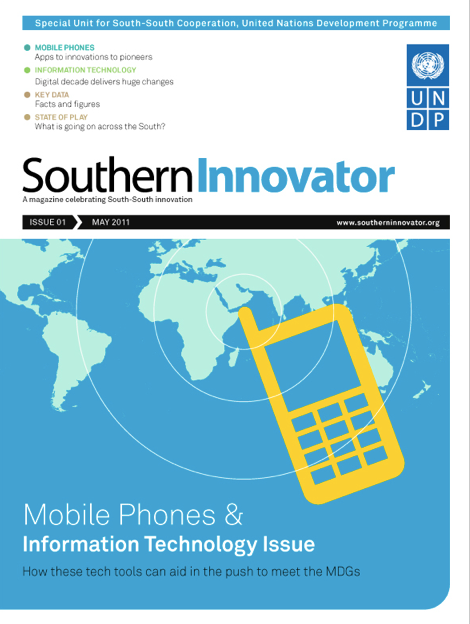
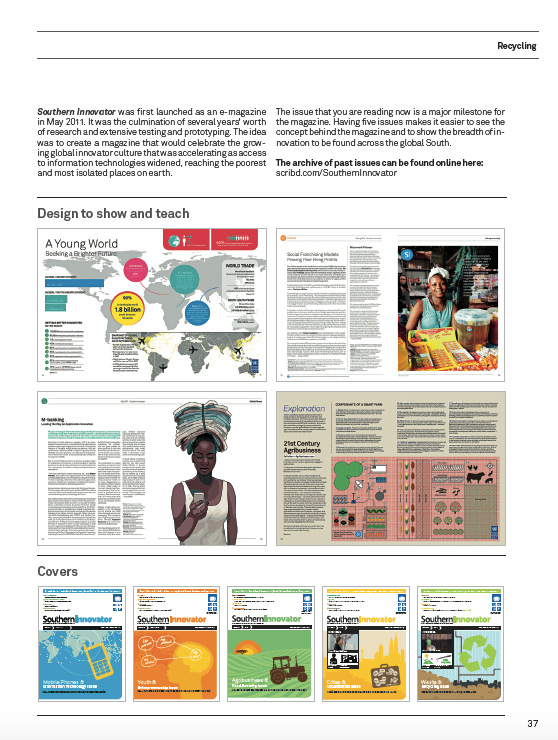
Development Challenges, South-South Solutions was launched as an e-newsletter in 2006 by UNDP’s South-South Cooperation Unit (now the United Nations Office for South-South Cooperation) based in New York, USA. It led on profiling the rise of the global South as an economic powerhouse and was one of the first regular publications to champion the global South’s innovators, entrepreneurs, and pioneers. It tracked the key trends that are now so profoundly reshaping how development is seen and done. This includes the rapid take-up of mobile phones and information technology in the global South (as profiled in the first issue of magazine Southern Innovator), the move to becoming a majority urban world, a growing global innovator culture, and the plethora of solutions being developed in the global South to tackle its problems and improve living conditions and boost human development. The success of the e-newsletter led to the launch of the magazine Southern Innovator.  

Other stories from Development Challenges, South-South Solutions:

African Digital Laser Breakthrough Promises Future Innovation

China Looking to Lead on Robot Innovation

Digital Mapping to put Slums on the Map

New Weapon Against Crime in the South

Follow @SouthSouth1

Google Books: https://books.google.co.uk/books?id=I_hcAwAAQBAJ&dq=development+challenges+october+2013&source=gbs_navlinks_s

Slideshare: http://www.slideshare.net/DavidSouth1/development-challenges-october-2013-issue

Southern Innovator Issue 1: https://books.google.co.uk/books?id=Q1O54YSE2BgC&dq=southern+innovator&source=gbs_navlinks_s

Southern Innovator Issue 2: https://books.google.co.uk/books?id=Ty0N969dcssC&dq=southern+innovator&source=gbs_navlinks_s

Southern Innovator Issue 3: https://books.google.co.uk/books?id=AQNt4YmhZagC&dq=southern+innovator&source=gbs_navlinks_s

Southern Innovator Issue 4: https://books.google.co.uk/books?id=9T_n2tA7l4EC&dq=southern+innovator&source=gbs_navlinks_s

Southern Innovator Issue 5: https://books.google.co.uk/books?id=6ILdAgAAQBAJ&dq=southern+innovator&source=gbs_navlinks_s

Creative Commons License
This work is licensed under a
Creative Commons Attribution-Noncommercial-No Derivative Works 3.0 License.

ORCID iD: https://orcid.org/0000-0001-5311-1052.

© David South Consulting 2023
Categories
Archive Blogroll Canadian Peace Report

Elect Peace

By David South

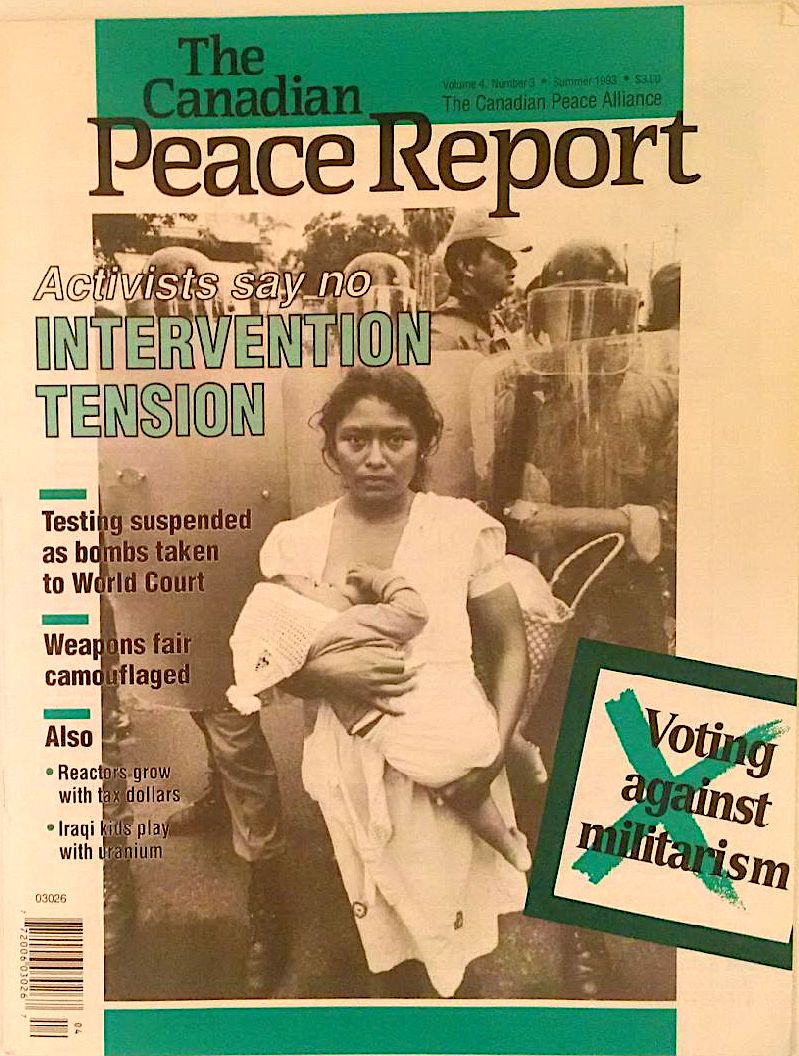
The Canadian Peace Report, Summer 1993

More than 80,000 people swarmed Parliament Hill on May 15 at an Action Canada Network and Canadian Labour Congress rally against free trade and other federal policies. In a paper issued just before, the Canadian Centre for Policy Alternatives criticizes Canadian military spending as “carried over from a cold war that no longer exists. At the same time, our assistance to poor nations is actually falling.” 

When a federal election is called, peace groups across Canada plan to be heard. They see the defence department’s $11.3-billion yearly budget – amidst cuts to social programs and calls for even more restraint – as ripe for a hot election battle over government priorities. 

A recent Gallup poll conducted for the Canadian Peace Alliance found broad support across all political allegiances for cutbacks to military spending. The CPA also wants daily life demilitarized, with duties like search and rescue turned over to civilian agencies. 

Local groups are mostly awaiting a date for the election, expected about late October, but national groups are already planning. Some groups will fight the Conservative Party’s backing of the North American Free Trade Agreement (NAFTA), which they fear will lead to further military integration of Canada and the United States. 

The Peace Alliance is working on action and information kits targetting military spending versus social needs, and is developing an election logo. It’s also building up to a national action day. 

The idea is to stimulate local and regional activity, coordinator Gideon Forman says. “Kits will help member groups organize actions during the election campaign. They will have information on, among other things, the plan to buy deluxe helicopters, military spending in general and the cost of social needs. 

“We will give local groups suggestions for local events and assist with media work.”

Project Ploughshares has produced a short booklet of questions to ask candidates, “but not a repeat of the Election Priorities Project” of the 1988 election, says researcher Bill Robinson. The booklet suggests calling for cuts in military spending, cancelling the EH-101, limiting Canada’s participation in military operations, and abolishing nuclear weapons. 

Also nationally, the Action Canada Network (to which the Peace Alliance belongs) met with groups from across the country in Winnipeg in mid-June to finalize election plans, which may include a radio ad campaign. National chair Tony Clarke would like local activists to dog the party leaders across the country, as progressive groups did to Ontario’s Liberals during the province’s 1990 election. 

“We will definitely make the link between a range of issues and the (Canada-U.S.) Free Trade Agreement and NAFTA, which we have to get rid of,” says Clarke. “We will be working very hard on jobs and arguing for a job strategy.”

Responding to the Gulf War two years ago (Action Canada Dossier #30), Clarke warned that Canada is “tied in closer than we have ever been before to the permanent war economy” of the U.S.. With a quarter of its output related to the military, the U.S. used militaristic diplomacy to justify maintaining defence budgets, he says. The trade agreements’ guarantees of U.S. access to Canadian energy resources confirm that “we are locking ourselves into what can only be described as Fortress North America.”

Maude Barlow of the Council of Canadians, a network ally, denounced the helicopter purchase during the Peace Alliance’s March 8 lobby of Parliament. Soon after, then defence minister Kim Campbell appeared to waver on the number of helicopters to be bought, but succeeded in winning the Tory leadership without it becoming a major issue. However, Liberal leader Jean Chretien promises to cancel the contract.

At CUSO’s national office, Marc Allain says the development agency will work with the CPA around military spending and the ‘copter purchase. 

To Peter Davison of the Halifax Peace Action Network, the stakes are clear and the passion to fight the issues simply awaits a polling date. 

“Never has the guns-or-butter issue been more prominent in our society,” says Davison. “Conservative economic policies have been collapsing around the globe. We’re seeing desperate restraint and universal trusts being violated – health care, education, pensions.

“It’s bizarre that we can still conceptualize $6 billion for helicopters to fight submarines – an absurd twist away from meeting human needs.”

Terry Gardner says Science for Peace’s mandate bars entering the election fray, but says the group is planning a high-level panel in the fall on NAFTA and militarization of Canadian culture. 

“We’re going to be asking candidates in our area for conversion and reduction in military spending,” says J.J. Verigin of the Doukhobour peace and disarmament committe in British Columbia. He says his MP has been supportive of chopping the choppers. 

Verigin found fact sheets helpful and says the CPA does a good job of getting out beyond the urban areas. But he would like the Alliance “to propose something that engages the electorate’s intellect as the gut.”

“We have a general intent to intervene in the election, but we’re not quite clear exactly how,” says North Bay Peace Alliance organizer Brennain Lloyd. “We’re considering a regional information package, something like the Election Priorities Project, that our groups could use.”

Being armed with the facts helps reach the public and pins down candidates, Lloyd says. She applauds the CPA’s idea of producing action kits that her group could integrate into its own. 

Toronto’s ACT for Disarmament won’t be working specifically on the election, but may participate in actions, says organizer Maggie Helwig. “Groups have certain things they focus on, and certain ways of operating. Other people do better at elections.”

In Montreal, Judith Berlyn of Westmount Initiative for Peace says, “We will be doing locally what has been developed by the Canadian Peace Alliance as a whole – go to all-candidates meetings, get the mike and ask the questions. We will be raising issues. Last time our candidate had never heard of low-level flying.”

Berlyn feels many people, including activists, often think they don’t know enough to speak publicly. But with information kits, “we know more than the candidates do.”

While approving the CPA’s focus on military spending, Berlyn says it would be a mistake to over-emphasize the helicopters. “Everybody has [already] picked up on that; it’s a good concrete example of insane military spending.”

She also finds the public receptive to informative and succinct pamphlets advocating alternatives to a militarized economy. A Coalition to Oppose the Arms Trade pamphlet is a good model, she says. 

“It has four concrete proposals of what the government can do to convert military industries – money that now goes to subsidizing the manufacturing of weapons can be turned into conversion subsidies.”

https://davidsouthconsulting.org/2020/12/15/continental-drift-and-military-complexities/

https://davidsouthconsulting.org/2022/04/06/mobile-phone-peacekeeping/

https://davidsouthconsulting.org/2021/07/28/pavlovs-army-this-magazine-august-1992/

https://davidsouthconsulting.org/2023/01/17/war-peace-and-development-may-2018/

Creative Commons License

This work is licensed under a
Creative Commons Attribution-Noncommercial-No Derivative Works 3.0 License.

ORCID iD: https://orcid.org/0000-0001-5311-1052.

© David South Consulting 2023

Categories
Archive Blogroll Canadian Peace Report

Continental Drift And Military Complexities

By David South

The Canadian Peace Report, Summer 1993

A cornerstone of the Conservative government since 1984 has been the Free Trade Agreement (FTA) between the United States and Canada, soon to be followed by a North American version (NAFTA), which adds Mexico. 

Peace researchers differ over how much the deals could further militarize Canada’s economy. 

“The Canadian government can invest in any military-related pursuit without fearing the U.S. or Mexico will say it is an unfair subsidy,” Kaye says. 

Under the Canada-US deal, articles 907, 1308 and 2003 immunize trade that fosters “national security” from charges of unfair subsidies. A free trade tribunal could deem subsidies to farmers or toilet-seat manufacturers as unfair competition – but not subsidies to weapons manufacturers. Articles 1018 and 2102 of NAFTA maintain the exemptions. 

CPA membership coordinator Gary Kaye argues that FTA, and NAFTA even more so, bind Canadian governments at all levels to military regional development. The United States has relied on investment in military industries as a regional development tool more than any other Western country, he says. 

“The Canadian government can invest in any military-related pursuit without fearing the U.S. or Mexico will say it is an unfair subsidy,” Kaye says. 

Ken Epps, a researcher with Project Ploughshares in Waterloo, Ont., agrees one reason the government insists on buying $5.8 billion helicopters in the face of overwhelming public opposition is that it’s a regional development program protected under the FTA. 

“Any other [subsidy] program of that size could well be protested by the Americans. The whole thing has been set up with new plants being built in different parts of Canada to build parts for the helicopters.”

But Epps disagrees that the trade agreements will integrate Canada much further into the U.S. war machine. De facto free trade in arms has existed since Canada and the U.S. signed the Defence Production Sharing Agreement in 1959, he points out, following the scrapping of Canada’s Avro Arrow jet plane. There-after Canada specialized in making military components rather than complete systems.

Epps and others say Ottawa’s high-tech hardware binge – including the 50 high-ticket EH-101 helicopters – and the Canadian military industries’ desire to sell to booming Pacific Rim and Middle East markets would exist even without the trade agreements. Epps sees the U.S. favouring its own defence industry at the expense of Canadian suppliers, which will increase Canadian businesses’ desire for foreign sales. 

Retired U.S. admiral Eugene Carroll, director of the Washington-based Center for Defense Information, says every nation is interested in boosting its own national prestige throught the military, and Western industrialized countries are looking to sustain exports by selling weapons to the Third World. 

“That’s just plain old profit-driven commercial activity,” says Carroll. “I don’t think trade agreements extend control onto military-related activities.”

Kaye, however, stresses that NAFTA will ensure the bilaterial agreements between Canada and the United States on military trade will continue untouched. “Under those agreements, we are committed to balance military imports and exports with the United States. 1992 figures show a $4-billion deficit; therefore we will be buying much more in the way of arms than anyone could imagine would be needed for Canada’s direct security.”

Many peace groups are worried about the implications. 

“NAFTA reveals an agenda for the military and the transnational corporations that binds the Canadian economy more to the U.S. military machine,” Marion Frank wrote for the Peace Alliance in Action Canada Network’s Action Dossier (Dec. 1992), drawing on a position reached by the CPA Steering Committee last fall.

“Under NAFTA, as under FTA, the only areas where government subsidies are allowed are in the military and energy sectors … Wide-ranging expansion of ‘intellectual property rights’ in NAFTA increases monopoly product protection for the transnationals here in Canada, and aids in the privatization of high-tech capacity, all of which ties us more closely to the U.S. military-industrial complex …

“In the U.S., trade strategy is linked to security strategy,” Frank adds, “The military tells U.S. industry what equipment to plan for and buy in order to meet U.S. strategic objectives. As we become more integrated into the North American [trading] bloc, our ability to develop our own strategies will disappear.”

Recommendations from the Peace Alliance-facilitated Citizens’ Inquiry into Peace and Security would be difficult to implement under NAFTA, contends Darrell Rankin of the Ottawa Disarmament Coalition. “Canada could no longer help developing countries by giving them better access to the Canadian market through preferrential tariffs.” Assisting military factories to produce civilian goods would be prohibited – but grants to develop weapons would not.

Last February, Science for Peace brought together labour, peace and other activist groups to make the connection between free trade and defence production and the weapons trade. “Both agreements are bound to cause in Canada what exists in the U.S.: a poweful military-industrial complex,” says S4P’s Terry Gardner. “It represents the loss of control of the institutions of government.”

Then prime minister Mulroney’s “unquestioning support” of the U.S. in the Gulf War “removed political roadblocks to Canada’s involvement” in U.S.-Mexico talks, recalls John Dillon of the Ecumenical Coalition for Economic Justice. Despite widespread Mexican opposition to the war, he adds, President Salinas increased oil production and exports to the U.S. during the build-up to it. 

The Ottawa Disarmament Coalition calls NAFTA “a vehicle for militarism without brakes.” It would create legal inducements for companies seeking government contracts to couch their bids in national security terms, a coalition brief to an Ontario cabinet committee on NAFTA argues. 

NAFTA would also hinder conversion of military to civilian industries and environmental protection above “generally agreed” standards, the coalition said.

The Ontario committee on NAFTA, which held public hearings in the spring, received briefs from: Northwatch (Brennain Lloyd, Sudbury), Voice of Women for Peace (Ann Emmett and Elizabeth Davies, Oshawa), Oshawa Peace Council (Doug Wilson), Ottawa Disarmament Coalition (Rankin), the CPA (Kaye), Science for Peace (David Parnas), Michael Polanyi, Allan MacIssac (Toronto Disarmament Network) and Veterans Against Nuclear Arms (Toronto). 

While recommending that Ontario oppose NAFTA, the committee’s report did not directly mention peace concerns. 

“The U.S. needs our resources and us to put together components for their military,” says J.J. Verigin of the Doukhobour peace and disarmament committee in B.C.

Abuse of resources

“The U.S. needs our resources and us to put together components for their military,” says J.J. Verigin of the Doukhobour peace and disarmament committee in B.C. He criticises “any agreement that locks us more into a country wired to massive consumption and abuse of resources at the expense of Canadians and other countries.”

In the United States, the Women’s International League for Peace and Freedom opposes NAFTA as a stage in “the neoliberal economics of intervention” that particularly victimize women (Peace and Freedom, July/August 1992). 

At CUSO’s national office, Marc Allain wants to end the notion that NAFTA is about improving the living standards of people in developing countries. “What we’re seeing is quite the contrary,” says Allain. “Low wages, no health and safety – we’re already seeing in Mexico job losses as they move to the maquiladoras (Mexico’s free trade industrial zones).”

(In a trade advisory, Ottawa tells Canadian companies that the defence market in Mexico, a notorious human rights violator, “is not readily identified … Commercial/industrial security, however, is an expanding market.”)

Allain says CUSO is working with the Ecumenical Coalition for Economic Justice to produce education kits on NAFTA and distribute them to unions and community groups. 

The Canadian Peace Report, Summer 1993

https://davidsouthconsulting.org/2020/12/15/elect-peace/

https://davidsouthconsulting.org/2022/04/06/mobile-phone-peacekeeping/

https://davidsouthconsulting.org/2021/07/28/pavlovs-army-this-magazine-august-1992/

https://davidsouthconsulting.org/2023/01/17/war-peace-and-development-may-2018/

Creative Commons License

This work is licensed under a
Creative Commons Attribution-Noncommercial-No Derivative Works 3.0 License.

ORCID iD: https://orcid.org/0000-0001-5311-1052.

© David South Consulting 2023