Categories
Archive Blogroll Development Challenges, South-South Solutions Newsletters The Global Urbanist

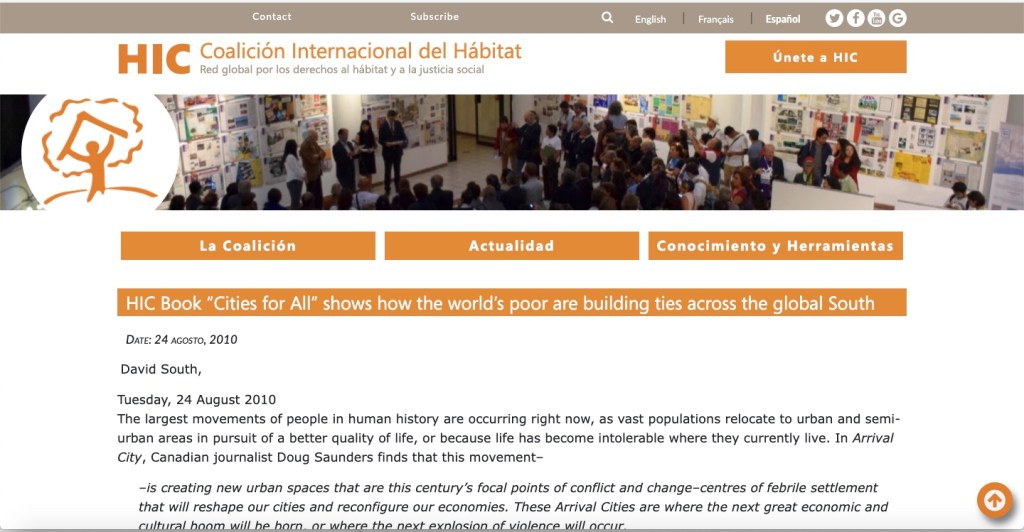
Cities For All Shows How The World’s Poor Are Building Ties Across The Global South

By David SouthDevelopment Challenges, South-South Solutions

SOUTH-SOUTH CASE STUDY

Cities for All, recently published by Habitat International Coalition, draws together thinkers and innovators in a compilation of case studies addressing the challenges of inclusive cities in the global South. The book seeks to articulate experiences of South-South cooperation and enhance the links between different regions. David South interviews the co-editor, Charlotte Mathivet.

Published: 24 August 2010

Global Urbanist (http://globalurbanist.com/2010/08/24/cities-for-all-shows-how-the-worlds-poor-are-building-ties-across-the-global-south)

The largest movements of people in human history are occurring right now, as vast populations relocate to urban and semi-urban areas in pursuit of a better quality of life, or because life has become intolerable where they currently live. In Arrival City, Canadian journalist Doug Saunders finds that this movement —

— is creating new urban spaces that are this century’s focal points of conflict and change — centres of febrile settlement that will reshape our cities and reconfigure our economies. These Arrival Cities are where the next great economic and cultural boom will be born, or where the next explosion of violence will occur.

For most, this process is chaotic, unplanned, and fraught with risk, hardship, poverty and stress; yet, because so many are also able to dramatically improve their life chances, many millions will continue to follow this path.

The speed of urbanisation makes the question of how to build liveable cities increasingly urgent. A new book hopes to help people get closer to solutions to these vexing problems.

Cities for All: proposals and experiences towards the right to the city, published by Habitat International Coalition (HIC) in Santiago, Chile, and co-edited by HIC’s Ana Sugranyes and Charlotte Mathivet, was launched during this year’s World Urban Forum in Rio de Janeiro, and highlights ways in which urban residents across the South are defining how they would like their cities to evolve, refusing to accept social exclusion and demanding a “right to the city”.

The book is published in three languages — EnglishSpanish and Portuguese.

“A lot of social initiatives based on the right to the city are coming from these ‘new cities of the South'”, says Mathivet. “The book highlights original social initiatives: protests and organising of the urban poor, such as the pavement dwellers’ movements in Mumbai where people with nothing, living on the pavements of a very big city, organise themselves to struggle for their collective rights, just as the park dwellers did in Osaka.”

“Another innovative experience came from the children’s workshops in Santiago, aimed at including children in urban planning in order to make a children-friendly city.”

The cities of Africa and Asia are growing by a million peole a week. If current trends continue, mega-cities and sprawling slums will be the hallmarks of this majority urban world. In sub-Saharan Africa, 72 per cent of the population lives in slum conditions. And by 2015, there will be 332 million slum-dwellers in Africa, with slums growing at twice the speed of cities.

“The consequences have produced a deeper gap between the city and countryside, and also within the city between the rich and poor,” said Mathivet.

Cities for All details African experiences from Nigeria, Cameroon, Ghana and South Africa. Mathivet believes “one common topic affecting these countries is the problem of forced evictions, due to the rural exodus and growing urbanisation. It is therefore very important for the right to the city to include a perspective of linking the struggle between rural and urban movements, because problems in cities and the countryside are closely connected, especially in Africa.”

And the current surge to cities in Africa raises the issue of what type of development will occur. The book argues that cities aren’t automatically a solution to the plight of the poor. Cities need to be worked on, and many of the problems faced by the South’s fast-growing cities stem from a power imbalance.

“A very important thing to realise is that a city life is not a synonym for a better life or a miracle solution for poor people, nor for the ‘capitalist’ way of life,” says Mathivet. “African nations and their people have to find effective solutions on their own to overcome poverty — which they are doing — without copying development models from the North.”

“In my understanding, urban growth is not haphazard or poorly planned in ‘developing’ countries. Rather, I think that urban ‘planning’ or lack of planning is done with a goal of generating more benefits for powerful interests and fewer benefits for poor people.”

The book argues for a two-way relationship with the people who make up the majority of these fast-growing cities. And it says each city will have to customise its solutions.

“It is very difficult to apply social innovations to other countries without understanding the history and the social, economic, cultural and political context,” says Mathivet.

“Hope comes from learning of different experiences. For example, if a social movement in South Africa succsesfully avoided an eviction from a slum, it may help another social movement in Brazil to strengthen its own strategy. One of the book’s goals was to articulate the various South-South experiences and enhance the links between different regions.”

In one chapter, contributor David Harvey argues that “the right to the city is not simply the right to what already exists in the city; it is also the right to transform the city into something radically different.”

“The right to the city itself will not stop the over-whelming phenomenon of urban growth,” believes Mathivet. “The consequences produced by implementing this collective right would rather change people’s daily lives by achieving more equality in cities as well as in the relationship between the city and coutnryside in regards to growing urban populations.”

Cities for All highlights the existence of ‘cities without citizens’: the vast numbers of slum dwellers and the poor who live mostly ignored by authorities (unless they are in the way of commercial development).

“The expression ‘cities without citizens’ means the exact opposite of the right to the city proposal,” Mathivet says. “This alternative to the present global paradigm proposes to allow people to participate in the process of creating the city in terms of urban planning, decision-making, budget, public policies, etc. It is possible for people to influence their own lives and the community.”

“There is no miracle solution, and the right to the city is a banner around which people can organise themselves to articulate their struggles and demand social justice.”

The book concludes by arguing for the advantages of a ‘slow city’ approach. But how does this work in fast-growing urban areas where people are looking to quickly escape poverty, or are seeking rapid improvements to their quality oflife? Would they not find a slow city approach frustrating?

Mathivet believes a leap of imagination is required: “Cities for All is not intended to be a recipe book. The slow city experience was chosen as a conclusion to the book in order to present a different approach, but not to propose a clear solution to follow. Concluding with the slow city experience, which is radically different and difficult to apply in African and Asian cities, where the spread of urbanisation is uncontrollable and leads to major problems, emphasises that the fight for the right to the city involves imagination and the desire for another possible city …

“Moreover, slow city experiences have been developed otuside of wealthy European countries, for example in some small Argentine and South Korean cities.”

And with the coming decade unfolding, what will cities in the South be like? Are we on the cusp of a new, dark age akin to the misery of Europe’s cities during the industrial revolution?

Mathivet acknowledges that “we can see a dark future where the interests of the most vulnerable will not be the priority. However, looking at the experiences by and for the people, we cannot consider them poor, but rich of knowledge, cognitive capital, and with courage to change their lives and their communities, through self-management and autonomy.

Cities for All aimed to show this richness … the challenges are for civil society to deepen links between different movements to build a stronger global strategy, during events like the next World Social Forum in Dakar, February 2011.”

David South is an international development consultant and writer. He writes the Development Challenges: South-South solutions e-newsletter for UNDP’s Special Unit for South-South Cooperation. He led the Communications Office for the UN in Ulaanbaatar from 1997 to 1999 and has worked for the UN in South Africa, Turkmenistan and Ukraine.

The Special Unit for South-South Cooperation is mandated to promote, coordinate and support South-South and triangular cooperation on a global and UN-systemwide basis.

This story is adapted from a piece in the July 2010 edition of Development Challenges.

http://globalurbanist.com/2010/08/24/cities-for-all-shows-how-the-worlds-poor-are-building-ties-across-the-global-south

https://www.hic-net.org/es/hic-book-cities-for-all-shows-how-the-worlds-poor-are-building-ties-across-the-global-south/

Development Challenges, South-South Solutions was launched as an e-newsletter in 2006 by UNDP’s South-South Cooperation Unit (now the United Nations Office for South-South Cooperation) based in New York, USA. It led on profiling the rise of the global South as an economic powerhouse and was one of the first regular publications to champion the global South’s innovators, entrepreneurs, and pioneers. It tracked the key trends that are now so profoundly reshaping how development is seen and done. This includes the rapid take-up of mobile phones and information technology in the global South (as profiled in the first issue of magazine Southern Innovator), the move to becoming a majority urban world, a growing global innovator culture, and the plethora of solutions being developed in the global South to tackle its problems and improve living conditions and boost human development. The success of the e-newsletter led to the launch of the magazine Southern Innovator. 

Creative Commons License

This work is licensed under a
Creative Commons Attribution-Noncommercial-No Derivative Works 3.0 License.

ORCID iD: https://orcid.org/0000-0001-5311-1052.

© David South Consulting 2021

Categories
Archive Blogroll Southern Innovator magazine United Nations Development Programme United Nations Office for South-South Cooperation

Southern Innovator Issue 4

Eco-cities Up Close

Smart Cities Up Close

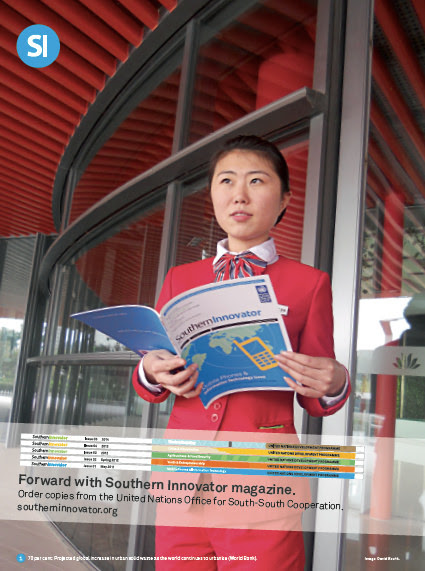
Launched in May 2011, the new global magazine Southern Innovator (ISSN 2222-9280) is about the people across the global South shaping our new world, eradicating poverty and working towards the achievement of the Millennium Development Goals (MDGs). 

Team | Southern Innovator Phase 1 Development (2010 – 2015)

They are the innovators.

Follow the magazine on Twitter @SouthSouth1. 

Southern Innovator Issue 1

Southern Innovator Issue 2

Southern Innovator Issue 3

Southern Innovator Issue 4

Southern Innovator Issue 5

If you would like hard copies of the magazine for distribution, then please contact the United Nations Office for South-South Cooperation (UNOSSC)(https://www.unsouthsouth.org/2014/12/25/southern-innovator-magazine/).

https://davidsouthconsulting.org/2021/12/20/press-release-2-southern-innovator/

https://davidsouthconsulting.org/southern-innovator-scale-up-fundraiser/

Southern Innovator Editor and Writer David South with Issue 4 at the Sydney Opera House in 2013. Photo: Jill Lawless

ORCID iD: https://orcid.org/0000-0001-5311-1052.

© David South Consulting 2024

Categories
Annex Gleaner Archive Blogroll

Safety At Stake

By David South

Annex Gleaner (Toronto, Canada), February 1997

Toronto’s innovative crime-fighting and crime-prevention experiments face elimination if and when the city is swallowed up by the monolithic megacity. And the Annex’s status as one of Toronto’s safest neighbourhoods could be destroyed by the resulting tax increases.

Since the late 1980s, thinking about crime in Toronto has focused on public safety rather than just cops in cars. Taking what can be called a holistic approach, the city has poured millions into public health programs, street lighting, safety audits and social services, and it has led the region in putting cops back on foot patrol.

Carolyn Whitzman, coordinator of the Safe City Committee – founded in 1989 and a symbol of that attitude change – worries many of the services will find their funds cut or their street-level approach altered.

“I don’t know if people in Toronto realize how privileged they are,” she says. “All these programs have led us to be one of the safest cities in the world. There is nothing like the Safe City Committee in surrounding municipalities. There is nothing like it at Metro – though they do fund safety initiatives.”

The Safe City Committee was the first of its kind in North America and subsequently has been copied by other cities. Initiatives funded by the committee include pamphlets on ending sibling violence, self-defense tips for volunteer workers, a youth drop-in centre at Dufferin Mall an community safety audits.

Whitzman also worries the new meagcity will follow the advice of government consultants KPMG, who recommended replacing some police duties with volunteer labour.

“They recommended store fronts (community police booths) and reporting of accidents be run by volunteers. What if you want a police officer?”

Whitzman also doesn’t like plans to encourage police to spend more time in their cars filing reports on laptop computers. She would rather see them out on the beat.

She also fears school safety programs, like extra lighting, will be jettisoned as school boards chase savings. This also applies to the TTC and public housing. (Whitzman says some housing projects have already cut security due to provincial funding reductions.)

Another factor could jeopardize the Annex’s status as one of the safest neighbourhoods in the city. Higher taxes may chase out homeowners, and the Annex many once again become a haven for transient populations living in rooming houses, as it was in the 1960s and 1970s.

According to Joe Page, a crime analyst at 52 Division for the past quarter century, the Annex had the dubious reputation in the late 1970s of being the busiest neighbourhood in Toronto for police.

It’s a different story today. For example, in the portion of the Annex between Avenue Road and Spadina Road from Dupont south to Bloor, there was one murder in 1995 and none in 1996, and major assaults were down from nine in 1995 to five in 1996. There was one murder in the Little Italy area west of Bathurst in 1996.

If there is a good side to rising crime rates in the surrounding municipalities, it’s that councillors there can no longer ignore public safety issues. This could mean greater sympathy for Toronto’s plight from once-smug suburban councillors.

Whitzman sees hypocrisy in the attitudes of many of the satellite cities. “Scarborough has a bad reputation and other municipalities are not immune to safety issues.”

Other stories from the Annex Gleaner

An Abuse of Privilege?

https://davidsouthconsulting.org/2021/08/31/an-abuse-of-privilege/

Artists Fear Indifference from Megacity 

https://davidsouthconsulting.org/2020/04/22/artists-fear-indifference-from-megacity/

https://davidsouthconsulting.org/2021/06/14/case-study-1-investigative-journalism-1991-1997-2/

Will the Megacity Mean Mega-Privatization? 

https://davidsouthconsulting.org/2020/04/22/will-the-megacity-mean-mega-privatization/

https://davidsouthconsulting.org/2022/02/09/african-megacity-makeovers-tackle-rising-populations/

https://davidsouthconsulting.org/2021/10/21/cities-for-all-shows-how-the-worlds-poor-are-building-ties-across-the-global-south/

https://davidsouthconsulting.org/2022/10/17/east-africa-to-get-its-first-dedicated-technology-city/

https://davidsouthconsulting.org/2017/11/08/eco-cities-up-close-2013/

https://davidsouthconsulting.org/2022/03/20/global-south-eco-cities-show-how-the-future-can-be/

https://davidsouthconsulting.org/2021/11/12/global-souths-rising-megacities-challenge-idea-of-urban-living/

https://davidsouthconsulting.org/2022/03/29/model-city-to-test-the-new-urbanism-concept-in-india/

https://davidsouthconsulting.org/2021/11/12/new-cities-offering-solutions-for-growing-urban-populations/

https://davidsouthconsulting.org/2017/11/08/smart-cities-up-close-2013/

https://davidsouthconsulting.org/2021/03/12/southern-innovator-magazine/

Creative Commons License

This work is licensed under a
Creative Commons Attribution-Noncommercial-No Derivative Works 3.0 License.

ORCID iD: https://orcid.org/0000-0001-5311-1052.

© David South Consulting 2023

Categories
Annex Gleaner Archive Blogroll

Artists Fear Indifference From Megacity

The Annex Gleaner (Toronto, Canada), February 1997

The Harris government’s proposed megacity is stirring up fear, rumour and speculation in many quarters, and no group is more worried than Toronto’s artists.

The merger of Toronto into a new megacity will place arts funding in jeopardy. Toronto’s generous contributions to the arts far exceed those of any other municipality in the region, meaning the city’s artists could be devastated if Toronto receives only a sixth of a new mega arts budget.

Currently, Annex-based artists and arts groups can turn to two levels of municipal funding: the City of Toronto and Metro Toronto.

Even at the Metro level, Toronto artists receive the bulk of arts funding, and a healthy share of that money goes to individuals and groups based in the Annex.

Alas, the Annex’s vibrant milieu of resident artists, festivals and respected institutions is small comfort to many arts supporters who fear the indifference of politicians from the satellite cities and the cost-cutting measures of the Tories.

They worry because the budget of the Toronto Arts Council, which will be eliminated under amalgamation, far exceeds the contributions to the arts made by the surrounding cities. In 1996, Toronto’s arts budget was $4.7 million, compared to $325,905 for the five other Metro municipalities combined.

Many fear Toronto’s superior cultural activities will simply be overlooked by philistine councillors from Metro’s satellite cities.

Tarragon Theatre general manager Mallory Gilbert, a former resident of Detroit who witnessed first-hand that city’s decline, worries Toronto could go the same way.

“Once you get a population that doesn’t work or entertain downtown, they will just want an expressway through the city.”

As Gilbert sees it, those voters who never patronize the arts in downtown Toronto are going to pressure politicians not to fund them. Gilbert also worries that suburban councillors will demand quotas to ensure arts funding is redirected away from downtown Toronto.

Anne Bermonte, associate director for the Toronto Arts Council, also fears downtown artists will be lost in the megacity abyss.

“The political make-up will resemble Metro rather than Toronto – the councillors who realize the arts accrue benefits will be out-voted.”

Not surprisingly, officials at Metro don’t think downtown will be neglected. John Elvidge, cultural affairs officer at Metro Parks and Culture, doesn’t believe suburban politicians will pull money out of the core of the city. He says this never happened in the past and sees no reason why it would in the future.

“The 28 councillors from the geographic area understand the core of arts is in the downtown. Look at our almost 40-year-funding history: 90 per cent is based in Toronto organizations. If you are a councillor in Etobicoke, you know people go downtown. (North York councillor) Howard Moscoe is the biggest supporter of the arts.”

Statistics show the Annex has a strong competitive advantage over other areas when it comes to receiving arts grants. Bermonte estimates the Annex area currently receives close to $400,000 in grants in the course of a year, from both Metro and Toronto. While half of the Metro culture budget goes to the “big four” (the Toronto Symphony, the Art Gallery of Ontario, the National Ballet and the Canadian Opera Company), the Annex receives 10 per cent of the remaining $3 million, estimates Elvidge. Out of the combined Metro and Toronto budgets of $10.7 million, the Annex receives just under five per cent. All for a population of 36,000.

“There are a lot of artists who live in the Annex area,” says Bermonte. “And the Annex enjoys the economic impact of the presence of those activities. If the Fringe disappeared, there wouldn’t be the animation in the area.”

Unfortunately for artists, the past five years have seen shrinking arts budgets at all levels of government.

While TAC has held on to its current funding level since 1994, Bermonte is worried this could change. TAC’s highest funding level was in 1991, when the board received $5.5 million. Metro has seen its budget drop from $7.5 million in 1993 to today’s $6 million. Both budgets are up for review, with Metro’s expected to drop by a further five per cent.

If the megacity goes through, Bermonte hopes the new municipality will commit to arts funding levels appropriate for a modern, cultured city. She points out that London, England spends $30 million, while Berlin, Germany spends $930 million on culture.

As Gilbert says, if the arts aren’t funded, the Annex will become less interesting to the many notables living here, such as writers Margaret Atwood, Rick Salutin, Judith Thompson, Stuart Ross and MT Kelly.

Deputations will take place at City Hall on Feb. 17 to defend the Toronto Arts Council’s 1997 budget.

Creative Commons License

This work is licensed under a
Creative Commons Attribution-Noncommercial-No Derivative Works 3.0 License.

ORCID iD: https://orcid.org/0000-0001-5311-1052.

© David South Consulting 2021