Tag: megacities

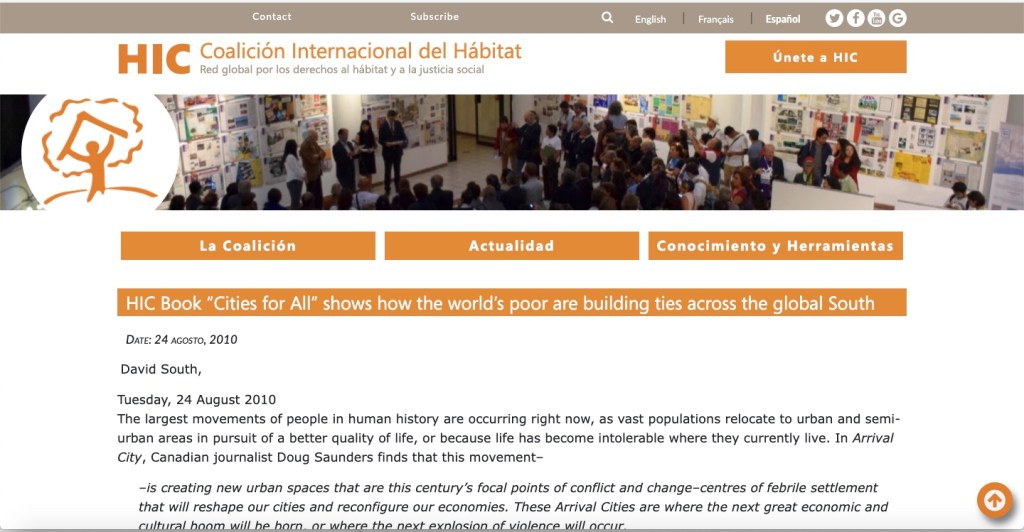
  • Cities For All Shows How The World’s Poor Are Building Ties Across The Global South

    Cities For All Shows How The World’s Poor Are Building Ties Across The Global South

    By David SouthDevelopment Challenges, South-South Solutions

    SOUTH-SOUTH CASE STUDY

    Cities for All, recently published by Habitat International Coalition, draws together thinkers and innovators in a compilation of case studies addressing the challenges of inclusive cities in the global South. The book seeks to articulate experiences of South-South cooperation and enhance the links between different regions. David South interviews the co-editor, Charlotte Mathivet.

    Published: 24 August 2010

    Global Urbanist (http://globalurbanist.com/2010/08/24/cities-for-all-shows-how-the-worlds-poor-are-building-ties-across-the-global-south)

    The largest movements of people in human history are occurring right now, as vast populations relocate to urban and semi-urban areas in pursuit of a better quality of life, or because life has become intolerable where they currently live. In Arrival City, Canadian journalist Doug Saunders finds that this movement —

    — is creating new urban spaces that are this century’s focal points of conflict and change — centres of febrile settlement that will reshape our cities and reconfigure our economies. These Arrival Cities are where the next great economic and cultural boom will be born, or where the next explosion of violence will occur.

    For most, this process is chaotic, unplanned, and fraught with risk, hardship, poverty and stress; yet, because so many are also able to dramatically improve their life chances, many millions will continue to follow this path.

    The speed of urbanisation makes the question of how to build liveable cities increasingly urgent. A new book hopes to help people get closer to solutions to these vexing problems.

    Cities for All: proposals and experiences towards the right to the city, published by Habitat International Coalition (HIC) in Santiago, Chile, and co-edited by HIC’s Ana Sugranyes and Charlotte Mathivet, was launched during this year’s World Urban Forum in Rio de Janeiro, and highlights ways in which urban residents across the South are defining how they would like their cities to evolve, refusing to accept social exclusion and demanding a “right to the city”.

    The book is published in three languages — EnglishSpanish and Portuguese.

    “A lot of social initiatives based on the right to the city are coming from these ‘new cities of the South’”, says Mathivet. “The book highlights original social initiatives: protests and organising of the urban poor, such as the pavement dwellers’ movements in Mumbai where people with nothing, living on the pavements of a very big city, organise themselves to struggle for their collective rights, just as the park dwellers did in Osaka.”

    “Another innovative experience came from the children’s workshops in Santiago, aimed at including children in urban planning in order to make a children-friendly city.”

    The cities of Africa and Asia are growing by a million peole a week. If current trends continue, mega-cities and sprawling slums will be the hallmarks of this majority urban world. In sub-Saharan Africa, 72 per cent of the population lives in slum conditions. And by 2015, there will be 332 million slum-dwellers in Africa, with slums growing at twice the speed of cities.

    “The consequences have produced a deeper gap between the city and countryside, and also within the city between the rich and poor,” said Mathivet.

    Cities for All details African experiences from Nigeria, Cameroon, Ghana and South Africa. Mathivet believes “one common topic affecting these countries is the problem of forced evictions, due to the rural exodus and growing urbanisation. It is therefore very important for the right to the city to include a perspective of linking the struggle between rural and urban movements, because problems in cities and the countryside are closely connected, especially in Africa.”

    And the current surge to cities in Africa raises the issue of what type of development will occur. The book argues that cities aren’t automatically a solution to the plight of the poor. Cities need to be worked on, and many of the problems faced by the South’s fast-growing cities stem from a power imbalance.

    “A very important thing to realise is that a city life is not a synonym for a better life or a miracle solution for poor people, nor for the ‘capitalist’ way of life,” says Mathivet. “African nations and their people have to find effective solutions on their own to overcome poverty — which they are doing — without copying development models from the North.”

    “In my understanding, urban growth is not haphazard or poorly planned in ‘developing’ countries. Rather, I think that urban ‘planning’ or lack of planning is done with a goal of generating more benefits for powerful interests and fewer benefits for poor people.”

    The book argues for a two-way relationship with the people who make up the majority of these fast-growing cities. And it says each city will have to customise its solutions.

    “It is very difficult to apply social innovations to other countries without understanding the history and the social, economic, cultural and political context,” says Mathivet.

    “Hope comes from learning of different experiences. For example, if a social movement in South Africa succsesfully avoided an eviction from a slum, it may help another social movement in Brazil to strengthen its own strategy. One of the book’s goals was to articulate the various South-South experiences and enhance the links between different regions.”

    In one chapter, contributor David Harvey argues that “the right to the city is not simply the right to what already exists in the city; it is also the right to transform the city into something radically different.”

    “The right to the city itself will not stop the over-whelming phenomenon of urban growth,” believes Mathivet. “The consequences produced by implementing this collective right would rather change people’s daily lives by achieving more equality in cities as well as in the relationship between the city and coutnryside in regards to growing urban populations.”

    Cities for All highlights the existence of ‘cities without citizens’: the vast numbers of slum dwellers and the poor who live mostly ignored by authorities (unless they are in the way of commercial development).

    “The expression ‘cities without citizens’ means the exact opposite of the right to the city proposal,” Mathivet says. “This alternative to the present global paradigm proposes to allow people to participate in the process of creating the city in terms of urban planning, decision-making, budget, public policies, etc. It is possible for people to influence their own lives and the community.”

    “There is no miracle solution, and the right to the city is a banner around which people can organise themselves to articulate their struggles and demand social justice.”

    The book concludes by arguing for the advantages of a ‘slow city’ approach. But how does this work in fast-growing urban areas where people are looking to quickly escape poverty, or are seeking rapid improvements to their quality oflife? Would they not find a slow city approach frustrating?

    Mathivet believes a leap of imagination is required: “Cities for All is not intended to be a recipe book. The slow city experience was chosen as a conclusion to the book in order to present a different approach, but not to propose a clear solution to follow. Concluding with the slow city experience, which is radically different and difficult to apply in African and Asian cities, where the spread of urbanisation is uncontrollable and leads to major problems, emphasises that the fight for the right to the city involves imagination and the desire for another possible city …

    “Moreover, slow city experiences have been developed otuside of wealthy European countries, for example in some small Argentine and South Korean cities.”

    And with the coming decade unfolding, what will cities in the South be like? Are we on the cusp of a new, dark age akin to the misery of Europe’s cities during the industrial revolution?

    Mathivet acknowledges that “we can see a dark future where the interests of the most vulnerable will not be the priority. However, looking at the experiences by and for the people, we cannot consider them poor, but rich of knowledge, cognitive capital, and with courage to change their lives and their communities, through self-management and autonomy.

    Cities for All aimed to show this richness … the challenges are for civil society to deepen links between different movements to build a stronger global strategy, during events like the next World Social Forum in Dakar, February 2011.”

    David South is an international development consultant and writer. He writes the Development Challenges: South-South solutions e-newsletter for UNDP’s Special Unit for South-South Cooperation. He led the Communications Office for the UN in Ulaanbaatar from 1997 to 1999 and has worked for the UN in South Africa, Turkmenistan and Ukraine.

    The Special Unit for South-South Cooperation is mandated to promote, coordinate and support South-South and triangular cooperation on a global and UN-systemwide basis.

    This story is adapted from a piece in the July 2010 edition of Development Challenges.

    http://globalurbanist.com/2010/08/24/cities-for-all-shows-how-the-worlds-poor-are-building-ties-across-the-global-south

    https://www.hic-net.org/es/hic-book-cities-for-all-shows-how-the-worlds-poor-are-building-ties-across-the-global-south/

    Development Challenges, South-South Solutions was launched as an e-newsletter in 2006 by UNDP’s South-South Cooperation Unit (now the United Nations Office for South-South Cooperation) based in New York, USA. It led on profiling the rise of the global South as an economic powerhouse and was one of the first regular publications to champion the global South’s innovators, entrepreneurs, and pioneers. It tracked the key trends that are now so profoundly reshaping how development is seen and done. This includes the rapid take-up of mobile phones and information technology in the global South (as profiled in the first issue of magazine Southern Innovator), the move to becoming a majority urban world, a growing global innovator culture, and the plethora of solutions being developed in the global South to tackle its problems and improve living conditions and boost human development. The success of the e-newsletter led to the launch of the magazine Southern Innovator. 

    Creative Commons License

    This work is licensed under a
    Creative Commons Attribution-Noncommercial-No Derivative Works 3.0 License.

    ORCID iD: https://orcid.org/0000-0001-5311-1052.

    © David South Consulting 2021

  • Southern Innovator Issue 4

    Southern Innovator Issue 4

    Eco-cities Up Close

    Smart Cities Up Close

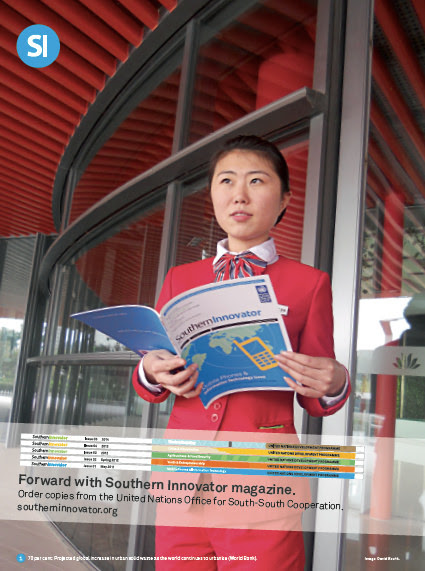
    Launched in May 2011, the new global magazine Southern Innovator (ISSN 2222-9280) is about the people across the global South shaping our new world, eradicating poverty and working towards the achievement of the Millennium Development Goals (MDGs). 

    Team | Southern Innovator Phase 1 Development (2010 – 2015)

    They are the innovators.

    Follow the magazine on Twitter @SouthSouth1. 

    Southern Innovator Issue 1

    Southern Innovator Issue 2

    Southern Innovator Issue 3

    Southern Innovator Issue 4

    Southern Innovator Issue 5

    If you would like hard copies of the magazine for distribution, then please contact the United Nations Office for South-South Cooperation (UNOSSC)(https://www.unsouthsouth.org/2014/12/25/southern-innovator-magazine/).

    https://davidsouthconsulting.org/2021/12/20/press-release-2-southern-innovator/

    https://davidsouthconsulting.org/southern-innovator-scale-up-fundraiser/

    Southern Innovator Editor and Writer David South with Issue 4 at the Sydney Opera House in 2013. Photo: Jill Lawless

    ORCID iD: https://orcid.org/0000-0001-5311-1052.

    © David South Consulting 2024

  • Big Data Can Transform the Global South’s Growing Cities

    Big Data Can Transform the Global South’s Growing Cities

    By David SouthDevelopment Challenges, South-South Solutions

    SOUTH-SOUTH CASE STUDY

    The coming years will see a major new force dominating development: Big Data. The term refers to the vast quantities of digital data being generated as a result of the proliferation of mobile phones, the Internet and social media across the global South – a so-called ‘data deluge’ (UN Global Pulse). It is an historically unprecedented surge in data, much of it coming from some of the poorest places on the planet and being gathered in real time.

    Big Data will have a profound impact on how the cities of the future develop, and will re-shape the way the challenges and problems of human development are handled.

    Estimates by Cisco (cisco.com) foresee 10 billion mobile Internet-enabled devices around the world by 2016. With the world population topping 7.3 billion by then, that will work out to 1.4 devices per person.

    Some estimates say 90 per cent of the digital data ever generated in the world has been produced in the past two years. It is also estimated that available digital data will increase by 40 per cent every year (UN Global Pulse). This digital transformation is being accompanied by another trend: the largest migration in human history from rural to semi-urban and urban areas.

    This presents an unprecedented opportunity to make this rapid urbanization and social change smarter and more responsive to human needs, and to avoid the failures of the past, from over-crowding to crime, disease, pollution, unemployment and poverty. Some believe data collection can radically alter development by flagging up problems quickly, giving cities the chance to respond and correct negative trends before they get out of control. In short, to build in resilience by way of digital technology.

    The latest region to see rapid industrialization and urbanization has been Asia – in particular China, a country that since the 1980s has simultaneously lifted the largest number of people in world history out of poverty and undertaken the biggest migration ever from rural to urban areas.

    And now Africa is beginning to follow in Asia’s wake.

    Unlike previous waves of industrialization and urbanization, Africa’s transformation is occurring in the age of the mobile phone, the Internet, personal computers and miniature electronic devices capable of more computing power than the computers used during the Apollo space programme (http://www.nasa.gov/audience/foreducators/diypodcast/rocket-evolution-index-diy.html). This changes the game significantly.

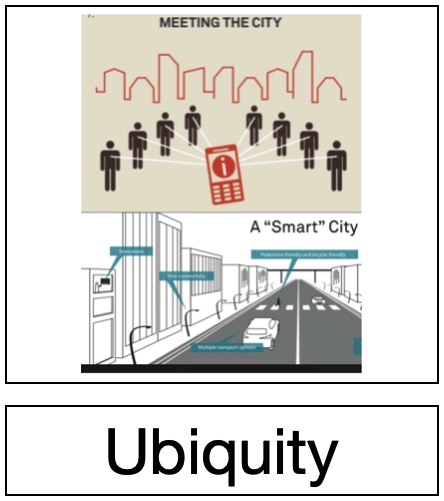
    This 21st-century approach to urban growth is at its most sophisticated, and utopian, in so-called “smart cities.” These are built-from-scratch cities that use the “Internet of Things”, where everything, from lamp posts to garbage bins to roads are embedded with microchips and radio frequency transmitters (RFID chips) (http://en.wikipedia.org/wiki/Radio-frequency_identification) to communicate data in real time. By analyzing this data, cities can be responsive to human needs and mitigate problems – improving waste collection and traffic management, reducing crime and pollution. Services can be customized to residents’ needs and liberate them to spend more time on things that matter such as their own health, family, work and hobbies. Examples of these cities include Tianjin Eco-city (tianjinecocity.gov.sg) in China, Masdar (masdar.ae) in Abu Dhabi in the United Arab Emirates and Songdo International Business District (songdo.com) in the Republic of Korea.

    These experimental smart cities are springing up in the East, and it will be the East – as well as Africa – that will see most of the action going forward. As the global management consulting firm McKinsey noted in its report Urban World: Mapping the Economic Power of Cities: “Over the next 15 years, the center of gravity of the urban world will move south and, even more decisively, east.”

    Cities in the global South will be generating the new prosperity of the 21st century. And it is widely accepted that people living in cities have the potential to become very efficient economically while rapidly driving prosperity higher.

    The McKinsey report says that “by 2025, developing-region cities of the City 600 (a list gathered by McKinsey) will be home to an estimated 235 million middle-class households earning more than (US) $20,000 a year at purchasing power parity (PPP).

    “Emerging-market mega-and middleweight cities together – 423 of them are included in the City 600 – are likely to contribute more than 45 percent of global growth from 2007 to 2025 (http://www.mckinsey.com/insights/urbanization/urban_world).”

    The world’s future prosperity is going to be found in the urban, the digitally connected, and the middle class.

    Tracking all this digital change is the UN Global Pulse. UN Global Pulse (unglobalpulse.org) was started by Secretary-General Ban Ki-moon in 2009 with a mandate to study these changes and build expertise in applying Big Data to global development. UN Global Pulse functions as a network of innovation labs where research on Big Data for development is conceived and coordinated. It partners with experts from UN agencies, governments, academia, and the private sector to research, develop, and mainstream approaches for applying real-time digital data to 21st-century development challenges.

    Unlike major technological trends of the past, this one is not restricted to the industrialized, developed world. Through the spread of mobile phone technology, billions of people are now using a device that constantly collects digital data, even in the poorest places on earth.

    From an international development perspective, Big Data has five characteristics, according to UN Global Pulse: it is digitally generated, passively produced by people interacting with digital services, automatically collected, can be geographically or temporally traced and can be continuously analyzed in real time.

    Sources of Big Data include chatter from social networks, web server logs, traffic flow sensors, satellite imagery, telemetry from vehicles and financial market data.

    The key to using Big Data is combining datasets and then contrasting them in lots of different ways and doing it very quickly. The purpose?  Better decision-making, based on an understanding of what is really happening on the ground.

    This data exceeds the capability of existing database software. It is either too much, or comes in too quickly, or can’t be handled using current software technology. Tackling this problem is creating a whole new wave of opportunities for those working in information technology.

    As technology and processing power continue to improve, the cost of wrestling with this data and putting it to use is coming down.

    The data can be analyzed for patterns and hidden information that before would have been too difficult to gather. This approach has been used by big companies such as WalMart (walmart.com), but it has cost them a large amount of money and time.

    Pioneers in Big Data include search engine Google, email and search provider Yahoo, online shopping service Amazon and social media service Facebook. Many supermarkets use Big Data to analyze the way customers behave when they are shopping, combining it with their social and geographical data.

    But new developments in hardware, cloud architecture, and open-source software mean Big Data processing is more accessible, including for small start-ups, who can just rent the capacity required on a cloud-based service (http://en.wikipedia.org/wiki/Cloud_computing).

    In the past, governments and planners had a ready excuse as to why they could not keep on top of ballooning urban populations and the chaos they brought. They could just throw up their hands and say “We do not know who these people are or what to do about them!”

    This excuse does not work in the age of the mobile phone. It is now relatively easy to deploy the power of the networked computing inside mobile phones to map urban slums and identify the needs of the people there. Parse that data, and you have an accurate account of what is happening in the slum – all in real-time.

    Making sense of all this information is creating its own new industries as innovators, entrepreneurs and companies step forward to chart this brave new world.

    Historically, significant improvements in human development have occurred only after large-scale gathering of data and information on the actual living conditions of the population. For example, prototypes of today’s infographics (http://en.wikipedia.org/wiki/Infographic) – informative visual representations of complex data – were created during the great attempts at tackling poverty and disease in Europe in the 19th century. Today’s masters of this technique include the Swedish doctor, academic and statistician Hans Rosling (gapminder.org), whose dynamic infographics are renowned for changing people’s perceptions of global problems.

    UN Global Pulse notes “much of the data used to track progress toward the Millennium Development Goals (MDGs) dates back to 2008 or earlier and doesn’t take into account the more recent economic crisis.

    “While this may feed a perception that there is a scarcity of information about the wellbeing of populations, the opposite is in fact true. Thanks to the digital revolution, there is an ocean of data, being continuously generated in both developed and developing nations, that did not exist even a few years ago.”

    UN Global Pulse believes Big Data can be used to protect social development gains when crises strike. Rather than undoing decades of good development work and human development achievements, Big Data can help to create agile responses to crisis as it happens.

    UN Global Pulse believes the same data, tools and analytics used by business can be turned to help the public sector understand “where people are losing the fight against hunger, poverty and disease, and to plan or evaluate a response.”

    Published: June 2014

    Resources

    1) Big Data: The Next Frontier for Innovation, Competition, and Productivity, Publisher: McKinsey Global Institute. Website: mckinsey.com

    2) United Nations Global Pulse: Global Pulse is an innovation initiative launched by the Executive Office of the United Nations Secretary-General, in response to the need for more timely information to track and monitor the impacts of global and local socio-economic crises. The Global Pulse initiative is exploring how new, digital data sources and real-time analytics technologies can help policymakers understand human well-being and emerging vulnerabilities in real-time, in order to better protect populations from shocks. Website: http://www.unglobalpulse.org/

    3) Business Models for the Data Economy by Q. Ethan McCallum and Ken Gleason. Website: http://www.oreilly.com/data/free/business-models-for-the-data-economy.csp?intcmp=il-strata-free-product-lgen_biz_models_for_data_economy_strata_right_rail

    4) Building Data Science Teams by D. J. Patil, Publisher: Radar. Website: http://www.oreilly.com/data/free/building-data-science-teams.csp

    5) Big Data for Development Primer, Publisher: UN Global Pulse. Website: http://www.slideshare.net/unglobalpulse/big-data-for-development-a-primer

    6) Mobile Phone Network Data for Development, Publisher: UN Global Pulse. Website: http://www.slideshare.net/unglobalpulse/mobile-data-for-development-primer-october-2013

    7) Big Data, Big Impact: New Possibilities for International Development, Publisher: World Economic Forum. Website: http://www.weforum.org/reports/big-data-big-impact-new-possibilities-international-development

    8) How numbers rule the world by Lorenzo Fioramonti, Publisher: Zed Books. Website: http://www.zedbooks.co.uk/node/16850

    9) Southern Innovator Issue 1: Mobile Phones and Information Technology: Considered a landmark work capturing this fast-changing field, Issue 1 comes packed with stories and contacts. Website: http://books.google.co.uk/books?id=Q1O54YSE2BgC&dq=southern+innovator+issue+1&source=gbs_navlinks_s

    10) Urban world: Mapping the economic power of cities published by McKinsey Global Institute. Website: http://www.mckinsey.com/insights/urbanization/urban_world

    11) Hadoop: Is open source software for handling of large data sets across clusters of computers using simple programming models. Website: http://hadoop.apache.org/

    12) Pivotal: Pivotal develops software applications for big data. A testimonial on the Pivotal website sums it up: “With the ability to load a day’s worth of data for a million meters in under fifty (50) seconds, we are able to keep up with the tremendous amount of data generated and start experimenting with many useful smart grid analytics.” Website: gopivotal.com

    13) TotallyDot: A way to centralize all the social media people use into a single page. Website: totallydot.com

    https://davidsouthconsulting.org/2022/02/09/african-health-data-revolution/

    https://davidsouthconsulting.org/2020/12/04/big-data-can-transform-the-global-souths-growing-cities/

    https://davidsouthconsulting.org/2020/04/27/computing-in-africa-is-set-to-get-a-big-boost/

    https://davidsouthconsulting.org/2020/12/04/data-surge-across-global-south-promises-to-re-shape-the-internet/

    https://davidsouthconsulting.org/2020/12/11/false-data-makes-border-screening-corruptible/

    https://davidsouthconsulting.org/2022/09/27/india-2-0-can-the-country-make-the-move-to-the-next-level/

    https://davidsouthconsulting.org/2021/03/04/indian-id-project-is-foundation-for-future-economic-progress/

    https://davidsouthconsulting.org/2020/04/26/starting-from-scratch-the-challenge-of-transition/

    Development Challenges, South-South Solutions was launched as an e-newsletter in 2006 by UNDP’s South-South Cooperation Unit (now the United Nations Office for South-South Cooperation) based in New York, USA. It led on profiling the rise of the global South as an economic powerhouse and was one of the first regular publications to champion the global South’s innovators, entrepreneurs, and pioneers. It tracked the key trends that are now so profoundly reshaping how development is seen and done. This includes the rapid take-up of mobile phones and information technology in the global South (as profiled in the first issue of magazine Southern Innovator), the move to becoming a majority urban world, a growing global innovator culture, and the plethora of solutions being developed in the global South to tackle its problems and improve living conditions and boost human development. The success of the e-newsletter led to the launch of the magazine Southern Innovator.

    https://davidsouthconsulting.org/2022/11/01/southern-innovator-magazine-2010-2014/

    Creative Commons License

    This work is licensed under a
    Creative Commons Attribution-Noncommercial-No Derivative Works 3.0 License.

    ORCID iD: https://orcid.org/0000-0001-5311-1052.

    © David South Consulting 2022

  • Safety At Stake

    Safety At Stake

    By David South

    Annex Gleaner (Toronto, Canada), February 1997

    Toronto’s innovative crime-fighting and crime-prevention experiments face elimination if and when the city is swallowed up by the monolithic megacity. And the Annex’s status as one of Toronto’s safest neighbourhoods could be destroyed by the resulting tax increases.

    Since the late 1980s, thinking about crime in Toronto has focused on public safety rather than just cops in cars. Taking what can be called a holistic approach, the city has poured millions into public health programs, street lighting, safety audits and social services, and it has led the region in putting cops back on foot patrol.

    Carolyn Whitzman, coordinator of the Safe City Committee – founded in 1989 and a symbol of that attitude change – worries many of the services will find their funds cut or their street-level approach altered.

    “I don’t know if people in Toronto realize how privileged they are,” she says. “All these programs have led us to be one of the safest cities in the world. There is nothing like the Safe City Committee in surrounding municipalities. There is nothing like it at Metro – though they do fund safety initiatives.”

    The Safe City Committee was the first of its kind in North America and subsequently has been copied by other cities. Initiatives funded by the committee include pamphlets on ending sibling violence, self-defense tips for volunteer workers, a youth drop-in centre at Dufferin Mall an community safety audits.

    Whitzman also worries the new meagcity will follow the advice of government consultants KPMG, who recommended replacing some police duties with volunteer labour.

    “They recommended store fronts (community police booths) and reporting of accidents be run by volunteers. What if you want a police officer?”

    Whitzman also doesn’t like plans to encourage police to spend more time in their cars filing reports on laptop computers. She would rather see them out on the beat.

    She also fears school safety programs, like extra lighting, will be jettisoned as school boards chase savings. This also applies to the TTC and public housing. (Whitzman says some housing projects have already cut security due to provincial funding reductions.)

    Another factor could jeopardize the Annex’s status as one of the safest neighbourhoods in the city. Higher taxes may chase out homeowners, and the Annex many once again become a haven for transient populations living in rooming houses, as it was in the 1960s and 1970s.

    According to Joe Page, a crime analyst at 52 Division for the past quarter century, the Annex had the dubious reputation in the late 1970s of being the busiest neighbourhood in Toronto for police.

    It’s a different story today. For example, in the portion of the Annex between Avenue Road and Spadina Road from Dupont south to Bloor, there was one murder in 1995 and none in 1996, and major assaults were down from nine in 1995 to five in 1996. There was one murder in the Little Italy area west of Bathurst in 1996.

    If there is a good side to rising crime rates in the surrounding municipalities, it’s that councillors there can no longer ignore public safety issues. This could mean greater sympathy for Toronto’s plight from once-smug suburban councillors.

    Whitzman sees hypocrisy in the attitudes of many of the satellite cities. “Scarborough has a bad reputation and other municipalities are not immune to safety issues.”

    Other stories from the Annex Gleaner

    An Abuse of Privilege?

    https://davidsouthconsulting.org/2021/08/31/an-abuse-of-privilege/

    Artists Fear Indifference from Megacity 

    https://davidsouthconsulting.org/2020/04/22/artists-fear-indifference-from-megacity/

    https://davidsouthconsulting.org/2021/06/14/case-study-1-investigative-journalism-1991-1997-2/

    Will the Megacity Mean Mega-Privatization? 

    https://davidsouthconsulting.org/2020/04/22/will-the-megacity-mean-mega-privatization/

    https://davidsouthconsulting.org/2022/02/09/african-megacity-makeovers-tackle-rising-populations/

    https://davidsouthconsulting.org/2021/10/21/cities-for-all-shows-how-the-worlds-poor-are-building-ties-across-the-global-south/

    https://davidsouthconsulting.org/2022/10/17/east-africa-to-get-its-first-dedicated-technology-city/

    https://davidsouthconsulting.org/2017/11/08/eco-cities-up-close-2013/

    https://davidsouthconsulting.org/2022/03/20/global-south-eco-cities-show-how-the-future-can-be/

    https://davidsouthconsulting.org/2021/11/12/global-souths-rising-megacities-challenge-idea-of-urban-living/

    https://davidsouthconsulting.org/2022/03/29/model-city-to-test-the-new-urbanism-concept-in-india/

    https://davidsouthconsulting.org/2021/11/12/new-cities-offering-solutions-for-growing-urban-populations/

    https://davidsouthconsulting.org/2017/11/08/smart-cities-up-close-2013/

    https://davidsouthconsulting.org/2021/03/12/southern-innovator-magazine/

    Creative Commons License

    This work is licensed under a
    Creative Commons Attribution-Noncommercial-No Derivative Works 3.0 License.

    ORCID iD: https://orcid.org/0000-0001-5311-1052.

    © David South Consulting 2023