Categories
Archive Development Challenges, South-South Solutions Newsletters

African Media Changing to Reach Growing Middle Class

By David SouthDevelopment Challenges, South-South Solutions

SOUTH-SOUTH CASE STUDY

Africa’s growing middle classes are being targeted by a new generation of media entrepreneurs. This growing group of Africans is ambitious and intelligent, and they want media that matches their aspirational ways. Clever media people are stepping up to feed this trend.

The continent as a whole forms the 10th largest economy in the world. Of Africa’s more than 1 billion people, 900 million can be classified as part of the consumer economy. Out of this group, there a third – approximately 300 million people – make modest sums by Western standards, about US $200 a month, but have spare cash to buy things like mobile phones, DVDs and new clothes, or pay for better schools. They are the population that is overlooked when attention is focused only on the very poor living on less than US $2 a day.

Pulitzer Prize-winning Nigerian journalist Dele Olojede is one of several African media pioneers re-shaping the continent’s media and taking it to the next level. Another is Godfrey Mwampembwa, whose popular puppet television show satirizes contemporary politics and current events and brings a welcome local flavour to a programming schedule packed with foreign imports.

A book by University of Texas professor Vijay Mahajan, Africa Rising, details the phenomenon of Africa’s middle class consumer society. He calls this group of middle class consumers ‘Africa 2’, with the desperately poor called Africa 3s, and the extremely rich Africa 1s.

This new group has expanded far beyond just the ruling elites and government workers. Many of its members work in the private sector, as secretaries, computer entrepreneurs, merchants and others who have benefited from consistent growth rates in many African countries.

And because these people consume products and services – and advertising products and services are the lifeblood of private media – the opportunities are plentiful.

“I’m convinced that Africa is going to be built by Africa 2s,” Mahajan told the Washington Post newspaper. “These are the people sending their kids to school . . . who are the most optimistic, the most forward-thinking.”

Olojede, owner and publisher of Next newspaper (http://234next.com/csp/cms/sites/Next/Home/index.csp) in Nigeria’s biggest city, Lagos, has been able to grab readers by breaking original stories and offering a quality, well-designed publication. Launched in 2008, it has its sights set on going continent-wide by 2011.

“There is a need for a newspaper for the African metropolitan middle classes, along the lines of the International Herald Tribune,” he told Monocle magazine.

Olojede cut his teeth as a foreign editor for the US newspaper Newsday and has used this experience to make Next such a success.

Next has become the number one news website in Nigeria’s highly competitive media scene.

Wisely, Olojede put design at the centre of making his newspaper and website stand out from the competition. He commissioned the experienced newspaper design team of Garcia Media (http://garciamedia.com/blog/articles/in_west_africa_a_new_newspaper_is_born_—online_first) – who have designed for The Wall Street Journal, The Miami Herald and Die Zeit – to develop the template and prototypes.

Kenyan economist James Shikwati (http://en.wikipedia.org/wiki/James_Shikwati) believes Africa’s middle-income consumers are also a driving force for political change.

“It’s empowering,” he told the Washington Post. “If you give people a sense of freedom in the economic sector, then you deny it in the political sector, you have a problem.”

Kenya-based newspaper cartoonist Gado (Godfrey Mwampembwa) has profited from this phenomenon. Fed up with TV channels sticking to a menu of foreign imports and dull news programmes, he looked to famous puppet TV shows Spitting Image (from Britain) and Les Guignols (from France) for inspiration. The result is the XYZ Show (http://xyzshow.com/blog), which features grotesque puppet caricatures of well-known public and political figures. The show’s blog makes for an excellent entry point into African TV programme-making and its ups and downs. The show is broadcast on Citizen TV in Kenya’s capital, Nairobi.

“I moved to Nairobi in 1992 when I was 23,” Mwampembwa explained to Monocle. “The Daily Nation, the biggest newspaper in Kenya, had lost its editorial cartoonist so they ran a competition to look for his replacement. I sent in my drawings and came second.”

“I took a year off in 2000-2001 to study film and animation in Vancouver. When I got back to Nairobi I started thinking about the sort of TV programme I would like to make. Kenya needed a show that would make fun of our politicians and expose hypocrisy and I thought a puppet show like Les Guignols or Spitting Image would be a great way to do it.”

“We managed to raise funds for a pilot in 2007 and Citizen TV (http://www.facebook.com/pages/Citizen-TV-Kenya/261061365404), a private station, eventually agreed to broadcast a series.”

Each episode costs US $16,740 and the puppets are US $3,600 to make. The programme-makers could only get money from foreign donors: the French, Dutch, and Finnish embassies and the Ford Foundation.

Despite initial complaints from politicians, the show is preparing for its second season – and, Mwampembwa said, “there will be a lot of big stories for us to cover.”

Making a popular TV show is not an easy thing to do. Mwampembwa maintains a furious work pace to straddle his many roles:

“I have to draw a cartoon every day but editorial cartooning is not a nine-to-five job, it’s 24/7. Whenever I get ideas I have to sketch them.

“It was a steep learning curve in the first season. The show is important for Kenyan TV and everything is done here in Nairobi. We won’t change any of the politics though. We are very hard-hitting and we will stay that way.

“Over the years I’ve got nasty letters, emails and phone calls but that’s OK, it’s part of it.”

As these media innovators show, there is nothing but opportunity for entrepreneurs feeding the hungry news and information appetite of the continent’s ambitious middle class.

And Mwampembwa says becoming better informed doesn’t have to be dull: “We are informing the public but I’d like to think we are entertaining them too.”

Published: September 2010

Resources

  • Africa Rising: A book by Professor Vijay Mahajan on how Africa’s consumer economy is growing and growing. Website: http://tinyurl.com/2vk3m9n

Development Challenges, South-South Solutions was launched as an e-newsletter in 2006 by UNDP’s South-South Cooperation Unit (now the United Nations Office for South-South Cooperation) based in New York, USA. It led on profiling the rise of the global South as an economic powerhouse and was one of the first regular publications to champion the global South’s innovators, entrepreneurs, and pioneers. It tracked the key trends that are now so profoundly reshaping how development is seen and done. This includes the rapid take-up of mobile phones and information technology in the global South (as profiled in the first issue of magazine Southern Innovator), the move to becoming a majority urban world, a growing global innovator culture, and the plethora of solutions being developed in the global South to tackle its problems and improve living conditions and boost human development. The success of the e-newsletter led to the launch of the magazine Southern Innovator. 

Creative Commons License

This work is licensed under a
Creative Commons Attribution-Noncommercial-No Derivative Works 3.0 License.

ORCID iD: https://orcid.org/0000-0001-5311-1052.

© David South Consulting 2023
Categories
Archive Blogroll United Nations Development Programme

UN Ukraine Web Development Experience | 2000

In November/December 2000 I worked in Kyiv/Kiev, Ukraine for the United Nations mission on the strategic re-launch of the mission website as a portal, whilst also advising the UN Resident Coordinator/UNDP Resident Representative Douglas Gardner on communications strategy. It was an extraordinary experience on many levels. It was a time when the Internet was fast evolving and required quick thinking and an ability to innovate; it was also a key moment in Ukraine’s history. 

The dangers at the time for communicating on the Internet were starkly clear: on September 16, the Ukrainian journalist Georgy Gongadze was murdered. In 2013 Aleksei Pukach, former head of the surveillance department in the Ministry of Interior, was convicted of the murder. 

According to Olena Nikolayenko in Youth Movements and Elections in Eastern Europe (Cambridge University Press, 2017), “Gongadze’s murder in September 2000 engendered the Ukraine without Kuchma Movement. The website Maidan (http://maidanua .org) was initially set up by civic activists to provide extensive coverage of the movement’s activities.”

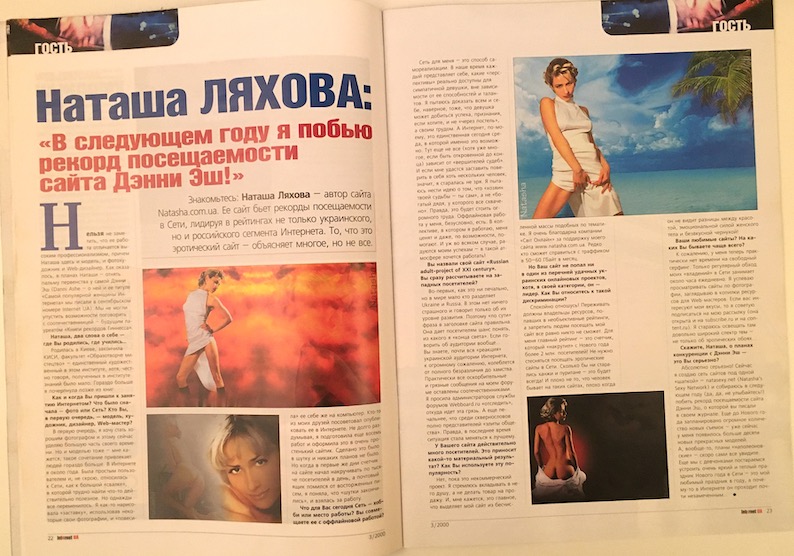
But despite those dangers and clear threats from the government of the time, there was a flourishing and inventive Internet and digital economy. The magazine Internet UA (whose editor I enjoyed meeting) gave a great overview of the scene in Ukraine and its creativity. Just as now, the creation of Internet stars who can exploit the medium (in this case sexy videos: a very large online market today) was driving viewers and subscribers. But there was also a vibrant online news media, blogging, commerce and gaming presence as well.

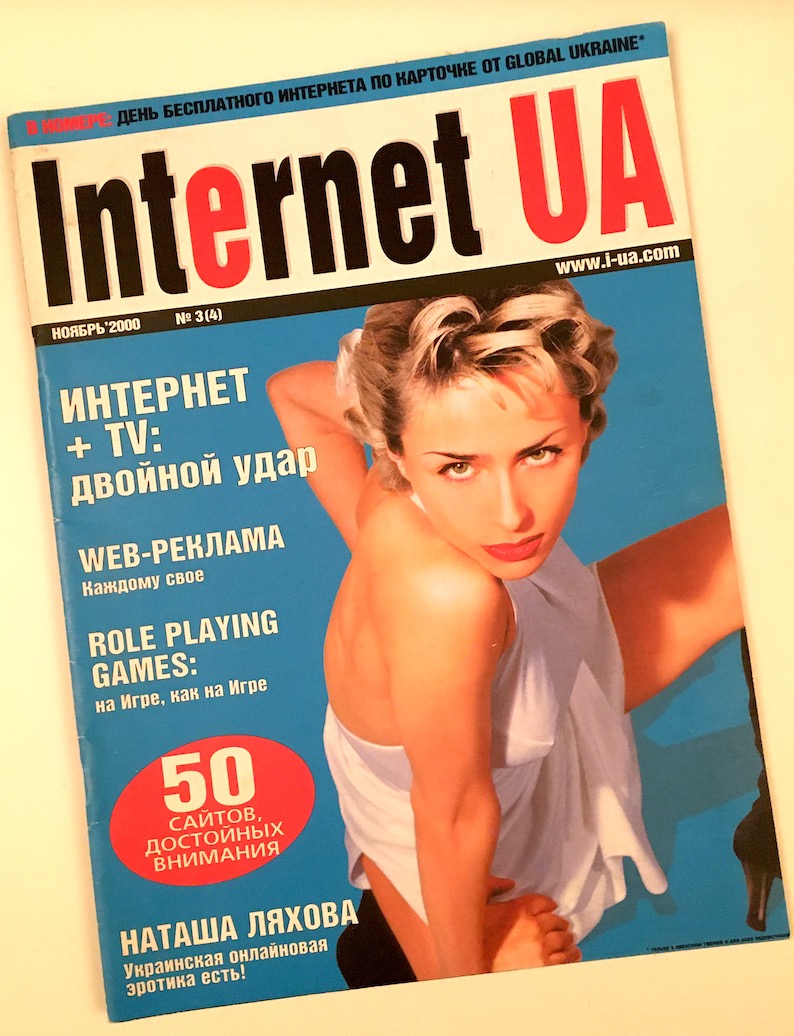
Internet UA magazine: Sex sells and the sex industry has always had pioneers seeking new ways to get eyeballs for their content. The Internet from its early days has been driven by the search for nude pictures and sex videos. In this cover feature, “Internet + TV: Double Impact”. That content mix has become the foundation of websites such as Pornhub etc.

According to ain.ua, the Ukrainian digital economy today is ” … ‘local’ only just figuratively speaking. Ukrainian startups are initially focused on international markets. Product companies are included into international industry ratings. Outsourcing works with clients from all over the world. Global players enter Ukrainian market, opening R&D offices, acquiring and investing into local companies. There are no boundaries.” 

A magazine feature on ‘Natasha’s’ Internet content offering.

It is easy to take digital freedoms for granted now but there was great resistance at the time and, unlike today, many governments were openly hostile to digital technology, online communications and e-commerce.

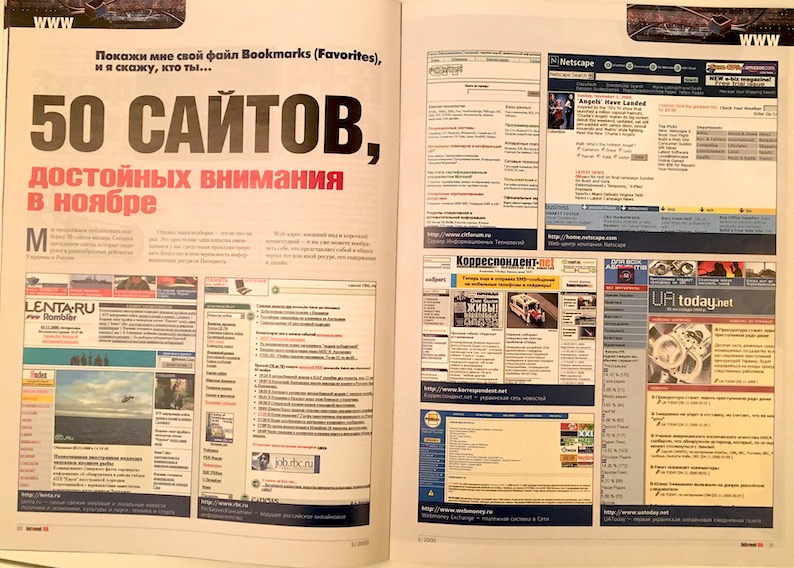
50 websites to bookmark in 2000.

The UN itself was evolving and embracing the communications and design revolution being driven by digital change. This was the first “dot.com” boom, which had begun in 1997. I had played a key role in pioneering online content for Mongolia (1997-1999) and could bring this experience to Ukraine. In particular, I launched an award-winning web portal for the UN Mongolia mission in 1997 (www.un-mongolia.mn) and also the country’s first web magazine, Ger

The UN Ukraine brief involved creating content that was accessible to users with low bandwidth, dial-up connections (few had mobile phones in 2000). I had been building new media experience throughout the 1990s, tracking the cable and satellite TV and mobile/Internet revolutions for the Financial Times as a journalist, as well as launching websites for various media clients. 

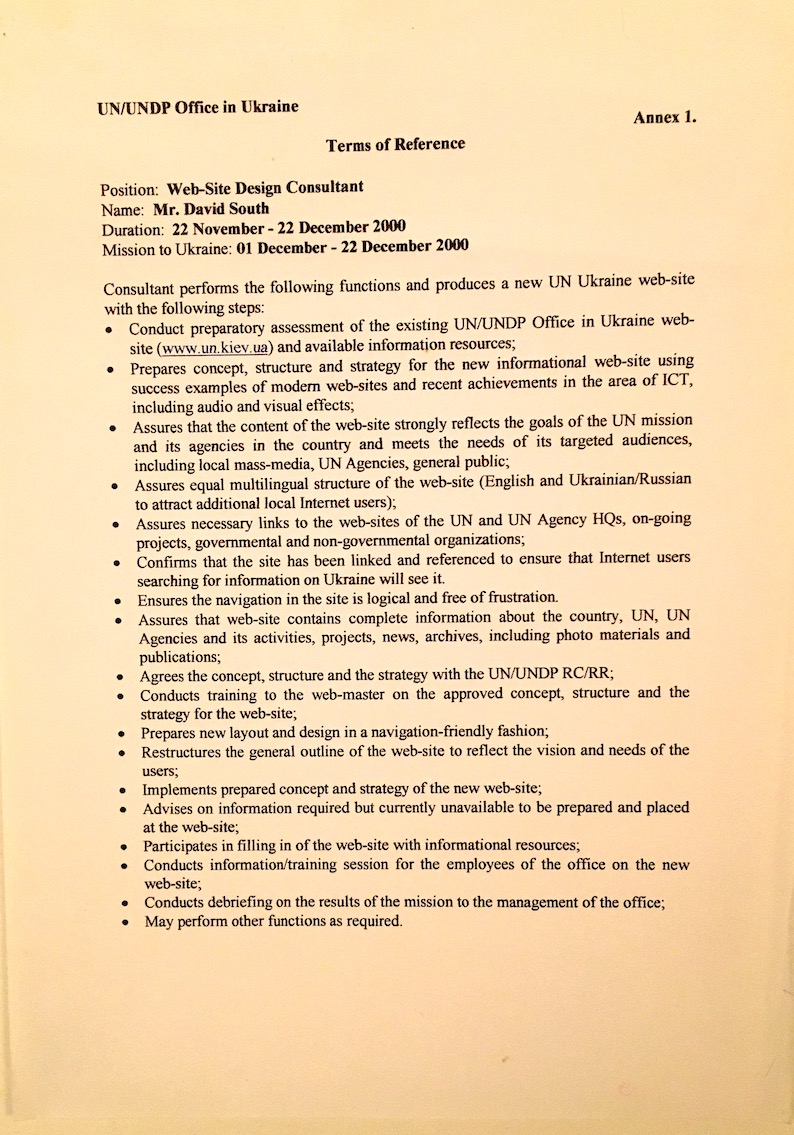
The Terms of Reference for the UN/UNDP Ukraine assignment.
The assignment business card.
The UN/UNDP Ukraine website before launch as a portal.
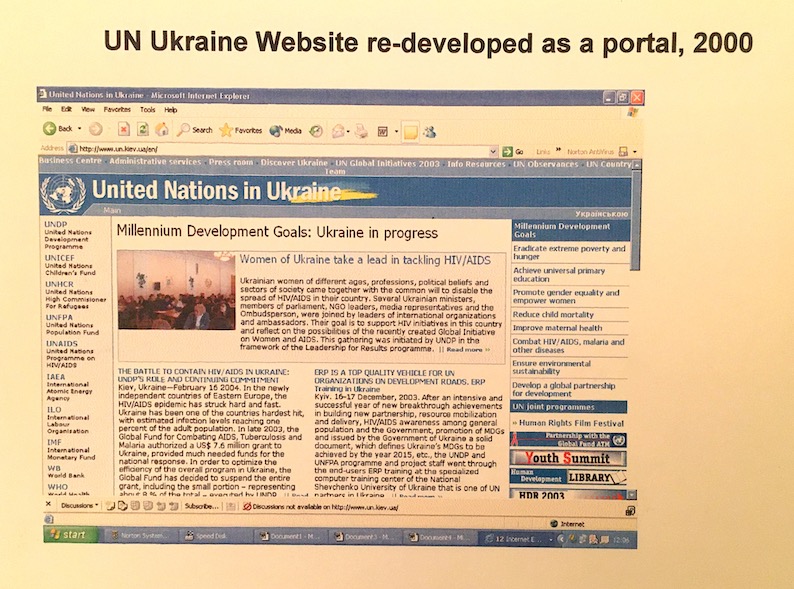
The first iteration of the new UN Ukraine portal.

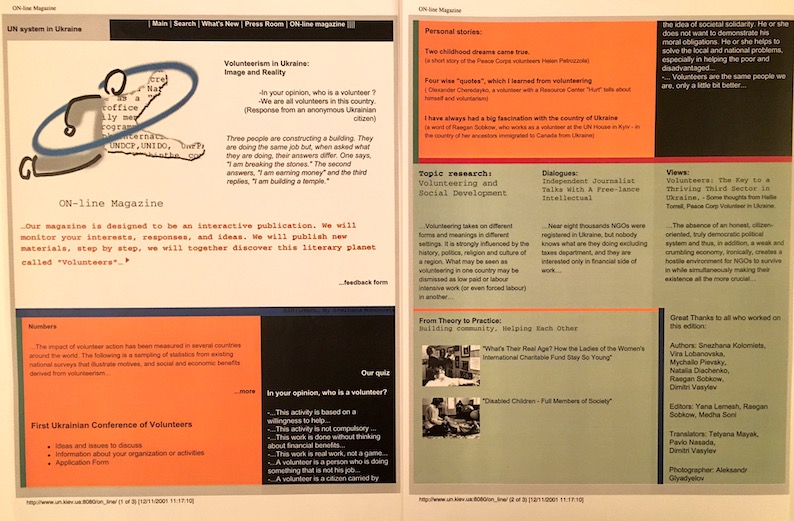
Key content created and launched on the UN Ukraine portal included critical information on the HIV/AIDS crisis in Ukraine, UN Ukraine’s first online magazine to explore perceptions of volunteering and NGOs in the post-communist period, and content preparing for the visit of the UN Secretary-General Kofi Annan, by showing how Ukraine was engaging with global development priorities, for example the eight Millennium Development Goals (MDGs), and bringing together UN agencies and entities into a cohesive web and “One UN” experience.

The first UN Ukraine online magazine.
Bringing together UN agencies and entities into a cohesive web and “One UN” experience.

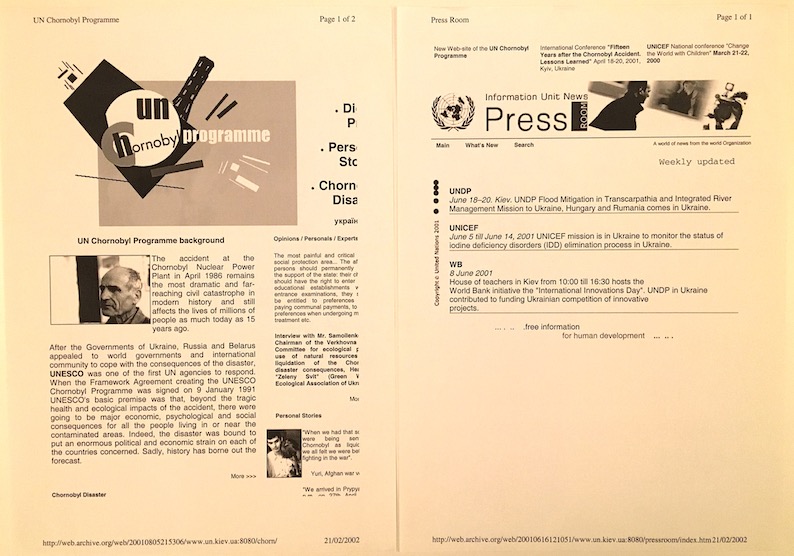
One highlight of this assignment was working with the “UN Chornobyl Programme” to develop its web content. This included visiting Pripyat (https://en.wikipedia.org/wiki/Pripyat),an abandoned city because of the Chernobyl Nuclear Power Plant disaster in 1986. I have visited many abandoned and “secret” cities and towns in the course of working with the United Nations but this particular visit had the added dimension of an environmental and human health disaster hanging over it (and as a former healthcare worker at Canada’s top cancer hospital and research institute, I couldn’t forget the impact of high radiation levels on the body).  

UN Chornobyl Programme website in development, 2000.
UN agencies in Ukraine.
UNDP in Ukraine.

The power of the Internet and the digital economy to engage people, especially the young, despite living in a country with significant political repression of free speech and even physical intimidation and murder, stuck with me. This work also contributed to laying the foundations for Ukraine’s growing freedoms and greater engagement with Europe. 

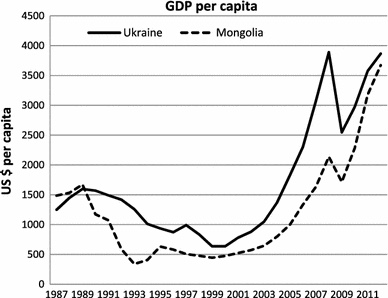
As this chart shows, increasing connectivity had a profound impact on living standards in Ukraine and Mongolia post-2000. The extreme turbulence Mongolia experienced in the 1990s – after the collapse of support mechanisms from the Soviet Union – calmed down as Mongolia integrated with the global economy, especially a booming China.

Read about my work in Mongolia in the late 1990s:

High Impact Communications In A Major Crisis: UNDP Mongolia 1997-1999 | 18 February 2016

CASE STUDY 4: UN + UNDP Mongolia | 1997 – 1999

https://davidsouthconsulting.org/2022/11/23/papers/

https://davidsouthconsulting.org/2021/11/16/us-mongol-construct-2000-business-prospectus-building-a-new-democracy-2000/

https://davidsouthconsulting.org/2020/11/05/wild-east-17-years-later-2000-2017/

Creative Commons License

This work is licensed under a
Creative Commons Attribution-Noncommercial-No Derivative Works 3.0 License.

ORCID iD: https://orcid.org/0000-0001-5311-1052

© David South Consulting 2024 

Categories
Archive Blogroll New Media Markets

Do TV porn channels degrade and humiliate?

By David South

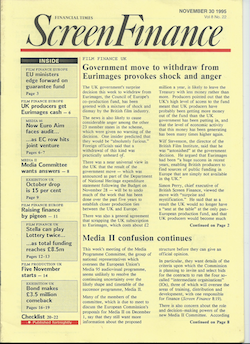
Financial Times New Media Markets (London, UK), October 26, 1995

ISSN: 02654717

OCLC Number / Unique Identifier: 1266447669

Susan Sontag, the renowned American essayist, described pornography as a “crutch for the pyschologically deformed and brutalisation of the morally innocent.” The Campaign Against Pornography in the UK believes that pornography exploits women and children “in a degrading and humiliating way, often with the message that we enjoy this and want to be abused.”

The campaign encourages its supporters to take direct action against any distributor of pornographic material as part of its wider campaign to put the industry out of business.

The porn channels dismiss arguments that they degrade women and encourage male violence against women. Playboy managing director Rita Lewis argues that “women are happy to consume erotic imagery like pin-ups. Women are not hung-up by this anymore, they are not threatened by the fantasy women we show in our programming. We hope Playboy will lead to couples’ making love together.”

Andrew Wren, financial director of the Adult Channel, also dismisses the link between pornographic programming and sexual violence. “I don’t think there is anything in programmes that would encourage men to go and rape. Women are interested in sex as men are.”

Television X’s (Deric) Botham says that porn programmes are “a bit of titilation” in the fine, upstanding tradition of the British Carry On films. None the less, he admits that “I wouldn’t want my daughter to get involved in pornography.”

He says that the women involved in the programmes, some of them housewives, are willing participants and enjoy the opportunity. “I don’t produce anything that is against the law. We speak to the individuals concerned. If you have a reluctant model, it doesn’t work – I just won’t buy the video.”

The Campaign Against Pornography sees it all rather differently. Ann Mayne, a member of the campaign’s management committee, was particularly critical of two programmes on Television X – Shag Nasty and Mutley and Fly on the Wall.

She said that Shag Nasty and Mutley, in which a presenter approaches women in the street or in supermarkets and offers them £25 to look at their knickers, or £50 to be filmed having sex with him, gave the message that women were simply objects and that it was acceptable to harass them.

“It is complete prostitution of female sexuality,” she said. “Botham wants full-on, across-the-board prostitution of women. In his view, every woman must have a price.”

Mayne said that Fly on the Wall, in which real-life couples are shown having sex, was an open invitation for men to coerce their partners into being filmed, possibly to the point of abuse.


From Special Report: NMM (New Media Markets) Spotlight On The Emergence Of Satellite Porn Channels In The UK

Read more on the 1990s sex economy here: From Special Report: Sexual Dealing: Today’s Sex Toys Are Credit Cards & Cash: A Report On The Sex-For-Money Revolution

Update: It is over 20 years since this Special Report was published. The Internet now plays a significant role in the growth of sex content and the sex industry and vice versa. Here is an interesting overview of the situation in 2020. The Internet is for Porn – It always was, it always will be.

“One of the biggest and most interesting things happening in the consumer web right now is running almost completely under the radar. It has virtually zero Silicon Valley involvement. There are no boastful VCs getting rich. It is utterly absent from tech’s plethora of twitters, fora and media (at least, as they say, “on main”). Indeed, the true extent of its incredible success has gone almost completely unnoticed, even by its many, many, many customers.

I’m talking, of course, about OnlyFans.” 

ORCID iD: https://orcid.org/0000-0001-5311-1052.

© David South Consulting 2023

Categories
Archive Blogroll

Vision + Strategy | 1991 – 2014

DS Consulting logo copy

From experience, the importance of crafting a vision prior to the execution of a strategy is key to success and inspiring others. If done well, the vision can do much of the work for you. An inspiring vision will bring others on board, aligning them to your strategy. Some examples of vision leading to strategic success can be found in the following Case Studies from David South Consulting:

Crisis Recovery

Case Study 4: UN + UNDP Mongolia | 1997 – 1999

Case Study 7: UNOSSC + UNDP | 2007 – 2016

Digital Transformation

Case Study 5: GOSH/ICH Child Health Portal | 2001 – 2003

Global Transformation

Case Study 7: UNOSSC + UNDP | 2007 – 2016

Media Start-up

Case Study 2: Watch Magazine | 1994 and 1996

David South Consulting practice areas icons_mini

© David South Consulting 2017