Categories
Archive Blogroll Southern Innovator magazine

Finding Southern Innovator Magazine | 2022

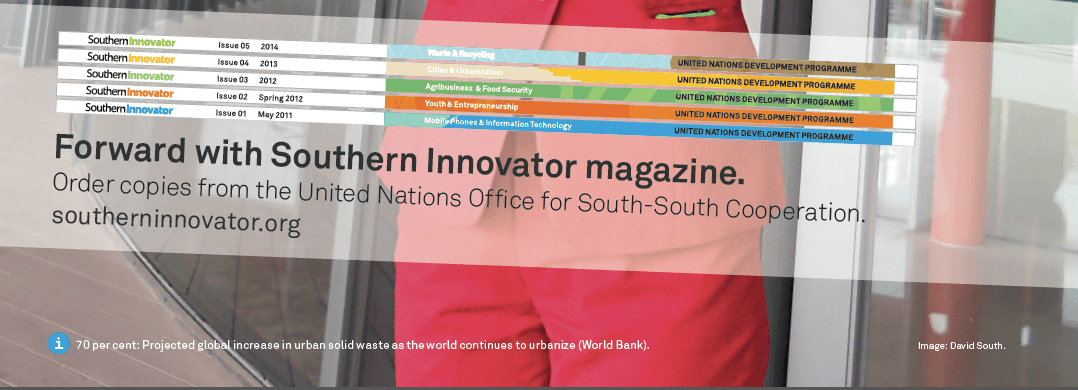
An ad promoting the magazine’s fourth issue is below:

Team | Southern Innovator Phase 1 Development (2010 – 2015)

Southern Innovator can be read online here:

ISSN: 2222-9280

Website of the United Nations Office for South-South Cooperation (UNOSSC): https://unsouthsouth.org/2014/12/25/southern-innovator-magazine/

Scribd

Issue 1: http://www.scribd.com/doc/57980406/Southern-Innovator-Issue-1

Issue 2: http://www.scribd.com/doc/86451057/Southern-Innovator-Magazine-Issue-2

Issue 3: http://www.scribd.com/doc/106055665/Southern-Innovator-Magazine-Issue-3-Agribusiness-and-Food-Security

Issue 4: http://www.scribd.com/doc/128283953/Southern-Innovator-Magazine-Issue-4

Issue 5:  http://www.scribd.com/doc/207579744/Southern-Innovator-Magazine-Issue-5-Waste-and-Recycling

Google Books

Issue 1: https://books.google.co.uk/books?id=Q1O54YSE2BgC&dq=southern+innovator&source=gbs_navlinks_s

Issue 2: https://books.google.co.uk/books?id=Ty0N969dcssC&dq=southern+innovator&source=gbs_navlinks_s

Issue 3: https://books.google.co.uk/books?id=AQNt4YmhZagC&dq=southern+innovator&source=gbs_navlinks_s

Issue 4: https://books.google.co.uk/books?id=9T_n2tA7l4EC&dq=southern+innovator&source=gbs_navlinks_s

Issue 5: https://books.google.co.uk/books?id=6ILdAgAAQBAJ&dq=southern+innovator&source=gbs_navlinks_s

Southern Innovator is held in the library collections below:

Biblioteca de la Asamblea Legislativa de El Salvador: https://biblioteca.asamblea.gob.sv/101180_southerninnovator-a-magazine-celebrating-south-south-innovation-may-2011?q=

Biblioteca Nationala a Republicii Moldova: http://cc.sibimol.bnrm.md/opac/bibliographic_view/399949;jsessionid=C516885A73E277718AE64598E869BC70

British Library: https://bll01.primo.exlibrisgroup.com/discovery/fulldisplay?docid=alma990158672410100000&context=L&vid=44BL_INST:BLL01&lang=en&search_scope=BL_Available&adaptor=Local%20Search%20Engine&tab=BL_Available&query=any,contains,Southern%20Innovator&offset=0

Central Michigan University Libraries: https://cmich.primo.exlibrisgroup.com/discovery/fulldisplay?docid=alma991015822649303781&context=L&vid=01CMICH_INST:01CMICH&lang=en&search_scope=UNIVERSITY_CI&adaptor=Local%20Search%20Engine&tab=Everything&query=any,contains,Southern%20Innovator&offset=0

Centre multimédia sur l’environnement et le développement Dakar, Senegal: http://enda-cremed.org/bpd/opac_css/index.php?lvl=serie_see&id=674

Library of Congress: http://catalog.loc.gov/vwebv/holdingsInfo?searchId=15784&recCount=25&recPointer=0&bibId=17462965
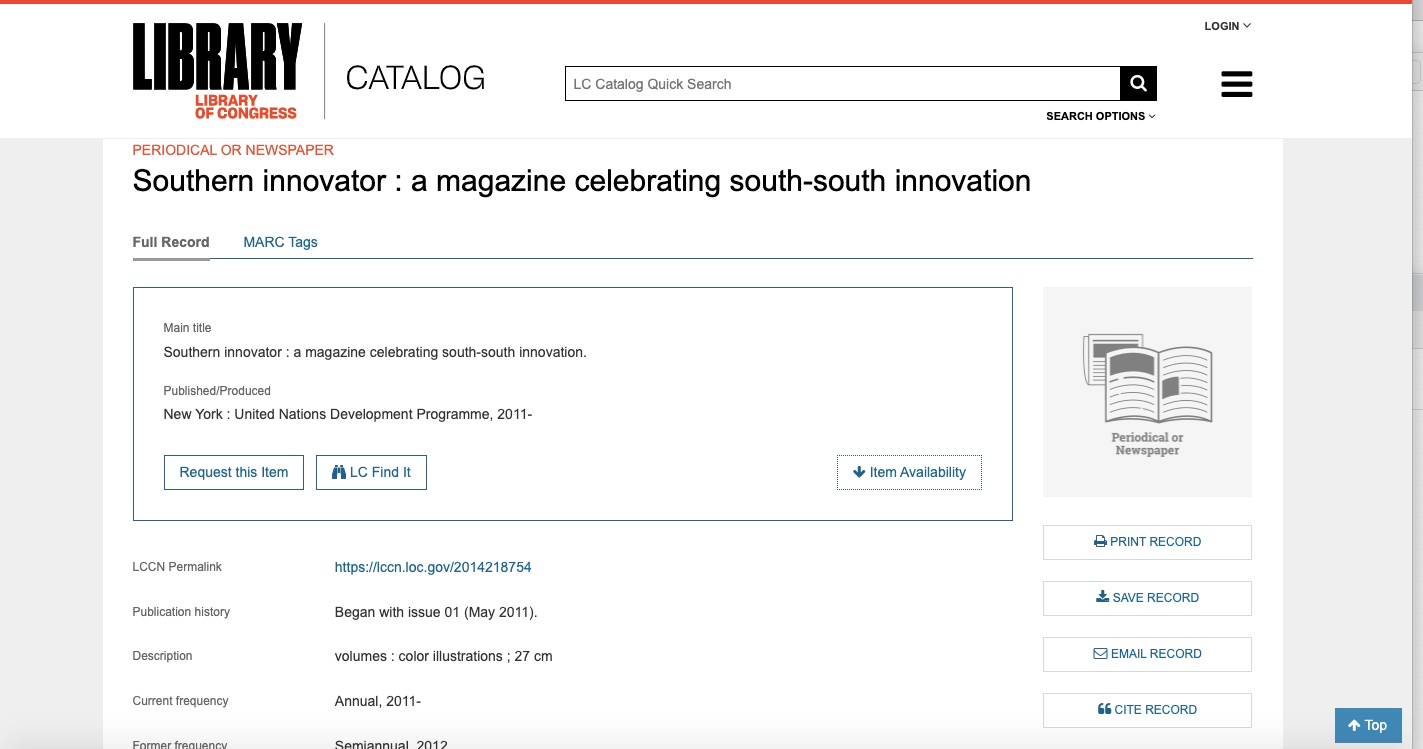
Louisiana State University, LSU Libraries: https://lsu.ent.sirsi.net/client/en_US/lsu/search/detailnonmodal/ent:$002f$002fSD_LSU$002f0$002fSD_LSU:7935129/ada?qu=southern+innovator&d=ent%3A%2F%2FSD_LSU%2F0%2FSD_LSU%3A7935129%7ESD_LSU%7E0&te=SD_LSU

Malaysian Academic Library Union: https://malcat.uum.edu.my/kip/Record/ukm.b15483824

National Library of Malaysia: https://opac.pnm.gov.my/search/query?term_1=Southern+Innovator&theme=PNM2
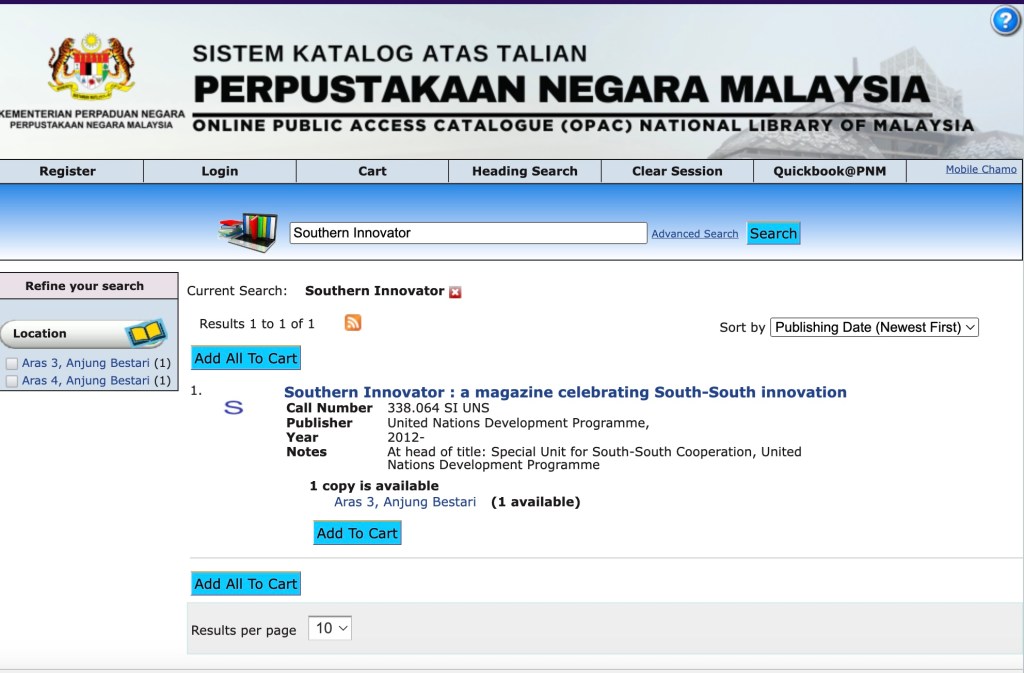
Toronto Public Library: http://vc4kb8yf3q.search.serialssolutions.com/?V=1.0&N=100&L=VC4KB8YF3Q&S=AC_T_B&C=southern+innovator

Uganda Martyrs University: https://catalogue.umu.ac.ug/cgi-bin/koha/opac-detail.pl?biblionumber=33335
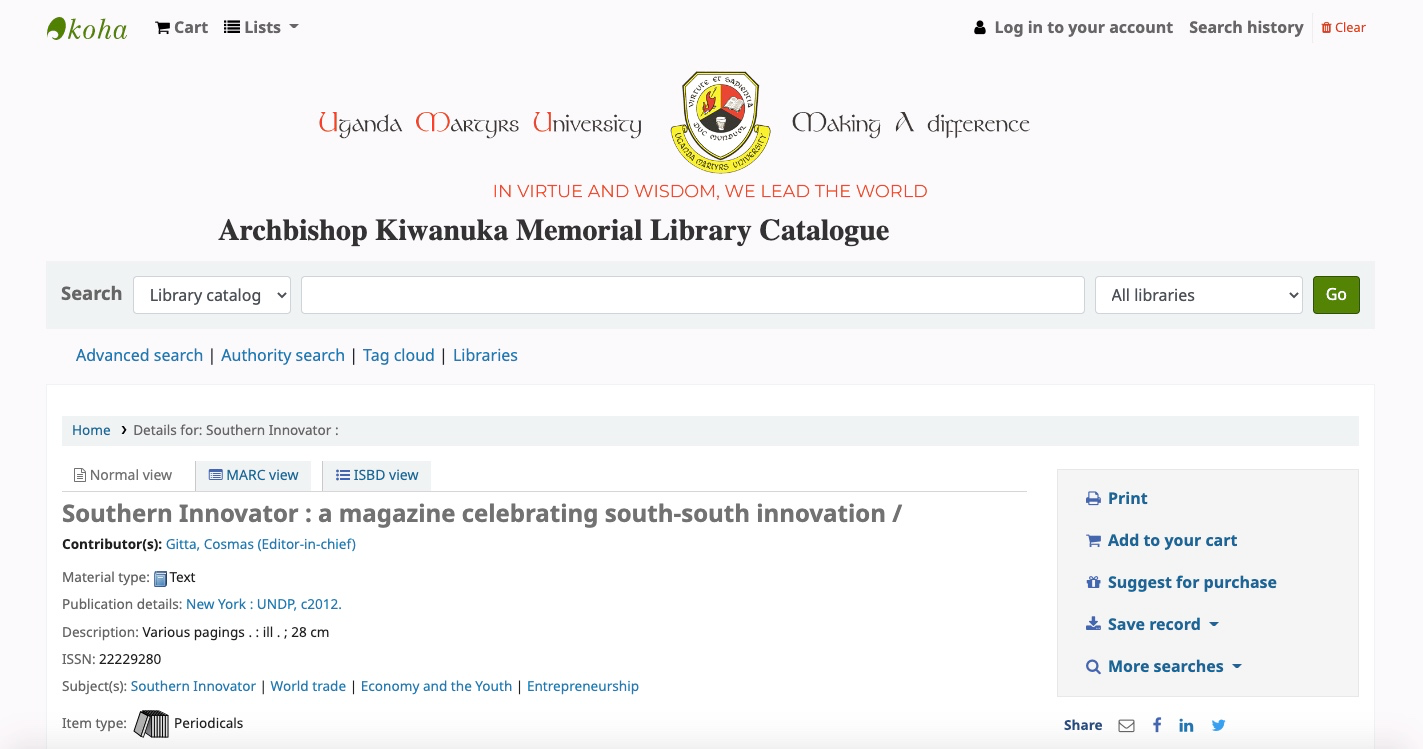
United Nations Library Geneva: Issues 2, 4, 5: Click ‘Get It’: 

Issue 1: https://tinyurl.com/3s22f236

University of Birmingham: https://birmingham-primo.hosted.exlibrisgroup.com/primo-explore/fulldisplay?docid=44BIR_ALMA_DS51193861790004871&context=L&vid=44BIR_VU1&lang=en_US&search_scope=CSCOP_44BIR_DEEP&adaptor=Local%20Search%20Engine&tab=local&query=any,contains,Southern%20Innovator&offset=0

The University of British Columbia: https://webcat.library.ubc.ca/vwebv/holdingsInfo?searchId=168763&recCount=100&recPointer=1&bibId=6682400

Universitat de Valencia: http://xv9lx6cm3j.search.serialssolutions.com/?V=1.0&L=XV9LX6CM3J&S=JCs&C=JC_018470248&T=marc

Universiti Teknologi Malaysia Libraries: http://ent.library.utm.my/client/en_AU/main/search/detailnonmodal/ent:$002f$002fSD_ILS$002f820$002fSD_ILS:820407/ada?qu=Youth&rw=1200&ic=true&ps=300

University of Cape Town Libraries (print copies destroyed in 2021 fire): https://tinyurl.com/2p8fnv6f

University of Liverpool: https://liverpool.primo.exlibrisgroup.com/discovery/fulldisplay?docid=alma991023308133807351&context=L&vid=44LIV_INST:44LIV_INST&lang=en&search_scope=MyInst_and_CI&adaptor=Local%20Search%20Engine&tab=Everything&query=any,contains,Southern%20Innovator&offset=0

University of Saskatchewan: http://sundog.usask.ca/search/t?SEARCH=southern+innovator&sortdropdown=-&searchscope=8
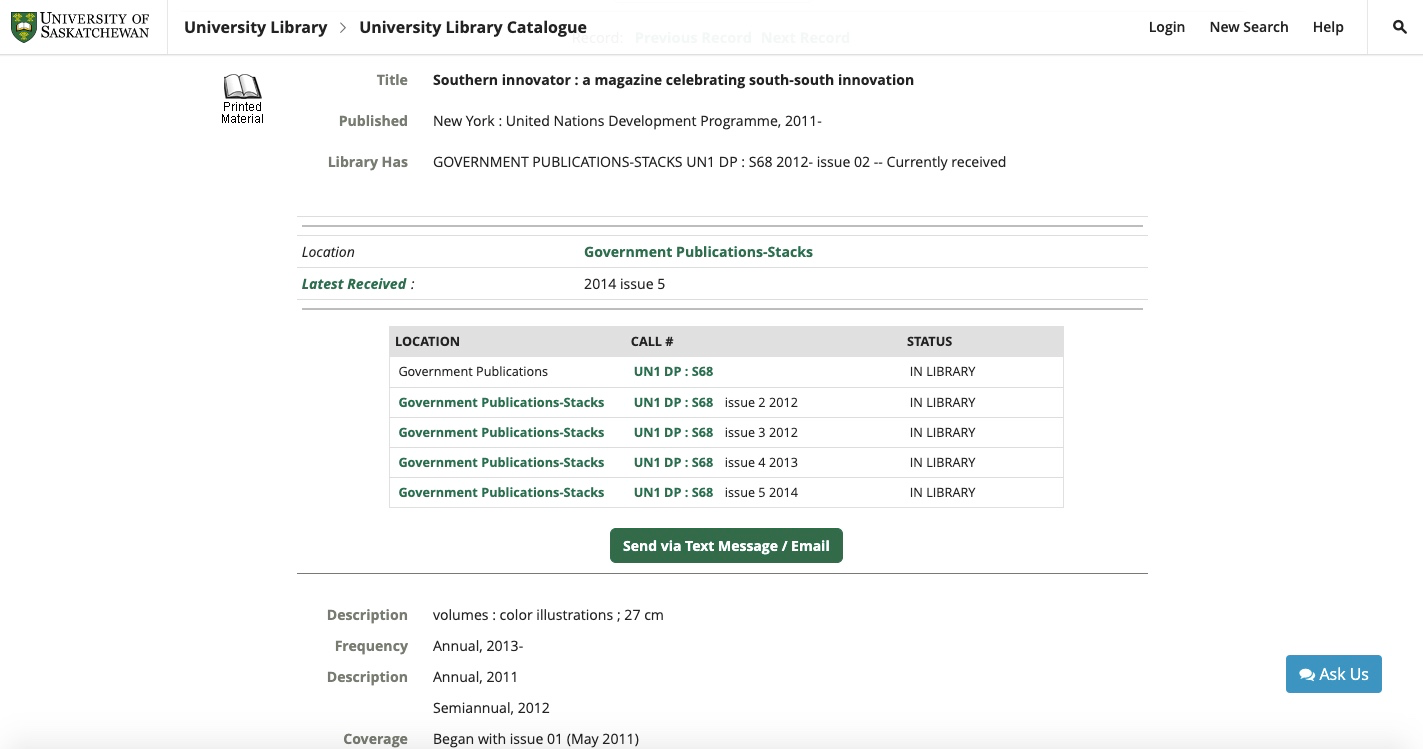
University of Zambia Online Public Access Catalogue

Washington State University: https://searchit.libraries.wsu.edu/discovery/fulldisplay?docid=alma99900557958601842&context=L&vid=01ALLIANCE_WSU:WSU&lang=en&search_scope=WSU_everything&adaptor=Local%20Search%20Engine&tab=default_tab&query=any,contains,Southern%20Innovator&offset=0

If you would like hard copies of the magazine for distribution, then please contact the United Nations Office for South-South Cooperation: Website: http://ssc.undp.org/content/ssc.html. If you would like to either sponsor an issue of Southern Innovator or place an advertisement in the magazine, then please contact southerninnovator@yahoo.co.uk. This is a great opportunity to reach millions around the world and to connect with the pioneers and innovators shaping this new world. With Issue 5 tackling the timely theme of Waste and Recycling, this is the moment to get on board and help support SI. With global urbanization levels continuing to rise, fresh thinking of the kind found in Southern Innovator‘s fifth issue is urgently required.

Follow @SouthSouth1
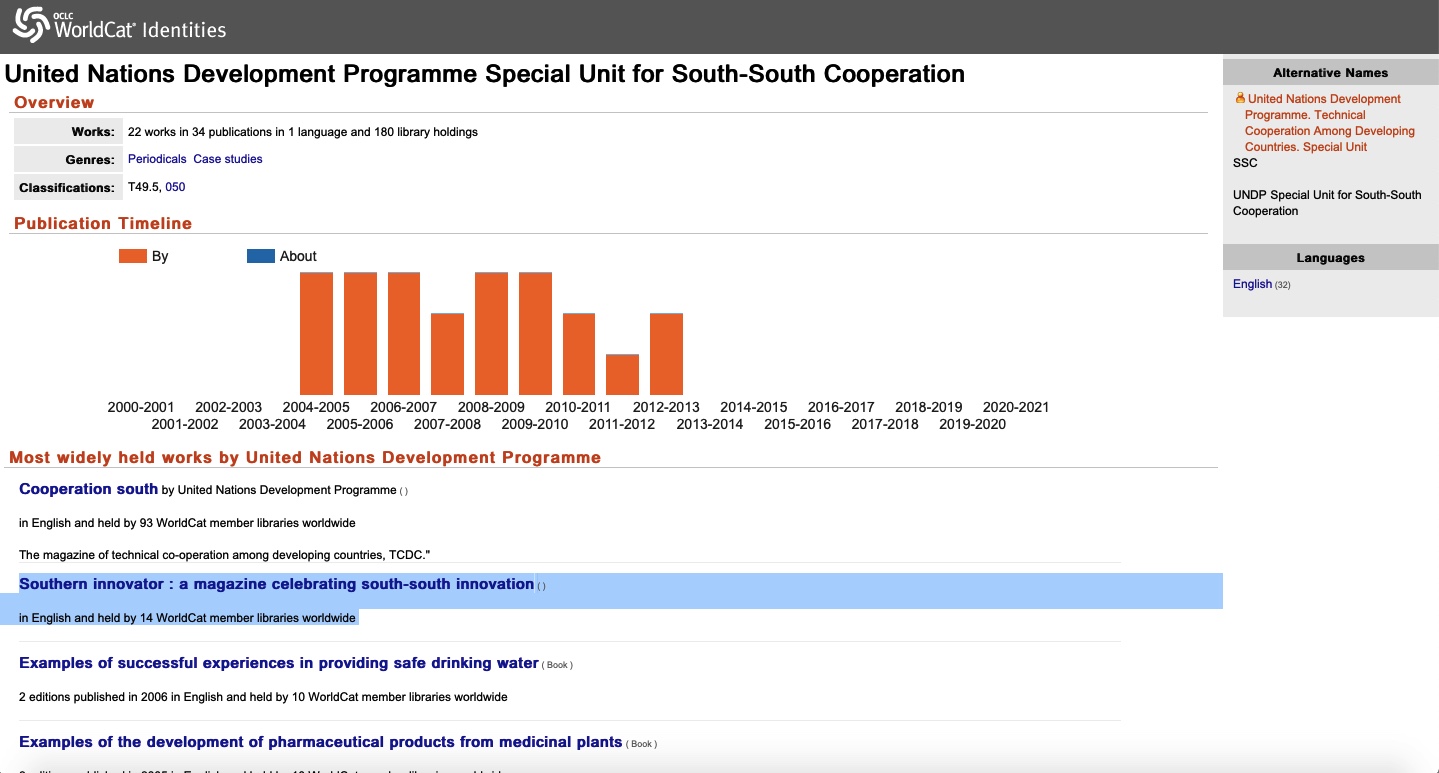
https://www.worldcat.org/title/southern-innovator-a-magazine-celebrating-south-south-innovation/oclc/1127120816?referer=list_view

https://davidsouthconsulting.org/southern-innovator-scale-up-fundraiser/

Creative Commons License

This work is licensed under a
Creative Commons Attribution-Noncommercial-No Derivative Works 3.0 License.

ORCID iD: https://orcid.org/0000-0001-5311-1052.

© David South Consulting 2024

Categories
Archive data Development Challenges, South-South Solutions Newsletters Southern Innovator magazine

Indian Mobile Phone Application Innovators Empower Citizens

By David SouthDevelopment Challenges, South-South Solutions

SOUTH-SOUTH CASE STUDY

With mobile phones becoming ubiquitous across the global South, the opportunity to make money – and possible fortunes – by providing ‘apps’ for these devices is now a reality.

Apps (http://en.wikipedia.org/wiki/Application_software) – applications which allow users of new mobile phones to do everything from running a business to banking to navigating chaotic cities – have quickly become a very creative space and a dynamic market for innovators and entrepreneurs. Because they are pieces of software and are relatively inexpensive to create, requiring only time and hard work, an individual working out of their home can develop an app, introduce it to the online marketplace and see if it will succeed.

The only limit is the imagination.

They are also a great way to solve people’s problems and possibly make some money in the process. As economies and cities grow across the South, many everyday difficulties can be tackled with these apps.

Apps are revolutionary because they solve the problem of how to view websites on mobile phones and smartphones (http://en.wikipedia.org/wiki/Smartphone). Apps are designed for a small screen and have simple functionality and design. They often can function without any constant connection to the Internet, updating themselves sporadically when the phone can connect with phone networks or the Internet. They are also either free or inexpensive, using micro-payments to make a profit. The essence of the micro-payment business model is to charge a small amount and turn this into a large amount by having large numbers of people download the app. It is a successful business formula that has made many vast fortunes throughout the age of the mass consumer market, which began in the late 19th century.

Bart Decrem, co-founder of Tapulous, a maker of apps for the iPhone (http://tapulous.com), told The Economist: “Apps are nuggets of magic.”

Apps are sold in online stores run by companies like Apple (http://itunes.apple.com/us/genre/ios/id36?mt=8), Google, Sweden’s GetJar (http://www.getjar.com), and South Korea’s SK Telecom. Apple’s store has over 425,000 apps and Google’s Android Market has more than 250,000. Other stores include Mobihand, PocketGear, Mobango, Handango, Blackberry App World and Handster (http://www.handster.com).

Research firm Gartner (http://www.gartner.com/technology/home.jsp) estimated that 18 billion apps have been downloaded since Apple opened its first app store in 2008. Remarkably, it forecasts this number could rise to 49 billion by 2013. The most popular topics include games, weather forecasts, social networks, maps, music and news.

The dynamic documented so far for apps seems to follow the way music charts work. A few apps, out of the many on offer, become big sellers and popular favourites, getting the most users. Partly this reflects the difficulty of quickly searching through all the apps available in the world to find the right one, a process that favours well-marketed apps.

The recent TechSparks 2011 App4India (http://www.facebook.com/techspark) contest showcased the creative thinking about apps now happening in India.

One Indian success story is the 1000Lookz (http://www.vdime.com/pro1.htm) app, developed by Vasan Sowriraj (http://www.vdime.com/about.htm), which helps women perform a virtual beauty makeover. A woman can check what shades work best for her skin tone by using her own photos uploaded to the app. The user adds features like foundation, blush, gloss, eye-shadow, eye-liner and lipstick. The app uses facial recognition and skin tone detection technology to assist the virtual makeover. It was developed by VDime Innovative Works headquarterd in Atlanta, Georgia, with its technology developed by its Indian division.

1000Lookz’ mission is to create “innovative products that bring cheer to consumers’ faces.”

Sowriraj got his experience from working as a key member of the team developing special image processing for the Indian Space and Research Organisation (http://www.isro.org).

The same team has also developed another service enabling users to transform standard emoticons – those cartoons used in electronic communications to convey emotions – into emoticons using your own face image. It is called Humecons (http://www.humecons.com), and its slogan is “Emote Yourself”.

The India TV Guide, based in Bangalore, India’s software hub (http://en.wikipedia.org/wiki/International_Tech_Park,_Bangalore), is a mobile phone application developed by Jini Labs (http://www.jinilabs.com) offering programme listings for 150 television channels broadcast in India, and allows viewers to save reminders for favourite shows and build favourites lists.

Jini Labs also makes Jini Books (http://itunes.apple.com/in/app/jinibooks/id404988026?mt=8), a clever app to display books, magazines and journals that are hard to find in conventional shops. It is free and promises to have “indie book authors and publishers – including small size, mid-size independent publishers, university presses, e-book publishers, and self-published authors.”

A very useful app improving people’s lives is the Indian Railway Lite app. India’s railways are a critical part of the country’s economy, and the world’s largest railway system. The complexity of trying to work out the train schedule has been made easier with the app.

Founded by Srinath Reddy, the app’s chief technology officer at RSG Software Services (http://www.rsgss.com), the app enables users to discover train connections between stations, and find which trains pass through stations, while navigating the Indian Railways website. It is a good example of how an app can quickly become a big hit. It became the second most popular on the Apple India app store and is downloaded more than 1,000 times a day.

One of the advantages of the app is its ability to function without access to the Internet. It draws on its own database of information and offers a friendlier user interface than the Indian State Railways website.

“This feature has proved to be very popular as users can access train information even while they are travelling and are out of network range,” Reddy told Yourstory.in. “We update the app at regular intervals and the user has to download a new version of the app to get updated information. Trains are generally added once in a few months and the timetable does not change significantly, so the user can use the same version until the next one is released.”

The app’s creators initially found it difficult to get information and updates from Indian Railways.

“We took around four to five months to build the app,” Reddy said. “Significant effort went into compiling the train and station data as this was not easily available. Refining the UI (user interface) took quite some time as well.”

The company saw a market for the app because there were so many iPhone (http://en.wikipedia.org/wiki/IPhone) users in India. The app was downloaded 45,000 times between June and September, and other versions, including one for Google Android (www.android.com) are in the works to broaden access to people without an iPhone.

The company has its headquarters in Ranchi, India and has four development centers in India located in Delhi, Pune, Ranchi and Hyderabad. Currently, the company has approximately 250 employees with core competencies in Apple, Filemaker and Open Source technologies.

The Tuk Tuk 2 app is a clever and practical application for users of India’s ubiquitous motorized and bicycle rickshaws. They are an important part of the country’s transport infrastructure – but a journey in one can be a stressful experience for many reasons. This app seeks to lesson the stress.

Tuk Tuk 2 app (https://market.android.com/details?id=com.mindhelix.tuktuk2&hl=en) is designed to introduce fairness to the auto rickshaw marketplace. It empowers travellers to track where they are on a journey, check the fare and find the distance covered. It helps to reduce exploitation of travellers and makes sure they know where they are at all times: a powerful resource in crowded, busy and confusing cities.

It was developed by Mind Helix Technologies (http://www.mindhelix.com), founded in 2009 as a dedicated application development company with a mission to empower people with its apps. And that is really what apps are all about!

Published: October 2011

Resources

1) Mobile phone boot camp: Entrepreneurial Programming and Research on Mobiles: Website: http://www.media.mit.edu/ventures/EPROM/entrepreneurship.html

2) Mobile Active: MobileActive.org connects people, organizations, and resources using mobile technology for social change. Website: http://mobileactive.org/

3) Teams of motorcyclists with mobile phones in Lagos, Nigeria take pictures of traffic gridlock and open road, send it to central control, who grade it “slow”, “moving” or “free” and in turn send the message to subscribers. Website: http://www.traffic.com.ng

4) Southern Innovator magazine: New global magazine’s first issue tackles the boom in mobile phone and information technologies across the global South. Website: www.scribd.com/doc/57980406/Southern-Innovator-Issue-1

Creative Commons License

This work is licensed under a
Creative Commons Attribution-Noncommercial-No Derivative Works 3.0 License.

ORCID iD: https://orcid.org/0000-0001-5311-1052.

© David South Consulting 2023

Categories
Archive Development Challenges, South-South Solutions Newsletters

Landmark Study Finds Simple Toys Key to Boosting Educational Development and Meeting MDGs

By David SouthDevelopment Challenges, South-South Solutions

SOUTH-SOUTH CASE STUDY

African youth need to play more according to a new landmark study published in the UK’s leading medical journal, The Lancet. The study tackles the high rates of illiteracy and educational under-achievement in Africa and finds that malnourishment and lack of stimulation are leaving millions unable to benefit from schooling. It found projects that encouraged learning through play led to children boosting their IQs and getting better reading skills. And it comes up with a very simple and low-cost solution – but excellent opportunity for entrepreneurs – toys and play.

“These are not high tech interventions,” said team leader for the study, Professor Sally McGregor of the Institute of Child Health of University College London. “Research over decades in Jamaica (and other countries) has shown that women with only primary school-level education and a few home made toys can be trained to make a significant difference in the education, intelligence and mental health of disadvantaged children. The Millennium Goal of universal primary education for all cannot be met unless these children’s poor development is tackled.”

The paper – Strategies to Avoid the Loss of Developmental Potential among Over 200 Million Children in the Developing World – is published in three parts in the journal.

Twenty projects around the world were evaluated for the benefits they produce for children under five who use toys. McGregor, who has set up several projects in Kenya, Tanzania and Uganda designing and constructing toys using whatever materials are available, was appalled by the widespread neglect of play throughout these countries. With play, the study found children read better, have better mental health and better self-esteem. In Africa it is ‘desperate, really desperate’ she says.

African primary school enrolments and literacy rates are among the lowest in the world, with over 42 million school children in sub-Saharan Africa not enrolled in school, and many children not able to afford to go or stay in primary school. Today a little more than half of African adults are literate and some 60 per cent of children go to school, according to UNESCO. The agency has forecasted the need for an additional 1.6 million teachers in Sub-Saharan African classrooms by 2015 – an increase of 68 percent.

The materials used to construct the toys do not need to be expensive or sophisticated. Toys can be constructed from banana trees, mud, corn on the cob, old plastic bottles, or cloth and straw dolls. It is key that the toys are safe for children under five and that anyone building such toys for sale must follow existing manuals.

McGregor continues: ‘One mother in a village was doing marvellous things with tiny scraps of material to make a doll. She received no recognition in the village for the work she was doing yet it was so important. It doesn’t take much – dolls or simple wooden blocks – they are so versatile. You see schools with nothing – it is unforgivable. The problem is how poor these people are – food just takes priority over toys – it is that stark.”

Locally produced toys are key to resolving this crisis for several reasons. Cost is the most important, with those most adversely affected also the least able to pay for toys and who are already living a precarious existence where basic survival takes precedence over play. Another factor is Africa being home to the countries who import the least number of toys: Somalia, Liberia, Togo, Rwanda and Chad. But the situation for African toymakers is often desperate as well, with many craft workers living at the economic margins. Several initiatives have emerged in the last couple of years to address this problem and ensure African toys are local and toymakers earn a living.

Initiatives like the African Toyshop based in Johannesburg, South Africa – a fair trade business – work to ensure African toymakers can make a living and get their wares to as wide a market as possible. The toymakers featured all use natural resources or recycled materials. Most work at the village level and produce toys that are culturally relevant to Africa. The organization COFTA – Cooperation For Fair Trade in Africa – is a network of Fair Trade producer Organizations in Africa involved and working with disadvantaged grassroots producers to eliminate poverty through fair trade. It is an excellent resource for grassroots organizations wanting to work with African toymakers.

Published: January 2007

Resources

The UK charity TALC – Teaching-aids At Low Cost – is planning to make available toy making manuals on a CD. Tel: (0) 1727 853869

This website also has excellent resources for budding toy and play area makers in Africa.

Online exhibition of African toys: Click here

Book: Africa on the Move: Toys from West Africa Stefan Eisenhofer, Karin Guggeis, Jacques Froidevaux Stuttgart, Germany: Arnoldsche, 2004. 216 pp., 195 color, 28 b/w illustrations. $75.00, cloth.

SDG Resource Centre: The southern origins of sustainable development goals: Ideas, actors, aspirations.

https://davidsouthconsulting.org/2021/06/02/case-study-5-gosh-ich-child-health-portal-2001-2003/

https://davidsouthconsulting.org/2021/02/05/channel-regulation-swedes-will-fight-childrens-advertising-all-the-way/

https://davidsouthconsulting.org/2021/07/29/infographics-2005-2014/

https://davidsouthconsulting.org/2021/03/04/innovation-villages-tackling-mdgs/

https://davidsouthconsulting.org/2016/04/14/interviews-for-the-gosh-child-health-portal-2001-2003-14-april-2016/

https://davidsouthconsulting.org/2020/12/10/one-world-youth-conferences-mongolia-1998-1999/

https://davidsouthconsulting.org/2021/03/05/southern-innovator-issue-2/

https://davidsouthconsulting.org/2020/12/09/study-finds-simple-toys-key-to-boosting-educational-development-january-2007/

https://davidsouthconsulting.org/2022/10/27/tapping-the-power-of-child-play/

https://davidsouthconsulting.org/2021/02/11/turning-street-children-into-entrepreneurs/

Creative Commons License

This work is licensed under a
Creative Commons Attribution-Noncommercial-No Derivative Works 3.0 License.

ORCID iD: https://orcid.org/0000-0001-5311-1052.

© David South Consulting 2023

Categories
Archive Development Challenges, South-South Solutions Newsletters Southern Innovator magazine

Innovation in the Slums can bring Peace and Prosperity

By David SouthDevelopment Challenges, South-South Solutions

SOUTH-SOUTH CASE STUDY

Rioting in Kenya has once again reminded people of the volatility of urban slums and the price to be paid if the dreams of those who live there are not met. As documented by urban development expert Jeb Brugmann, “mismanaged urban migrations have been a central part of political revolutions in our world since the 1960s.” In Kenya, “as elsewhere, these slums have effectively become huge, parallel cities, with their own economies, governance and social dynamics. Two-thirds of Nairobi’s slum dwellers eke a living in the underground informal sector. Ninety per cent of them are tenants. The poverty rate in Nairobi doubled, for instance, between 1992 and 1997.”

Slums are usually despised by the local urban authorities around the world. They end up either being totally ignored and seen as an embarrassment, or in more extreme circumstances like Zimbabwe’s slum clearance in 2005 – “Operation Clean Up Trash” – they are swept away (only to pop up somewhere else). Recently in Ghana, slums were cleared with flame-throwers, as residents were quickly cleared out of their homes to make way for a football stadium. Schoolteacher Ibrahim Addalah, who lost his home, said: “My school is gone. The community had bought us a blackboard; we had made a small school. It took us a long time to get all those things: the benches, the books. They gave us no time to leave; they just burnt our homes and our future to the ground. Now we are living in the rubble with nowhere to go.”

Over 900 million people – almost a sixth of the world’s population – now live in urban slums (UN). Improving conditions for these people is a Millennium Development Goal target. And half the world’s population will soon live in cities: already, in developing countries 43 per cent of urban dwellers live in slums – and in the least-developed countries the figure is 78 per cent. The UN has estimated it will take US $18 billion a year to improve living conditions for these people – and most of it will have to come from the people themselves.

An essential route to improving the situation is to give people living in slums the dignity and respect they deserve as human beings. Initiatives across the South seek to do this and turn the situation on its head: seeing slum dwellers as a valuable asset, not an urban blight.

The concept of ‘slum networking’ has been developed by Indian engineer Himanshu Parikh of Ahmedabad , a winner of the Aga Khan award for architecture. He starts from the point of believing there is no need for slum conditions to exist in India, but that slums do not need to be moved, just upgraded; and that good change can happen quickly.

He also sees the residents’ involvement and financial contribution as critical to the sustainability of any improvements. His approach has already helped one million people overall, including 8,703 families (43,515 people) in Ahmedabad in 41 slum communities. Slum networking does not depend on aid funds but is a self-reliant approach, in which residents make a partnership with private suppliers to get access to the most important services first: clean water and hygiene and sanitation.

Parikh’s approach involves providing channels for sewage, water supply and roadways in existing slum areas by exploiting the natural topography and pattern of development to provide the new infrastructure.

Parikh makes a detailed survey plan of the existing houses and divides them into groups based on the quality of construction. If they are of reasonable quality, they are left in place. Where possible, slum dwellers are allowed to buy the land they are squatting on. By buying the land, the owner now has a direct stake in its development.

“Working inside out, i.e. starting with quality infrastructure in the poor areas and working outwards to produce larger networks for the city or village, not only integrates the two levels, but actually produces far cheaper infrastructure at both levels,” Parikh told Architecture Week magazine.

In the slums of the Indian city of Indore, 181 slums were networked, giving the city 360 kilometres of new roads, 300 kilometres of new sewer lines, 240 kilometres of new water lines, 120 community halls and 120,000 trees. This transformed the two local rivers from open sewers back to water. According to the World Bank, fatal water diseases fell by 90 per cent.

“No project for their rehabilitation could be successful until they were involved as the capital partners,” Parikh told India’s The Tribune. Upgrading “the civic amenities, including sewerage, roads and water supply, was the need of the hour for better living conditions of the slum dwellers.” In South Africa, the country’s fast-growing tourism trade is being directed towards its slums, not just its game parks, wineries and cities.

The sprawling Soweto district on the outskirts of Johannesburg – the heart of the struggle against the former apartheid regime – has lured tourists to come and stay with its network of bed and breakfasts (http://www.sowetonights.co.uk/snaccom_vhavenda.htm): home-based places to stay run by families. Like many slums, Soweto is a heady mix of contrasts: from wealthy suburban homes, to makeshift tin shacks to outright squalor and destitution. But the B and Bs ensure tourists stick around and spend more money, creating lasting jobs.

Over 200,000 visitors a year tour Soweto to see where Nelson Mandela and Bishop Desmond Tutu once lived. And as with all success, it attracts more success: the international hotel chain Holiday Inn has just opened a 48-room hotel in Soweto.
Giving dignity to the lives of slum dwellers is the work of a do-it-yourself “TV station” in Kenya. Kenya’s dramatic turn to violence after recent elections has led to a myopic view of the country, according to the young filmmakers and photographers behind Slum TV (http://www.slum-tv.info/). Based deep inside Nairobi’s largest slum, Mathare, they have been seeking out the stories of hope where international media only see violence and gloom.

“We look at what is good and what is bad. We see what is behind the scenes. The international media only shows the negative side,” said Benson Kamau of Slum TV.

Slum TV is a group of young men in Mathare with only a two-week workshop in the basics of film shooting and editing. They pay their bills by doing odd jobs. A grant from Austria paid for their one camera and a computer.

They screen their films every month to the residents of Mathare on a giant white sheet hanging over some vacant land. They illegally tap an overhanging electricity line for power – few can afford electricity. The films document everyday life in the slum – a man selling dougnuts, women frying potatoes – and the locals can see their lives recorded and acknowledged.

Resources 

1. Shelter Associates: established by Indian architect Pratima Joshi, it is an NGO working on slum rehabilitation. http://www.shelter-associates.org

2. SPARC: one of the largest Indian NGOs working on housing and infrastructure issues for slum dwellers. http://www.sparcindia.org

3. Improving the Lives of Slum Dwellers: published by the Millennium Project. http://www.unmillenniumproject.org/reports/tf_slum.htm

4. For local bed and breakfasts in South Africa, click here sa-venues.com, tourist information at http://www.southafrica.net/

5. Slum Networking: Innovative Approach to Urban Development by Diane Diacon (editor). Website: http://www.amazon.co.uk

https://davidsouthconsulting.org/2022/02/17/digital-mapping-to-put-slums-on-the-map/

https://davidsouthconsulting.org/2022/04/28/envisioning-better-slums/

https://davidsouthconsulting.org/2022/11/16/housing-innovation-in-souths-urban-areas/

https://davidsouthconsulting.org/2020/12/14/innovation-in-growing-cities-to-prevent-social-exclusion/

https://davidsouthconsulting.org/2021/03/05/southern-innovator-issue-4/

Development Challenges, South-South Solutions was launched as an e-newsletter in 2006 by UNDP’s South-South Cooperation Unit (now the United Nations Office for South-South Cooperation) based in New York, USA. It led on profiling the rise of the global South as an economic powerhouse and was one of the first regular publications to champion the global South’s innovators, entrepreneurs, and pioneers. It tracked the key trends that are now so profoundly reshaping how development is seen and done. This includes the rapid take-up of mobile phones and information technology in the global South (as profiled in the first issue of magazine Southern Innovator), the move to becoming a majority urban world, a growing global innovator culture, and the plethora of solutions being developed in the global South to tackle its problems and improve living conditions and boost human development. The success of the e-newsletter led to the launch of the magazine Southern Innovator. 

Creative Commons License

This work is licensed under a
Creative Commons Attribution-Noncommercial-No Derivative Works 3.0 License.

ORCID iD: https://orcid.org/0000-0001-5311-1052.

© David South Consulting 2023