Categories
Archive Development Challenges, South-South Solutions Newsletters

2011 Trends for the South

By David SouthDevelopment Challenges, South-South Solutions

SOUTH-SOUTH CASE STUDY

The world has been through a dramatic and fascinating period since the global economic crisis erupted in 2008. While the wealthy, developed nations of the North have been pitched into one crisis after another, the countries of the global South (many of whom are well accustomed to crises) have been part of a powerful new economic phenomenon: the rapid growth of South-South trade, investment and exchange. Its effects include stronger ties between Asia and South America and between China and Africa.

South-South trade is the great economic success story of the past decade. World Trade Organization (WTO) (www.wto.org) figures show South-South trade grew to 16.4 percent of the US $14 trillion in total world exports in 2007, from 11.5 percent in 2000. While the global economic crisis has slowed trade down, the overall trend for South-South trade and connections seems firmly established.

South-South trade made up 20 percent of global exports by 2010, and foreign direct investment to developing economies rose by 10 percent in 2010 due to a rapid economic recovery and increasing South-South flows.

Trade between China and Africa has surged during the decade since China joined the WTO in 2001, from around US $10 billion in 2000 to US $73.3 billion in 2007, a year-on-year increase of 32.2 percent. By 2008, it had soared by 44.1 percent to reach a record high of US $106.84 billion, according to Zhang Yongpeng of the Institute for West Asian and African Studies (IWAAS).

The surge is remarkable and recent. For example, according to accountants KPMG, between 2001 and 2009 China invested just US $215 million in Brazil. But in 2010, China invested US $20 billion in energy and chemical companies in Argentina and Brazil. And Luis Alberto Moreno, president of the Inter-American Development Bank, told the Financial Times that “seven percent of Colombian gasoline has been replaced by domestic ethanol, produced with green Indian technology – while Indian companies, including Infosys and Tata, now have 17,000 employees in Latin America and the Caribbean.”

This jump in investment has also had its downside: coming fast and furious as investment cash chases better investment profits in the global South, it has pushed up inflation and commodity prices and spawned property speculation bubbles. This, as can be seen across North Africa and the Middle East, can lead to political and social instability.

A review of the big trends bubbling under the surface in 2011 shows how important South-South exchange will be in alleviating poverty and improving lives in the run-up to the 2015 Millennium Development Goals (http://www.un.org/millenniumgoals/). It also shows up the dangers inherent in this new environment – rising inflation without economic growth can crush the poor. A focus on innovation and new thinking will be necessary to get through this year and beyond.

Some of the top trends that will have a big impact in 2011 are:

– Inflation: In 2011 it looks like we will hear a lot about inflation. As the global economy tries to stabilize and return to growth, there will be inflation surges for a wide variety of reasons. People will need strategies and new techniques to make sure they can afford the necessities of life. This will be critical if development gains from the past decade are not to be lost.

– Super cycle: Some are putting forward the theory we are entering a ‘super cycle’ (http://www.bloomberg.com/news/2011-01-23/super-cycle-leaves-no-economy-behind-as-davos-shifts-to-growth-from-crisis.html) created by better connectivity, global travel and mobility and the ease of moving around investment to create businesses and jobs. The super cycle theory claims that this will spark the greatest period of human development in history – raising all national economies – as more and more people benefit from rising living standards and opportunities.

– Switch to South-South trade: With the trend of increasing South-South trade now firmly established, there is a greater awareness now of the power of sharing ideas across the South. One example of this idea-sharing is the annual Global South-South Development Expo (http://www.southsouthexpo.org/) run by UNDP’s Special Unit for South-South Cooperation Unit (http://ssc.undp.org/).

– New technologies: The spread of new technologies around the world will continue and bring many changes. Africa is seeing increasing access to high-speed Internet as new undersea cables are laid around the continent. Mobile phones will continue to be a critical tool for many to stay in touch and boost incomes.

– MDGs on horizon in 2015: The Millennium Development Goals (MDGs) target of 2015 is just four years away. This will face the headwinds of the global economic crisis and urgent attention will be needed to make sure gains are not lost as 2015 approaches. The role played by South-South trade will be a critical partner in aiding goal achievements.

– Cities: A surge to the urban was pronounced by 2007 and we are now living in a majority urban world. Innovation and sharing experiences and knowledge will play a key role in ensuring this is not a disaster. A recent book, Arrival City by Canadian journalist Doug Saunders, detailed this urban surge occurring across the global South, the largest movement of people to cities and urban and semi-urban areas in human history. It follows the pattern that was seen in Europe in the 19th century, as economies change and people seek the new opportunities promised by cities, or find rural economies unsustainable.

– The China model of development: The big talking point will be China’s economic model for eradicating poverty on a mass scale. A new book by Dambisa Moyo, How the West Was Lost: Fifty Years of Economic Folly – And the Stark Choices Ahead, investigates the mistakes made in developed, Western nations and what can be learned from the experiences in the global South.

– Food crisis: At the beginning of February, the Food and Agricultural Organization (FAO) issued a warning about the risk of a new global food crisis after its food price index reached a record high in January 2011. The FAO also issued an alert about severe drought in China, the world’s largest wheat producer. Flooding in Brazil and Australia have also devastated crops, much of which are exported to countries across the South. There is also risk to crops from flooding in southern Africa. Wheat, corn and soybean prices are rising, and prices reached a peak just as they did in 2008 (FAO).

Even developed countries normally used to food surpluses are at risk. In the US, corn reserves are at a 15 year low (US Department of Agriculture), and the price of corn has doubled in past six months.

A billion people go to bed hungry every night; someone starves to death every 3.6 seconds – 75 percent are children under five, according to the World Food Programme (http://www.wfp.org/1billion).

Published: 2011

Resources
1) Global Information and Early Warning System on Food and Agriculture: A data mix tracking global food prices and situation reports. Website: http://www.fao.org/worldfoodsituation/wfs-home/en/
2) World Bank Food Crisis blog: Website: http://www.worldbank.org/foodcrisis/
3) Trade Law Centre for Southern Africa: “Building capacity to help Africa trade better”: tralac’s mission is to build trade law capacity in southern Africa so that these countries can participate effectively in the global economy; to negotiate trade agreements that will support their development objectives, and so that they can implement the agreements to ensure that they realise the potential benefits of international trade. Website: http://www.tralac.org/cgi-bin/giga.cgi?cmd=cause_dir_cause&cause_id=1694
4) Future Forum world videos: Compelling animated videos exploring the hard choices of an urbanizing world and the need to promote sustainable development and environmental harmony. Website: http://www.youtube.com/user/forumforthefuture96

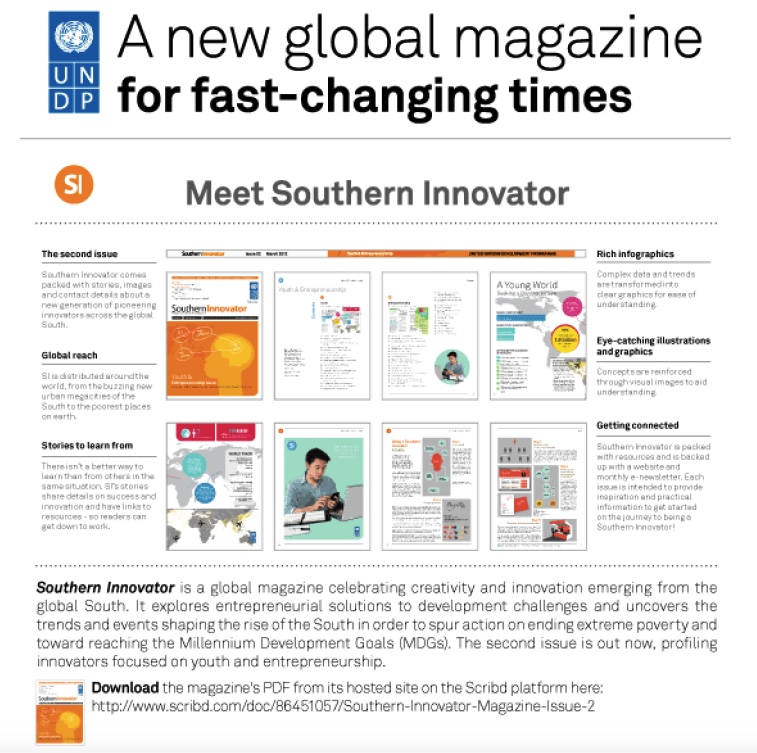
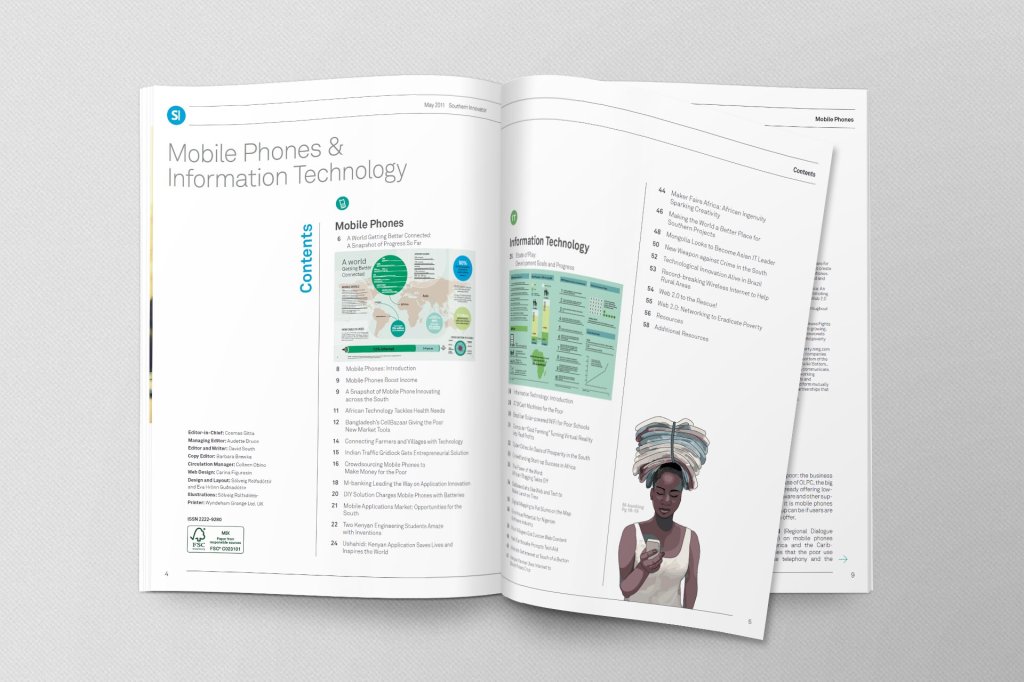
Development Challenges, South-South Solutions was launched as an e-newsletter in 2006 by UNDP’s South-South Cooperation Unit (now the United Nations Office for South-South Cooperation) based in New York, USA. It led on profiling the rise of the global South as an economic powerhouse and was one of the first regular publications to champion the global South’s innovators, entrepreneurs, and pioneers. It tracked the key trends that are now so profoundly reshaping how development is seen and done. This includes the rapid take-up of mobile phones and information technology in the global South (as profiled in the first issue of magazine Southern Innovator), the move to becoming a majority urban world, a growing global innovator culture, and the plethora of solutions being developed in the global South to tackle its problems and improve living conditions and boost human development. The success of the e-newsletter led to the launch of the magazine Southern Innovator. 
Creative Commons License

This work is licensed under a
Creative Commons Attribution-Noncommercial-No Derivative Works 3.0 License.

ORCID iD: https://orcid.org/0000-0001-5311-1052.

© David South Consulting 2022

Categories
Archive Development Challenges, South-South Solutions Newsletters

Online Education Could Boost African Development

By David SouthDevelopment Challenges, South-South Solutions

SOUTH-SOUTH CASE STUDY

Education is recognized as a major catalyst for human development. During a high-level meeting on the Millennium Development Goals (MDGs) (http://www.undp.org/content/undp/en/home/mdgoverview.html) in 2010, UNESCO – the United Nations Educational, Scientific and Cultural Organization – pointed out the necessity of making rapid gains in education if all the MDGs are to be achieved. The goals deadline is 2015 – just two years away.

Two of the eight goals are directly related to education systems. MDG2 focuses on boosting universal primary education by 2015, and MDG3 calls for the elimination of barriers to primary and secondary education for women and girls.

UNESCO found that between 2000 and 2007, the share of total government education expenditure devoted to primary education across sub-Saharan Africa fell from 49 per cent to 44 per cent (Rawle, 2009). It also found total aid for education was on the decline and foreign aid for basic education began to stagnate in 2008. This contrasted, UNESCO stated, with the “strong advances made over the past decade.”

Overall, in the countries of sub-Saharan Africa, resources for education fell by US $4.6 billion a year on average in 2009 and 2010 (UNESCO, 2010).

With funding for education dependent on fluctuating factors such as foreign aid, government budgets and the state of the global economy, alternatives are needed to retain the gains made in education and to improve them even further.

Thankfully, one new innovative learning tool, dubbed massive open online courses (MOOCs) (http://en.wikipedia.org/wiki/Massive_open_online_course), is about to have a major impact in Africa. Rapid improvements in access to the Internet in Africa means that online learning tools could be a growing solution to the education deficit.

MOOCs mean people will have access to a global treasure trove of free online courses in science, technology, engineering and math. Many believe the leapfrog into digital education will do for education what mobile phones have done for African’s ability to communicate and do business.

These online courses vary in approach – some have set start and finish dates and can last from six to 10 weeks, while others are more loosely structured. But they all offer students the ability to learn from online video lectures and use online forums as a replacement for seminars, debates and question-asking.

According to a recent paper by Harvard University Professor of International Development Calestous Juma, “There is a real possibility for Africa to dramatically improve its teaching – especially in science, technology, engineering, and math – through the deployment of MOOCs.”

The diffuse nature of the Internet means many of the drivers behind promoting this trend in Africa will be found at the regional rather than the national level. The Internet helps remove the dependence on national governments and their education policies and funding – or lack thereof – to further education goals. This means the ability to make the most of the powerful new resource of MOOCs will be amplified by innovators within Africa, from entrepreneurs to information technology pioneers.

Their solutions will help make it easier to access these learning resources.

MOOCs are a variation on OpenCourseWare (http://en.wikipedia.org/wiki/OpenCourseWare) university courses, created for free distribution on the Internet. MOOCs bypass the hazard in the past of digital courses going missing or being mislaid: they are online and always available. Nobody can mislay the content by accident.

The Khan Academy (khanacademy.org) is one of the best-known popular MOOCs pioneers. It was founded in the United States in 2008 by Salman Khan, who quit his job as a hedge fund manager to run the business full time. Khan is academically highly accomplished – he has three degrees from MIT and an MBA from Harvard University. The Khan Academy targets mainly secondary school students and claims to have 5.5 million unique users a month. It is run as a not-for-profit and receives donations to keep it going.

It does this with a staff of just 37: proof of how much can be achieved when the power of the Internet is leveraged to pass on knowledge.

The Khan Academy platform greets readers with questions such as “What is the eccentricity of an ellipse?” or “What if there’s a negative exponent?” And if you do not know, you better get cracking doing their problem sets. Students can practice their math skills, answer other students’ questions or watch a video walk-through of the services on offer on the website. The main categories are math, science and economics, computer science, the humanities and help with preparing for various standardized tests such as the GMAT (Graduate Management Admission Test). There are over 4,000 videos on offer on the website.

“Each video is a digestible chunk, approximately 10 minutes long, and especially purposed for viewing on the computer,” the website states.

“I teach the way that I wish I was taught. The lectures are coming from me, an actual human being who is fascinated by the world around him,” states Khan.

MOOCs offer not just course materials, videos, readings and problem sets but also discussion forums for the students, professors/teachers and tutorial assistants to build a community. This is considered an ideal model for reaching students over great distances and in remote regions. So-called “open” educational resources are used and often no fees or tuition are charged.

The OpenCourseWare (OCW) (http://ocw.mit.edu/index.htm) project at the Massachusetts Institute of Technology (MIT) seeks to “publish all of our course materials online and make them widely available to everyone,” according to Dick K.P. Yue, Professor at MIT’s School of Engineering.

Through its website, it offers nearly all of MIT’s course content, a treasure trove from one of the top research universities in the world, a long-standing home for pioneers and innovators in science and technology.

By way of the Internet, anybody anywhere in the world can access this resource. The most visited courses online as of February 2013 included undergraduate “Introduction to Computer Science and Programming,” “Physics I: Classical Mechanics,” “Introduction to Electrical Engineering and Computer Science I,” “Principles of Microeconomics,” “Introduction to Algorithms,” and “Principles of Chemical Science.” There are 2,150 courses and so far 125 million visitors to the website.

Having access to the courses allows teachers to gain new insights into the subjects they teach and benefit from the impressive resources of MIT.

MIT also sees it as a way to aid people to tackle the big development issues of our time, including climate change and health problems such as cancer.

Other MOOCs providers include Peer-to-Peer University (https://p2pu.org/en/), Udemy (udemy.com), Coursera (coursera.org), Udacity (udacity.com), and
edX (edx.org), a not-for-profit partnership between Harvard and MIT to develop courses for interactive study on the Internet.

In the United Kingdom, the Open University (open.ac.uk) and Futurelearn (http://futurelearn.com/) also offer online courses, as does Open2Study (http://www.open.edu.au/open2study) in Australia.

Boosting access to MOOCs presents a great business opportunity for Africa’s mobile phone entrepreneurs and its mushrooming information technology (IT) hubs (https://africahubs.crowdmap.com/).

“I view online learning as a rising tide that will lift all boats,” Anant Agarwal, professor of electrical engineering and computer science at MIT and president of edX, told The Financial Times. “It will not only increase access, it will also improve the quality of education at all our universities.”

All of this matters because it means Africans will increasingly have the tools to participate in the global marketplace of ideas and products and services on a more level playing field. By far the biggest obstacle to competing is the lack of timely information and knowledge about what is happening in the global economy. It is a frequent complaint, from the farmer desperate for the latest news on market prices and trends and innovations, to the strivers in the growing megacities of the continent who have their sights set on global success.

Published: May 2013

Resources

1) African Union’s High Level Panel on Science, Technology and Innovation. Website: http://belferinthenews.wordpress.com/2012/08/03/calestous-juma-to-co-chair-new-au-panel-on-science-technology-and-innovation/

2) Queen Elizabeth Prize for Engineering: The Queen Elizabeth Prize for Engineering is a new global engineering prize that will reward and celebrate an individual (or up to three individuals) responsible for a ground-breaking innovation in engineering that has been of global benefit to humanity. Website: http://www.qeprize.org/

3) Belfer Center for Science and International Affairs: The Belfer Center is the hub of the Harvard Kennedy School’s research, teaching, and training in international security affairs, environmental and resource issues, and science and technology policy. Website: http://belfercenter.ksg.harvard.edu/

4) A place to host MOOC news and information. Website: http://mooc.ca/

5) OpenCourseWare Consortium: The OpenCourseWare Consortium is a collaboration of higher education institutions and associated organizations from around the world creating a broad and deep body of open educational content using a shared model.  Website: http://www.ocwconsortium.org/

6) Engineering the Future by Calestous Juma, Professor of the Practice of International Development at Harvard Kennedy School. Website: http://www.technologyandpolicy.org/2013/03/18/engineering-the-future/#.UUeWY1fm8
g4

7) Hiobo MoPC: Joining the ongoing push to drive down the price of personal computers in Africa is the latest offering from Mauritian information technology company, Hiobo. Website: http://www.hiobo.com/mopc/

Southern Innovator logo

London Edit

31 July 2013

Development Challenges, South-South Solutions was launched as an e-newsletter in 2006 by UNDP’s South-South Cooperation Unit (now the United Nations Office for South-South Cooperation) based in New York, USA. It led on profiling the rise of the global South as an economic powerhouse and was one of the first regular publications to champion the global South’s innovators, entrepreneurs, and pioneers. It tracked the key trends that are now so profoundly reshaping how development is seen and done. This includes the rapid take-up of mobile phones and information technology in the global South (as profiled in the first issue of magazine Southern Innovator), the move to becoming a majority urban world, a growing global innovator culture, and the plethora of solutions being developed in the global South to tackle its problems and improve living conditions and boost human development. The success of the e-newsletter led to the launch of the magazine Southern Innovator. 

Creative Commons License

This work is licensed under a
Creative Commons Attribution-Noncommercial-No Derivative Works 3.0 License.

ORCID iD: https://orcid.org/0000-0001-5311-1052.

© David South Consulting 2023

Categories
Archive Development Challenges, South-South Solutions Newsletters

Ghana Wants to Tap Global Trendy Party Scene

By David SouthDevelopment Challenges, South-South Solutions

SOUTH-SOUTH CASE STUDY

Tourism is big business – and one of the most resilient parts of the global economy. Despite the international economic crisis that has wreaked havoc and increased unemployment and poverty in many countries since 2007, tourism is still going strong.

The UN’s World Tourism Organization (UNWTO) (http://www2.unwto.org/) found international tourist arrivals grew by 5 per cent during the first half of 2013 from the same period in 2012, reaching 500 million arrivals.

“The fact that international tourism grew above expectations confirms that traveling is now part of consumer patterns for an increasing number of people in both emerging and advanced economies,” said UNWTO Secretary-General Taleb Rifai. “This underlines the need to rightly place tourism as one of the key pillars of socio-economic development, being a leading contributor to economic growth, exports and jobs.”

One successful way to lure tourists, especially young tourists, is to nurture hubs of culture, outdoor activities, music and fashion around a holiday destination – generally one involving sun and sand. Such “party scenes” can be found in hotspots as far afield as Florida, the Spanish island of Ibiza and Koh Samui (http://www.kohsamui.com/) in Thailand. While at times annoying to local people, these groups of young tourists do bring significant wealth to smaller towns and seaside communities.

And now there are some in Africa who want to replicate this successful business formula in beach communities.

The Ghanaian fishing village of Kokrobrite (http://en.wikipedia.org/wiki/Kokrobite), located west of the capital, Accra, has become a nascent hub for a dance music scene and beach parties.

“We are organizing an all-day-long beach party with DJs, food and partying, inspired by the kind of summer jams that are held in Miami,” Basil Anthony, Chief Executive of Silky Entertainment (http://www.silkyentertainment.com/), told The Guardian newspaper. Silky Entertainment is organizer of Ghana Summer Beach Rave 2013.

“We are expecting partygoers in the thousands, and double the number we had last year. It’s going to be big.”

Other popular events include Tidal Rave (http://www.youtube.com/watch?v=8f5Wy3g9Y7w), aimed at university students, and an upmarket champagne party at Bella Roma beach which attracts expats and wealthy Ghanaians.

While these events have been very popular locally, ambitious entertainment entrepreneurs want to take the parties to the next level and make them truly global events, attracting tourists from around the world.

“The next Ibiza will be in Africa. It has already started,” said Andrew Tumi, also known as Won, a singer from the group Supafly.

“We are trying to recreate the good things about going to Ibiza, the music and the vibes. But more and more we are creating our own sound here, an Afro-house, reggae, African mashup… It’s really blending the African rhythm into a house scene.”

Dance music is hot right now, and is being refreshed with new trends in Afro-house and Afro-pop from across the continent. This in turn is creating a demand for parties to celebrate and enjoy the music.

The economic impact is considerable as the parties inspire other businesses to feed off the good vibrations. DJ MoBlack, who works in a nightclub in Accra, told The Guardian, “It’s not just the music, it’s a whole scene that’s on the rise – goods, fashion, jewelry – there is a style revolution happening around it. It’s a unique African vibe, but something that people everywhere can relate to.”

The impact on the tourism sector is already quantifiable. Tourist visits to Ghana grew from 400,000 a year in 2005 to 1 million in 2011.

Ben Ohene-Aryeh at the Ghana Tourism Authority (http://www.ghana.travel/) is optimistic bigger things are to come: “[The scene] is catching on well with the youth and now we hope that it will be done on a massive scale,” he said.

There is, however, a downside to this strategy: drug use is on the increase. According to the West Africa Commission on Drugs (wacommissionondrugs.org), marijuana use is on the rise as well as harder drugs such as cocaine.

It’s clear there are pitfalls to the youth-tourism strategy, but these can be managed with the right strategy – and the economic opportunities for small communities are substantial.

Published: November 2013

Resources

1) Information on drug tourism from DARA Thailand: DARA is Asia’s first and leading international destination for drug and alcohol rehabilitation. Website: http://alcoholrehab.com/alcohol-rehab/drug-tourism/

2) 3rd UNWTO International Conference on Tourism and the Media: How new media is shaping the news: With the rise of the new media, both the media landscape and the way stories are being told are changing. Millions of consumers now have the possibility to directly engage in the editorial process due to faster than ever evolving technology. More recently, mobile technology and a myriad of applications for smart phone devices are increasingly influencing communication flows. Website: http://www2.unwto.org/en/event/3rd-unwto-international-conference-tourism-and-media-how-new-media-shaping-news

3) The UNWTO World Tourism Barometer: A regular publication of the Tourism Trends and Marketing Strategies Programme of UNWTO aimed at monitoring the short-term evolution of tourism and providing the sector with relevant and timely information. Website: http://mkt.unwto.org/en/barometer

Tourism Investment and Business Forum for Africa: INVESTOUR is an annual tourism business and knowledge exchange platform in which representatives of African tourism and potential Spanish and Portuguese investors/partners meet to discuss about business and cooperation opportunities. Website: http://africa.unwto.org/en/event/v-tourism-investment-and-business-forum-africa-investour-edition-2014-madrid-spain

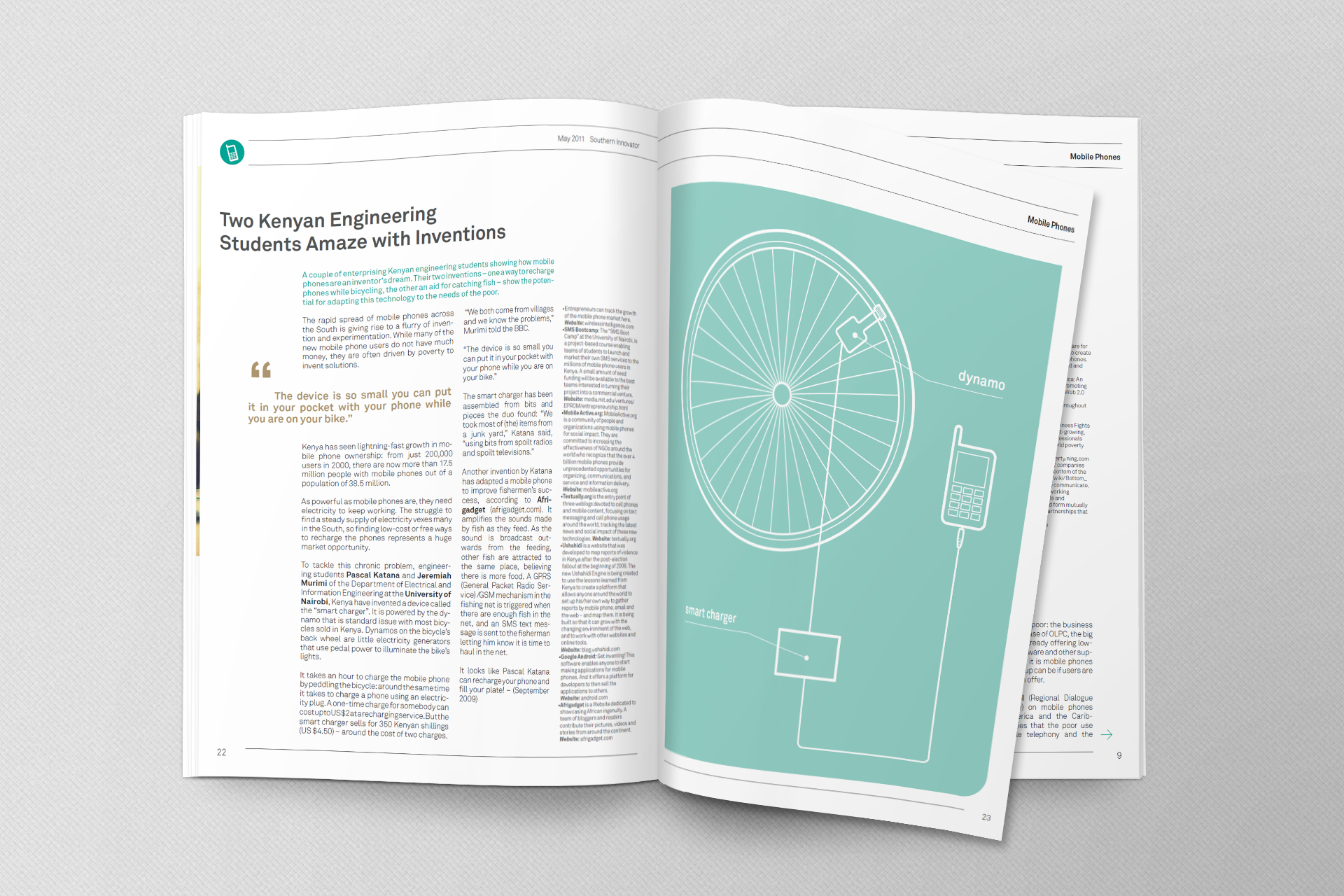
Development Challenges, South-South Solutions was launched as an e-newsletter in 2006 by UNDP’s South-South Cooperation Unit (now the United Nations Office for South-South Cooperation) based in New York, USA. It led on profiling the rise of the global South as an economic powerhouse and was one of the first regular publications to champion the global South’s innovators, entrepreneurs, and pioneers. It tracked the key trends that are now so profoundly reshaping how development is seen and done. This includes the rapid take-up of mobile phones and information technology in the global South (as profiled in the first issue of magazine Southern Innovator), the move to becoming a majority urban world, a growing global innovator culture, and the plethora of solutions being developed in the global South to tackle its problems and improve living conditions and boost human development. The success of the e-newsletter led to the launch of the magazine Southern Innovator. 
Creative Commons License

This work is licensed under a
Creative Commons Attribution-Noncommercial-No Derivative Works 3.0 License.

ORCID iD: https://orcid.org/0000-0001-5311-1052.

© David South Consulting 2023

Categories
Archive Development Challenges, South-South Solutions Newsletters

South Africa Innovates Healthcare with Prepay Phone Vouchers

By David SouthDevelopment Challenges, South-South Solutions

SOUTH-SOUTH CASE STUDY

Pioneers in Africa are experimenting with new ways to fund the delivery of healthcare that is affordable and sustainable and not dependent on foreign aid and donations. A South African company is prototyping the selling of pre-payment healthcare services through mobile phones with a range of vouchers that can be bought and downloaded at the tap of a keypad. They are priced at between US $12 and US $49 and cover medical and dental check-ups, tests, treatments, chronic care and medicines. They are flexible and can also be sent to friends and family who need help.

In South Africa, poverty is still widespread. The majority black population has a median income of US $2,000 a year (New Internationalist) and many still live in crowded townships and poor rural communities. Poverty has also increased for many white Afrikaner South Africans (http://en.wikipedia.org/wiki/Afrikaner). A study by the Standard Bank of South Africa found the number of whites earning less than US $80 a month grew from 2000 to 2004 by more than 50 per cent. In the government capital of Pretoria, 50 Afrikaner squatter camps have emerged in recent years. For many, affordable healthcare is a critical issue.

The story of healthcare in Africa is not a linear one of constant progress. The continent as whole achieved its lowest child mortality rates in the 1970s. But after that, the quality of healthcare declined as a result of various factors including economic crises and the HIV/AIDS crisis – both of which overwhelmed public systems. In sub-Saharan Africa, health systems reached rock bottom in the late 1990s.

“Few people could afford annual check-ups, medicines or user fees at hospitals,” wrote Dr. Ebrahim Malick Samba in the paper “African health care systems: what went wrong?” for News Medical (www.news-medical.net). “One result was the resurgence of infectious diseases such as malaria, tuberculosis and cholera.

“Prior to the 1980s, the district hospitals, community health centres and other outreach health posts provided medical services and essential drugs free of charge. With reforms, user fees and cost recovery were introduced, and the sale of drugs was liberalized.

“Many governments discontinued budget support to the health sector which paralysed the public health system. There was no money for medical equipment and maintenance; salaries and working conditions declined.”

Things have been steadily improving from this low base through the 2000s, the result of increased aid funding for public health systems and greater national investments in staff, facilities and equipment. There is still a long way to go, but Africa is becoming a world leader in developing and deploying mobile phone applications for health and healthcare.

Despite dramatic improvements to the quality of hospitals and the number of qualified doctors, the continent’s healthcare services are still a patchwork, with rural and slum dwellers poorly served and the stresses of treating patients with contagious diseases like HIV/AIDS and malaria pushing resources to the limit.

Research has shown it is better and fairer to develop pre-payment mechanisms for healthcare than to just hit patients with fees when they are ill. With pre-payment, a person can buy care services when they are financially able to and bank up care for when they become ill and not able to work and save.

This is a crucial issue for people with low incomes who can quickly be devastated by their illness or that of loved one or family member.

The World Health Organization (WHO) has taken a firm stand against so-called out-of-pocket payments and encourages the growth in pre-payment methods. The World Health Report 2000 found that “Fairness of financial risk protection requires the highest possible degree of separation between contributions and utilization.”

South Africa’s Yarona Care (www.yaronacare.co.za/prepaid.html) – a health insurance provider network – is rolling out prepaid mobile phone vouchers, allowing patients to see doctors or dentists and even traditional healers for treatment. When a patient visits, the healthcare worker redeems the mobile phone voucher to get paid. One product, Impilo Go, allows people to pay for one visit to a doctor and seven days of medicine for R230 (US $34). For people on a tighter budget, there is Impilo Care for R80 (US$12). A patient can visit a nurse practitioner for a medical check-up and receive tests.

Impilo One offers medicines alone for R100, while Impilo Plus for R195 (US $29) is aimed at people with chronic conditions. They can get a prescription from the doctor and then go to a pharmacy participating in the scheme to receive medicines.

Dental work is also covered by the vouchers.

An online demonstration shows how the mobile phone process works (www.yaronacare.co.za/cellphonedemo.html).

The service is marketed at a mix of customers, from individuals to corporate clients looking to cover large numbers of people to government and NGOs. They can purchase services by voucher, payroll schemes or mobile phones.

Prepaid by mobile phone as a concept is already well established across Africa. It is a simple way to make payments and sell services. In the case of Yarona’s offering, the customer or patient uses their mobile phone to dial a code to pay for a service. When at the doctor or dentist’s office, he or she spends the voucher for the service by giving a unique code to the healthcare professional. Once this is done, Yarona Care pays the healthcare provider for the service.

The voucher approach allows customers to buy health services for family members for a defined period of time. Vouchers can also be sent to family members for emergencies.

Published: April 2011

Resources

1) South Africa’s Afridoctor mobile phone application claims to be Africa’s first personal mobile health clinic. It lets patients use its “SnapDiagnosis” system to submit photos of their ailments and in turn receive advice from a panel of medical professionals, or use the mapping feature to find doctors, clinics and health industry-related services nearby. Website: http://twitter.com/afridoctor

2) Ghana’s mPedigree uses cell phones to build networks to tackle and identify counterfeit drugs. Website: http://mpedigree.net

Development Challenges, South-South Solutions was launched as an e-newsletter in 2006 by UNDP’s South-South Cooperation Unit (now the United Nations Office for South-South Cooperation) based in New York, USA. It led on profiling the rise of the global South as an economic powerhouse and was one of the first regular publications to champion the global South’s innovators, entrepreneurs, and pioneers. It tracked the key trends that are now so profoundly reshaping how development is seen and done. This includes the rapid take-up of mobile phones and information technology in the global South (as profiled in the first issue of magazine Southern Innovator), the move to becoming a majority urban world, a growing global innovator culture, and the plethora of solutions being developed in the global South to tackle its problems and improve living conditions and boost human development. The success of the e-newsletter led to the launch of the magazine Southern Innovator. 
Creative Commons License

This work is licensed under a
Creative Commons Attribution-Noncommercial-No Derivative Works 3.0 License.

ORCID iD: https://orcid.org/0000-0001-5311-1052.

© David South Consulting 2023