Categories
Archive

Clay Filters are Simple Solution for Clean Water

By David SouthDevelopment Challenges, South-South Solutions

SOUTH-SOUTH CASE STUDY

Access to clean water is critical to good health. It is a basic human need that when met, leads to the biggest improvements in health and well-being. Dirty water causes diarrhoea (http://en.wikipedia.org/wiki/Diarrhea), cholera and typhoid. Diseases caused by dirty drinking water kill almost 5,000 children a day around the world (WHO).

But millions have benefited from a simple solution using clay filters invented and pioneered in Central America, and now manufactured by 28 small factories in 23 countries – the largest in Ghana and Cambodia. Each factory makes up to several thousand filters a day. They offer an ingenious solution that also creates local jobs and skills.

Looking like 30 centimetre-high flowerpots, the filters designed by Guatemalan chemist Fernando Mazariegos blend local clay and plant husks to create a filter capable of killing 98 percent of the contaminants that cause diarrhoea. The husks are burnt away when the filters are fired in a kiln, creating tiny holes that filter out harmful organisms. A coating of colloidal silver (http://en.wikipedia.org/wiki/Colloidal_silver) is painted on the filters after they have been fired in the kiln.

“Each filter can support a family of six,” said Kaira Wagoner, Coordinator of Ceramic Water Filter Projects with the NGO Potters for Peace (www.pottersforpeace.org). Founded in Nicaragua but now US-based, Potters for Peace has popularized the filters and helps with all the training and support required to establish the workshops and market the filters.

The first filter-making workshop was set up in Managua, Nicaragua after Hurricane Mitch in 1999 (http://en.wikipedia.org/wiki/Hurricane_Mitch). That workshop has made and distributed 40,000 filters through the Red Cross and NGOs such as Medecins Sans Frontieres/Doctors Without Borders. Potters for Peace has now stopped running workshops and factories themselves, and provides others with the training and advice necessary to produce clay filters.

To work, the filters are placed in a plastic bucket, a spigot added, and a cover put on top to prevent contamination. The filters are capable of filtering four litres of water an hour.

The genius behind the filters is the fact they can be made by small, local workshops – making access to clean water available anywhere, and creating jobs. Just three to four people can produce up to 50 filters a day. According to tests by the Family Foundation of the Americas, a Guatemalan NGO, the filters halve the incidence of diarrhoea in households that use them.

“The cost of establishing a workshop varies largely,” said Wagoner, “depending on the factory’s location, desired production – from 50 per day to 1000 per day – and on the equipment already available in the potter’s workshop. Potters for Peace generally tries to work with potters who already have some of the needed equipment, such as a hammer mill and clay mixer.

“Filters are distributed hand in hand with health and sanitation information which highlights practices such as hand washing,” said Wagoner. “Since many individuals would otherwise boil their water, the filter significantly reduces the time many women would spend gathering firewood. This gives them time for other things such as school and income generating activities, and is better for the environment, especially in locations where problems with deforestation are significant.”

Experience has found marketing is key to the successful adoption of the filters by communities.

“It is very difficult to create a market in a region of poverty,” said Beverly Pillars, also from Potters for Peace, “and to gain acceptance of a new product that the community will want to purchase to keep a workshop sustainable. NGOs may distribute the ceramic water filters, but for the community to fully accept the idea of seeking out clean, safe drinking water on their own, we urge the local owners of the factory to be innovative in marketing.

“Our best approach has been to select partners in developing areas that have some experience such as a potter or brick maker, and help them to find methods that work in their communities to distribute as many of the ceramic water filters as possible, such as a distribution link through local health centres and small corner markets, adds in Yellow Pages, road signs.”

To get a workshop up and running, they need to have a machine to press the clay filters, a kiln to fire them, and a pyrometer (http://en.wikipedia.org/wiki/Pyrometer) to measure the temperature of the kiln. It usually takes between three and six weeks of training to become proficient at making the filters. Trainers help with acquiring the proper equipment, building the kiln, the clay filter formula, quality control procedures, and marketing techniques and materials.

“My advice to people wanting to start making filters is to look for local craftspeople to partner with,” said Pillars. “Look at local access to brick, clay and sawdust. Be prepared for hard and rewarding work to bring safe, clean drinking water to developing populations.

“Every location is a best location, because the demand for safe, clean drinking water worldwide is so great. The beauty of the ceramic water filter technology is that it uses very few resources: clay, sawdust or other burnout material available and bricks for a kiln. We have found these resources to be present worldwide.”

The filter has been cited by the United Nations’ Appropriate Technology Handbook, and is used by the International Red Cross and the Nobel Prize winning medical relief organization Doctors Without Borders. There are plans to start more filter factories in Cote d’Ivoire, Bolivia and Somaliland.

Published: December 2008

Resources

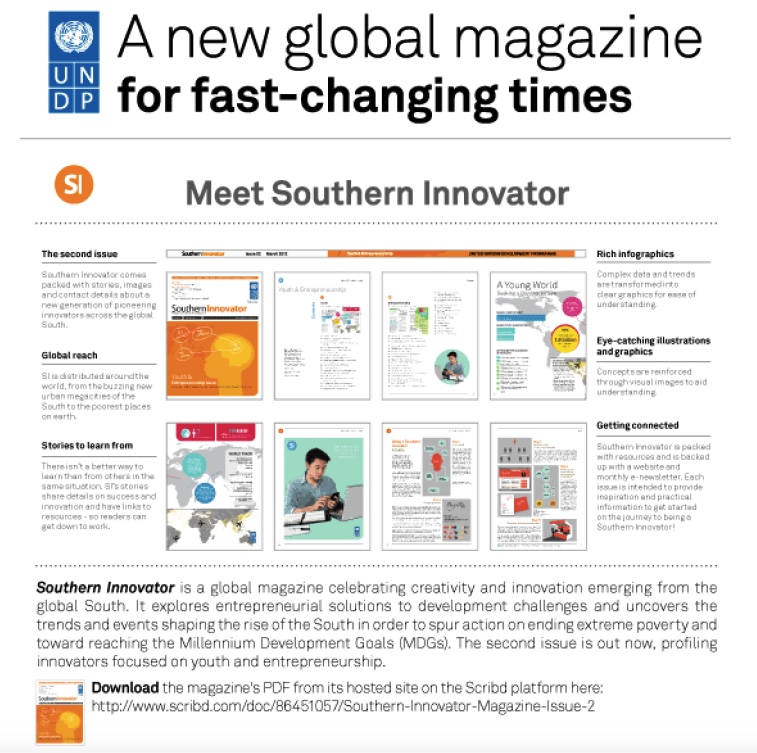
Development Challenges, South-South Solutions was launched as an e-newsletter in 2006 by UNDP’s South-South Cooperation Unit (now the United Nations Office for South-South Cooperation) based in New York, USA. It led on profiling the rise of the global South as an economic powerhouse and was one of the first regular publications to champion the global South’s innovators, entrepreneurs, and pioneers. It tracked the key trends that are now so profoundly reshaping how development is seen and done. This includes the rapid take-up of mobile phones and information technology in the global South (as profiled in the first issue of magazine Southern Innovator), the move to becoming a majority urban world, a growing global innovator culture, and the plethora of solutions being developed in the global South to tackle its problems and improve living conditions and boost human development. The success of the e-newsletter led to the launch of the magazine Southern Innovator. 

Creative Commons License

This work is licensed under a
Creative Commons Attribution-Noncommercial-No Derivative Works 3.0 License.

ORCID iD: https://orcid.org/0000-0001-5311-1052.

© David South Consulting 2022

Categories
Archive Blogroll Southern Innovator magazine Special Unit for South-South Cooperation United Nations Development Programme United Nations Office for South-South Cooperation

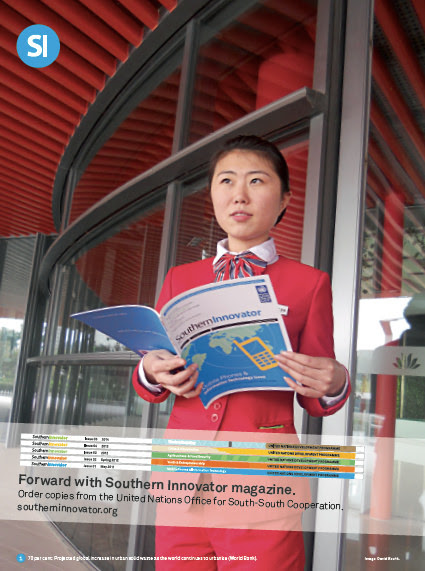
Southern Innovator Magazine | 2010 – 2014 

By David South

“I think you [David South] and the designer [Solveig Rolfsdottir] do great work and I enjoy Southern Innovator very much!” 

Ines Tofalo, Programme Specialist, United Nations Office for South-South Cooperation
Southern Innovator in Tianjin, China.
Issue 5 of Southern Innovator at the Global South-South Development Expo (GSSD Expo) 2014 held in Washington, D.C.
Volunteers in Nairobi, Kenya pose with Southern Innovator Issue 4 at the Global South-South Development Expo (GSSD Expo) in 2013.
Southern Innovator Editor and Writer David South in Australia.
Southern Innovator Graphic Designer and Illustrator Sólveig Rolfsdóttir in Iceland.

Some comments that have come in so far about SI’s first issue:

“What a tremendous magazine your team has produced! It’s a terrific tour de force of what is interesting, cutting edge and relevant in the global mobile/ICT space… Really looking forward to what you produce in issues #2 and #3. This is great, engaging, relevant and topical stuff.”, to “Looks great. Congratulations. It’s Brill’s Content for the 21st century!”

What they are saying about SI on Twitter: From @CapacityPlus Nice job RT @ActevisCGroup: RT @UNDP: Great looking informative @SouthSouth1 mag on South-South Innovation; @UNDP Great looking informative @SouthSouth1 mag on South-South Innovation; @JeannineLemaireGraphically beautiful & informative @UNDP Southern Innovator mag on South-South Innov. 

And on Pinterest:

Peggy Lee • 1 year ago 

“Beautiful, inspiring magazine from UNDP on South-South innovation. Heart is pumping adrenaline and admiration just reading it”

Southern Innovator Magazine can be found in libraries around the world.

Development Challenges, South-South Solutions was launched as an e-newsletter in 2006 by UNDP’s South-South Cooperation Unit (now the United Nations Office for South-South Cooperation) based in New York, USA. It led on profiling the rise of the global South as an economic powerhouse and was one of the first regular publications to champion the global South’s innovators, entrepreneurs, and pioneers. It tracked the key trends that are now so profoundly reshaping how development is seen and done. This includes the rapid take-up of mobile phones and information technology in the global South (as profiled in the first issue of magazine Southern Innovator), the move to becoming a majority urban world, a growing global innovator culture, and the plethora of solutions being developed in the global South to tackle its problems and improve living conditions and boost human development. The success of the e-newsletter led to the launch of the magazine Southern Innovator. 

https://davidsouthconsulting.org/southern-innovator-scale-up-fundraiser/

Creative Commons License

This work is licensed under a
Creative Commons Attribution-Noncommercial-No Derivative Works 3.0 License.

ORCID iD: https://orcid.org/0000-0001-5311-1052.

© David South Consulting 2022
Categories
Archive

Tapping the Power of Child Play

By David SouthDevelopment Challenges, South-South Solutions

SOUTH-SOUTH CASE STUDY

Children are an amazing source of energy. Each generation fizzes with the restlessness and optimism of youth. But all that energy is expended in the playground, leaving behind nothing but the sound of laughter. What if that energy could actually be harnessed and turned into electricity? And electricity to power the cash-strapped school the children need to attend to get a good head start in life?

Meeting the Millennium Development Goal of achieving universal primary education would be significantly helped if schools had electricity and in turn the ability to use computers and the Internet. As well, school buildings can be used to their maximum if they have lights for night schools, and expand to secondary and adult education. It is typical practice in Africa to use schools in the evenings for older students. But usually they only have kerosene lamps to turn to for light.

The need is urgent for electricity for schools in Africa: even sub-Saharan Africa’s richest nation, South Africa, has 5,131 schools without electricity. And in the battle for energy, schools have to compete with businesses and cities, as increasing demand makes power outages more common.

Child-power is currently used to run Playpumps’ merry-go-rounds, drawing water from wells. But a children’s see-saw hopes to use the same principle to bring light to power-starved African schools. Children in Uganda are involved in a pilot test of a see-saw that generates electricity with the simple up-and-down motion of the playground ride. The electricity generated is sent to a storage battery via an underground cable. Just five to 10 minutes on the see-saw can generate enough electricity to light a classroom for an evening.

The see-saw is being tested in the Ugandan city of Jinja, made from locally sourced parts, and has been designed by 23-year-old British design student Daniel Sheridan. He was inspired after volunteering on a school trip to the island of Wasimi, south of Mombasa, Kenya, while building a school and teaching.

“The number of children we saw there that loved to play, and their vibrancy, I thought it would be great if I could somehow make use of this,” he told the BBC. “They don’t have Gameboys and all the rest. They are just so genuine and keen to help – they would grab the wheelbarrows we were working with given the chance.”

Sheridan won £5,500 (US $10,930) to further develop the idea at various university student enterprise award schemes. The money is being used for prototype development.

“The current need for electricity in sub-Saharan Africa is staggering. Without power, development is extremely difficult. The potential for this product is huge and the design could be of benefit to numerous communities in Africa and beyond.”

After the prototype testing in Uganda he hopes to either start a business or charity to manufacture the see-saws. His dream?

“Ultimately I would love to design a whole playground of different pieces of equipment that could generate enough electricity to power a whole village.”

Published: April 2008

Resources

  • Playpumps International: More child-powered ways to make a difference: these water pumps draw water from a well while children spin on the merry-go-round. Website: www.playpumps.org
  • OUiP! Or Optimized Universal Interface Platform: This white plastic handheld electronic bar uses the child’s play motion to power it, while it makes noises and displays images. Website: www.thinkthing.net
  • Sprig Toys: Electro-mechanical toys made from wood and recycled plastic that are run on child-power only. Website: www.sprigtoys.com

Development Challenges, South-South Solutions was launched as an e-newsletter in 2006 by UNDP’s South-South Cooperation Unit (now the United Nations Office for South-South Cooperation) based in New York, USA. It led on profiling the rise of the global South as an economic powerhouse and was one of the first regular publications to champion the global South’s innovators, entrepreneurs, and pioneers. It tracked the key trends that are now so profoundly reshaping how development is seen and done. This includes the rapid take-up of mobile phones and information technology in the global South (as profiled in the first issue of magazine Southern Innovator), the move to becoming a majority urban world, a growing global innovator culture, and the plethora of solutions being developed in the global South to tackle its problems and improve living conditions and boost human development. The success of the e-newsletter led to the launch of the magazine Southern Innovator. 

Creative Commons License

This work is licensed under a
Creative Commons Attribution-Noncommercial-No Derivative Works 3.0 License.

ORCID iD: https://orcid.org/0000-0001-5311-1052.

© David South Consulting 2023

Categories
Archive Development Challenges, South-South Solutions Newsletters Southern Innovator magazine

Colombian Architect Proving Strength and Beauty of Bamboo

By David SouthDevelopment Challenges, South-South Solutions

SOUTH-SOUTH CASE STUDY

Fast-growing bamboo grass (http://en.wikipedia.org/wiki/Bamboo) has become a cause celebre amongst those looking for a sustainable and tough building material.

In the last five years, more and more construction projects have turned to bamboo. It has many advantages: it grows quickly, is super-strong yet also supple enough to bend in a hurricane or earthquake and has a high tensile strength (http://en.wikipedia.org/wiki/Ultimate_tensile_strength) equivalent to steel. It is, of course, green since it is grown in forests, and is cheap and plentiful in many countries of the South, especially across Asia and Latin America.

It is also aesthetically pleasing and makes beautiful structures with intricate patterns.

But despite all these advantages, it has been a hard sales job to get people to choose bamboo as a building material rather than traditional woods, steel or concrete. Many people wrongly think green means not strong. But as many a construction worker knows in Asia, where scaffolding made from bamboo is commonplace, it is tough and stands on its own.

Pioneers are working hard to prove bamboo deserves respect as a building material for a greener future.

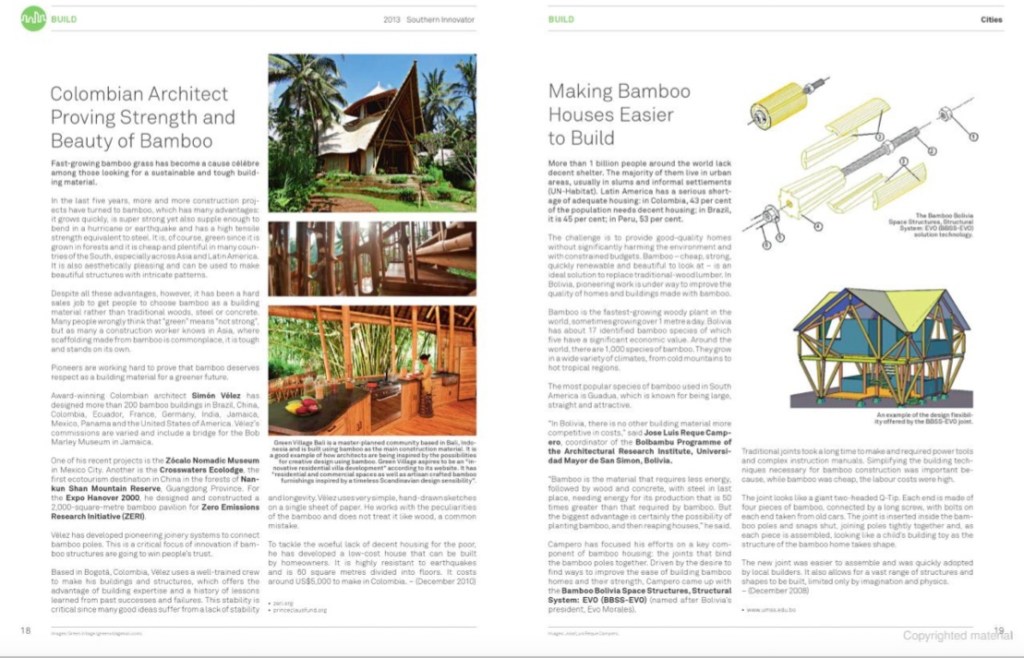
Award-winning Colombian architect Simón Vélez has designed more than 200 bamboo buildings in Germany, France, the United States, Brazil, Mexico, China, Jamaica, Colombia, Panama, Ecuador, and India.

Vélez’s commissions are varied, and include a bridge for the Bob Marley Museum in Jamaica.

One of his recent projects is the Zócalo Nomadic Museum (http://en.wikipedia.org/wiki/Nomadic_Museum) in Mexico City. Another is the Crosswaters Ecolodge (http://www.asla.org/2010awards/370.html), the first ecotourism destination in China in the forests of Nankun Shan Mountain Reserve, Guangdong Province. For the Expo Hanover 2000, he designed and constructed a 2000-square-meter bamboo pavilion for ZERI (Zero Emissions
Research Initiative) (http://www.zeri.org/).

Vélez has developed pioneering joinery systems to connect bamboo poles together. This is a critical focus of innovation if bamboo structures are going to win people’s trust.

Based in Bogotá, Colombia, Vélez uses a well-trained crew to make his buildings and structures. This has the advantage of building expertise and a history of lessons learned from past successes and failures. That stability is a critical insight: many good ideas suffer from a lack of stability and longevity. He uses very simple, hand-drawn sketches on a single sheet of paper. He works with the peculiarities of the bamboo and does not treat it like wood: a common mistake.

To tackle the woeful lack of decent housing for the poor, he has developed a low-cost house that can be built by home-owners. It is highly resistant to earthquakes and is 60 square metres divided on two floors. It costs
around US $5,000 to make in Colombia.

Winner of the Prince Claus Fund (http://www.princeclausfund.org/en/index.html), Vélez’s work promotes sustainable development, introducing new ideas on ecological issues and questions. The Fund calls him an architect “whose aesthetic and technical innovations have considerably expanded the possibilities of bamboo as a building material, providing a challenge to prevailing architectural trends.”

With more than 1 billion people around the world lacking decent shelter, many see plentiful bamboo as a key part of the solution. Most people with poor quality housing live in urban areas, usually in slums and informal settlements (UN-HABITAT). Latin America has a serious shortage of adequate housing: in Colombia, 43 percent of the population needs decent housing; in Brazil, 45 percent; Peru, 53 percent.

The challenge is to provide good quality homes without significantly harming the environment – and with constrained budgets. Bamboo – cheap, strong, quickly renewable and beautiful – is an ideal solution to replace traditional wood lumber.

Bamboo is the fastest growing woody plant in the world, sometimes growing over 1 metre a day. Around the world, there are 1,000 species of bamboo. They grow in a wide variety of climates, from cold mountains to hot tropical regions.

Once called the “poor man’s timber” – a temporary building material to replace once there is more money – bamboo is now getting the respect it deserves. Bamboo for housing has a long history in Latin America, stretching back 4,500 years to ancient civilizations. In Asia, it has long been a traditional construction material. But most of the existing bamboo dwellings in Latin America are 50 to 100 years old.

The most popular species of bamboo used in South America is Guadua, which is known for being large, straight and attractive.

Thoughtful and methodical pioneers like Vélez are proving bamboo has a viable future as a building material that will tackle the housing needs of the world’s poor and the fast-growing cities of the South.

Published: December 2010

Resources

Development Challenges, South-South Solutions was launched as an e-newsletter in 2006 by UNDP’s South-South Cooperation Unit (now the United Nations Office for South-South Cooperation) based in New York, USA. It led on profiling the rise of the global South as an economic powerhouse and was one of the first regular publications to champion the global South’s innovators, entrepreneurs, and pioneers. It tracked the key trends that are now so profoundly reshaping how development is seen and done. This includes the rapid take-up of mobile phones and information technology in the global South (as profiled in the first issue of magazine Southern Innovator), the move to becoming a majority urban world, a growing global innovator culture, and the plethora of solutions being developed in the global South to tackle its problems and improve living conditions and boost human development. The success of the e-newsletter led to the launch of the magazine Southern Innovator. 

Creative Commons License

This work is licensed under a
Creative Commons Attribution-Noncommercial-No Derivative Works 3.0 License.

ORCID iD: https://orcid.org/0000-0001-5311-1052.

© David South Consulting 2023