“I think you [David South] and the designer [Solveig Rolfsdottir] do great work and I enjoy Southern Innovator very much!”
Ines Tofalo, Programme Specialist, United Nations Office for South-South Cooperation
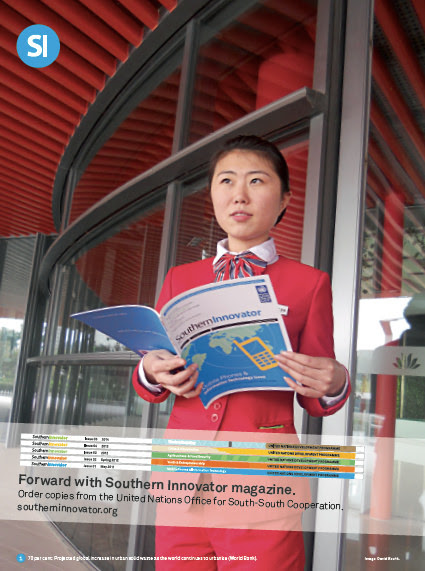
Southern Innovator in Tianjin, China.Issue 5 of Southern Innovator at the Global South-South Development Expo (GSSD Expo) 2014 held in Washington, D.C.Volunteers in Nairobi, Kenya pose with Southern Innovator Issue 4 at the Global South-South Development Expo (GSSD Expo) in 2013.Southern Innovator Editor and Writer David South in Australia.Southern Innovator Graphic Designer and Illustrator Sólveig Rolfsdóttir in Iceland.
Some comments that have come in so far about SI’s first issue:
“What a tremendous magazine your team has produced! It’s a terrific tour de force of what is interesting, cutting edge and relevant in the global mobile/ICT space… Really looking forward to what you produce in issues #2 and #3. This is great, engaging, relevant and topical stuff.”, to “Looks great. Congratulations. It’s Brill’s Content for the 21st century!”
What they are saying about SI on Twitter: From @CapacityPlus Nice job RT @ActevisCGroup: RT @UNDP: Great looking informative@SouthSouth1 mag on South-South Innovation; @UNDP Great looking informative @SouthSouth1 mag on South-South Innovation; @JeannineLemaireGraphically beautiful & informative @UNDP Southern Innovator mag on South-South Innov.
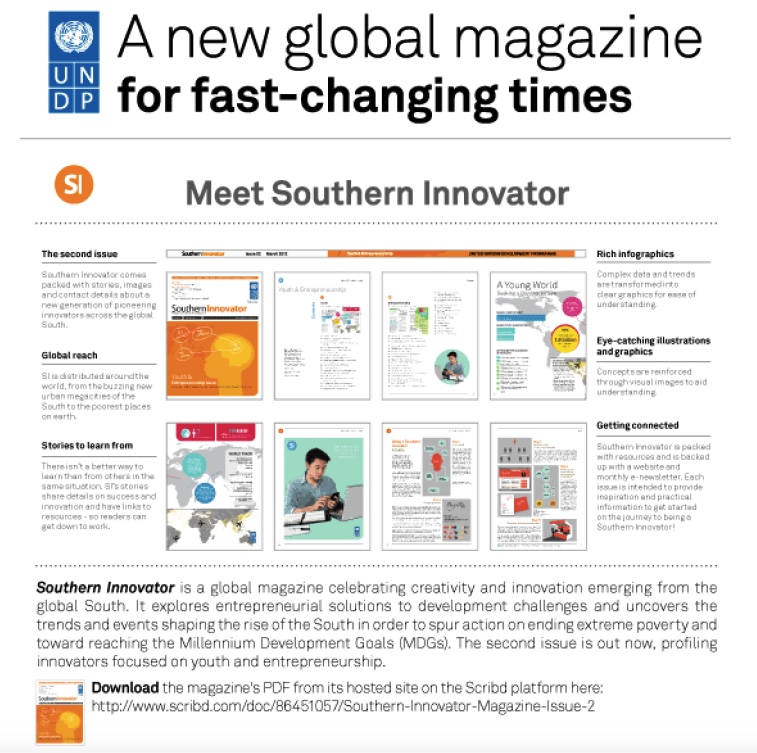
Development Challenges, South-South Solutions was launched as an e-newsletter in 2006 by UNDP’s South-South Cooperation Unit (now the United Nations Office for South-South Cooperation) based in New York, USA. It led on profiling the rise of the global South as an economic powerhouse and was one of the first regular publications to champion the global South’s innovators, entrepreneurs, and pioneers. It tracked the key trends that are now so profoundly reshaping how development is seen and done. This includes the rapid take-up of mobile phones and information technology in the global South (as profiled in the first issue of magazine Southern Innovator), the move to becoming a majority urban world, a growing global innovator culture, and the plethora of solutions being developed in the global South to tackle its problems and improve living conditions and boost human development. The success of the e-newsletter led to the launch of the magazine Southern Innovator.
Good quality banking services are a basic building block to rising incomes. Yet the poor across the South are often overlooked and denied access to savings accounts and loans. Many low-income people are openly discriminated against as ‘bad risks’ by banks, and denied the sort of banking services middle and higher income people take for granted. Yet it is a myth that the poor do not have money or do not wish to save and invest for their future or for business.
The so-called Bottom of the Pyramid (BOP) – the 4 billion people around the world who live on less than US $2 a day – are being targeted by a wide range of businesses. Indian business consultant and professor CK Prahalad (http://en.wikipedia.org/wiki/C.K._Prahalad) , the man who coined the term BOP, has gone so far as to claim this is a market potentially worth US $13 trillion, while the World Resources Institute puts it at US $5 trillion in its report, “The Next 4 Billion” (http://www.nextbillion.net/thenext4billion).
A Kenyan commercial bank has proven it is possible to target the BOP and become successful doing it; so successful that they have seen off foreign rivals and were voted Kenya’s third most respected company.
By offering Kenya’s poor people savings accounts and microloans, Equity Bank (http://www.equitybank.co.ke/) has captured 50 percent of the Kenyan bank market. It now has more than 3 million customers and 2.8 million account holders and opens 4,000 new accounts a day.
Its chief executive officer, James Mwangi, said Equity Bank built its success by doing the opposite of what other banks have done – it doesn’t target the middle and upper classes, but the “the watchmen, tomato sellers and small-scale farmers”.
The Kenyan banking sector in the past was dominated by foreign banks. But by investing in the 46 percent of the population who still live below the food poverty line, Equity has become the third most profitable bank in the country. Its approach was once considered odd. Most of the bank’s borrowers work in the informal sector and have few assets to use as collateral for the loans. So Equity uses what it calls ‘social collateral’. This includes a mix of measures: in some cases, account holders join together to guarantee a person’s debt. Even more unusually, women offer their matrimonial beds as security – it would be shameful for a woman to admit her bed has been taken to pay for the debt.
“For us it’s psychological security. Nobody wants to be excommunicated and lose their inheritance,” said Mwangi.
“By focusing on the previously excluded, Equity has revolutionized the banking sector,” James Shikwati, a director of Kenyan think tank the Inter Region Economic Network (http://www.irenkenya.com/), told The Guardian newspaper. “It has forced the multinational banks to change their business strategies.”
Started in 1984, the bank was still insolvent by 1994, when Mwangi joined as an accountant. Things were looking grim as Kenya’s economy was in a slump and foreign banks like Barclays were closing branches outside big centres.
Mwangi and other Equity Bank managers realized there were millions of low-paid poor in Kenya – all BOP – but who wanted to save and borrow but had nowhere to go.
“Banking was the only industry in Kenya led by supply rather than demand,” said Mwangi. “There was no ‘bottom of the pyramid bank’.”
While absolute poverty in Kenya has declined in recent years, inequality remains high. The population of 37 million people make on average a per capita income of US $580.
By 2003, as the economy picked up, Equity Bank gained 256,000 account holders. It now has 100 branches across the country and 500 automatic teller machines (ATMs). It uses armoured trucks to go into rural areas so that the people can receive banking services. While traditional banks require pay slips and utility bills as proof of a person’s address before letting them open an account, and charge high monthly fees, Equity only requires an identity card.
Within just one year, the bank saw the number of account holders jump to 600,000. Mwangi likes to say that the bank’s competition is the bed mattress, since most people have never had a bank account before. Most savers have around US $148 in their savings account.
The bank’s micro credit operation makes loans of less than US $7 and gives borrowers a few months to repay them.
The bank claims loan defaults are less than 3 percent on 600,000 outstanding loans – the banking industry average is 15 percent.
It keeps its transaction costs down by using the latest in information technology. These efficiencies enabled the bank to earn pre-tax profits of more than US $40 million in 2007.
Equity does face competition, as its success attracts mainstream banks into the BOP market.
In Africa these days, banking is hot: a South African research and analysis company BMI-TechKnowledge (http://www.bmi-t.co.za/) in a report identifies a boom in banking services across Africa. In particular, South Africa, Botswana, Namibia, Angola, Mauritius, Tanzania, Kenya, Ghana, Nigeria, Egypt and Morocco – all have seen surges in profit and services as a result of improving banking regulations and political conditions.
Mwangi isn’t worried, however, since the number of people still without bank accounts is huge. Equity Bank is expanding its operations into Uganda, Rwanda and Sudan.
Elsewhere, mobile phone banking in Kenya is proving highly successful. Equity has a service, but so does Safaricom with M-PESA (http://www.safaricom.co.ke/index.php?id=745). Customers can deposit, transfer and withdraw money using their phones. Over 4 million are now using the service.
Published: January 2009
Resources
1) NextBillion.net: Hosted by the World Resources Institute, it identifies sustainable business models that address the needs of the world’s poorest citizens. Websites: http://www.nextbillion.net/ and World Resources Institute
Development Challenges, South-South Solutions was launched as an e-newsletter in 2006 by UNDP’s South-South Cooperation Unit (now the United Nations Office for South-South Cooperation) based in New York, USA. It led on profiling the rise of the global South as an economic powerhouse and was one of the first regular publications to champion the global South’s innovators, entrepreneurs, and pioneers. It tracked the key trends that are now so profoundly reshaping how development is seen and done. This includes the rapid take-up of mobile phones and information technology in the global South (as profiled in the first issue of magazine Southern Innovator), the move to becoming a majority urban world, a growing global innovator culture, and the plethora of solutions being developed in the global South to tackle its problems and improve living conditions and boost human development. The success of the e-newsletter led to the launch of the magazine Southern Innovator.
Children are an amazing source of energy. Each generation fizzes with the restlessness and optimism of youth. But all that energy is expended in the playground, leaving behind nothing but the sound of laughter. What if that energy could actually be harnessed and turned into electricity? And electricity to power the cash-strapped school the children need to attend to get a good head start in life?
Meeting the Millennium Development Goal of achieving universal primary education would be significantly helped if schools had electricity and in turn the ability to use computers and the Internet. As well, school buildings can be used to their maximum if they have lights for night schools, and expand to secondary and adult education. It is typical practice in Africa to use schools in the evenings for older students. But usually they only have kerosene lamps to turn to for light.
The need is urgent for electricity for schools in Africa: even sub-Saharan Africa’s richest nation, South Africa, has 5,131 schools without electricity. And in the battle for energy, schools have to compete with businesses and cities, as increasing demand makes power outages more common.
Child-power is currently used to run Playpumps’ merry-go-rounds, drawing water from wells. But a children’s see-saw hopes to use the same principle to bring light to power-starved African schools. Children in Uganda are involved in a pilot test of a see-saw that generates electricity with the simple up-and-down motion of the playground ride. The electricity generated is sent to a storage battery via an underground cable. Just five to 10 minutes on the see-saw can generate enough electricity to light a classroom for an evening.
The see-saw is being tested in the Ugandan city of Jinja, made from locally sourced parts, and has been designed by 23-year-old British design student Daniel Sheridan. He was inspired after volunteering on a school trip to the island of Wasimi, south of Mombasa, Kenya, while building a school and teaching.
“The number of children we saw there that loved to play, and their vibrancy, I thought it would be great if I could somehow make use of this,” he told the BBC. “They don’t have Gameboys and all the rest. They are just so genuine and keen to help – they would grab the wheelbarrows we were working with given the chance.”
Sheridan won £5,500 (US $10,930) to further develop the idea at various university student enterprise award schemes. The money is being used for prototype development.
“The current need for electricity in sub-Saharan Africa is staggering. Without power, development is extremely difficult. The potential for this product is huge and the design could be of benefit to numerous communities in Africa and beyond.”
After the prototype testing in Uganda he hopes to either start a business or charity to manufacture the see-saws. His dream?
“Ultimately I would love to design a whole playground of different pieces of equipment that could generate enough electricity to power a whole village.”
Published: April 2008
Resources
Playpumps International: More child-powered ways to make a difference: these water pumps draw water from a well while children spin on the merry-go-round. Website: www.playpumps.org
OUiP! Or Optimized Universal Interface Platform: This white plastic handheld electronic bar uses the child’s play motion to power it, while it makes noises and displays images. Website: www.thinkthing.net
Sprig Toys: Electro-mechanical toys made from wood and recycled plastic that are run on child-power only. Website: www.sprigtoys.com
Development Challenges, South-South Solutions was launched as an e-newsletter in 2006 by UNDP’s South-South Cooperation Unit (now the United Nations Office for South-South Cooperation) based in New York, USA. It led on profiling the rise of the global South as an economic powerhouse and was one of the first regular publications to champion the global South’s innovators, entrepreneurs, and pioneers. It tracked the key trends that are now so profoundly reshaping how development is seen and done. This includes the rapid take-up of mobile phones and information technology in the global South (as profiled in the first issue of magazine Southern Innovator), the move to becoming a majority urban world, a growing global innovator culture, and the plethora of solutions being developed in the global South to tackle its problems and improve living conditions and boost human development. The success of the e-newsletter led to the launch of the magazine Southern Innovator.
With the so-called Arab Spring still unfolding across much of the Arabic-speaking world, it is easy to miss a rising new economic opportunity: The introduction of an Arabic domain name system for the Internet.
The explosion in mobile phones in the Arab world has dramatically increased the number of people who can now access the Internet. One Arabic financial website put the number of people who can now access the Internet in one way or another in the Arab world as 75 million (www.nuqudy.com). As highlighted in the 2003 Arab Human Development Report (AHDR), Arabic-speaking countries have been at a knowledge disadvantage for some time: more than 270 million citizens have access to fewer books than other languages, slower growth economies, and greater illiteracy than the faster-growing emerging economies. At the time, the AHDR found there were just 18 computers per 1,000 people compared to a global average of 78. And just 1.6 percent of Arabs had Internet access, one of the lowest ratios in the world (AHDR 2003).
Since the dawn of the Internet, Latin script has been used exclusively for top-level web domain names, the addresses that end .com, .org and so on. That has been a big obstacle for users of non-Latin script languages like Arabic. It is estimated just 10 percent of people in the Arab world speak English. Many of the resources on the Internet and its utility have been lost to these people. But by using Arabic domain names, there will be a consistency and no more guesswork.
A typical problem in Latin transliterations of Arabic is the conundrum as to either using El or Al as the prefix to a word. This problem is eliminated when Arabic is used.
The Arab world is also very mixed, including the resource-rich, cash-rich Gulf States – Kuwait, Qatar, United Arab Emirates, Saudi Arabia, Oman and Bahrain – and states with high rates of poverty such as Egypt, Djibouti and Yemen.
The protests and uprisings this year in Tunisia, Egypt and elsewhere – with their Facebook pages and Twitter streams – have shown that a growing group of highly Internet-savvy young people is emerging in the Arab world. But for many without the education or the resources, access to knowledge still remains weak. But armed with Internet-capable mobile phones and Arabic language domain names, rapid change is now possible.
The number of books published in Arabic is notoriously relatively low, and print runs are small. Arabic language books make up just 1.1 percent of world production.
The AHDR reports have called this knowledge deficit a direct obstacle to human development in Arab countries.
But things are changing and the rise of Arabic domain names offers the potential for an explosion in Arabic language Internet content.
In May 2010 ICANN, the world’s Internet domain authority, decided to allow top-level domains in non-Latin script. For Arabic speakers, it started this program in Egypt, Saudi Arabia and the United Arab Emirates.
As a sign of the importance of Arabic participation in future growth of the Internet, this year’s World Summit for the Information Society (WSIS) held in Geneva, Switzerland in May 2011 was sponsored by the United Arab Emirates (UAE).
A catchy domain name has many advantages. For Arabic speakers, this means they can type in Arabic domain names for websites and even do it right to left, as they do in print.
In 2009, the first Arabic domain name was grabbed by Egypt. As the Internet naming authority, the Internet Corporation for Assigned Names and Numbers (ICANN) (www.icann.org), started to allow the registering of non-Latin script names. The domain was for the Arabic word for Egypt or “.masr”.
As an early adopter, Egypt sees it as an important part of bringing more Arabic speakers online. George Victor, from the Egyptian National Telecom Regulatory Authority, told the BBC: “We believe that this is a great step that will open new horizons for many e-services in Egypt, and it will have its direct impact, enlarging the number of online users.”
Victor believes using Arabic builds trust.
“Having a domain name in your own language is a point of having a local identity,” he said.
“When talking about Arabic domain names, we are talking about having users which are not online now. People with languages disabilities – people who are having language as a barrier to connect online.”
From now on Internet address names will be able to end with almost any word in any language, offering organizations around the world the opportunity to market their brand, products, community or cause in new and innovative ways.
The advantages of registering an Arabic domain name are numerous. They include clear improvements to business and trade: an ability to protect a trademark, better communication with Arabic customers, better Arabic-language advertising opportunities, better memorability for Arabic domain names because they will be in the Arabic language, and greater access to Arabic customers.
But there are also significant improvements to how the Internet functions in the Arabic world. Search results on Arabic search engines will be more precise with Arabic domain names; catchy, memorable domain names will be a spur to the advertising and marketing industries; and a more Arab-friendly Internet will draw in more Arabic-speaking Internet users, helping them to enjoy the fruits of this great technological advance just as speakers of other languages have.
In March 2011, the Gulf state of Qatar enthusiastically started to offer Arabic domain names.
“The launch of Qatar’s Arabic top-level domain names is a major milestone as we work to build a more digitally inclusive society,” said Dr. Hessa Al Jaber, Secretary General of the Supreme Council of Information and Communication Technology, which will manage Qatar’s Internet domain names through the Qatar Domains Registry.
“As more organizations and individuals begin adopting Arabic domain names, the Internet will literally be opened up to broad new audiences. The Arab world represents a region with enormous potential for growth both in terms of usage and the creation of new digital content, especially Arabic content.”
ICANN’s President and Chief Executive, Rod Beckstrom, sees this as a new phase for the Internet: “ICANN has opened the Internet’s naming system to unleash the global human imagination. Today’s decision respects the rights of groups to create new Top Level Domains in any language or script. We hope this allows the domain system to better serve all of mankind.”
Published: July 2011
Resources
1) Watch the ICANN educational video “Get Ready for the Next Big Thing”, explaining how domain names work and what the changes mean. Website:http://www.icann.org
Development Challenges, South-South Solutions was launched as an e-newsletter in 2006 by UNDP’s South-South Cooperation Unit (now the United Nations Office for South-South Cooperation) based in New York, USA. It led on profiling the rise of the global South as an economic powerhouse and was one of the first regular publications to champion the global South’s innovators, entrepreneurs, and pioneers. It tracked the key trends that are now so profoundly reshaping how development is seen and done. This includes the rapid take-up of mobile phones and information technology in the global South (as profiled in the first issue of magazine Southern Innovator), the move to becoming a majority urban world, a growing global innovator culture, and the plethora of solutions being developed in the global South to tackle its problems and improve living conditions and boost human development. The success of the e-newsletter led to the launch of the magazine Southern Innovator.













 David South Consulting
You must be logged in to post a comment.