Categories
Archive Development Challenges, South-South Solutions Newsletters

Diaspora Bonds to Help Build up Infrastructure

By David SouthDevelopment Challenges, South-South Solutions

SOUTH-SOUTH CASE STUDY

Many people are aware of the significant role played in global development by remittance payments from migrant workers working in the wealthy North to the global South. But they may not be aware of the significant sums migrant workers have saved in bank accounts in these wealthy countries. Across the global South, efforts are underway to lure these sums back to home countries to boost development efforts.

As the hard-earned money migrant workers save sits in bank accounts in wealthy Western countries earning very low interest rates – a consequence of the current global economic crisis – so-called “Diaspora Bonds” seek to offer a way to earn good interest returns and help build up home countries at the same time.

The money can help developing countries build facilities they need but cannot afford: roads, bridges, railways, water supplies, power, sewerage, street lighting. It is a way to bypass dependence on foreign aid and borrowing from aid agencies or the general marketplace.

US $501 billion in remittance payments was sent in 2011, of which US $372 billion went to developing countries, involving some 192 million migrants or 3 per cent of the world’s population (World Bank). On top of this, migrants from developing countries have saved an estimated US $400 billion – and these funds are being targeted by those selling diaspora bonds (The Economist).

The idea is being promoted by the World Bank and draws on the successful experiences with bonds for Israel and India. Both countries have long histories of turning to diaspora communities to raise funds through bonds.

The bonds work by playing on patriotism and the genuine desire of migrants to want to see conditions improve back home. As the thinking goes, patriotic investors are more likely to be patient. This is critical because many countries cannot offer rapid profits and a quick pay off – something sought by short-term investors obsessed with the ups and downs of the stock market. They are also sterner investors, less likely to run away when the going gets tough. Their local knowledge means they will not panic and pull their investments when bad news hits the headlines. And probably best of all, they don’t mind if the local currency declines in value – that just means they can pick up a local house on the cheap or buy a business for even less money.

One business working in this area is Homestrings (homestrings.com): Motto “Come make a difference.” An Internet platform offering diaspora bonds, it is run by founder and chief executive officer Eric-Vincent Guichard. An American born to a Guinean father and American mother, he spent 20 years growing up in rural Guinea and knows the country well. He also heads up GRAVITAS Capital Advisors, Inc. (gravitascapital.com), founded in 1996, which advises governments on how to manage their assets. A graduate of HarvardBusinessSchool and a former World Bank scholar, he is based in Washington, D.C.

According to its website, Homestrings works like this: “It all starts with your ability to scan through a catalog of projects, funds and public-private partnership opportunities that focus on regions you come from or that you care deeply about. Each of these projects and/or funds is detailed in a Fact Sheet that is set up to help you do the due diligence needed to make an investment decision. Then, Homestrings directs your investment into the selected project or fund, with the help of our administrator.”

Investments are monitored on a monthly or quarterly basis and are selected for their socio-economic impact and investment profitability.

The website has a personal “Dashboard” that allows investors to use the site to vote for or against investments and make comments. And Homestrings will promote the investments that receive the most support and positive comments.

To make an investment, a potential investor selects a fund or project that matches their interest. They read the Fact Sheet and choose. The funds are then passed on to the investment bond and an interest percentage or dividend is paid at regular intervals. Investors can keep track of the investment through the personal Dashboard on the website.

Fact Sheets are organized by geographical region, industry focus, and development theme. Investments “cover infrastructure, health care, education, transportation, and small and medium sized enterprise finance – all critical areas of economic growth.”

The Homestrings Catalog of investments includes the governments of Kenya, Senegal, Ghana, Nigeria and also AFREN PLC, which is looking to finance oil and gas exploration off the coast of Nigeria.

Dramatic improvements in global communications in the past five years have also made it much easier for everyone involved to stay in touch and for bond promoters to identify and target potential customers.

The World Bank is currently advising countries on how to run diaspora bond schemes. Kenya, Nigeria and the Philippines have schemes in the works, according to The Economist.

Ethiopia has announced the “Renaissance Dam Bond” (http://grandmillenniumdam.net/). Proceeds will be used to fund the construction of the Grand Renaissance Dam, the largest hydroelectric power plant in Africa, able to generate 5,250 megawatts. Ethiopia tried a similar scheme before with the Millennium Corporate Bond to raise funds for the Ethiopian Electric Power Corporation (EEPCO). This did not entirely meet expectations and sales were slow. Reasons given for this included a perception that EEPCO could not meet payment expectations when the hydroelectric power plant was operating. There was also a lack of trust in the government and its financial stability and the overall political risks.

The second attempt at a bond is believed to better thought through. It comes with an aggressive marketing and awareness-raising campaign aimed at the diaspora, and it starts at US $50, making it more affordable for more people.  It can be used as collateral in Ethiopia – an advantage for those wanting to do business back in the home country.

For potential investors, it is worth remembering that bonds are debts that are rewarded with regular interest payments and paid back at the end of the bond term. They are not risk-free and the risk can lie either in the sovereign solvency of the country or in the investment.

The secret to a successful bond issue is to keep up good relations with the diaspora; countries that are too oppressive could find themselves short of people willing to take up the offer.

Published: October 2012

Resources

1) Remittance Payments Worldwide: A website by the World Bank tracking remittance prices worldwide. Website:http://remittanceprices.worldbank.org/About-Us

2) The World Bank blog on diaspora bonds. Website:http://blogs.worldbank.org/category/tags/diaspora-bond

3) A critical perspective on diaspora bonds at Africa Unchained. Website:http://africaunchained.blogspot.co.uk/2012/03/are-diaspora-bonds-worth-risk.html

Development Challenges, South-South Solutions was launched as an e-newsletter in 2006 by UNDP’s South-South Cooperation Unit (now the United Nations Office for South-South Cooperation) based in New York, USA. It led on profiling the rise of the global South as an economic powerhouse and was one of the first regular publications to champion the global South’s innovators, entrepreneurs, and pioneers. It tracked the key trends that are now so profoundly reshaping how development is seen and done. This includes the rapid take-up of mobile phones and information technology in the global South (as profiled in the first issue of magazine Southern Innovator), the move to becoming a majority urban world, a growing global innovator culture, and the plethora of solutions being developed in the global South to tackle its problems and improve living conditions and boost human development. The success of the e-newsletter led to the launch of the magazine Southern Innovator. 
Creative Commons License

This work is licensed under a
Creative Commons Attribution-Noncommercial-No Derivative Works 3.0 License.

ORCID iD: https://orcid.org/0000-0001-5311-1052.

© David South Consulting 2022

Categories
Archive Development Challenges, South-South Solutions Newsletters Southern Innovator magazine

Fashion Recycling: How Southern Designers are Re-using and Making Money

By David SouthDevelopment Challenges, South-South Solutions

SOUTH-SOUTH CASE STUDY

With the rising awareness of the importance of doing fashion in an ethical and sustainable way, more and more fashion designers in the South are getting very creative. Fashion earns big money around the world: The global clothing industry is estimated to be worth US $900 billion a year.

In Paris, the Ethical Fashion Show, now in its fifth year, showcases fashion that respects people and the environment while still being glamorous, luxurious and trendy. It has attracted designers from around the world, including Mongolia, Thailand, China, Peru and Bolivia. The show demands that all participants adhere to International Labour Organization conventions – including banning forced and child labour – respect for the environment, creating local employment and working with craftspeople to ensure skills are retained and the fashion reflects the diversity of the world’s cultures.

In Abidjan, Ivory Coast, Felicite Mai is using pride in her nation’s top export commodity, cocoa (Ivory Coast is the world’s number one exporter of cocoa), to make smart fashion wear at affordable prices. She has turned the beige-coloured jute sacks used to ship cocoa beans around the world into clothes for men and women.

“Ivory Coast’s economy is based on agriculture, especially cocoa and coffee. So I decided to promote these crops by creating these fashion designs,” Mai, whose real name is Maimouna Camara Gomet, told the Reuters news agency.

“For me, it’s a way of drawing the whole world’s attention to cocoa and coffee,” she said

Mai comes from a family of cocoa planters and is a graduate of a sewing school. She works out of a studio-cum-shop in the Treichville suburb of Abidjan.

The clothes are usually beige, but some are dyed dark brown or blue. They include skirts, tops, trousers, shirts, waistcoats, caps, bags and accessories; she gets the sacks – most emblazoned with “Product of Ivory Coast, Cocoa” — from the city’s port warehouses. She cleans the jute cloth first, before creating the fashions.

“I had this idea from when I was still at sewing school in 1987. Then I opened my own workshop in 1996 and I first launched these kind of designs in 2003 during a fashion contest at Divo (in the south of Ivory Coast)” said Mai, who has several assistants at her shop.

She has been able to attract as clients local celebrities, artists and musicians and even a few from abroad.

In Brazil, it is footwear that is getting the recycled-look treatment. The brand Melissa specializes in plastic shoes that are eco-friendly and made from 100 percent recycled materials. They use a plastic called melflex made from recovered plastic. The shoes are made in injection molds and the factory is so efficient, it has next to no waste as a byproduct. It recycles all the waste and water used in the production process. And as a plus, they make a point of paying the workers well, and supporting social and environmental causes in Brazil.

Their secret to putting zing into recycled plastic shoes is to have high-profile, celebrity designers design some of the shoes. So far, they have had UK fashion mistress Vivienne Westwood, the Campana Brothers, and the UK-based, Iraqi-born architect Zaha Hadid. Hadid is a controversial figure who always stirs up debate, and her rubber shoes have brought attention to the brand.

The Chilean studio Modulab has turned to recycled rubber from the car industry to make bags. The rubber comes in sheets so it is easy to cut and shape into bags, thus reducing the amount of time and energy used to make the bags. The line is called RTA (ready to assemble) and includes three types of bags: an envelope, a handbag and a messenger bag. Each sheet of recycled rubber comes with the specific slots and pins for the consumer to put the bag together at home, without any glue or sewing involved. Energy used in the making of the entire bag is 100 percent human, except in the production of the material itself.

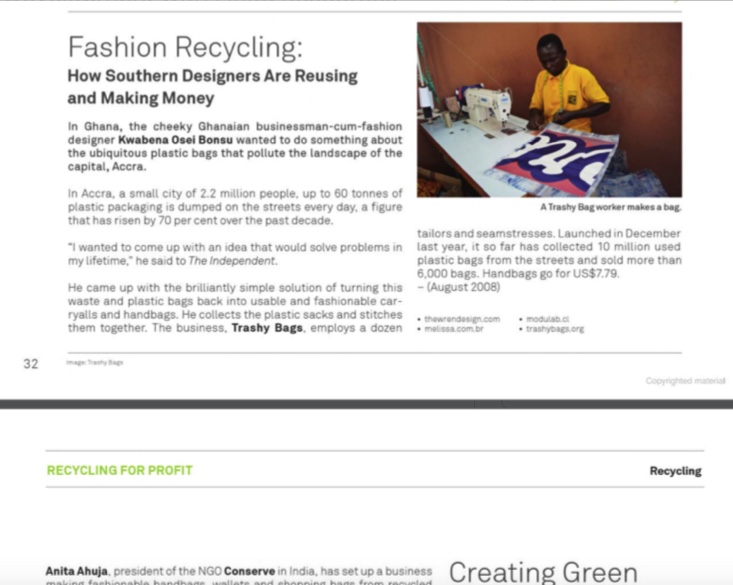
In Ghana, the cheeky Ghanaian businessman-cum-fashion designer Kwabena Osei Bonsu wanted to do something about the ubiquitous plastic bags that pollute the landscape of the capital, Accra.

In Accra, a small city of 2.2 million people, up to 60 tons of plastic packaging is dumped on the streets every day, a figure that has risen by 70 per cent over the past decade.

“I wanted to come up with an idea that would solve problems in my lifetime,” he said to the Independent.

He came up with the brilliantly simple solution of turning these wasted and damaging plastic bags back into usable and fashionable carryalls and handbags. He collects the plastic sacks and stitches them back together. The business, Trashy Bags, employs a dozen tailors and seamstresses. Launched in December last year, it so far has collected 10 million used plastic sachets from the streets, and sold more than 6,000 bags. Handbags go for US $7.79.

Ghana’s huge quantity of discarded plastic water bottles are gathered up for recycling too. A storage room overflows with more than 3 million sachets that have been collected and cleaned ready for recycling.

Bonsu’s business has turned into a source of income for local people, who receive US $3.89 for 1,000 sachets – a good return where the average yearly income is US $495

“I collect sachets because I am jobless and this gives me money,” said Hadiza Ishmael, a 55-year-old grandmother who has delivered 4,000 plastic bags. “It also makes the place look nicer.”

Published: August 2008

Resources

  • The Re: Fashion Awards show is a brand new fashion phenomenon, set to transform social and environmental standards in the fashion industry within a decade. The RE:Fashion Awards will take place in London in November 2008. The glittering event will see major faces from the fashion world come together to recognise the most significant development in the fashion industry of the 21st century. The deadline for budding fashion designers to enter their contest is August 20th.
    Website: http://www.refashionawards.org/
  • A photogallery of the cocoa fashions:
    here: Photogallery 1
    and here: Photogallery 2
    And a video of Mai making the garments here: Video
  • Ethical Fashion Show: Isabelle Quehe, who established the event, said “You almost never see designers from developing countries doing shows in Paris, so this brings together natural products, local fair labour, respect for the environment and finding sales outlets in Paris.” Potential designers and exhibitors can contact the Ethical Fashion Show by sending collection photos and a brief explanation on how the fashions contribute to the ethical fashion movement.
    Send contributions to: 4, rue Trousseau 75011 Paris
    Email: unilove@wanadoo.fr
  • Once inspired to get into the global fashion business, check out this business website for all the latest news, jobs and events.
    Website: http://us.fashionmag.com/news/index.php
  • A creative agency specialising in the promotion of African culture to the world. They organise RUNWAY AFRICA—Africa’s annual Fall Fashion Show featuring five of Africa’s most promising rising design stars on the runway.
    Website: http://inspirationafrica.org/aboutus.html
  • Green fashion must really be making an impact–the BBC, Britain’s venerable public broadcaster, has started an on-line fashion magazine. Called Thread. Fashion Without Victim, it is dedicated to bringing the “latest of eco-fabulous style”. Through a “unique mix of affordable fashion, exclusive videos, photo galleries and thought-provoking features” the site is committed to promoting all aspects of ethical fashion.
    Website: http://www.bbc.co.uk/thread/
  • Traidcraft fights poverty through trade, helping people in developing countries to transform their lives. Established in 1979 as a Christian response to poverty, we are the UK’s leading fair trade organisation.
    Website: http://www.traidcraftshop.co.uk/default.aspx

Development Challenges, South-South Solutions was launched as an e-newsletter in 2006 by UNDP’s South-South Cooperation Unit (now the United Nations Office for South-South Cooperation) based in New York, USA. It led on profiling the rise of the global South as an economic powerhouse and was one of the first regular publications to champion the global South’s innovators, entrepreneurs, and pioneers. It tracked the key trends that are now so profoundly reshaping how development is seen and done. This includes the rapid take-up of mobile phones and information technology in the global South (as profiled in the first issue of magazine Southern Innovator), the move to becoming a majority urban world, a growing global innovator culture, and the plethora of solutions being developed in the global South to tackle its problems and improve living conditions and boost human development. The success of the e-newsletter led to the launch of the magazine Southern Innovator. 

Creative Commons License

This work is licensed under a
Creative Commons Attribution-Noncommercial-No Derivative Works 3.0 License.

ORCID iD: https://orcid.org/0000-0001-5311-1052.

© David South Consulting 2023

Categories
Archive Development Challenges, South-South Solutions Newsletters

Housing Innovation in South’s Urban Areas

By David SouthDevelopment Challenges, South-South Solutions

SOUTH-SOUTH CASE STUDY

As urban populations around the South increase, the quality of city housing will be critical to the quality of life and sustainability of improvements to living standards.

Living in crowded and chaotic urban and semi-urban areas does not have to mean suffering poor quality housing. A variety of Southern architects are showing how new perspectives on common problems like cramped spaces, traffic noise, minimal green spaces and tight budgets can be addressed with clever thinking and new concepts.

The bustling and crowded Brazilian city of Sao Paulo has evolved in a chaotic fashion over the years. As Brazilian photographer Reinaldo Coser admitted to design and architecture magazine Dwell (www.dwell.com) , in many places it is “very ugly.”

Sao Paulo suffers from the downside of rapid urban and semi-urban development familiar to cities across the South: traffic gridlock, pollution, noise. It’s a toxic combination of factors that turns even simple tasks like buying groceries into depressingly long, stressful ordeals.

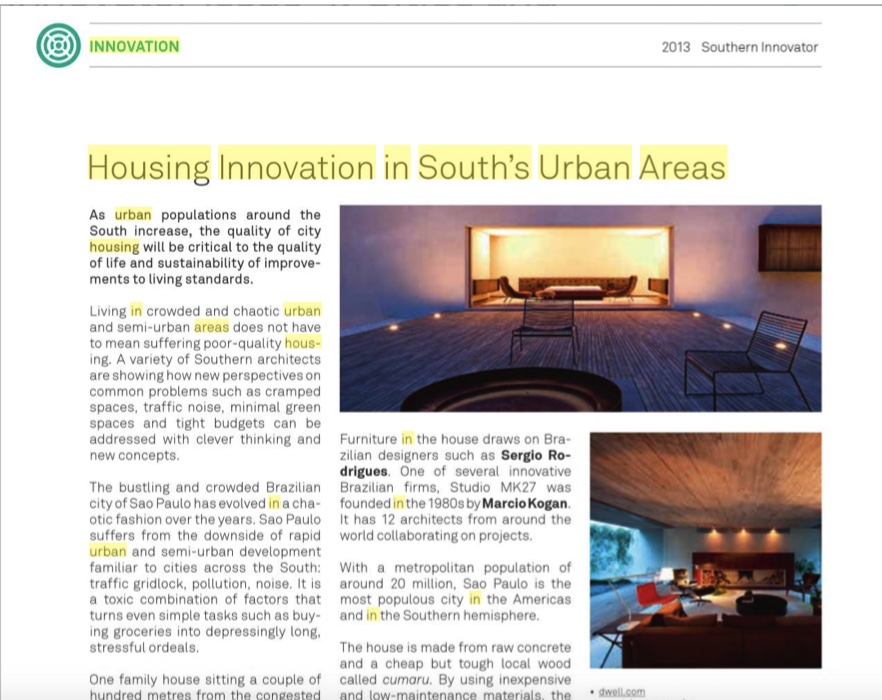
Coser’s family home sits a couple hundred metres from the congested Avenida Brigadeiro Faria Lima (http://en.wikipedia.org/wiki/Avenida_Brigadeiro_Faria_Lima) , the city’s unofficial main street. Yet the dwelling has been cleverly designed to make living in the centre of this modern urban hurly burly a peaceful and calming oasis. Designed by Brazilian architects Studio MK27 (http://www.marciokogan.com.br) – and in keeping with the rich Brazilian modernist tradition pioneered by Oscar Niemeyer in the country’s capital, Brasilia (http://en.wikipedia.org/wiki/Bras%C3%ADlia) – the home uses clever techniques to build calm into chaos.

The front and back gardens are level with the living room, creating an enormous living space that seamlessly flows from indoor to outdoor space. By using a large overhang over the gardens, even on rainy days the home can be lived in almost without walls.

Furniture in the home draws on Brazilian designers like Sergio Rodrigues (http://www.sergiorodrigues.com.br).

One of several innovative Brazilian firms, Studio MK27 was founded in the 1980s by Marcio Kogan. It has 12 architects from around the world collaborating on projects.

With a metropolitan population of around 20 million, Sao Paulo (http://en.wikipedia.org/wiki/S%C3%A3o_Paulo) is the most populous city in the Americas, and in the Southern hemisphere.

While it is easy to point out the downsides of rapid and chaotic urban development, Coser, a professional photographer, lives and loves Sao Paulo nonetheless because, like so many cities across the South, it is a vibrant and dynamic place to be.

And by choosing a design for his home that is calming, he has been able to introduce balance into his family’s life while benefiting from the economic opportunities of the city.

“This house has actually changed the rhythm of our lives,” he told Dwell. “We eat at home more. We go to bed earlier. We wake up earlier. We sleep more.”

And how has the calm helped his two daughters? One is able to play without disturbing the neighbours, and the other can quietly study her books, which was difficult when the family lived in the noise and buzz of a small two-bedroom apartment.

And – something often overlooked in development plans cooked up by economists and urban planners – the aesthetics of the house are very appealing. “Our house is so pretty,” says his wife, Sophia. “Sometimes I like to just look at it for a long time.”

This calm home was created out of basic need. The family needed more space with a second daughter on the way, and had become frustrated with the congestion of the city and the lack of green space. Architect Marcio Kogan was consulted for a solution.

“We wanted a place where we could just shut the door and travel,” says Reinaldo.

The house is made from raw concrete and a cheap-but-tough local wood called cumaru (http://tinyurl.com/3y8kh8v) . By using inexpensive and low maintenance materials, the home is able to weather the environmental stresses of a polluted, tropical city with harsh sunshine.

Kogan deployed his previous experience as a filmmaker to make the home feel and look more spacious and open than it is. He calls it “looking at the world through a wide-screen lens.” The design of the home is seen as a “narrative”, leading the occupant from the garden to the living room, up the stairs, past bedrooms to a rooftop deck with panoramic views of the city.

Another innovative solution in Sao Paulo is USINA (http://www.usinactah.org.br) – a finalist for the World Habitat Awards (http://www.worldhabitatawards.org/about/?lang=00) – which brings people together to build high-density urban housing. It has aided more than 5,000 people to build with their own labour multi-storey buildings. These new apartments are not isolated from other services, but come with community facilities, childcare facilities, professional training courses and other employment-generating activities.

It is estimated up to 15 percent of the city’s population live in slums. This community organising approach is in contrast to the existing ad-hoc building of homes in the slums – often with no technical assistance – or public housing projects built by developers looking for quick profits while ignoring quality and services. USINA’s approach has led to Sao Paulo being a pioneer in participatory housing policies.

USINA provides the technical assistance to social movements looking to build housing for the poor. The cost for the buildings is borne by a combination of public funding and the labour of the residents (working 16 hours per week per household). The cost per housing unit tends to be between US $12,000 and US $15,000 (with land usually donated free by public authorities).

Architectural innovation is also underway in Indonesia, another country that has experienced spurts of rapid economic growth and urbanization, and where a growing middle class is demanding a higher quality of life.

The country’s capital, Jakarta (http://en.wikipedia.org/wiki/Jakarta) , with a population over 8 million, is a mixed bag of modern skyscrapers, crumbling colonial architecture, suburbs and slums.

In the Jakarta suburb of Bekasi (population more than 2 million), Nugrohu Wisnu was looking for a little more space for his family.

At first, the family encountered the downside of poorly designed housing. They bought a house which was infested with termites and was uncomfortable to live in. Frustrated, they began shopping around for something better. And they turned to Indonesian architects Djuhara + Djuhara (http://djuhara.com/home.html).

“We thought that an all-steel house like the one that Mr. Djuhara had built just down the road would be termite resistant,” Wisnu told Dwell.

Djuhara is a high-profile architect and chair of the Jakarta chapter of the Indonesian Institute of Architects (http://www.iai.or.id) and helped to modernize the city’s planning regulations.

The stereotype of young Indonesian architects is that they only work on luxury hotels. But Djuhara was designing and building suburban homes and this grabbed Wisnu’s attention.

Also against stereotype, Djuhara was actually attracted by a tight budget and the small space for the house. In a crowded city, using every bit of space efficiently is critical. The existing house was torn down and Djuhara set about building a new home. The majority of the building materials were sourced within the immediate area: an easy thing to do in Jakarta since there are many vendors selling building supplies on the streets.

By buying local like this, shipping costs were eliminated from the cost of the house. The home’s cost, US $20,000, is just 2/3 of what a more conventional Indonesian home would cost.

Djuhara revelled in the job: “Ad-hocism is my religion,” he told Dwell.

The split-level design of the home uses the space well. The kitchen opens up into the garden.

“Family breakfasts are great in here,” says Wisnu. “And the open kitchen encourages the kids to head out into the garden and run and play.”

There is also a strong environmental component to the design. Airflow cavities in the ceiling are used in the bedrooms to cool them. The house also uses heavy wooden shutters to keep the house cool during the day: “The shutters are unusual, but they are thick and sturdy,” Wisnu explains.

“They really shade the master bedroom to the extent that it feels mellow and cool. They let us reduce our air-conditioning consumption, even during the height of the day.”

And Djuhara also has another difference from many other architects: he refuses to patent his design.

“My friends have asked me why I don’t patent my low-cost houses,” he explains, “but they completely miss the point. I actually want my designs to be copied. I want Indonesian society to rethink its attitudes towards urban architecture.”

Published: June 2010

Resources

https://davidsouthconsulting.org/2021/10/21/cities-for-all-shows-how-the-worlds-poor-are-building-ties-across-the-global-south/

https://davidsouthconsulting.org/2022/05/23/debt-free-homes-for-the-poor/

https://davidsouthconsulting.org/2021/11/11/decent-and-affordable-housing-for-the-poor/

https://davidsouthconsulting.org/2021/11/11/housing-solution-for-worlds-growing-urban-population/

https://davidsouthconsulting.org/2020/12/14/innovation-in-growing-cities-to-prevent-social-exclusion/

https://davidsouthconsulting.org/2021/10/22/lima-to-delhi-what-can-be-learned-on-urban-resilience/

https://davidsouthconsulting.org/2022/11/19/securing-land-rights-for-the-poor-now-reaping-rewards/

https://davidsouthconsulting.org/2017/11/08/smart-cities-up-close-2013/

https://davidsouthconsulting.org/2022/05/23/solar-bottle-bulbs-light-up-dark-homes/

https://davidsouthconsulting.org/2021/10/22/south-south-cooperation-for-cities-in-asia/

https://davidsouthconsulting.org/2021/03/05/southern-innovator-issue-4/

https://davidsouthconsulting.org/2021/03/12/southern-innovator-magazine/

https://davidsouthconsulting.org/2022/11/17/tiny-homes-to-meet-global-housing-crisis/

Development Challenges, South-South Solutions was launched as an e-newsletter in 2006 by UNDP’s South-South Cooperation Unit (now the United Nations Office for South-South Cooperation) based in New York, USA. It led on profiling the rise of the global South as an economic powerhouse and was one of the first regular publications to champion the global South’s innovators, entrepreneurs, and pioneers. It tracked the key trends that are now so profoundly reshaping how development is seen and done. This includes the rapid take-up of mobile phones and information technology in the global South (as profiled in the first issue of magazine Southern Innovator), the move to becoming a majority urban world, a growing global innovator culture, and the plethora of solutions being developed in the global South to tackle its problems and improve living conditions and boost human development. The success of the e-newsletter led to the launch of the magazine Southern Innovator. 

Creative Commons License

This work is licensed under a
Creative Commons Attribution-Noncommercial-No Derivative Works 3.0 License.

ORCID iD: https://orcid.org/0000-0001-5311-1052.

© David South Consulting 2023

Categories
Archive Development Challenges, South-South Solutions Newsletters

Indonesia Best for Entrepreneurs

By David SouthDevelopment Challenges, South-South Solutions

SOUTH-SOUTH CASE STUDY

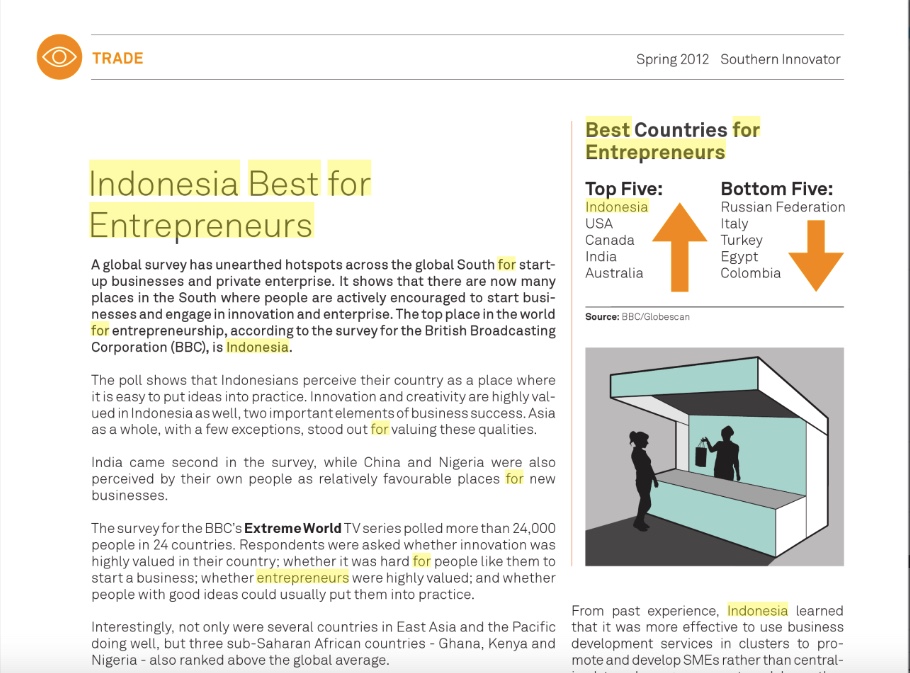
A global survey has unearthed hotspots across the global South for start-up businesses and private enterprise. It shows there are now many places in the South where people are actively encouraged to start businesses and engage in innovation and enterprise. The top place in the world for entrepreneurship, according to the survey for the British Broadcasting Corporation (BBC), is Indonesia.

The poll shows that Indonesians perceive their country as a place where it is easy to put ideas into practice. Innovation and creativity are highly valued in Indonesia as well, two important elements of business success. Asia as a whole, with a few exceptions, stood out for valuing these qualities.

India came second in the survey, while China and Nigeria were also perceived by their own people as relatively favourable places for new businesses.

The survey for the BBC’s Extreme World TV series polled more than 24,000 people across 24 countries (http://www.globescan.com/news_archives/bbc2011_entrepreneur/backgrounder.html). Respondents were asked whether innovation was highly valued in their country; whether it was hard for people like them to start a business; whether entrepreneurs were highly valued; and whether people with good ideas could usually put them into practice.

Interestingly, not only were several countries in East Asia and the Pacific doing well, but three sub-Saharan African countries – Nigeria, Kenya and Ghana – ranked above the global average.

The survey found work still needed to be done in Latin America. While Mexico and Peru scored highly, Brazil and Colombia ranked below average.

So, what are the things that make Indonesia so positive for entrepreneurs and private business? And what do they do – or not do – for small business start-ups?

According to Bali International Consulting Group, the Indonesian economy is highly dependent on small and medium-sized enterprises: they make up 99.95 percent of the total number of enterprises, and provide most of the country’s jobs. Authorities have identified a problem with the sector, however: productivity per worker is very low compared to large enterprises. Poor productivity matters because it means people are working very hard for low return and this affects the overall standard of living in the country and its human development.

The Indonesian government has set about boosting productivity in the sector, adopting a ‘clustering’ approach in partnership with non-governmental organizations (NGOs). Like-minded businesses tend to cluster together across the archipelago of islands that makes up the nation. By targeting these places with resources and support, it can use those resources more efficiently. The country has a dedicated ministry for small and medium enterprises (http://www.depkop.go.id) and a wide range of businesses and services targeting them. From dedicated trading and office facilities (http://www.smescoindonesia.com) to an online marketplace to display, trade and sell SME products (http://www.smescotrade.com), extensive resources are applied to give SMEs a boost and a competitive edge in the global marketplace.

From past experience, Indonesia learned it was more effective to use business development services in clusters to promote and develop SMEs, rather than centralised, top-down government models or other approaches.

As Bali International Consulting Group notes, “The government has introduced many models for promoting SMEs, including business incubators, business consulting clinics and technology centers. However, those sponsoring programs have not been productive and could not sustain themselves for a long time. The government then turned to supporting BDS (Business Development Services) providers to serve a certain cluster in a selected area.”

Developed countries like the United States significantly grew their wealth by allowing entrepreneurs and small and medium-sized enterprises to flourish. The USA’s highly innovative and globe-straddling high tech and information technology businesses would not have been so successful without entrepreneurs. Think of Bill Gates, one of the founders of Microsoft, or Steve Jobs, one of the pioneers behind the Apple computer brand.

China – the country that has seen the largest lifting of people out of poverty in our time – is awash with entrepreneurs. So successful at providing manufacturing services to foreign companies, China is fast on track to become the wealthiest country in the world. The International Monetary Fund recently issued a report predicting China would be number one within five years.

Entrepreneurs play a key role in any country’s economic strategy. The more they are encouraged to flourish – and build wealth and their businesses – the better a country can do. Large human development gains can come about when entrepreneurs are matched with a fair and transparent tax system, balancing between social and economic needs.

China is the source of one of the most successful aids to small business growth in the global South. Hong Kong-based Alibaba (http://www.alibaba.com) is an online trading and selling marketplace aimed at small businesses and start-ups. Packed with support, advice and inspiration, it makes it possible for people anywhere in the world to get trading and selling.

To help small businesses trade with each other, New Delhi, India-based Go4World Business.com (http://indonesia.go4worldbusiness.com) has for the past 12 years helped exporters and importers to explore new markets and increase their international business in a simple, cost effective manner.

The Internet has not only radically transformed how to trade and sell, it has also opened up many ways for small and medium-sized businesses to raise funds and borrow money. Examples include Zopa (www.zopa.com) – “Where people meet to lend and borrow money”; social lenders like Kiva (www.kiva.org)w, whose mission is to connect people, through lending, for the sake of alleviating poverty; and Betterplace (www.betterplace.org), an online marketplace for projects to raise funds. It is free to use, and it passes on 100 percent of the money raised on the platform to the projects. For those with a creative business idea, Kickstarter (http://www.kickstarter.com) is a funding platform for artists, designers, filmmakers, musicians, journalists, inventors, and explorers.

Published: June 2011

Resources

1) Small business guide: An online resource packed with advice and resources on starting a small business. Website: http://www.smallbusiness.co.uk/

2) The red dot logo stands for belonging to the best in design and business. The red dot is an internationally recognized quality label for excellent design that is aimed at all those who would like to improve their business activities with the help of design. Website: http://www.red-dot.de

3) Dutch Designers in Development: The Dutch NGO works with producers to develop skills and adapt producers’ products to present and future demands in Europe. By following this approach, Southern producers can reduce the risk of making products nobody wants, or that lack originality in the marketplace and thus won’t sell. Website: http://www.ddid.nl/english/index.html

4) SME toolkits abound: Here are two from Africa: SME Toolkit Kenya Website: http://kenya.smetoolkit.org/kenya/en and SME Toolkit South Africa: Website: http://southafrica.smetoolkit.org/sa/en

5) African Alliance for Capital Expansion: A management consultancy focused on private sector development and agribusiness in West Africa. Website: http://www.africanace.com/v3

6) World Business Fair: The World Business Fair is an international trade platform for global entrepreneurs and professionals. Website: http://www.worldbusinessfair.com

7) Small businesses looking to develop their brand can find plenty of free advice and resources here. Website: www.brandingstrategyinsider.com

8) Brandchannel: The world’s only online exchange about branding, packed with resources, debates and contacts to help businesses intelligently build their brand. Website: www.brandchannel.com

9) ZanaAfrica (ZanaA) is a non-profit whose mission is to craft tools from within Africa to slay the giants of poverty. The tools are in the nexus of health, education, and environment with a particular focus on gender and technology. These tools address root causes of poverty, and are primarily market-based solutions with a national and replicable scope to provide leveraged, lasting solutions with significant multiplier effects. Website: http://www.zanaa.org/

10) Small Business in Indonesia by Peter Van Diermen. Explores how critical families are to business success in Indonesia. Website: http://books.google.com/books/about/Small_business_in_Indonesia.html?id=WSu1AAAAIAAJ

11) SME Toolkit Indonesia: The SME Toolkit Indonesia offers a wide range of how-to articles, business forms, free business software, online training, self-assessment exercises, quizzes, and resources to help entrepreneurs, business owners, and managers in emerging markets and developing countries start, finance, formalize, and grow their businesses. Website: http://indonesia.smetoolkit.org/indonesia/en

12) The 3rd Indonesia International Conference on Innovation, Entrepreneurship, and Small Business 2011: From July 25 to 28, is aimed at challenging researchers, Indonesians in particular, to study and create local knowledge on Innovation, Entrepreneurship, and Small Business. Website: http://www.ciel-sbm-itb.com/iicies2011

Development Challenges, South-South Solutions was launched as an e-newsletter in 2006 by UNDP’s South-South Cooperation Unit (now the United Nations Office for South-South Cooperation) based in New York, USA. It led on profiling the rise of the global South as an economic powerhouse and was one of the first regular publications to champion the global South’s innovators, entrepreneurs, and pioneers. It tracked the key trends that are now so profoundly reshaping how development is seen and done. This includes the rapid take-up of mobile phones and information technology in the global South (as profiled in the first issue of magazine Southern Innovator), the move to becoming a majority urban world, a growing global innovator culture, and the plethora of solutions being developed in the global South to tackle its problems and improve living conditions and boost human development. The success of the e-newsletter led to the launch of the magazine Southern Innovator. 

Creative Commons License

This work is licensed under a
Creative Commons Attribution-Noncommercial-No Derivative Works 3.0 License.

ORCID iD: https://orcid.org/0000-0001-5311-1052.

© David South Consulting 2023