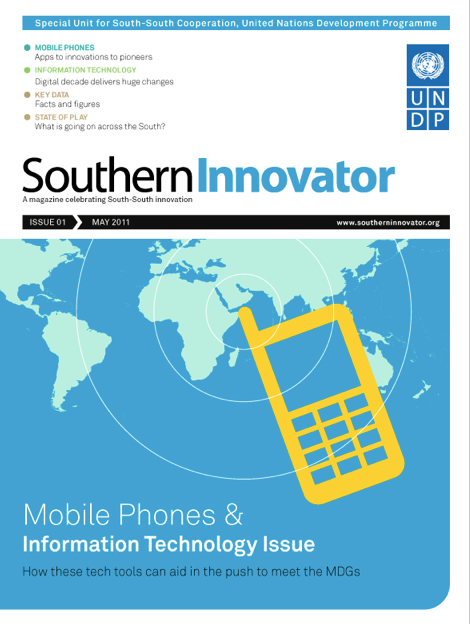
Work began in 2010 to develop what became the United Nations magazine Southern Innovator. A highly talented global team of international development and design professionals based in New York and London collaborated with an Icelandic studio to create an innovation media brand showcasing global South innovators inspired by the mobile and information technology revolutions. It was launched in 2011 at the UN General Assembly in New York.
“Dr. Cosmas Gitta is a senior UN consultant and the former Assistant Director for Policy and UN Affairs at the UN Office for South-South Cooperation, where he oversaw the convening of various intergovernmental and interagency forums as well as the preparation of related reports and studies, including the biennial reports of the Secretary-General on the state of South-South cooperation. He was Editor-in-Chief of the magazine Southern Innovator and an e-newsletter, Development Challenges, South-South Solutions, both of which are media to share information on development related innovations with partners around the world. He was for many years Managing Editor of Cooperation South, a print and electronic development journal promoting collaboration among developing countries. Mr. Gitta holds a PhD in international and comparative education from Columbia University and he has lectured on human rights education at his alma mater, and on a range of other subjects at various campuses of the City University of New York.” (From Integral Leadership Review)
David South is the founder and senior partner for David South International and David South Consulting. He has worked around the world for the United Nations and has led a number of groundbreaking projects for major institutions. Clients have included the United Nations Office for South-South Cooperation (UNOSSC), the United Nations Development Programme (UNDP), the Great Ormond Street Hospital for Children (GOSH)/Institute of Child Health (ICH)/National Health Service (NHS), Harvard Institute for International Development, UNICEF, World Bank, USAID, and the Hannah Institute for the History of Medicine, among others.
He has worked for, or side-by-side, with many high-level senior professionals and executives. These experienced professionals had roles under close public scrutiny and needed to show the impact of their work to a tight deadline.
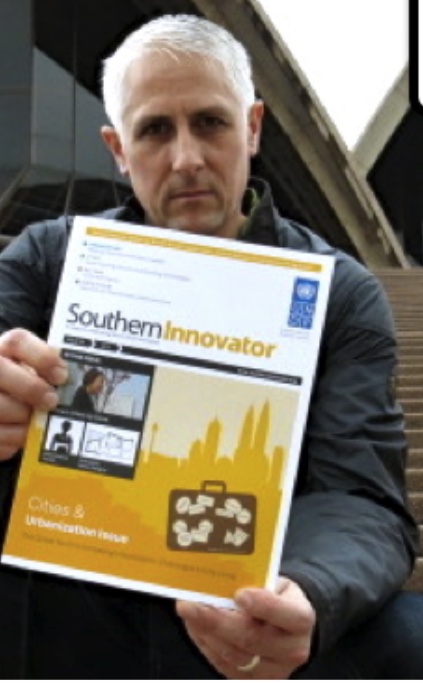
He has been the editor for the United Nations magazine Southern Innovator since 2010. He also researched and wrote the influential United Nations e-newsletter Development Challenges, South-South Solutions (2007-2014). He has over two decades’ experience in media and journalism (developing strong relationships with many top journalists and media professionals), health and human development, and the role innovation plays in transforming major organisations while getting the most from people tackling complex problems in challenging environments.
Launched in May 2011, the new global magazine Southern Innovator (ISSN 2222-9280) is about the people across the global South shaping our new world, eradicating poverty and working towards the achievement of the Millennium Development Goals (MDGs).
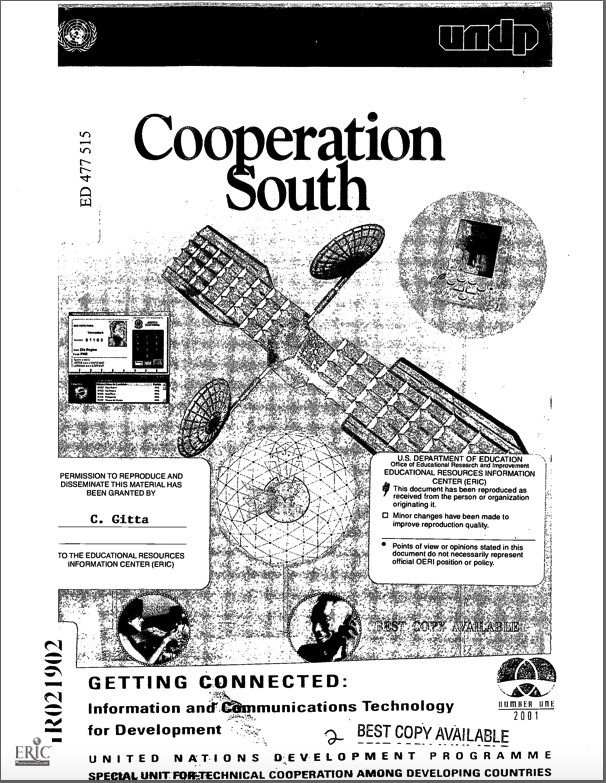
Cooperation South, Getting Connected: Information and Communications Technology for Development, Number 1, 2001, United Nations Development Programme, ISSN-0259-3882. The team behind Cooperation South joined up with a team from Canada/UK/Iceland to create Southern Innovator Magazine (ISSN 2222-9280). Both publications highlighted the innovators behind the global South’s connectivity revolution.
The pace of change across the South has been blistering. Over the past decade, the overall population has moved from being primarily rural to majority urban. In the process, rural communities have suffered, as they have seen their young and ambitious leave in droves seeking a better life in cities.
More than 200 million Chinese farmers have moved to cities in recent years. It’s easy to see why. Chinese farms are tiny, with the average rural household farming just 0.6 hectares. And incomes are low compared to the cost of living: average annual income was just US$606 in 2007, a third of city salaries.
But it is possible to improve the quality of life in rural areas and in turn boost economic fortunes.
In China, projects that upgrade homes to modern standards while respecting traditional designs and architecture are breathing new life into rural communities. A return to the age-old technique of using earth as the principal building material is saving energy and keeping house costs low.
The tradition of packing earth to build a wall dates back to some of the earliest stretches of the Great Wall of China in 220 BC.
Currently it is estimated that half the world’s population-approximately 3 billion people on six continents – lives or works in buildings constructed of earth.
This traditional building technique is being used in the reconstruction effort to build new homes after the May 12, 2008 earthquake in Sichuan Province. The earthquake left millions of people homeless in the country’s worst natural disaster in 30 years, and has made low-cost but efficient house building critical.
In western China, villages have been entirely rebuilt from scratch. The application of research and science to the traditional designs – roofs in the pagoda style, with buildings arranged around courtyards – enabled the development of homes that are energy efficient to run, and are more hygienic and earthquake safe. In Yongren County of Yunnan Province, over 7,000 mountain dwellers were moved to better farming land and over 2,000 homes were built in the new village of BaLaWu. Over 30 of the homes were built using rammed earth by the Xi-an team.
“The original homes had very low living quality,” said team member Hu Rong Rong of the Green Building Research Centre of Xi’an University of Architecture and Technology (http://www.xauat.edu.cn/jdeg/about.html), which oversees building of the new homes. “The architecture layout of the indoor space and courtyard was not reasonable. In the courtyard the areas for living, raising livestock, storing and processing crops were mixed up. The indoor environment was not comfortable. It was cold in the houses during winter and hot during summer. Most of the rooms lacked natural lighting and were dark in the daytime.
“In the poor areas, many people still live in earth houses because of the low cost. However, most of the earth houses have low living quality.
“After we finished the project, through our design, the living quality was improved very much. The dwellers were satisfied with their new houses.”
Land reform in China has brought more hope to the country’s 750 million rural poor, many of whom live on less than US$1 a day. It is hoped that giving the rural poor more control over their lives will bring an improvement in agricultural production, food security and economic prosperity. Reforms also mean the poor have more secure land rights.
Hu said gaining the trust and buy-in of the villagers was critical to the success of the project.
“We built the first home as a demonstration. After we finished, the villagers could experience the advantages of the new home. Most of them decided to use our design and they could choose the one they liked from several proposals.”
Poverty is a big problem in the villages. Incomes are very low, at 2000 RMB per year (US $290). Hu said “families were given a house-building allowance of 8000 RMB (US $1,160) to meet the cost of building materials – and the land was free for them to use.”
“The villagers built the houses by self-help. We helped them to design and build the houses for free,” Hu said.
The houses are pioneering in using natural sources to provide light, heat, waste disposal and gas for cooking and heating.
“We used natural material like earth as a main building material to get good thermal mass and also to reduce CO2 emission,” Hu said.
“We designed a simple family sewage-purge-pool and marsh-gas-well system to reduce pollution and get energy from wastes.”
Using rammed earth has a long history in China. Across Western China, there are many buildings constructed with rammed earth. And using earth has many advantages when resources are scarce or expensive: “Earth buildings avoid deforestation and pollution, and can achieve low energy costs throughout their lifetime,” said Hu.
“With living standards increasing, more and more people would like to use burned bricks and concrete to build new houses, which will consume more energy and bring pollution,” said Hu.
But like any technology, the application of modern science and environmental knowledge to the traditional designs, can reap huge improvements in the quality of the homes and comfort levels. And win people back to the benefits of rammed earth dwellings.
“Building with earth materials can be a way of helping with sustainable management of the earth’s resources,” said Hu.
And Hu is adamant the new, environmentally designed homes respect the wisdom of traditional design.
“The new earth house design should consider the local culture. It should be proved that both the house style and the construction technique can be accepted by the users.”
Published: December 2008
Resources
The Rural Development Institute focuses on land rights for the poor and has a series of articles on China’s land reforms. Website:www.rdiland.org
Rural DeveIopment Institute has recently been given an award from the World Bank’s Development Marketplace competition to create Legal Aid and Education Centres in China’s countryside. Website:www.rdiland.org/PDF/092808_WorldBankComp.pdf
A blog gives more details on the Chinese rammed earth project. Website:www.51xuewen.com
Earth Architecture, a book and blog on the practice of building with earth, including contemporary designs and projects. Website:www.eartharchitecture.org
Ethiopia and Djibouti are the latest global South countries to make a significant commitment to developing geothermal energy – a green energy source that draws on the heat below the earth’s surface (http://en.wikipedia.org/wiki/Geothermal_energy) – to meet future development goals.
Ambitiously, Ethiopia also hopes to build Africa’s largest geothermal power plant.
It joins Kenya, which in 2012, announced projects to expand its geothermal capacity further. Currently, Kenya is Africa’s largest geothermal producer and has geothermal resources concentrated near a giant volcanic crater in the Great Rift Valley with 14 fields reaching from Lake Magadi to Lake Turkana. There are also low temperature fields in Homa Hills and Massa Mukwe (http://www.gdc.co.ke/index.php?option=com_content&view=article&id=191&Itemid=163). Around 1,400 steam holes are being drilled.
Cooperating with Reykjavik Geothermal (rg.is), a US-Icelandic private developer, Ethiopia will spend US $4 billion to build a 1,000 megawatt geothermal plant at Corbetti (http://www.volcano.si.edu/volcano.cfm?vn=221290). It is expected to be ready in eight to 10 years. The country wants to be carbon neutral by 2025.
Drilling will need to go down as deep as 3 kilometers to tap the source. This is expensive and a technological challenge, thus the need for international expertise. The country hopes to develop this source of energy and then export electricity to neighboring African countries.
Another plant, Aluto Langano 7, is being built 201 kilometers south of Addis Ababa, the capital, by a partnership between the Japanese government, Ethiopia and the World Bank.
Ethiopia has enormous potential for geothermal energy, according to a paper in the journal Geothermics: “Ethiopia holds an enormous capacity to generate geothermal energy in the volcano-tectonically active zones of the East African Rift System (http://www.sciencedirect.com/science/article/pii/S0375650513000023).”
At present, 70 per cent of people in sub-Saharan Africa, some 600 million, are without a domestic electricity supply (USAID). Electricity and other sources of energy are required if living standards are to be raised for millions of the world’s poor. The danger of this, however, is to the planet if the energy comes from polluting sources.
In March 2013 the World Bank announced a significant push to increase development of geothermal resources around the world, and in particular in energy-hungry, fast-developing countries.
“Geothermal energy could be a triple win for developing countries: clean, reliable, locally produced power,” the bank says. “And once it is up and running, it is cheap and virtually endless.”
The bank joined forces with Iceland to make a pledge to secure US $500 million in financing to get geothermal projects up and running. The announcement was made at the Iceland Geothermal Conference (http://geothermalconference.is/) in Reykjavík, the Icelandic capital.
Few countries have such easy access to geothermal energy as Iceland, with its plentiful volcanoes, geysers and hot springs bursting through the surface. But it is there, under the ground, and through the Global Geothermal Development Plan (GGDP), it is hoped this plentiful energy source will become the norm for countries around the world.
The World Bank believes at least 40 countries can get into geothermal on a significant scale with the correct investment. Many developing world regions are rich in geothermal resources, including East Africa, Southeast Asia, Central America, and the Andean region.
Just 11 gigawatts of geothermal capacity is currently being tapped in the world. Nuclear power, for example, generates 370 gigawatts a year (2012) (EIA). What has held back many countries has been the high upfront costs involved in getting projects going. A site must be found, drilled and tested to see if it is viable.
The GGDP plan is to raise US $500 million from donors and others to fund geothermal exploration and development. The GGDP will identify promising sites and then acquire funding to pay for drilling to identify commercially viable projects.
The World Bank has increased financing for geothermal development from US $73 million in 2007 to US $336 million in 2012. It comprises 10 per cent of the Bank’s renewable energy lending.
The Icelandic International Development Agency (iceida.is) signed a partnership in September 2013 with the government of Ethiopia to undergo geothermal surface exploration and to build Ethiopia’s capacity to develop this energy source. The World Bank estimates that Ethiopia has the potential to generate 5,000 megawatts (MW) of energy from geothermal sources.
The Geological Survey of Ethiopia (GSE) and the Ethiopian Electric Power Corporation (EEPCO) will undertake exploration at sites in Tendaho Alalobeda and Aluto Langano.
It fits in with a wider push by Ethiopia to develop its renewable energy resources. The country is also increasing investment in hydro-electric power.
The Ethiopia project is part of the wider World Bank-Iceland compact to develop global geothermal energy capacity. It is the second such arrangement, with the first already underway in Rwanda.
Djibouti is also moving into geothermal, with a new agreement with the World Bank to develop a site at Lake Assal. The World Bank will provide US $6 million to evaluate its commercial potential. Djibouti tried to develop its geothermal resources privately but was not successful.
Overall, geothermal power has the potential to help reduce Djibouti’s electricity production costs by 70 per cent, boost access to electricity for the population and alleviate the country’s energy dependency. The country hopes to have 100 per cent green energy by 2020.
Joining forces on helping boost geothermal in Africa is USAID’s Power Africa fund, which is providing US $7 billion in financial support and loan guarantees for energy projects.
Apart from generating electricity, what else can this powerful resource do? Countries such as Iceland now use hot geothermal water to heat homes and provide domestic hot water. Iceland also has an extensive network of swimming pools and spas in each town. The Blue Lagoon (bluelagoon.com) is a good example of how geothermal power generation can have lots of side benefits. The giant, steamy blue-colored lagoon is the consequence of an accident in 1976 at the nearby geothermal power plant; it’s now a spa and one of the country’s main tourist attractions.
The geothermal-heated pools and spas play a key role in keeping the cold north Atlantic country healthy – Iceland ranked number one on the UNDP human development index in 2007 – and provide a recreational source even in the depths of winter.
Published: December 2013
Resources
1) Iceland Review: A great way to learn about life on an island powered by geothermal energy. Website: icelandreview.com
2) Nordic Development Fund: The Nordic Development Fund (NDF) is the joint development finance institution of the five Nordic countries. The objective of NDF’s operations is to facilitate climate change investments in low-income countries. Website: ndf.fi
3) Icelandic International Development Agency (ICEIDA): The Icelandic International Development Agency (ICEIDA) is an autonomous agency under the Ministry of Foreign Affairs and is responsible for the implementation of official Icelandic bilateral development cooperation. It follows the Icelandic government’s Act on Development Cooperation No 121/2008, which is in keeping with the UN Millennium Development Goals and other international commitments, such as the Monterrey Consensus on Financing for Development and the Paris Declaration on Aid Effectiveness. Website: iceida.is
4) Geothermal Exploration Project, NDF: The main objective of the Geothermal Exploration Project is to assist countries in East Africa to enhance geothermal knowledge and capacity in order to enable further actions on geothermal energy development in the respective countries. The project could extend to 13 countries in the East Africa Rift Valley: Burundi, Comoros, Djibouti, DR Congo, Eritrea, Ethiopia, Kenya, Malawi, Mozambique, Rwanda, Tanzania, Uganda and Zambia. Website: http://www.iceida.is/iceida-projects/nr/1488
5) Power Africa: Power Africa – an initiative to double the number of people with access to power in sub-Saharan Africa. Power Africa will achieve this goal by unlocking the substantial wind, solar, hydropower, natural gas, and geothermal resources in the region to enhance energy security, decrease poverty, and advance economic growth. Website: http://www.usaid.gov/powerafrica
6) Geological Survey of Ethiopia: The GSE has been generating , collecting and managing geoinformation of the country for the last 4 decades. Website: http://www.gse.gov.et/index.php
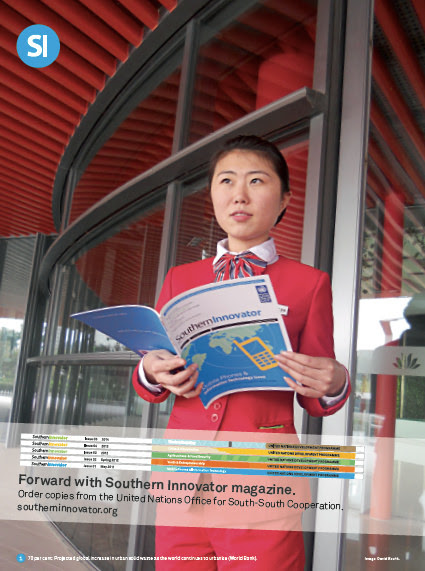
Like geothermal energy? Then we think you will like our Southern Innovator Magazine. Designed and laid out in Iceland using 100% renewable energy (much of which is geothermal).
In an effort to diversify its power supply and meet growing electricity demand, Kenya is looking to increase its use of geothermal energy sources (http://en.wikipedia.org/wiki/Geothermal_electricity). Tapping the abundant heat and steam that lurks underground to drive electric power plants offers a sustainable and long-term source of low-cost energy.
Kenya currently gets most of its electricity from hydroelectric projects. This is great until there is a drought, which there now is. With water resources low, the country has had to turn to fossil fuels to power electricity generators. This means relying on imported diesel, which is both expensive and polluting. It is also not generating enough electricity to keep up with demand.
Electricity blackouts have become common in the country and this is harming economic development. This is a particularly damaging setback in a country that has, in the last five years, gained a deserved reputation for its technological advances in mobile phone applications and Internet services – all needing reliable supplies of electricity.
Kenya is Africa’s largest geothermal producer and has geothermal resources concentrated near a giant volcanic crater in the Great Rift Valley with 14 fields reaching from Lake Magadi to Lake Turkana. There are also low temperature fields in Homa Hills and Massa Mukwe (http://www.gdc.co.ke/index.php?option=com_content&view=article&id=191&Itemid=163).
Kenya is expecting its gross domestic product (GDP) to grow by 10 per cent from 2012 onwards. The country hopes to become a middle income country by 2030.
Around 1,400 steam wells will be drilled by companies to meet these goals.
There are also many spin-off opportunities from tapping geothermal heat sources. These include using the steam heat for greenhouses growing plants, for cooling and heating buildings, and for drying and pasteurising foods.
Kenya is currently building a 52-megawatt (MW) geothermal project with funding from the United States government. It is also receiving US$149 million funding from the African Development Bank Group (AfDB) to build the Menengai Geothermal Development Project. This plant will be able to generate 400 megawatts of renewable electricity from the Menengai geothermal sources in the steam field located 180 kilometres northwest of the capital, Nairobi (http://www.gdc.co.ke/index.php?option=com_content&view=category&layout=blog&id=49&Itemid=137).
Speaking at a press conference this month, Gabriel Negatu, AfDB’s Regional Director, said he sees geothermal technology as an important driver of Kenya’s green growth ambition.
“Geothermal generation yields energy that is clean, affordable, reliable and scalable,” he said.
The Geothermal Development Company (GDC) (gdc.co.ke) is a state-owned company in Kenya and recently declared it had tapped steam with a well in the Menengai steam field. GDC started surface exploration in 2009 and has been using two drilling rigs to look for geothermal steam.
The Menengai Geothermal Development Project is slated to be completed by 2016 and will boost the country’s geothermal capability by 20 per cent. It is estimated to be able to power the electricity needs of 500,000 Kenyan households and power the needs of 300,000 small businesses.
Geothermal as a source of energy and electricity can help a country make big development gains. The best example is the Northern European island nation of Iceland. According to Orkustofnun (nea.is/geothermal), Iceland’s National Energy Authority, the country is a successful example of how a small, poor nation (Iceland was one of Europe’s poorest countries in the 20th century), shook off its dependence on burning peat and importing coal for its energy use. By 2007, Iceland was listed in the global Human Development Report as the country with the highest level of human development in the world. And one aspect of this success was the country’s ability to tap its renewable energy resources. Around 84 per cent of the country’s primary energy use comes from renewable resources, and 66 per cent of this is geothermal.
It is estimated Kenya could generate 7,000 megawatts of geothermal power and the Kenyan government is looking to increase the nation’s geothermal capacity from the current 198 MW to 1,700 MW by 2020 and 5,530 MW by 2031.














 David South Consulting
You must be logged in to post a comment.