Categories
Archive Development Challenges, South-South Solutions Newsletters

Kiva: New Gateway of Loans for the Poor

By David SouthDevelopment Challenges, South-South Solutions

SOUTH-SOUTH CASE STUDY

The rise of social networking websites has created new opportunities for the poor to gain access to much needed credit. Kiva.org is pioneering a new way for entrepreneurs in the South to obtain for their businesses unsecured, no-interest financing from lenders worldwide. By just a click of the mouse a person anywhere in the world can lend as little as US $25 or more to aspiring entrepreneurs in developing countries.

Kiva, which means “agreement” or “unity” in Swahili, was founded by Matthew and Jessica Flannery after time spent in East Africa. They built upon the idea of Nobel Peace Prize Winner, Mohammud Yunus’ Grameen Bank but took it a step further by tapping into the resources of the web. It works by allowing potential lenders to search for an entrepreneur via the website. Each entrepreneur’s business idea is explained, a photo of the entrepreneur is posted and the amount of the loan they require and how much they have raised so far are clearly displayed. It is then a simple matter of the lenders using their credit cards to make a loan online. Kiva then transfers all the funds to their local partners (microfinance institutions) which, in turn, disburse the loans to each business. All entrepreneurs are screened for their trustworthiness and the viability of their business. Loans are usually between 6 to 12 months and lenders receive regular email journal updates from the business they sponsor. Gradually, the loan is paid back and the lender is returned the full value of the loan.

The process is so simple that one may ask, “Does this really work?” Take the story of Nicholas Kristof, columnist for the New York Times who recently accounted his experience with Kiva.org in his New York Times Op-Ed piece, “You, Too, Can Be a Banker to the Poor”. Through Kiva.org he chose two entrepreneurs, a baker and an owner of a TV repair shop in Afghanistan and lent them US $25 each instantly making himself a business partner with total strangers. He recently visited Afghanistan to see their progress and found two thriving businesses. Mr. Abdul Satar, the baker, borrowed a total of US $425 from a variety of lenders, Nicholas being one of them, and was able to open a second bakery with four employees. Mr. Abdul Saboor who runs a small TV repair shop now has a second shop with two new employees.

By harnessing a user friendly website to make instant cash loans, Kiva has come up with one of the simplest and most direct ways to help poor entrepreneurs who need start up capital. It was first tried out in Uganda about a year ago where partnerships were forged with local microfinance institutions that examined and evaluated each business before they were posted on the website. It has now attracted close to 18,000 lenders contributing an average of US $82.

“I believe the real solutions to poverty alleviation hinge on bringing capitalism and business to areas where there wasn’t business or where it wasn’t efficient,” co-founder Matthew Flannery told the New York Times. “This doesn’t have to be charity. You can partner with someone who’s halfway around the world.”

Published: April 2007

Development Challenges, South-South Solutions was launched as an e-newsletter in 2006 by UNDP’s South-South Cooperation Unit (now the United Nations Office for South-South Cooperation) based in New York, USA. It led on profiling the rise of the global South as an economic powerhouse and was one of the first regular publications to champion the global South’s innovators, entrepreneurs, and pioneers. It tracked the key trends that are now so profoundly reshaping how development is seen and done. This includes the rapid take-up of mobile phones and information technology in the global South (as profiled in the first issue of magazine Southern Innovator), the move to becoming a majority urban world, a growing global innovator culture, and the plethora of solutions being developed in the global South to tackle its problems and improve living conditions and boost human development. The success of the e-newsletter led to the launch of the magazine Southern Innovator.
Creative Commons License

This work is licensed under a
Creative Commons Attribution-Noncommercial-No Derivative Works 3.0 License.

ORCID iD: https://orcid.org/0000-0001-5311-1052.

© David South Consulting 2022

Categories
Archive Development Challenges, South-South Solutions Newsletters

Old Adage Gets New Life

By David SouthDevelopment Challenges, South-South Solutions

SOUTH-SOUTH CASE STUDY

Education is recognized as critical for development and improving people’s lives. Universal primary education is a Millennium Development Goal and countries are now allocating more funds for primary education across the global South. However, the options available to youth after primary education are often very limited.

The World Bank estimates that only nine percent of youth in the developing world will be able to go to a university or benefit from higher education scholarships. For the vast majority of youth, getting a job is often the only viable option to securing a livelihood; but in most developing countries the number of formal sector jobs is low and the only option is self-employment. Acquiring relevant training and practical skills can be crucial to becoming successfully self-employed. But where will the training and skills come from and who will provide it and pay for it?

This dilemma is being addressed by the “self-sufficient schools” concept. The model combines entrepreneurship and vocational education through school-based businesses that blend training and revenue-generation. The principle is simple: entrepreneurship and entrepreneurial skills are taught by successful entrepreneurs.

The model is being pioneered in several countries and has been successfully applied by UK-based charity TeachAManToFish in Ghana and Paraguay, targeting rural youth from farming families through a network of 250 vocational experts and institutions in 45 countries. The approach promotes a model for making education both more relevant and financially sustainable in rural communities.

Self-sufficient schools share several characteristics: they produce and sell goods and services; they focus on developing an entrepreneurial culture; they make a direct connection between theory, practical work and financial reward; they encourage learning by doing; they strive to keep improving in order to remain economically competitive; students are encouraged to work cooperatively; and students receive support after graduating, often in the form of microfinance for their new businesses.

In the South American nation of Paraguay, the Fundacion Paraguaya – San Francisco Agricultural High School – run by an NGO committed to poverty reduction through supporting entrepreneurship – found that small-scale farmers not only knew how to produce food, they also knew how to make a prosperous living out of it when given the right tools. Taking over a school previously run by a religious order, the NGO had the opportunity to put the concept to the test.

The organization’s head, Martin Burt states, ”It is not a matter of knowing how to grow the crop, or raise the animal; it is a matter of how to make money and then how to be financially successful doing farming in poor countries.”

The Paraguayan school is half way through its five-year plan, and already is covering two thirds of its recurring costs from the production and sale of goods and services, including specialist cheeses.

Published: May 2007

Resources

  • A paper on the concept of self-sufficient schools: Click here
  • CIDA City Campus, Johannesburg, South Africa: CIDA is the country’s only “’free’, open-access, holistic, higher educational facility” and is “operated and managed by its students, from administration duties to facilities management. In addition every student is required to return to their rural schools and communities, during holidays, to teach what they have learnt.”
  • The First International Conference on Self-Sufficient Schools is being planned by TeachAManToFish. Expressions of interest are sought from all individuals and organizations interested in taking part in the conference. Email conference@teachamantofish.org.uk for more information.

Development Challenges, South-South Solutions was launched as an e-newsletter in 2006 by UNDP’s South-South Cooperation Unit (now the United Nations Office for South-South Cooperation) based in New York, USA. It led on profiling the rise of the global South as an economic powerhouse and was one of the first regular publications to champion the global South’s innovators, entrepreneurs, and pioneers. It tracked the key trends that are now so profoundly reshaping how development is seen and done. This includes the rapid take-up of mobile phones and information technology in the global South (as profiled in the first issue of magazine Southern Innovator), the move to becoming a majority urban world, a growing global innovator culture, and the plethora of solutions being developed in the global South to tackle its problems and improve living conditions and boost human development. The success of the e-newsletter led to the launch of the magazine Southern Innovator.

Creative Commons License

This work is licensed under a
Creative Commons Attribution-Noncommercial-No Derivative Works 3.0 License.

ORCID iD: https://orcid.org/0000-0001-5311-1052.

© David South Consulting 2022

Categories
Archive Development Challenges, South-South Solutions Newsletters

Tourist Passion for Quirky Holidays Helps South

By David SouthDevelopment Challenges, South-South Solutions

SOUTH-SOUTH CASE STUDY

Conventional thinking holds that any country with a poor or non-existent reputation in the international media will not attract tourists. But this conventional thinking is wrong: The hottest tourist trend for 2009 is directly benefiting the South’s more out-of-the-way and under-appreciated countries. So says a travel expert who specializes in overlooked travel destinations.

Prior to the economic downturn, tourism accounted for more than 10 percent of global GDP and 8 percent of total employment worldwide. It grew by 6 percent in 2007, according to the UN World Tourism Organization. Tourism in the Asia-Pacific region grew by 10 percent and Africa by 8 percent.

But it has since declined by 8 percent between January and April of 2009 compared to the same period in 2008. Destinations worldwide recorded a total of 247 million international tourist arrivals in those four months, down from 269 million in 2008 (UNWTO World Tourism Barometer).

This means competition is heating up for tourists. Well-travelled tourists are now looking for out-of-the-way places and places far off the beaten track. They want to be unique and have a tale to tell when they get home.

Tony Wheeler, author of the book Bad Lands: A Tourist on the Axis of Evil and co-founder of the Lonely Planet travel guides, said “Lots of tourists want to be the first through the door.”

During the Fitur Travel Fair in Madrid in January 2009, Myanmar (formerly Burma) appeared for the first time. Europe’s biggest travel fair also saw Zimbabwe, the Palestinian territories and Iran chasing travellers to come and see the sights.

Wheeler told Britain’s Daily Telegraph newspaper that, ironically, the more negative reports in the media a country gets, the more this new breed of tourist want to visit and find out the truth.

And his travel experiences have taught him, for example, the Burmese people do not believe in isolation and boycotts, as he wrote in the Guardian.

“Over the three decades since my first visit, tourism has grown from 20,000 tourists a year to more than 100,000.”
“Cutting the country off from the rest of the world isn’t going to help. We recently received a letter from one of our Burma authors saying the psychological damage of being isolated can be as bad as the economic damage.”

North Korea – which was labelled part of the “axis of evil” by President George W. Bush – saw its foreign tourist numbers rise to 4,500 in 2008 from just 600 in 2001.

Ross Kennedy of Africa Albida Tourism, which operates safari lodges in Zimbabwe, said bad headlines hurt but presenting an alternative view can reverse apprehension and lure tourists to come.

The lodges saw a 4 percent rise in visitors in 2008 in spite of chaotic elections in Zimbabwe that drew negative press.

“You certainly can’t write off an entire destination because of the choices or behaviour of a few individuals,” Kennedy told the Telegraph.

Tourism is now generally recognized to be one of the largest industries in the world, if not the largest. It has grown rapidly and almost continuously over the past 20 years, and is now one of the world’s most significant sources of employment and of Gross Domestic Product (GDP). Tourism particularly benefits the economies of developing countries, where most of the sector’s new tourism jobs and businesses are being created.

Tourism, because it is a labor-intensive industry, is seen as a great way both to reduce poverty and to meet all the Millennium Development Goals. It favours small-scale businesses, it is decentralized and can diversify regional economies, it is relatively non-polluting and can contribute to the conservation and promotion of natural and cultural heritage, and most importantly it can act as a catalyst for kick-starting other sectors of the economy.

In Iran, the Laleh Kandovan International Rocky Hotel, located in the province of East Azerbaijan in the north-west of the country, has been luring in tourists with the villages’ cave homes. Located in the village of Kandovan, where residents speak a Turkish dialect, the homes look like craggy sandcastles with holes in them; around 700 people live in the hollowed out rocks.

Prior to the hotel opening, it was only possible to visit for a day and the locals, who make their money harvesting fruit and walnuts, were suspicious of outsiders.

Kandovan means “Land of the Unknown Carvers”. An added attraction to visiting Kandovan is the mystery surrounding the houses. No one knows how long people have been there or when the homes were carved out of the rock. Others claim it is the biblical land of Nod, where Cain was left to wander after murdering his brother Abel.

The hotel occupies a hillside of caves and has a large restaurant and rooms that blend traditional décor like Persian rugs with modernist touches like recessed lighting. The rooms offer under-floor heating and some even have whirlpool baths. The hotel currently has 10 rooms, but plans to expand to 30.

Published: July 2009

Resources

United Nations World Tourism Organization (UNWTO). Website: www.unwto.org

Magic Carpet Travel: It specializes in trips to Iran and bookings for the Laleh Kandovan International Rocky Hotel. Website: www.magic-carpet-travel.com

African Travel and Tourism Association: ATTA creates the platform for buyers across Europe to meet suppliers of African tourism products at networking events, trade shows and through its links with the media. Website: www.atta.co.uk

Planeta: One of the first ecotourism resources to go online (since 1994) and still offers plenty of information for those wanting to start a business. Website: www.planeta.com

Off The Beaten Track Travel Magazine: Off The Beaten Track is a site for the traveller who avoids the beaten path of mass tourism. Website: www.off-the-beaten-track.net

World Tourism Cities: Developing Tourism Off the Beaten Track, edited by Robert Maitland and Peter Newman, Publisher: Routledge. Website: www.amazon.com

https://davidsouthconsulting.org/2022/10/20/african-tourism-leads-the-world-and-brings-new-opportunities/

https://davidsouthconsulting.org/2022/10/20/africas-tourism-sector-can-learn-from-asian-experience/

https://davidsouthconsulting.org/2022/02/07/boosting-tourism-in-india-with-surfing-culture/

https://davidsouthconsulting.org/2022/09/27/caribbean-island-st-kitts-goes-green-for-tourism/

https://davidsouthconsulting.org/2022/11/20/ecotourism-to-heal-the-scars-of-the-past/

https://davidsouthconsulting.org/2022/11/23/kenyan-safari-begins-minutes-from-airport/

https://davidsouthconsulting.org/2022/10/10/a-solution-to-stop-garbage-destroying-tourism/

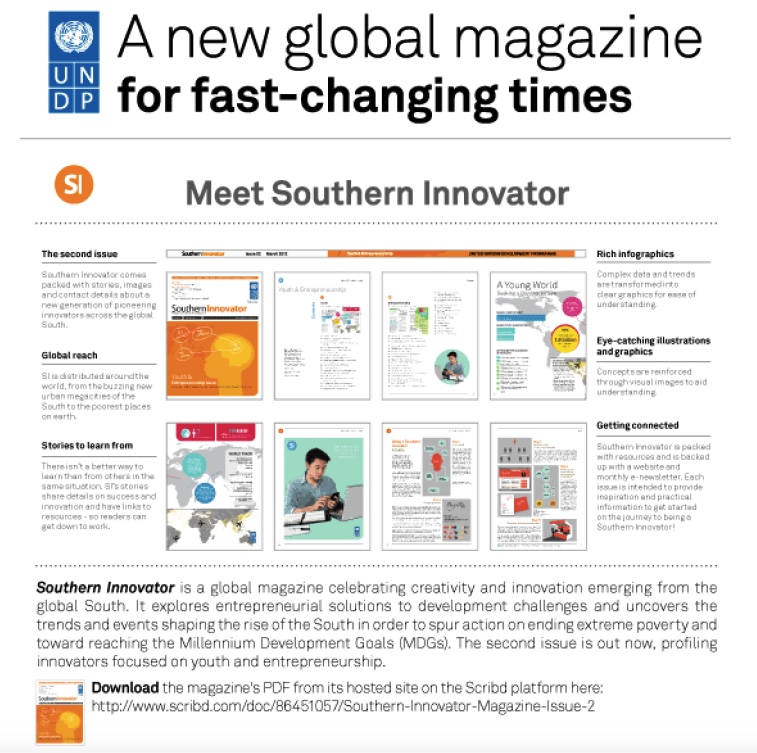
https://davidsouthconsulting.org/2021/03/05/southern-innovator-issue-2/

Development Challenges, South-South Solutions was launched as an e-newsletter in 2006 by UNDP’s South-South Cooperation Unit (now the United Nations Office for South-South Cooperation) based in New York, USA. It led on profiling the rise of the global South as an economic powerhouse and was one of the first regular publications to champion the global South’s innovators, entrepreneurs, and pioneers. It tracked the key trends that are now so profoundly reshaping how development is seen and done. This includes the rapid take-up of mobile phones and information technology in the global South (as profiled in the first issue of magazine Southern Innovator), the move to becoming a majority urban world, a growing global innovator culture, and the plethora of solutions being developed in the global South to tackle its problems and improve living conditions and boost human development. The success of the e-newsletter led to the launch of the magazine Southern Innovator. 

Creative Commons License

This work is licensed under a
Creative Commons Attribution-Noncommercial-No Derivative Works 3.0 License.

ORCID iD: https://orcid.org/0000-0001-5311-1052.

© David South Consulting 2023

Categories
Archive Development Challenges, South-South Solutions Newsletters

Toilet Malls Make Going Better

By David SouthDevelopment Challenges, South-South Solutions

SOUTH-SOUTH CASE STUDY

Across the global South, clever entrepreneurs are transforming services that were bare-bones, grim and out-of-date into modern facilities packed with features that help to pay for their operation. In Kenya, an entrepreneur has used this approach to transform the poor quality of public toilets.

Public sanitation is essential for good health and a high quality of life. Around the world, more than 2.6 billion people, or 41 percent of the world’s population, are without access to basic sanitation. As a result, most have to make do and defecate or urinate wherever they can. In crowded urban areas, the result is an unpleasant source of disease and filth that fouls living spaces and sickens or kills many people.

Nairobi’s slums are notorious for so-called ‘flying toilets’ or ‘scud missiles’: plastic bags filled with excrement that act as the only toilet available for many. Half the population also has no access to clean water. It has been estimated these appalling conditions contribute to up to 50 percent of health problems for slum dwellers.

The Iko Toilet started by David Kuria first came to life in Nairobi’s central business district.

“What we saw in the last 10 years, the few public toilets that existed were in very poor shape,” he told CNN. “In fact they had been taken over by the street boys, and they were a point for mugging and drug trafficking. With that background we needed some sort of social transformation. For people to gain the confidence that you could have a public toilet which is clean which is safe and you can go in and come out the same way.”

The solution was “toilet malls,” complete with a range of on-site micro businesses to make going to the public toilet attractive. Apart from music and radio to listen to, there is a shoe shining service, snack bars selling fruit and water, and even banking services. The idea is that the micro businesses pay for the upkeep and cleaning of the toilet. And their presence also keeps the toilets safe because there is always somebody around.

While the concept was pioneered in the business district, it is now moving out into Nairobi’s slums. So far, Kuria has completed 12 toilets in Nairobi and has another 18 under development. He is also rolling out the toilets to other parts of the country. He receives the plots of land from local municipalities and his company, Ecotact, builds the toilets.

It costs five Kenyan shillings (US .07 cents) to use the toilets.

Kuria had become frustrated with the city council’s inability to provide clean and safe public toilets.

“I thought for some time before coming up with the idea,” he told The Nation. “People had nowhere to go and thugs were holding them to ransom in the few facilities then run by the council.”

Kuria said people are leaving good comments about the toilets and say it makes them proud to be Kenyan.

The cost to build a toilet is Sh 2 million (US $26,000) and the toilet is managed by Kuria for five years. At the end of the contract, he will hand them over to the local council.

“We are getting support from UNDP and other partners like East African Breweries, the Global Water International and the Rotary International,” he said.

An architect by training, Kuria is hoping to employ more than 1,000 people by the end of this year. So far 120 people work for the Iko Toilets. Like so many others, he is also affected by chronic water shortages.

“We are worried because when there is scarcity of water, we are forced to buy it at an additional cost,” he said.

Private vendors currently provide the water for the toilet malls.

Iko Toilets are so successful they have made it into the ‘Hall of Fame’ at the World Toilet Organization (http://www.worldtoilet.org/). Kuria was also winner of the World Economic Forum’s Africa Entrepreneur of the Year award earlier this year.

And his ambitions extend beyond Kenya.

“We also want to go to other countries. Uganda, Rwanda and South Africa have already approached me for Iko Toilets,” he said.

Published: August 2009

Resources

1) World Toilet Organization: The global non-profit organization committed to improving toilet and sanitation conditions. Website: http://www.worldtoilet.org

2) World Toilet College: Established in 2005, the World Toilet College (WTC) started as a social enterprise, with the belief that there is a need for an independent world body to ensure the best practices and standards in toilet design, cleanliness, and sanitation technologies are adopted and disseminated through training. Website: http://www.worldtoilet.org/ourwork3.asp

3) Official website for the 2008 International Year of Sanitation. Website: http://esa.un.org/iys/

4) Waste has expert knowledge on domestic solid and liquid waste management and sanitation issues. Its website offers a comparison of designs and methods for toilets. Website: http://www.ecosan.nl/page/353

5) A set of photos on Flickr of the Iko toilets. Website: http://www.flickr.com/photos/wateradvocates/3306962447/

Development Challenges, South-South Solutions was launched as an e-newsletter in 2006 by UNDP’s South-South Cooperation Unit (now the United Nations Office for South-South Cooperation) based in New York, USA. It led on profiling the rise of the global South as an economic powerhouse and was one of the first regular publications to champion the global South’s innovators, entrepreneurs, and pioneers. It tracked the key trends that are now so profoundly reshaping how development is seen and done. This includes the rapid take-up of mobile phones and information technology in the global South (as profiled in the first issue of magazine Southern Innovator), the move to becoming a majority urban world, a growing global innovator culture, and the plethora of solutions being developed in the global South to tackle its problems and improve living conditions and boost human development. The success of the e-newsletter led to the launch of the magazine Southern Innovator. 

Creative Commons License

This work is licensed under a
Creative Commons Attribution-Noncommercial-No Derivative Works 3.0 License.

ORCID iD: https://orcid.org/0000-0001-5311-1052.

© David South Consulting 2023