Categories
Archive Development Challenges, South-South Solutions Newsletters

Kenyan Bank Helps the Poor and Gets Rich

By David SouthDevelopment Challenges, South-South Solutions

SOUTH-SOUTH CASE STUDY

Good quality banking services are a basic building block to rising incomes. Yet the poor across the South are often overlooked and denied access to savings accounts and loans. Many low-income people are openly discriminated against as ‘bad risks’ by banks, and denied the sort of banking services middle and higher income people take for granted. Yet it is a myth that the poor do not have money or do not wish to save and invest for their future or for business.

The so-called Bottom of the Pyramid (BOP) – the 4 billion people around the world who live on less than US $2 a day – are being targeted by a wide range of businesses. Indian business consultant and professor CK Prahalad (http://en.wikipedia.org/wiki/C.K._Prahalad) , the man who coined the term BOP, has gone so far as to claim this is a market potentially worth US $13 trillion, while the World Resources Institute puts it at US $5 trillion in its report, “The Next 4 Billion” (http://www.nextbillion.net/thenext4billion).

A Kenyan commercial bank has proven it is possible to target the BOP and become successful doing it; so successful that they have seen off foreign rivals and were voted Kenya’s third most respected company.

By offering Kenya’s poor people savings accounts and microloans, Equity Bank (http://www.equitybank.co.ke/) has captured 50 percent of the Kenyan bank market. It now has more than 3 million customers and 2.8 million account holders and opens 4,000 new accounts a day.

Its chief executive officer, James Mwangi, said Equity Bank built its success by doing the opposite of what other banks have done – it doesn’t target the middle and upper classes, but the “the watchmen, tomato sellers and small-scale farmers”.

The Kenyan banking sector in the past was dominated by foreign banks. But by investing in the 46 percent of the population who still live below the food poverty line, Equity has become the third most profitable bank in the country. Its approach was once considered odd. Most of the bank’s borrowers work in the informal sector and have few assets to use as collateral for the loans. So Equity uses what it calls ‘social collateral’. This includes a mix of measures: in some cases, account holders join together to guarantee a person’s debt. Even more unusually, women offer their matrimonial beds as security – it would be shameful for a woman to admit her bed has been taken to pay for the debt.

“For us it’s psychological security. Nobody wants to be excommunicated and lose their inheritance,” said Mwangi.

“By focusing on the previously excluded, Equity has revolutionized the banking sector,” James Shikwati, a director of Kenyan think tank the Inter Region Economic Network (http://www.irenkenya.com/), told The Guardian newspaper. “It has forced the multinational banks to change their business strategies.”

Started in 1984, the bank was still insolvent by 1994, when Mwangi joined as an accountant. Things were looking grim as Kenya’s economy was in a slump and foreign banks like Barclays were closing branches outside big centres.

Mwangi and other Equity Bank managers realized there were millions of low-paid poor in Kenya – all BOP – but who wanted to save and borrow but had nowhere to go.

“Banking was the only industry in Kenya led by supply rather than demand,” said Mwangi. “There was no ‘bottom of the pyramid bank’.”

While absolute poverty in Kenya has declined in recent years, inequality remains high. The population of 37 million people make on average a per capita income of US $580.

By 2003, as the economy picked up, Equity Bank gained 256,000 account holders. It now has 100 branches across the country and 500 automatic teller machines (ATMs). It uses armoured trucks to go into rural areas so that the people can receive banking services. While traditional banks require pay slips and utility bills as proof of a person’s address before letting them open an account, and charge high monthly fees, Equity only requires an identity card.

Within just one year, the bank saw the number of account holders jump to 600,000. Mwangi likes to say that the bank’s competition is the bed mattress, since most people have never had a bank account before. Most savers have around US $148 in their savings account.

The bank’s micro credit operation makes loans of less than US $7 and gives borrowers a few months to repay them.

The bank claims loan defaults are less than 3 percent on 600,000 outstanding loans – the banking industry average is 15 percent.

It keeps its transaction costs down by using the latest in information technology. These efficiencies enabled the bank to earn pre-tax profits of more than US $40 million in 2007.

Equity does face competition, as its success attracts mainstream banks into the BOP market.

In Africa these days, banking is hot: a South African research and analysis company BMI-TechKnowledge (http://www.bmi-t.co.za/) in a report identifies a boom in banking services across Africa. In particular, South Africa, Botswana, Namibia, Angola, Mauritius, Tanzania, Kenya, Ghana, Nigeria, Egypt and Morocco – all have seen surges in profit and services as a result of improving banking regulations and political conditions.

Mwangi isn’t worried, however, since the number of people still without bank accounts is huge. Equity Bank is expanding its operations into Uganda, Rwanda and Sudan.

Elsewhere, mobile phone banking in Kenya is proving highly successful. Equity has a service, but so does Safaricom with M-PESA (http://www.safaricom.co.ke/index.php?id=745). Customers can deposit, transfer and withdraw money using their phones. Over 4 million are now using the service.

Published: January 2009

Resources

1) NextBillion.net: Hosted by the World Resources Institute, it identifies sustainable business models that address the needs of the world’s poorest citizens.
Websites: http://www.nextbillion.net/ and World Resources Institute

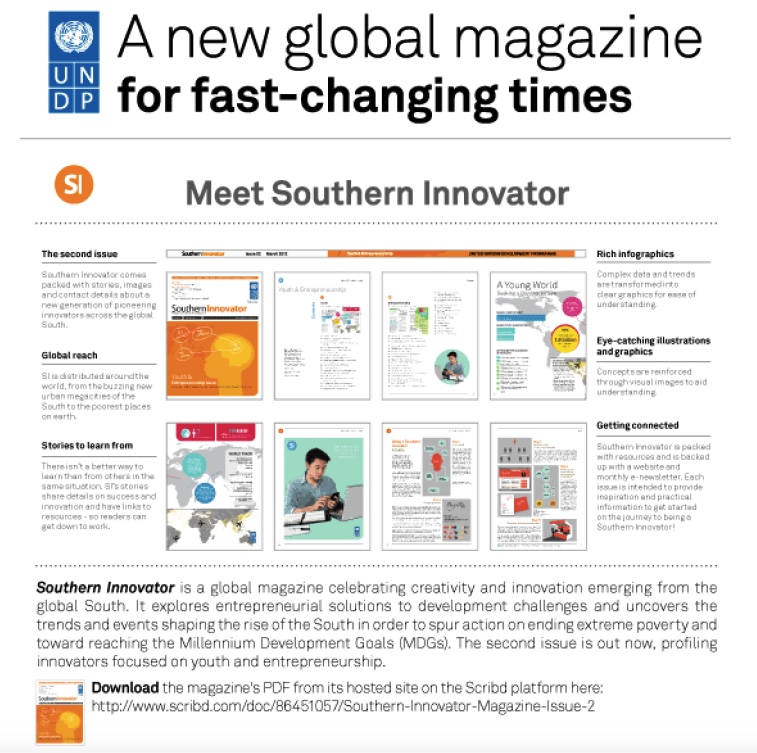
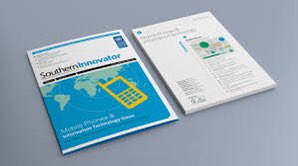
Development Challenges, South-South Solutions was launched as an e-newsletter in 2006 by UNDP’s South-South Cooperation Unit (now the United Nations Office for South-South Cooperation) based in New York, USA. It led on profiling the rise of the global South as an economic powerhouse and was one of the first regular publications to champion the global South’s innovators, entrepreneurs, and pioneers. It tracked the key trends that are now so profoundly reshaping how development is seen and done. This includes the rapid take-up of mobile phones and information technology in the global South (as profiled in the first issue of magazine Southern Innovator), the move to becoming a majority urban world, a growing global innovator culture, and the plethora of solutions being developed in the global South to tackle its problems and improve living conditions and boost human development. The success of the e-newsletter led to the launch of the magazine Southern Innovator. 
Creative Commons License

This work is licensed under a
Creative Commons Attribution-Noncommercial-No Derivative Works 3.0 License.

ORCID iD: https://orcid.org/0000-0001-5311-1052.

© David South Consulting 2023

Categories
Archive Development Challenges, South-South Solutions Newsletters Southern Innovator magazine

Flurry of Anti-poverty Innovations

By David SouthDevelopment Challenges, South-South Solutions

SOUTH-SOUTH CASE STUDY

Innovation is key to transforming the lives of the world’s four billion poor. And it is at the core of much of the new thinking these days. While the world’s poor can’t rely on political developments, or wider macro-economic events to go their way, they can harness the power of invention, innovation and self-reliance to make big changes in the quality of their lives and increase income – and so can those who want to help them. New York Times journalist and author Thomas Friedman put it like this: “Africa needs many things, but most of all it needs capitalists who can start and run legal companies. More Bill Gateses, fewer foundations. People grow out of poverty when they create small businesses that employ their neighbours. Nothing else lasts.”

In the 1940s, Austrian economist Joseph Schumpeter wrote that “the function of entrepreneurs is to reform or revolutionise the pattern of production.” Schumpeter’s definition remains at the core of an entrepreneurial approach that focuses on innovation and enterprise as a means of addressing social needs. “Social innovators” are pragmatic and embrace innovation to tackle social problems through both for-profit and non-profit models.

International Development Enterprises India (IDEI) is a non-profit that uses product invention to transform the lives of the poor and tackle hunger and malnutrition. Its approach is to take existing technologies and adapt them, reducing costs and improving effectiveness. By constantly evolving the design, they can focus in on making it cheap and relevant.

One innovation is the Treadle Pump: a foot operated, water pump for small plots of land. It enables crops to be grown in winter and summer – no need to rely on rain. And since women are key to farm life, it is physically easy for women to use. So far more than 350,000 small farms are using it. It has been calculated the pump increases household incomes by a minimum of US $100/year.

Another of their innovations is the Affordable Drip Irrigation Technology Intervention. While drip irrigation systems have been for sale in India for the past 15 years, they were not relevant or affordable for small and marginal farms. IDEI adapted these technologies during trials from 1997 to 2000. Existing technologies suffer from two drawbacks: they are complicated to maintain and they are expensive to buy. A big challenge was demystifying the idea that crop irrigation methods were for only the big orchards. The irrigation systems are sold as kits and are scalable so that farmers can expand their systems if they want. IDEI has sold over 85,000 of the various irrigation kits.

Both inventions are designed to mimic traditional technologies and are inexpensive, thus maximising take-up by small farmers, who can recover the cost within one season of crops.

They not only do the research and development and product design and manufacturing, but also set up the vertically integrated marketing and sales network and make it viable for the private sector to step up and sell the kits.

Paul Polak, the founder of the global International Development Enterprises, believes progress is only possible if products are sold at a fair market price. “When you give things away, you lack discipline in how you design them because you don’t have to get feedback from the customer,” he said.

In the village of Otse, Botswana in southern Africa, the Godisa Technologies Trust has brought affordable solar-powered hearing aids to the poor. Most of the employees are deaf, and as a non-profit social enterprise, its battery chargers – and its branded Solar Aid digital behind-the-ear (BTE) hearing aid – are all for use in developing countries. It is estimated over 600 million people suffer from some form of hearing impairment. According to the World Health Organization, 278 million people in the world are affected by moderate hearing loss. Yet the global production of hearing aids does not come anywhere close to meeting the need.

The Solar Aid needs only six to eight hours of sunlight to recharge for a full week. And it is fully compliant with WHO guidelines. Conventional hearing aids and batteries are very expensive and often not locally available. Solar Aid batteries can take 400 charges before being replaced.

The Solar Aid hearing aid was developed through field testing, funds were raised for further design improvements, and it went on to win several awards. But it initially failed to earn back its production costs and so the Godisa Technologies Trust was established to sweat the details on making it sustainable. It was developed in partnership with the Botswana Technology Centre,

“I want to help other deaf people to have access to education training and employment. I would like to use my skills and opportunities to help other deaf people achieve their goals,” said one of Godisa’s technicians, Sarah Phiri. So successful are these hearing aids, there is interest around the world, including in Canada.

Adequate street lighting has been proven to cut down muggings and improve public safety, reduce traffic accidents, and boost business confidence in neighbourhoods because people feel safe going there. StarSight’s street lamps combine solar-powered street lighting and internet access in a wireless configuration, freeing up the lighting poles from needing to access the main power and telephone grids. Each one contains VoIP, wi-fi broadband, CCTV and are being rolled out in Istanbul.

StarSight street lamp poles, designed in Turkey, are also being rolled out in Martinique, Republic of Congo, Cameroon, and Cote d-Ivoire. StarSight’s goal is to install 70,000 street lamps by 2011. Malaysia and Indonesia are next.

d.light design is a social enterprise targeting the 1.6 billion people who rely on kerosene oil to light their lanterns, or use candles. There is an ambitious goal behind this business: they want to replace all the kerosene lanterns in the world with their lights within the next ten years. They use light emitting diode (LED) technology and are about commercializing light and power solutions for families living without electricity in emerging markets.

Better lighting has many benefits, including helping children and adults to study and learn during dark hours. Importantly, it will make the air inside dwellings cleaner and the environment safer without the risk of fire. Indoor air pollution is one of the biggest killers of children under five in India. UNDP has found that families with improved lighting see a 30 per cent increase in their income because they can keep doing things at night.

On high beam, the lights last five hours; on low beam, they last for 200 hours without a charge. It can be re-charged by solar panels or by normal electric outlet. They promise consumers can expect to save $150 over five years. They have received additional support from the Acumen Fund to enter the peri-urban and, later, the rural market in India.

Published: December 2007

Resources

  • Rockefeller Foundation Innovation for Development Initiative: It will “spur the development of solutions to the challenges facing poor or vulnerable people around the world.”
    Team leader: Maria Blair, email: Innovation_dev@rockfound.org
  • Pratt Design Incubator for Sustainable Innovation: It brings together the entrepreneurial talents of designers, artists and architects with one goal: to link the social entrepreneur with the business of design. Budding social entrepreneurs get start-up support, design help and connection to mentors.
  • E and Co: An investor providing seed funding to energy entrepreneurs in developing countries.
  • SEAF (Small Enterprise Assistance Fund): A global investment firm focused on helping small companies and entrepreneurs in emerging markets, and those underserved by traditional sources of capital.
  • Microplace: An online marketplace to connect retail investors (anybody looking to invest US $100 or more) with microfinance organisations looking for funds.

https://davidsouthconsulting.org/2022/02/17/african-digital-laser-breakthrough-promises-future-innovation/

https://davidsouthconsulting.org/2022/10/05/african-innovation-eco-system-taking-shape/

https://davidsouthconsulting.org/2021/05/18/african-innovation-helps-make-banking-transactions-safer/

https://davidsouthconsulting.org/2022/10/10/bringing-the-invention-and-innovation-mindset-to-young-kenyans/

https://davidsouthconsulting.org/2020/04/25/china-looking-to-lead-on-robot-innovation/

https://davidsouthconsulting.org/2021/03/24/frugal-innovation-trend-meets-global-souths-innovation-culture/

https://davidsouthconsulting.org/2022/11/16/housing-innovation-in-souths-urban-areas/

https://davidsouthconsulting.org/2017/10/18/innovation-agenda-and-timeline-2007-2015/

https://davidsouthconsulting.org/2022/11/11/innovation-cairos-green-technology-pioneers/

https://davidsouthconsulting.org/2020/12/14/innovation-in-growing-cities-to-prevent-social-exclusion/

https://davidsouthconsulting.org/2022/04/28/innovation-in-the-slums-can-bring-peace-and-prosperity/

https://davidsouthconsulting.org/2020/04/27/innovation-from-the-global-south/

https://davidsouthconsulting.org/2021/03/04/innovation-villages-tackling-mdgs/

https://davidsouthconsulting.org/2021/10/22/innovations-in-green-economy-top-three-agenda/

https://davidsouthconsulting.org/2022/10/27/kenyan-mobile-phone-innovations/

https://davidsouthconsulting.org/2021/03/02/new-3d-technology-makes-innovation-breakthrough-and-puts-mind-over-matter/

https://davidsouthconsulting.org/2022/10/09/next-generation-of-innovation-for-the-grassroots/

https://davidsouthconsulting.org/2022/04/08/technological-innovation-alive-in-brazil/

Development Challenges, South-South Solutions was launched as an e-newsletter in 2006 by UNDP’s South-South Cooperation Unit (now the United Nations Office for South-South Cooperation) based in New York, USA. It led on profiling the rise of the global South as an economic powerhouse and was one of the first regular publications to champion the global South’s innovators, entrepreneurs, and pioneers. It tracked the key trends that are now so profoundly reshaping how development is seen and done. This includes the rapid take-up of mobile phones and information technology in the global South (as profiled in the first issue of magazine Southern Innovator), the move to becoming a majority urban world, a growing global innovator culture, and the plethora of solutions being developed in the global South to tackle its problems and improve living conditions and boost human development. The success of the e-newsletter led to the launch of the magazine Southern Innovator. 

https://davidsouthconsulting.org/2022/11/01/southern-innovator-magazine-2010-2014/

Creative Commons License

This work is licensed under a
Creative Commons Attribution-Noncommercial-No Derivative Works 3.0 License.

ORCID iD: https://orcid.org/0000-0001-5311-1052.

© David South Consulting 2023

Categories
Archive Development Challenges, South-South Solutions Newsletters

Online Education Could Boost African Development

By David SouthDevelopment Challenges, South-South Solutions

SOUTH-SOUTH CASE STUDY

Education is recognized as a major catalyst for human development. During a high-level meeting on the Millennium Development Goals (MDGs) (http://www.undp.org/content/undp/en/home/mdgoverview.html) in 2010, UNESCO – the United Nations Educational, Scientific and Cultural Organization – pointed out the necessity of making rapid gains in education if all the MDGs are to be achieved. The goals deadline is 2015 – just two years away.

Two of the eight goals are directly related to education systems. MDG2 focuses on boosting universal primary education by 2015, and MDG3 calls for the elimination of barriers to primary and secondary education for women and girls.

UNESCO found that between 2000 and 2007, the share of total government education expenditure devoted to primary education across sub-Saharan Africa fell from 49 per cent to 44 per cent (Rawle, 2009). It also found total aid for education was on the decline and foreign aid for basic education began to stagnate in 2008. This contrasted, UNESCO stated, with the “strong advances made over the past decade.”

Overall, in the countries of sub-Saharan Africa, resources for education fell by US $4.6 billion a year on average in 2009 and 2010 (UNESCO, 2010).

With funding for education dependent on fluctuating factors such as foreign aid, government budgets and the state of the global economy, alternatives are needed to retain the gains made in education and to improve them even further.

Thankfully, one new innovative learning tool, dubbed massive open online courses (MOOCs) (http://en.wikipedia.org/wiki/Massive_open_online_course), is about to have a major impact in Africa. Rapid improvements in access to the Internet in Africa means that online learning tools could be a growing solution to the education deficit.

MOOCs mean people will have access to a global treasure trove of free online courses in science, technology, engineering and math. Many believe the leapfrog into digital education will do for education what mobile phones have done for African’s ability to communicate and do business.

These online courses vary in approach – some have set start and finish dates and can last from six to 10 weeks, while others are more loosely structured. But they all offer students the ability to learn from online video lectures and use online forums as a replacement for seminars, debates and question-asking.

According to a recent paper by Harvard University Professor of International Development Calestous Juma, “There is a real possibility for Africa to dramatically improve its teaching – especially in science, technology, engineering, and math – through the deployment of MOOCs.”

The diffuse nature of the Internet means many of the drivers behind promoting this trend in Africa will be found at the regional rather than the national level. The Internet helps remove the dependence on national governments and their education policies and funding – or lack thereof – to further education goals. This means the ability to make the most of the powerful new resource of MOOCs will be amplified by innovators within Africa, from entrepreneurs to information technology pioneers.

Their solutions will help make it easier to access these learning resources.

MOOCs are a variation on OpenCourseWare (http://en.wikipedia.org/wiki/OpenCourseWare) university courses, created for free distribution on the Internet. MOOCs bypass the hazard in the past of digital courses going missing or being mislaid: they are online and always available. Nobody can mislay the content by accident.

The Khan Academy (khanacademy.org) is one of the best-known popular MOOCs pioneers. It was founded in the United States in 2008 by Salman Khan, who quit his job as a hedge fund manager to run the business full time. Khan is academically highly accomplished – he has three degrees from MIT and an MBA from Harvard University. The Khan Academy targets mainly secondary school students and claims to have 5.5 million unique users a month. It is run as a not-for-profit and receives donations to keep it going.

It does this with a staff of just 37: proof of how much can be achieved when the power of the Internet is leveraged to pass on knowledge.

The Khan Academy platform greets readers with questions such as “What is the eccentricity of an ellipse?” or “What if there’s a negative exponent?” And if you do not know, you better get cracking doing their problem sets. Students can practice their math skills, answer other students’ questions or watch a video walk-through of the services on offer on the website. The main categories are math, science and economics, computer science, the humanities and help with preparing for various standardized tests such as the GMAT (Graduate Management Admission Test). There are over 4,000 videos on offer on the website.

“Each video is a digestible chunk, approximately 10 minutes long, and especially purposed for viewing on the computer,” the website states.

“I teach the way that I wish I was taught. The lectures are coming from me, an actual human being who is fascinated by the world around him,” states Khan.

MOOCs offer not just course materials, videos, readings and problem sets but also discussion forums for the students, professors/teachers and tutorial assistants to build a community. This is considered an ideal model for reaching students over great distances and in remote regions. So-called “open” educational resources are used and often no fees or tuition are charged.

The OpenCourseWare (OCW) (http://ocw.mit.edu/index.htm) project at the Massachusetts Institute of Technology (MIT) seeks to “publish all of our course materials online and make them widely available to everyone,” according to Dick K.P. Yue, Professor at MIT’s School of Engineering.

Through its website, it offers nearly all of MIT’s course content, a treasure trove from one of the top research universities in the world, a long-standing home for pioneers and innovators in science and technology.

By way of the Internet, anybody anywhere in the world can access this resource. The most visited courses online as of February 2013 included undergraduate “Introduction to Computer Science and Programming,” “Physics I: Classical Mechanics,” “Introduction to Electrical Engineering and Computer Science I,” “Principles of Microeconomics,” “Introduction to Algorithms,” and “Principles of Chemical Science.” There are 2,150 courses and so far 125 million visitors to the website.

Having access to the courses allows teachers to gain new insights into the subjects they teach and benefit from the impressive resources of MIT.

MIT also sees it as a way to aid people to tackle the big development issues of our time, including climate change and health problems such as cancer.

Other MOOCs providers include Peer-to-Peer University (https://p2pu.org/en/), Udemy (udemy.com), Coursera (coursera.org), Udacity (udacity.com), and
edX (edx.org), a not-for-profit partnership between Harvard and MIT to develop courses for interactive study on the Internet.

In the United Kingdom, the Open University (open.ac.uk) and Futurelearn (http://futurelearn.com/) also offer online courses, as does Open2Study (http://www.open.edu.au/open2study) in Australia.

Boosting access to MOOCs presents a great business opportunity for Africa’s mobile phone entrepreneurs and its mushrooming information technology (IT) hubs (https://africahubs.crowdmap.com/).

“I view online learning as a rising tide that will lift all boats,” Anant Agarwal, professor of electrical engineering and computer science at MIT and president of edX, told The Financial Times. “It will not only increase access, it will also improve the quality of education at all our universities.”

All of this matters because it means Africans will increasingly have the tools to participate in the global marketplace of ideas and products and services on a more level playing field. By far the biggest obstacle to competing is the lack of timely information and knowledge about what is happening in the global economy. It is a frequent complaint, from the farmer desperate for the latest news on market prices and trends and innovations, to the strivers in the growing megacities of the continent who have their sights set on global success.

Published: May 2013

Resources

1) African Union’s High Level Panel on Science, Technology and Innovation. Website: http://belferinthenews.wordpress.com/2012/08/03/calestous-juma-to-co-chair-new-au-panel-on-science-technology-and-innovation/

2) Queen Elizabeth Prize for Engineering: The Queen Elizabeth Prize for Engineering is a new global engineering prize that will reward and celebrate an individual (or up to three individuals) responsible for a ground-breaking innovation in engineering that has been of global benefit to humanity. Website: http://www.qeprize.org/

3) Belfer Center for Science and International Affairs: The Belfer Center is the hub of the Harvard Kennedy School’s research, teaching, and training in international security affairs, environmental and resource issues, and science and technology policy. Website: http://belfercenter.ksg.harvard.edu/

4) A place to host MOOC news and information. Website: http://mooc.ca/

5) OpenCourseWare Consortium: The OpenCourseWare Consortium is a collaboration of higher education institutions and associated organizations from around the world creating a broad and deep body of open educational content using a shared model.  Website: http://www.ocwconsortium.org/

6) Engineering the Future by Calestous Juma, Professor of the Practice of International Development at Harvard Kennedy School. Website: http://www.technologyandpolicy.org/2013/03/18/engineering-the-future/#.UUeWY1fm8
g4

7) Hiobo MoPC: Joining the ongoing push to drive down the price of personal computers in Africa is the latest offering from Mauritian information technology company, Hiobo. Website: http://www.hiobo.com/mopc/

Southern Innovator logo

London Edit

31 July 2013

Development Challenges, South-South Solutions was launched as an e-newsletter in 2006 by UNDP’s South-South Cooperation Unit (now the United Nations Office for South-South Cooperation) based in New York, USA. It led on profiling the rise of the global South as an economic powerhouse and was one of the first regular publications to champion the global South’s innovators, entrepreneurs, and pioneers. It tracked the key trends that are now so profoundly reshaping how development is seen and done. This includes the rapid take-up of mobile phones and information technology in the global South (as profiled in the first issue of magazine Southern Innovator), the move to becoming a majority urban world, a growing global innovator culture, and the plethora of solutions being developed in the global South to tackle its problems and improve living conditions and boost human development. The success of the e-newsletter led to the launch of the magazine Southern Innovator. 

Creative Commons License

This work is licensed under a
Creative Commons Attribution-Noncommercial-No Derivative Works 3.0 License.

ORCID iD: https://orcid.org/0000-0001-5311-1052.

© David South Consulting 2023
Categories
Archive Development Challenges, South-South Solutions Newsletters Southern Innovator magazine

Innovation in the Slums can bring Peace and Prosperity

By David SouthDevelopment Challenges, South-South Solutions

SOUTH-SOUTH CASE STUDY

Rioting in Kenya has once again reminded people of the volatility of urban slums and the price to be paid if the dreams of those who live there are not met. As documented by urban development expert Jeb Brugmann, “mismanaged urban migrations have been a central part of political revolutions in our world since the 1960s.” In Kenya, “as elsewhere, these slums have effectively become huge, parallel cities, with their own economies, governance and social dynamics. Two-thirds of Nairobi’s slum dwellers eke a living in the underground informal sector. Ninety per cent of them are tenants. The poverty rate in Nairobi doubled, for instance, between 1992 and 1997.”

Slums are usually despised by the local urban authorities around the world. They end up either being totally ignored and seen as an embarrassment, or in more extreme circumstances like Zimbabwe’s slum clearance in 2005 – “Operation Clean Up Trash” – they are swept away (only to pop up somewhere else). Recently in Ghana, slums were cleared with flame-throwers, as residents were quickly cleared out of their homes to make way for a football stadium. Schoolteacher Ibrahim Addalah, who lost his home, said: “My school is gone. The community had bought us a blackboard; we had made a small school. It took us a long time to get all those things: the benches, the books. They gave us no time to leave; they just burnt our homes and our future to the ground. Now we are living in the rubble with nowhere to go.”

Over 900 million people – almost a sixth of the world’s population – now live in urban slums (UN). Improving conditions for these people is a Millennium Development Goal target. And half the world’s population will soon live in cities: already, in developing countries 43 per cent of urban dwellers live in slums – and in the least-developed countries the figure is 78 per cent. The UN has estimated it will take US $18 billion a year to improve living conditions for these people – and most of it will have to come from the people themselves.

An essential route to improving the situation is to give people living in slums the dignity and respect they deserve as human beings. Initiatives across the South seek to do this and turn the situation on its head: seeing slum dwellers as a valuable asset, not an urban blight.

The concept of ‘slum networking’ has been developed by Indian engineer Himanshu Parikh of Ahmedabad , a winner of the Aga Khan award for architecture. He starts from the point of believing there is no need for slum conditions to exist in India, but that slums do not need to be moved, just upgraded; and that good change can happen quickly.

He also sees the residents’ involvement and financial contribution as critical to the sustainability of any improvements. His approach has already helped one million people overall, including 8,703 families (43,515 people) in Ahmedabad in 41 slum communities. Slum networking does not depend on aid funds but is a self-reliant approach, in which residents make a partnership with private suppliers to get access to the most important services first: clean water and hygiene and sanitation.

Parikh’s approach involves providing channels for sewage, water supply and roadways in existing slum areas by exploiting the natural topography and pattern of development to provide the new infrastructure.

Parikh makes a detailed survey plan of the existing houses and divides them into groups based on the quality of construction. If they are of reasonable quality, they are left in place. Where possible, slum dwellers are allowed to buy the land they are squatting on. By buying the land, the owner now has a direct stake in its development.

“Working inside out, i.e. starting with quality infrastructure in the poor areas and working outwards to produce larger networks for the city or village, not only integrates the two levels, but actually produces far cheaper infrastructure at both levels,” Parikh told Architecture Week magazine.

In the slums of the Indian city of Indore, 181 slums were networked, giving the city 360 kilometres of new roads, 300 kilometres of new sewer lines, 240 kilometres of new water lines, 120 community halls and 120,000 trees. This transformed the two local rivers from open sewers back to water. According to the World Bank, fatal water diseases fell by 90 per cent.

“No project for their rehabilitation could be successful until they were involved as the capital partners,” Parikh told India’s The Tribune. Upgrading “the civic amenities, including sewerage, roads and water supply, was the need of the hour for better living conditions of the slum dwellers.” In South Africa, the country’s fast-growing tourism trade is being directed towards its slums, not just its game parks, wineries and cities.

The sprawling Soweto district on the outskirts of Johannesburg – the heart of the struggle against the former apartheid regime – has lured tourists to come and stay with its network of bed and breakfasts (http://www.sowetonights.co.uk/snaccom_vhavenda.htm): home-based places to stay run by families. Like many slums, Soweto is a heady mix of contrasts: from wealthy suburban homes, to makeshift tin shacks to outright squalor and destitution. But the B and Bs ensure tourists stick around and spend more money, creating lasting jobs.

Over 200,000 visitors a year tour Soweto to see where Nelson Mandela and Bishop Desmond Tutu once lived. And as with all success, it attracts more success: the international hotel chain Holiday Inn has just opened a 48-room hotel in Soweto.
Giving dignity to the lives of slum dwellers is the work of a do-it-yourself “TV station” in Kenya. Kenya’s dramatic turn to violence after recent elections has led to a myopic view of the country, according to the young filmmakers and photographers behind Slum TV (http://www.slum-tv.info/). Based deep inside Nairobi’s largest slum, Mathare, they have been seeking out the stories of hope where international media only see violence and gloom.

“We look at what is good and what is bad. We see what is behind the scenes. The international media only shows the negative side,” said Benson Kamau of Slum TV.

Slum TV is a group of young men in Mathare with only a two-week workshop in the basics of film shooting and editing. They pay their bills by doing odd jobs. A grant from Austria paid for their one camera and a computer.

They screen their films every month to the residents of Mathare on a giant white sheet hanging over some vacant land. They illegally tap an overhanging electricity line for power – few can afford electricity. The films document everyday life in the slum – a man selling dougnuts, women frying potatoes – and the locals can see their lives recorded and acknowledged.

Resources 

1. Shelter Associates: established by Indian architect Pratima Joshi, it is an NGO working on slum rehabilitation. http://www.shelter-associates.org

2. SPARC: one of the largest Indian NGOs working on housing and infrastructure issues for slum dwellers. http://www.sparcindia.org

3. Improving the Lives of Slum Dwellers: published by the Millennium Project. http://www.unmillenniumproject.org/reports/tf_slum.htm

4. For local bed and breakfasts in South Africa, click here sa-venues.com, tourist information at http://www.southafrica.net/

5. Slum Networking: Innovative Approach to Urban Development by Diane Diacon (editor). Website: http://www.amazon.co.uk

https://davidsouthconsulting.org/2022/02/17/digital-mapping-to-put-slums-on-the-map/

https://davidsouthconsulting.org/2022/04/28/envisioning-better-slums/

https://davidsouthconsulting.org/2022/11/16/housing-innovation-in-souths-urban-areas/

https://davidsouthconsulting.org/2020/12/14/innovation-in-growing-cities-to-prevent-social-exclusion/

https://davidsouthconsulting.org/2021/03/05/southern-innovator-issue-4/

Development Challenges, South-South Solutions was launched as an e-newsletter in 2006 by UNDP’s South-South Cooperation Unit (now the United Nations Office for South-South Cooperation) based in New York, USA. It led on profiling the rise of the global South as an economic powerhouse and was one of the first regular publications to champion the global South’s innovators, entrepreneurs, and pioneers. It tracked the key trends that are now so profoundly reshaping how development is seen and done. This includes the rapid take-up of mobile phones and information technology in the global South (as profiled in the first issue of magazine Southern Innovator), the move to becoming a majority urban world, a growing global innovator culture, and the plethora of solutions being developed in the global South to tackle its problems and improve living conditions and boost human development. The success of the e-newsletter led to the launch of the magazine Southern Innovator. 

Creative Commons License

This work is licensed under a
Creative Commons Attribution-Noncommercial-No Derivative Works 3.0 License.

ORCID iD: https://orcid.org/0000-0001-5311-1052.

© David South Consulting 2023