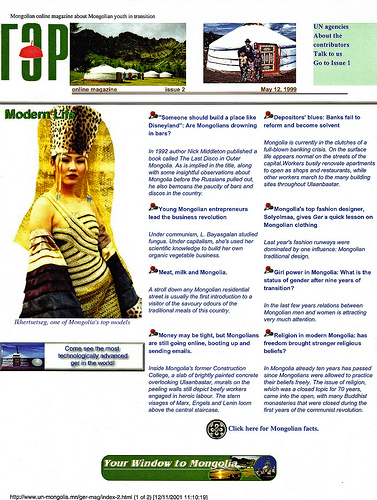
It could be said that there is no girl who does not dream of becoming a model. Many Mongolian girls, particularly Ulaanbaatar city girls, are flocking to attend courses in modelling in the last few years. Some say models are mushrooming in Mongolia, a country known for its fresh-faced people and robust physiques.
Ger interviewed S. Ikhertsetseg, one of the twin top models of Mongolia.
When did you first appear on the fashion stage?
“When we were 15 we played piano for the state concert on International Women’s Day on March 8. The ( Best Fashion) company was in trouble and they did not have anyone to wear some leather fashions for the show in the concert. It was fortuitous that we were asked to be the models. We kept it secret from our parents until we received a prize from Mongolia’s top fashion show, Goyol (or beauty) , in 1988. That was a year after the state concert. Being a fashion model was not considered so desirable as it is now. We were busy studying at music school and our parents did not know what we were doing.”
What do you think of today’s models?
“In the early days of fashion shows in Mongolia in the 1980s, we did not have many competitors. These days there are many beautiful Mongolian models we have to compete with, but only a few are very good. If someone is lucky, they have the potential to compete at the world level. Personally, I don’t like models who are too trained by courses.”
Do you think becoming famous is pure luck?
“Of course it is luck. But that doesn’t mean it isn’t a lot of hard work. You must send photos to agencies, and then only then, will someone see your photo – that is luck.”
What about design and fashion in Mongolia? Are Mongolians fashion sensitive?
“I can not say Mongolians are sensitive to fashion. I think our designers should work harder. Design is not a dress or a suit. It is everything, the whole cornucopia of details. I do not think we are going to compete with Europe, which has a long history of making clothing, rich in colors or designs. There is a big difference between fashion in the West and in Mongolia.”
Mongolia has a lively free press who sometimes step over the line when it comes to gossip and scandal reporting. These so-called “yellow” newspapers have damaged many people’s reputations. This had also happened to you. Some newspapers called the two of you the Barbie girls in Beijing, earning a lot of money.
“Yes, they did say those bad things. We replied to them.”
Was it before the court?
“No, that is a personal question.”
What was the result?
“The newspapers didn’t do that again.”
What do you do now?
“Both of us keep up the fashion work and also teach piano. Music is our profession and love. We founded the Association of Models of Mongolia to protect their rights and strengthen their position in the society.”
“A stroll down any Mongolian residential street is usually the first introduction to a visitor of the savoury odours of the traditional meals of this country. If you are invited into somebody’s ger (or traditional tent dwelling) or apartment, you will probably have an opportunity of tasting buuz, khuushuur and bansh.
“These Mongolian national meals are made with minced meat seasoned with garlic or onion (it can be anything from mutton to beef to camel to horse to gazelle) covered with flour and steamed in boiling water, fried in oil and boiled in water. For many visitors to the country the vast quantities of meat consumed can at first be surprising. But it is not long before a visitor finds their favourite Mongolian food, be it buuz, khuushur or a number of other treats. A Canadian living in Ulaanbaatar once told me, “the Mongolian national food contains a lot of meat, but I like the buuz.
“The meat-dependent diet arises from the need for hearty food to stave off the cold and long winters. Traditionally nomadic herders, Mongolians have for centuries been dependent on mostly animal products for their dietary staples. Now after over nine years of transition, the traditional diet has been used as a shield against hunger and for the wealthy, subject to the influence of imported foreign foods and cuisine. When the Russians pulled the plug on Mongolia’s aid in 1991, the economy went into a severe crisis. For many Mongolians it was their first experience of serious hunger. The staple traditional diet of meat, milk and flour saw many people through this crisis, when food imports from the former Soviet Union dropped off.
“Mongolians traditionally have turned to foods that are high in protein and minerals, relying less on more seasonable foods like vegetables and fruits. This means a diet heavy on meat and dairy products, the latter when sour in the summer time thought to clean the stomach. It isn’t just about meat though. Mongolians do also eat cereal, barley and natural fruits and plants native to the country.
“Out of necessity Mongolians have found creative and ingenious ways to use the milk of all five of the domestic animals in the country: sheep, cattle, goats, camels and horses. Orom is the cream that forms on top of boiled milk; aaruul are dried curds and can be seen baking in the sun on top of gers in the summer; eetsgii is the dried cheese; airag is fermented milk of mares (female horses); nermel, is the home-brewed vodka that packs a punch; tarag, is the sour yogurt; shar tos, melted butter from curds and orom, and tsagaan tos, boiled orom mixed with sometimes flour, natural fruits or eesgii. The method of drying the dairy products is common in preparing them. The Mongolians prepare enough dairy products for the long winter and spring.
“The traditions of using, producing and preparing these foods are stronger outside the main cities, where the population is more reliant on the vast herds for food. B. Baljmaa (Mongolians generally use their first names), a dietitian and nutritionist at the National Nutrition Research Centre, says there is a genetic compatability for the food.
‘Before 1992 there wasn’t much research in this area. But now we know from our research that Mongolians are better able to absorb foods with more acid. So, traditional food should be kept in the country.’
“Since 1997 Mongolians have seen a substantial increase in the variety and quantity of imported foods, many of which were only thought of as exotic 10 years ago. Since the start of 1999 the Soviet-style market stalls now compete against western-style supermarkets, with trolleys and shelves proudly saying “Made in Mongolia.” In markets like Dalai Eej, Dorvon Uul, Food Land and Mercury it is possible to buy delicious prepared and canned foods, candies, biscuits, and unknown and unused before by Mongolians, products like oranges, bananas, plums and American chickens.
“On top of the canteens and cafes serving Mongolian food, there are now many restaurants, canteens, bakeries and tea shops which serve meals from Russia, Italy, India, China, Japan, Korea, England, France, Senegal and Turkey. Most of these restaurants are located in the capital, Ulaanbaatar. Mongolians have taken to the new tastes. “I think Mongolians like roasted chicken and fish when they go to the foreign sit-down restaurants, and hot dogs and pizzas in the fast foods shops,” says I. Narantsetseg and her husband J.Battulga. Both were dining in the Seoul restaurant, and are happy they can go out for food: “it is a very good thing that there are opening a lot of restaurants where friends and family can go and enjoy food in comfort.”
“Isobe Hiroshi, manager of Seketei, a high-end Japanese restaurant, told me “only 20 per cent of our customers are Mongolians. The vast majority of our clients are foreign, especially Japanese people who are working and traveling here. I think Mongolians have still not grown used to sushi and sashimi, the raw fish prepared in our restaurant. But I hope we will welcome more and more Mongolians in the future.”
“The traditional diet in the cities is more changed, more european. And with comes its own dangers for Mongolians says the Nutrition Centre’s Baljmaa:
‘There is a big problem of importing poisonous foods and food which probably will cause the nutrition-related diseases common in more developed countries,” she continues.”While the trend around the world amongst health-conscious people is towards natural products for their food, some Mongolians use some food which can cause troubles for their health. For example, fast food made with more oil, salt and sugar are considered the biggest dangers for human health. On the plus side prices for these imported foods are higher and only the wealthiest people can afford them; the poor people can’t buy and eat it no matter how much they desire. This means their poverty is protecting their health. We should boost our efforts to raise awareness on what foods protect your health.’
“Help in improving nutrition awareness a poster portraying a ger details the food habits of Mongolians and the nutritional value of common foods.
“Now I want to present to you recipes of processing and preparing some Mongolian national products and meals:
“From ancient times, Mongolians use abundant and peculiar methods of processing meat and preparing food.. One of the more popular methods of processing the meat is to prepare borts (dried meat) for use in winter. Borts is made from the meat of cows, goats and camels. Here is a recipe for camel borts presented by Dr. Sh. Tserenpuntsag who engages in the research of the meat.
1. Separate the meat from its layer of fat, as fat will spoil in drying. 2. Cut meat into strips about 20-30 centimeters long and two to five centimeters thick. 3. Hang to dry in a well-ventilated room. 4. Leave for four to five months. 5. Cut into small strips for use in any dish you like.
“If soaked in water, the meat will expand up to two and half times in size. It should then be cooked for 18 minutes.
“The main method of cooking the meals of the Mongolians is boiling and steaming, considered the most healthy method in cooking by researchers the world over. Here is a recipe for buuz from the Nutrition Centre. It is considered one of the national meals of the Mongolians and is cooked by steaming and is a good fast food.”


 David South Consulting
You must be logged in to post a comment.