Tag: markets

  • Growing A Southern Brand To Global Success: The Olam Story

    Growing A Southern Brand To Global Success: The Olam Story

    By David SouthDevelopment Challenges, South-South Solutions

    SOUTH-SOUTH CASE STUDY

    Most people haven’t heard of Olam International, but they know the brands they work for and they more than likely eat their produce. The story of Olam (http://www.olamonline.com) – a global food supply company in ‘agri-products’ that got its start in Nigeria – shows how a Southern brand can grow and go global, and overcome the difficulties of cross-border trade.

    Olam supplies well-known global food brands including Cadbury (chocolate), Nestle, Lavazza (coffee), Mars (chocolate), Tchibo and Planters (peanuts).

    Olam not only survived its startup in Nigeria, it has thrived, trading around Africa and across the globe, becoming a major supplier to the world’s top food brands.

    The quantity of agri-products harvested in the world is 5.2 billion metric tonnes. In that market, Olam is a significant producer of cashews, peanuts, spices, beans, coffee, cocoa, sheanuts, packaged foods, rice, wheat, barley, sugar, cotton, wood, and rubber. It is already the world’s largest supplier of cashew nuts and sesame nuts and in the top three for peanuts. Olam’s cashew business in Africa provides work for 17,000 people, 95 percent of whom are women.

    Olam also uses its success to play a critical role in securing the world’s food supply and has specialized in meeting the food needs of the world’s rapidly growing population, especially in China and India. Between 2001 and 2007, annual increases in the global consumption of agricultural commodities were larger than during the 1980s and 1990s. Higher incomes are leading to higher consumption of proteins like meat. And as meat demand rises, so does the demand for grain and protein feeds to produce the meat. It takes two kilograms of grain to produce one kilogram of chicken, four kilograms of produce for one kilogram of pork, and eight kilograms of produce for one kilogram of beef.

    Chris Brett, Olam’s senior vice president and head of corporate social responsibility and sustainability, said the company tries to blend business success with wider social goals.

    “We are one of the few businesses investing in rural environments and am tackling the problem of urbanization,” said Brett in Olam’s London office – the company’s global headquarters is in Singapore.

    In 2008, it won the World Business Development Award for its contribution to achieving the Millennium Development Goals (MDGs) (http://www.un.org/millenniumgoals/).

    Olam also has been recognized for its contribution to global food security. By providing farmers with credit to help build their communities, it has also been able to revive declining rural economies and help stem the outflow of farmers to the big cities and urban slums.

    “Many countries are afraid to lend to farmers,” Brett said. “We gather the farmers together in groups of 500 and Olam manages the loan while a local bank receives the money. Defaults have been low and farmers are building up a credit rating. In this way, farming becomes a business not just a subsistence existence.”

    The dramatic changes taking place in African countries – especially rapid urbanization that has made the continent home to 25 of the world’s fastest growing cities (International Institute for Environment and Development) – means there is an urgent need to increase food production and stabilize rural economies to support farming.

    Olam International, started in 1989 in Nigeria by its India-born CEO Sonny George Verghese has many lessons for any Southern entrepreneurs who have their sights set high.

    After developing its skills in exporting cashew nuts from Nigeria, Olam moved into cotton, cocoa and sheanuts. From 1993 to 1995, the company explored ways of taking their skills into other countries and different products. It was a period of rapid expansion into other African countries including Benin, Togo, Ghana, Cote d’Ivoire, Burkina Faso and Senegal.

    Olam now operates in 26 African countries.

    There has been a renaissance in South-South trade in recent years before the current economic crisis, growing by an average of 13 percent per year between 1995 and 2007. By 2007, South-South trade made up 20 percent of world trade.

    Olam started with one product, got its supply right, and then started looking around and seeing what other products and services it could offer, applying already-tested expertise and supply skills – what the company calls the ‘Olam DNA’.

    Olam claims its success has come from building strong relationships with farmers to guarantee high standards for the food products. The company does this by tightly tracking its stock and its quality. Olam then uses the information to analyze risks to the supply network. The company also keeps both warehouses and field managers close to the farmers. Olam estimates 65 percent of its profit comes from managing the journey from farmer’s field to factory gate.

    Its selling point to customers is the ability to guarantee the entire journey from farmer’s field to factory gate, taking on all the risk and stress for ensuring the product is of the right standard and delivered on time.

    Its niche is to provide the food products required by some of the world’s top food brands. The company has grown from just one product in Nigeria and two employees in 1989, to directly employing over 10,000 people worldwide and supplying 20 products in 60 countries, according to Brett. He says the company, which had a total 2008 turnover of US $5.75 billion, was “born out of Africa.”

    Brett says the company is now “investing heavily in Africa in processing and distribution centres” – proof that a success story feeds back into more success and investment. It has been able to use its profits to go back and buy up failing businesses and former state-run enterprises, and modernize them. Olam now grows the food, processes it, and transports it to market.

    Olam actively works with international donors, global NGOs like Technoserve (farmer business development), WWF (environmental impact of supply chain), and the Bill and Melinda Gates Foundation (cocoa and cashew farmers).

    Olam, however, has received criticisms for its past practices. The global environmental group Greenpeace attacked its logging in the Democratic Republic of Congo (DRC) (http://www.greenpeace.org.uk/tags/olam), and the International Finance Corporation (IFC) divested its holdings from Olam for it trading illegally cut timber.

    Olam and the Gates Foundation project are working with 200,000 cocoa farmers in West Africa to double their incomes. In Ghana, cocoa farming has become synonymous with poverty and perceived as an occupation of last resort. The work force is rapidly aging and the industry will die out if it doesn’t become more profitable and attractive to young people.

    “We want the farmers to be profitable, the transporters to be profitable,” Brett said. “We believe a supply chain does not work if one player takes too much.”

    And what advice does Olam have for budding food producers and growers? “Catchy, simple brands work. Our Mama Mia pasta caught the wave of the Abba revival.”

    “Our Tasty Tom brand became very popular in Africa so we extended the brand into other products than just tomato paste. You reduce the cost of advertising by extending the brand name.”

    “We feel SMEs (small, medium enterprises) growth is critical because it would give us more support. If more people invested in SMEs, we would have more people to do business with. We want to be able to make deals: they could be entrepreneurs.

    “If you can add extra value it costs nothing but time.”

    Brett advises budding SMEs: “It’s all about quality: trust and shared business ethics like formal contracts. When you have those, the bigger brands will give you support.”

    Published: October 2009

    https://davidsouthconsulting.org/2022/11/21/africa/

    https://davidsouthconsulting.org/2020/12/14/african-farming-wisdom-now-scientifically-proven/

    https://davidsouthconsulting.org/2022/11/21/agribusiness-food-security/

    https://davidsouthconsulting.org/2022/11/16/brazils-agricultural-success-teaches-south-how-to-grow/

    https://davidsouthconsulting.org/2022/10/10/cheap-farming-kit-hopes-to-help-more-become-farmers/

    https://davidsouthconsulting.org/2022/11/18/farmers-weather-fertilizer-crisis-by-going-organic/

    https://davidsouthconsulting.org/2022/11/23/kenyan-farmer-uses-internet-to-boost-potato-farm/

    https://davidsouthconsulting.org/2021/09/16/small-fish-farming-opportunity-can-wipe-out-malnutrition/

    https://davidsouthconsulting.org/2021/09/16/ugandan-fish-sausages-transform-female-fortunes/

    https://davidsouthconsulting.org/2022/11/11/urban-farming-to-tackle-global-food-crisis/

    https://davidsouthconsulting.org/2022/10/10/us-1-trillion-opportunity-for-africas-agribusinesses-says-report/

    https://davidsouthconsulting.org/2022/10/18/woman-wants-african-farming-to-be-cool/

    Development Challenges, South-South Solutions was launched as an e-newsletter in 2006 by UNDP’s South-South Cooperation Unit (now the United Nations Office for South-South Cooperation) based in New York, USA. It led on profiling the rise of the global South as an economic powerhouse and was one of the first regular publications to champion the global South’s innovators, entrepreneurs, and pioneers. It tracked the key trends that are now so profoundly reshaping how development is seen and done. This includes the rapid take-up of mobile phones and information technology in the global South (as profiled in the first issue of magazine Southern Innovator), the move to becoming a majority urban world, a growing global innovator culture, and the plethora of solutions being developed in the global South to tackle its problems and improve living conditions and boost human development. The success of the e-newsletter led to the launch of the magazine Southern Innovator.  

    Follow @SouthSouth1

    Google Books: https://books.google.co.uk/books?id=tRKYBgAAQBAJ&dq=development+challenges+october+2009&source=gbs_navlinks_s

    Slideshare: http://www.slideshare.net/DavidSouth1/development-challengessouthsouthsolutionsoctober2009issue

    Southern Innovator Issue 1: https://books.google.co.uk/books?id=Q1O54YSE2BgC&dq=southern+innovator&source=gbs_navlinks_s

    Southern Innovator Issue 2: https://books.google.co.uk/books?id=Ty0N969dcssC&dq=southern+innovator&source=gbs_navlinks_s

    Southern Innovator Issue 3: https://books.google.co.uk/books?id=AQNt4YmhZagC&dq=southern+innovator&source=gbs_navlinks_s

    Southern Innovator Issue 4: https://books.google.co.uk/books?id=9T_n2tA7l4EC&dq=southern+innovator&source=gbs_navlinks_s

    Southern Innovator Issue 5: https://books.google.co.uk/books?id=6ILdAgAAQBAJ&dq=southern+innovator&source=gbs_navlinks_s

    https://davidsouthconsulting.org/2021/03/05/southern-innovator-issue-3/

    https://davidsouthconsulting.org/2021/03/05/southern-innovator-issue-5/

    Creative Commons License

    This work is licensed under a
    Creative Commons Attribution-Noncommercial-No Derivative Works 3.0 License.

    ORCID iD: https://orcid.org/0000-0001-5311-1052.

    © David South Consulting 2023

  • A Local Drink Beats Global Competition

    A Local Drink Beats Global Competition

    By David SouthDevelopment Challenges, South-South Solutions

    SOUTH-SOUTH CASE STUDY

    For many decades, strong American and multinational food brands have penetrated markets in the South. This is a global business success story for those companies, but the downside has been the marginalizing of local alternatives. This not only reduces wealth-creating opportunities for local entrepreneurs, but also leads to products like sugary soda pops (http://tinyurl.com/yzwal98) pushing aside healthier, local alternatives like tea.

    But one company in Indonesia has been pioneering a healthy local drinks empire while also seeing off aggressive foreign rivals. Teh Botol Sosro, a tea drink in Indonesia bottled by family-owned business Sosro, was not only the first bottled tea brand in the country, but also in the world, it claims. The company started bottling the jasmine-flavoured black tea drink in the 1970s.

    The Indonesian company has shown that it is possible for local flavours to beat powerful international brands like Coca Cola in the battle for drinkers’ palates. While Coca Cola has tried to sell many bottled tea drinks in the Indonesian market, they have not been able to push aside the local product, The Teh Botol Sosro. Brewed by the Sinar Sosro company, it has captured 70 percent of the non-carbonated drinks market.

    It is a drink of cool, black, sweetened tea with a hint of jasmine. Invented by the Indonesian family of Sosrodjojos, Sosro (http://www.sosro.com/) was founded in central Java in the 1940s.

    Culturally, Indonesians have either coffee or tea with their meals. The brand’s marketing slogan plays on this: “Whatever you eat, you drink Teh Sosro.”

    The company has aggressively fought off competition not only from local rivals, but also from Coca Cola’s Frestea brand and Pepsi Cola’s Tekita. The company stayed sharp in its business strategy, never letting a rival product take hold. Just as a rival would introduce a new product, Sosro would reply with a new drink attuned to Indonesian tastes. This ability to not be complacent about the company’s success, and to use its knowledge of local tastes to always outsmart foreign competition, has kept the company where it is today.

    Sosro pioneered bottled drinking tea with its launch in 1970 and started with a dried tea only distributed in Central Java.

    The journey to cold, bottled tea is an amusing one. The company first wanted to promote its tea in Jakarta, the capital, by having public tastings. But by brewing the tea on the spot, the too-hot tea took too long to drink for impatient Jakartens. The solution was to not brew the tea on the spot, but instead to brew it off-site and deliver to markets in big pans on trucks. But the bad roads made this a bit of a mistake as well: the tea would spill on the journey.

    The ‘aha’ moment came when the idea arose to store the brewed tea in bottles. The bottles were eye-catching and have evolved in design over the years.

    The drink now comes in various packages, from a returnable glass bottle (220 ml) to a Tetra Pak (1 litre, 250 ml, and 200 ml) and a 230 ml pouch.

    The Botol Sosro (http://www.sosro.com/teh-botol-sosro.php) is not the company’s only product: it also brews Fruit Tea, The Botol Kotak and S-Tee. The economic benefits of these popular brands stay local, as Sosro gets the tea from PT Gunung Slamet, which operates three tea estates covering 1,587 hectares in Indonesia.

    Published: March 2010

    Resources

    1) Just Food is a web portal packed with the latest news on the global food industry and packed with events and special briefings to fill entrepreneurs in on the difficult issues and constantly shifting market demands. Website:http://www.just-food.com

    2) Brandchannel: The world’s only online exchange about branding, packed with resources, debates and contacts to help businesses intelligently build their brand. Website:http://www.brandchannel.com

    3) Small businesses looking to develop their brand can find plenty of free advice and resources here. Website: http://www.brandingstrategyinsider.com

    4) Growing Inclusive Markets, a web portal from UNDP packed with case studies, heat maps and strategies on how to use markets to help the poor. Website:http://www.growinginclusivemarkets.org

    5) Tea Genius: A website from Taiwan packed with information on tea, its health benefits and rituals. Website: http://www.teagenius.com/

    Cited

    As cited in Export Now: Five Keys to Entering New Markets by Frank Lavin and Peter Cohan (Wiley).

    Creative Commons License

    This work is licensed under a
    Creative Commons Attribution-Noncommercial-No Derivative Works 3.0 License.

    ORCID iD: https://orcid.org/0000-0001-5311-1052.

    © David South Consulting 2022

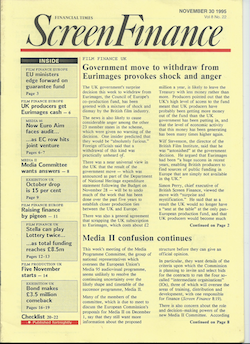
  • From Special Report: NMM (New Media Markets) Spotlight On The Emergence Of Satellite Porn Channels In The UK

    From Special Report: NMM (New Media Markets) Spotlight On The Emergence Of Satellite Porn Channels In The UK

    October 26 1995

    Is the UK rushing to watch TV porn? 

    By David South

    Financial Times New Media Markets (London, UK), October 26, 1995

    ISSN: 02654717

    OCLC Number / Unique Identifier:1266447669

    The aspect of satellite and cable programming most feared by the British government when it pushed the development of new media in the mid-80s looks set to become firmly entrenched as a part of the emerging television era. 

    Next Wednesday, the USA’s most famous soft-pornography channel will arrive in the UK, almost certainly heralding a satellite porn war for the eyes of the British public. 

    The Home Office, which used to look after televsion, was worried that porn would be one shock too many for the British and would create havoc with British television laws. But the mores of the marketplace have changed the climate, although the Broadcasting Act and the Independent Television Commission (ITC) still create limits that are stricter than in most other countries. 

    Hard-core pornography – such as that shown on several continental channels which can be picked up in the UK – remains out of bounds, as evidenced by the Department of National Heritage’s recent proscription of the hard-core TV Erotica. 

    But the drawing of the line between hard-porn and soft-porn changes over time: the programming now permitted by the ITC is a lot stronger than many might have thought likely a few years ago. The porn channels have learned how to push the boundaries of acceptability and, with competition increasing, are likely to push their luck even further.

    Politicians, journalists and old-fashioned new-media programmers – for instance, the United Artists people who were dismayed at the decision of parent company TeleCommunications Inc to bring Playboy over to the UK – may believe that porn channels serve only to cheapen the quality of life. 

    But the supply side of the marketplace detects that there is a widespread demand for porn and (ironically) religion and so programmers will follow the demand by supplying suitable programming. 

    The soi-dissant “adult” channels estimate their potential audience at between 7 per cent and 30 per cent of cable and satellite homes – between 400,000 and 1.7 million homes at present penetration levels. 

    Their main target market is the consumer of “top shelf” magazines which range from the glossy, even glamorous Playboy to the more downmarket magazines of the “reader’s wives” variety.  According to the Campaign Against Pornography, the top six pornographic magazine titles sell about 2.5 million copies a month. Altogether, there are about 200 pornographic titles on sale in the UK. 

    Deric Botham, programmer at the recently-launched Television X – The Fantasy Channel  and a porn-industry veteran, estimates that the total UK sex industry – from videos and magazines to sex aids, but excluding prostitution – generates revenues of £4 billion a year, a figure which is difficult to substantiate but is equivalent to 10 times the investment in the UK film industry in 1994. 

    According to Botham, “our research shows that people want this thing and the majority of people want it to some degree.”

    The porn channels are finding it relatively easy to find satellite capacity, largely because they are forced by the rules to operate at a time of day (i.e. night) when most channels have quit their transponders and are only too happy to find someone to sub-lease them to. 

    According to Botham, “our research shows that people want this thing and the majority of people want it to some degree.”

    The first of the new porn channels will be the Playboy Channel, which likes to think of itself as being a cut above the others. The others, it claims, are for “sad, lonely men”. Playboy, on the other hand, is for “happy, heterosexual couples”. 

    The channel, probably the softest of the genre, will be launched on November 1 by Flextech, BSkyB and the US Playboy Channel. 

    It will be followed by the not-so-soft Penthouse which is being launched in the UK by a joint venture of Penthouse magazine owners General Media and Graff Pay-Per-View, which already owns the UK Adult Channel. 

    Two other channels have received licences from the ITC – David (Sunday Sport newspaper) Sullivan’s Babylon Blue and the Adam and Eve Channel. With the Adult Channel and Television X already broadcasting, there could be six porn channels on offer to UK viewers. 

    But two other channels are beamed into the UK for those willing to pay the cost of extra reception equipment: the continental pirates, Rendezvous and Eurotica. There is also the now-banned TV Erotica. 

    Cable and satellite was bound to be an attractive medium for the porn channels, given the possibility of encrypting the signal and imposing a subscription fee and, as a consequence, benefiting from the lighter regulation that has seemed likely. Sex-channel executives say that the ITC has become increasingly flexible in what it will allow. 

    Three other factors have fuelled would-be channels to turn to cable and satellite: 

    1.  The replacement of the independent high-street video store by big video superstores has robbed the porn industry of a key outlet. 
    2. New-media distribution should bring in consumers who are embarassed to hire a porn video from a shop. Yet buying a subscription to a porn channel may be a more embarassing act within the family environment. 
    3. The Adult Channel is regarded as demonstrating that there is an audience for porn in the UK: it is thought to have about 224,000 subscribers. 

    Cable and satellite has far more potential for the porn industry than the traditional-format channel. The prize, which will make everything worthwhile, is pay-per-view (ppv). Bill Furrelle, Playboy Channel’s sales director, said that he had been asked by several UK cable operators about providing a ppv service next year. The operators want Playboy, the Adult Channel and Adam and Eve to contribute to the Home Cinema ppv service which they hope to put together. 

    Do TV porn channels degrade and humiliate? 

    By David South

    Financial Times New Media Markets (London, UK), October 26, 1995

    Susan Sontag, the renowned American essayist, described pornography as a “crutch for the pyschologically deformed and brutalisation of the morally innocent.” The Campaign Against Pornography in the UK believes that pornography exploits women and children “in a degrading and humiliating way, often with the message that we enjoy this and want to be abused.”

    The campaign encourages its supporters to take direct action against any distributor of pornographic material as part of its wider campaign to put the industry out of business.

    The porn channels dismiss arguments that they degrade women and encourage male violence against women. Playboy managing director Rita Lewis argues that “women are happy to consume erotic imagery like pin-ups. Women are not hung-up by this anymore, they are not threatened by the fantasy women we show in our programming. We hope Playboy will lead to couples’ making love together.”

    Andrew Wren, financial director of the Adult Channel, also dismisses the link between pornographic programming and sexual violence. “I don’t think there is anything in programmes that would encourage men to go and rape. Women are interested in sex as men are.”

    Television X’s (Deric) Botham says that porn programmes are “a bit of titilation” in the fine, upstanding tradition of the British Carry On films. None the less, he admits that “I wouldn’t want my daughter to get involved in pornography.”

    He says that the women involved in the programmes, some of them housewives, are willing participants and enjoy the opportunity. “I don’t produce anything that is against the law. We speak to the individuals concerned. If you have a reluctant model, it doesn’t work – I just won’t buy the video.”

    The Campaign Against Pornography sees it all rather differently. Ann Mayne, a member of the campaign’s management committee, was particularly critical of two programmes on Television X – Shag Nasty and Mutley and Fly on the Wall.

    She said that Shag Nasty and Mutley, in which a presenter approaches women in the street or in supermarkets and offers them £25 to look at their knickers, or £50 to be filmed having sex with him, gave the message that women were simply objects and that it was acceptable to harass them.

    “It is complete prostitution of female sexuality,” she said. “Botham wants full-on, across-the-board prostitution of women. In his view, every woman must have a price.”

    Mayne said that Fly on the Wall, in which real-life couples are shown having sex, was an open invitation for men to coerce their partners into being filmed, possibly to the point of abuse.

    UK laws on satellite porn among toughest in Europe

    By David South

    Financial Times New Media Markets (London, UK), October 26, 1995

    UK regulations on what can be shown on sex channels are tougher than in most countries of the European Union. Channels such as the hard-core Swedish TV Erotica and the recently-launched French Rendezvous are licensed in their respective countries and transmit explicit scenes of sexual intercourse, straight and gay, featuring close-up shots of copulating genitals. 

    Graff Pay-Per-View, the experienced US sex channel operator, consciously decided to exclude the UK as a market for its hard-core Eurotica channel which is licensed in Denmark and, like the other hard-core channels, transmits via a Eutelsat satellite. But pirate smart cards for the channel, as for the other channels, are available in the UK in specialist satellite shops. 

    Graff’s seeming respect for the UK regulations may not be unconnected with the fact that it owns the Adult Channel and would be wary of upsetting the ITC. Broadcasting unacceptable material into the UK could provoke the ITC into seeing Graff as a body unfit to hold a licence, thereby threatening the Adult Channel. 

    The ITC’s guidelines on sexually explicit material state that representations of sexual intercourse can be shown only after 9pm and that “the portrayal of sexual behaviour, and of nudity, needs to be defensible in context and presented with tact and discretion.”

    There has been some relaxation of the rule. The ITC will, on an experimental basis, allow the watershed to be broken by a ppv or video-on-demand service. It is not, however, prepared to give this freedom to a porn channel, at least not in the early days, because it does not want to be seen to be licensing pornography. The relaxation will affect only general services. 

    The ITC will also monitor any ppv service to ensure that there are no cases of children accessing the programming before deciding if the programme code should be revised. 

    The transmission pf 18-rated films on terrestrial or new-media channels is not permitted before 10pm. Films with a 15-rating are not allowed before 9pm on terrestrial channels such as BSkyB’s Sky Movies or the Movie Channel. These are minimum requirements. Some 15-rated films, for instance those which show scenes of sexual intercourse or drug-taking, would not be deemed suitable for transmission even on an encrypted channel at 8pm. 

    In practice, the ITC does not permit depictions of erect penises, anal intercourse, close-ups of genitalia or ejaculation. 

    Where channels have overstepped the mark and gone abroad to get licences from less strict authorities – the late Red Hot Dutch and TV Erotica – the ITC has recommended that the channels be proscribed, action which has subsequently been taken by the Department of National Heritage. The ITC is now monitoring the Rendezvous channel, which shows a mix of gay and heterosexual hard-core pornography with graphic scenes of sexual intercourse. 

    The DNH issues proscription orders under Sections 177 and 178 of the Broadcasting Act. The orders make it a criminal offence to supply equipment to receive the channels or to market and advertise them. 

    The European Union directive on transfrontier broadcasting lays down that one country cannot prevent the reception of channels licensed by other European Union countries. However, it allows individual governments to take action against any broadcast which could damage the physical, mental or moral development of minors. 

    Playboy ‘is not for sad and lonely single men’

    By David South

    Financial Times New Media Markets (London, UK), October 26, 1995

    The Playboy Channel, due to launch in the UK on November 1, is trying to position itself as being a cut above the existing sex channels with which it will compete for subscribers. 

    The channel, which is running an advertising campaign costing more than £1.5 million, believes that its big budgets and slick production values will attract viewers who have hitherto been uninterested in so-called “adult” entertainment. It hopes to win an audience among women as well as men. 

    Managing director Rita Lewis dismisses the other sex channels as being aimed at people who are “a bit sad and on their own”. The channels promote “deviant” behaviour. 

    Playboy hopes to attract happy, heterosexual couples who will treat the channel as an aid to foreplay: “We hope Playboy will lead to couples’ making love,” said Lewis, who believes that women, as well as men “are happy to consume erotic imagery like pin-ups.”

    In the USA, according to Lewis, 70 per cent of the audience for the channel comprises couples. 

    “We hope Playboy will lead to couples’ making love,” said Lewis, who believes that women, as well as men “are happy to consume erotic imagery like pin-ups.”

    She said that the UK Playboy will run programmes that have more in common with programmes like Channel Four’s The Good Sex Guide. “These days, a whole bunch of people are sampling erotic programming like The Good Sex Guide. It is very sexy programming with mass-market appeal.”  

    Playboy’s movies would have a high standard of production, she said, very different from what she claims to be the cheap programming made for the other channels, often home videos and often shot with hand-held cameras. 

    Playboy’s programming will comprise sex films, interviews with “centrefold” models, documentaries on the sex industry and general-entertainment programming such as quiz shows. 

    The rival channels claim that Playboy will not be a big threat to them. The Adult Channel’s Wren says that all the new channels “hype the market, which helps us.” In any case, adult entertainment consumers have already been weaned on a harder mix of programming and do not want something that offers little more than what Channel Four shows. 

    The UK Playboy Channel, which is owned by UK programmer Flextech (51 per cent), British Sky Broadcasting (30 per cent) and Playboy Enterprises (19 per cent), will transmit from between midnight and 4am on the Bravo transponder on Astra 1c. 

    Read more on the 1990s sex economy here: From Special Report: Sexual Dealing: Today’s Sex Toys Are Credit Cards & Cash: A Report On The Sex-For-Money Revolution

    Special Report: Sexual Dealing: Today’s Sex Toys Are Credit Cards & Cash: A Report On The Sex-For-Money Revolution.

    Update: It is over 20 years since this Special Report was published. The Internet now plays a significant role in the growth of sex content and the sex industry and vice versa. Here is an interesting overview of the situation in 2020. The Internet is for Porn – It always was, it always will be.

    “One of the biggest and most interesting things happening in the consumer web right now is running almost completely under the radar. It has virtually zero Silicon Valley involvement. There are no boastful VCs getting rich. It is utterly absent from tech’s plethora of twitters, fora and media (at least, as they say, “on main”). Indeed, the true extent of its incredible success has gone almost completely unnoticed, even by its many, many, many customers.

    I’m talking, of course, about OnlyFans.”

    More from the Financial Times here:

    “Opinion Inside Business

    OnlyFans shows how the creator economy is shaping media 

    Porn is a kind of paradigm for broader changes for publishers and musical labels”

    https://www.ft.com/content/4be047b7-0517-403a-9374-c6ea317b1b7e?segmentid=acee4131-99c2-09d3-a635-873e61754ec6

    ORCID iD: https://orcid.org/0000-0001-5311-1052.

    © David South Consulting 2024

  • Mobile Phones: Engineering South’s Next Generation of Entrepreneurs

    Mobile Phones: Engineering South’s Next Generation of Entrepreneurs

    By David SouthDevelopment Challenges, South-South Solutions

    SOUTH-SOUTH CASE STUDY

    Technology is fuelling unprecedented growth in productivity in Asia, with sub-Saharan Africa languishing behind (International Labour Organization). But the growth in mobile phones could help close this gap, as home-grown entrepreneurs are stepping up to exploit this new opportunity.

    Mobile phone applications are proving a boon to small businesses and entrepreneurs. They are now putting power in the hands of individuals, making it easier to invent new ways of doing things, transfer money, organise business accounts, provide services, sell things, and keep in touch and up-to-date.

    Technology has been the common factor in increases in productivity around the world, and with the rapid rise in mobile phone use, especially in Africa, it looks as if this handy device augers in the next wave of innovation.

    And technology and mobile phones in particular, are creating a whole new route to wealth: “The switch.. frees people from geography,” Gregory Clark, an economic historian at the University of California, Davis told The Christian Science Monitor. “Singapore can be as rich as Canada, even though Singapore has no land.”

    Technology is seen to be opening a new phase in economic competition in services, embracing a wide range of fields, from banking to tourism to healthcare. And it is entrepreneurs who will be at the forefront of making this happen. The majority (59 per cent) of the world’s 2.4 billion mobile phone users live in developing countries (MIT) – making it the first telecommunications technology in history to have more users there than in the developed world. The number of African mobile phone users passed 200 million at the beginning of this year (www.ovum.com), making it the fastest growing mobile phone market. It has increased at an annual rate of 65 per cent – twice the global average (MIT Media Laboratory).

    In Kenya in 2005, the government’s Economic Survey found the small business sector, which employs the majority of workers in the nation of 32 million people, created 437,900 jobs – mostly down to the boom in mobile phones. According to the Massachusetts Institute of Technology (MIT), adding an additional 10 mobile phones per 100 people boosts a typical developing country’s GDP growth by 0.6 per cent. The boost comes from the innovative use of mobile phone technology by local entrepreneurs.

    At the University of Nairobi, the SMS Boot Camp (SMS is the text messaging system on mobile phones) is breeding the next generation of African technology entrepreneurs. Working in partnership with MIT, the student entrepreneurs are working on an impressive list of projects, which can be found online at eprom.mit.edu. The projects are varied, and include perfecting prototype ways to collect medical data on mobiles, accurately tracking phone user’s profiles (habits, friend networks etc.), improving communication between Kenyan hospitals and the centralised blood banks in the country, and quick ways to install applications on all of Kenya’s mobile phone SIM cards.

    One graduate, Mohammed Temam Ali in Addis Ababa, is now working on a project for the Ethiopian Telecommunications Company. Another is working for Kenyan mobile phone download service, Cellulant.

    Nathan Eagle, a visiting lecturer at the University of Nairobi, has been working with the students on the projects: “Phones are starting to be used as a surrogate for all sorts of technology we take for granted in the West. Credit cards, TVs, radios, computers, etc… In the small Kenyan village where I’m writing this email, I can pay for the taxi ride home with my mobile — we’re even scheduled to be getting a Wimax network (wireless internet) here next year. Talk about leapfrog…”

    “I’m also advising a small group of newly graduated Rwandan hackers who are building an SMS-based payment system for electricity.”

    But Eagle says the obstacles can still be huge: “Government corruption and red-tape. SMS is illegal in Ethiopia… it is pretty frustrating when you go over to teach an ‘sms bootcamp’ class.”

    In India, where there are 185 million mobile phone subscribers, computer science doctoral student and founder of Ekgaon Technologies, Tapan Parikh, has founded a business specifically targeting developing mobile phone-based information systems for small businesses in the developing world. Working in rural India, the applications are designed to make it easier for business owners to manage their own operations in an efficient and transparent way, and also to build strong connections both with established financial institutions and their customers. By making it easier to access finance, and also to get a better price, these businesses will stand a better chance of flourishing, it is believed.

    One of his applications is called Cam (named after the phone’s camera). It is a toolkit that makes it simple to use phones to capture images and scan documents, enter and process data, and run interactive audio and video.

    Parikh is also using these applications to improve micro-finance. Targeting Indian self-help groups (15 to 20 people who pool their capital together, usually women), the application (called SHG MIS – self-help group management and information system) uses the phone’s camera to enter data, uploading it to online databases, and a package of Web-based software for managing data and reporting to the institution that lent the money.

    “In these groups, things are often done in a somewhat ad hoc manner, using informal documentation,” Parikh says, “which can lead to instability and impermanence and contribute to the kinds of tensions that lead small groups to fall apart.” The software gives groups a more systematic method of documenting decisions, tracking financial performance over time, and collecting information on loan effectiveness. Parikh has developed his applications around the needs and behaviour of the users.

    This next wave of entrepreneurs will be joining a growing list of made-in-the-South mobile phone innovators like ARYTYG-Cash and Smart Money in the Philippines; WIZZITand MTN Mobile Money in South Africa; M-Pesa in Kenya; Celpay in Zambia and the Democratic Republic of Congo.

    Published: September 2007

    Resources

    • Key Indicators of the Labour Market, 2007: www.ilo.org
    • Commission for Africa report on mobile phones and development: www.commissionforafrica.org
    • The Massachusetts Institute of Technology and the University of Nairobi are training the next generation of mobile phone entrepreneurs with their “SMS Boot Camp”, focused on developing applications for African phone users: eprom.mit.edu.
    • Entrepreneurs can track the growth of the mobile phones market here: www.wirelessintelligence.com

    Development Challenges, South-South Solutions was launched as an e-newsletter in 2006 by UNDP’s South-South Cooperation Unit (now the United Nations Office for South-South Cooperation) based in New York, USA. It led on profiling the rise of the global South as an economic powerhouse and was one of the first regular publications to champion the global South’s innovators, entrepreneurs, and pioneers. It tracked the key trends that are now so profoundly reshaping how development is seen and done. This includes the rapid take-up of mobile phones and information technology in the global South (as profiled in the first issue of magazine Southern Innovator), the move to becoming a majority urban world, a growing global innovator culture, and the plethora of solutions being developed in the global South to tackle its problems and improve living conditions and boost human development. The success of the e-newsletter led to the launch of the magazine Southern Innovator.

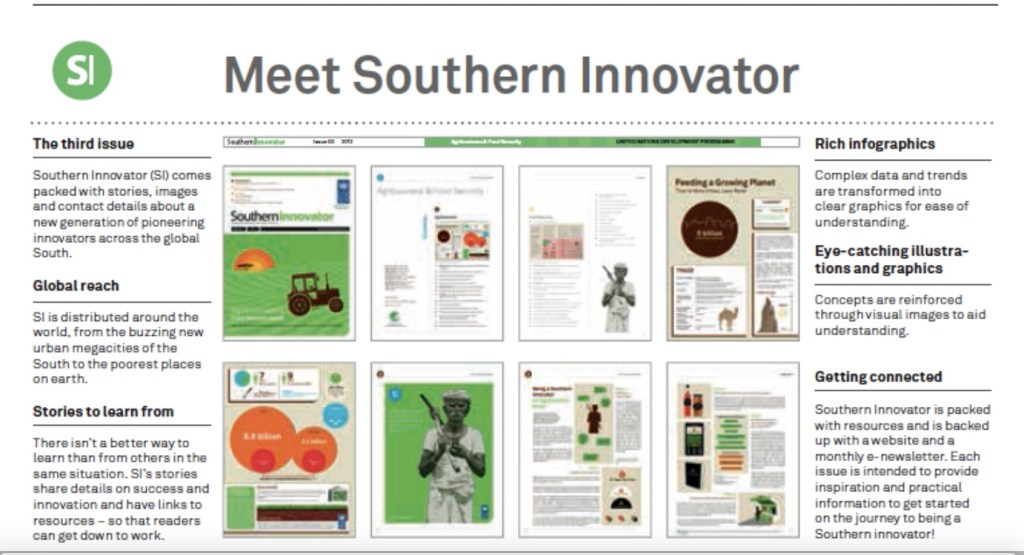
    Four issues of Southern Innovator Magazine.
    Creative Commons License

    This work is licensed under a
    Creative Commons Attribution-Noncommercial-No Derivative Works 3.0 License.

    ORCID iD: https://orcid.org/0000-0001-5311-1052.

    © David South Consulting 2022