
By David South, Development Challenges, South-South Solutions

There is sometimes a great deal of negativity surrounding the issue of manufacturing in Africa. Some claim the risks of doing business are too high or that the workers are not motivated enough. But one garment manufacturer is out to prove the skeptics wrong. It pays decent wages and gives its mostly female workforce a stake in the business in a bid to drive motivation and make it worthwhile to work hard.
Liberty and Justice (http://libertyandjustice.com), one of Africa’s newest fair-trade garment manufacturers, is drawing attention for the way it is transforming women’s lives. It is also giving opportunities to a group often ignored by employers: women over the age of 30.
Liberty and Justice has factories in Liberia and Ghana, and 90 per cent of its workers are female. The company says it pays 20 per cent higher wages than the industry norm, and gives employees collectively a 49 per cent stake in the enterprise.
The global fair trade market – in which producers are guaranteed a minimum fair price and goods are marketed under the Fairtrade logo – has been growing year on year since it was established in the late 1980s.
The brand and certification process is managed by the Fairtrade Foundation (fairtrade.net) and is considered the most recognized ethical mark in the world.
More than 1 million small-scale producers and workers around the world participate in the Fairtrade system. As of 2013, fair trade has become a 5 billion euro-a-year (US $6.79 billion a year) global movement.
The label can be found on more than 30,000 products, ranging from tea to bananas to sugar and chocolate. It benefits more than 1.35 million farmers and workers around the world.
Liberty and Justice specializes in “high-volume, time-sensitive, duty-free goods for leading American clothing brands, trading companies, and other importers who care about exceptional quality, on-time delivery, social and environmental impact, and geographic diversity.”
The company wants to “transform the apparel supply chain from worker exploitation and environmental degradation to partnership and sustainability.”
Liberty and Justice was established by Chid Liberty (http://libertyandjustice.com/#about), the son of an exiled Liberian diplomat. His life had been a privileged one living amongst Africa’s overseas diplomatic community.
“I thought Africans drove (Mercedes) Benzes and dressed up every day and went to the best schools,” he told Fast Company magazine. “It even messed up my orientation on things like race, because we had all different kinds of people working in my house as a kid – German, Indian, Turkish – and all of them were serving us in some way. So I just kind of grew up thinking that Africans were at the top of the food chain.”
Living in a prosperous bubble in Germany, he had an awakening to the real conditions in Africa when he was in the seventh grade: “When I read only 2 per cent of people have a telephone, I was so confused,” he said. “I started to really understand my place.”
After the death of his father, Liberty started to wonder about life back in Liberia. He had moved on to working in Silicon Valley in California, helping technology startups get funding. Inspired by Liberia’s President Ellen Sirleaf (http://en.wikipedia.org/wiki/Ellen_Johnson_Sirleaf) and the end of the country’s 15-year civil war, he thought: “‘All right, well, I think I can apply that skill to providing economic opportunities for women.’ And decided to come here and try, in an industry that I knew absolutely nothing about.”
In 2010 he and Adam Butlein founded Liberty and Justice fair-trade apparel manufacturer. The company now makes tops and bottoms for brands such as Prana, FEED Projects, Haggar and others in the US.
“We really try to be worker-focused,” Liberty said. “And we actually think that’s what gave us a cutting edge at the end of the day: having really devoted workers. People don’t really believe in these types of factories in Africa, because they believe that African workers aren’t motivated. I think that’s hogwash.”
The company faced a dilemma common to any manufacturing enterprise trying to make goods for the highly competitive global export markets. How to produce the garments fast enough? A consultant had advised them to only hire young women. But Liberty and Justice had hired women in their 30s, 40s and 50s. Rather than firing everyone, the company decided to invest in the workers’ skills and get productivity to where it should be.
“These older women really set the culture of the Liberian Women’s Sewing Project, our first factory,” Liberty said. “They come to work an hour early – we never asked them to do that – they pray and sing together before they get on the machines, they’re very serious about the details of how your uniform should look, and you just wouldn’t have gotten that out of a bunch of 19-year-old girls the first time.”
Liberty and Justice expanded to Ghana in 2012 and launched the Ghanaian Women’s Sewing Project. It had to adapt to how things are done in Ghana, and that was a steep learning curve.
But the company has learned a great deal about how to succeed in Africa as opportunities increase alongside growing wealth and incomes.
“You could easily get squashed in Africa if you don’t know the right people. You’ll just get sent down rabbit holes every day,” Liberty said.
“In Liberia, the World Bank reports that about 40 per cent of children are enrolled in school. Among the women for whom we provide jobs, 98 per cent of their children are in school. So to me it’s very clear: You give a woman the opportunity to work, and her priority will be putting her kids in school.”
And he believes this is just the beginning of something big. As LIberia recovers from civil war, it will lead to an economic and innovation renaissance that will filter out across West Africa.
“I really think that the opportunities for innovation are right here. And once we get the social finance opportunities right, I think you’ll see a little West African impact renaissance happening. There’s still a lot of work to do. I hope Liberty and Justice can be a small part of that.”
Published: March 2014
Resources
1) Fairtrade International: Fair trade is an alternative approach to conventional trade based on a partnership between producers and traders, businesses and consumers. The international Fairtrade system – made up of Fairtrade International and its member organizations – represents the world’s largest and most recognized fair trade system. Website: http://www.fairtrade.net/
2) Fairtrade Max Havelaar Netherlands: The Max Havelaar Foundation is an independent non-profit organization that licenses use of the Fairtrade Certification Mark on products in the Netherlands in accordance with internationally agreed Fairtrade standards. Website: http://www.maxhavelaar.nl/
3) Ten Thousand Villages: Ten Thousand Villages is an exceptional source for unique handmade gifts, jewelry, home decor, art and sculpture, textiles, serveware and personal accessories representing the diverse cultures of artisans in Asia, Africa, Latin America and the Middle East. One of the world’s largest fair trade organizations and a founding member of the World Fair Trade Organization (WFTO), the company strives to improve the livelihood of tens of thousands of disadvantaged artisans in 38 countries. Website: http://www.tenthousandvillages.com/
4) Ananse Village: An online marketplace selling traditional African crafts produced in a fair trade environment. Website: http://www.anansevillage.com/
5) Ecouterre: An online guide to the best ideas, innovations and emerging trends in eco fashion, sustainable style, organic beauty and ethical apparel. Website: http://www.ecouterre.com
6) Partnering with the United Nations-endorsed Ethical Fashion Initiative, whose motto “Not Charity, Just Work” seeks to promote sustainable development over aid, New Zealand designer Karen Walker tasked Kenya’s finest micro-producers, designers, and craftspeople to produce screen-printed pouches that will accompany every Karen Walker eyewear purchase from the collection. Website: http://www.karenwalkereyewear.com/ and https://www.facebook.com/media/set/?set=a.10152167286434183.1073741834.92673569182&type=1
Google Books: https://books.google.co.uk/books?id=WBM9BQAAQBAJ&dq=development+challenges+march+2014&source=gbs_navlinks_s
Slideshare: http://www.slideshare.net/DavidSouth1/development-challenges-march-2014-published-44135069
Southern Innovator Issue 1: https://books.google.co.uk/books?id=Q1O54YSE2BgC&dq=southern+innovator&source=gbs_navlinks_s
Southern Innovator Issue 2: https://books.google.co.uk/books?id=Ty0N969dcssC&dq=southern+innovator&source=gbs_navlinks_s
Southern Innovator Issue 3: https://books.google.co.uk/books?id=AQNt4YmhZagC&dq=southern+innovator&source=gbs_navlinks_s
Southern Innovator Issue 4: https://books.google.co.uk/books?id=9T_n2tA7l4EC&dq=southern+innovator&source=gbs_navlinks_s
Southern Innovator Issue 5: https://books.google.co.uk/books?id=6ILdAgAAQBAJ&dq=southern+innovator&source=gbs_navlinks_s

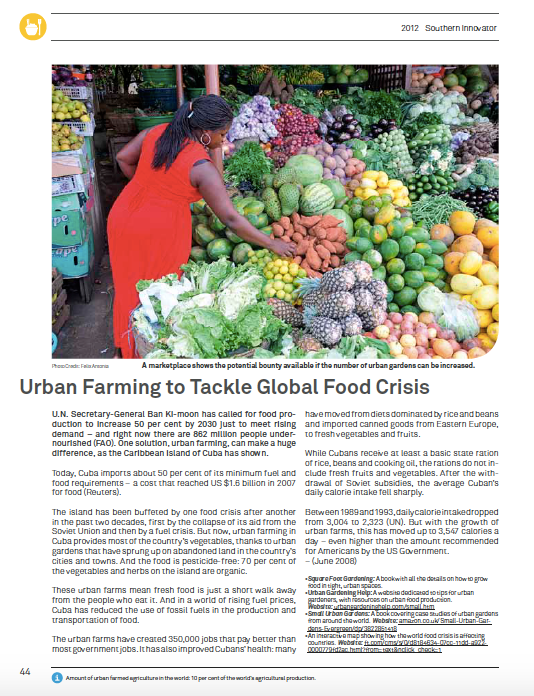
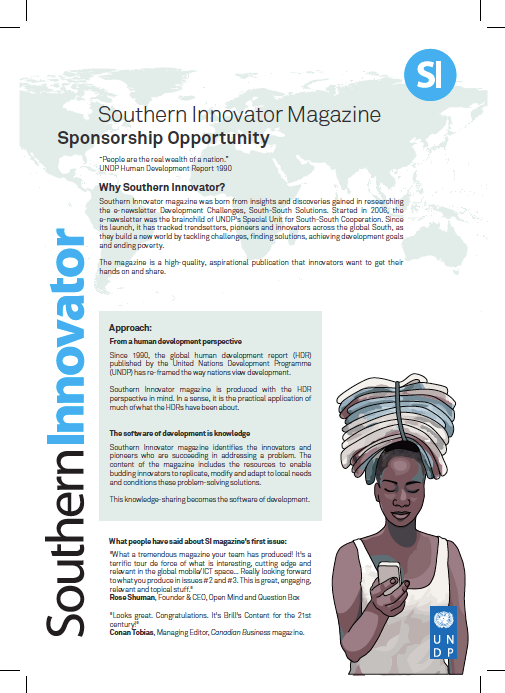
Development Challenges, South-South Solutions was launched as an e-newsletter in 2006 by UNDP’s South-South Cooperation Unit (now the United Nations Office for South-South Cooperation) based in New York, USA. It led on profiling the rise of the global South as an economic powerhouse and was one of the first regular publications to champion the global South’s innovators, entrepreneurs, and pioneers. It tracked the key trends that are now so profoundly reshaping how development is seen and done. This includes the rapid take-up of mobile phones and information technology in the global South (as profiled in the first issue of magazine Southern Innovator), the move to becoming a majority urban world, a growing global innovator culture, and the plethora of solutions being developed in the global South to tackle its problems and improve living conditions and boost human development. The success of the e-newsletter led to the launch of the magazine Southern Innovator.

This work is licensed under a
Creative Commons Attribution-Noncommercial-No Derivative Works 3.0 License.
ORCID iD: https://orcid.org/0000-0001-5311-1052.
© David South Consulting 2023
 David South Consulting
You must be logged in to post a comment.