Categories
Archive Development Challenges, South-South Solutions Newsletters

Farmers Weather Fertilizer Crisis by Going Organic

By David SouthDevelopment Challenges, South-South Solutions

SOUTH-SOUTH CASE STUDY

Around the world, large-scale agriculture relies on the use of chemical fertilizers. But increasing expense and decreasing supply of fertilizer is driving up the cost of food, and in turn contributing to the overall food crisis.

According to a soon-to-be-released UN report, prices have shot up and will stay high for at least three years. Prices have almost doubled and in some cases risen by 500 percent over 15 months.

The fertilizer crisis is caused by several factors. Anhydrous ammonia, which is the source of nearly all nitrogen fertilizer, needs natural gas, and the price of gas has risen sharply. Other fertilizer ingredients like phosphorous, potassium and potash are also increasingly expensive. Fertilizer needs to be transported long distances to get to farmers, so costs have risen with the soaring price of oil. And finally, the rise in demand for food has put the price of fertilizer up, as countries hoard supplies for themselves.

The 1960s ‘Green Revolution’ in agriculture made developing-world farmers dependent on supplies of fertilizers, pesticides and artificial irrigation. Monoculture cash crops became the norm. Yields were doubled, but at the expense of using three times as much water by accessing groundwater using electric pumps. This and fertilizer pollution has caused widespread damage to soil and water. In India, for example, 57 per cent of the land is degraded, according to Tata Energy Research.

In Cambodia, farmers are reaching back to past practices for answers to the fertilizer crisis. One is to go organic. Taking this approach has many health and environmental advantages – and, best of all for farmers, it keeps costs down.

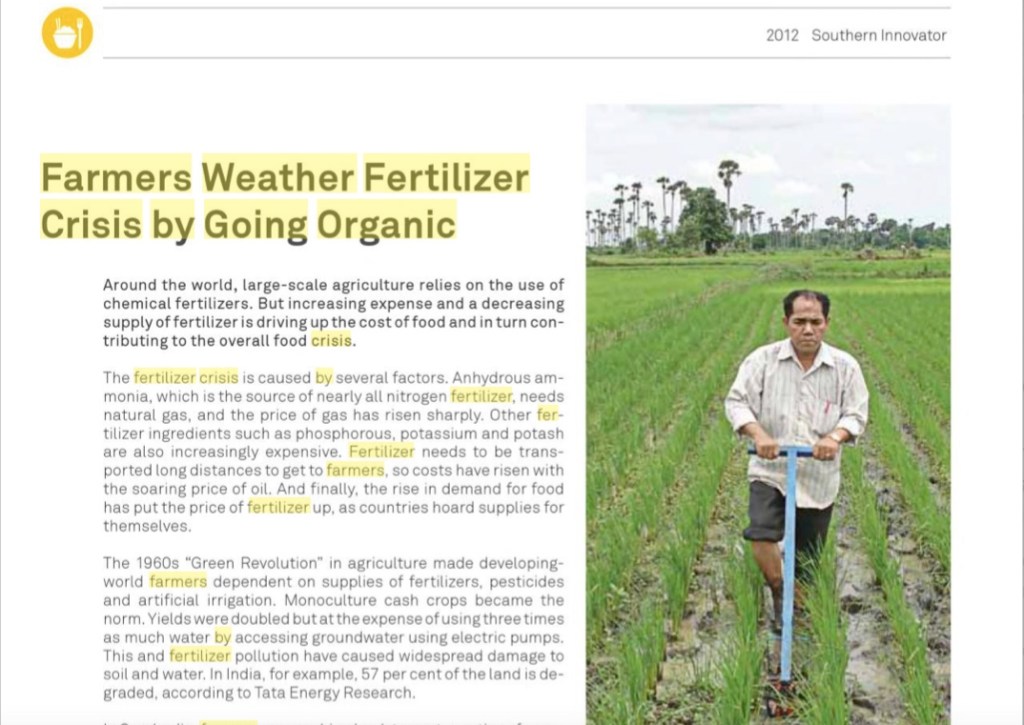
Khim Siphay, a Cambodian farmer, has found he gets bigger crops of rice and vegetables while paying a lot less for fertilizers.

“Using pesticide or fertilizers kills important insects, and causes the soil to become polluted,” he told Reuters. “I use compost and it helps keep the soil good from one year to another. All of my family members help make the compost.”

The push to organic methods for Cambodia’s 13 million people relying on agriculture for a living comes from a non-governmental organization, the Cambodian Center for Study and Development in Agriculture (CEDAC). It has successfully moved to organic methods, starting from just a handful of 28 farmers in 2000, to the current 60,000 – and received an endorsement from the Cambodian Ministry of Agriculture.

CEDAC says farms using the organic methods have been able to increase rice yields per hectare, while the seeds needed have fallen by 70 to 80 percent. By using a “System of Rice Intensification”, the mostly small-scale farmers are able to get more out of the land, with less labour. Add to that the fact that organic rice gets a premium price on world markets, and the result for the farmers has been a rise in income from US $58 to US $172 per hectare.

“The important point of organic farming is that farmers don’t need to spend money on fertilizers and pesticide so they spend less money on farming,” said CEDAC official Yang Saing Koma.

“They can sell the produce for a higher price. Also they can avoid being infected by pesticides and they will be healthier. It is also good for the environment,” he said.

Rice and other produce can be used to feed chickens to produce organic poultry and eggs – another bonus for farmers looking to raise the value of their produce.

“I started doing organic farming outside my rice paddy, but then I noticed production was double, so in the next season, I decided to grow organically on all of my land,” said farmer Ros Meo. “I spend less money now and I can grow more and I am not sick as I was before, my health is now good.”

Going organic in Cambodia is something that is becoming more attractive to the country’s growing middle class, and the government hopes the country will gain a reputation as an organic producer.

Another approach to cheap fertilizer comes from Caracas, Venezuala. Marjetica Potrc, an artist and architect who works closely with impoverished communities, has come up with a “dry toilet” which collects human waste and converts it to fertilizer.

Developed after spending six months in the barrios of Caracas, the dry, ecologically safe toilet was built on the upper part of La Vega barrio, a district in the city without access to the municipal water grid. It is a place where about half the population receives water from municipal authorities no more than two days a week.

Published: March 2014

Resources

  • South African company Eat Your Garden: It provides urban dwellers and food businesses with their own food gardens bursting with juicy and tasty foods whilst at the same time reducing carbon footprints, and creating employment and provide training, helping poverty alleviation.
    Website: http://www.eatyourgarden.co.za/
  • Soil Association: The organization that establishes the standards necessary for food to be called organically grown.
    Website: http://www.soilassociation.org/
  • Patrick Kamzitu, a farmer in Malawi, on the impact of fertilizer prices:
    Website: www.guardian.co.uk/environment

https://davidsouthconsulting.org/2022/11/21/agribusiness-food-security/

https://davidsouthconsulting.org/2022/11/11/building-an-interactive-radio-network-for-farmers-in-nigeria/

https://davidsouthconsulting.org/2022/05/30/carbon-credits-can-benefit-african-farmers-thanks-to-new-system/

https://davidsouthconsulting.org/2022/10/10/cheap-farming-kit-hopes-to-help-more-become-farmers/

https://davidsouthconsulting.org/2022/11/01/indonesian-food-company-helps-itself-by-making-farmers-more-efficient/

https://davidsouthconsulting.org/2022/11/23/kenyan-farmer-uses-internet-to-boost-potato-farm/

https://davidsouthconsulting.org/2022/10/21/a-new-african-beer-helps-smallholder-farmers/

https://davidsouthconsulting.org/2021/11/09/pocket-friendly-solution-to-help-farmers-go-organic/

https://davidsouthconsulting.org/2022/10/26/perfume-of-peace-helps-farmers-switch-from-drug-trade/

https://davidsouthconsulting.org/2022/11/23/putting-worms-to-work/

https://davidsouthconsulting.org/2022/10/17/small-scale-farmers-can-fight-malaria-battle/

https://davidsouthconsulting.org/2021/03/05/southern-innovator-issue-3/

https://davidsouthconsulting.org/2021/03/05/southern-innovator-issue-5/

https://davidsouthconsulting.org/2022/02/10/urban-farmers-gain-from-waste-water/

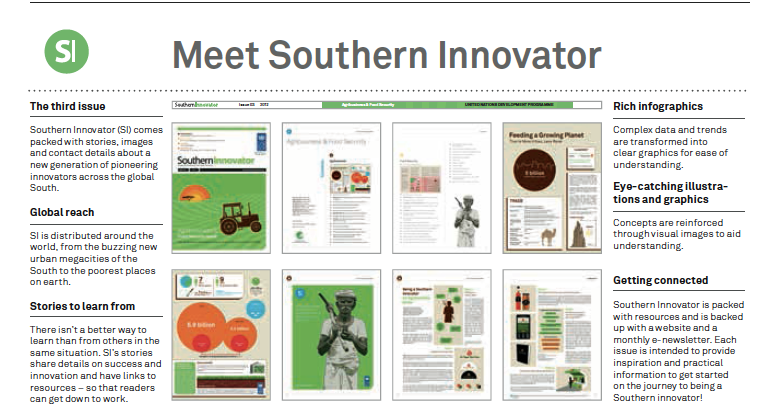
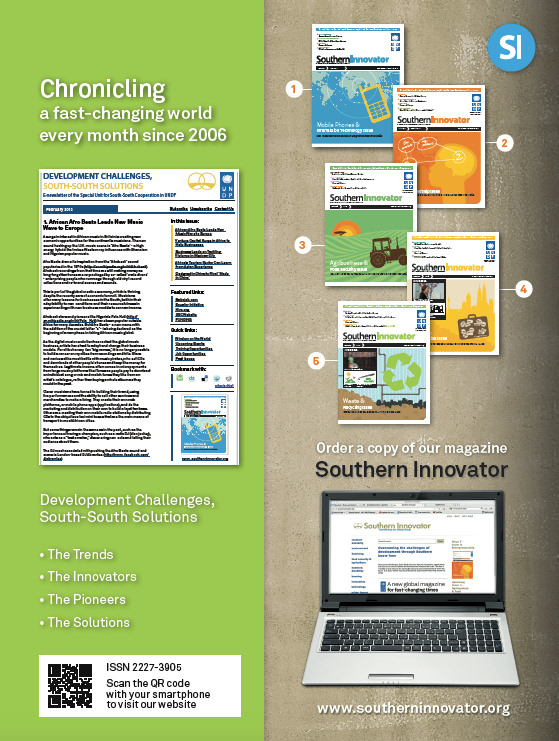
Development Challenges, South-South Solutions was launched as an e-newsletter in 2006 by UNDP’s South-South Cooperation Unit (now the United Nations Office for South-South Cooperation) based in New York, USA. It led on profiling the rise of the global South as an economic powerhouse and was one of the first regular publications to champion the global South’s innovators, entrepreneurs, and pioneers. It tracked the key trends that are now so profoundly reshaping how development is seen and done. This includes the rapid take-up of mobile phones and information technology in the global South (as profiled in the first issue of magazine Southern Innovator), the move to becoming a majority urban world, a growing global innovator culture, and the plethora of solutions being developed in the global South to tackle its problems and improve living conditions and boost human development. The success of the e-newsletter led to the launch of the magazine Southern Innovator.

Creative Commons License

This work is licensed under a
Creative Commons Attribution-Noncommercial-No Derivative Works 3.0 License.

ORCID iD: https://orcid.org/0000-0001-5311-1052.

© David South Consulting 2023

Categories
Archive Development Challenges, South-South Solutions Newsletters

African Tourism Leads the World and Brings New Opportunities

By David SouthDevelopment Challenges, South-South Solutions

SOUTH-SOUTH CASE STUDY

Tourism around the world is growing rapidly again after the setbacks caused by the September 11, 2001 terrorist attacks. Tourism is also finally acknowledging Africa – home to 888 million people (2005, UN) – and where 46 percent of sub-Saharan Africa’s people live on less than US$1 a day. Led by Kenya and South Africa, the continent has come out on top in world tourism growth according to the United Nations World Tourism Organisation (UNWTO) (http://www.unwto.org/). While global tourism is forecast to grow by four percent in 2007, Africa as a whole enjoyed growth of 10.6 percent in 2006.

Tourism, because it is a labour intensive industry, is seen as a great way to both reduce poverty and meet all the Millennium Development Goals. It favours small scale businesses, it is decentralized and can diversify regional economies, it is relatively non-polluting and can contribute to the conservation and promotion of natural and cultural heritage, and most importantly it can act as a catalyst for kick-starting other sectors of the economy.

Tourism is now generally recognized to be one of the largest industries-if not the largest-in the world. It has grown rapidly and almost continuously over the past 20 years, and is now one of the world’s most significant sources of employment and of Gross Domestic Product (GDP). Tourism particularly benefits the economies of developing countries, where most of the sector’s new tourism jobs and businesses are being created. This rapid growth has encouraged many developing nations to view tourism as key to promoting economic growth, and global development assistance agencies see it as having real potential to help achieve many of their own development goals.

Tourism provides opportunities for diversifying local economies and promoting formation of micro and small enterprises, many of them women-owned. These enterprises promote better lives for poor entrepreneurs, especially in rural areas where there may be few other livelihood options. Tourism is generally labor-intensive and it tends to employ relatively higher proportions of women and young people than most other sectors. Tourism introduces technology and basic infrastructure, and strengthens linkages with the outside world. Well-planned and -implemented tourism projects can improve local governance, natural resources management, biodiversity conservation and other important development goals.

Within Africa, sub-Saharan Africa led the way with 12.6 percent growth. The countries benefiting the most included Kenya, South Africa, Mozambique, Swaziland and the Seychelles. Kenya received almost a million tourists in 2006, and earned US $857 million in revenue.

Kenya’s success rests on the fact it set aside 10 percent of the country for wildlife and biodiversity conservation. The majority of its tourists come to see the ‘big five’ – elephant, rhino, lion, buffalo, and leopard. Tourism currently employs 11 percent of the country’s workforce.

In October 2004 the World Tourism Organization released the Washington Declaration on Tourism as a Sustainable Development Strategy. Governments, international aid agencies, and the world’s leading universities agreed to make sustainable tourism development a top priority in their strategies to reduce poverty and meet other MDGs.

Aid agencies like USAID have targeted women for micro-funding for tourism projects. They have been able to help women start businesses making crafts in Tanzania and Botswana. The UK’s DfID helped Toni Shina from the Cape Town-based The Backpack to become a fair trade business. “Fair Trade Tourism South Africa recognises our commitment to uplifting our staff and community, and our utilisation of local service providers,” she said. “As a business we also have a strong and positive attitude to working with and supporting staff who are affected by HIV and Aids and we abide strongly with required labour and legal standards.”

And the fair trade concept is getting greater recognition. In a recent survey of the local tourism industry in South Africa, half recognised the Fair Trade in Tourism South Africa brand.

On the other hand, the scale of missed opportunities is illuminated in Rwanda. A consultant on a tourism management plan for the Volcano National Park, Edwin Sabuhoro, is urging communities living nearby to embrace eco-tourism and cash in on the tourists visiting nearby gorillas.

“According to our research,” he told Kigali’s The New Times, “some tourists say they carry their money back to their countries because they can’t find what to spend on.” And he pointed out the fate of the gorillas were directly linked to the poverty of the community: poachers would not be stopped if the community remained poor and had no other source of income.

How popular Africa has become is exemplified by Ethiopia’s rise into the top ten travel destinations for 2007, according to travel guide specialist Frommer’s. According to the guide, “Ethiopia has finally emerged out of the shadows caused by years of political strife, economic hardship and famine. The improved infrastructure has made travelling in Ethiopia increasingly popular, especially among independent-minded travellers and those seeking adventure.”

Another country, Tanzania, is targeting tourism as a key growth area. The country is trumpeting its peaceful and stable status and low-crime to attract tourists.

Published: March 2014

Resources

Development Challenges, South-South Solutions was launched as an e-newsletter in 2006 by UNDP’s South-South Cooperation Unit (now the United Nations Office for South-South Cooperation) based in New York, USA. It led on profiling the rise of the global South as an economic powerhouse and was one of the first regular publications to champion the global South’s innovators, entrepreneurs, and pioneers. It tracked the key trends that are now so profoundly reshaping how development is seen and done. This includes the rapid take-up of mobile phones and information technology in the global South (as profiled in the first issue of magazine Southern Innovator), the move to becoming a majority urban world, a growing global innovator culture, and the plethora of solutions being developed in the global South to tackle its problems and improve living conditions and boost human development. The success of the e-newsletter led to the launch of the magazine Southern Innovator. 

Creative Commons License

This work is licensed under a
Creative Commons Attribution-Noncommercial-No Derivative Works 3.0 License.

ORCID iD: https://orcid.org/0000-0001-5311-1052.

© David South Consulting 2023

Categories
Archive Development Challenges, South-South Solutions Newsletters

Cheap Farming Kit Hopes to Help More Become Farmers

By David SouthDevelopment Challenges, South-South Solutions

SOUTH-SOUTH CASE STUDY

Food security is key to economic growth and human development. A secure and affordable food supply means people can meet their nutrition needs and direct their resources to improving other aspects of their lives, such as housing, clothing, health services or education.

One solution hopes to boost productivity for small-scale farmers and make agriculture a more attractive income source to the young and poor, by making it possible to grow food year-round. Kenyan social enterprise Amiran Kenya is selling the Amiran Foundation Kit (amirankenya.com), a simple-to-use greenhouse farming kit. As well as helping people grow both food and their agricultural business, Amiran Kenya hopes young people will also buy the kits at a discount and then sell them for a profit to others.

The technology to grow food year-round is already available, but it is generally expensive to set up. This cost is usually prohibitive to the poor and young: two groups who could really benefit from the income. And if young people in Africa learn the basics of farming, in time they could expand and develop into agribusinesses and benefit from the growing food demand on the continent.

Africa, a continent undergoing significant economic change, has yet to fully realize its potential as a producer of agricultural products to feed itself and the world. Africa currently has a labour-intensive but very inefficient agriculture system. While many Africans either make their living in agriculture or engage in subsistence farming for survival, much of Africa’s farming is inefficient and fails to make the most of the continent’s rich resources and potential.

At present, agriculture, farmers and agribusinesses make up almost 50 per cent of Africa’s economic activity, and the continent’s food system is worth an estimated US $313 billion a year (World Bank). A World Bank report, Growing Africa: Unlocking the Potential of Agribusiness (http://siteresources.worldbank.org/INTAFRICA/Resources/africa-agribusiness-report-2013.pdf), argues that Africa could have a trillion-dollar agriculture market by 2030.

While large-scale agribusinesses are increasing in Africa, it is still reliant on small-scale farmers to meet the daily food needs of most of the population.

“The time has come for making African agriculture and agribusiness a catalyst for ending poverty,” said Makhtar Diop, World Bank Vice President for Africa. The continent needs to “boost its high growth rates, create more jobs, significantly reduce poverty, and grow enough cheap, nutritious food to feed its families, export its surplus crops, while safeguarding the continent’s environment.”

Any country that has to import food will be vulnerable to currency fluctuations and the inflation in prices this can cause. A country that has many options for food, and reduces its dependency on imported food resources, will have greater resilience when crisis strikes.

Greenhouses are a great way to expand the growing season, avoiding ups and downs in temperature. But they can be expensive to set up – something the kit hopes to resolve. A typical greenhouse kit will cost a Kenyan an estimated 10 times more than the Amiran Foundation Kit, which retails at Sh 14,500 (US $168).

The package includes a drip-feed kit, a 250 liter water tank, a one liter sprayer, instructional growing guides, fertilizer, agro chemicals and high-quality seeds. Crops that can be grown include cabbage, watermelon, kale and spinach. The drip kit is highly durable and can last eight years, according to its manufacturer.

The kit is being marketed as a “kick starter for the small scale farmers who want to adopt agribusiness” as their method for growing food.

“The farmers will have a chance to start small and grow bit by bit until they are able to afford the modern greenhouses which will set the ball rolling for them to enjoy the benefits of modern agribusiness,” Yariv Kedar, Amiran Kenya’s Deputy Director, explains on the company’s website.

The plan is to draw more people into agriculture by showing they do not need to be prisoners of weather patterns. Larger agribusiness enterprises already have the resources to benefit from technology such as greenhouses and avoid the worst effects of the weather.

By transcending fickle weather patterns, it is possible to reduce the risk of crop failure and the resulting financial damage – one reason people shy away from farming.

Amiran’s philosophy behind the kit is simple: knowledge and know-how matched with high-quality inputs that do not harm the environment. The idea is to introduce people to the concept of agribusiness, no matter how small their land size. Amiran estimates that by investing Sh 14,500 (US $168), a person could make Sh 25,000 (US $290) per season – making back in a season the initial investment cost.

Urban farmers and home gardeners are among those who can benefit, along with small-scale farmers in arid and semi-arid areas of Kenya.

Kedar said the kit’s drip pipes, which deliver water directly to the root of the plant, ensure that “every drop counts” and save between 30 to 60 per cent of water compared to other methods of irrigation.

“Using the Amiran Foundation Kit, farmers are now able to grow all year round and experience high yields while still conserving the scarce resource, water,” he said.

Published: March 2014

Resources

1) World Vegetable Center: The World Vegetable Center is the world’s leading international non-profit research and development institute committed to alleviating poverty and malnutrition in developing countries through vegetable research and development. Website: http://www.avrdc.org

2) Songhai Centre: a Benin-based NGO that is a training, production, research, and development centre in sustainable agriculture. Website: http://www.songhai.org/english

3) Marketing African Leafy Vegetables: Challenges and Opportunities in the Kenyan Context by Kennedy M. Shiundu and Ruth. K. Oniang. Website: http://www.ajfand.net/Issue15/PDFs/8%20Shiundu-IPGR2_8.pdf

4) African Alliance for Capital Expansion: A management consultancy focused on private sector development and agribusiness in West Africa. Website: http://www.africanace.com/v3

Development Challenges, South-South Solutions was launched as an e-newsletter in 2006 by UNDP’s South-South Cooperation Unit (now the United Nations Office for South-South Cooperation) based in New York, USA. It led on profiling the rise of the global South as an economic powerhouse and was one of the first regular publications to champion the global South’s innovators, entrepreneurs, and pioneers. It tracked the key trends that are now so profoundly reshaping how development is seen and done. This includes the rapid take-up of mobile phones and information technology in the global South (as profiled in the first issue of magazine Southern Innovator), the move to becoming a majority urban world, a growing global innovator culture, and the plethora of solutions being developed in the global South to tackle its problems and improve living conditions and boost human development. The success of the e-newsletter led to the launch of the magazine Southern Innovator. 

Creative Commons License

This work is licensed under a
Creative Commons Attribution-Noncommercial-No Derivative Works 3.0 License.

ORCID iD: https://orcid.org/0000-0001-5311-1052.

© David South Consulting 2023

Categories
Archive Development Challenges, South-South Solutions Newsletters

Women Empowered by Fair Trade Manufacturer

By David SouthDevelopment Challenges, South-South Solutions

SOUTH-SOUTH CASE STUDY

There is sometimes a great deal of negativity surrounding the issue of manufacturing in Africa. Some claim the risks of doing business are too high or that the workers are not motivated enough. But one garment manufacturer is out to prove the skeptics wrong. It pays decent wages and gives its mostly female workforce a stake in the business in a bid to drive motivation and make it worthwhile to work hard.

Liberty and Justice (http://libertyandjustice.com), one of Africa’s newest fair-trade garment manufacturers, is drawing attention for the way it is transforming women’s lives. It is also giving opportunities to a group often ignored by employers: women over the age of 30.

Liberty and Justice has factories in Liberia and Ghana, and 90 per cent of its workers are female. The company says it pays 20 per cent higher wages than the industry norm, and gives employees collectively a 49 per cent stake in the enterprise.

The global fair trade market – in which producers are guaranteed a minimum fair price and goods are marketed under the Fairtrade logo – has been growing year on year since it was established in the late 1980s.

The brand and certification process is managed by the Fairtrade Foundation (fairtrade.net) and is considered the most recognized ethical mark in the world.

More than 1 million small-scale producers and workers around the world participate in the Fairtrade system. As of 2013, fair trade has become a 5 billion euro-a-year (US $6.79 billion a year) global movement.

The label can be found on more than 30,000 products, ranging from tea to bananas to sugar and chocolate. It benefits more than 1.35 million farmers and workers around the world.

Liberty and Justice specializes in “high-volume, time-sensitive, duty-free goods for leading American clothing brands, trading companies, and other importers who care about exceptional quality, on-time delivery, social and environmental impact, and geographic diversity.”

The company wants to “transform the apparel supply chain from worker exploitation and environmental degradation to partnership and sustainability.”

Liberty and Justice was established by Chid Liberty (http://libertyandjustice.com/#about), the son of an exiled Liberian diplomat. His life had been a privileged one living amongst Africa’s overseas diplomatic community.

“I thought Africans drove (Mercedes) Benzes and dressed up every day and went to the best schools,” he told Fast Company magazine. “It even messed up my orientation on things like race, because we had all different kinds of people working in my house as a kid – German, Indian, Turkish – and all of them were serving us in some way. So I just kind of grew up thinking that Africans were at the top of the food chain.”

Living in a prosperous bubble in Germany, he had an awakening to the real conditions in Africa when he was in the seventh grade: “When I read only 2 per cent of people have a telephone, I was so confused,” he said. “I started to really understand my place.”

After the death of his father, Liberty started to wonder about life back in Liberia. He had moved on to working in Silicon Valley in California, helping technology startups get funding. Inspired by Liberia’s President Ellen Sirleaf (http://en.wikipedia.org/wiki/Ellen_Johnson_Sirleaf) and the end of the country’s 15-year civil war, he thought: “‘All right, well, I think I can apply that skill to providing economic opportunities for women.’ And decided to come here and try, in an industry that I knew absolutely nothing about.”

In 2010 he and Adam Butlein founded Liberty and Justice fair-trade apparel manufacturer. The company now makes tops and bottoms for brands such as Prana, FEED Projects, Haggar and others in the US.

“We really try to be worker-focused,” Liberty said. “And we actually think that’s what gave us a cutting edge at the end of the day: having really devoted workers. People don’t really believe in these types of factories in Africa, because they believe that African workers aren’t motivated. I think that’s hogwash.”

The company faced a dilemma common to any manufacturing enterprise trying to make goods for the highly competitive global export markets. How to produce the garments fast enough? A consultant had advised them to only hire young women. But Liberty and Justice had hired women in their 30s, 40s and 50s. Rather than firing everyone, the company decided to invest in the workers’ skills and get productivity to where it should be.

“These older women really set the culture of the Liberian Women’s Sewing Project, our first factory,” Liberty said. “They come to work an hour early – we never asked them to do that – they pray and sing together before they get on the machines, they’re very serious about the details of how your uniform should look, and you just wouldn’t have gotten that out of a bunch of 19-year-old girls the first time.”

Liberty and Justice expanded to Ghana in 2012 and launched the Ghanaian Women’s Sewing Project. It had to adapt to how things are done in Ghana, and that was a steep learning curve.

But the company has learned a great deal about how to succeed in Africa as opportunities increase alongside growing wealth and incomes.

“You could easily get squashed in Africa if you don’t know the right people. You’ll just get sent down rabbit holes every day,” Liberty said.

“In Liberia, the World Bank reports that about 40 per cent of children are enrolled in school. Among the women for whom we provide jobs, 98 per cent of their children are in school. So to me it’s very clear: You give a woman the opportunity to work, and her priority will be putting her kids in school.”

And he believes this is just the beginning of something big. As LIberia recovers from civil war, it will lead to an economic and innovation renaissance that will filter out across West Africa.

“I really think that the opportunities for innovation are right here. And once we get the social finance opportunities right, I think you’ll see a little West African impact renaissance happening. There’s still a lot of work to do. I hope Liberty and Justice can be a small part of that.”

Published: March 2014

Resources

1) Fairtrade International: Fair trade is an alternative approach to conventional trade based on a partnership between producers and traders, businesses and consumers. The international Fairtrade system – made up of Fairtrade International and its member organizations – represents the world’s largest and most recognized fair trade system. Website: http://www.fairtrade.net/

2) Fairtrade Max Havelaar Netherlands: The Max Havelaar Foundation is an independent non-profit organization that licenses use of the Fairtrade Certification Mark on products in the Netherlands in accordance with internationally agreed Fairtrade standards. Website: http://www.maxhavelaar.nl/

3) Ten Thousand Villages: Ten Thousand Villages is an exceptional source for unique handmade gifts, jewelry, home decor, art and sculpture, textiles, serveware and personal accessories representing the diverse cultures of artisans in Asia, Africa, Latin America and the Middle East. One of the world’s largest fair trade organizations and a founding member of the World Fair Trade Organization (WFTO), the company strives to improve the livelihood of tens of thousands of disadvantaged artisans in 38 countries. Website: http://www.tenthousandvillages.com/

4) Ananse Village: An online marketplace selling traditional African crafts produced in a fair trade environment. Website: http://www.anansevillage.com/

5) Ecouterre: An online guide to the best ideas, innovations and emerging trends in eco fashion, sustainable style, organic beauty and ethical apparel. Website: http://www.ecouterre.com

6) Partnering with the United Nations-endorsed Ethical Fashion Initiative, whose motto “Not Charity, Just Work” seeks to promote sustainable development over aid, New Zealand designer Karen Walker tasked Kenya’s finest micro-producers, designers, and craftspeople to produce screen-printed pouches that will accompany every Karen Walker eyewear purchase from the collection. Website: http://www.karenwalkereyewear.com/ and https://www.facebook.com/media/set/?set=a.10152167286434183.1073741834.92673569182&type=1

Google Books: https://books.google.co.uk/books?id=WBM9BQAAQBAJ&dq=development+challenges+march+2014&source=gbs_navlinks_s

Slideshare: http://www.slideshare.net/DavidSouth1/development-challenges-march-2014-published-44135069

Southern Innovator Issue 1: https://books.google.co.uk/books?id=Q1O54YSE2BgC&dq=southern+innovator&source=gbs_navlinks_s

Southern Innovator Issue 2: https://books.google.co.uk/books?id=Ty0N969dcssC&dq=southern+innovator&source=gbs_navlinks_s

Southern Innovator Issue 3: https://books.google.co.uk/books?id=AQNt4YmhZagC&dq=southern+innovator&source=gbs_navlinks_s

Southern Innovator Issue 4: https://books.google.co.uk/books?id=9T_n2tA7l4EC&dq=southern+innovator&source=gbs_navlinks_s

Southern Innovator Issue 5: https://books.google.co.uk/books?id=6ILdAgAAQBAJ&dq=southern+innovator&source=gbs_navlinks_s

Development Challenges, South-South Solutions was launched as an e-newsletter in 2006 by UNDP’s South-South Cooperation Unit (now the United Nations Office for South-South Cooperation) based in New York, USA. It led on profiling the rise of the global South as an economic powerhouse and was one of the first regular publications to champion the global South’s innovators, entrepreneurs, and pioneers. It tracked the key trends that are now so profoundly reshaping how development is seen and done. This includes the rapid take-up of mobile phones and information technology in the global South (as profiled in the first issue of magazine Southern Innovator), the move to becoming a majority urban world, a growing global innovator culture, and the plethora of solutions being developed in the global South to tackle its problems and improve living conditions and boost human development. The success of the e-newsletter led to the launch of the magazine Southern Innovator.  

Creative Commons License

This work is licensed under a
Creative Commons Attribution-Noncommercial-No Derivative Works 3.0 License.

ORCID iD: https://orcid.org/0000-0001-5311-1052.

© David South Consulting 2023