Categories
Archive Development Challenges, South-South Solutions Newsletters Southern Innovator magazine

Business as a Tool to Do Good

By David SouthDevelopment Challenges, South-South Solutions

SOUTH-SOUTH CASE STUDY

The United States’ fast-paced and highly inventive technology sector is re-shaping philanthropy and proving it is possible to do good and make money at the same time. The approach taken by these philanthropists is flavoured by their experiences in the cut-throat world of technology, where innovation is a necessity and where re-invention and risk are de rigeur. They share many of these qualities, counter intuitively, with millions of the world’s poor as they struggle day in and day out to survive and get ahead.

Differing from the Fairtrade movement – whose origins are in NGOs seeking guaranteed fair price for goods – so-called ‘venture philanthropists’ and ‘social entrepreneurs’ focus more on profit and growth. They draw their inspiration from the online networks that have rocked the business world in the past few years, and look to apply a model of constant innovation.

The past ten years have seen non-profits more and more adopt the language and methods of business. For ‘venture philanthropists’ and ‘social entrepreneurs’, business is the tool to do good. By breaking out of the narrow view of philanthropy as about giving away money, it becomes possible to see the connections between doing good and making good money, venture philanthropists argue. And as more people think this way, more tools are emerging to make it easier and easier to do.

The highly successful online auction house Ebay’s founders Jeff Skoll and Pierre Omidyar are part of a wave of new thinking from California’s high-tech Silicon Valley that is shaping the way huge sums of private capital get invested in social change.

‘Venture philanthropists’ focus on a small portfolio of grantees that make the most of the investment. By giving them large, long commitments, including money for infrastructure such as staff and computers, they don’t spend all their time fundraising. And unlike traditional philanthropists, they get in their offices and work with them like partners instead of waiting for annual reports, and they hold the grantees to quantifiable goals.

The success of Nobel Prize winner Mohammed Yunus and his microcredit bank, Grameen, has spawned an even more ambitious venture. The Omidyar Network – led by billionaire Omidyar – calculated it would take between US $50 and US $60 billion to provide micro-lending services to the entire world’s poor. The Network is currently putting together the financing to launch this new micro-lending facility across the world. According to Omidyar, private capital is functionally limitless. Look at it that way, he said recently to the Los Angeles Times, and “$60 billion is nothing.”

Billing itself as a nonprofit venture capital firm, the Acumen Fund uses the principles of design to solve the problems of the poor. Just as the Procter & Gambles (PG) and Motorolas (MOT) of the corporate world conduct extensive ethnographic research on consumers, Acumen finances companies that create systems from the bottom up. “Start with the individuals,” said founder Jacqueline Novogratz. “Build systems from their perspective. Really pay attention, and then see if they can scale.”

Under Novogratz’s leadership, the New York-based fund manages $20 million in investments in companies that fall within three portfolios: health, water, and housing. It’s not a lot of money compared with any of the traditional venture funds in Silicon Valley. But Acumen’s goal is not to launch initial public offerings. Rather, Novogratz and her team are building prototypes for new business models that measure returns in social benefits as well as monetary rewards.

“We are betting on entrepreneurs, we look for a strong management team,” said Brian Trelstad, Chief Investment Officer of the Acumen Fund. “We currently have US $20 million in investments in six countries. We hope to take that to US $100 million in the next five years. We are beginning to see a really rich pipeline developing in our investment countries and more high quality investment opportunities coming our way. We are looking for people who are passionate about their approach and who continue to build their business from the perspective of the people in need.”

Larry Page and Sergey Brin, the founders of the successful search engine Google, started their philanthropic wing, Google.org, following Ebay’s example. They endowed Google.org with stock now worth about US $1 billion. Then they followed Omidyar’s example and set themselves up as a for-profit network.

“In the old American business model, the relationships between a firm and its investors, bank, suppliers and customers tended to be very arm’s length,” says Annalee Saxenian, dean of UC Berkeley’s School of Information. “You would make a deal and report back after some specified period of time. The new business model is much more engaged. Everyone learns from one another, and there is a continuous flow of information. The firms are more specialized, but they see each other as collaborators.”

The approach, just like in the pell mell pace of the computer industry, is relentless. Just as computer software and hardware manufacturers follow a constant improvement and innovation cycle, so can social entrepreneurs.

Published: March 2007

Resources

  • The Skoll Centre for Social Entrepreneurship at Oxford’s Said Business School, hosts the Skoll World Forum every year to promote entrepreneurial solutions to social problems.
  • Ashoka: Ashoka is the global association of the world’s leading social entrepreneurs. It identifies and invests in leading social entrepreneurs with innovative and practical ideas at the launch stage. They then receive a living stipend for three years to focus on their ideas.
  • Social Ventures Partners: While only focused on the Seattle, USA area, SVP offers a model that can be applied throughout the global South. The vision of the founders was to build a philanthropic organization using a venture capital model, where partners actively nurture their financial investments with guidance and resources.
  • Generation Investment Management: Started in 2004 with former US vice president Al Gore, they only focus on investments that are long-term, sustainable and that they really believe in.
  • Omidyar Network: Started by Ebay’s founders, it funds for-profits and non-profits who promote equal access to information, tools and opportunities, and encourage shared interests and a sense of ownership among participants.
  • Skoll Foundation: The mission of the Foundation is to seek out social entrepreneurs who are already implementing successful programs on a small scale, and then through three-year awards, support the continuation, replication or extension of the program. Issues funded are: tolerance and human rights, health, environmental sustainability, economic and social equity, institutional responsibility, and personal security.
  • SV2: Silicon Valley Social Venture Fund: A partnership of successful technology entrepreneurs, it pools funds to support social entrepreneurs by giving money and giving time – venture philanthropy.
  • Google.org: It uses the talent, technology and financial resources of the successful search engine to tackle global poverty.
  • Acumen Fund: A non-profit venture fund that invests in market-based solutions to global poverty. The Fund supports entrepreneurial approaches to developing affordable goods and services for the 4 billion people in the world who live on less than $4 a day.
  • TechnoServe: Helps budding entrepreneurs turn good business ideas into thriving enterprises. With funding from the Google Foundation, they are launching a Business Plan Competition and an Entrepreneurship Development Program in Ghana.

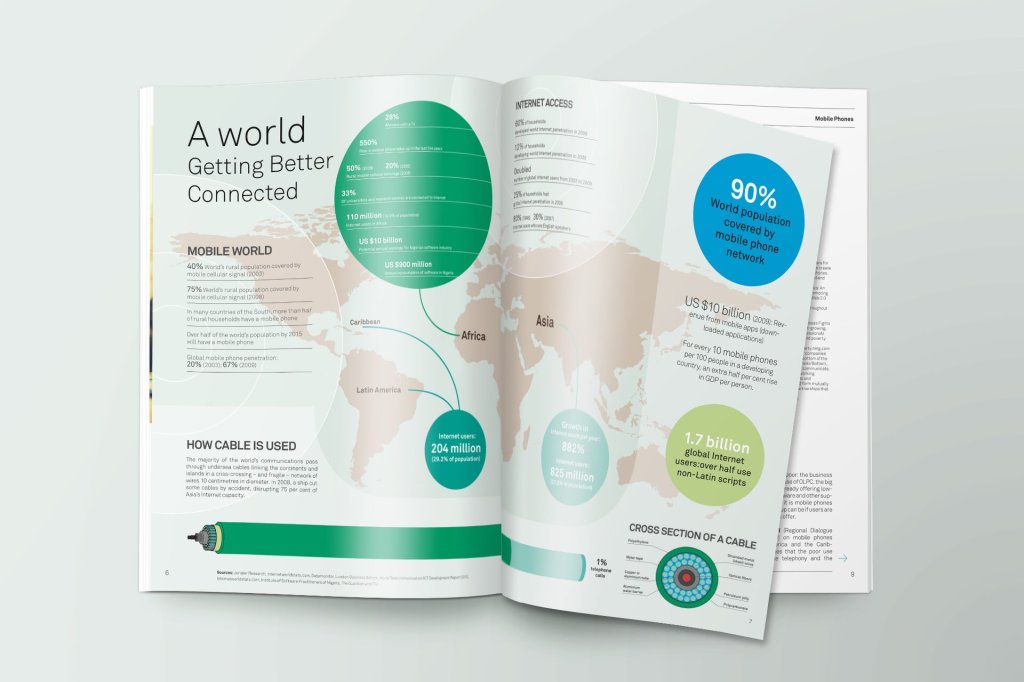
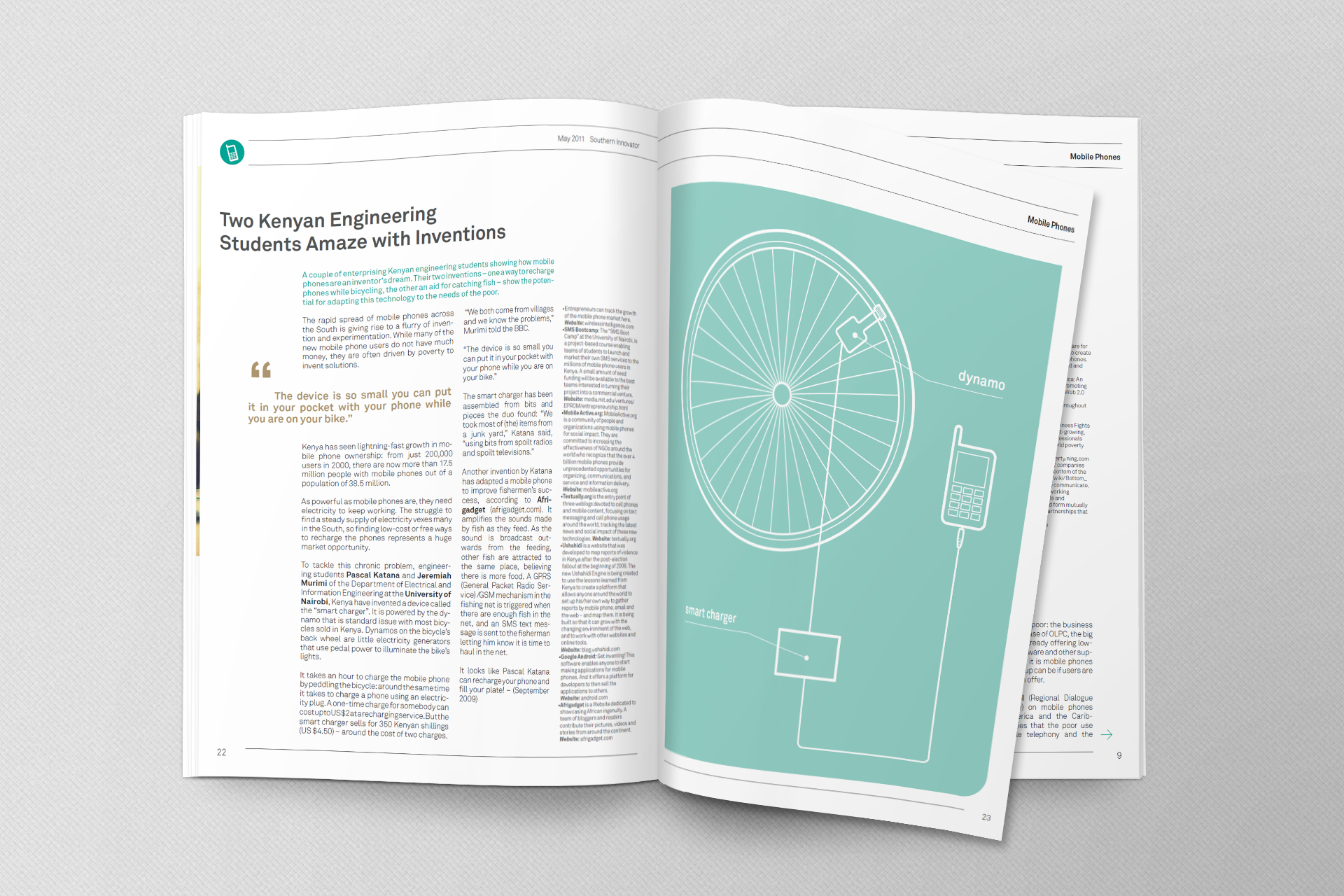
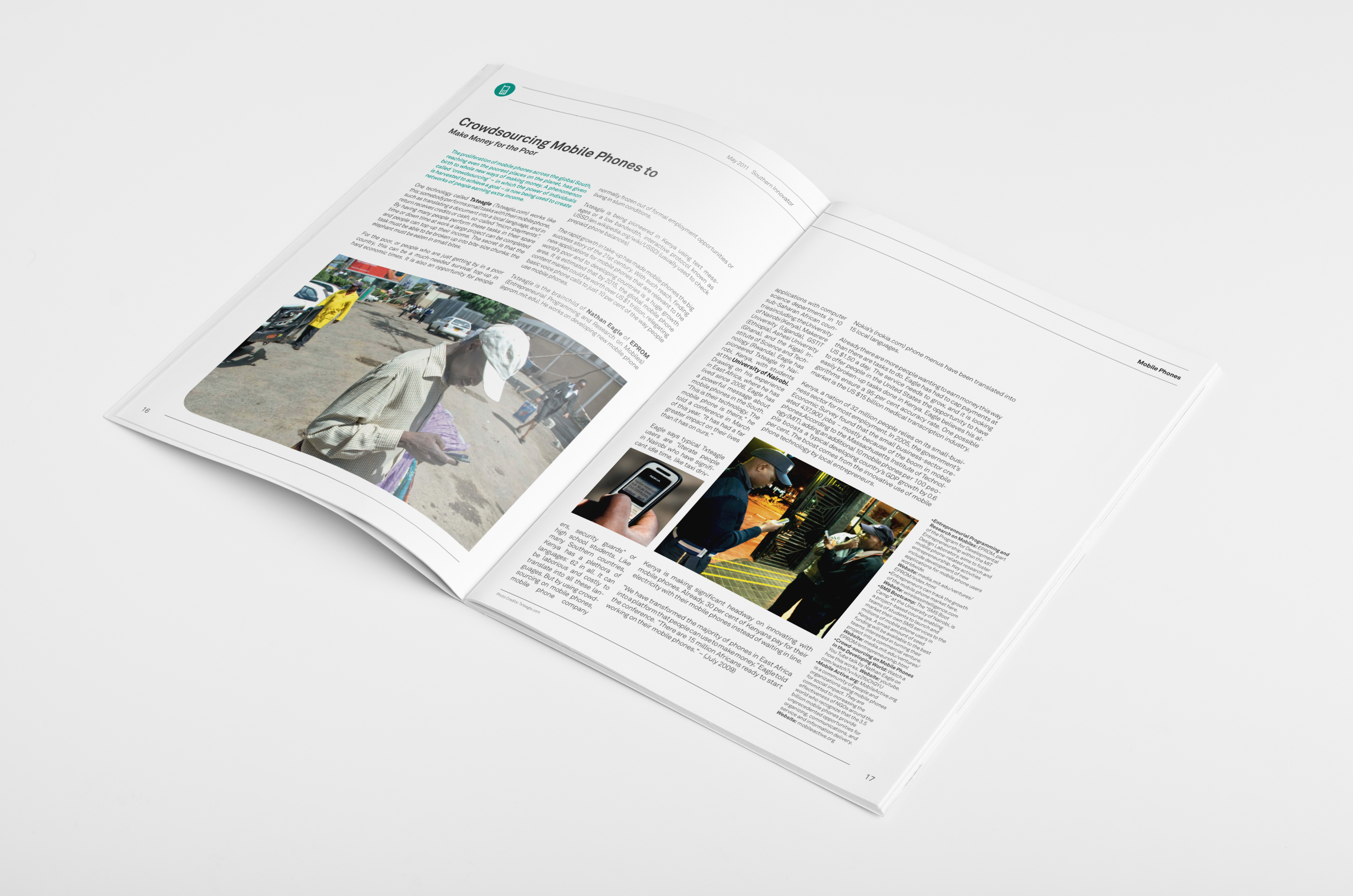
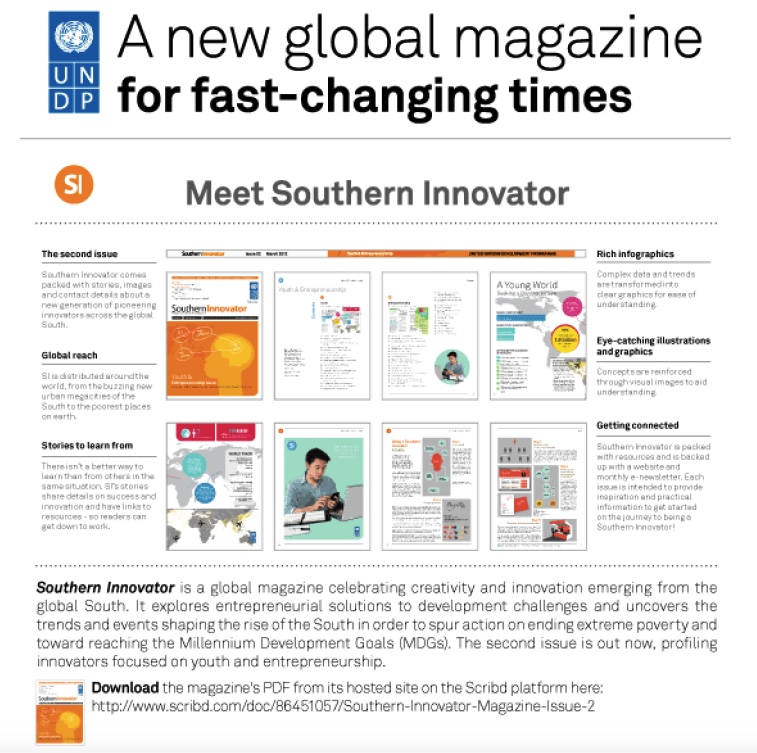
Development Challenges, South-South Solutions was launched as an e-newsletter in 2006 by UNDP’s South-South Cooperation Unit (now the United Nations Office for South-South Cooperation) based in New York, USA. It led on profiling the rise of the global South as an economic powerhouse and was one of the first regular publications to champion the global South’s innovators, entrepreneurs, and pioneers. It tracked the key trends that are now so profoundly reshaping how development is seen and done. This includes the rapid take-up of mobile phones and information technology in the global South (as profiled in the first issue of magazine Southern Innovator), the move to becoming a majority urban world, a growing global innovator culture, and the plethora of solutions being developed in the global South to tackle its problems and improve living conditions and boost human development. The success of the e-newsletter led to the launch of the magazine Southern Innovator. 

Creative Commons License

This work is licensed under a
Creative Commons Attribution-Noncommercial-No Derivative Works 3.0 License.

ORCID iD: https://orcid.org/0000-0001-5311-1052.

© David South Consulting 2023

Categories
Archive data Development Challenges, South-South Solutions Newsletters digital ID Southern Innovator magazine

Social Networking Websites: A Way Out of Poverty

By David SouthDevelopment Challenges, South-South Solutions

SOUTH-SOUTH CASE STUDY

Social networking websites also known as, Web 2.0 – the name given to the new wave of internet businesses and websites such as YouTube and MySpace that are transforming the way people interact with the Web – has been dubbed the social web for its power to bring people together. The label has been derided as a marketing gimmick by some, but many argue there are a number of characteristics to Web 2.0 that make it something different and a valuable tool for entrepreneurs seeking ways out of poverty.

The new Web 2.0 applications offer many free software tools stored online, from accounting and business related tools, to new multimedia ways to communicate for free. Unlike Web 1.0 sites, which offered information to passive users, Web 2.0 sites allow interaction and comment. These qualities have meant Web 2.0 can be used to build communities and social and business networks. By being able to store vast quantities of information online, it becomes faster to work and reduces the painful delays brought on by slow connections.

All these new tools are making it easier and easier for entrepreneurs to work from home, in internet centres, or anywhere there is a wireless connection, and is slashing the costs of managing a business. All the applications are online so there is no need to be hidebound by one operating system or hardware capability. The number of internet centres has increased significantly all over Asia and Africa, bringing the power of Web 2.0 to millions more people.

Linking mobile phones and the internet is also remarkable. It is becoming more and more possible in Africa to send messages to weblogs via text messaging, to post photos and videos, or to stay connected with a community, advocacy or business group via messaging to its website.

“Web 2.0 is a pre-occupation of ours that can be beneficial in fighting poverty,” said Tobias Eigan, founder and co-executive director of Kabissa.org, a web portal dedicated to promoting Web 2.0 in Africa. “It is really relevant for Africa. It makes the internet a read and write function, it is more user-friendly – that dynamic is going to make a big difference. It is so much easier to upload content with Web 2.0. It will build the capacity of local institutions and society and that will improve the lives of people – it will be much easier to fight poverty with this connectivity.”

Two other champions of the Web 2.0 way out of poverty are Waleed al-Shobakky, science and technology reporter for alJazeera.net, and Jack Imsdahl, a consultant and technology commentator. While they admit subsistence farmers and the illiterate will not directly benefit, those who are students or are working in proximity to computers will definitely benefit. They point out how rapidly mobile phones have been taken up by the poor and that this is being driven by the new services they offer.

There are still profound obstacles to more rapid take-up, however. Internet connection speeds will have to get better and more will need to be invested in this area. Web 2.0 tools will also need to be adapted to local languages if they hope to get past those who speak major web languages like English.

Entrepreneurs in the global South can now easily sign up to a vast array of e-newsletters that are sent to email accounts and keep on top of trends and innovations in their field. The relative anonymity of these email lists mean subscribers are less likely to be judged on their physical circumstances.

Published: March 2007

Resources

Afriville is a Web 2.0 service and an African Caribbean social network started by two Nigerian web entrepreneurs in their twenties, Folabi Ogunkoya and Lawrence Bassey-Oden.

Afriville is a community website along the lines of the famous MySpace. Users are free to message and post profiles. The difference is that the user is able to choose how closed or open the networks are. The site features a state of the art music management system which allows African and Caribbean artists to get straight in touch with their fans.

“We have created a solid app(lication) with features that will give the big players a run for their money,” said Ogunkoya.

African entrepreneurs have already stepped in with other Web 2.0 offerings. These include: Mooziko.com (an African YouTube), Afribian.com (news sharing), Afriqueka.com (social networking), Yesnomayb (online dating).

Both Yahoo! And Google offer extensive free online tools for entrepreneurs and businesses that integrate seamlessly with their email services.

Kabissa: Space for Change in Africa: An online African web community promoting and supporting the transition to Web 2.0 services in Africa. Offers lots of opportunities to meet people throughout Africa and learn more.

Alexa: Here can be found a detailed break down by country in Africa of web use and site popularity and trends.

Digital Divide Network: A website linking together initiatives and offering opportunities to debate current issues and problems.

Global Voices: An initiative from the Reuters news agency to aggregate the global conversation online from countries outside the US and Western Europe.

Free Web 2.0 tools for entrepreneurs:

Wikis: Here is a detailed article on wikis – collaborative websites that allow authorised users to rapidly and easily change the content of pages – and a detailed list of free or low-cost wiki services.

>> Blogging (an online diary):

Blogger.com – A free, easy-to-use, online service owned by Google.

BlogPlanet.net – Blog from your mobile phone, free.

Blogsome.com – An easy-to-use, free service with good support for photos.

Movable Type – An open-source, free, easy to use, online publishing system popular with bloggers.

WordPress – Another easy, free, and popular online publishing system popular with bloggers.

>> Aggregators (these are programmes that gather links and resources off the web):

AmphetaDesk – One of the first news aggregators to really catch on, it’s still popular.

Bloglines – Allows bloggers and webmasters to search, subscribe to, publish, and share RSS news feeds online.

Del.icio.us – Aggregate content from your favorite Web sites and share them with others.

Feed Demon – The news you want delivered to your desktop.

Technorati – A real-time search engine that keeps track of what is happening in the world of blogs.

Techsoup.org is an excellent resource for all the latest developments in Web 2.0 and how to access free or low-cost resources. Being based in the US, it gets the inside scoop on cutting edge developments in Silicon Valley.

Development Challenges, South-South Solutions was launched as an e-newsletter in 2006 by UNDP’s South-South Cooperation Unit (now the United Nations Office for South-South Cooperation) based in New York, USA. It led on profiling the rise of the global South as an economic powerhouse and was one of the first regular publications to champion the global South’s innovators, entrepreneurs, and pioneers. It tracked the key trends that are now so profoundly reshaping how development is seen and done. This includes the rapid take-up of mobile phones and information technology in the global South (as profiled in the first issue of magazine Southern Innovator), the move to becoming a majority urban world, a growing global innovator culture, and the plethora of solutions being developed in the global South to tackle its problems and improve living conditions and boost human development. The success of the e-newsletter led to the launch of the magazine Southern Innovator. 
Creative Commons License

This work is licensed under a
Creative Commons Attribution-Noncommercial-No Derivative Works 3.0 License.

ORCID iD: https://orcid.org/0000-0001-5311-1052.

© David South Consulting 2023

Categories
Archive Development Challenges, South-South Solutions Newsletters

Fashion Closes Gap Between Catwalk and Crafts

By David SouthDevelopment Challenges, South-South Solutions

SOUTH-SOUTH CASE STUDY

The notion of doing right with fashion has been getting a make-over in the past few years. In the West, non-sweatshop clothing and crafts from developing countries have long been confined to a small niche in the marketplace. They were seen at best as garments for the eccentric or unconventional, and at worst as a poor substitute for clothing and accessories peddled by the major manufacturers. Organic or ethically produced products were often stigmatized as unfashionable and frumpy.

In Paris, the Ethical Fashion Show, now in its fourth year, showcases fashion that respects people and the environment while still being glamorous, luxurious and trendy. It has attracted designers from around the world, including Mongolia, Thailand, China, Peru and Bolivia. The show demands that all participants adhere to International Labour Organization conventions – including banning forced and child labour – respect the environment, create local employment and work with craftspeople to ensure skills are retained and the fashion reflects the diversity of the world’s cultures.

As an example of the high growth in ethical fashion in the past year, the UK chain of clothing and food retailers Marks and Spencer has become the world’s biggest buyer of Fairtrade cotton.

“I have only been in the business for the past 12 months, but at first it was hard to find producers,” said Tamzin Berry, owner of the British company Ethical Catwalk. “But now it has really taken off. Celebrities have helped to raise the profile. One line we carry, Red Mother, Madonna’s backing dancers wear it. I have found everybody in the business to be very approachable, genuinely caring and ethical people.”

Style is the big consideration now, said Berry. “More of the trendy labels have taken up the challenge and it seems to be going the same way as the organic food. “

“The fashion industry has one of the worst reputations of any industry,” Dr. Katie Beverley of the University of Leeds’ Nonwovens Research Group told The Guardian newspaper. “But the drive for ethical and environmental considerations in design has never been stronger.”

In Mozambique, catwalk fashions are helping poor people and saving fast-depleting forests. A project by the International Trade Centre (a joint initiative between UNCTAD and the WTO (www.intracen.org)) in the forests of Sofala Province – stretching from Angola to southern Tanzania, Mozambique, and northern South Africa – targets this home of rare hardwoods. Local craftspeople in the town of Dondo were producing crafts for a tourist market that didn’t exist and a local market that couldn’t afford them. But by bringing on board the social entrepreneur Allan Schwarz – an expert in working with forest communities and an Ashoka fellow (www.ashoka.org) – they were able to create bracelets of high enough quality to sell in fashion magazines and be a hit at the Ethical Fashion Show in Paris. On average, workers wages have increased 14 times topping at US $300/month in a country where average income per year is US $250.

Published: March 2007

Resources

  • Potential designers and exhibitors can contact the Ethical Fashion Show by sending collection photos and a brief explanation on how the fashions contribute to the ethical fashion movement, to 4, rue Trousseau 75011 Paris. Email: unilove@wanadoo.fr
  • Ethical Catwalk: One of the UK’s leading suppliers of ethical fashion and accessories. They only use organic and Fairtrade products.
  • People Tree: A five-year-old online shopping site created in partnership with producers from the poorest communities around the world.
  • Allan Schwarz bracelets: www.allanschwarz.com
  • Cebra: Fair Trade Crafts from Africa: An online shopping site that sources handcrafted fair trade fashions and products from Africa.
  • Fair Indigo: A fair trade fashion company based in Madison, Wisconsin, USA.

Development Challenges, South-South Solutions was launched as an e-newsletter in 2006 by UNDP’s South-South Cooperation Unit (now the United Nations Office for South-South Cooperation) based in New York, USA. It led on profiling the rise of the global South as an economic powerhouse and was one of the first regular publications to champion the global South’s innovators, entrepreneurs, and pioneers. It tracked the key trends that are now so profoundly reshaping how development is seen and done. This includes the rapid take-up of mobile phones and information technology in the global South (as profiled in the first issue of magazine Southern Innovator), the move to becoming a majority urban world, a growing global innovator culture, and the plethora of solutions being developed in the global South to tackle its problems and improve living conditions and boost human development. The success of the e-newsletter led to the launch of the magazine Southern Innovator.  

Creative Commons License

This work is licensed under a
Creative Commons Attribution-Noncommercial-No Derivative Works 3.0 License.

ORCID iD: https://orcid.org/0000-0001-5311-1052.

© David South Consulting 2022