Categories
Archive Development Challenges, South-South Solutions Newsletters

Bolivia Grabs World Media Attention with Salt Hotel

By David SouthDevelopment Challenges, South-South Solutions

SOUTH-SOUTH CASE STUDY

Tourism is a great way to attract foreign currency to a country and build local economies, especially in remote or isolated places. But the catch is finding a way to get people to go the distance and come and visit and spend their money.

In a global South twist on the well-known Ice Hotel in Sweden(www.icehotel.com) – a hotel entirely built out of ice – enterprising Bolivians have built a hotel out of salt.

A Bolivian hotel in the middle of the world’s largest salt flats has found a clever way to attract tourists to this remote holiday destination: build the hotel entirely out of salt, right down to its furniture.

The South American nation is one of the poorest inLatin America, and its income distribution is among the region’s most unequal. Bringing in foreign currency and attracting more tourists can help to reduce this poverty. According to the World Travel and Tourism Council, travel and tourism will contribute 2 percent to the country’s gross domestic product (GDP) in 2011. Around 75,000 jobs are directly dependent on the tourism business in the country and this is projected to rise to 96,000 jobs by 2021.

And it is a good business to be involved in: “Travel and tourism is one of the world’s great industries, providing 9 percent of global GDP and 260 million jobs; it drives economic growth, business relationships and social mobility,” according to David Scowsill, President and CEO of the World Travel and Tourism Council.

The Hotel de Sal Cristal (http://www.hosteldesal.com/?L=2), near Colchani, hosts guests who come to visit the salt flats of Salar de Uyuni (http://en.wikipedia.org/wiki/Salar_de_Uyuni). They are believed to store 50 to 70 percent of the world’s lithium supplies and an economic boom has started in the area. The striking and blinding white salt flats were featured in the James Bond film “Quantum of Solace.”

The hotel’s unique construction from rock-hard salt hewn from the salt flats is working to encourage tourists to stay longer in the area during their holiday. Before, they would just take a quick excursion on to the salt flats before moving on to their next destination.

The Hotel de Sal Cristal is built using blocks of salt cut from the surrounding flats. The architectural design is inspired by the ancient Chinese balancing philosophy of Feng Shui (http://en.wikipedia.org/wiki/Feng_shui). Following the principles of the philosophy, it faces the sun and balances both masculine and feminine energies. Shaped like three coca leaves, the feminine side, this balances with the more masculine side reflected in the salt flats, the hotel’s website claims.

The hotel has 27 rooms with hot water and heating. – and beds made of salt. In the dining room, people can sit on chairs made of salt and eat at salt tables. The rooms are wall-to-wall salt, bright and white.

The hotel’s pool is surrounded by sand-like salt.

The hotel’s ‘Resto-Bar’ offers views of the salt flats and promises it will “allow the cosmic energy…” to flow freely.

The menu offers llama meat and risotto of quinoa (http://en.wikipedia.org/wiki/Quinoa) alongside traditional Bolivian dishes, salads and soups and Bolivian-themed treats.

The hotel has an ‘astronomic observatory’ for star gazing, making the most of the low level of light pollution on the flats.

One of the hotel’s tour guides, Pedro Pablo Michel Rocha from Hidalgo Tours (http://www.salardeuyuni.net/), told the Daily Mail newspaper: “I love it when visitors come to this place for the first time.

“They can’t get over the fact that everything is made out of salt and I’ve even seen a few people lick the furniture to make sure!

“It is a wonderful experience to come somewhere like this where they’ve used the natural materials available to create something like a hotel.”

The salt flats, formed from prehistoric lakes, have a salt crust hard-baked by the sun with a pool of salty water underneath which is rich in the rare element lithium. Lithium (http://en.wikipedia.org/wiki/Lithium) is sought-after for its use in things like re-chargeable batteries for mobile phones, computers and electric cars.

The area’s economy has boomed since 3.4 million tons of lithium – believed to be half the world’s supply – was discovered underneath the salt flats.

The power of tourism to alleviate poverty has been documented by Caroline Ashley, co-author of Tourism and Poverty Reduction: Pathways to Prosperity (http://www.earthscan.co.uk/?TabId=92842&v=497073), after extensive research on tourism’s impact on poverty in countries across Africa andAsia.

She argues that “tourism can fight poverty.”

“Note, we say ‘can’, not that it always does. The share of spending by tourists within a destination that reaches poor people can vary from less than 10 percent to a high of 30 percent,” Ashley told BusinessFightsPoverty (http://www.businessfightspoverty.org).

“When it works, international tourism is actually a very good way of channelling resources from rich to poor. In destinations as diverse as hiking on Mount Kilimanjaro in Tanzania, business tourism in Vietnam and cultural tourism in Ethiopia, between one quarter and one third of all in-country tourist spending accrues to poor households in and around the destination.”    

Ashley said a successful tourism strategy needs to focus on “the 4Ps: pay, procurement, persuasion and partnership.”

“Pay a living wage to local employees; take a hard look at procurement and potential to source locally … persuade – or at least inform – your clients how to take up opportunities to spend in the local economy…” and build a partnership with government to integrate tourism into the local economy.

And it looks like the hotel can’t get more connected to the local economy than being made of the very salt that surrounds it.

Published: November 2011

Resources

1) The Global Summit: World Travel and Tourism Council: Taking place in Tokyo/Sendai from 16-19 April 2012. Website: http://www.wttc.org

2) A website packed with resources for planning a trip to Bolivia. Website: http://www.boliviacontact.com/turismo/

3) The Intercontinental Hotels Group has an interactive website showing the many ways hotels can become sustainable. Website: http://innovation.ihgplc.com/

4) Hotel designs: A website for interior designers, architects and hoteliers. Website: http://www.hoteldesigns.net/home.php

https://davidsouthconsulting.org/2022/10/20/african-tourism-leads-the-world-and-brings-new-opportunities/

https://davidsouthconsulting.org/2022/10/20/africas-tourism-sector-can-learn-from-asian-experience/

https://davidsouthconsulting.org/2022/02/07/boosting-tourism-in-india-with-surfing-culture/

https://davidsouthconsulting.org/2022/09/27/caribbean-island-st-kitts-goes-green-for-tourism/

https://davidsouthconsulting.org/2022/11/20/ecotourism-to-heal-the-scars-of-the-past/

https://davidsouthconsulting.org/2022/11/21/from-warriors-to-tour-guides/

https://davidsouthconsulting.org/2022/11/23/kenyan-safari-begins-minutes-from-airport/

https://davidsouthconsulting.org/2022/10/10/a-solution-to-stop-garbage-destroying-tourism/

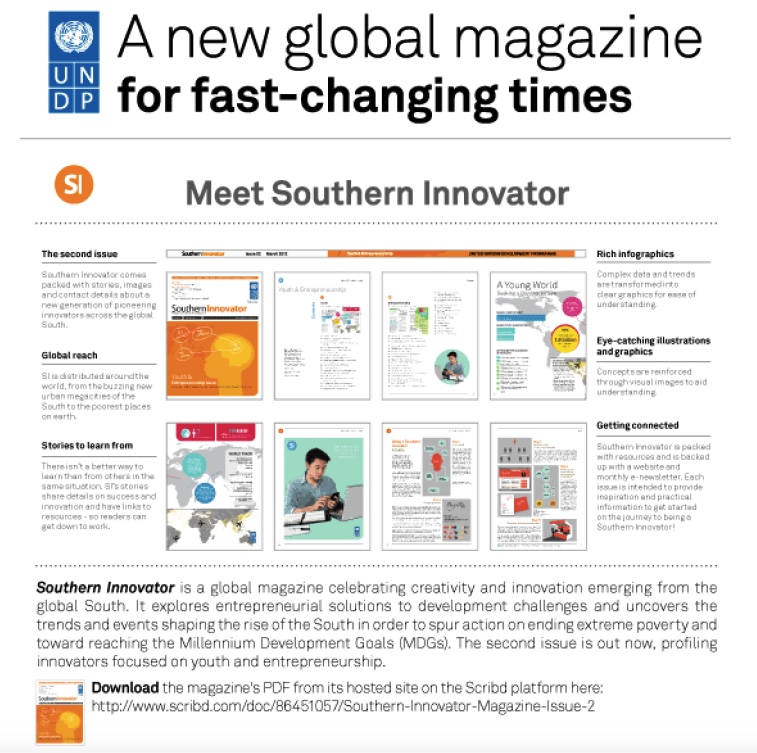
https://davidsouthconsulting.org/2021/03/05/southern-innovator-issue-2/

https://davidsouthconsulting.org/2021/03/05/southern-innovator-issue-5/

Development Challenges, South-South Solutions was launched as an e-newsletter in 2006 by UNDP’s South-South Cooperation Unit (now the United Nations Office for South-South Cooperation) based in New York, USA. It led on profiling the rise of the global South as an economic powerhouse and was one of the first regular publications to champion the global South’s innovators, entrepreneurs, and pioneers. It tracked the key trends that are now so profoundly reshaping how development is seen and done. This includes the rapid take-up of mobile phones and information technology in the global South (as profiled in the first issue of magazine Southern Innovator), the move to becoming a majority urban world, a growing global innovator culture, and the plethora of solutions being developed in the global South to tackle its problems and improve living conditions and boost human development. The success of the e-newsletter led to the launch of the magazine Southern Innovator. 

Creative Commons License

This work is licensed under a
Creative Commons Attribution-Noncommercial-No Derivative Works 3.0 License.

ORCID iD: https://orcid.org/0000-0001-5311-1052.

© David South Consulting 2023

Categories
Archive Development Challenges, South-South Solutions Newsletters Southern Innovator magazine

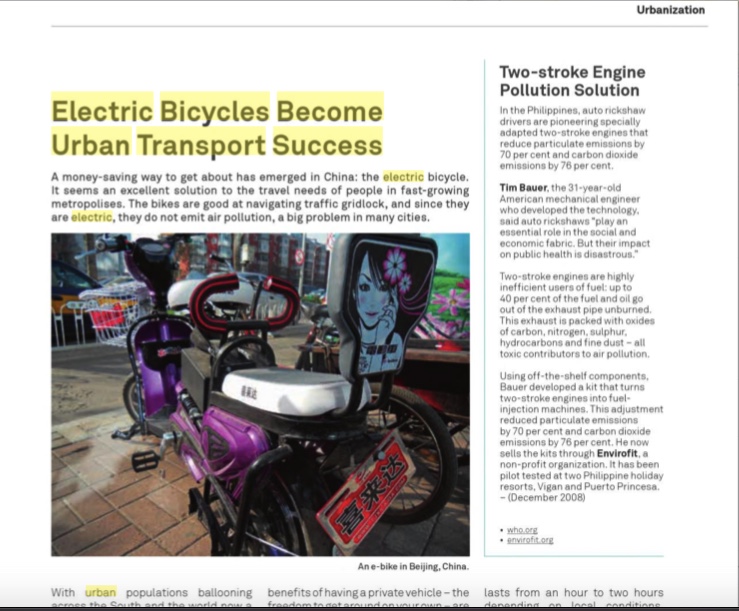
Electric Bicycles Become Urban Transport Success

By David SouthDevelopment Challenges, South-South Solutions

SOUTH-SOUTH CASE STUDY

A money-saving way to get about has emerged in China: the electric bicycle. It seems an excellent solution to the travel needs of people in fast-growing metropolises. The bikes are good at navigating traffic gridlock, and since they are electric they do not emit air pollution, a big problem in many cities.

With urban populations ballooning across the South – and the world now a majority urban place – the challenge of moving people around economically and cleanly is a big issue. While turning to cars seems an appealing option for people who have raised their incomes, the resulting traffic jams and pollution are a major drawback. Gridlock (http://en.wikipedia.org/wiki/Gridlock) is a daily reality in cities across Asia and Africa.

The success of e-bikes in China is striking: It is estimated there are four times more electric bikes than cars in the country, 120 million in all. According to the Electric Bikes website (www.electricbikee.com), the number of electric bicycles produced each year has grown from 200,000 eight years ago to 22 million in 2008. It is estimated to be a US $11 billion a year business: a true Southern success story that is going around the world.

A typical electric bicycle has a rechargeable power pack, with a battery that takes up to four hours to charge and lasts from an hour to two hours depending on local conditions, like hills. The batteries can range from heavy lead acid models (around only 100 charges) to nickel metal to lightweight, long-lasting lithium batteries. The batteries range from 12 volts to 36 volts. How long a battery lasts depends on its energy retention ability, road and temperature conditions and the rider’s weight.

And while some cities are turning to encouraging more peddle power with human-powered bicycles, this is an unappealing option in hot or humid climates. Who wants to turn up at work hot and sweaty?

In China, a highly competitive market of manufacturers has sprung up in the last 10 years to provide e-bikes for every taste and need.

China has a long tradition as a cycling nation: in the 1980s, four out of five commuters used bicycles. But that changed dramatically as people bought cars with their rising incomes.

In the capital, Beijing, rapid economic development and rising incomes have led to serious traffic congestion. There are over 4 million cars on Beijing’s roads. The pollution in the city is very bad and has led to various campaigns to ban high-polluting vehicles.

The ensuing traffic gridlock means the benefits of having a private vehicle – the freedom to get around on your own – are eroded as a driver wastes time in long commutes. So, many have turned to the nimble electric bicycles.

One resident, David Dai, told the BBC “It takes only 10 minutes to ride my electric bike from home to work.”

“If I took the bus, I’d have to spend time waiting for it, and then I could be trapped in a traffic jam. It could take me half an hour to make the same journey.”

Competition is fierce in the electric bike market, with shops sometimes sitting side-by-side.

A manager of a Beijing electric bicycle store, Zhang Zhiyong, puts the success down to this: “Beijing is not like other smaller cities – it’s big. If people ride their bicycles to work, they get really tired. If they drive to work, the roads are often congested,” he told the BBC.

“But an electric bike is environmentally friendly and convenient. Promoting the use of these bikes would benefit us all.”

And the price is a definite incentive: just 2,680 yuan (US $390), while cars sell for thousands of dollars.

The electric bicycles are so successful they are now growing faster than cars in a country that has become the fastest growing car market in the world.

Some believe the bikes are just a stop gap before people get enough money to buy automobiles. But the bigger trend of growing urban populations and the ensuing traffic jams will ensure they remain a practical option to get around the gridlock.

Published: April 2010

Resources

1) Electric Bike Website: Home to news and links to manufacturers. Also lots of resources on how to convert peddle bikes into electric bikes. Website:http://www.electricbikee.com/

2) The Luyuan Electric Vehicle Company of Jinhua City in China has been making the bikes for 10 years. They come fully equipped with lights, baskets, fenders and in many colours. Website: http://en.luyuan.cn/?gclid=CJXu_tr576ACFclr4wodG1GsGQ

3) Empowered Ebikes: An online retailer of e-bikes specializing in urban commuters. Website:http://www.empoweredebikes.com/index.php

4) Made-in-China.com: A large list of e-bike manufacturers in China and how to contact the dealers and manufacturers. Website: http://www.made-in-china.com/products-search/hot-china-products/E-bike.html

5) Pedego: An American company making high-end e-bikes. Website: http://www.pedegoelectricbikes.com/index.php

Development Challenges, South-South Solutions was launched as an e-newsletter in 2006 by UNDP’s South-South Cooperation Unit (now the United Nations Office for South-South Cooperation) based in New York, USA. It led on profiling the rise of the global South as an economic powerhouse and was one of the first regular publications to champion the global South’s innovators, entrepreneurs, and pioneers. It tracked the key trends that are now so profoundly reshaping how development is seen and done. This includes the rapid take-up of mobile phones and information technology in the global South (as profiled in the first issue of magazine Southern Innovator), the move to becoming a majority urban world, a growing global innovator culture, and the plethora of solutions being developed in the global South to tackle its problems and improve living conditions and boost human development. The success of the e-newsletter led to the launch of the magazine Southern Innovator. 

Creative Commons License

This work is licensed under a
Creative Commons Attribution-Noncommercial-No Derivative Works 3.0 License.

ORCID iD: https://orcid.org/0000-0001-5311-1052.

© David South Consulting 2023

Categories
Archive Development Challenges, South-South Solutions Newsletters

Asian Factories Starting to go Green

By David SouthDevelopment Challenges, South-South Solutions

SOUTH-SOUTH CASE STUDY

Media headlines have recently highlighted the growing air pollution crisis in Asia’s expanding cities. This is caused by a mix of factors – the growing number of vehicles, coal-powered factories, people burning dirty fuels to heat their homes, and poor enforcement of standards – and has severe consequences for human health. If it’s not tackled, more and more countries will see large rises in respiratory problems, cancers and early deaths from pollution-caused illnesses (http://www.nrdc.org/air/).

The World Health Organization (WHO) says air pollution is the world’s largest environmental health risk, killing 7 million people every year. Asia has the largest number of air pollution deaths in the world, with 3.3 million deaths linked to indoor air pollution and 2.6 million deaths related to outdoor air pollution (Clean Air Asia).

While most of the Asian countries where this is a problem are also aggressively growing their economies in order to get richer and raise living standards, there is a rising awareness of the need to balance a modern, industrial economy with human health and the environment.

One solution is to adopt green and sustainable building standards when constructing new factories. This is more than just a public relations exercise: the energy savings possible from building smart pay off in the long run. And green factories not only pollute less, they save lives and the environment.

Asia plays a critical role in producing the world’s consumer products, from the small and simple to the highly complex components used in 21st-century computing technologies.

Intel (intel.com), the manufacturer of electronic devices and the computer chips that go inside them, is trying to lead the way. It has built a US $1 billion manufacturing plant 16 kilometers outside Ho Chi Minh City, Vietnam, and it is designed to exceed Vietnamese environmental and sustainability guidelines and laws.

Opened in 2010, it boasts the country’s largest solar power system. It is also currently working on a water reclamation system to reduce water consumption at the plant by 68 per cent, according to The New York Times. It is hoping to receive certification from the US Green Building Council (usgbc.org).

It is all part of a wider trend that is starting to reverse the damaging, short-termist approach of the past. More and more Western multinationals and their Asian suppliers are building environmentally sound factories in the developing world.

According to the US Green Building Council, around 300 manufacturing facilities in Asia are either certified or are awaiting Leadership in Energy and Environmental Design (LEED) certification. The LEED certification recognizes the building has met certain standards in becoming a ‘green’ building.

Going green is more and more part of corporate policy for companies that want to avoid the bad publicity of disasters such as the garment factory collapse that killed 1,135 people in Bangladesh in April 2013.

But it is not just driven by a desire to avoid bad publicity: large corporations that build factories in the global South are also realizing there are big financial savings to be made.

Intel has been able to reduce its global energy costs by US $111 million since 2008. It did this by investing US $59 million in 1,500 projects to boost sustainability across its facilities worldwide. The projects have reduced carbon dioxide emissions equivalent to the amount produced by 126,000 American households per year.

Intel’s solar array in Vietnam, which cost US $1.1 million, offsets the equivalent of 500 pollution-belching motorbikes every day.

How effective are LEED-certified buildings? The New York Times reported that a 2011 survey compared a typical shoe factory with a LEED factory run by the American sport shoe maker Nike. It found the LEED factory used 18 per cent less electricity and fuel and 53 per cent less water.

And this trend is creating a new economy unto itself. As an example, a new marketplace for industrial efficiency upgrading is developing in India. Power outages are frequent in India, so finding a way to save electricity and alternatives to dependence on the national power grid is attractive to any economic enterprise.

Prashant Kapoor, principal industry specialist for green buildings at the International Finance Corporation (IFC), believes demand for upgrades is strong enough that various companies can specialize in this field and profit from it.

And things are also happening in the notoriously smog-choked cities of China. By the end of 2012, China had certified eight factories and 742 buildings as LEED, according to the China buildings programme at the Energy Foundation (ef.org) in San Francisco.

Damien Duhamel of Solidiance (solidiance.com), a firm that advises businesses on how to grow in Asia, believes avoiding risk caused by environmental accidents or scandals is heightened by the growing presence of social media, which amplifies negative publicity.

“The next battle will be here” for higher corporate environmental standards, Duhamel believes. “This is why some smart companies – Intel, for example – took the steps of being proactive.”

Published: April 2014

Resources

1) Leadership in Energy and Environmental Design (LEED): LEED, or Leadership in Energy & Environmental Design, is a green building certification program that recognizes best-in-class building strategies and practices. Website: http://www.usgbc.org/leed

2) US Green Building Council (USGBC): Its mission is to transform the way buildings and communities are designed, built and operated, enabling an environmentally and socially responsible, healthy, and prosperous environment that improves the quality of life. Website: http://www.usgbc.org/

3) Dwell: Dwell magazine is focused on demonstrating that modern design can be both functional and comfortable. Website: dwell.com

4) Inhabitat: Design for a Better World: Inhabitat.com is a weblog devoted to the future of design, tracking the innovations in technology, practices and materials that are pushing architecture and home design towards a smarter and more sustainable future. Website: inhabitat.com

5) Solidiance: Singapore-based consulting firm specializing in Asia’s green-building sector. Website: solidiance.com

6) Clean Air Asia: Clean Air Asia was established in 2001 as the premier air quality network for Asia by the Asian Development Bank, World Bank, and USAID. Its mission is to promote better air quality and livable cities by translating knowledge to policies and actions that reduce air pollution and greenhouse gas emissions from transport, energy and other sectors. Website: cleanairinitiative.org

7) Southern Innovator Issue 4: Cities and Urbanization: This issue is packed with ideas on to how make cities and urban environments greener and reduce air pollution. Website: http://www.scribd.com/doc/133622315/Southern-Innovator-Magazine-Issue-4-Cities-and-Urbanization and here: http://tinyurl.com/oc2mqgm

8) Better Air Quality Conference 2014 and 8th Regional Environmentally Sustainable Transport Forum in Asia:  From 19 to 21 November 2014 in Colombo, Sri Lanka, BAQ is the leading event on air quality in Asia, covering the key sectors of transport, energy, industry and climate change, with a particular emphasis on government policies and measures. Website: http://cleanairinitiative.org/portal/node/12274

9) Tianjin Eco-city: The Sino-Singapore Tianjin Eco-city’s vision is to be a thriving city which is socially harmonious, environmentally-friendly and resource-efficient. Website: tianjinecocity.gov.sg

10) Songdo: Songdo International Business District (IBD) officially opened on August 7, 2009 as a designated Free Economic Zone and the first new sustainable city in the world designed to be an international business district. Website: songdo.com

https://davidsouthconsulting.org/2022/09/27/caribbean-island-st-kitts-goes-green-for-tourism/

https://davidsouthconsulting.org/2021/01/25/creating-green-fashion-in-china/

https://davidsouthconsulting.org/2021/02/01/ethiopia-and-djibouti-join-push-to-tap-geothermal-sources-for-green-energy/

https://davidsouthconsulting.org/2023/02/03/environmental-public-awareness-handbook-case-studies-and-lessons-learned-in-mongolia/

https://davidsouthconsulting.org/2021/08/29/indian-business-model-makes-green-energy-affordable/

https://davidsouthconsulting.org/2022/11/11/innovation-cairos-green-technology-pioneers/

https://davidsouthconsulting.org/2021/10/22/innovations-in-green-economy-top-three-agenda/

https://davidsouthconsulting.org/2021/08/07/mongolian-green-book/

https://davidsouthconsulting.org/2022/04/14/prisons-with-green-solutions/

https://davidsouthconsulting.org/2021/02/04/us-450-million-pledged-for-green-economy-investments-at-kenyan-gssd-expo/

Development Challenges, South-South Solutions was launched as an e-newsletter in 2006 by UNDP’s South-South Cooperation Unit (now the United Nations Office for South-South Cooperation) based in New York, USA. It led on profiling the rise of the global South as an economic powerhouse and was one of the first regular publications to champion the global South’s innovators, entrepreneurs, and pioneers. It tracked the key trends that are now so profoundly reshaping how development is seen and done. This includes the rapid take-up of mobile phones and information technology in the global South (as profiled in the first issue of magazine Southern Innovator), the move to becoming a majority urban world, a growing global innovator culture, and the plethora of solutions being developed in the global South to tackle its problems and improve living conditions and boost human development. The success of the e-newsletter led to the launch of the magazine Southern Innovator.  

Creative Commons License

This work is licensed under a
Creative Commons Attribution-Noncommercial-No Derivative Works 3.0 License

ORCID iD: https://orcid.org/0000-0001-5311-1052.

© David South Consulting 2022

Categories
Archive Blogroll Southasiadisasters.net United Nations Office for South-South Cooperation

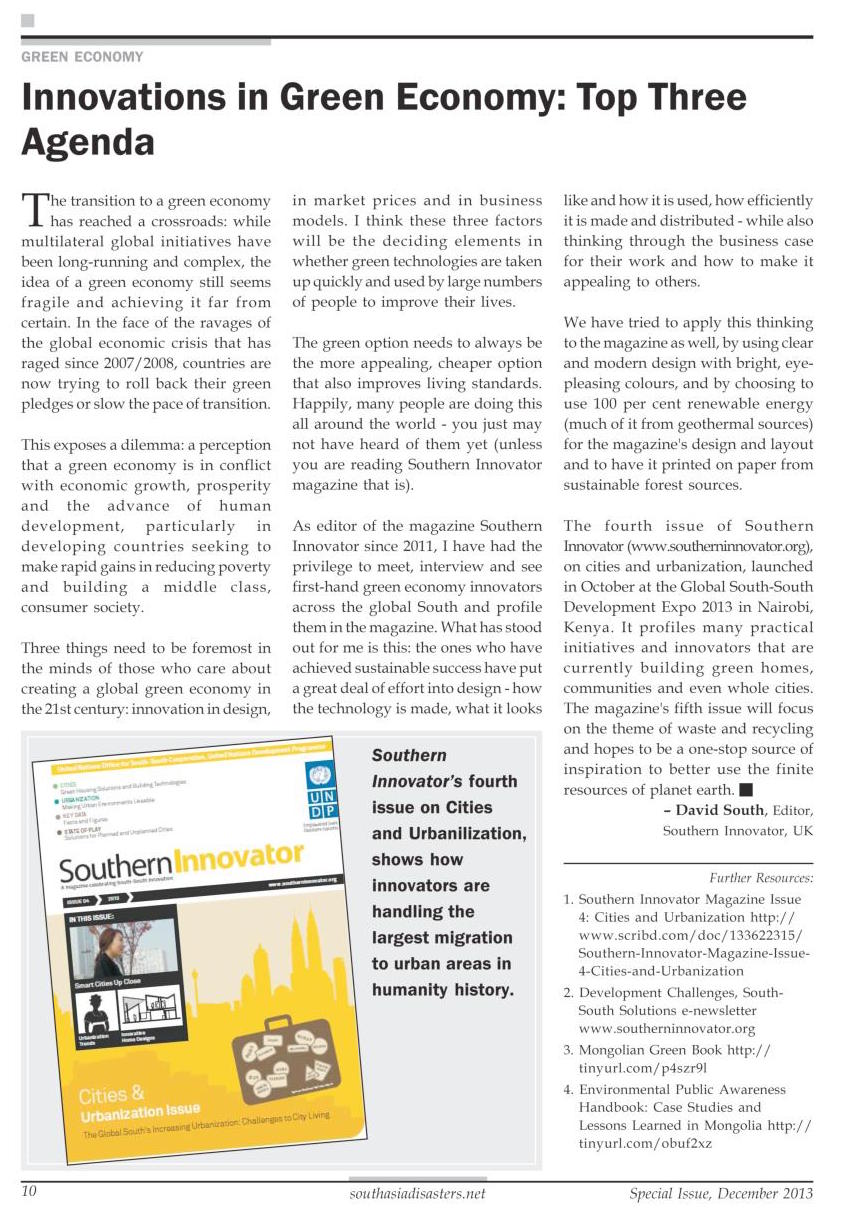
Innovations In Green Economy: Top Three Agenda

By David South

southasiadiasters.net December 2013

The transition to a green economy has reached a crossroads: while multilateral global initiatives have been long-running and complex, the idea of a green economy still seems fragile and achieving it far from certain. In the face of the ravages of the global economic crisis that has raged since 2007/2008, countries are now trying to roll back their green pledges or slow the pace of transition. 

This exposes a dilemma: a perception that a green economy is in conflict with economic growth, prosperity and the advance of human development, particularly in developing countries seeking to make rapid gains in reducing poverty and building a middle class, consumer society. 

Three things need to be foremost in the minds of those who care about creating a global green economy in the 21st century: innovation in design, in market prices and in business models. I think these three factors will be the deciding elements in whether green technologies are taken up quickly and used by large numbers of people to improve their lives. 

The green option needs to always be the more appealing, cheaper option that also improves living standards. Happily, many people are doing this all around the world – you just may not have heard of them yet (unless you are reading Southern Innovator magazine that is). 

As editor of the magazine Southern Innovator since 2011, I have had the privilege to meet, interview and see first-hand green economy innovators across the global South and profile them in the magazine. What has stood out for me is this: the ones who have achieved sustainable success have put a great deal of effort into design – how the technology is made, what it looks like and how it is used, how efficiently it is made and distributed – while also thinking through the business case for their work and how to make it appealing to others. 

We have tried to apply this thinking to the magazine as well, by using clear and modern design with bright, eye-pleasing colours, and by choosing to use 100 per cent renewable energy (much of it from geothermal sources) for the magazine’s design and layout and to have it printed on paper from sustainable forest sources. 

The fourth issue of Southern Innovator (www.southerninnovator.org), on cities and urbanization, launched in October at the Global South-South Development Expo 2013 in Nairobi, Kenya. It profiles many practical initiatives and innovators that are currently building green homes, communities and even whole cities. The magazine’s fifth issue will focus on the theme of waste and recycling and hopes to be a one-stop source of inspiration to better use the finite resources of planet earth.

David South, Editor, Southern Innovator
United Nations Office for South-South Cooperation (UNOSSC)

Southern Innovator Issue 1: https://books.google.co.uk/books?id=Q1O54YSE2BgC&dq=southern+innovator&source=gbs_navlinks_s

Southern Innovator Issue 2: https://books.google.co.uk/books?id=Ty0N969dcssC&dq=southern+innovator&source=gbs_navlinks_s

Southern Innovator Issue 3: https://books.google.co.uk/books?id=AQNt4YmhZagC&dq=southern+innovator&source=gbs_navlinks_s

Southern Innovator Issue 4: https://books.google.co.uk/books?id=9T_n2tA7l4EC&dq=southern+innovator&source=gbs_navlinks_s

Southern Innovator Issue 5: https://books.google.co.uk/books?id=6ILdAgAAQBAJ&dq=southern+innovator&source=gbs_navlinks_s

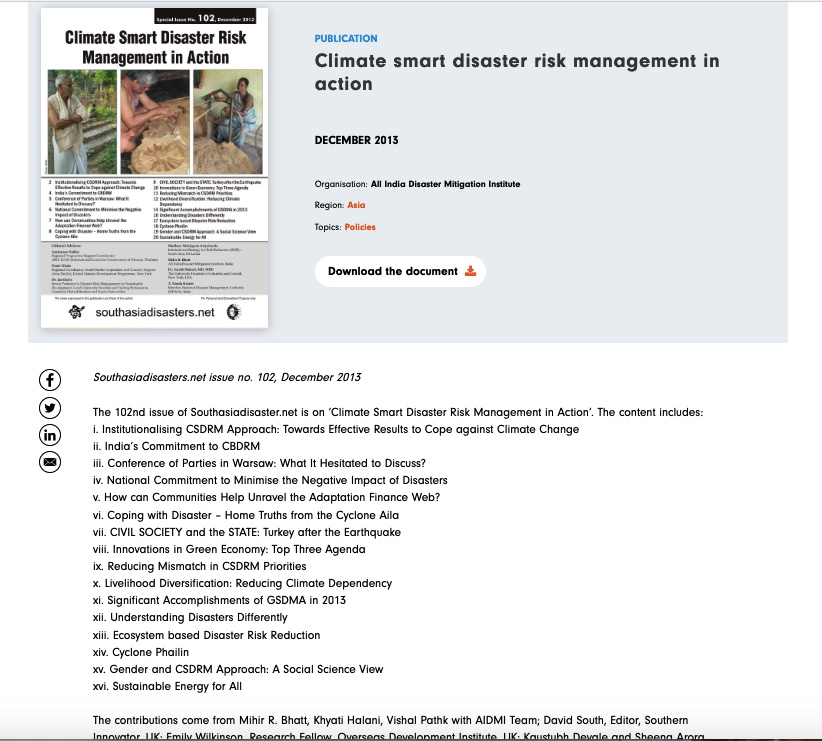
https://wrd.unwomen.org/explore/library/climate-smart-disaster-risk-management-action

https://davidsouthconsulting.org/2022/09/28/asian-factories-starting-to-go-green/

https://davidsouthconsulting.org/2022/09/27/caribbean-island-st-kitts-goes-green-for-tourism/

https://davidsouthconsulting.org/2021/01/25/creating-green-fashion-in-china/

https://davidsouthconsulting.org/2023/02/03/environmental-public-awareness-handbook-case-studies-and-lessons-learned-in-mongolia/

https://davidsouthconsulting.org/2021/02/01/ethiopia-and-djibouti-join-push-to-tap-geothermal-sources-for-green-energy/

https://davidsouthconsulting.org/2021/08/29/indian-business-model-makes-green-energy-affordable/

https://davidsouthconsulting.org/2022/11/11/innovation-cairos-green-technology-pioneers/

https://davidsouthconsulting.org/2021/10/22/lima-to-delhi-what-can-be-learned-on-urban-resilience/

https://davidsouthconsulting.org/2021/08/07/mongolian-green-book/

https://davidsouthconsulting.org/2022/04/14/prisons-with-green-solutions/

https://davidsouthconsulting.org/2021/10/22/south-south-cooperation-for-cities-in-asia/

https://davidsouthconsulting.org/2021/02/23/southern-innovator-in-southasiadisasters-net/

https://davidsouthconsulting.org/2021/03/05/southern-innovator-issue-5/

https://davidsouthconsulting.org/2021/07/15/undp-mongolia-handbooks-and-books-1997-1999/

https://davidsouthconsulting.org/2021/01/02/a-undp-success-story-grassroots-environmental-campaign-mobilizes-thousands-in-mongolia-1998/

https://davidsouthconsulting.org/2021/02/04/us-450-million-pledged-for-green-economy-investments-at-kenyan-gssd-expo/

Creative Commons License

This work is licensed under a
Creative Commons Attribution-Noncommercial-No Derivative Works 3.0 License.

ORCID iD: https://orcid.org/0000-0001-5311-1052.

© David South Consulting 2023