Access to electricity is critical for making substantial development gains. With steady supplies of electricity, it is possible to read and study at night, to run modern appliances, to better use the latest information technologies and to work using time- and labour-saving devices. A home with electricity literally switches the light on modern life and gives a family huge advantages compared to those without electricity.
But there are two potential obstacles to providing electricity for the poor: one is just getting access to a steady supply; the other is paying for it.
In Africa, much of the population suffers from an electricity famine. The situation is worse than on any other continent: the proportion of people in Africa still without electricity is higher – and the rate of urban electrification is lower – than anywhere else. Four out of five rural residents in Africa live without electricity. The rate of rural electrification is also lower than on any other continent and the proportion of Africans who depend on inefficient traditional energy sources is higher than elsewhere (Desertec-Africa).
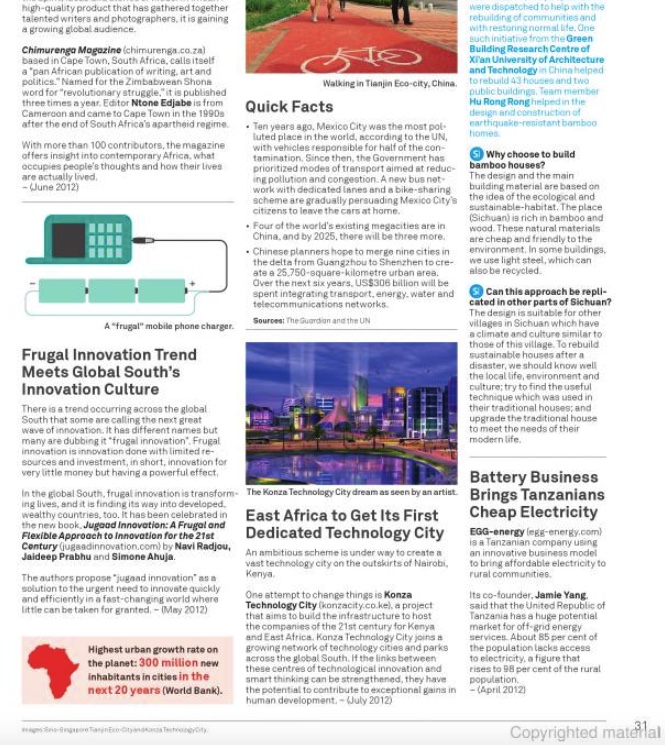
EGG-energy (http://egg-energy.com) is a Tanzanian company using an innovative business model to bring affordable electricity to rural communities.
Its co-founder, Jamie Yang, said Tanzania has a huge potential market for offgrid energy services. About 85 per cent of the population lacks access to electricity, a figure that rises to 98 per cent of the rural population.
EGG-energy says it is “dedicated to helping low-income consumers in sub-Saharan Africa gain access to clean, affordable energy, using a unique strategy based around portable rechargeable batteries.” The company has eight full-time staff based in their Makumbusho office, 6 kilometres north of Dar es Salaam, the capital.
It calls its system the “portable grid,” and it works like this: customers have a power system installed in their home that runs on brick-sized, re-chargeable batteries. The batteries are re-charged at a central charging station using power from the Tanzanian power grid, and sent to local distribution centres where customers can pick them up. Customers rent the batteries for a subscription fee, and they last about five nights in a home. When the battery is empty, the customer returns it, swaps for a fresh battery and pays a small swapping fee.
It is a brilliant solution to the problem of getting power from the main Tanzanian power grid to people’s homes. According to EGG-energy, most Tanzanians live within 5 kilometres from a power grid line. Yet the majority of the population lack access to electricity.
“After researching the energy situation in Tanzania and other countries with similar electricity access problems, it became clear that one of the primary problems was a lack of last-mile distribution,” explained Yang. “The only way to get power from the source into homes and businesses were power lines, and for the vast majority of rural Tanzanians, this was very much out of reach.
We saw situations in which power lines would pass right over large populations that were still using kerosene for lighting. We also saw that distributed generation like solar was finding only very limited markets because there was no share or sell power from that source without an affordable way to distribute the electricity.”
While EGG-energy is based in Tanzania, it hopes hope to expand across the developing world.
In order to develop an effective distribution network, EGG-energy partners with local store owners and delivery businesses to help with distributing the batteries. The batteries are based on those used in the airline industry and are light enough to be held in one hand.
Yang believes marketing is critical to the success of the technology.
“Don’t underestimate the cost of sales, marketing, and distribution,” he said.
“Many companies focus on the technology and in lowering the cost of the technology, while not paying enough attention to the gaps in the distribution channels.
“We have a sales team that communicates what we do through a variety of methods, including door-to-door sales, road shows and village meetings. We also make contact with the local political leaders and offer referral awards to our existing customers. Potential customers come to our charging stations to purchase the system and to connect to EGG.”
When a customer signs up with EGG-energy, a technician is dispatched to their home to make sure the electricity system is sound and effective. The company also sells energy-efficient lights, radios and mobile phone chargers to complement the electricity system. It’s a wise business model, since having a steady and reliable supply of electricity is a great motivator for customers to purchase other electric-powered appliances.
“We have technicians that have received vocational training through the Tanzanian system and technicians that we train ourselves,” Yang said. “We have very standardized electricity installations that are easy to teach, and have more experienced technicians that we rely on for troubleshooting and support.”
EGG-energy also makes the claim it can reduce a household’s energy expenses by 50 per cent as they make the switch from traditional batteries for radios and kerosene lamps for light.
EGG-energy calls itself a “for-profit company with a social mission.” It sees the provision of affordable electricity and energy as a spur for small entrepreneurs to build their businesses, boost educational opportunities through longer study time, and help with connecting families with the outside world.
It uses regular feedback with customers to make sure their service is actually cheaper than other options – a good habit for any business looking to build a lasting customer relationship.
“One of the key deficiencies in the energy supply chain is customer support,” said Yang. “We have seen multiple solar installations given by NGOs to community organizations that are no longer functioning because the user doesn’t have someone reliable to call or hasn’t allotted a budget to maintain the system.
“Customer support is a key component of last mile distribution, and something that EGG-energy is focusing on as an energy services company with a local, physical presence.”
Published: April 2012
Resources
1) ANSOLE (the African Network for Solar Energy) is a research-oriented network of 200 scientists from 22 African and 10 non-African countries. It believes, according to Mammo Muchie, founding editor of the African Journal of Science, Technology, Innovation, and Development, “solar power will become the major renewable energy source on the continent only by organized research, training, design, and engineering.” Website: ansole.org
2) The Kenya-based non-governmental organization (NGO) Access: energy is tackling the problem of 84 per cent of Kenyans – 32 million people – lacking access to electricity at home. It is doing this by teaching people how to make and assemble wind turbines out of scrap metal and car parts and other materials found within communities. Their turbine design is called the Night Heron Turbine. Website: http://access-collective.com/energy/
Development Challenges, South-South Solutions was launched as an e-newsletter in 2006 by UNDP’s South-South Cooperation Unit (now the United Nations Office for South-South Cooperation) based in New York, USA. It led on profiling the rise of the global South as an economic powerhouse and was one of the first regular publications to champion the global South’s innovators, entrepreneurs, and pioneers. It tracked the key trends that are now so profoundly reshaping how development is seen and done. This includes the rapid take-up of mobile phones and information technology in the global South (as profiled in the first issue of magazine Southern Innovator), the move to becoming a majority urban world, a growing global innovator culture, and the plethora of solutions being developed in the global South to tackle its problems and improve living conditions and boost human development. The success of the e-newsletter led to the launch of the magazine Southern Innovator.
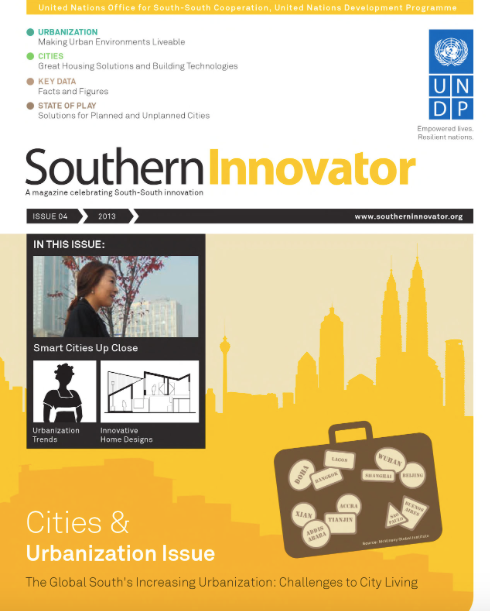
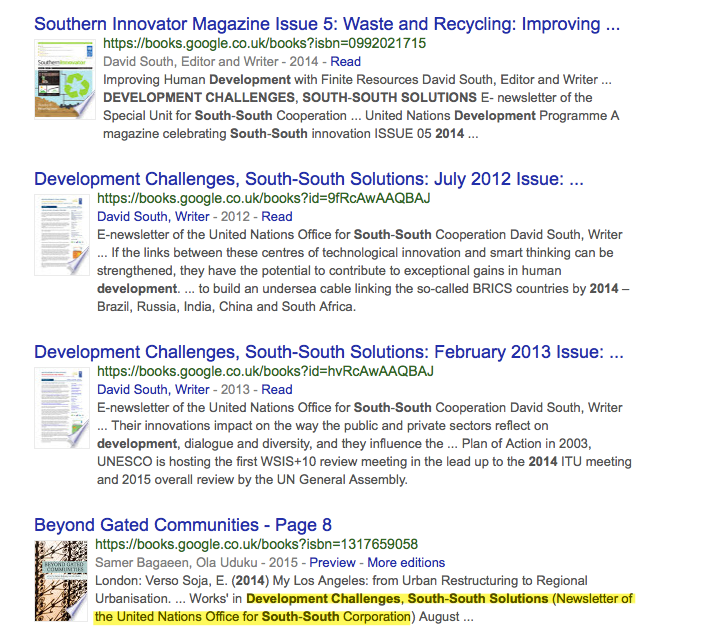
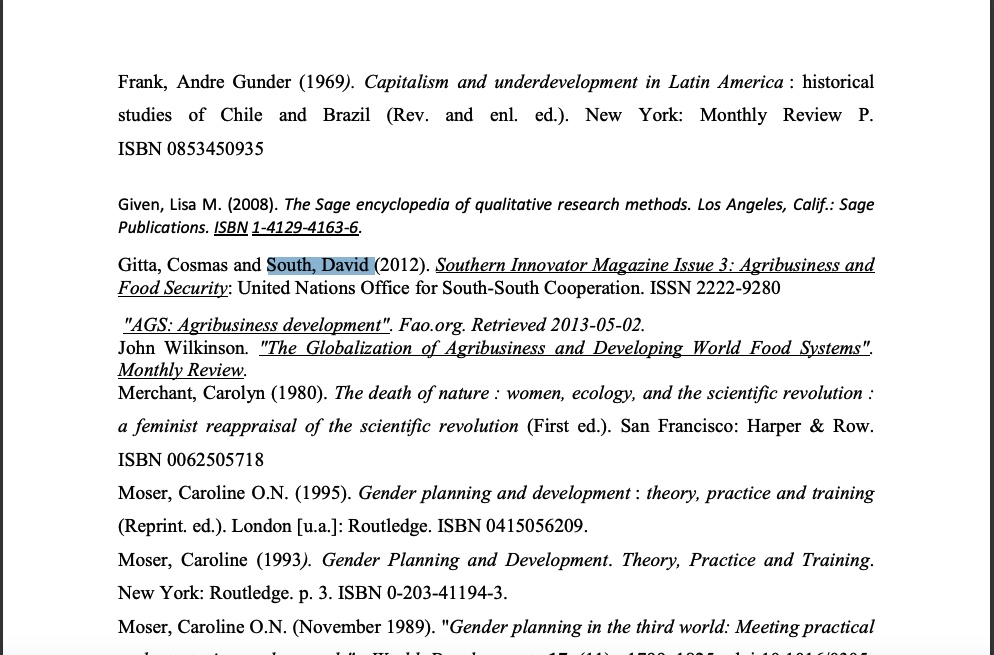
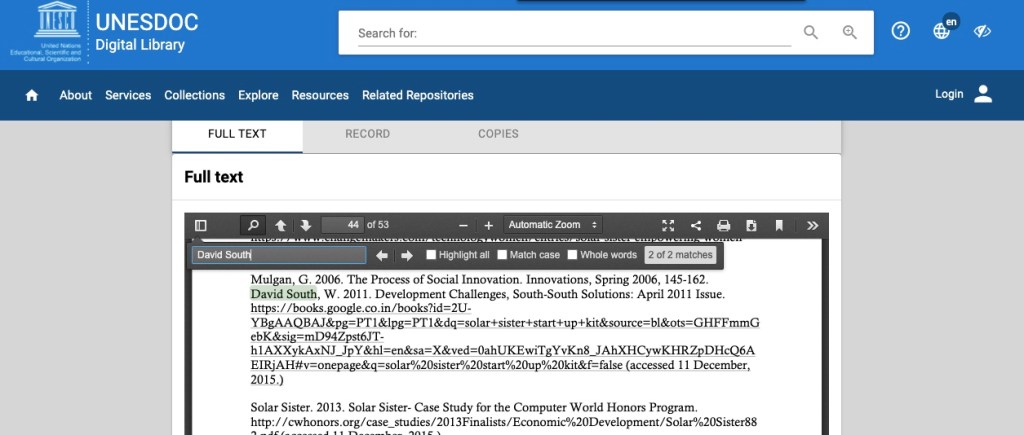
Southern Innovator was initially launched in 2011 with the goal of – hopefully – inspiring others (just as we had been so inspired by the innovators we contacted and met). The magazine seeks to profile stories, trends, ideas, innovations and innovators overlooked by other media. The magazine grew from the monthly e-newsletter Development Challenges, South-South Solutions published by the United Nations Office for South-South Cooperation (UNOSSC) since 2006. A selection of books and papers citing stories from the magazine are featured below to aid researchers, in particular those interested in health and human development and the role of innovators in international development.
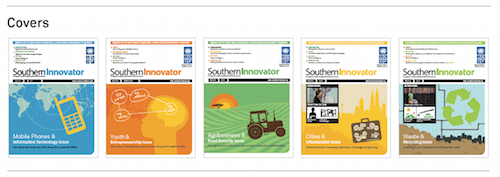
The first five issues of Southern Innovator from 2011 to 2014. Called a “Beautiful, inspiring magazine from UNDP on South-South innovation.”
“Innovation is critical to growth and development in Africa. In the context of a continent characterized by fast growing economies as well as an array of socioeconomic challenges, such as high levels of poverty and inequality, innovation in Africa must be understood in an encompassing manner. Africa needs to support the emergence of its own Silicon Valleys, but it must also foster the invention and adoption of cleaner technologies that limit respiratory illnesses, deforestation and combat climate change. This book contains a number of analytical case studies that examine the nature and origins of emerging high-end innovation hubs in Africa. These “hubs” or ecosystems are both understudied and little known inside and outside the continent. With this analysis, the book highlights and draws lessons from some of the most promising and successful innovation cases in Africa today, exploring the key factors driving their successful emergence, growth and future prospects. Relevant for scholars, policymakers, and business leaders, the book provides both inspiration and useful policy advice that can inform strategies and concrete measures to speed up the pace of innovation in Africa today.”
“Research on gated communities is moving away from the hard concept of a ‘gated community’ to the more fluid one of urban gating. The latter allows communities to be viewed through a new lens of soft boundaries, modern communication and networks of influence.
The book, written by an international team of experts, builds on the research of Bagaeen and Uduku’s previous edited publication, Gated Communities (Routledge 2010) and relates recent events to trends in urban research, showing how the discussion has moved from privatised to newly collectivised spaces, which have been the focal point for events such as the Occupy London movement and the Arab Spring.
Communities are now more mobilised and connected than ever, and Beyond Gated Communities shows how neighbourhoods can become part of a global network beyond their own gates. With chapters on Australia, Canada, Europe, South America, Asia, Africa and the Middle East, this is a truly international resource for scholars and students of urban studies interested in this dynamic, growing area of research.”
“The economic, political and social situation in Chile shows a country in transition. Some observers anticipate a broad “reboot” of the nation. While Chile is still seen by many as an example of progress in South America and of developmental potential in the global South, it faces a complex political constellation, particularly in the aftermath of the re-election of Michelle Bachelet. Many wonder how social and institutional innovations can be incepted without interrupting the country’s remarkable success over the past decades.
This book provides an interdisciplinary analysis of Chile’s situation and perspectives. In particular, it addresses the questions:
What is Chile’s real socio-political situation behind the curtains, irrespective of simplifications?
What are the nation’s main opportunities and problems?
What future strategies will be concretely applicable to improve social balance and mitigate ideological divisions?
The result is a provocative examination of a nation in search of identity and its role on the global stage.
Roland Benedikter, Dr., is Research Scholar at the Orfalea Center for Global and International Studies, University of California, Santa Barbara, Senior Research Scholar of the Council on Hemispheric Affairs Washington D.C., Trustee of the Toynbee Prize Foundation Boston and Full Member of the Club of Rome.
Katja Siepmann, MA, is Senior Research Fellow of the Council on Hemispheric Affairs Washington D.C., Member of the German Council on Foreign Relations, and Lecturer at the Faculty of Interdisciplinary Cultural Sciences of the European University Frankfurt/Oder.
The volume features a Foreword by Ned Strong, Executive Director of the David Rockefeller Center for Latin American Studies, Harvard University, and a Preface by Larry Birns, Director of the Council on Hemispheric Affairs, Washington D.C., and Former Senior Public Affairs Officer of the United Nations’ Economic Commission for Latin America (Santiago, Chile).”
“A Sociological Approach to Health Determinants investigates how the social works in determining health and health inequity. Taking a global perspective, the book shines a light on how experiences of health, illness and health care are shaped by a variety of complex social dynamics. Informed primarily by sociology, the book engages with the WHO’s social determinants of health approach and draws on contributions from history, political economy and policy analysis to examine issues such as class, gender, ethnicity and indigeneity, and the impact they have on health. A Sociological Approach to Health Determinants is a comprehensive resource that provides a new perspective on the influence of social structures on health, and how our understanding of the social can ensure improved health outcomes for people all over the globe. Toni Schofield is Associate Professor at the University of Sydney. She specialises in research and teaching in sociology, and public policy and administration.”
New Directions in Children’s and Adolescents’ Information Behavior Research edited by Dania Bilal and Jamshid Beheshti (Emerald Group Publishing: 2014)”This book comprises innovative research on the information behavior of various age groups. It also looks at special populations such as ethnic minorities, indigenous peoples, and users with disabilities. The book presents research and reflections on designing systems that help the new generation cope with a complex knowledge society.
Economy Reports for APEC Economies on demographics, policies & ICT applications for people with Special Needs (Seniors and People with Disabilities), Asia-Pacific Economic Cooperation, APEC Telecommunications and Information Working Group, January 2013
Taming the Tide: Stories from India by Claire Bentley, Vanessa Brombosz, Sofianne Gabrielli, Ga Eun Lee, Vaidehi Nafade, Lindsay Steele and Muhammad Wali, Global Health Case Studies: A Compilation from PPHS 511 Fundamentals of Global Health, McGill Global Health Programs, Case studies – Fall 2015, pages 23 to 32
If you would like to either sponsor an issue of Southern Innovator or place an advertisement in the magazine, then please contact southerninnovator@yahoo.co.uk.

























 David South Consulting
You must be logged in to post a comment.