Tag: June 2007

  • Bio-ethanol From Sturdy and Once-Unwanted Indian Plant

    Bio-ethanol From Sturdy and Once-Unwanted Indian Plant

    By David SouthDevelopment Challenges, South-South Solutions

    SOUTH-SOUTH CASE STUDY

    With awareness of global warming at an all-time high – and governments seeking real-world solutions to solve this enormous problem – bioethanol fuel has risen up the agenda as a replacement for conventional fuel sources. At present, most bioethanol fuel is produced from either corn or sugar but a less known plant jatropha could be the real solution. Brazil has been a pioneer in producing bioethanol fuel from sugar, while the United States has focused on its substantial corn crop as a source, and both contribute more than half the world’s supply. Brazil alone made US $5.4 billion from biofuels (ethanol and biodiesel combined) in 2005, while global production is estimated at 48 billion litres (Biofuel Market Worldwide (2007-2010) www.canbiotech.com).

    Global prices for crude oil, under pressure from a number of sources, are volatile and far above 1990s levels. This hurts the poorest countries most (Human Development Report 2005). Expensive fuel means the world’s poor are denied affordable access to machinery and appliances that can make life more comfortable. Poorer nations are often more dependent on oil imports than richer countries. As well, most of their industries are energy intensive, and their cars and homes are less energy efficient. This means low-income countries spend twice as much of their national income on imported oil than do developed countries (World Bank). A US $10 per barrel increase in the cost of crude oil shaves half a percentage point from economic growth in the West; in the poorest countries, it is nearly three times higher.

    The two common sources of bioethanol fuel – corn and cane sugar – have a major drawback: they are diverting food sources into fuel for vehicles. Already, the massive US diversion of corn into the bioethanol fuel market has sent the price of corn skyrocketing, making this hardy food staple in countries like Mexico more expensive for the poor. Some estimates claim ethanol plants will burn up to half of the United States’ domestic corn supplies within a few years (Foreign Affairs). To fill the fuel tank of a sports utility vehicle (SUV) with pure ethanol requires 450 pounds of corn – enough calories to feed one person for a year.

    And this is why many are now advocating a non-edible Indian fruit bush called jatropha as a better solution. It is like a grapefruit, with each fruit containing three plum-sized seeds. Each seed contains 35 percent oil which can be converted into biodiesel. A shrub from the family euphorbiaceae, jatropha’s lifespan is 50 years. It bears fruit several times a year, and each bunch is five to eight fruits. Being unedible, the oil is mostly used for soap and varnishes.

    Cultivation of the jatropha was prioritised a year ago by the Indian Railway Minister, Lalu Prasad Yadav. Disused railways lands were to be put aside for growing the crop. Brazil’s biodiesel company, Biomasa, plans to plant two million hectares with jatropha this year, and it is believed jatropha will surpass sugar cane as the principal source for bioethanol in Brazil.

    The advantages of jatropha include its hardy nature: it does not require pesticide, manure, or irrigation to grow and it is drought resistant. A single jatropha plant will yield one litre of biodiesel per year for 40 years, and it yields 1,300 kg of seeds per hectare per year. Its advocates hope to see jatropha bushes planted alongside existing crops, with an acre producing 100 litres of fuel per year.

    The downsides of cultivating jatropha as a fuel source would need to be overcome. At present, jatropha’s high acidity means its seeds degrade quickly in humid environments (much of the global South) when exposed to air. Steel tanks used for storage require a nitrogen blanket to prevent water absorption. During the processing stage (something called transesterification), the large quantities of glycerine are produced as a byproduct. Demand is low for this byproduct and disposal is a problem. A cake is also produced that has no real value or use. To make it economically worthwhile to grow in India for example, farmers would need to receive four rupees per kg of seed. This would produce a biofuel costing 50 rupees per litre – considered too expensive at present. Jatropha advocates are urging government subsidies to kick-start production and make the price competitive.

    In Ghana, smallholder farmers have already rebelled against growing jatropha. They say that since the oil is inedible, and growing the crop leaves them at the mercy of price-setting by the refineries, they do not want to run the risk.

    “What may encourage farmers to venture into jatropha,” said Wisdom Yao Adjah-Cudjoe, a cereal farmers’ representative, “would be a guaranteed price arrangement, as is the case with cocoa.”

    In Africa, research by the South African Biodiversity Institute has estimated that 50 percent of the landmass of the continent is suitable for jatropha cultivation (a total of 1,080 million hectares). It could be a huge opportunity for African farmers and a big cost saving for poor countries, but if farmers are to be encouraged to grow jatropha, they will need the right price incentives and guarantees.

    Published: June 2007

    Resources

    • Jain Irrigation Systems Ltd: An Indian company specialising in helping farmers to begin growing jatropha plants.
    • Centre for Jatropha Promotion: Based in Charu, Rajasthan, India, it researches all aspects of jatropha cultivation and acts as a seed bank.
    • Kick Start Oil Press: Developed in 1993, the Kick Start Oil Press was designed for use in Africa by farmers. It is manufactured in Kenya and sold as a complete kit for entrepreneurs to get started pressing seed for oil. The Kick Start NGO designs technologies for private entrepreneurs of small-scale enterprises, and has offices in Kenya, Tanzania and Mali.
    • Haiti Innovation: Established by former Peace Corps volunteers, and links Haitian NGOs with aid donors. It encourages projects to post on the web and contributors to donate directly to them. It is currently promoting the growing of jatropha in Haiti.
    • Agricultural Biotechnology Network in Africa (ABNETA): This is an excellent source for real-time news and information sources on the biofuel market in Africa.

    Development Challenges, South-South Solutions was launched as an e-newsletter in 2006 by UNDP’s South-South Cooperation Unit (now the United Nations Office for South-South Cooperation) based in New York, USA. It led on profiling the rise of the global South as an economic powerhouse and was one of the first regular publications to champion the global South’s innovators, entrepreneurs, and pioneers. It tracked the key trends that are now so profoundly reshaping how development is seen and done. This includes the rapid take-up of mobile phones and information technology in the global South (as profiled in the first issue of magazine Southern Innovator), the move to becoming a majority urban world, a growing global innovator culture, and the plethora of solutions being developed in the global South to tackle its problems and improve living conditions and boost human development. The success of the e-newsletter led to the launch of the magazine Southern Innovator.

    Creative Commons License

    This work is licensed under a
    Creative Commons Attribution-Noncommercial-No Derivative Works 3.0 License.

    ORCID iD: https://orcid.org/0000-0001-5311-1052.

    © David South Consulting 2022

  • Entrepreneurs Use Mobiles and IT to Tackle Indian Traffic Gridlock

    Entrepreneurs Use Mobiles and IT to Tackle Indian Traffic Gridlock

    By David SouthDevelopment Challenges, South-South Solutions

    SOUTH-SOUTH CASE STUDY

    Around the world, traffic congestion is often accepted as the price paid for rapid development and economic dynamism. But as anyone who lives in a large city knows, a tipping point is soon reached where the congestion begins to harm economic activity by wasting people’s time in lengthy and aggravating commuting, and leaving them frazzled and burned out by the whole experience. According to the World Business Council for Sustainable Development, 95 percent of congestion growth in the coming years will come from developing countries. Even in developed countries like the United States, in 2000, the average driver experienced 27 hours of delays (up seven hours from 1980) (MIT Press). This balloons to 136 hours in Los Angeles.

    Developing countries are growing their vehicle numbers by between 10 and 30 percent per year (World Bank). In economic hotspots, growth is even faster. In India, the cities of Delhi, Mumbai, Kolkata and Bangalore account for five percent of the nation’s population but have 14 percent of the total registered vehicles. In the Islamic Republic of Iran, Kenya, Mexico and Chile, 50 percent of cars are in the capital cities (www.peopleandplanet.net).

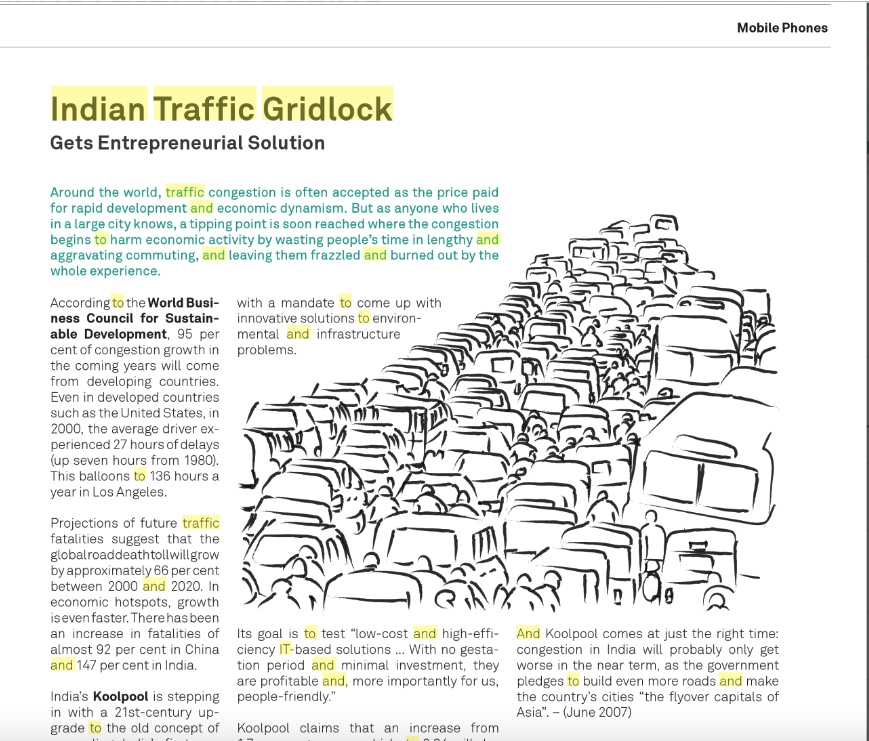
    India’s Koolpool is stepping in with a 21st century upgrade to the old concept of carpooling. India’s first carpooling service (in which drivers share rides to reduce congestion and save money) uses the power of the country’s mobile phone network to link up people by SMS (short message service) text. Already launched in Mumbai, it is being rolled out in other cities as well.

    Koolpool surveyed Indian drivers and found that the average car only had two passengers. Koolpool is an idea from the Mumbai Environmental Social Network (MESN), a registered charity with the mandate to come up with innovative solutions to environmental and infrastructure problems. Its goal is to prove “low-cost and high efficiency IT-based solutions are the way of the future. With no gestation period and minimal investment, they are profitable and more importantly for us, people friendly.” Koolpool claims that an increase from 1.7 passengers per vehicle to 2.04 will decrease travel time and pollution levels by 25 percent. It also claims to be the first carpooling service to combine SMS text messaging and IT.

    Ride-givers send a text message to Koolpool just before going down a major road. Koolpool then sends a list of ride seekers on the route, their membership identifications, the designated stopping point for pick-up, number of riders and login time. If there are no ride givers on that route, then ride seekers are pooled together to get a taxi and share the costs. Members of Koolpool pay an annual membership fee and exchange credits by mobile phone between ride seekers and ride givers, which are then redeemed at gas stations for petrol.

    And Koopool comes at just the right time: congestion in India will probably only get worse in the near term, as the government pledges to build even more roads and make the country’s cities “the flyover capital of Asia”.

    In Kolkata, says Sudarsanam Padam, former director of the Central Institute of Road Transport in the city of Pune, the average speed during peak hours in the central business district (CBD) area is as low as seven km/hr. Bangalore currently has average speeds of about 13-15 km/hr in its CBD, but this is expected to go down to three to eight km/hr in the next 15 years, according to the city’s police traffic commissioner, M N Reddi.

    Published: June 2007

    Resources

    • Mobility 2001: World Mobility at the End of the Twentieth Century and its Sustainability published by the World Business Council for Sustainable Development.
    • Another Indian car pooling business allows people to post requests for rides on an internet bulletin board, Car Sales India.
    • Another solution to traffic congestion has been the motorcycle taxi. Beginning in Thailand, motorcycle taxis can now be found in Cambodia, India and the UK. Read more at here.
    • SENSEable City: A project at the Massachusetts Institute of Technology’s SENSEable City Laboratory to use the new generation of sensors and hand-held electronics to change how cities are understood and navigated. This includes creating real-time maps of cities that can then be used to help with avoiding traffic congestion and other problems.
    • Read more about India’s traffic congestion problem by India’s only science and environment biweekly online newsletter, Down to Earth.

    Development Challenges, South-South Solutions was launched as an e-newsletter in 2006 by UNDP’s South-South Cooperation Unit (now the United Nations Office for South-South Cooperation) based in New York, USA. It led on profiling the rise of the global South as an economic powerhouse and was one of the first regular publications to champion the global South’s innovators, entrepreneurs, and pioneers. It tracked the key trends that are now so profoundly reshaping how development is seen and done. This includes the rapid take-up of mobile phones and information technology in the global South (as profiled in the first issue of magazine Southern Innovator), the move to becoming a majority urban world, a growing global innovator culture, and the plethora of solutions being developed in the global South to tackle its problems and improve living conditions and boost human development. The success of the e-newsletter led to the launch of the magazine Southern Innovator.  

    Creative Commons License

    This work is licensed under a
    Creative Commons Attribution-Noncommercial-No Derivative Works 3.0 License.

    ORCID iD: https://orcid.org/0000-0001-5311-1052.

    © David South Consulting 2022
  • African Entrepreneur Wants to Bring Order to Urban Chaos

    African Entrepreneur Wants to Bring Order to Urban Chaos

    By David SouthDevelopment Challenges, South-South Solutions

    SOUTH-SOUTH CASE STUDY

    All over the global South, urban and semi-urban areas are growing at a furious pace. Great swathes of mega-regions – places where large cities blend seamlessly into smaller towns and villages creating a giant economic hub – are becoming key economic and opportunity drivers in developing countries. One of the downsides of this rapid growth and economic vitality is the chaos and confusion brought by frenetic change. Into this busy landscape steps the fast-moving new world of everywhere computing, where computers exchange information with almost everything in the environment. A Ghanaian information technology pioneer and entrepreneur is changing perceptions about Africa by using the new technology of Semacodes – and proving a semblance of order can arise from the chaos and bustle of the street.

    Semacode – a smart 2D barcode – was developed by Canadian Simon Woodside and is a tool to make everywhere computing a possibility. It works by embedding a web address into a 2D barcode called a tag which can be affixed to buildings, street lamps, and other landmarks. If one would like to know more information regarding the area they are in, all they need to do is find the nearest Semacode and use their internet-enabled camera phone to scan and read the code. A camera phone containing the Semacode’s Software Development Kit (SDK) detects and decodes the tag and sends the user the web address using the phone’s built-in browser. The user quickly learns what businesses and services are in the area and what the current street name is.

    With code developed in Ghana called Semafox, one can create Semacodes for objects and contexts using a web browser – (http://sohne.net/semafox/). It is now being adapted by Ghanaian entrepreneur Guido Sohne to solve the common African problem of chaotic cityscapes brought about by rapid change, high turnover of businesses and changing street names. This handy tool has the power to revolutionise how people communicate and do business in the South, and a rival technology using a similar concept – QR code – is already widespread in Japan. Semacode also has its own user-contributed community website, Semapedia, to produce semacodes for any object or building.

    *~~~~~~~~~~~~~~~~~~~~~*

    Sohne is a computer code developer working for CoreNett – a Ghanaian electronic transaction processing company – and has been working on developing the code underlying the semacodes, and also piloting its application on the streets of Accra, the capital. Sohne (a former Kofi Annan ICT Centre for Excellence developer-in-residence), is an excellent example of how an IT innovator in the South is linking up early in a new technology’s development to help develop and evolve it.“It is rare to find African-created technology being used today in Western cyberspace,” concludes Sohne. It “is indeed a step forward for African technology as well as an indication of the benefits of collaborative development based on liberal software licensing such as open source software.”

    Published: June 2007

    Resources

    • You can download the Semacode reader software, here. This includes software for mobile phones and computer servers.
    • The latest stories and updates on Semacode can be found here.
    • A thorough explanation of rival technology QR Codes and their impact in Japan and how they work, can be found here. At present, QR Codes are used in a variety of ways, from linking to content and advertising in magazines and newspapers, to food product labels, public transportation signage, and as a way to communicate between people on the street.

    https://davidsouthconsulting.org/2020/12/04/big-data-can-transform-the-global-souths-growing-cities/

    https://davidsouthconsulting.org/2020/12/11/cyber-cities-an-oasis-of-prosperity-in-the-south/

    https://davidsouthconsulting.org/2020/12/04/data-surge-across-global-south-promises-to-re-shape-the-internet/

    https://davidsouthconsulting.org/2022/02/17/digital-mapping-to-put-slums-on-the-map/

    https://davidsouthconsulting.org/2022/10/09/entrepreneurs-use-mobiles-and-it-to-tackle-indian-traffic-gridlock/

    https://davidsouthconsulting.org/2022/09/27/india-2-0-can-the-country-make-the-move-to-the-next-level/

    https://davidsouthconsulting.org/2021/03/04/indian-id-project-is-foundation-for-future-economic-progress/

    https://davidsouthconsulting.org/2021/03/31/new-weapon-against-crime-in-the-south/

    https://davidsouthconsulting.org/2021/02/18/what-is-the-un-doing-with-your-data/

    Creative Commons License

    This work is licensed under a
    Creative Commons Attribution-Noncommercial-No Derivative Works 3.0 License.

    ORCID iD: https://orcid.org/0000-0001-5311-1052.

    © David South Consulting 2023