Categories
Archive

Innovative Solutions Celebrated in Ashden Awards

By David SouthDevelopment Challenges, South-South Solutions

SOUTH-SOUTH CASE STUDY

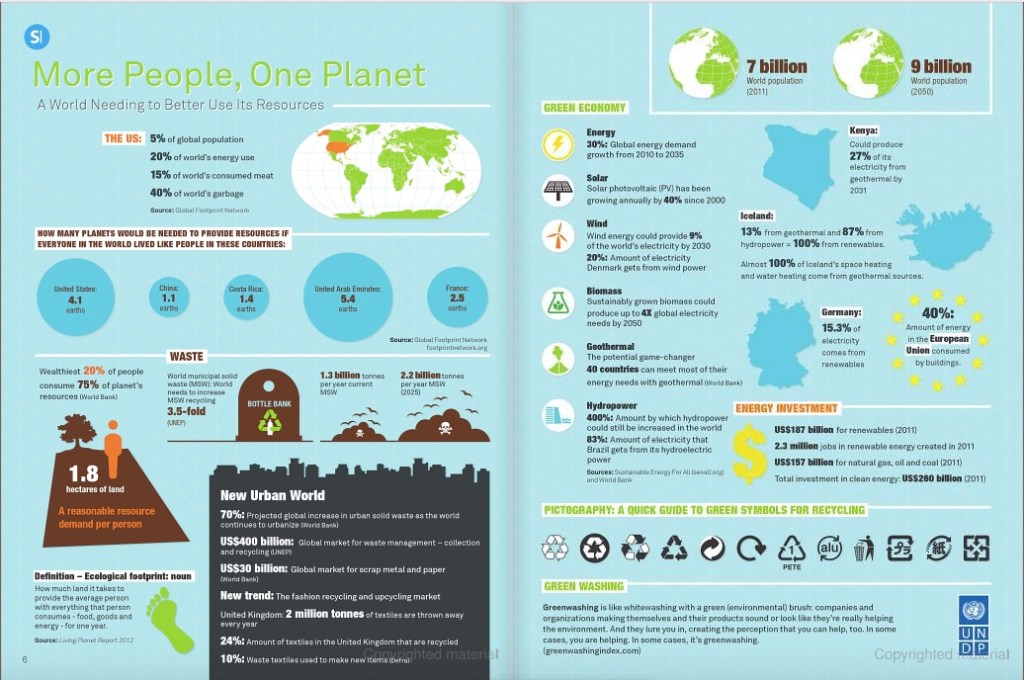
The world’s population is heading towards 9.6 billion by 2050 (UN). Combined with a growing middle class and rising living standards across the global South, that means ever-greater demand on the world’s finite resources. This raises a crucial question: Where will the energy to power rising living standards come from, and how much damage will be done to the planet’s environment by pollution created generating it (https://www.un.org/en/development/desa/news/population/un-report-world-population-projected-to-reach-9-6-billion-by-2050.html)?

The solution advocated by the world’s scientists is to move to sustainable energy creation, which does not rob from the future to create energy for today.

Such an approach requires fresh thinking and engagement from those who are actually involved in the struggle to raise living standards and improve human development.

One way to do this is to use high-profile awards and prizes to lure out fresh thinking and innovators and help them get the funding they need to realize their plans.

The International Ashden Awards (ashden.org) – considered the “leading green energy awards” – is about championing and promoting “practical, local energy solutions that cut carbon, protect the environment, reduce poverty and improve people’s lives”. It recently announced the finalists and winners for 2014.

The international finalists are 10 sustainable energy enterprises drawn from Africa (Burkina Faso, Tanzania), India and Southeast Asia (Cambodia, Myanmar). A handy, clickable and searchable online map (http://www.ashden.org/winners) further explains the winners and finalists for 2014 and previous years.

“With the stark warnings from the IPCC (Intergovernmental Panel on Climate Change) of the impacts of climate change, especially for the most vulnerable, we need to find solutions before it is too late,” said Ashden founder-director Sarah Butler-Sloss.

“Our role at Ashden is to shine a light on those organizations around the world that are helping reduce carbon emissions and finding ways of adapting to the effects of climate change.”

The mix of non-profit organizations and businesses among 2014’s winners and finalists shows there is no shortage of enthusiasm and fresh thinking out there. Proof the global South is alive with innovators with solutions.

Among the five international winners – who will receive between US $8,566 and US $68,531 each – is India’s Greenway Grameen (greenwaygrameen.com). It is tackling the problem of harmful pollution caused by cooking. Despite rapid economic growth and the spread of consumer goods such as televisions and mobile phones, most Indian women still cook with wood or dung. This is not only time-consuming, it also produces health-damaging smoke. Greenway Grameen was founded by two young MBA graduates in 2010 to make and sell affordable, desirable cookstoves that reduce smoke, cook food more quickly and stay cleaner for longer, dramatically improving the quality of life for many women and girls. As of March 2014 more than 120,000 of Greenway’s made-in-India smart stoves had been sold, benefitting around 610,000 people.

Another Indian winner is Infosys (infosys.com). India’s fast-growing economy is making ever-greater demands on its electrical grid. Global IT giant Infosys is leading the way to more sustainable growth by embracing green building measures, decreasing electricity consumption per staff member across its Indian business campuses. Success lies in seizing every opportunity to cut energy consumption in its existing buildings – from reducing the size of chiller plants for air conditioning to painting roofs white to reflect the heat. Cutting-edge design of new buildings also helps keep offices cooler and maximizes natural light. Taking US $80 million off its electricity bills, Infosys has proven the business case for large companies to invest in energy efficiency – not just in India but around the globe.

Among the other winners:

– Tanzania’s Off Grid Electric (offgrid-electric.com) is a leader in solar energy in East Africa, using mobile money to sell solar power as a daily service at an affordable price. Mobile money – where customers pay with their mobile phones – is increasingly used as a method of payment. Off Grid stands out because it understands the importance of customer service, offering an all-day customer care telephone line and ongoing support from a local agent. More than 10,000 households have taken up the service since April 2012. As fast as systems are manufactured they are off to customers – thanks to a sophisticated mobile phone app-based customer registration and product-tracking system.

– Myanmar’s Proximity Designs (proximitydesigns.org) is introducing treadle pumps (http://en.wikipedia.org/wiki/Treadle_pump) and other sustainable agriculture technologies to the country for the first time. Lifting water from wells and carrying it across fields is back-breaking, time-consuming work for rural farmers. Combined with water-saving drip irrigation technology, foot-operated treadle pumps that draw up water from wells can dramatically increase yields and incomes. Farmers are now seeing their lives transformed with some harvests and incomes more than doubling – and the pumps are helping ease the daily drudgery of farming. With over 90,000 households benefiting so far, Proximity Designs continues to adapt and introduce new products like solar pumps, to meet the needs of this rapidly changing country.

– Cambodia’s Sustainable Green Fuel Enterprise (http://www.sgfe-cambodia.com/environment) is turning leftover coconut shells and other waste into clean-burning briquettes for use as cooking fuel in the capital Phnom Penh’s homes and restaurants. While most Cambodians cook on wood charcoal, contributing to the country’s rampant deforestation and air pollution, this pioneering Cambodian business – led by Carlo Figà Talamanca – can scarcely keep up with demand.

The finalists are also an innovative lot too. Kéré Architecture (kerearchitecture.com) in Burkina Faso, Africa, has set a new standard for green school buildings. The school it built has a ventilated roof and other clever design features, providing a much cooler environment for children to study in. Not only that, the school was built by local people, and largely with local materials. Germany-based Francis Kéré, originally from Burkina Faso, designed and built the school in his home village. Kéré Architecture has since designed and built more than 20 innovative, naturally cooled public buildings in Africa.

India’s Sakhi Unique Rural Enterprise (sureindia.co.in), or SURE, is a not-for-profit social enterprise in central Maharashtra that has selected, trained and supported more than 600 female micro-entrepreneurs to sell clean energy products such as solar lanterns and cleaner cookstoves to other women. For the women entrepreneurs, selling energy products boosts income and carries a social cachet, while customers also see their lives improved with time-saving products.

Another Indian innovator, Mera Gao Power (http://meragaopower.com/), is demonstrating the business case for meeting the needs of some of the poorest people in India with unsubsidized commercial micro-electric grids, connecting more than 20,000 Uttar Pradesh families to clean, affordable power. Each system is easy to install and provides seven hours of light and mobile phone-charging for up to 32 houses. And with weekly payments of just US $0.42 cents, the electricity is even cheaper than kerosene.

The Rajasthan Horticulture Development Society (http://horticulture.rajasthan.gov.in/) in India has come up with a novel way to boost green agriculture and boost farming incomes. Farmers in the desert state of Rajasthan are seeing their sons return from cities to work on their farms thanks to a new solar-powered agricultural boom. The Rajasthan Horticulture Development Society (RHDS) has provided more than 10,000 farmers with new solar-powered water pumps, enabling year-round cultivation of high-value crops and the kind of high-tech horticulture that’s never been seen in the region before. With farmers’ incomes more than doubling, the programme has given them the “gift of life”.

And finally, Tanzania’s SimGas (simgas.com) is selling biogas plants that help people turn manure into clean gas for cooking instead of using charcoal, helping reduce deforestation. The plants are factory-produced and made of plastic, so they can be installed much more quickly than conventional plants and reach many more thousands of people. SimGas has just installed the largest plastic injection-moulding machine in East Africa, creating the potential to roll out biogas plants across East Africa.

The Ashden Awards were set up in 2001 to champion trailblazing sustainable energy enterprises and programmes that improve people’s lives and tackle climate change. Ashden says its 150 award winners have improved the lives of 37 million people worldwide, and are now saving over 5 million tonnes of carbon emissions every year.

Published: July 2014

Resources

1) Innovation Prize for Africa: The IPA is an initiative of the African Innovation Foundation (AIF) started in 2011. IPA honours and encourages innovative achievements that contribute toward developing new products, increasing efficiency or saving cost in Africa. Website: http://innovationprizeforafrica.org

2) Champions of the Earth Award: The Champions of the Earth Award recognizes outstanding environmental leaders, whether individuals or organizations, that have exemplified inspiration, vision, innovation, leadership and action for the environment. This international award was established by UNEP in 2004. Website: unep.org/awards/

The SEED Awards: The SEED Award recognizes innovation in local, environmentally-responsible and sustainable entrepreneurship. This international award is the flagship programme of the SEED Initiative, a partnership founded by the United Nations Development Programme (UNDP), UNEP, and the International Union for Conservation of Nature (IUCN). Website: seedinit.org

4) Green Star Awards: The Green Star Awards recognize those who have made remarkable efforts to prevent, prepare for, and respond to environmental disasters around the world. This international award is a joint initiative between UNEP, the UN Office for the Coordination of Humanitarian Affairs and Green Cross International. Website: http://www.gcint.org/green-star-awards3

Creative Commons License

This work is licensed under a
Creative Commons Attribution-Noncommercial-No Derivative Works 3.0 License.

ORCID iD: https://orcid.org/0000-0001-5311-1052.

© David South Consulting 2023

Categories
Archive Development Challenges, South-South Solutions Newsletters Southern Innovator magazine

3D Home Printing Landmark: 10 Houses in a Day

By David SouthDevelopment Challenges, South-South Solutions

SOUTH-SOUTH CASE STUDY

The global South is experiencing urban growth on a scale unprecedented in human history, far outstripping the great urbanization wave that swept across Europe and North America during the 19th and 20th centuries.

Faced with growth at this pace, governments – both national and local – often become overwhelmed by the rate of change and find it difficult to cope. One of the most common complaints urban-dwellers around the world have is about their living conditions. Even in developed countries, creating enough housing to match demand can be a struggle.

Quality housing is crucial to human development and quality of life. Adequate living space and access to running water make a significant contribution to people’s health and well-being. Despite this obvious conclusion, millions of urban dwellers live in squalid conditions with poor sanitation, overcrowding, crime, pollution, noise and a general feeling of insecurity. Insecure people find it difficult to access stable jobs and suffer stigma for living in poor-quality neighbourhoods.

But many initiatives are seeking to speed up the pace of home construction.

These include the Moladi construction system from South Africa (moladi.net). Moladi uses moulds to assemble houses, so that the building skills required are minimal and easily learned. Built to a template that has been tested for structural soundness and using a design that produces a high-quality home both in structure and appearance, the Moladi system seeks to provide an alternative to makeshift homes that are structurally unsound and vulnerable to fires, earthquakes and other natural disasters.

Another clever approach is a home and dwelling assembly system developed by architect Teddy Cruz (http://estudioteddycruz.com) (http://visarts.ucsd.edu/faculty/teddy-cruz) that allows slum dwellers to gradually construct a building in stages as they can afford it. It is earthquake-safe and fire resistant.

Another approach turns to the fast-growing technology of 3D printing (http://en.wikipedia.org/wiki/3D_printing). This technology has gone mainstream in the past five years in the form of desktop-sized 3D printers, or fabricators as they are sometimes called. The machines assemble objects in an additive fashion – layer-by-layer – using digital designs from a computer.

3D printers can make a complex object without having to resort to mass manufacturing. An accurate, one-off object can be created with the same precision as a machined object. Architects, for example, use the technology to make 3D models of their designs. And now a company in China is hoping to use 3D printers to make houses.

The WinSun Decoration Design Engineering Co. (http://www.yhbm.com/index.aspx) 3D printed 10 houses in 24 hours in Shanghai’s Qinpu district, reported Business Insider.

This landmark achievement was accomplished with a giant printer – 152 meters long, 10 meters wide, and 6 meters high – which manufactured walls for the house from a mix of construction waste and cement.

As a sign of the confidence the company has in the innovative construction technique, it built its own 10,000 square meter headquarters in one month using the same materials. The company’s chief executive officer, Ma Yihe, is also the inventor of the technique. It is a very flexible technology and the material can be tinted different colors according to the customer’s wishes. It is cheap to work with and is also less draining on environmental resources than traditional building materials.

The 10 houses consist of two concrete side supporting walls with glass panels at the front and back and with a triangle roof. They will be used as offices at a high-tech industrial park in Shanghai. The company has big plans, hoping to use the technology to build more homes – and even skyscrapers.

Competition is heating up as people around the world seek to perfect 3D technology to print houses to meet the growing demand for dwellings.

In The Netherlands, Dutch architectural firm Dus Architects (dusarchitects.com)  commissioned the development of a leviathan 3D printer so it could print entire rooms. Modeled on a much smaller home desktop version, the Ultimaker (ultimaker.com), this printer creates whole rooms that are then assembled into custom-built houses.

The 6-meter high KamerMaker (kamermaker.com), or “room builder”, is being used in Amsterdam to build a full-size house.

The project is called “3D Print Canal House” (http://3dprintcanalhouse.com/). The printer assembles the rooms individually, and then they are snapped together to make a house. The internal structure of the building blocks are in a honey-comb pattern, which is then filled with a foam that becomes as hard as concrete.

“For the first time in history, over half of the world’s population is living in cities,” Dus Architects founder Hans Vermeulen told cnet.com. “We need a rapid building technique to keep up the pace with the growth of the megacities. And we think 3D printing can be that technique.

“We bought a container from the Internet and we transformed it into one of the biggest printers on this planet.”

This technology can also easily use recycled waste materials and lower the pollution and cost of moving building materials around. The Dus Architects prototype house is expected to take three years to complete (so, still in its early development phase) and will look like a typical Dutch canal house with a pointy, gabled roof (http://www.build.com.au/gabled-roof).

One of the pioneering advocates for using 3D technology to address the global South’s urbanization and housing challenge has been Larry Sass, director of the Digital Design Fabrication Group (http://ddf.mit.edu/) at the Massachusetts Institute of Technology (MIT).

Three technologies have been developed at MIT since the 1950s that have made digital fabrication possible – computer numerical control (CNC), which enables computers to control machines; computer-aided design software in the 1960s; and 3D printing in the 1980s to make solid models using digital designs.

Sass told MIT’s Spectrum newsletter (spectrum.mit.edu) that large-scale 3D printing would mean “buildings will rise faster, use fewer resources, cost less, and be more delightful to the eye than ever before.”

He envisions a future in which architects will be able to send their designs by computer to a 3D printer and it will then be able to start “printing” the building or a house accurately according to the original designs.

The conventional way of making buildings has been stuck in the same approach since the 1800s, according to Sass. It uses highly skilled and extensive labour, it is slow and plagued by weather disruptions and urban congestion, and it is expensive, often using materials brought from far away.

Digitally fabricating buildings takes a radically different approach: the building is made in a series of precision-cut, interlocking parts and then assembled on site like a jigsaw puzzle.

“It’s the right delivery system for the developing world, because the developing world doesn’t have an infrastructure of tools, air guns, saws and power,” Sass said.

“Design and high-quality construction is mostly for the rich,” added Sass, who was raised in Harlem, a New York City neighbourhood with high poverty levels. “I’ve always wanted to figure out how to bring design choice and architectural delight to the poor.”

Published: July 2014

Resources

1) 3D Printing Technologies: A website exploring the development of 3D technology. Website: http://www.3d-printing-technologies.com/index.html

2) Sweet Home 3D: An open source, free interior design software application that allows users to draw the plan of their house, arrange furniture and view in 3D. Website: sweethome3d.com

3) A video showing how it was done is here: http://www.businessinsider.com/this-video-shows-how-a-company-3-d-printed-10-houses-in-a-day-2014-4.

4) 3-D Printed Buildings for A Developing World from MIT’s Spectrum. Website: http://spectrum.mit.edu/articles/3-d-printed-buildings-for-a-developing-world/


This work is licensed under a Creative Commons Attribution 4.0 International License.

ORCID iD: https://orcid.org/0000-0001-5311-1052.

© David South Consulting 2023

Categories
Archive Development Challenges, South-South Solutions Newsletters

Innovative Ways to Collect Water from Air

By David SouthDevelopment Challenges, South-South Solutions

SOUTH-SOUTH CASE STUDY

 World water resources are being depleted quickly as populations grow, urbanize and demand better living standards. Many scientists believe we are reaching peak water – the point at which fresh water is consumed faster than it is replenished.

According to Ensia (ensia.com), a magazine showcasing environmental solutions in action, 70 per cent of the earth’s fresh water reserves are locked up in snow or ice, and are expensive to tap and bring to the world’s water-stressed places. Of the remainder, most is in groundwater, soil moisture, swamps or permafrost, while just 0.3 per cent is easy to access in freshwater lakes and rivers.

By far the biggest user of water in the world – accounting for 69 per cent of the total – is farm irrigation. That’s a serious concern when considering the world will need to grow more food to feed an increasing population. Just 1 per cent of water is used for livestock, while 15 per cent is used for electricity generation and 7 per cent for manufacturing. More water is currently being pumped from underground resources than is being replaced from underground aquifers.

The average person needs to consume 0.6 to 1.3 gallons (2.72 liters to 6 liters) of water per day to survive in a moderate climate. For drinking, cooking, bathing and sanitation, an individual needs 13 gallons (59 liters) a day (Ensia).

In many places, obtaining water requires a long trek to a well or stream. But non-desert climates have water as a resource readily available all around – trapped in the air. The clue to this resource’s existence is in the air’s humidity levels, the most visible sign of which is the dew that is found covering the grass and leaves every morning when people wake up. The trick is to extract that water from the air and create a steady supply of this essential resource.

Italian architect and designer Arturo Vittori (http://www.vittori-lab.com/team/arturo-vittori), a lecturer on aerospace architecture, technology transfer and sustainability, believes he has an answer.

Wired magazine (http://www.wired.com/2014/03/warka-water-africa/) reported that Vittori was inspired by a trip to Ethiopia, where he observed the daily struggle to get water. Access to water in northeastern Ethiopia often requires a long walk, which reduces the amount of time left in the day to do other things. Parents often take along their children, meaning the children cannot go to school. The time consumed by gathering water leaves people poorer and unable to dedicate more of their day to income-earning activities.

And there is no guarantee the water is safe to drink or free of chemical contaminants. This situation left Vittori pondering ways of coming up with an inexpensive solution that would eliminate the daily hassle of finding water and guarantee its quality.

The answer was a WarkaWater Tower (http://www.architectureandvision.com/projects/chronological/84-projects/art/492-073-warkawater-2012?showall=&start=1). The bamboo structure – which looks like an upended, latticework funnel – captures the dew and moisture in the air and collects it in a basket at the bottom.

The water collector is inspired by the Warka tree, or Ficus vasta (http://en.wikipedia.org/wiki/Ficus_vasta). Native to Ethiopia, it is known for providing shade and as a rendezvous point for traditional gatherings.

A WarkaWater Tower stands 8 meters in height and is made from either bamboo or reeds. Inside, a mesh traps humidity from the air and the water drips down into a basket. One tower can gather around 94 liters of water a day. The water is right there in the community and not kilometers away, meaning time and energy saved for income-generating tasks.

A WarkaWater Tower is constructed in sections, which are assembled and then stacked on top of each other. The construction does not need special scaffolding or special machinery. Once the tower is in place, it can also be used as a solar-power generator.

The tower is still a prototype and Vittori plans to build two towers for a launch in 2015.

In Peru, reports the Latin American Herald Tribune (http://www.laht.com/article.asp?ArticleId=700400&CategoryId=14095), another innovative solution to the water crisis has been developed by students at the University of Engineering and Technology (UTEC) (http://www.utec.edu.pe/Utec.aspx). The students have developed a highway advertising billboard that can draw drinking water out of the air. Inspired by a campaign called “Ingenuity in Action”, the students teamed up with a local advertising agency to design the billboard. It is capable of extracting water from the air and processing it through a filtration system as it flows down to a series of taps at the bottom.

The water-making billboard is at the 89.5 kilometer distance marker of the Pan-American Highway and has five electric-powered tanks that can hold a total of 96 liters of drinkable water. It is capable of providing enough water for hundreds of families. A true sign of our times!

Published: July 2014

Resources

1) How to Build a Rainwater Collection System. Website: http://www.wikihow.com/Build-a-Rainwater-Collection-System

2) The geopolitical difficulties of access to water covered in The Devil and the Disappearing Sea: A True Story about the Aral Sea Catastrophe by Robert Ferguson. Website: amazon.com

3) “Earth may have underground ‘ocean’ three times that on surface” from The Guardian. Website: http://www.theguardian.com/science/2014/jun/13/earth-may-have-underground-ocean-three-times-that-on-surface

An article on the impact of the water crisis on food supplies. Website: http://www.theguardian.com/lifeandstyle/2014/jul/09/enjoy-your-coffee-you-may-soon-not-be-able-to-afford-it

5) How to Make Water in the Desert. Website: http://www.wikihow.com/Make-Water-in-the-Desert


Development Challenges, South-South Solutions was launched as an e-newsletter in 2006 by UNDP’s South-South Cooperation Unit (now the United Nations Office for South-South Cooperation) based in New York, USA. It led on profiling the rise of the global South as an economic powerhouse and was one of the first regular publications to champion the global South’s innovators, entrepreneurs, and pioneers. It tracked the key trends that are now so profoundly reshaping how development is seen and done. This includes the rapid take-up of mobile phones and information technology in the global South (as profiled in the first issue of magazine Southern Innovator), the move to becoming a majority urban world, a growing global innovator culture, and the plethora of solutions being developed in the global South to tackle its problems and improve living conditions and boost human development. The success of the e-newsletter led to the launch of the magazine Southern Innovator.  

https://davidsouthconsulting.org/2022/11/02/clay-filters-are-simple-solution-for-clean-water/

https://davidsouthconsulting.org/2023/01/16/hip-driven-pump-brings-water-to-parched-fields/

https://davidsouthconsulting.org/2022/11/19/saving-water-to-make-money/

https://davidsouthconsulting.org/2021/03/05/southern-innovator-issue-5/

https://davidsouthconsulting.org/2022/02/10/urban-farmers-gain-from-waste-water/

https://davidsouthconsulting.org/2022/10/17/the-water-free-south-african-bathing-solution/

Follow @SouthSouth1

Google Books: https://books.google.co.uk/books?id=waeXBgAAQBAJ&dq=Development+Challenges+February+2008&source=gbs_navlinks_s

Slideshare: http://www.slideshare.net/DavidSouth1/development-challengessouthsouthsolutionsfebruary2008issue

Southern Innovator Issue 1: https://books.google.co.uk/books?id=Q1O54YSE2BgC&dq=southern+innovator&source=gbs_navlinks_s

Southern Innovator Issue 2: https://books.google.co.uk/books?id=Ty0N969dcssC&dq=southern+innovator&source=gbs_navlinks_s

Southern Innovator Issue 3: https://books.google.co.uk/books?id=AQNt4YmhZagC&dq=southern+innovator&source=gbs_navlinks_s

Southern Innovator Issue 4: https://books.google.co.uk/books?id=9T_n2tA7l4EC&dq=southern+innovator&source=gbs_navlinks_s

Southern Innovator Issue 5: https://books.google.co.uk/books?id=6ILdAgAAQBAJ&dq=southern+innovator&source=gbs_navlinks_s

Creative Commons License

This work is licensed under a
Creative Commons Attribution-Noncommercial-No Derivative Works 3.0 License.

ORCID iD: https://orcid.org/0000-0001-5311-1052.

© David South Consulting 2023

Categories
Archive Blogroll Southasiadisasters.net United Nations Office for South-South Cooperation

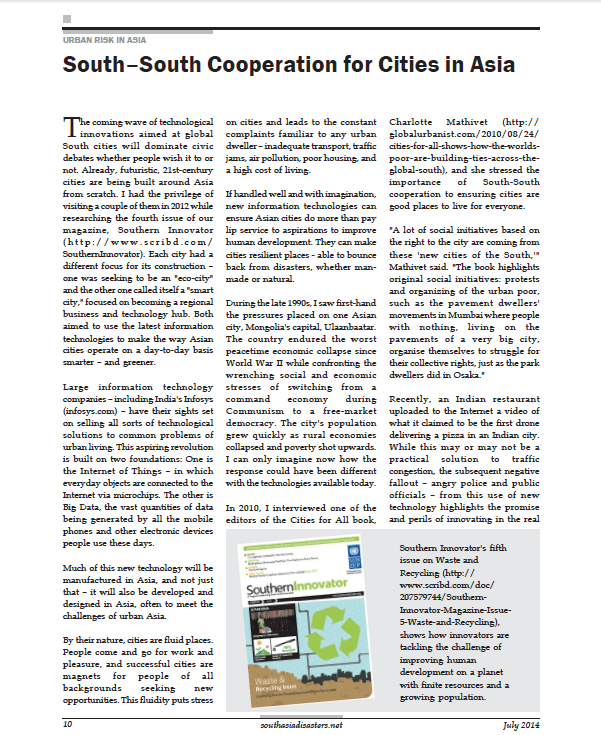
South–South Cooperation For Cities In Asia

Published: July 2014

Publisher: Southasiadisasters.net

Issue No. 114, July 2014

Theme: Towards Urban Resilience

The coming wave of technological innovations aimed at global South cities will dominate civic debates whether people wish it to or not. Already, futuristic, 21st-century cities are being built around Asia from scratch. I had the privilege of visiting a couple of them in 2012 while researching the fourth issue of our magazine, Southern Innovator (  h t t p : / / w w w . s c r i b d . c o m / SouthernInnovator). Each city had a different focus for its construction – one was seeking to be an “eco-city” and the other one called itself a “smart city,” focused on becoming a regional business and technology hub. Both aimed to use the latest information technologies to make the way Asian cities operate on a day-to-day basis smarter – and greener.

Large information technology companies – including India’s Infosys (infosys.com) – have their sights set on selling all sorts of technological solutions to common problems of urban living. This aspiring revolution is built on two foundations: One is the Internet of Things – in which everyday objects are connected to the
Internet via microchips. The other is Big Data, the vast quantities of data being generated by all the mobile phones and other electronic devices people use these days.

Much of this new technology will be manufactured in Asia, and not just that – it will also be developed and designed in Asia, often to meet the challenges of urban Asia.

By their nature, cities are fluid places. People come and go for work and pleasure, and successful cities are magnets for people of all backgrounds seeking new opportunities. This fluidity puts stress on cities and leads to the constant complaints familiar to any urban dweller – inadequate transport, traffic jams, air pollution, poor housing, and a high cost of living.

If handled well and with imagination, new information technologies can ensure Asian cities do more than pay lip service to aspirations to improve human development. They can make cities resilient places – able to bounce back from disasters, whether man made or natural.

During the late 1990s, I saw first-hand the pressures placed on one Asian city, Mongolia’s capital, Ulaanbaatar. The country endured the worst peacetime economic collapse since World War II while confronting the wrenching social and economic stresses of switching from a command economy during Communism to a free-market democracy. The city’s population grew quickly as rural economies collapsed and poverty shot upwards. I can only imagine now how the response could have been different with the technologies available today.

In 2010, I interviewed one of the editors of the Cities for All book, Charlotte Mathivet (http://globalurbanist.com/2010/08/24/cities-for-all-shows-how-the-worldspoor-are-building-ties-across-theglobal-
south), and she stressed the importance of South-South cooperation to ensuring cities are good places to live for everyone.

“A lot of social initiatives based on the right to the city are coming from these ‘new cities of the South,'” Mathivet said. “The book highlights original social initiatives: protests and organizing of the urban poor, such as the pavement dwellers’ movements in Mumbai where people with nothing, living on the pavements of a very big city, organise themselves to struggle for their collective rights, just as the park dwellers did in Osaka.”

Recently, an Indian restaurant uploaded to the Internet a video of what it claimed to be the first drone delivering a pizza in an Indian city. While this may or may not be a practical solution to traffic congestion, the subsequent negative fallout – angry police and public officials – from this use of new technology highlights the promise
and perils of innovating in the real world of Asian cities (http:/
/www.bbc.co.uk/news/
b l o g s – n e w s – f r o m –
elsewhere-27537120).

Micro electronics are becoming cheaper and more powerful by the month. Small businesses armed with a only laptop computer, access to the Internet and/or mobile phone networks, and cloud computing services, can offer very powerful business and public services solutions. And sharing solutions across the global South via information technologies has never been easier.

The U.S. Pentagon published various reports and studies in the 2000s forecasting a dark future for cities in the global South. As author Mike Davis revealed in his seminal work, Planet of Slums (http://www.amazon.com/exec/obido/ASIN/1844670228/nationbooks08), the Pentagon saw the developing world’s cities as the “battlespace of the twenty-first century.” It imagined sprawling, crime ridden cities full of poverty and slums and needing tiny drones and robots darting back and forth, keeping an eye on everything and suppressing unrest. This threat-based view of future cities is one to be avoided. It is possible, through the right application of quick solutions to the challenges that arise as cities grow, to turn to cooperation across the cities of the global South to avoid this pessimistic fate.


David South, Editor,
United Nations Office for
South-South Cooperation
(UNOSSC), UK

https://reliefweb.int/report/india/southasiadisastersnet-issue-no114-july-2014-towards-urban-resilience

Southern Innovator’s fifth issue on Waste and Recycling (https://books.google.co.uk/books?id=6ILdAgAAQBAJ&dq=southern+innovator&source=gbs_navlinks_s), shows how innovators are tackling the challenge of improving human development on a planet with finite resources and a growing population.

https://davidsouthconsulting.org/2021/10/21/cities-for-all-shows-how-the-worlds-poor-are-building-ties-across-the-global-south/

https://davidsouthconsulting.org/2020/12/14/innovation-in-growing-cities-to-prevent-social-exclusion/

https://davidsouthconsulting.org/2021/10/22/innovations-in-green-economy-top-three-agenda/

https://davidsouthconsulting.org/2021/10/22/lima-to-delhi-what-can-be-learned-on-urban-resilience/

https://davidsouthconsulting.org/2021/02/23/southern-innovator-in-southasiadisasters-net/

https://davidsouthconsulting.org/2021/03/05/southern-innovator-issue-4/

https://davidsouthconsulting.org/2021/03/05/southern-innovator-issue-5/

https://davidsouthconsulting.org/2021/03/12/southern-innovator-magazine/

Creative Commons License

This work is licensed under a
Creative Commons Attribution-Noncommercial-No Derivative Works 3.0 License.

ORCID iD: https://orcid.org/0000-0001-5311-1052.

© David South Consulting 2023