Categories
Archive Development Challenges, South-South Solutions Newsletters

African Theatre Becomes European Success

By David SouthDevelopment Challenges, South-South Solutions

SOUTH-SOUTH CASE STUDY

In Britain, the country that gave the world the plays of William Shakespeare (http://en.wikipedia.org/wiki/William_Shakespeare), a new creative force has taken stages by storm: African theatre.  And it is proving how economically rewarding Southern culture can be.

“African theatre is very eclectic and very narrative driven, which I think appeals to audiences.  Here (the United Kingdom) it’s very much more reflective and intellectual,” director Nick Kent told The Independent newspaper.

Over the last decade, the world’s creative industries have gained greater recognition as an important spark that can drive economic development and entrepreneurship. World exports of creative products were valued at US $424.4 billion in 2005 as compared to US $227.5 billion in 1996, according to UNCTAD figures. It has grown by 8.8 percent a year between 1996 and 2005 (UNCTAD).

In Germany, more than 35 million people go to almost 110,000 theatre performances – not including opera and ballet – every year. That’s almost half the population.

The creative economy is seen as a fast growth area and good job creator, and importantly, a lynchpin of cultural identity and diversity. While the creative economy flourishes in North America and Europe, Southern countries are still not reaping its full benefits. Despite their cultural diversity and richness, out of 132 developing countries, 85 have never produced a commercial film.

UNESCO, through its Global Alliance for Cultural Diversity, has been in the forefront of helping African countries re-shape their policies to take this into consideration. The promotion of cultural industries also has been incorporated into the New Partnership for Africa’s Development (NEPAD).

Kent, the artistic director of London’s Tricycle Theatre, believes the popularity of African theatre is a product of its vibrancy and the fact both music and stories’ narratives engage with difficult topics.

“Since the apartheid era (in South Africa), African theatre has been more engaged socially,” continues Kent. “South Africa has managed to capture music and storytelling.”

Nigeria’s Nobel Prize-winning playwright Wole Soyinka packed Britain’s National Theatre recently by tackling tensions in colonial Nigeria in his play Death and the King’s Horseman. Another Nigerian play is Iya-lle (The First Wife), about a chief’s preparations for his wife’s 40th birthday. It runs at London’s Soho Theatre.

Yet another success is a re-telling stories from the Bible called The Mysteries – Yiimimangaliso — by the South African theatre company Isango Portobello. It was such a huge success when it first appeared on London’s stages in 2002, it will be returning in September.

One way companies in countries like Britain use to introduce audiences to new cultures and creative experiences is to run a special ‘season.’ In April, London’s Tricycle Theatre began a season of 12 plays about Afghanistan by a variety of writers. They were divided into half-hour mini-plays that could be seen in parts over several evenings or in a weekend marathon of 12 plays.

The project was so successful that the Tricycle is starting a South Africa season, beginning with the play Karoo Moose, an award-winning story about a girl’s struggle to survive in a village with the help of an escaped moose. Another play in the season is Koos Sas: Last Bushman of Montagu, a musical about a heroic rebel.

West Africa features in the play The Observer, also at London’s National Theatre. It tells the story of an election observer forced to rubber-stamp the victory of a corrupt president. Lost in the Stars, a musical adaptation of the novel Cry, the Beloved Country – a global success in the 1940s – explores racial tensions in apartheid South Africa and runs at the Queen Elizabeth Hall.

“African theatre addresses issues of identity and conflict,” said Dr .Yvette Hutchison, who lectures in African theatre at the University of Warwick.”Because of its history, there is much to explore. “European theatre became very intellectual and rational after the Enlightenment. African theatre remains spiritual and metaphysical. There is also less formality – the audience expects to contribute.”

The fresh perspective brought by African theatre is its appeal.

“I do think people have become tired of formulaic music in theatre,” said the British-born South African director of The Mysteries, Mark Dornford-May.

“African culture will incorporate, for example, Mozart and a work song, and perceive them as equally valid, or perhaps favour the work song. There’s also a lot of physicality. The audience expects to be engaged. In Europe you sit in your seat and don’t have contact with anyone and you may as well be watching a DVD. There’s a sense of excitement in African theatre and exuberance of performance.”

Published: July 2009

Resources

The British Council sponsors numerous awards for international creatives. Website: www.creativeconomy.org.uk

Creative Clusters: Creative Clusters is an independent policy conference examining the growth of the creative economy. It is interested in initiatives from around the world that are designed to have an impact in both cultural and economic terms.   Website: www.creativeclusters.com

Iroko Theatre Company: The theatre uses traditional African theatre art forms to explore social issues that are of interest to children and young people and in doing so help them to experience new cultures and art forms. Website:www.irokotheatre.org.uk/index.html

A BBC story on the success of African theatre. Website: www.bbc.co.uk/africabeyond/africanarts/18625.shtml

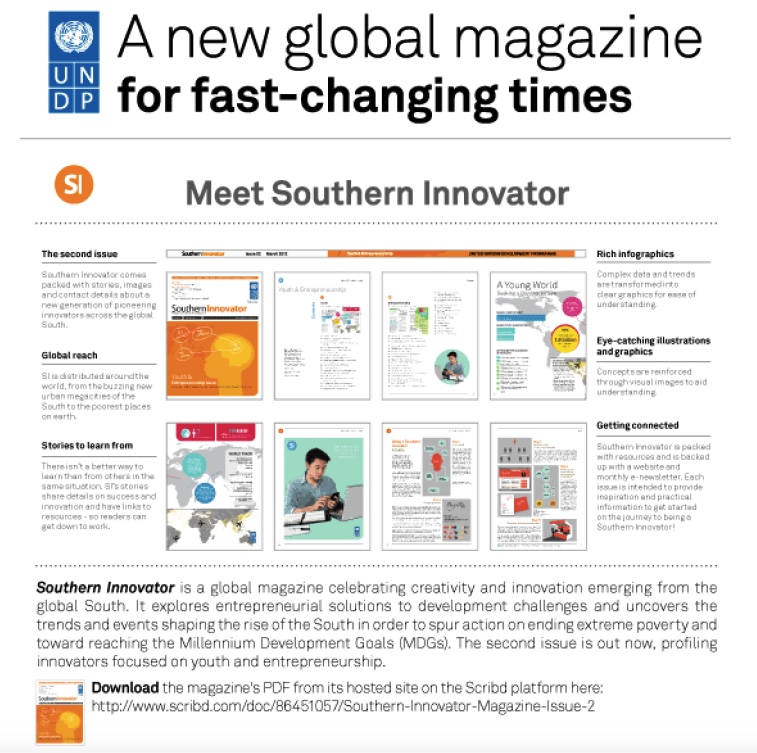
Development Challenges, South-South Solutions was launched as an e-newsletter in 2006 by UNDP’s South-South Cooperation Unit (now the United Nations Office for South-South Cooperation) based in New York, USA. It led on profiling the rise of the global South as an economic powerhouse and was one of the first regular publications to champion the global South’s innovators, entrepreneurs, and pioneers. It tracked the key trends that are now so profoundly reshaping how development is seen and done. This includes the rapid take-up of mobile phones and information technology in the global South (as profiled in the first issue of magazine Southern Innovator), the move to becoming a majority urban world, a growing global innovator culture, and the plethora of solutions being developed in the global South to tackle its problems and improve living conditions and boost human development. The success of the e-newsletter led to the launch of the magazine Southern Innovator.

Creative Commons License

This work is licensed under a
Creative Commons Attribution-Noncommercial-No Derivative Works 3.0 License.

ORCID iD: https://orcid.org/0000-0001-5311-1052.

© David South Consulting 2022

Categories
Archive Development Challenges, South-South Solutions Newsletters

Southern Drinks Challenge Corporate Dominance

By David SouthDevelopment Challenges, South-South Solutions

SOUTH-SOUTH CASE STUDY

Across the global South, its thirsty people have long been a target market for Northern drinks companies. The ubiquity of the American soft drink Coca Cola, or even its rival Pepsi Cola, is testimony to that. Even the most remote village on the impoverished island of Haiti can offer an ice-cold Coke.

But the marketing power of these companies has a down side: it has pushed aside local drink brands based on traditional formulations. But in some countries, local brands are fighting back.

In India, the Cow Protection Department of the Rashtriya Swayamsevak (called RSS) based in Hardwar (www.hardwar.com), one of the four holy cities on the River Ganges, has produced a soft drink made from recycled cow urine. They call it ‘gau jal’ (Sanskrit for ‘cow water’) and it is set for a launch at the end of 2009.

The urine is highly processed to make the drink. “Don’t worry, it won’t smell like urine and will be tasty too,” Om Prakash told the Daily Mail. “Its unique selling point will be that it’s going to be very healthy. It won’t be like carbonated drinks and will be devoid of any toxins.”

The price will be less than American brands such as Coca Cola.

“We’re going to give them good competition as our drink is good for mankind,” he continued. “We may also think of exporting it.”

The drink contains not only cow urine but a blend of medicinal and ayurvedic herbs. Ayurveda is the 5,000-year-old ancient Indian health system.

The RSS was founded in 1925 and claims to have eight million members.

Cows are sacred to India’s Hindu population and killing them is illegal in many parts of India.Finding ways to make a living from cows’ waste products is common. Cow dung (manure) is already used as a fertilizer in villages. It is claimed the new soda pop will help with cancer, obesity and liver disease.

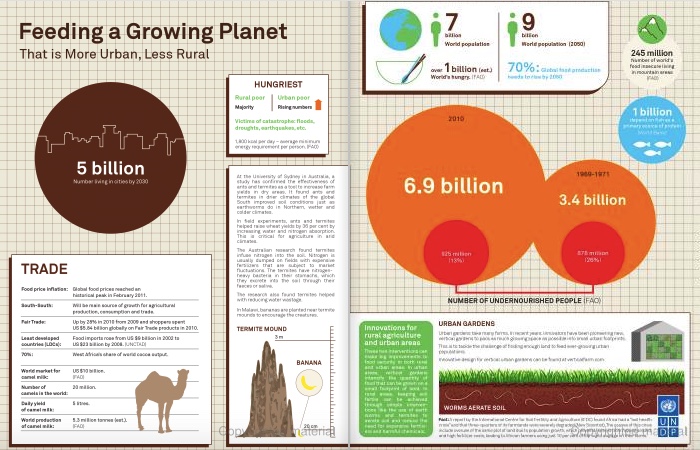
Another drink that has been consumed for its health-giving properties is Mongolian mare’s (female horse) milk. Studies by female scientists from Mongolia, South Korea and China for UNDP in the late 1990s found the milk was packed with vitamins and minerals and effective in treating liver diseases, cancer, intestine inflammations and tuberculosis.

Mongolians have used mare’s milk for centuries in their traditional diet. The drink, called airag in Mongolian, is consumed especially during traditional holidays.

There are eight times as many horses in Mongolia as the human population, which numbers 2.7 million, so the potential for this drink is enormous. The Food and Biotechnology Institute of the Mongolian University of Science and Technology (www.must.edu.mn/beta_new/) in association with the Swiss International Development Agency (www.sdc.admin.ch), has been developing technology to process mare’s milk, and make value-added products with it to create rural jobs. Under the project, eight kinds of beauty products have been manufactured so far using mare’s milk.

Published: July 2009

Resources

Just Food is a web portal packed with the latest news on the global food industry and packed with events and special briefings to fill entrepreneurs in on the difficult issues and constantly shifting market demands. Website: www.just-food.com

Brandchannel: The world’s only online exchange about branding, packed with resources, debates and contacts to help businesses intelligently build their brand. Website: www.brandchannel.com

Small businesses looking to develop their brand can find plenty of free advice and resources here. Website: www.brandingstrategyinsider.com

Growing Inclusive Markets, a new web portal from UNDP packed with case studies, heat maps and strategies on how to use markets to help the poor. Website: www.growinginclusivemarkets.org

Asia-Pacific Traditional Medicine and Herbal Technology Network: an excellent first stop for any entrepreneur, where they can find out standards and regulations and connect with education and training opportunities. Website: www.apctt-tm.net

Development Challenges, South-South Solutions was launched as an e-newsletter in 2006 by UNDP’s South-South Cooperation Unit (now the United Nations Office for South-South Cooperation) based in New York, USA. It led on profiling the rise of the global South as an economic powerhouse and was one of the first regular publications to champion the global South’s innovators, entrepreneurs, and pioneers. It tracked the key trends that are now so profoundly reshaping how development is seen and done. This includes the rapid take-up of mobile phones and information technology in the global South (as profiled in the first issue of magazine Southern Innovator), the move to becoming a majority urban world, a growing global innovator culture, and the plethora of solutions being developed in the global South to tackle its problems and improve living conditions and boost human development. The success of the e-newsletter led to the launch of the magazine Southern Innovator.

Southern Innovator’s online archive portal was launched in New York City, U.S.A. (home to the UN’s headquarters) in 2011 (southerninnovator.org).
Creative Commons License

This work is licensed under a
Creative Commons Attribution-Noncommercial-No Derivative Works 3.0 License.

ORCID iD: https://orcid.org/0000-0001-5311-1052.

© David South Consulting 2024

Categories
Archive Development Challenges, South-South Solutions Newsletters

Tourist Passion for Quirky Holidays Helps South

By David SouthDevelopment Challenges, South-South Solutions

SOUTH-SOUTH CASE STUDY

Conventional thinking holds that any country with a poor or non-existent reputation in the international media will not attract tourists. But this conventional thinking is wrong: The hottest tourist trend for 2009 is directly benefiting the South’s more out-of-the-way and under-appreciated countries. So says a travel expert who specializes in overlooked travel destinations.

Prior to the economic downturn, tourism accounted for more than 10 percent of global GDP and 8 percent of total employment worldwide. It grew by 6 percent in 2007, according to the UN World Tourism Organization. Tourism in the Asia-Pacific region grew by 10 percent and Africa by 8 percent.

But it has since declined by 8 percent between January and April of 2009 compared to the same period in 2008. Destinations worldwide recorded a total of 247 million international tourist arrivals in those four months, down from 269 million in 2008 (UNWTO World Tourism Barometer).

This means competition is heating up for tourists. Well-travelled tourists are now looking for out-of-the-way places and places far off the beaten track. They want to be unique and have a tale to tell when they get home.

Tony Wheeler, author of the book Bad Lands: A Tourist on the Axis of Evil and co-founder of the Lonely Planet travel guides, said “Lots of tourists want to be the first through the door.”

During the Fitur Travel Fair in Madrid in January 2009, Myanmar (formerly Burma) appeared for the first time. Europe’s biggest travel fair also saw Zimbabwe, the Palestinian territories and Iran chasing travellers to come and see the sights.

Wheeler told Britain’s Daily Telegraph newspaper that, ironically, the more negative reports in the media a country gets, the more this new breed of tourist want to visit and find out the truth.

And his travel experiences have taught him, for example, the Burmese people do not believe in isolation and boycotts, as he wrote in the Guardian.

“Over the three decades since my first visit, tourism has grown from 20,000 tourists a year to more than 100,000.”
“Cutting the country off from the rest of the world isn’t going to help. We recently received a letter from one of our Burma authors saying the psychological damage of being isolated can be as bad as the economic damage.”

North Korea – which was labelled part of the “axis of evil” by President George W. Bush – saw its foreign tourist numbers rise to 4,500 in 2008 from just 600 in 2001.

Ross Kennedy of Africa Albida Tourism, which operates safari lodges in Zimbabwe, said bad headlines hurt but presenting an alternative view can reverse apprehension and lure tourists to come.

The lodges saw a 4 percent rise in visitors in 2008 in spite of chaotic elections in Zimbabwe that drew negative press.

“You certainly can’t write off an entire destination because of the choices or behaviour of a few individuals,” Kennedy told the Telegraph.

Tourism is now generally recognized to be one of the largest industries in the world, if not the largest. It has grown rapidly and almost continuously over the past 20 years, and is now one of the world’s most significant sources of employment and of Gross Domestic Product (GDP). Tourism particularly benefits the economies of developing countries, where most of the sector’s new tourism jobs and businesses are being created.

Tourism, because it is a labor-intensive industry, is seen as a great way both to reduce poverty and to meet all the Millennium Development Goals. It favours small-scale businesses, it is decentralized and can diversify regional economies, it is relatively non-polluting and can contribute to the conservation and promotion of natural and cultural heritage, and most importantly it can act as a catalyst for kick-starting other sectors of the economy.

In Iran, the Laleh Kandovan International Rocky Hotel, located in the province of East Azerbaijan in the north-west of the country, has been luring in tourists with the villages’ cave homes. Located in the village of Kandovan, where residents speak a Turkish dialect, the homes look like craggy sandcastles with holes in them; around 700 people live in the hollowed out rocks.

Prior to the hotel opening, it was only possible to visit for a day and the locals, who make their money harvesting fruit and walnuts, were suspicious of outsiders.

Kandovan means “Land of the Unknown Carvers”. An added attraction to visiting Kandovan is the mystery surrounding the houses. No one knows how long people have been there or when the homes were carved out of the rock. Others claim it is the biblical land of Nod, where Cain was left to wander after murdering his brother Abel.

The hotel occupies a hillside of caves and has a large restaurant and rooms that blend traditional décor like Persian rugs with modernist touches like recessed lighting. The rooms offer under-floor heating and some even have whirlpool baths. The hotel currently has 10 rooms, but plans to expand to 30.

Published: July 2009

Resources

United Nations World Tourism Organization (UNWTO). Website: www.unwto.org

Magic Carpet Travel: It specializes in trips to Iran and bookings for the Laleh Kandovan International Rocky Hotel. Website: www.magic-carpet-travel.com

African Travel and Tourism Association: ATTA creates the platform for buyers across Europe to meet suppliers of African tourism products at networking events, trade shows and through its links with the media. Website: www.atta.co.uk

Planeta: One of the first ecotourism resources to go online (since 1994) and still offers plenty of information for those wanting to start a business. Website: www.planeta.com

Off The Beaten Track Travel Magazine: Off The Beaten Track is a site for the traveller who avoids the beaten path of mass tourism. Website: www.off-the-beaten-track.net

World Tourism Cities: Developing Tourism Off the Beaten Track, edited by Robert Maitland and Peter Newman, Publisher: Routledge. Website: www.amazon.com

https://davidsouthconsulting.org/2022/10/20/african-tourism-leads-the-world-and-brings-new-opportunities/

https://davidsouthconsulting.org/2022/10/20/africas-tourism-sector-can-learn-from-asian-experience/

https://davidsouthconsulting.org/2022/02/07/boosting-tourism-in-india-with-surfing-culture/

https://davidsouthconsulting.org/2022/09/27/caribbean-island-st-kitts-goes-green-for-tourism/

https://davidsouthconsulting.org/2022/11/20/ecotourism-to-heal-the-scars-of-the-past/

https://davidsouthconsulting.org/2022/11/23/kenyan-safari-begins-minutes-from-airport/

https://davidsouthconsulting.org/2022/10/10/a-solution-to-stop-garbage-destroying-tourism/

https://davidsouthconsulting.org/2021/03/05/southern-innovator-issue-2/

Development Challenges, South-South Solutions was launched as an e-newsletter in 2006 by UNDP’s South-South Cooperation Unit (now the United Nations Office for South-South Cooperation) based in New York, USA. It led on profiling the rise of the global South as an economic powerhouse and was one of the first regular publications to champion the global South’s innovators, entrepreneurs, and pioneers. It tracked the key trends that are now so profoundly reshaping how development is seen and done. This includes the rapid take-up of mobile phones and information technology in the global South (as profiled in the first issue of magazine Southern Innovator), the move to becoming a majority urban world, a growing global innovator culture, and the plethora of solutions being developed in the global South to tackle its problems and improve living conditions and boost human development. The success of the e-newsletter led to the launch of the magazine Southern Innovator. 

Creative Commons License

This work is licensed under a
Creative Commons Attribution-Noncommercial-No Derivative Works 3.0 License.

ORCID iD: https://orcid.org/0000-0001-5311-1052.

© David South Consulting 2023

Categories
Archive Development Challenges, South-South Solutions Newsletters Southern Innovator magazine

Protecting Threatened Fruits and Nuts in Central Asia

By David SouthDevelopment Challenges, South-South Solutions

SOUTH-SOUTH CASE STUDY

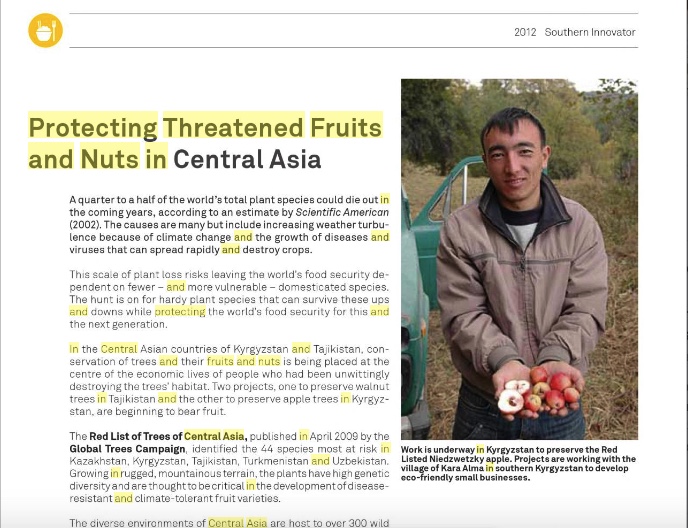
Between 94,000 and 144,000 plant species — a quarter to a half of the world’s total — could die out in the coming years, according to an estimate by Scientific American (2002).  Among them are vital food crops, threatened by a world in which climate change is causing more weather turbulence and diseases and viruses can spread rapidly and destroy crops.

This scale of plant loss risks leaving the world’s food security dependent on fewer – and more vulnerable – domesticated species. The hunt is on for hardy plant species that can survive these ups and downs while protecting the world’s food security for this and the next generation.

In the Central Asian nations of Kyrgyzstan and Tajikistan, conservation of trees and their fruits and nuts are being placed at the centre of the economic lives of people who had been unwittingly destroying the trees’ habitat. Two projects, one to preserve walnut trees in Tajikistan, and the other to preserve apple trees in Kyrgyzstan, are beginning to bear fruit.

The Red List of Trees of Central Asia published in April 2009 by the Global Trees Campaign (http://www.globaltrees.org/rl_centralasia.htm), identified the 44 species most at risk in Kyrgyzstan, Kazakhstan, Uzbekistan, Turkmenistan and Tajikistan. Growing in rugged, mountainous terrain, the plants have high genetic diversity and are thought to be critical in the development of disease-resistant and climate-tolerant fruit varieties.

The diverse environments of Central Asia are host to over 300 wild fruit and nut species that are ancestors to the fruits and nuts we eat today, including wild apple, plum, pears, pistachios, cherry, apricot, and walnut.

Many face extinction as local people — driven by the need for fire wood, or to earn an income — cut down this precious resource. The Red List estimates that over 90 percent of the trees in the fruit and nut forests across Central Asia have been destroyed in the past 50 years.

The importance of these fruits and nuts can’t be over-emphasized: all the common varieties of apricot come from one living ancestor, the species Armeniaca vulgaris, now very rare in Central Asia. Central Asia’s Malus sieversii (http://en.wikipedia.org/wiki/Malus_sieversii) gave birth to today’s domestic apples. It spread its way around the world along the ancient Silk Road (http://en.wikipedia.org/wiki/Silk_Road). The name of Kazakhstan’s former capital city is Almaty (http://en.wikipedia.org/wiki/Almaty), which literally means ‘Grandfather of Apples’.

Scientists have found genetic diversity and disease resistance greater in wild plant species that have not been domesticated, like Malus sieversii. Malus sieversii is highly resistant to Fire Blight (http://en.wikipedia.org/wiki/Fire_blight), a nasty disease that turns the fruits black (USDA).

To stop this free-for-all in which resources are plundered to extinction and trees wiped out to be used for firewood, deals are being struck to guarantee local communities’ rights to exploit the trees as a resource, while also obligating them to preserve them.

In Tajikistan, the walnut trade is a critical source of income for some villages, with most of the crop exported to Turkey. The country shares with Kyrgyzstan the world’s largest natural-growth walnut forest. But the use of short-term land leases discouraged long-term management, while local people were lacking any other sources of income and over-exploited the trees.

Jilly McNaughton of British NGO Fauna and Flora International (www.fauna-flora.org), said the current situation “is not good, with use of the forest by local people both heavy and inadequately controlled.” “Collection of firewood and grazing are perhaps the biggest concerns,” she said. “There is very little natural regeneration of wild trees due to grazing and hay making in the forest. “As the walnut is valued as an income generating crop, other trees are cut for firewood and timber, meaning parts of the forest have become a park-like landscape with scattered large walnut trees.”

Fauna and Flora International, which specializes in species preservation, is encouraging local people to work towards long-term leases and diversify their sources of income. The strategy includes encouraging other ways to make a living, including raising chickens, making clothes and bee keeping.

As one villager said: “We have bought honey buckets and bees. Next year we will get a lot of honey – it will be a great income. We got a job.”

The Red List of Trees found the causes of species’ destruction are multiple: over-exploitation, human development, pests and diseases, overgrazing, desertification and fires. Since the break up of the Soviet Union, funds have been short to help reverse these threats.

The most threatened apple species in the Red List is the Niedzwetzky apple (Malus niedzwetzkyana) (www.globaltrees.org/kyrgyzstan_apple.htm).

In Kyrgyzstan, work to preserve the Niedzwetsky apple is directly involving the community. Projects are working with the village of Kara Alma in southern Kyrgyzstan and government forest services to encourage eco-friendly small businesses to earn incomes and protect the forests.

They have catalogued all 111 trees that still survive, and have set up a community-run nursery to grow more. The ambition is to expand this approach across the region, both preserving these great resources and bringing hope and employment to the people.

Published: July 2009

Resources

  • The Global Trees Campaign, a partnership between Fauna & Flora International, Botanic Gardens Conservation International and many other organisations around the world, aims to save threatened tree species through provision of information, conservation action and support for sustainable use. Website: www.globaltrees.org
  • The Red List of Trees of Central Asia: Has evaluated 96 of the region’s tree species, identifying 44 as globally threatened with extinction. Website: www.globaltrees.org/news_RLCA.htm
  • Association of Cities of Kyrgyz Republic. Website: www.citykr.kg/en/index.php
  • Planeta: One of the first ecotourism resources to go online (since 1994) and still offers plenty of information for those wanting to start a business. Website: www.planeta.com
  • Environmental Public Awareness Handbook: A thorough account with case studies of a successful two-year project in Mongolia to combine environmental protection with livelihoods. Website: http://tiny.cc/oZ9sA

Development Challenges, South-South Solutions was launched as an e-newsletter in 2006 by UNDP’s South-South Cooperation Unit (now the United Nations Office for South-South Cooperation) based in New York, USA. It led on profiling the rise of the global South as an economic powerhouse and was one of the first regular publications to champion the global South’s innovators, entrepreneurs, and pioneers. It tracked the key trends that are now so profoundly reshaping how development is seen and done. This includes the rapid take-up of mobile phones and information technology in the global South (as profiled in the first issue of magazine Southern Innovator), the move to becoming a majority urban world, a growing global innovator culture, and the plethora of solutions being developed in the global South to tackle its problems and improve living conditions and boost human development. The success of the e-newsletter led to the launch of the magazine Southern Innovator. 

Creative Commons License

This work is licensed under a
Creative Commons Attribution-Noncommercial-No Derivative Works 3.0 License.

ORCID iD: https://orcid.org/0000-0001-5311-1052.

© David South Consulting 2023