Tag: journalists

  • Ger: Mongolia’s First Web Magazine (And A Pioneering Web Project For The United Nations) | 12 January 2016

    Ger: Mongolia’s First Web Magazine (And A Pioneering Web Project For The United Nations) | 12 January 2016

    Ger Magazine was hosted on the http://www.un-mongolia.mn website from 1998.
    • Editor-in-chief: David South (1998-1999)
    • Logo design: P. Davaa-Ochir

    “The years 1998 and 1999 have been volatile ones for Mongolia, with revolving door governments, the assassination of a minister, emerging corruption, a banking scandal, in-fighting within the ruling Democratic Coalition, frequent paralysis within the Parliament, and disputes over the Constitution. Economically, the period was unstable and rife with controversies.” Mongolia in 1998 and 1999: Past, Present, and Future at the New Millennium by Sheldon R. Severinghaus, Asian Survey, Vol. 40, No. 1, A Survey of Asia in 1999 (Jan. – Feb., 2000). pp. 130-139 (Publisher: University of California)

    Ger Magazine was launched on September 9, 1998 (Ger is the Mongolian word for both the traditional tent dwelling and home). The theme of youth in the transition was explored by a combined team of Mongolian and foreign journalists. The Ger Magazine project had basically three goals: first, raise the quality of journalism in the country, secondly, introduce the country to a wider global audience and, thirdly, by being the country’s first online magazine, prove the internet was an effective way to communicate.

    Issue 1

    Issue 1 of the magazine investigated what life was like for youth during the transition years (post-1989). Stories tackled the struggle to find work in the free market, the booming pop music scene and how it is leading the way in business entrepreneurship, reproductive health, the basics on Mongolian culture, and vox pop views from Mongolian youth.

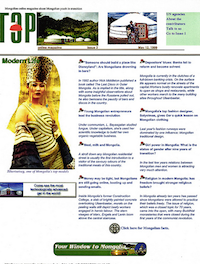
    Issue 2

    Issue 2 of the magazine investigated modern life in Mongolia during transition. The team of journalists were hitting their stride by this issue. Stories probed the proliferation of bars and the problem of alcoholism, corrupt banking practices and the loss of savings, how the young were the country’s leading entrepreneurs, Mongolia’s meat and milk diet, “girl power” and the strong role played by women, the burgeoning new media, the rise and rise of Buddhism, and Mongolia’s dynamic fashion designers (this article inspired foreign fashion designers to embrace the Mongolian ‘look’ in the next season’s designs).

    Editor-in-Chief: David South, UNDP Communications Coordinator
    EditorA. Delgermaa, UB Post newspaper
    TranslationA. Delgermaa
    Photography: N. Baigalmaa, David South
    Design and layout: B. Bayasgalan, UN Homepage Webmaster

    “This is the second issue of Ger. We have chosen the theme “Modern Life” to introduce people outside of Mongolia to the complexities of life in today’s Mongolia – the good, the bad and the ugly as a cowboy film once said. Ger is a project that draws upon the best journalists of this country. Under democracy Mongolia enjoys a flourishing free press, with over 800 officially registered newspapers for a population of 2.4 million! Ger has chosen A. Delgermaa of the UB Post newspaper to edit this issue. The UB Post is one of two English language newspapers in Mongolia and is owned by the Mongol News Company, a publisher of five newspapers, including the daily Today newspaper. Ger is a project to improve the quality of journalism in Mongolia, while introducing the people of the world to Mongolian journalists and this wonderful country. We hope you enjoy this issue of Ger. Please send us your comments. 

    Ger is not an official UNDP publication but a project to improve the quality of journalism. Opinions expressed in the magazine do not necessarily reflect the official views or policies of the United Nations Development Programme. Articles may be freely reproduced so long as credit is given and the editors are notified. Ger is published in English and Mongolian. 

    Contributors

    Ms. A Delgermaa: A reporter with the UB Post English weekly newspaper, which enjoys a good reputation among readers. Delgermaa is a young journalist and started her career in 1997, after graduating from the English Department of the Foreign Service School, Mongolian National University. She is a regular contributor to UN publications and has been published by Inter Press Service. She thinks Mongolia needs more psychologists to give courage to those many who are yearning for a better life. Like many young Mongolians she also wants to study abroad, to learn how journalism is practised in other countries.

    Ms. N. Oyunbayar: Also a reporter with the UB Post newspaper, Oyunbayar, is a graduate of Ekaterinburg University in Russia, where she qualified as a Russian language teacher. She left her pupils in Sukhbaatar aimag, where she was born, some years ago and decided to undertake a personal crusade against wrongdoing by becoming a journalist for the UB Post. She is an award-winning journalist and a member of the Mongolian Free Democratic Journalists Association. She loves to cook and enjoys learning about new cuisines. 

    Ms. T. Mandala: A historian and journalist, she is a reporter with the “Weekend” weekly newspaper. She has been a journalist for two years, has written several interesting interviews with politicians, including the Mongolian parliamentary speaker R. Gonchigdorj and MPs Da. Ganbold and E. Bat-Uul. She explores issues like life after death and she wants to be a public defender in a court one day. 

    She is a successor of her grandfather Khodoogiin Perlee, who is a famous historian in Mongolia. And studies religion, especially Buddhism and Shamanism. 

    Mr. D. Dorjjav: A psychologist and a lecturer at the Administrative Management Department of Mongolian National University, he is married and has two girls and a boy. He is currently working on his doctoral thesis. His wish is to help people to open themselves up and discover their abilities. His plan for the future is to contribute to the psychological understanding of life in Mongolia. Dorjjav’s hobby is to talk to people and exchange opinions.

    G. Enkhtuya: Born in the year of the pig (there are twelve years in the lunar calendar), a professional in marketing, trading, journalism, she is currently studying law in the Institute of Legal Studies, Mongolian National University. She is also a reporter for Odriin Sonin independent daily newspaper, once the largest state-owned newspaper until the start of 1999. She likes to cook when she is liberated from her official duties.

    Jill Lawless: An Honourary Foreign Member of the Mongolian Free Democratic Journalists Association, Jill has been the editor of the UB Post newspaper since 1997. Jill regularly contributes to Agence France-Presse, Far Eastern Economic Review, Deutsche Welle and the Canadian Broadcasting Corporation. She is happiest riding camels in the Gobi desert. 

    Michael Kohn: Michael is the editor of the Mongol Messenger and contributed to the first edition of Ger. He is a regular contributor to Associated Press and the Far Eastern Economic Review. Michael is an avid traveler and is an expert on hitchhiking across Mongolia.  

    Ms. N. Baigalmaa: Photo journalist for Onoodor (Today) newspaper, the number one independent newspaper for three years. “Photo journalism is always interesting. I really enjoy taking action photos.” She is fed up of taking photos of static photos of people standing or sitting and has devoted her life to photo journalism. One never boring thing for her is her two sons and a girl. Sometimes she loses her sports jacket to her oldest son, now taller than her.”

    Stories

    Depositors’ blues: Banks fail to reform and become solvent.In the absence of a trustworthy formal banking system, Mongolians are sticking to an elaborate informal banking system driven by pawn shops

    by G. Enkhtuya

    “Mongolia is currently in the clutches of a full-blown banking crisis. On the surface life appears normal on the streets of the capital. Workers busily renovate apartments to open as shops and restaurants, while other workers march to the many building sites throughout Ulaanbaatar. But there is no doubting the situation is serious.”

    Young Mongolian entrepreneurs lead the business revolution

    By Michael Kohn

    “Under communism, L. Bayasgalan studied fungus. Under capitalism, she’s used her scientific knowledge to build her own organic vegetable business. The 35-year-old is in the vanguard of a budding army of Mongolian entrepreneurs cashing in on the impoverished landlocked country’s nine year transformation from the world’s second oldest communist state to a free-market democracy.”

    Meat, milk and Mongolia: 
    Misunderstood and often maligned, the Mongolian diet does make sense

    By N. Oyunbayar

    “A stroll down any Mongolian residential street is usually the first introduction to a visitor of the savoury odours of the traditional meals of this country. If you are invited into somebody’s ger (or traditional tent dwelling) or apartment, you will probably have an opportunity of tasting buuz, khuushuur and bansh.

    “These Mongolian national meals are made with minced meat seasoned with garlic or onion (it can be anything from mutton to beef to camel to horse to gazelle) covered with flour and steamed in boiling water, fried in oil and boiled in water. For many visitors to the country the vast quantities of meat consumed can at first be surprising. But it is not long before a visitor finds their favourite Mongolian food, be it buuz, khuushur or a number of other treats. A Canadian living in Ulaanbaatar once told me, “the Mongolian national food contains a lot of meat, but I like the buuz.

    “The meat-dependent diet arises from the need for hearty food to stave off the cold and long winters. Traditionally nomadic herders, Mongolians have for centuries been dependent on mostly animal products for their dietary staples. Now after over nine years of transition, the traditional diet has been used as a shield against hunger and for the wealthy, subject to the influence of imported foreign foods and cuisine. When the Russians pulled the plug on Mongolia’s aid in 1991, the economy went into a severe crisis. For many Mongolians it was their first experience of serious hunger. The staple traditional diet of meat, milk and flour saw many people through this crisis, when food imports from the former Soviet Union dropped off.

    “Mongolians traditionally have turned to foods that are high in protein and minerals, relying less on more seasonable foods like vegetables and fruits. This means a diet heavy on meat and dairy products, the latter when sour in the summer time thought to clean the stomach. It isn’t just about meat though. Mongolians do also eat cereal, barley and natural fruits and plants native to the country.

    “Out of necessity Mongolians have found creative and ingenious ways to use the milk of all five of the domestic animals in the country: sheep, cattle, goats, camels and horses. Orom is the cream that forms on top of boiled milk; aaruul are dried curds and can be seen baking in the sun on top of gers in the summer; eetsgii is the dried cheese; airag is fermented milk of mares (female horses); nermel, is the home-brewed vodka that packs a punch; tarag, is the sour yogurt; shar tos, melted butter from curds and orom, and tsagaan tos, boiled orom mixed with sometimes flour, natural fruits or eesgii. The method of drying the dairy products is common in preparing them. The Mongolians prepare enough dairy products for the long winter and spring.

    “The traditions of using, producing and preparing these foods are stronger outside the main cities, where the population is more reliant on the vast herds for food. B. Baljmaa (Mongolians generally use their first names), a dietitian and nutritionist at the National Nutrition Research Centre, says there is a genetic compatability for the food.

    ‘Before 1992 there wasn’t much research in this area. But now we know from our research that Mongolians are better able to absorb foods with more acid. So, traditional food should be kept in the country.’

    “Since 1997 Mongolians have seen a substantial increase in the variety and quantity of imported foods, many of which were only thought of as exotic 10 years ago. Since the start of 1999 the Soviet-style market stalls now compete against western-style supermarkets, with trolleys and shelves proudly saying “Made in Mongolia.” In markets like Dalai Eej, Dorvon Uul, Food Land and Mercury it is possible to buy delicious prepared and canned foods, candies, biscuits, and unknown and unused before by Mongolians, products like oranges, bananas, plums and American chickens.

    “On top of the canteens and cafes serving Mongolian food, there are now many restaurants, canteens, bakeries and tea shops which serve meals from Russia, Italy, India, China, Japan, Korea, England, France, Senegal and Turkey. Most of these restaurants are located in the capital, Ulaanbaatar. Mongolians have taken to the new tastes. “I think Mongolians like roasted chicken and fish when they go to the foreign sit-down restaurants, and hot dogs and pizzas in the fast foods shops,” says I. Narantsetseg and her husband J.Battulga. Both were dining in the Seoul restaurant, and are happy they can go out for food: “it is a very good thing that there are opening a lot of restaurants where friends and family can go and enjoy food in comfort.”

    “Isobe Hiroshi, manager of Seketei, a high-end Japanese restaurant, told me “only 20 per cent of our customers are Mongolians. The vast majority of our clients are foreign, especially Japanese people who are working and traveling here. I think Mongolians have still not grown used to sushi and sashimi, the raw fish prepared in our restaurant. But I hope we will welcome more and more Mongolians in the future.”

    “The traditional diet in the cities is more changed, more european. And with comes its own dangers for Mongolians says the Nutrition Centre’s Baljmaa:

    ‘There is a big problem of importing poisonous foods and food which probably will cause the nutrition-related diseases common in more developed countries,” she continues.”While the trend around the world amongst health-conscious people is towards natural products for their food, some Mongolians use some food which can cause troubles for their health. For example, fast food made with more oil, salt and sugar are considered the biggest dangers for human health. On the plus side prices for these imported foods are higher and only the wealthiest people can afford them; the poor people can’t buy and eat it no matter how much they desire. This means their poverty is protecting their health. We should boost our efforts to raise awareness on what foods protect your health.’

    “Help in improving nutrition awareness a poster portraying a ger details the food habits of Mongolians and the nutritional value of common foods.

    “Now I want to present to you recipes of processing and preparing some Mongolian national products and meals:

    “From ancient times, Mongolians use abundant and peculiar methods of processing meat and preparing food.. One of the more popular methods of processing the meat is to prepare borts (dried meat) for use in winter. Borts is made from the meat of cows, goats and camels. Here is a recipe for camel borts presented by Dr. Sh. Tserenpuntsag who engages in the research of the meat.

    1. Separate the meat from its layer of fat, as fat will spoil in drying.
    2. Cut meat into strips about 20-30 centimeters long and two to five centimeters thick.
    3. Hang to dry in a well-ventilated room.
    4. Leave for four to five months.
    5. Cut into small strips for use in any dish you like.

    “If soaked in water, the meat will expand up to two and half times in size. It should then be cooked for 18 minutes.

    “The main method of cooking the meals of the Mongolians is boiling and steaming, considered the most healthy method in cooking by researchers the world over. Here is a recipe for buuz from the Nutrition Centre. It is considered one of the national meals of the Mongolians and is cooked by steaming and is a good fast food.”

    Girl power in Mongolia: What is the status of gender after nine years of transition?

    By D. Dorjjav

    “As American author Arthur Schlesinger once said, the main breaker of peace in our time is social differentiation. It is unfortunate that, despite developments in human civilisation, modern times have brought only new manifestations of this phenomenon, based on people’s mind, feeling, life style, goals and dreams.”

    Money may be tight, but Mongolians are still going online, booting up and sending emails

    By Jill Lawless

    “Inside Mongolia’s former Construction College, a slab of brightly painted concrete overlooking Ulaanbaatar, murals on the peeling walls still depict beefy workers engaged in heroic labour. The stern visages of Marx, Engels and Lenin loom above the central staircase.

    But students these days have neither communism nor construction on their minds. The building is now the School of Computer Science and Management of the Mongolian Technical University.”

    The real Mongolian gets the nod from Western fashion designers. Mongolia’s top fashion designer, Solyolmaa, gives Ger a quick lesson on Mongolian clothing

    By A. Delgermaa

    “Last year’s fashion runways were dominated by one influence: Mongolian traditional design. If a designer wanted to show they were boldly embracing natural fibers and furs, then the refrain ” my show is all Mongolian” would be proudly boasted to the media. The country has become a synonym for sartorial flare and rugged beauty. It also doesn’t hurt that one of Mongolia’s top exports, cashmere wool, is in vogue, from Japan to Europe to the United States. After years of being isolated from the west under the umbrella of the Soviet Union, Mongolian fashion is proudly strutting the catwalks of the world.”

    Cashmere is king but Mongolia still struggles to reap the benefit

    By A. Delgermaa

    A Mongolian cashmere designer once opined that Mongolians are lucky that most goats in the country are capable of producing fine cashmere. And while Chinese cashmere dominates the marketplace, Mongolian cashmere is by far the purest and finest.

    About 30 cashmere companies contributes tens of millions of dollars a year to the country’s wealth (though nobody is quite sure how much because most cashmere sales go unreported to the government). But the revenue isn’t what it used to be due to problems in the domestic industry and a drop in the world price. Z. Ayur, chief secretariat of the Gobi company, thinks it doesn’t have to be that way. “Unfortunately we lose half of our raw cashmere to China,” he says.” The Chinese buy cashmere at a high price, not depending on the quality. This means national manufacturers lack raw cashmere to process into garments.” He thinks raw cashmere exports should be banned or subject to a duty of 100 to 150 per cent. Mongolia’s weak infrastructure plays a part as well. It is cheaper for herders to travel to the Chinese border with cashmere than to bring it to the capital, Ulaanbaatar. Often when they are at the border with China, they are subjected to some hard bargaining by Chinese brokers, who exploit the fact herders can’t afford to walk away empty handed. 

    Cashmere has always been considered a luxury and expensive. But in the past two years it has lost its fusty image as only for old people. Trendy designs have attracted a vast market of younger cashmere consumers. “I guess in the past it was dear and expensive and designs weren’t very appealing to the younger set,” thinks Gerelmaa, the chief designer of Gobi company. 

    The Gobi company is one of the few state enterprises left over from the socialist period that still makes money (and is due for privatization this year – a prime pick for foreign investors). 

    In 1972 the United Nations funded projects to experiment with starting a cashmere garment industry in Mongolia. This innovative thinking led to a joint Japanese-Mongolian venture in 1981 to start the first cashmere manufacturer, Gobi. These days it still produces one third of the country’s cashmere products. 

    Mongolian Wool and Cashmere Federation head Tsendmaa is optimistic about the drop in the world market price.” It will soon go back up again,” she says with confidence. “The reserve of cashmere in the world will run out soon. What happened with the drop in prices is typical of any industry when it overproduces.” What worries her most is the flood of Mongolian cashmere going to China, where Chinese workers process and knit the garments and reap the job benefits.

    While cashmere is still known for its use in classic turtle, crew and v-neck jumpers, things have changed. “Before we mostly exported classic styles in off-white, brown, grey, black, bark, blue or dark red to Japan or Germany,” continues Tsendmaa. “Now Americans order more fashionable cashmere for the young. The designs of short jumpers that expose bare chests and waists are cheap to produce (less material) and suitable for young fashions.” 

    Italian, French or Belgian customers are fussier and demand greater variety in designs. These countries determine the vogue for cashmere wear and use the most high tech knitting technology.

    Contemporary cashmere fashion in France or Italy can combine fur or silk. Colours have also been revamped, with the young going for light blue, light pink, snow white, off-white and light green. Italians and Americans like metal grey with rose or pink. Mixing up the colours in sporty stripes and lines is also popular.

    Cashmere is very practical, warm and light. “It is not suitable for the office,” says Gerelmaa.” Cashmere wear is more suitable to wear for a night out or just for hanging out. But of course it is not for sport!” 

    Fashionable Mongolian cashmere is becoming a strong competitor to Chinese, Italian, Scottish or American cashmere. “The raw material is pure and the design is more fashionable.” And a happy Gerelmaa likes the sound the cash register makes in Japan: “In Japan classic Mongolian style is sold for more than US $1,200 in the Takashimaya Store, in GINZA.” Now if more of that kind of hard cash found its way back to Mongolia, the country would definitely be better off. 

    Mongolians call them mannequins, but this model has something to say and a good head on her shoulders

    Interview by A. Delgermaa

    It could be said that there is no girl who does not dream of becoming a model. Many Mongolian girls, particularly Ulaanbaatar city girls, are flocking to attend courses in modeling in the last few years. Some say models are mushrooming in Mongolia, a country known for its fresh-faced people and robust physiques. 

    Ger interviewed S. Ikhertsetseg, one of the twin top models of Mongolia.

    When did you first appear on the fashion stage?

    “When we were 15 we played piano for the state concert on International Women’s Day on March 8. The ( Best Fashion) company was in trouble and they did not have anyone to wear some leather fashions for the show in the concert. It was fortuitous that we were asked to be the models. We kept it secret from our parents until we received a prize from Mongolia’s top fashion show, Goyol (or beauty) , in 1988. That was a year after the state concert. Being a fashion model was not considered so desirable as it is now. We were busy studying at music school and our parents did not know what we were doing.”

    What do you think of today’s models?

    “In the early days of fashion shows in Mongolia in the 1980s, we did not have many competitors. These days there are many beautiful Mongolian models we have to compete with, but only a few are very good. If someone is lucky, they have the potential to compete at the world level. Personally, I don’t like models who are too trained by courses.”

    Do you think becoming famous is pure luck?

    “Of course it is luck. But that doesn’t mean it isn’t a lot of hard work. You must send photos to agencies, and then only then, will someone see your photo – that is luck.”

    What about design and fashion in Mongolia? Are Mongolians fashion sensitive?

    “I can not say Mongolians are sensitive to fashion. I think our designers should work harder. Design is not a dress or a suit. It is everything, the whole cornucopia of details. I do not think we are going to compete with Europe, which has a long history of making clothing, rich in colors or designs. There is a big difference between fashion in the West and in Mongolia.”

    Mongolia has a lively free press who sometimes step over the line when it comes to gossip and scandal reporting. These so-called “yellow” newspapers have damaged many people’s reputations. This had also happened to you. Some newspapers called the two of you the Barbie girls in Beijing, earning a lot of money.

    “Yes, they did say those bad things. We replied to them.”

    Was it before the court?

    “No, that is a personal question.”

    What was the result?

    “The newspapers didn’t do that again.”

    What do you do now?

    “Both of us keep up the fashion work and also teach piano. Music is our profession and love. We founded the Association of Models of Mongolia to protect their rights and strengthen their position in the society.”

    Impact

    The stories have been featured in many books on the country, and the magazine was recommended as a good resource by the Lonely Planet guidebook. 

    This was not only the first publication of its kind in the UN, it was also a pioneering online venture and remarkable for a country lacking the advantages of wealthier countries.

    An online survey of the state of Mongolia’s media and its history (www.pressreference.com/Ma-No/Mongolia.html), had this to say: “An interesting variation from some of the other publications available is Ger Magazine (published online with guidance from the United Nations Development Program, UNDP), which is concerned with Mongolian youth in cultural transition. The name of the magazine is meant to be ironic because a ger is the Mongolian word for yurt—a yurt being traditional nomadic housing—but the magazine is about urbanization and globalization of Mongolian youth.”

    Citations

    A Complete Guide on Celebrations, Festivals and Holidays around the World by Sarah Whelan, Asteroid Content, 2015

    Gale Directory of Publications and Broadcast Media by Jeff Summer, Gale Group, 2001

    In Search of Mongolian Barbecue by Debra McCown, Abingdon, Virginia, 2017

    Mongol Survey, Issue 8, The Society, 2001

    Mongolian Culture and Society in the Age of Globalization by Henry G. Schwarz (editor), Center for East Asian Studies, Western Washington University, 2006

    Nations in Transition: Mongolia by Jennifer L. Hanson, Infobase Publishing, 2003

    Teen Life in Asia by Judith J. Slater, Greenwood Publishing Group, 2004

    World Press Encyclopedia: A Survey of Press Systems Worldwide, Volume 1 by Amanda C. Quick, Gale Group, 2003

    Some of the team behind Ger:

    Editor-in-Chief: David South

    Logo Design: P. Davaa-Ochir

    Layout and Online: B. Bayasgalan

    Contributors: A. DelgermaaMichael KohnJill LawlessPeter Marsh, and N. Oyuntungalag.

    Read the Wikipedia entry here: en.wikipedia.org/wiki/Ger_magazine

    Read the full content by searching the www.archive.org wayback machine via the http://www.un-mongolia.mn website: https://web.archive.org/web/19990420090143/http://www.un-mongolia.mn/

    Ger Magazine contributor Jill Lawless’ book Wild East: Travels in the New Mongolia here: https://wildeasttravelsinthenewmongolia.wordpress.com

    This work is licensed under a Creative Commons Attribution 4.0 International License.

    ORCID iD: https://orcid.org/0000-0001-5311-1052.

    © David South Consulting 2021

  • Mongolia Prepares For A Magazine Explosion | 1998

    Mongolia Prepares For A Magazine Explosion | 1998

    Story: Jill Lawless

    Publication: UB Post

    Date: 08/09/1998

    Ulaanbaatar (Mongolia) – Mongolian newsstands are bursting at the seams. But while the content of the country’s publications is varied, their form is not. Newsprint rules this country’s publishing industry. The few glossy magazines for sale are imports from Russia.

    When the democratic revolution unleashed the tide of free expression in the early 1990s, a flood of newspapers poured forth. It made sense. The cheap-and-cheerful technology of newsprint is low-tech, accessible and inexpensive. Suddenly everyone could be a publisher. 

    But Mongolia’s increasingly sophisticated media landscape is about to go “glossy”. Tomorrow (September 9) sees the launch of Ger (Home), Mongolia’s first on-line magazine. A bilingual quarterly funded by the United Nations, it combines entertainment – articles on the changing sexual attitudes of young Mongolians and the country’s vibrant pop scene – with information on the work of the UN and other NGOs in Mongolia.

    “We want something that will tell the stories of Mongolians and their experiences over the last eight years – both to Mongolians and to the rest of the world,” says David South, communications coordinator at the United Nations Development Programme.

    This month also brings the premiere issue of Tusgal (Strike), billed as the first full-colour, general-interest magazine in the new Mongolia. Published by Mongol News Company – the privately owned media group whose stable of publications includes the daily newspaper Onoodor and The UB Post – it offers a lively mix of sport, culture and celebrity articles, also aimed primarily at the young.

    These two publications are just the top of the stack. Mongolia’s two best-known printing houses, Admon and Interpress, are said to be working on titles of their own.

    Mongolia’s quick-to-learn capitalists see a gap – and they want to fill it. 

    “In Mongolia there are many newspapers, but no world-class magazines,” says Tusgal’s editor-in-chief, Do. Tsendjav. “On the streets you can see a lot of publications that aren’t exactly magazines but you can’t call newspapers, either – newspapers that appear every 10 days or two weeks.

    “We want to fill this space. We want to produce the first colour magazine that will reach world standards, something close to Time or Newsweek.” 

    “There’s an enormous thirst for quality journalism, quality publications that are interesting to look at, top photojournalism – all the things newspapers don’t cover,” adds South. 

    “We’ve seen newspapers moving to more colour, more photographs, and that shows a desire for quality.”

    That quality comes at a price. Tusgal, with 70 colour pages, will sell for between Tg 1500 and Tg 2000 – not much cheaper than an American publication like Time, and too expensive for many Mongolians. 

    With only 1000 Internet subscribers in Mongolia, Ger has an even smaller market within the country – though South is quick to point out, the UN has established public-access Internet centres in Ulaanbaatar and several aimags. 

    And he says a print version is planned to follow. 

    “Distribution is the big problem right now,” he says. 

    “We have to see how we can organize distribution to reach the whole country. I know more magazines will be launched soon in Mongolia, and hope a distribution network may grow out of that.”

    The editors know Mongolia’s magazine market and magazine technology are in their infancy. Although companies like Admon and Interpress get more sophisticated equipment by the month, the capacity to produce quality publications is still limited – the first issue of Tusgal has been printed outside Mongolia. 

    Human resources need to develop as well, Tsendjav admits. 

    “To produce a monthly magazine you need highly qualified journalists. We don’t have that right now. We’re still seeking them out.”

    But he is confident this will change – and quickly, too, if the pace of development in the past eight years is anything to go by. 

    “During socialism, Mongolia had many magazines, but it all stopped after 1990,” notes Tsendjav. “It was a question of economics.

    “At first we don’t think we can earn money from this. If you want to make money you have to wait two or three years. So what we are aiming for at first is to build a readership.

    “I think in two or three years, living standards will improve. People will have more money to spend on things like magazines. But we don’t want to wait for people to get enough money. We want to be the first, so people will develop an interest.

    “There will be competition. Nowadays a lot of business-people understand the importance of the media. I welcome competition. It’ll make us work harder. It’s good for everybody.”

    From In Their Own Words: Selected Writings by Journalists on Mongolia, 1997-1999

    Read a story by Jill in The Guardian (9 June 1999): Letter from Mongolia | Herding instinct 

    Jill’s story for the Far Eastern Economic Review is cited in the WHO Global Status Report on Alcohol 2004.

    Wild East: Travels in the New Mongolia by Jill Lawless offers a vibrant account of what it was like to be a journalist in Mongolia in the late 1990s.

    ORCID iD: https://orcid.org/0000-0001-5311-1052.

    © David South Consulting 2018

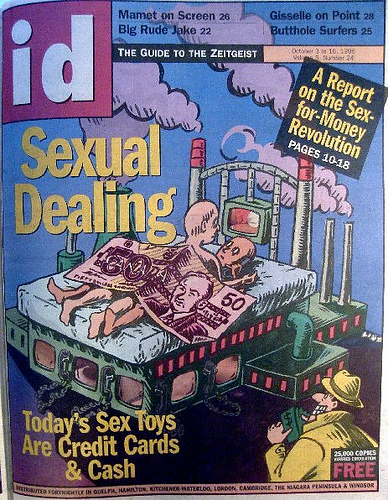
  • From Special Report: Sexual Dealing: Today’s Sex Toys Are Credit Cards & Cash: A Report On The Sex-For-Money Revolution

    From Special Report: Sexual Dealing: Today’s Sex Toys Are Credit Cards & Cash: A Report On The Sex-For-Money Revolution

    Porn Again: More Ways to Get Off, But Should We Regulate the Sex Industry?

    By David South

    Id Magazine (Canada), October 3-16, 1996

    “Wang thinks the internet is the way forward for porn distribution.”

    Meet Steven Wang. The young Toronto distributor of porn magazines and videos is jerking his arm up and down as he describes what sells adult videos.

    “Explicit boxes – dick in the mouth, cum in the face makes it sell,” says Wang as he tells me about packaging the videos he distributes.

    Wang doesn’t fit the stereotype of a smut dealer. He is wiry, well-groomed and fits in easily amid Toronto’s army of yuppies. Despite the topic of our conversation, he isn’t shy about being graphic in a public place.

    Wang admits his parents aren’t too keen about his success as a smut dealer, but he proudly tells me about his latest project, Cybercafe (located on Toronto’s main goodtime drag, Yonge Street). Banks of computers line the walls of the cafe, and a few customers bang away on keyboards and swivel mouses. Blinders on video terminals are quickly jerked forward by shy internet users as each new customer walks by.

    Wang thinks the internet is the way forward for porn distribution.

    “It’s heading more to bondage, violence – anything that is weird. Haven’t seen it, want to see it. You can only find penetration on VHS (video), though fisting is allowed.” continues Wang, who prides himself on foreseeing trends. “Now that people have seen these things, they want to go to the next step. Because you can only get these things on the internet, 80 per cent of the people are there for the adult material. Internet is the future, period.”

    “Because you can only get these things on the internet, 80 per cent of the people are there for the adult material. Internet is the future, period.”

    Wang got into distributing porn videos in 1990, just as the Ontario government began to relax the restrictions on hardcore porn movies, as long as they didn’t contain sex involving violence, coercion, bondage, sado-masochism, degradation, incest, animals, or minors under the age of 18.

    Wang says he has made some good money, but it’s time to start looking to the next trend. He says those who consume his products have an insatiable appetite for sex in all its forms.

    Money-for-sex revolution

    The 90s have seen a quiet revolution in the sale of sex. While paying for sex is nothing new, never before has such a plethora of choices been so openly peddled in Ontario’s newspapers and magazines, mostly at a male audience. There are escort services, so-called massage parlours, phone sex, adult videos, sadism and masochism shops and clubs, strip clubs and swingers’ clubs. On the internet, 127 sex news groups compete with over 200 sex services on the World Wide Web, many charging for the privilege to peek at sex photos. And the sex trade comes at a price, with evidence showing lack of regulation means youths continue to be drawn into the business, while users search for bigger and better thrills.

    Toronto weekly Now Magazine has been a pioneer in sex advertising. In September, 1989 the magazine’s back pages of classified ads contained around 130 “business personals,” ads placed by the city’s working prostitutes.

    In the September 26, 1996 issue of Now, in seven pages of telephone personals and phone sex ads, there were 514 “Adult Classified” ads, a cornucopia of “massage” parlours, prostitutes, and escort agencies offering shemales, “hot Asian” and “Swedish” beauties.

    While there isn’t any one source for accurate information on the size of Ontario’s sex industry, it is obvious it has not only grown in visibility, but in size.

    “There definitely seems to be more of everything,” says Detective-Constable Austin Ferguson of the Metro Toronto Police’s vice section. “Look at how pornography video stores have blossomed – the spas, whatever you want to call them. Look through the yellow pages for strip bars, escort agencies.

    “You got Now, Eye, pink pages, green pages, you can pick up the Toronto Star, The Sun. The phone lines are everywhere you look. I love it, it’s a great business,” says Ferguson sarcastically.

    “Even five years ago, there were only a few massage parlours. Now there are 400 to 500 massage parlours in Toronto alone. It has quadrupled since 1990.”

    “It’s an underground revolution,” says Sue McGarvie, a sex therapist and Ottawa talk-radio personality. “You go out on the street and see how many prostitutes there are, and how much more open it is, how many more night clubs there are that are gender neutral, that are fetish.”

    McGarvie doesn’t think it necessarily means more people are turning to commercial sex.

    “We are having as much sex as we ever had, we have as much sexual desire as we ever had,” says McGarvie. “I think the outlets are changing, so that we are going to have to be flexible about that.”

    Steven Wang estimates 3,000 out of 5,000 Metro Toronto video stores carry adult videos. Another 1,250 exclusively carry adult videos. A manager at Toronto’s Adult Video Superstore says, “Sales and rentals have gone up in the last three years.” The Adults Only Video chain, founded by Kitchener-Waterloo resident Randy Jorgensen, now spans Canada with 51 stores, 12 in Toronto. And what internet user hasen’t taken a few minutes (or hours) to play voyeur on the many adult web sites or chat lines?

    An Adults Only Video survey found, out of 2,000 customers, 56 per cent watch adult videos with a partner. It also claims 20 per cent of renters are women. Many are skeptical about these claims.

    Barking through what sounds like a speaker phone, Larry Gayne, president of sex toy mail-order company Lady Calston, says “It’s all men who look at the back of Now. Some claim as much as 50 per cent of adult video watchers are women. I don’t know if I believe that figure.

    “Sex is a US $40-billion business in North America alone. In 1992, more sex aids were sold than breakfast cereal.”

    The businesses manufacturing sex try to distance themselves from the more visibly seedy porn stores.

    “The explosion in triple X video stores is the only seedy end,” continues Gayne. “The sad part is you take away those triple X stores, there is no seedy part to this industry. Not behind the scenes, not in front. It doesn’t exist. There is nobody seedy at our level. Those people don’t exist, they are just normal businesses. There is in fact a downside to the triple X stores.”

    Sue McGarvie is an enthusiastic supporter of greater sexual liberation, even if its expression is through the sex industry.

    Speaking between clients from her Ottawa office, she says 36 new adult video stores have opened in Ottawa in the past five years.

    “Some are small sections of regular video stores,” says McGarvie. “I’m a big believer, I’m still under 30, my generation is one of the first generations that is no longer attending church as a regular part of what we do. Sex is no longer a moral issue. But people are saying ‘wait a minute, because of STDs I’m going to be stuck with my partner for the rest of my life? I better make it the best damn sex we possibly can have.’ Vibrators are outselling any other appliance.

    “I’m poised on the industry of the next decade, the next millennium. Sexuality as an expression is the second most powerful drive after food.”

    McGarvie doesn’t think that what is in the adult video stores is unhealthy. “Porn as a term is not right, either. Porn is illegal, but the stuff in the video stores is not illegal.”

    McGarvie also doubts adult videos are contributing to an atomised world, similar to Aldous Huxley’s Brave New World, where the government controls a population anaesthetized by the buzz of orgasms and drugs.

    “I don’t necessarily think it is causing people to be less intimate. The industry needs to stop being in the shadows. Our lives are busy. People are having a hard time connecting with others, but I think that is a separate issue. I think there is a new sexual revolution going on, and if our reality checks catch up with our sex drive, we’ll be okay. We don’t have socially acceptable ways of meeting people that isn’t in a bar when people are drinking.”

    Toronto swinger and strip club DJ Ron Michaels thinks the tables are turning on the money-for-sex industry.

    “A lot of adult video stores are closing. A lot of strip clubs are on the verge of going under,” says Michaels. “It is like a ghost town in there. I don’t see it is a growing trend. Perhaps it is more front page, more visible. I don’t think it’s any larger than is has been before. I think our society in general is far more sexually liberated than we were 50 years ago. Certainly more than 100 years ago.

    “A lot of people thought they could make a fast buck off of it. The market can’t support that number,” according to Michaels.

    Child porn

    But is this really just good fun? Unfortunately, there is too much evidence showing a direct connection between a robust sex industry, and the sexual exploitation of minors and demand for degrading sex. A booming sex industry just can’t be disconnected from the exploitation of youths and an absorption in degrading, freaky sex, like defecation or bestiality. The industry may not be directly connected to the much-publicized paedophile rings in the news, but the mainstream sex industry is not adverse to exploiting youths and an appetite for sex with minors to sell videos and magazines.

    “We have laid charges on people who were initially operating a reputable business,” says Ferguson, “until they found there was a demand for the seedier stuff.”

    Sue Miner, the head of Toronto’s Street Outreach Services, says high unemployment rates amongst youth feeds the sex industry with a steady supply of desperate teens.

    “It’s indicative of people needing to survive and not having jobs. I’ve heard enough young people saying they needed some money to pay the rent. A lot of young people do it to survive – survival sex.”

    “I have yet to come across an escort agency that uses minors,” claims Ferguson, admitting that because he hasn’t, doesn’t mean it isn’t happening. “It’s usually a bit more classier than that. You don’t get your Parkdale hooker types. Pimps don’t run escort agencies.”

    A 1984 government study on prostitution, the Badgley Committee on Sexual Offences Against Children and Youth, found one-half of prostitutes had entered the sex trade under the age of 16, 96 per cent had become prostitutes before the age of 18.

    The overwhelming majority of prostitutes have run away from home at least once. Street prostitutes leave home at an earlier age than other children, at an average age of 13.7 years, compared to 17.3 years.

    The most difficult porn to regulate, as most governments know, is on the internet.

    Detective-Constable Ferguson says having photos of bestiality and paedophilia, for a few seconds on a harddrive, is considered by the law to be possession. He also admits because of the ethereal nature of computers, the law is totally unenforceable.

    “You would have to get online with that person. Get to know them, chat with them.”

    He does warn any internet cafes to stay clear of the stuff. “They are totally nuts to have obscene or child pornography available because somebody would spill the beans pretty quick.”

    Escorts

    As for prostitution, the police have a harder time controlling escort agencies because they are careful to never make a deal on the phone, says Ferguson.

    “They are only going out for dinner and dance, eh?,” chuckles Ferguson. “Somebody sees a business opportunity to run prostitutes. They are harder to crack. It’s a long, long process to take one of these places down because of all the undercover work involved. What you can, can’t do. It’s no easy task.

    “They won’t make a deal over the phone. They might say ‘you can have my service for $150/$200 an hour,’ as soon as you say ‘what do you get for that?’…click.”

    McGarvie says she wouldn’t be too happy if her husband went to a prostitute to cope with sexual stress if they were too busy to have sex. On the other hand, she thinks the escort industry would decline if there were more healthy outlets for sexual release.

    “Business goes up when we get pickets, negative reviews are always positive for the business – automatically sales go up that day,” says Wang smiling.

    Toronto feminist and author Susan G. Cole, in her book Power Surge: Sex, Violence and Pornography, and ironically a Now Magazine editor, has called for greater regulation of pornography, arguing the industry really has no claim on freedom of expression. The public, Cole says, can accept a regulatory role for government when it comes to other industries, so why the exception for the smut trade?

    This should be extended to the rest of the sex trade, she argues. Body-rub parlours, escort services, street prostitutes, strip clubs and phone sex, should not be allowed to remain in regulatory limbo, only subject to police attention when community groups kick up a storm.

    Back at the Cybercafe, Steven Wang is trying to be heard over the Pet Shop Boys’ pounding dance beats.

    If anybody wants to protest outside one of Wang’s two Toronto stores, or any other adult stores his videos are distributed in, he would probably make the placards. “Business goes up when we get pickets, negative reviews are always positive for the business – automatically sales go up that day,” says Wang smiling.

    Source: statista

    Swing Shift: Sexual liberation is back in style

    By David South

    Id Magazine (Canada), October 3-16, 1996

    Deep in the bedrooms (and livingrooms) of the home-owning classes, the sexual liberation movement marches on: swingers’ parties are back. Those libidinous libertines many thought were lost in a 70s disco haze, according to a Toronto swinger, are back in greater numbers than in those polyester days. 

    In contrast to the many people (mostly men) looking for the anonymous and on-demand buzz of escort agencies, porn videos and sex toys, it seems to me swinging is the most idealistic camp in the army of sexual liberation. There isn’t any sneaking around behind your spouse’s back – in fact, you bring them along for the good times. 

    Swingers were usually the subject of the porn movies I watched at the base cinema during my army days. They weren’t real people, but some sort of myth from more electric times. 

    Ron Michaels, 41, is an unabashed proselytizer for swinging. A strip-club DJ and erotic and commerical photographer, he’s also co-owner, along with his wife, of swingers’ club Eros. A confident and articulate spokesperson, he has been swinging since he was 17. 

    “We believe honesty is the cornerstone of our lifestyle – that makes it work,” he says. “The people engaging in back-alley sex are being dishonest. It’s the same with having an affair – wanting your cake but not being able to share it with the rest of us. 

    “Swinging is a moral alternative to having affairs.” 

    The divorce rate among swingers, Michaels maintains, is only five per cent, compared to 51 per cent for the general population. The one wrinkle in this impressive “fact” is Michaels’ other admission that many swingers are on their second “married relationship”.

    Interviewing Michaels, I feel like I’m talking to a Rotary Club member or a boy scout leader, not a swinger. The talk is about clubs, memberships ($69 a year per couple), trips. It’s a hobby, sport and lifestyle to many swingers, claims Michaels. 

    “We have regular weekly functions throughout the year. Some of them are organized by the members. We organize trips and holidays. Weekends in the Caribbean. Like any other social club.”

    That can’t be wife/husband swapping he’s talking about, can it?

    Michaels’ Toronto Beaches home leaves no doubt as to its occupant’s lifestyle choices: “If you don’t swing, don’t ring,” says a brass plaque nailed to the door. 

    Michaels is very proud of swinging’s growth in the 90s. His group has grown from 300 member-couples 14 years ago to 1,800 today. Michaels ambitiously estimates that between 100,000 and 200,000 Southern Ontarians are into swinging, between 20 and 25 million across North America. 

    So, how does swinging in the 90s work?

    Michaels says most clubs operate more as matchmaking parties than full-out orgies. Couples get to know each other and make the arrangements to meet away from the club’s party. Michaels is quick to disassociate his club from drop-in style swingers parties. 

    “Canadians are much more conservative than Americans. In New York they are more hardcore, less selective of their partners. When they get there they are more like, ‘let’s find the first available body and get to it,’ whereas people at social clubs want to get to know you. We are talking about four-way compatability here.”

    According to Michaels, the big victory for Canadian swingers took place in 1992. “Our Mississauga club was raided back in ’92 and we took it through the courts for a year. We were acquitted and set a legal precedent, making swingers’ clubs legal.”

    To many men, the whole swinging thing seems like the best of both worlds: you keep your wife and get to taste the fruits of other trees at the same time. But Michaels says this male teenage fantasy doesn’t pan out in reality. 

    “That wears off pretty quickly. Let’s face it, men have a much lower capacity for sex than women do. Men need a longer recovery period and don’t have as many orgasms in a night. Women can just go and go. Guys can’t compete with that. After a while the fantasy wears thin, and it’s the guy that wants to drop out of the lifestyle.” 

    And what about that oher most-asked-question: what’s it like to see your spouse having the time of their life with your neighbour?

    “They don’t get into those kinds of comparisons. How can I describe this? It’s not a competitive thing where you try to outperform each other. Most swingers appreciate each other as being unique and different, rather than this is bigger, this is harder, this is faster, this is better. Each new experience is taken at face value, ‘Hey, it’s a good time’. You move on to the next one or you go back to your regular partner.”

    “Cock Tales” too much for Hamilton

    By David South

    Id Magazine (Canada), October 3-16, 1996

    Steeltown is a little less hot now that View, Hamilton’s alternative weekly, has dropped a controversial sex columnist in the face of complaints from distributors. The fracas has raised a thorny issue: to what extent should a newspaper stand behind a controversial writer?

    My Messy Bedroom, a weekly column by Montreal journalist Josey Vogels, mixes graphic language and humour in its look at sexuality. The dispute erupted over a column in the August 22 issue entitled Cock Tales 1 (Cock Tales 2 will not run in View). 

    A surprised and angry Vogels says she only found out her column had been dropped when id called her in September. Vogels believes the problem was with the frank discussion by men of their sexual tastes. “Maybe it was the opening line. ‘Mouth on my cock, finger in my butt, looking me in the eyes,’ then a joke: ‘Would you like fries with that?’”

    Vogels maintains View knew what it was getting into when it picked up the syndicated column in June, 1995. “You can’t say you want a column because of its nature, then say you don’t like it.”

    Vogels says she co-operated in the past when the magazine asked her to tone down a column. “But there is a line where my integrity is at stake.”

    Tucked away among five pages of classified ads, My Messy Bedroom was the only piece of journalism with a sexual theme in View

    Editor Veronica Magee says View received complaints that children were reading the column, and some distributors refused to carry the paper. In a rambling editorial in the September 5 issue, Magee defends the decision to drop the column, saying it was time the paper made some changes. 

    Magee writes that Vogels’ column taught “sexuality is something clean, not dirty,” but admits some urban weeklies aren’t so urban, and must cater to a more conservative, suburban readership. “Hamilton is a conservative city,” she claims. 

    In an interview with id, Magee admitted View’s attitude towards the column was “what can we get away with – let’s push the limit.

    “Some people argue she should have known better. Although I’m sure people will believe we are making the writer suffer for a decision we made, that is not the intent.”

    But the publisher and editor of View offer conflicting explanations of who actually pulled the column. “It was a collective decision,” says Magee. 

    Sean Rosen, one of View’s two publishers, told id the magazine had been considering dropping the column for some time. But Rosen says the decision was solely Magee’s. “The editor decided it had run its course, trying to be sensational for the sake of being sensational.” 

    Other stories from the special feature: 

    “Barely Legal”: Scummy New Generation of Mags Evades Anti-paedophilia Laws by Nate Hendley

    Randy for the People: Conservative Ontario City Home to Porn Empire by Nate Hendley

    Is Stripping Worth It? by Cynthia Tetley

    Those Old Crusaders: Pornography and the Right by Eric Volmers

    Feminists for Porn by Nate Hendley

    The Sex Trade Down the Ages by Fiona Heath

    Update: It is over 20 years since this Special Report was published. It forecast the significant role the Internet was to play in the growth of sex content and the sex industry and vice versa. Here is an interesting overview of the situation in 2020. The Internet is for Porn – It always was, it always will be.

    “One of the biggest and most interesting things happening in the consumer web right now is running almost completely under the radar. It has virtually zero Silicon Valley involvement. There are no boastful VCs getting rich. It is utterly absent from tech’s plethora of twitters, fora and media (at least, as they say, “on main”). Indeed, the true extent of its incredible success has gone almost completely unnoticed, even by its many, many, many customers.

    I’m talking, of course, about OnlyFans.”

    Id Magazine (Canada), October 3-16, 1996

    Read more on the 1990s sex economy here: From Special Report: NMM (New Media Markets) Spotlight On The Emergence Of Satellite Porn Channels In The UK

    ORCID iD: https://orcid.org/0000-0001-5311-1052.

    © David South Consulting 2021

  • Top Reporters Offer Military Media Handling Tips

    Top Reporters Offer Military Media Handling Tips

    Ryerson’s course on handling media has raised eyebrows

    By David South

    Now Magazine (Toronto, Canada), November 12-18, 1992

    The whimsical Certificate of Military Achievement hanging in the offices of the Ryersonian newspaper at Ryerson journalism school is testament to the warm relationship between the armed forces and one of Canada’s top journalism schools.

    But a two-month crash course in journalism for military public affairs officers hosted by Ryerson this summer has left a bad taste in the mouths of some participants and critics.

    The course, which involved 18 soldiers, included two weeks of classes in each of print, radio and TV journalism, wrapping up with two weeks of “crisis management” training. The 60 instructures included such prominent journalists as Ann Medina and Pamela Wallin.

    According to an administration newsletter, the course netted Ryerson more than $350,000. Organizers say the course was merely an exercise in familiarizing soldiers with the needs of working journalists. But given the often conflicting roles of the military and the media, some fear journalistic ethics may have taken some collateral damage.

    “The course had nothing to do with national defence or the armed forces,” says course teacher and organizer Shelley Robertson. “They just wanted to understand the roles of journalists from the other side. The military didn’t ask us to teach what we teach our students.”

    Robertson says the course also benefited the participating journalists by giving them contacts in the military.

    But according to media critic Barrie Zwicker, the exercise blurs what should be the distinctly different interests of journalists and the military. “It’s similar to press and politicians. By getting close to the politician, journalists can get information they couldn’t normally obtain. The negative side is that the media can get sucked in and lose a larger perspective. The same tensions exist with covering the military.

    Managing media

    “It’s up to the media to break the rules and try and get the story. The military always wants to hide its victims. If a Ryerson journalist strikes up a friendship with a public affairs officer, will the reporter be true to their journalistic tradition?”

    Colloquially known as spin doctors, hype-meisters and flak catchers, public affairs officers perform much the same tasks in the military as their civilian counterparts in industry and government – including managing information that gets to the public or media.

    In the past, Canadian soldiers had to go to the US for special training at the Defense Information School at Fort Benjamin Harrison. But, according to Robertson, the armed forces were looking for a Canadian spin.

    With 4,600 Canadian peacekeepers now stationed around the world, including a contingent in the dangerous and volatile former Yugoslav republics, the chances for conflict – and casualties – have increased.

    Lieutenant-commander Glen Chamberlain, who helped coordinate the course, says the military’s increased profile means that the forces have to become more adept at media relations. “There is a great desire among Canadians to know what troops on peacekeeping duties are up to. We have a wonderful story to tell.”

    Chamberlain says he works on journalists’ behalf with stubborn military commanders. “The armed forces are finding there is a real benefit to having specialized PA officers. We want to help journalists to tell our story well.”

    The crisis management section of the course offered participants a hands-on approach to managing journalists. The officers were presented with two scenarios – a murder at Moss Park armoury and a highway helicopter crash – and then practised handling a group of journalists investigating the events.

    Course lecturer Kevin Donovan, who covered the Gulf war for the Toronto Star, remembers the effectiveness and sophistication of PA officers in the field.

    “When I was in Riyadh, Saudi Arabia, I walked into a hotel and on the wall were pool reports – news briefs written by US military public affairs officers – that journalists were encouraged to use for stories. There were some journalists going out into the field to cover stories, but a huge number just sat in this beautiful hotel.”

    “Canadian journalists are ignorant of the military and could do with getting closer. You almost never find a full-time journalist in Canada who knows anything about them. The more you know about the military, the less you will be manipulated.”

    Stop information

    Donovan feels uncomfortable about teaching on the course.

    “I was asked by Ryerson to give a talk on my experiences in Saudi Arabia, Kuwait and Iraq,” he says. “My initial reaction was no. I hate the existance of public affairs people with a passion. Their job is to stop information.

    “I’m uncomfortable with Ryerson being hired by the department of national defence. One officer in the course got very upset when I told them to make contacts with the media and leak stories.”

    Course organizer Clive Vanderburgh admits organizers had concerns about conflicts between the role of journalists and military officers. “There was a lot of discussion concerning the potential for conflict – especially that the people hired to teach might think they were there to help the department of national defence to avoid the media

    “But we were trying to give a general understanding of the media’s needs. We didn’t sell the country down the drain.”

    Another teacher was Robert Fulford, the well-known writer and lecturer on journalistic ethics. “I don’t have a problem with Ryerson teaching the military,” says Fulford. “It’s a way of spreading journalistic technique to people in the DND. It seems to be a natural extension of the work of Ryerson.

    “Canadian journalists are ignorant of the military and could do with getting closer. You almost never find a full-time journalist in Canada who knows anything about them. The more you know about the military, the less you will be manipulated.”

    But Gideon Forman, coordinator of the Canadian Peace Alliance, fears Ryerson may be helping the military mislead the public.

    “Why do these guys practise handling the media so much of there’s nothing to hide? This is just better packaging for the military so they can get what they want from the public.

    “I have problems with public money being spent teaching the military to be more effective with the media, while other organizations have their budgets cut or eliminated.

    “Is there a similar program for food banks or women’s shelters?”

    Note on story context: This story was researched and written after two key events involving Canada’s military: the first Gulf War from 1990-1991; and the Oka Crisis in 1990, where the Canadian Armed Forces confronted an armed group of Mohawk “Warriors” in Oka, Quebec.

    More investigative journalism here: 

    Peaceniks Questioning Air-Raid Strategy In Bosnia

    Somali Killings Reveal Ugly Side Of Elite Regiment

    Study Says Jetliner Air Quality Poses Health Risks: CUPE Takes On Airline Industry With Findings Of Survey

    Creative Commons License

    This work is licensed under a
    Creative Commons Attribution-Noncommercial-No Derivative Works 3.0 License.

    ORCID iD: https://orcid.org/0000-0001-5311-1052.

    © David South Consulting 2023