

Porn Again: More Ways to Get Off, But Should We Regulate the Sex Industry?
By David South
Id Magazine (Canada), October 3-16, 1996
“Wang thinks the internet is the way forward for porn distribution.”
Meet Steven Wang. The young Toronto distributor of porn magazines and videos is jerking his arm up and down as he describes what sells adult videos.
“Explicit boxes – dick in the mouth, cum in the face makes it sell,” says Wang as he tells me about packaging the videos he distributes.
Wang doesn’t fit the stereotype of a smut dealer. He is wiry, well-groomed and fits in easily amid Toronto’s army of yuppies. Despite the topic of our conversation, he isn’t shy about being graphic in a public place.
Wang admits his parents aren’t too keen about his success as a smut dealer, but he proudly tells me about his latest project, Cybercafe (located on Toronto’s main goodtime drag, Yonge Street). Banks of computers line the walls of the cafe, and a few customers bang away on keyboards and swivel mouses. Blinders on video terminals are quickly jerked forward by shy internet users as each new customer walks by.
Wang thinks the internet is the way forward for porn distribution.
“It’s heading more to bondage, violence – anything that is weird. Haven’t seen it, want to see it. You can only find penetration on VHS (video), though fisting is allowed.” continues Wang, who prides himself on foreseeing trends. “Now that people have seen these things, they want to go to the next step. Because you can only get these things on the internet, 80 per cent of the people are there for the adult material. Internet is the future, period.”
“Because you can only get these things on the internet, 80 per cent of the people are there for the adult material. Internet is the future, period.”
Wang got into distributing porn videos in 1990, just as the Ontario government began to relax the restrictions on hardcore porn movies, as long as they didn’t contain sex involving violence, coercion, bondage, sado-masochism, degradation, incest, animals, or minors under the age of 18.
Wang says he has made some good money, but it’s time to start looking to the next trend. He says those who consume his products have an insatiable appetite for sex in all its forms.
Money-for-sex revolution
The 90s have seen a quiet revolution in the sale of sex. While paying for sex is nothing new, never before has such a plethora of choices been so openly peddled in Ontario’s newspapers and magazines, mostly at a male audience. There are escort services, so-called massage parlours, phone sex, adult videos, sadism and masochism shops and clubs, strip clubs and swingers’ clubs. On the internet, 127 sex news groups compete with over 200 sex services on the World Wide Web, many charging for the privilege to peek at sex photos. And the sex trade comes at a price, with evidence showing lack of regulation means youths continue to be drawn into the business, while users search for bigger and better thrills.
Toronto weekly Now Magazine has been a pioneer in sex advertising. In September, 1989 the magazine’s back pages of classified ads contained around 130 “business personals,” ads placed by the city’s working prostitutes.
In the September 26, 1996 issue of Now, in seven pages of telephone personals and phone sex ads, there were 514 “Adult Classified” ads, a cornucopia of “massage” parlours, prostitutes, and escort agencies offering shemales, “hot Asian” and “Swedish” beauties.
While there isn’t any one source for accurate information on the size of Ontario’s sex industry, it is obvious it has not only grown in visibility, but in size.
“There definitely seems to be more of everything,” says Detective-Constable Austin Ferguson of the Metro Toronto Police’s vice section. “Look at how pornography video stores have blossomed – the spas, whatever you want to call them. Look through the yellow pages for strip bars, escort agencies.
“You got Now, Eye, pink pages, green pages, you can pick up the Toronto Star, The Sun. The phone lines are everywhere you look. I love it, it’s a great business,” says Ferguson sarcastically.
“Even five years ago, there were only a few massage parlours. Now there are 400 to 500 massage parlours in Toronto alone. It has quadrupled since 1990.”
“It’s an underground revolution,” says Sue McGarvie, a sex therapist and Ottawa talk-radio personality. “You go out on the street and see how many prostitutes there are, and how much more open it is, how many more night clubs there are that are gender neutral, that are fetish.”
McGarvie doesn’t think it necessarily means more people are turning to commercial sex.
“We are having as much sex as we ever had, we have as much sexual desire as we ever had,” says McGarvie. “I think the outlets are changing, so that we are going to have to be flexible about that.”
Steven Wang estimates 3,000 out of 5,000 Metro Toronto video stores carry adult videos. Another 1,250 exclusively carry adult videos. A manager at Toronto’s Adult Video Superstore says, “Sales and rentals have gone up in the last three years.” The Adults Only Video chain, founded by Kitchener-Waterloo resident Randy Jorgensen, now spans Canada with 51 stores, 12 in Toronto. And what internet user hasen’t taken a few minutes (or hours) to play voyeur on the many adult web sites or chat lines?
An Adults Only Video survey found, out of 2,000 customers, 56 per cent watch adult videos with a partner. It also claims 20 per cent of renters are women. Many are skeptical about these claims.
Barking through what sounds like a speaker phone, Larry Gayne, president of sex toy mail-order company Lady Calston, says “It’s all men who look at the back of Now. Some claim as much as 50 per cent of adult video watchers are women. I don’t know if I believe that figure.
“Sex is a US $40-billion business in North America alone. In 1992, more sex aids were sold than breakfast cereal.”
The businesses manufacturing sex try to distance themselves from the more visibly seedy porn stores.
“The explosion in triple X video stores is the only seedy end,” continues Gayne. “The sad part is you take away those triple X stores, there is no seedy part to this industry. Not behind the scenes, not in front. It doesn’t exist. There is nobody seedy at our level. Those people don’t exist, they are just normal businesses. There is in fact a downside to the triple X stores.”
Sue McGarvie is an enthusiastic supporter of greater sexual liberation, even if its expression is through the sex industry.
Speaking between clients from her Ottawa office, she says 36 new adult video stores have opened in Ottawa in the past five years.
“Some are small sections of regular video stores,” says McGarvie. “I’m a big believer, I’m still under 30, my generation is one of the first generations that is no longer attending church as a regular part of what we do. Sex is no longer a moral issue. But people are saying ‘wait a minute, because of STDs I’m going to be stuck with my partner for the rest of my life? I better make it the best damn sex we possibly can have.’ Vibrators are outselling any other appliance.
“I’m poised on the industry of the next decade, the next millennium. Sexuality as an expression is the second most powerful drive after food.”
McGarvie doesn’t think that what is in the adult video stores is unhealthy. “Porn as a term is not right, either. Porn is illegal, but the stuff in the video stores is not illegal.”
McGarvie also doubts adult videos are contributing to an atomised world, similar to Aldous Huxley’s Brave New World, where the government controls a population anaesthetized by the buzz of orgasms and drugs.
“I don’t necessarily think it is causing people to be less intimate. The industry needs to stop being in the shadows. Our lives are busy. People are having a hard time connecting with others, but I think that is a separate issue. I think there is a new sexual revolution going on, and if our reality checks catch up with our sex drive, we’ll be okay. We don’t have socially acceptable ways of meeting people that isn’t in a bar when people are drinking.”
Toronto swinger and strip club DJ Ron Michaels thinks the tables are turning on the money-for-sex industry.
“A lot of adult video stores are closing. A lot of strip clubs are on the verge of going under,” says Michaels. “It is like a ghost town in there. I don’t see it is a growing trend. Perhaps it is more front page, more visible. I don’t think it’s any larger than is has been before. I think our society in general is far more sexually liberated than we were 50 years ago. Certainly more than 100 years ago.
“A lot of people thought they could make a fast buck off of it. The market can’t support that number,” according to Michaels.
Child porn
But is this really just good fun? Unfortunately, there is too much evidence showing a direct connection between a robust sex industry, and the sexual exploitation of minors and demand for degrading sex. A booming sex industry just can’t be disconnected from the exploitation of youths and an absorption in degrading, freaky sex, like defecation or bestiality. The industry may not be directly connected to the much-publicized paedophile rings in the news, but the mainstream sex industry is not adverse to exploiting youths and an appetite for sex with minors to sell videos and magazines.
“We have laid charges on people who were initially operating a reputable business,” says Ferguson, “until they found there was a demand for the seedier stuff.”
Sue Miner, the head of Toronto’s Street Outreach Services, says high unemployment rates amongst youth feeds the sex industry with a steady supply of desperate teens.
“It’s indicative of people needing to survive and not having jobs. I’ve heard enough young people saying they needed some money to pay the rent. A lot of young people do it to survive – survival sex.”
“I have yet to come across an escort agency that uses minors,” claims Ferguson, admitting that because he hasn’t, doesn’t mean it isn’t happening. “It’s usually a bit more classier than that. You don’t get your Parkdale hooker types. Pimps don’t run escort agencies.”
A 1984 government study on prostitution, the Badgley Committee on Sexual Offences Against Children and Youth, found one-half of prostitutes had entered the sex trade under the age of 16, 96 per cent had become prostitutes before the age of 18.
The overwhelming majority of prostitutes have run away from home at least once. Street prostitutes leave home at an earlier age than other children, at an average age of 13.7 years, compared to 17.3 years.
The most difficult porn to regulate, as most governments know, is on the internet.
Detective-Constable Ferguson says having photos of bestiality and paedophilia, for a few seconds on a harddrive, is considered by the law to be possession. He also admits because of the ethereal nature of computers, the law is totally unenforceable.
“You would have to get online with that person. Get to know them, chat with them.”
He does warn any internet cafes to stay clear of the stuff. “They are totally nuts to have obscene or child pornography available because somebody would spill the beans pretty quick.”
Escorts
As for prostitution, the police have a harder time controlling escort agencies because they are careful to never make a deal on the phone, says Ferguson.
“They are only going out for dinner and dance, eh?,” chuckles Ferguson. “Somebody sees a business opportunity to run prostitutes. They are harder to crack. It’s a long, long process to take one of these places down because of all the undercover work involved. What you can, can’t do. It’s no easy task.
“They won’t make a deal over the phone. They might say ‘you can have my service for $150/$200 an hour,’ as soon as you say ‘what do you get for that?’…click.”
McGarvie says she wouldn’t be too happy if her husband went to a prostitute to cope with sexual stress if they were too busy to have sex. On the other hand, she thinks the escort industry would decline if there were more healthy outlets for sexual release.
“Business goes up when we get pickets, negative reviews are always positive for the business – automatically sales go up that day,” says Wang smiling.
Toronto feminist and author Susan G. Cole, in her book Power Surge: Sex, Violence and Pornography, and ironically a Now Magazine editor, has called for greater regulation of pornography, arguing the industry really has no claim on freedom of expression. The public, Cole says, can accept a regulatory role for government when it comes to other industries, so why the exception for the smut trade?
This should be extended to the rest of the sex trade, she argues. Body-rub parlours, escort services, street prostitutes, strip clubs and phone sex, should not be allowed to remain in regulatory limbo, only subject to police attention when community groups kick up a storm.
Back at the Cybercafe, Steven Wang is trying to be heard over the Pet Shop Boys’ pounding dance beats.
If anybody wants to protest outside one of Wang’s two Toronto stores, or any other adult stores his videos are distributed in, he would probably make the placards. “Business goes up when we get pickets, negative reviews are always positive for the business – automatically sales go up that day,” says Wang smiling.

Swing Shift: Sexual liberation is back in style
By David South
Id Magazine (Canada), October 3-16, 1996
Deep in the bedrooms (and livingrooms) of the home-owning classes, the sexual liberation movement marches on: swingers’ parties are back. Those libidinous libertines many thought were lost in a 70s disco haze, according to a Toronto swinger, are back in greater numbers than in those polyester days.
In contrast to the many people (mostly men) looking for the anonymous and on-demand buzz of escort agencies, porn videos and sex toys, it seems to me swinging is the most idealistic camp in the army of sexual liberation. There isn’t any sneaking around behind your spouse’s back – in fact, you bring them along for the good times.
Swingers were usually the subject of the porn movies I watched at the base cinema during my army days. They weren’t real people, but some sort of myth from more electric times.
Ron Michaels, 41, is an unabashed proselytizer for swinging. A strip-club DJ and erotic and commerical photographer, he’s also co-owner, along with his wife, of swingers’ club Eros. A confident and articulate spokesperson, he has been swinging since he was 17.
“We believe honesty is the cornerstone of our lifestyle – that makes it work,” he says. “The people engaging in back-alley sex are being dishonest. It’s the same with having an affair – wanting your cake but not being able to share it with the rest of us.
“Swinging is a moral alternative to having affairs.”
The divorce rate among swingers, Michaels maintains, is only five per cent, compared to 51 per cent for the general population. The one wrinkle in this impressive “fact” is Michaels’ other admission that many swingers are on their second “married relationship”.
Interviewing Michaels, I feel like I’m talking to a Rotary Club member or a boy scout leader, not a swinger. The talk is about clubs, memberships ($69 a year per couple), trips. It’s a hobby, sport and lifestyle to many swingers, claims Michaels.
“We have regular weekly functions throughout the year. Some of them are organized by the members. We organize trips and holidays. Weekends in the Caribbean. Like any other social club.”
That can’t be wife/husband swapping he’s talking about, can it?
Michaels’ Toronto Beaches home leaves no doubt as to its occupant’s lifestyle choices: “If you don’t swing, don’t ring,” says a brass plaque nailed to the door.
Michaels is very proud of swinging’s growth in the 90s. His group has grown from 300 member-couples 14 years ago to 1,800 today. Michaels ambitiously estimates that between 100,000 and 200,000 Southern Ontarians are into swinging, between 20 and 25 million across North America.
So, how does swinging in the 90s work?
Michaels says most clubs operate more as matchmaking parties than full-out orgies. Couples get to know each other and make the arrangements to meet away from the club’s party. Michaels is quick to disassociate his club from drop-in style swingers parties.
“Canadians are much more conservative than Americans. In New York they are more hardcore, less selective of their partners. When they get there they are more like, ‘let’s find the first available body and get to it,’ whereas people at social clubs want to get to know you. We are talking about four-way compatability here.”
According to Michaels, the big victory for Canadian swingers took place in 1992. “Our Mississauga club was raided back in ’92 and we took it through the courts for a year. We were acquitted and set a legal precedent, making swingers’ clubs legal.”
To many men, the whole swinging thing seems like the best of both worlds: you keep your wife and get to taste the fruits of other trees at the same time. But Michaels says this male teenage fantasy doesn’t pan out in reality.
“That wears off pretty quickly. Let’s face it, men have a much lower capacity for sex than women do. Men need a longer recovery period and don’t have as many orgasms in a night. Women can just go and go. Guys can’t compete with that. After a while the fantasy wears thin, and it’s the guy that wants to drop out of the lifestyle.”
And what about that oher most-asked-question: what’s it like to see your spouse having the time of their life with your neighbour?
“They don’t get into those kinds of comparisons. How can I describe this? It’s not a competitive thing where you try to outperform each other. Most swingers appreciate each other as being unique and different, rather than this is bigger, this is harder, this is faster, this is better. Each new experience is taken at face value, ‘Hey, it’s a good time’. You move on to the next one or you go back to your regular partner.”
“Cock Tales” too much for Hamilton
By David South
Id Magazine (Canada), October 3-16, 1996
Steeltown is a little less hot now that View, Hamilton’s alternative weekly, has dropped a controversial sex columnist in the face of complaints from distributors. The fracas has raised a thorny issue: to what extent should a newspaper stand behind a controversial writer?
My Messy Bedroom, a weekly column by Montreal journalist Josey Vogels, mixes graphic language and humour in its look at sexuality. The dispute erupted over a column in the August 22 issue entitled Cock Tales 1 (Cock Tales 2 will not run in View).
A surprised and angry Vogels says she only found out her column had been dropped when id called her in September. Vogels believes the problem was with the frank discussion by men of their sexual tastes. “Maybe it was the opening line. ‘Mouth on my cock, finger in my butt, looking me in the eyes,’ then a joke: ‘Would you like fries with that?’”
Vogels maintains View knew what it was getting into when it picked up the syndicated column in June, 1995. “You can’t say you want a column because of its nature, then say you don’t like it.”
Vogels says she co-operated in the past when the magazine asked her to tone down a column. “But there is a line where my integrity is at stake.”
Tucked away among five pages of classified ads, My Messy Bedroom was the only piece of journalism with a sexual theme in View.
Editor Veronica Magee says View received complaints that children were reading the column, and some distributors refused to carry the paper. In a rambling editorial in the September 5 issue, Magee defends the decision to drop the column, saying it was time the paper made some changes.
Magee writes that Vogels’ column taught “sexuality is something clean, not dirty,” but admits some urban weeklies aren’t so urban, and must cater to a more conservative, suburban readership. “Hamilton is a conservative city,” she claims.
In an interview with id, Magee admitted View’s attitude towards the column was “what can we get away with – let’s push the limit.
“Some people argue she should have known better. Although I’m sure people will believe we are making the writer suffer for a decision we made, that is not the intent.”
But the publisher and editor of View offer conflicting explanations of who actually pulled the column. “It was a collective decision,” says Magee.
Sean Rosen, one of View’s two publishers, told id the magazine had been considering dropping the column for some time. But Rosen says the decision was solely Magee’s. “The editor decided it had run its course, trying to be sensational for the sake of being sensational.”
Other stories from the special feature:
“Barely Legal”: Scummy New Generation of Mags Evades Anti-paedophilia Laws by Nate Hendley
Randy for the People: Conservative Ontario City Home to Porn Empire by Nate Hendley
Is Stripping Worth It? by Cynthia Tetley
Those Old Crusaders: Pornography and the Right by Eric Volmers
Feminists for Porn by Nate Hendley
The Sex Trade Down the Ages by Fiona Heath
Update: It is over 20 years since this Special Report was published. It forecast the significant role the Internet was to play in the growth of sex content and the sex industry and vice versa. Here is an interesting overview of the situation in 2020. The Internet is for Porn – It always was, it always will be.
“One of the biggest and most interesting things happening in the consumer web right now is running almost completely under the radar. It has virtually zero Silicon Valley involvement. There are no boastful VCs getting rich. It is utterly absent from tech’s plethora of twitters, fora and media (at least, as they say, “on main”). Indeed, the true extent of its incredible success has gone almost completely unnoticed, even by its many, many, many customers.
I’m talking, of course, about OnlyFans.”
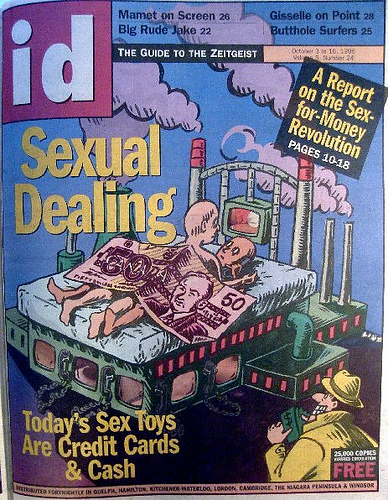
Read more on the 1990s sex economy here: From Special Report: NMM (New Media Markets) Spotlight On The Emergence Of Satellite Porn Channels In The UK
ORCID iD: https://orcid.org/0000-0001-5311-1052.
© David South Consulting 2021

















 David South Consulting
You must be logged in to post a comment.