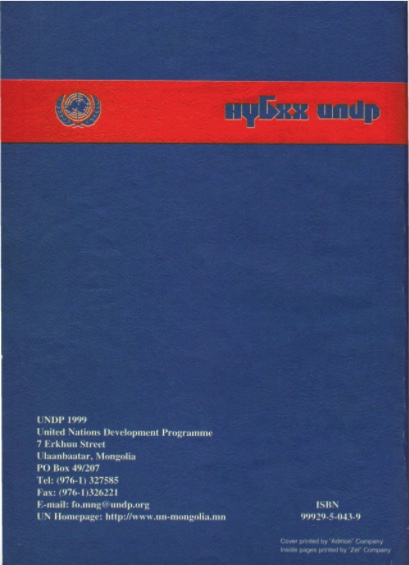
Launched in 1999 towards the end of my two-year assignment in Mongolia, this book is a unique resource for a developing country: a one-stop compilation of journalism chronicling the ups and downs of life in a country where the political and economic system has been turned on its head. You can download an edited selection of the book from Google Books here: In their own words: Selected writings by journalists on Mongolia, 1997-1999.
“Herding instinct” by Jill Lawless, The Guardian, 9 June 1999.“A Mongolian Shopping Spree Fizzles” by Thomas Crampton, The New York Times, June 25, 1998.“The Milk of Kindness Flows in a Peculiar Land A Steppe From Nowhere” by Leslie Chang, The Asian Wall Street Journal, 15 August 1998.
Top journalists covering Asia in the late 1990s contributed to the book.
In 1996 I was hired as Features Editor for Id Magazine, a bi-weekly alternative magazine in Guelph, Ontario, Canada.
About
In 1996 Id Magazine, an Ontario, Canada alternative biweekly, was expanding and needed to improve the quality of its journalism, while also making the difficult shift to being a more consistently professional offering. I was hired as Features Editor and set about swiftly assembling a team of investigative journalists. My strategy involved targeting stories overlooked by Canadian newspapers and TV news. In the 1990s, it was often the case the best journalism and the best investigative journalism in Canada could be found in the country’s alternative media. This led to a number of firsts, including an extensive investigation into Canada’s flourishing sex industry, the government’s addiction to casinos to boost revenues, unearthing a plot by neo-nazis to infiltrate Ontario high schools with hate rock, university students’ catastrophic debt culture, reporting from the streets of Port-au-Prince, Haiti on Canada’s UN mission, and probing the government’s public services privatisation plans (including being invited to debate this topic on CBC TV’s programme, Face Off). With a keen eye for new media trends, the magazine covered the fast-rising Internet economy, early experiments with digital currencies and smart cards (Mondex) (Canadian Town Tries Out Cash Cards) being carried out in Guelph, Ontario, and concerns about data privacy.
There clearly was a gap in the news marketplace Id could better fill with solid investigative journalism and features writing aimed at a younger demographic.
How large a market gap can be confirmed by various analyses on the state of the Canadian media at the time and since. According to the book The Missing News: Filters and Blind Spots in Canada’s Press (Robert A. Hackett and Richard S. Garneau, Canadian Centre for Policy Alternatives, University of Toronto Press 2000), Canada’s media was in a mess in the 1990s resulting from declining resources, staff layoffs and media closures reducing the breadth and depth of news coverage.
My challenge: Could I bring together a talented, young team and improve the quality and consistency of journalism for a start-up magazine seeking to grow? The proof came in the form of improved audited pick-up of the magazine by readers, the magazine’s confident push to expand on the Internet, and the fact many from that original team have gone on to not only have successful careers in the media and film, but also to be influential in their own right – proof the original belief in their talent was correct.
Pressure on journalists to toe the line and not upset advertisers was also increasing in the context of ongoing high unemployment, a stagnant economy in a recession, and government austerity. Canadian media as whole also has a “great dependence on advertising, which accounts for more than 70% of daily newspaper revenues, about 64% of magazine revenues,” which means there is enormous pressure to only publish stories that do not upset advertisers. And monopolies exert great control over news content in Canada: “In the United States, ten companies control 43.7% of total daily newspaper circulation. By contrast, in Canada since 1996, one single company controls a comparable share of the media pie.”
Quoting Jeffrey Simpson in the book, newspapers are “shrinking in size, personnel, ambition and, as a consequence, in their curiosity,” …. “I believe the result has been a diminution in quality.” (p64)
Fast forward to “Today, we have a crisis in the journalism industry unprecedented in scope. A media implosion. Newspapers being reduced to digital editions, large numbers losing their jobs, circulation falling, ad revenues plunging, near monopoly ownership of big-city dailies, the old business model in a state of collapse.” (Canada’s media: A crisis that cries out for a public inquiry by Lawrence Martin, The Globe and Mail, Feb. 02, 2016).
Brief descriptions of sample issues are below:
Can Harris be Stopped? Cover
My first Id Magazine cover. It was thrown together in a few days after being hired. While a work of resourcefulness under pressure, it did capture the spirit of the times as multiple demonstrations and strikes tried to bring down the much-hated Conservative government in Ontario.
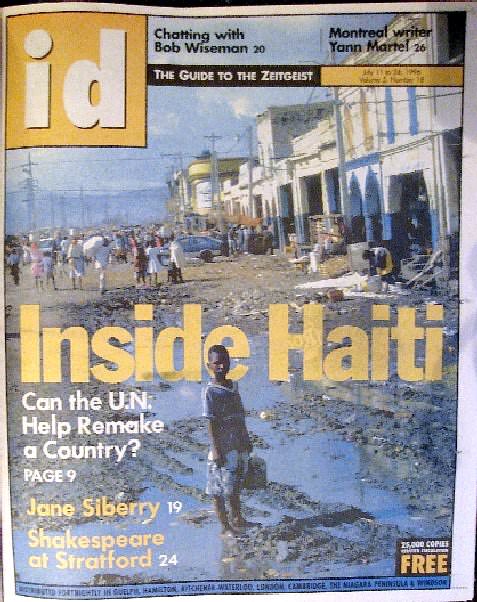
“Can the UN Help Remake a Country?” Cover
This cover photo by Phillip Smith was taken in the market area of Port-au-Prince, Haiti. I had never seen such squalor and desperation in my life. It got worse as we visited the city’s morgue, packed to the rafters with the dead and mutilated bodies of children and adults. It was a tough assignment and one that was captured with professionalism by Phillip’s camera.
Christmas Issue Cover
Back in 1996, the Thatcher thirst for privatisation came to Ontario with a vengeance. In this issue, we asked if it showed a lack of imagination to just sell publicly paid for assets to wealthy investors. We offered other ownership models and I debated this topic on CBC TV’s Face Off.
“Pulling the Plug on Hate Rock” Cover
This excellent cover by Gareth Lind was, as far as I know, the first use of pop art on a biweekly magazine cover in Ontario at that time (I certainly hadn’t seen anyone else do it). It sold the excellent investigation into skinhead rock bands infiltrating Ontario high schools very well. It was timed for release during the North-by-Northeast music festival in Toronto, and had zero returns (as in all issues were picked up).
Sarah Polley Cover
A regular contributor to Id, Canadian actor and director Sarah Polley challenged the stale Canadian left with her spiky views. In this issue we tackled the decline in the quality of TV programmes and asked if it was a moral vacuum being hoovered up by consumerism.
Student Issue Cover
This cover is by great Canadian political cartoonist and illustrator Jack Lefcourt. Always funny, Jack captures well the corporate take-over of the country’s universities and the introduction of the catastrophic debt culture that leaves so many students in a financial pickle. It was also Id’s first student issue.
“The Great Education Swindle: Are Reforms Destroying Your Future?”
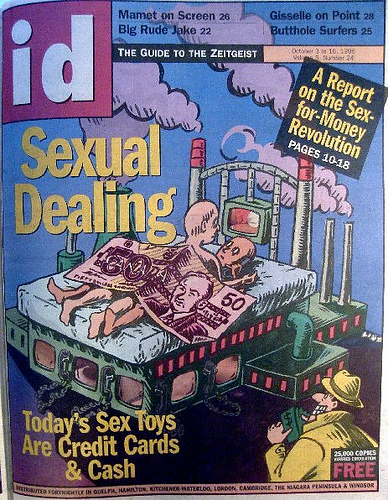
“Today’s Sex Toys are Credit Cards and Cash” Cover
As Ontario’s economy experienced year-after-year of high unemployment and stagnant salaries, its sex economy flourished. In another first, the Id team tackled all aspects of the growth of the sex economy and changing attitudes to sexual behaviour. Beating the big papers to this story, they wrote with honesty and verve and made a refreshing break from the limp journalism of most Canadian newspapers.
Timeline
1996: Hired as Features Editor and assembled editorial and creative team.
1997: Id Magazine begins to simultaneously publish its content online, a pioneering move at the time.
Impact
Micro
reducing returns and boosting audited pick-ups of the free magazine – a key metric for a publication reliant on local advertising
assembled talented investigative team and graphic design and photo team
introduced pop art front covers
increased news coverage, especially impact of austerity in Canada
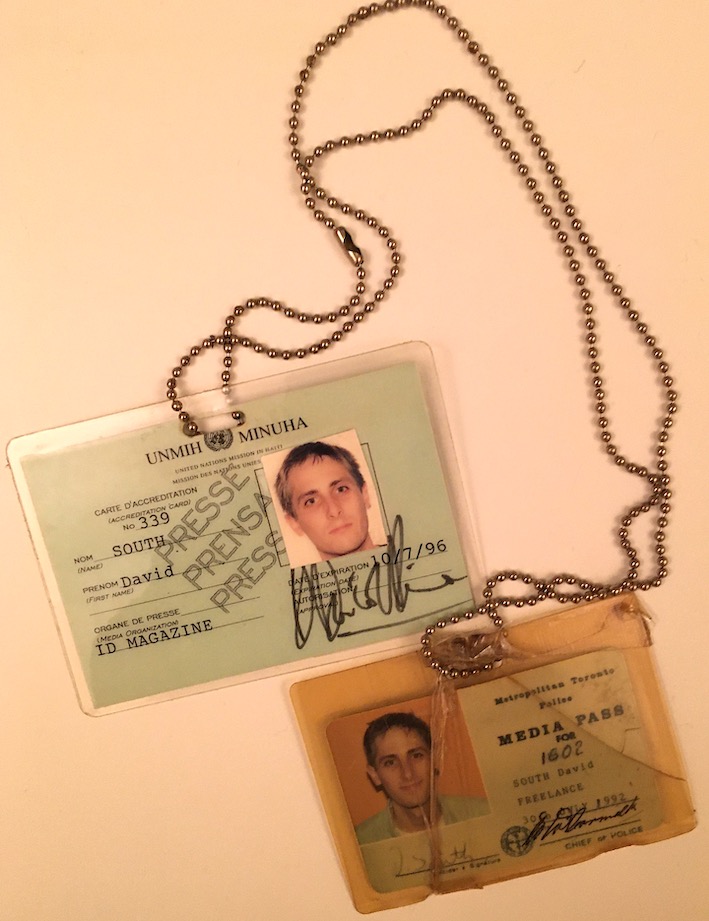
increased foreign coverage, including on Canada’s United Nations mission in Haiti
introduced high-profile contributors, including actor and director Sarah Polley
debated stories on other media, including CBC TV’s Face Off
Macro
most of the team have gone on to very successful careers in the media
magazine still receives good comments on Facebook many years after its closure
one of the first Canadian magazines to embrace the Internet and publish simultaneously online
Bonn, Germany: “The training allows us to learn about western theories of journalism,” says Mr. Nyamjav, editor of the Erkh Choloo (Freedom) newspaper. A UNDP project in Mongolia has brought journalists from Ulaanbaatar, Mongolia’s capital, to run an investigative journalist training programme for their colleagues in the rural community of Moron. The programme introducing investigative journalism to students consists of a workshop and various field assignments. Here, I report on day two of the training.
9:00 a.m.
Eleven student journalists and the two trainers, Ms Oyunsetseg and Mr. Batbold from the Press Institute of Mongolia, quickly run through the day’s schedule. The journalists will spend the next two hours interviewing subjects for their stories. All the journalists say this is the first time they’ve explored in detail this sub-category of journalism. Not all the students are experienced journalists, but this is made up for by the quality of the two facilitators, both of whom keep the workshop lively.
11:30 a.m.
The debate begins over the choice of stories. One team has chosen to look at poverty alleviation projects at the Bak (local government) level. They want to write a story looking at poor accountability for loans, the practice of nepotism and the ability of recipients to start small businesses. The team investigating power black-outs wants to conduct further interviews with the poorest people affected by such interruptions.
4:00 p.m.
Back at the offices of the Erkh Choloo newspaper, editor Nyamjav discusses the week’s news with his graphic designer. The skills of the staff impress me. While they have only one computer and barren offices, the paper won an award from the Press Institute for being the best local paper in 1997. The newspaper will be cut off from local government subsidies for printing at the end of this year and is already making plans to find other sources of revenue. Nyamjav is pleased with the results of the UNDP project, saying: “It has noticeably changed our stories – I know how to criticise reporters and push them to be more investigative.”
8:30 p.m.
Outside Ulaanbaatar a petrol shortage has hit hard. At a Moron filling station drivers patiently wait for new supplies to arrive or to receive their ration. Not only is there no fuel, there is also no electricity. On a field assignment the journalists investigating the power black-outs interview Mr. Sukhbaatar the power station director who says 3,500 households owe the utility Tug 27 million (US$27,411). It is the poorest households that are unable to pay in the Ger districts. A Ger is a Mongolian felt tent. Without payment, their power is cut off.
9:00 p.m.
I am asked to conduct a one-hour discussion of my experiences as an investigative journalist in Canada and England. The debate afterwards is lively. A common question is how to deal with pressure from government and corporations to alter the content of stories. The difficulty the regional journalists have in distributing newspapers to remote communities is a common complaint. They ask how international donors could help in this matter, pointing out that in the past the government subsidised newspaper distribution to a greater extent. They would like to be linked with international journalists in some way, preferably through an association.
Expertise: Investigative journalism, editing, start-ups, content and magazine design, digital content, digital strategy.
Locations: Toronto and Guelph, Ontario, Canada and London, UK 1991 to 1997
Investigative Journalist, Editor, Reporter, Writer:David South
Abstract
I worked as a journalist for magazines and newspapers from 1991 to 1997 in Canada and the United Kingdom and as a radio host for a weekly spoken word interview programme, Word of Mouth (CKLN-FM).
CKLN-FM’s “Word of Mouth 6 pm-6:55 pm Hosts: David South, Jill Lawless This show goes well behind the headlines for the real story behind the events.”
This included working as an investigative journalist for Now Magazine, “Toronto’s alternative news and entertainment source”, as a Medical and Health Correspondent for Today’s Seniors, and as an investigative journalist and reporter for two Financial Times newsletters, New Media Markets and Screen Finance.
Could it be possible to do high-quality investigative journalism in the context of a shrinking economy undergoing austerity, and where the media sector is contracting and consolidating around a small number of media companies? Is it possible to launch new media products in the face of a contracting economy and reach new audiences and create new markets?
In Canada, the early to mid 1990s were the years of government austerity and economic crisis. After the crash of 1989/1990*, institutions came under great stress. Health care, for example, was pitched into a period of turmoil and change. Drawing on my experience working in the health sector (Princess Margaret Hospital/Ontario Cancer Institute), I covered this crisis in many stories for various publications, in particular Today’s Seniors.
The Canadian economy severely contracted and unemployment was at 11.4 per cent by 1993 (Statistics Canada), and as Statistics Canada says, “Because employment recovered at a snail’s pace after the recession of the early 1990s, the decline in the unemployment rate was delayed until 1994”.
The media in general could not avoid the wider economic crisis. According to the book The Missing News: Filters and Blind Spots in Canada’s Press (Robert A. Hackett and Richard S. Garneau, Canadian Centre for Policy Alternatives, University of Toronto Press 2000), Canada’s media was also in a crisis throughout the 1990s, as declining resources, staff layoffs and media closures reduced the breadth and depth of news coverage. Canadian media as a whole also has a “great dependence on advertising, which accounts for more than 70% of daily newspaper revenues, about 64% of magazine revenues,” which means there is enormous pressure to only publish stories that do not upset advertisers. And monopolies exert great control over news content in Canada: “In the United States, ten companies control 43.7% of total daily newspaper circulation. By contrast, in Canada since 1996, one single company controls a comparable share of the media pie.”
The impact of this crisis was summed up by Jeffrey Simpson in the book The Missing News, where he said newspapers are “shrinking in size, personnel, ambition and, as a consequence, in their curiosity,” …. “I believe the result has been a diminution in quality.” (p64)
This is the context in which, ironically, it was possible to flourish as a much-sought-after investigative journalist who could get the story and get the quotes and as an editor. And it was also a time for opportunity, in particular as new media rose in importance, from cable and satellite television, to the rise of the Internet.
I broke original stories for Now Magazine as a member of their investigative reporting team, for Today’s Seniors as its Medical and Health Correspondent, and as a reporter for two Financial Times newsletters in London, UK. I also broke original stories as a freelancer for many other magazines and newspapers, including Hospital News, The Toronto Star, This Magazine, The Annex Gleaner, Flare, The Financial Post Magazine, Canadian Living, and others. I drew on strong contacts in health care, media, politics, international relations and the military.
I was an editor for magazines, newspapers and newsletters as well, gaining invaluable experience and contacts. This included as Editor-in-Chief for start-up youth publication, Watch Magazine (see Case Study 2), and as Features Editor for Id Magazine (see Case Study 3).
Themes covered included the uses – and abuses – of data, the impact of military engagements to uphold international law, how to re-structure health care when budgets are tight, with populations ageing, and technology and scientific advances quickly expanding options, the emerging new media world of cable and satellite television and the Internet, the sexual revolution 2.0, urbanization and how it re-shapes politics and community, international development, and youth culture.
Story highlights include covering data concerns over Canada’s border screening measures, questions about the air quality of aircraft cabins, the debate over airstrikes in Bosnia, scandals involving peacekeepers in Somalia and reporting on the UN peacekeeping mission in Haiti, reforms to medical education in Canada, innovators in health care, the tug of war over health care spending during austerity measures, London, UK designers, the growing role of Nordic countries in cable and satellite television, the film financing scene in Europe and the UK, the new sexual revolution and its impact on cable and satellite television and the rising Internet, changes to Canada’s media industry, and Toronto’s embracing of the megacity concept and the political battles it sparked.
I edited newsletters and newspapers aimed at specific communities, from Canada’s medical history community to part-time students. And had the privilege of helming a start-up youth magazine as its Editor-in-Chief to its commercial success (see Case Study 2).
* “The last two recessions in Canada occurred in 1982 and 1990. … The most recent Canadian recession began in the second quarter of 1990 and over the next 12 months GDP fell by 3.2%. … The recovery from this recession was unusually slow; there was almost no growth between mid-1991 and mid-1992. This slow recovery was export driven.” (The Canadian Encyclopedia)
“In early 1994, Canada’s economic situation was not that favourable—our economy was facing some rather serious problems.
“… the recession here was more severe than in the United States.
“Working their way out of these difficulties was disruptive and painful for Canadian businesses. Defaults, restructurings, and downsizings became the order of the day. With all this, unemployment took a long time to recover from the 1990–91 recession and, in many instances, wages and salaries were frozen or reduced (Bank of Canada: Canada’s Economic Future: What Have We Learned from the 1990s?)
A small sample of published stories with links is below:
1991: Begin career as investigative journalist and editor.
1992: Work as a Medical and Health Reporter for Today’s Seniors and as an Investigative Journalist for Now Magazine. Work as Editor and Writer for the Hannah Institute for the History of Medicine’s newsletter.
1993: Published in many publications, including The Toronto Star, Canadian Living and This Magazine.
1994: Work on re-launch of Watch Magazine 2.0 and its expansion (see Case Study 2).
1995: Work as reporter for two Financial Times newsletters in London, UK.
1996: Work on re-launch of Watch Magazine 3.0 and its expansion. Begin work at Id Magazine as its Features Editor (see Case Study 3).
1997: Begin two-year assignment with the United Nations mission in Mongolia (see Case Study 4).
Testimonials
“David South … proved himself to be a penetrating, thorough and hard-working journalist. He produced a lot of very good stories …” Neil McCartney, Editor, Screen Finance, Telecom Markets and Mobile Communications, London, UK
















 David South Consulting
You must be logged in to post a comment.