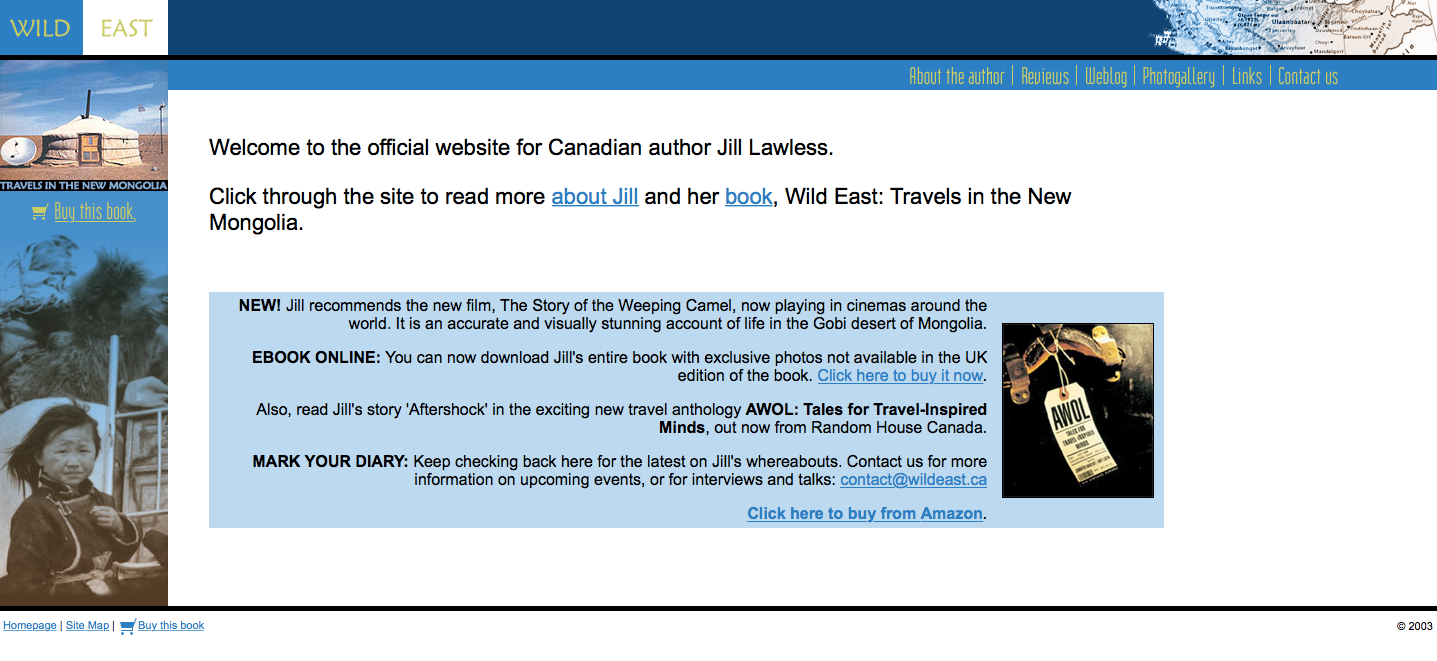
The original website at wildeast.ca (see below) was launched in 2003 and designed and built in London, UK. It served the book very well in the years after but, with the abrupt ending of business trading by the US server host, we have been prompted into revisiting a project that has been on the back burner for some time: to launch the official brand site for Jill Lawless.
For most of us, the name Mongolia conjures up exotic images of wild horsemen, endless grasslands, and nomads — a timeless and mysterious land that is also, in many ways, one that time forgot. Under Genghis Khan, the Mongols’ empire stretched across Asia and into the heart of Europe. But over the centuries Mongolia disappeared from the world’s consciousness, overshadowed and dominated by its huge neighbours — first China, which ruled Mongolia for centuries, then Russia, which transformed the feudal nation into the world’s second communist state.
Jill Lawless arrived in Mongolia in the late 1990s to find a country waking from centuries of isolation, at once rediscovering its heritage as a nomadic and Buddhist society and simultaneously discovering the western world.
The result is a land of fascinating, bewildering contrasts: a vast country where nomadic herders graze their sheep and yaks on the steppe, it also has one of the world’s highest literacy levels and a burgeoning high-tech scene. While trendy teenagers rollerblade amid the Soviet apartment blocks of Ulaanbaatar and dance to the latest pop music in nightclubs, and the rich drive Mercedes and surf the Internet, more than half the population still lives in felt tents, scratching out a living in one of the world’s harshest landscapes.
Mongolia, it can be argued, is the archetypal 21st-century nation, a country waking from a tumultuous 20th century in which it was wrenched from feudalism to communism to capitalism, searching for its place in the new millennium.
This is a funny and revealing portrait of a beautiful, troubled country whose fate holds lessons for all of us.
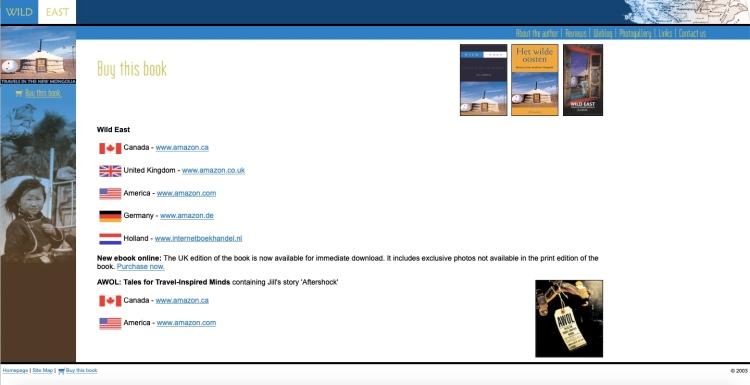
Launched in 2003, the original wildeast.ca website served us well. Beautifully designed and built in London, it stood out for its clean and crisp look and ease of use.Author Jill Lawless photographed in Tunisia in 2002. Originally published in Canada in 2000, Wild East: Travels in the New Mongolia was also published in the UK (2002) and the Netherlands (Het Wilde Oosten: Reizen in het moderne Mongolie) and in a large print version in 2012. The Dutch edition of Wild East: Travels in the New Mongolia by Jill Lawless.
Mongolië is voor veel mensen nog een mysterieus land dat vooral beelden oproept van woeste ruiters, uitgestrekte grasvlakten en nomaden. Het is een land waar de tijdstil lijkt te hebben gestaan. Als Jill Lawless arriveert in Mongolië treft ze een hoofdstad aan die veel westerser is dan ze had verwacht. De trendy geklede jongeren en moderne discotheken van Ulaanbaatar staan in schril contrast met de nomadische bevolking die nog in tenten op de ruige vlakten leven.
Het wilde Oosten is het onthullende reisverslag van Lawless’ verblijf in Mongolië waarbij je als lezer alle wetenswaardigheden over de lokale politiek, de diverse tradities en de historie van dit intrigerende land leert kennen.
De Canadese Jill Lawless werkte als redacteur in Mongolië bij de enige Engelstalige en onafhankelijke krant The UB Post. Zij schreef ook diverse artikelen over Mongolië voor internationale dagbladen. Momenteel woont en werkt ze als verslaggeefster in Londen.
“Lawless introduces us to Mongolia’s tabloid press, to teenage mineworkers, sharp-eyed young hustlers, nomads whose only possessions are their livestock, Mongolian wrestlers and Mongolian horse races.” Toronto Star
“This readable and reportorial book is the perfect antidote to … those tiresomely difficult, pointlessly dangerous, and essentially fake expeditions undertaken against the advice of local people who know better.” The Georgia Straight, Vancouver
“Wryly funny and wide-spectrum account of Mongolia’s tumultuous rebirthing into the 21st century. Half the population lives in Soviet apartment blocks and watches satellite TV but the other half still eek a living from the exquisite, barren hills while living in nomadic felt tents. Of course, I’d much rather be in the tents… but whatever your preference, you will definitely enjoy Ms. Lawless’ writing. She was editor of an Ulaan Baator newspaper for two years, and she tells it like it is. Very highly recommended.” Mongolian Buryat Civilisation Bookstore
“Jill Lawless’ book is not a scholarly tome per se, yet it is of definite value to the contemporary Mongolian scholar … Lawless’ period is 1997-1999, the heart of the tumultuous and ill-spent years of Democratic Coalition Government… a period of great hopes for democratic flowering and free market enterprise leading the nation to prosperity and progress.” Alicia J. Campi in Mongolian Studies
Historical dictionary of Mongolia, by Alan J. K. Sanders, Scarecrow Press, 2003.
“Others sent me Jill Lawless’s Wild East: The New Mongolia, a compilation of pieces she wrote when she was editor of Mongolia’s English-language newspaper, the UB Post, during Mongolia’s transition from a socialist people’s republic to young democracy. With the wind shaking the frame of my ger, I lit the stove and read what these and other writers claimed to have found just outside my flapping felt walls.
“By the time veteran journalist Jasper Becker’s Mongolia: Travels in an Untamed Land arrived, I had put aside books written since Mongolia opened up to the West in the early 1990s. Most Western travellers and writers discovered the same sights from the back of a borrowed horse. Only Lawless had investigated the place over time on its own terms. The others, full of pith and vinegar and a standard set of assumptions about what they would find, built books on flights of fancy – golfing across Mongolia, following the path of medieval monks, ‘rediscovering shamanism’ – that were flimsier even than those that had set me in motion. The books were as exciting as museum diorama, papier-mâché models of their ‘medieval’ travels and capitalist fantasies.” Three Years in Mongolia: Trying to be a Travel Writer, Luke Meinzen, Kill Your Darlings, 10 April 2012
Ulaanbaatar (Mongolia) – Mongolian newsstands are bursting at the seams. But while the content of the country’s publications is varied, their form is not. Newsprint rules this country’s publishing industry. The few glossy magazines for sale are imports from Russia.
When the democratic revolution unleashed the tide of free expression in the early 1990s, a flood of newspapers poured forth. It made sense. The cheap-and-cheerful technology of newsprint is low-tech, accessible and inexpensive. Suddenly everyone could be a publisher.
But Mongolia’s increasingly sophisticated media landscape is about to go “glossy”. Tomorrow (September 9) sees the launch of Ger (Home), Mongolia’s first on-line magazine. A bilingual quarterly funded by the United Nations, it combines entertainment – articles on the changing sexual attitudes of young Mongolians and the country’s vibrant pop scene – with information on the work of the UN and other NGOs in Mongolia.
“We want something that will tell the stories of Mongolians and their experiences over the last eight years – both to Mongolians and to the rest of the world,” says David South, communications coordinator at the United Nations Development Programme.
This month also brings the premiere issue of Tusgal (Strike), billed as the first full-colour, general-interest magazine in the new Mongolia. Published by Mongol News Company – the privately owned media group whose stable of publications includes the daily newspaper Onoodor and The UB Post – it offers a lively mix of sport, culture and celebrity articles, also aimed primarily at the young.
These two publications are just the top of the stack. Mongolia’s two best-known printing houses, Admon and Interpress, are said to be working on titles of their own.
Mongolia’s quick-to-learn capitalists see a gap – and they want to fill it.
“In Mongolia there are many newspapers, but no world-class magazines,” says Tusgal’s editor-in-chief, Do. Tsendjav. “On the streets you can see a lot of publications that aren’t exactly magazines but you can’t call newspapers, either – newspapers that appear every 10 days or two weeks.
“We want to fill this space. We want to produce the first colour magazine that will reach world standards, something close to Time or Newsweek.”
“There’s an enormous thirst for quality journalism, quality publications that are interesting to look at, top photojournalism – all the things newspapers don’t cover,” adds South.
“We’ve seen newspapers moving to more colour, more photographs, and that shows a desire for quality.”
That quality comes at a price. Tusgal, with 70 colour pages, will sell for between Tg 1500 and Tg 2000 – not much cheaper than an American publication like Time, and too expensive for many Mongolians.
With only 1000 Internet subscribers in Mongolia, Ger has an even smaller market within the country – though South is quick to point out, the UN has established public-access Internet centres in Ulaanbaatar and several aimags.
And he says a print version is planned to follow.
“Distribution is the big problem right now,” he says.
“We have to see how we can organize distribution to reach the whole country. I know more magazines will be launched soon in Mongolia, and hope a distribution network may grow out of that.”
The editors know Mongolia’s magazine market and magazine technology are in their infancy. Although companies like Admon and Interpress get more sophisticated equipment by the month, the capacity to produce quality publications is still limited – the first issue of Tusgal has been printed outside Mongolia.
Human resources need to develop as well, Tsendjav admits.
“To produce a monthly magazine you need highly qualified journalists. We don’t have that right now. We’re still seeking them out.”
But he is confident this will change – and quickly, too, if the pace of development in the past eight years is anything to go by.
“During socialism, Mongolia had many magazines, but it all stopped after 1990,” notes Tsendjav. “It was a question of economics.
“At first we don’t think we can earn money from this. If you want to make money you have to wait two or three years. So what we are aiming for at first is to build a readership.
“I think in two or three years, living standards will improve. People will have more money to spend on things like magazines. But we don’t want to wait for people to get enough money. We want to be the first, so people will develop an interest.
“There will be competition. Nowadays a lot of business-people understand the importance of the media. I welcome competition. It’ll make us work harder. It’s good for everybody.”
The first two issues of Mongolia’s web magazine, Ger.
Expertise: Crisis leadership, mission leadership, strategy, communications, web strategy, digital media, crisis recovery, public health, Northeast Asia, UN system.
Location: Ulaanbaatar, Mongolia 1997 to 1999
UN/UNDP Mongolia Communications Coordinator:David South
The question posed itself from the start of the assignment: In the middle of a major crisis, is it possible to recover quickly while simultaneously growing and modernizing the United Nations mission (this was the dawn of the digital revolution)? It was only possible by teaching and mentoring colleagues, offering leadership, vision, strategy, and practical actions to get there – all with a budget and mandate for two years.
The mission had to tackle in particular, three, severe crises: the country’s turbulent transition from Communism to free markets and democracy, the social and economic crash this caused, and, later in 1997, the Asian Financial Crisis (Pomfret 2000)* – all combined with the political instability this exacerbated. Richard Pomfret said in 1994, “In 1991 Mongolia suffered one of the biggest peacetime economic collapses ever (Mongolia’s Economic Reforms: Background, Content and Prospects, Richard Pomfret, University of Adelaide, 1994).” From Curbing Corruption in Asia: A Comparative Study of Six Countries by Jon S. T. Quah: “The combined effect of these three shocks was devastating as ‘Mongolia suffered the most serious peacetime economic collapse any nation has faced during this century’. Indeed, Mongolia’s economic collapse ‘was possibly the greatest of all the (peaceful) formerly’” Communist countries.
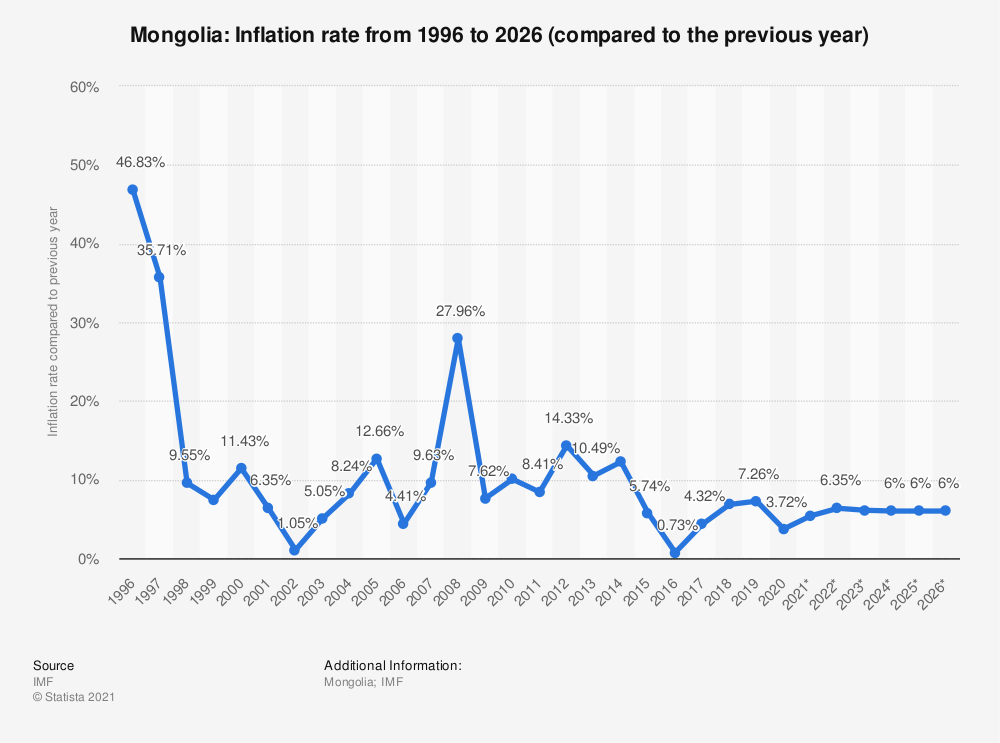
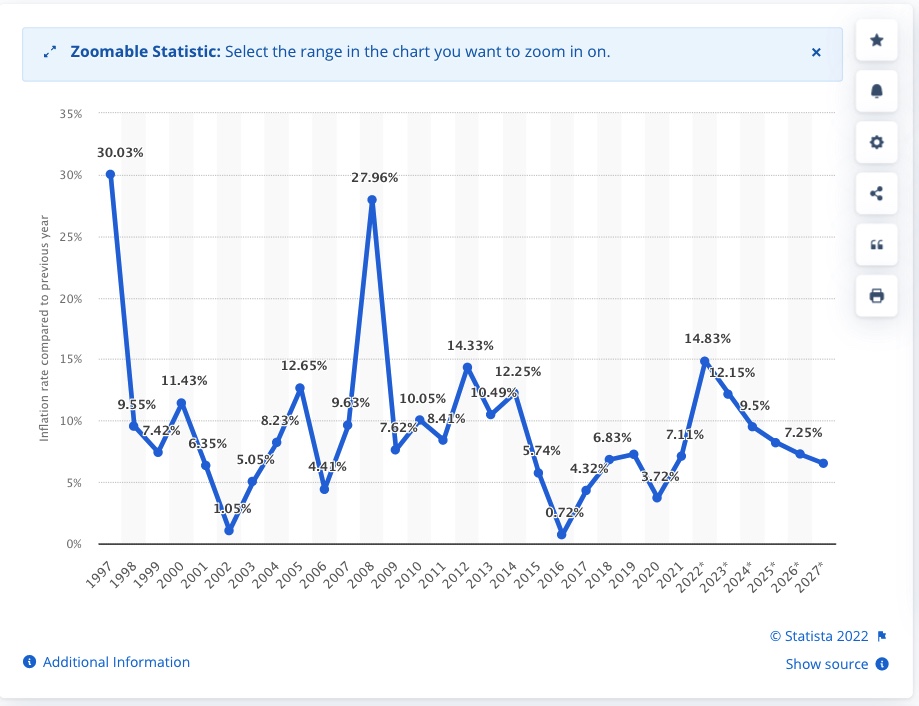
A dramatic decline in inflation paired with political and economic stabilisation allowed Mongolia to enjoy the fruits of the fast-growing economies of the 2000s. Source: Statista.
During the last 16 years the financial and monetary system of our country saw the worst crisis in 1991-1994, there was a recovery in 1995-1997 and another crisis in 1997-1999. However, it has entered a stable stage since 2000.
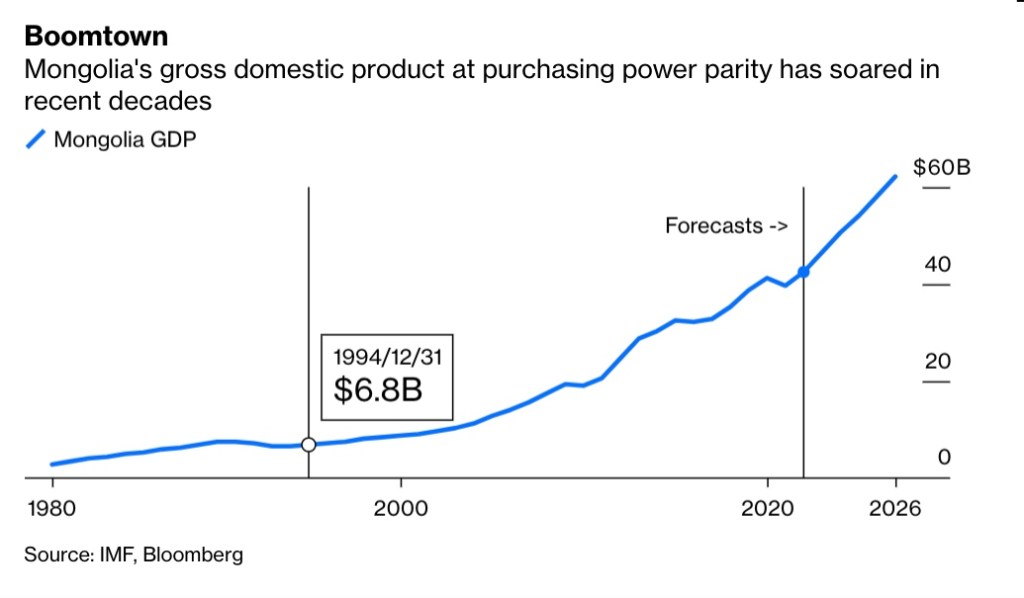
A resources “boomtown” throughout the 2000s. Source: Bloomberg. When I left in 1999, Mongolia’s PPP was US $8.8 bn; today (2021) it is US $42.4 bn. Graph from Migration under economic transition and changing climate in Mongolia, Journal of Arid Environments, Volume 185, February 2021. “Urbanization in Mongolia accounted for over 80% of all migration, mostly into the capital city Ulaanbaatar (UB), where nearly 70% of recent population growth was from migration.” As can be seen in this chart, Mongolia’s economic growth since 2000 has benefited greatly from its proximity to China.
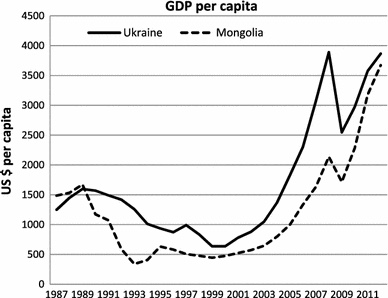
As this chart shows, increasing connectivity had a profound impact on living standards in Ukraine and Mongolia post-2000. The extreme turbulence Mongolia experienced in the 1990s – after the collapse of support mechanisms from the Soviet Union – calmed down as Mongolia integrated with the global economy, especially a booming China. Read about my work in Ukraine here: UN Ukraine Web Development Experience | 2000.
The Economist: “Those free-trading Mongolians” was published Apr 24th 1997. I arrived in May of 1997 to find a country on the cusp of great and turbulent change.
In this role, I pioneered innovative uses of the Internet and digital resources to communicate the UN’s work and Mongolia’s unfolding crises. The UN called this work a “role model” for the wider UN and country offices. A survey of United Nations country office websites in 2000 ranked the UN Mongolia website I launched in 1997 and oversaw for two years (1997-1999), third best in the world, saying: “A UN System site. A very nice, complete, professional site. Lots of information, easily accessible and well laid out. The information is comprehensive and up-to-date. This is a model of what a UNDP CO web site should be.” (http://www.scribd.com/doc/274319690/UNDP-Mongolia-United-Nations-2000-Survey-of-Country-Office-Websites)
“The years 1998 and 1999 have been volatile ones for Mongolia, with revolving door governments, the assassination of a minister, emerging corruption, a banking scandal, in-fighting within the ruling Democratic Coalition, frequent paralysis within the Parliament, and disputes over the Constitution. Economically, the period was unstable and rife with controversies.” Mongolia in 1998 and 1999: Past, Present, and Future at the New Millennium by Sheldon R. Severinghaus, Asian Survey, Vol. 40, No. 1, A Survey of Asia in 1999 (Jan. – Feb., 2000). pp. 130-139 (Publisher: University of California)
As part of a strategic plan to raise awareness of Mongolia’s development challenges and to spur action on meeting them, a Communications Office was established for the UN mission in 1997 – a structure that is commonplace in UN missions today. The Office also led on digital communications, marking many firsts, from the first digital photo and video library, the first online magazine, the first web portal, the first online newsletter, and many other firsts. It gathered numerous stories on resilience in a crisis, and documented in data and storytelling the country’s development challenges, while introducing a transparent way of working and communicating unprecedented for the time (the country was still recovering from the state secrecy of its years under Communism), and led on modernizing communications in the country. Acting as a strategic hub, the Communications Office and its dynamic and talented team, were able to leverage the existing budget to spur action on many fronts, including:
I launched it in 1997 in the middle of a major crisis, and oversaw its expansion and development for two years. A pioneering digital resource, this award-winning United Nations Mongolia development web portal was singled out by UN headquarters in New York as an example of what a country office website should be like. It featured extensive resources in both Mongolian and English and also was home to the bilingual online magazine, Ger – Mongolia’s first web magazine. It can be viewed at www.archive.org and there is more at Wikipedia here: https://en.wikipedia.org/wiki/Ger_(magazine).
Media
Working with journalists and media both within Mongolia and outside, the Communications Office was able to significantly raise awareness of Mongolia and its development challenges. This was reflected in a substantial increase in media coverage of the country and in the numerous books and other publications that emerged post-1997. The book In Their Own Words: Selected Writings by Journalists on Mongolia, 1997-1999 (ISBN 99929-5-043-9) published by UNDP Mongolia archived the stories by theme.
Ger Magazine
Ger Magazine (the Mongolian word for home and traditional tent dwelling) was published as the country’s first e-magazine in 1998. There were four issues in total from 1998 to 2000. The launch issue was on the theme of youth in the transition. Mongolia was transitioning from Communism to free markets and democracy and this had been both an exhilarating time and a wrenching time for young people. The magazine drew on talented journalists from Mongolia and the handful of international journalists based there to create a mix of content, from stories about life adapting to free markets to stories on various aspects of Mongolian culture and life.
The second issue of the magazine proved particularly effective and inspiring, with its modern life theme and cover story on a thriving Mongolian fashion scene.
Archived issues of the magazine can be found at the Wayback Machine here: https://archive.org/. Just type in the UN Mongolia website address for the years 1997 to 1999: http://www.un-mongolia.mn.
An online survey of the state of Mongolia’s media and its history (www.pressreference.com/Ma-No/Mongolia.html), had this to say: “An interesting variation from some of the other publications available is Ger Magazine (published online with guidance from the United Nations Development Program, UNDP), which is concerned with Mongolian youth in cultural transition. The name of the magazine is meant to be ironic because a ger is the Mongolian word for yurt—a yurt being traditional nomadic housing—but the magazine is about urbanization and globalization of Mongolian youth.”
Blue Sky Bulletin
The Blue Sky Bulletin newsletter was launched in 1997 initially as a simple, photocopied handout. It quickly founds its purpose and its audience, becoming a key way to communicate what was happening in the country and a crucial resource for the global development community, scholars, the media and anyone trying to figure out what was happening in a crazy and chaotic time. It eschewed the typical ‘grip and grin’ content found in many development newsletters and instead offered stories, data and insights useful to anyone seeking to understand Mongolia’s development challenges. The Blue Sky Bulletin was distributed via email and by post and proved to be a popular and oft-cited resource on the country. The quality of its production also paralleled Mongolia’s growing capacity to publish to international standards, as desktop publishing software became available and printers switched to modern print technologies. The Blue Sky Bulletin evolved from a rough, newsprint black and white publication to becoming a glossy, full-colour, bilingual newsletter distributed around Mongolia and the world.
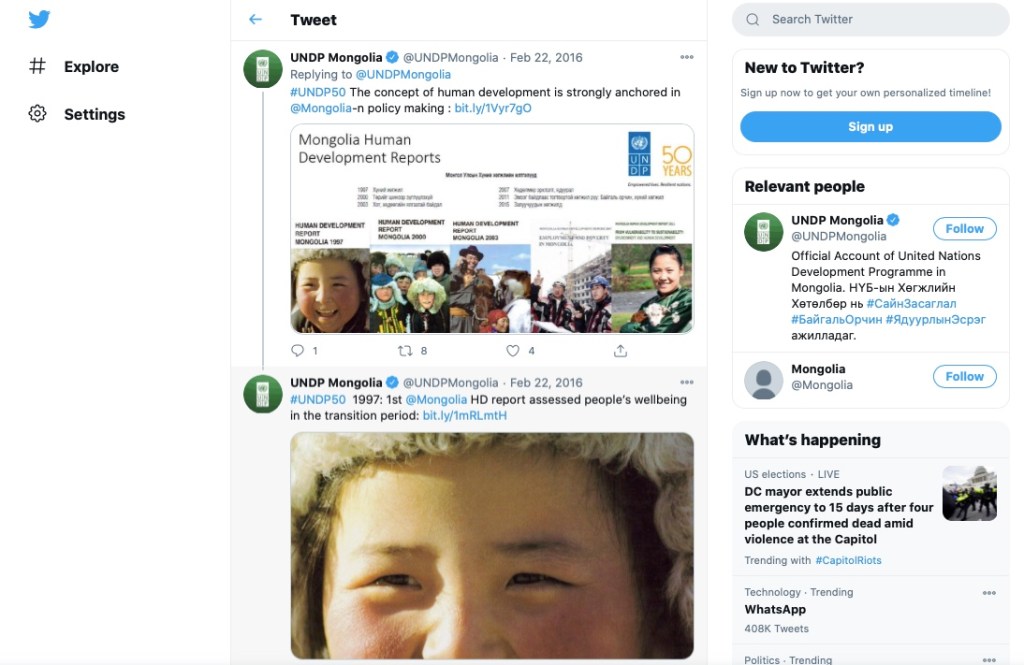
The Mongolian Human Development Report 1997 (MHDR), the country’s first, placed the story of the Mongolian people during the transition years (post-1989) at its heart, using photographs, stories and case studies to detail the bigger narrative at play.
This groundbreaking Mongolian Human Development Report – the country’s first – went beyond just chronicling Mongolia’s state of development in statistics and graphs. Designed, laid out and published in Mongolia, the report broke with the practices of many other international organisations, who would publish outside of Mongolia – denying local companies much-needed work and the opportunity to develop their skills. The report’s costs helped to kick-start a publishing boom in the country and significantly raised standards in design and layout in the Mongolia. The foundations laid down by the project producing the report ushered in a new age in publishing for Mongolia.
The report’s launch was innovative, not only being distributed for free across the country, but also part of a multimedia campaign including television programming, public posters, town hall meetings and a ‘roadshow’ featuring the report’s researchers and writers.
The initial print run of 10,000 copies was doubled as demand for the report increased. To the surprise of many, once hearing about the free report, herders would travel to the capital, Ulaanbaatar, to pick up their copy. The report proved people cared passionately about the development of their country and that development concepts are not to be the secret domain of ‘development practitioners’. The report also became an English language learning tool as readers compared the Mongolian and English-language versions.
1997 saw the launch of the first human development report for Mongolia.
Mongolian AIDS Bulletin
UNDP acted swiftly to address a breaking HIV/AIDS crisis in 1997, offering a key lesson for others working in public health (the Ebola Crisis and global air pollution crisis both show those lessons have still yet to be fully absorbed).
Assembled by a team of health experts after the Fourth International Congress on AIDS in Asia and the Pacific, the Mongolian AIDS Bulletin was published in 1997 in the middle of an HIV/AIDS crisis. It provided timely information and health resources in the Mongolian language and was distributed across the country.
“Mongolia’s first AIDS Bulletin marked the beginning of the UNDP Response to HIV/AIDS/STDs Project back in the autumn of 1997. Over 5,000 copies of the magazine were distributed across the country, offering accurate information on the HIV/AIDS situation. The project has been pivotal in the formulation of a national information, education and communication (IEC) strategy, bringing together NGOs, donors, UN agencies and the government.”
Source: YouandAids: The HIV/AIDS Portal for Asia Pacific
Green Book
In the Mongolian language, the Mongolian Green Book details effective ways to live in harmony with the environment while achieving development goals. Based on three years’ work in Mongolia – a Northeast Asian nation coping with desertification, mining, and climate change – the book presents tested strategies.
EPAP Handbook
The Environmental Public Awareness Handbook was published in 1999 and features the case studies and lessons learned by UNDP’s Mongolian Environmental Public Awareness Programme (EPAP). The handbook draws on the close to 100 small environmental projects the Programme oversaw during a two-year period. These projects stretched across Mongolia, and operated in a time of great upheaval and social, economic and environmental distress. The handbook is intended for training purposes and the practice of public participation in environmental protection.
In its 2007 Needs Assessment, the Government of Mongolia found the EPAP projects “had a wide impact on limiting many environmental problems. Successful projects such as the Dutch/UNDP funded Environmental Awareness Project (EPAP), which was actually a multitude of small pilot projects (most costing less than $5,000 each) which taught local populations easily and efficiently different ways of living and working that are low-impact on the environment.”
Mongolia Updates 1997, 1998, 1999
Mongolia Update 1998 detailed how the country was coping with its hyperinflation and the Asian economic crisis.
1998 proved a tumultuous year for Mongolia. The country’s existing economic crisis caused by the transition from Communism to free markets was made worse by the wider Asian Crisis. The government was destabilised, leading to an often-confusing revolving door of political figures. In order to help readers better understand the political changes in the country, a special edition of Mongolia Update was published that year.
UNDP Mongolia: The Guide
The Guide, first published in 1997, provided a rolling update on UNDP’s programmes and projects in Mongolia during a turbulent time (1997-1999). The mission simultaneously had to deal with the 1997 Asian Crisis (http://en.wikipedia.org/wiki/1997_Asian_financial_crisis) and the worst peacetime economic collapse in post-WWII history.
Each edition came with short project and context summaries, key staff contacts, and facts and figures on how the country was changing. For the first time, any member of the public could grasp what the UN was up to in the country and be able to contact the project staff. An unusual level of transparency at the time for a UN mission.
Memoranda of Understanding
Three Memoranda of Understanding were negotiated with the Mongolian Government to help focus efforts and aid the attainment of internationally-agreed resolutions. This was affirmed by a series of youth conferences, One World, held in 1998 and 1999.
Strategy and Leadership in a Crisis
The scale and gravity of the crisis that struck Mongolia in the early 1990s was only slowly shaken off by the late 1990s. The economic and social crisis brought on by the collapse of Communism and the ending of subsidies and supports from the Soviet Union, led to a sharp rise in job losses, poverty, hunger, and family and community breakdowns.
The challenge was to find inspiring ways out of the crisis, while building confidence and hope. The sort of challenges confronted by the UNDP Mongolia Communications Office included:
1) A food crisis: agricultural production was down sharply, and the traditional nomadic herding economy, while at peak herd, was failing to get the meat to markets and to a high enough standard to restore export levels to where they once were. As a result, a cross-border trading frenzy became the solution to falling domestic food production and availability.
2) HIV/AIDS/STDs crisis.
3) A major banking crisis.
4) Both the Asian Financial Crisis and the Russia Crisis.
5) An ongoing political crisis and an inability to form stable governments.
UN Annual Reports
Editor and designer. 1998 Report called by Under-Secretary-General Nafis Sadik “a clear, well-written, attractive and colourful report.”
One of many documents from that time held in the United Nations Archives Search Engine. In this case, reporting on Mongolia’s follow-up to global conferences to then-Secretary-General Kofi A. Annan in 1999.
Mongolia’s Follow-Up To The UN Global Conferences (1999) UNDP Mongolia Communications Office, Ulaanbaatar, Mongolia.
Production/Design Supervision: David South, UNDP Communications Coordinator; Proof Reading: N. Oyuntungalag, UNDP Communications Officer/David South (1999).
1998: International media tours of the country, launching of Mongolia’s first online magazine, Ger, distribute globally a regular newsletter on Mongolia’s development challenges, Blue Sky Bulletin. Open United Nations Info Shop for the public. Assist the Government of Canada to connect with Canadians working with the United Nations in Mongolia during the first official visit by a Canadian Government Minister.
1999: Launch a string of books documenting insights gleaned from the Mongolia development experience.
Testimonials
“Mongolia is not an easy country to live in and David [South] showed a keen ability to adapt in difficult circumstances. He was sensitive to the local habits and cultures and was highly respected by his Mongolian colleagues. … David’s journalism background served him well in his position as Director of the Communications Unit. … A major accomplishment … was the establishment of the UNDP web site. He had the artistic flare, solid writing talent and organizational skills that made this a success. … we greatly appreciated the talents and contributions of David South to the work of UNDP in Mongolia.” Douglas Gardner, UN Resident Coordinator and UNDP Resident Representative Mongolia
Impact
Micro
strategic communications approach including establishing the UN/UNDP Mongolia Communications Office and team and strategic communications plan
led on digital transformation, including use of digitial media (photo/video archive) and digital publishing (web site, online magazine and newsletter, etc.)
established and ran the United Nations Info Shop – a one-stop resource open to the public with archive of development publications and current periodicals and Internet access
began largest bilingual online and offline publishing programme in country – led on publishing and design modernisation
laid down the foundations for many UN initiatives in Mongolia that are still underway. Contributed to stabilizing the country in a turbulent time. Mongolia was briefly the fastest-growing economy in the world by 2011
championed transparency and access to information and media freedoms
oversaw a period in which Transparency International found lower levels of perceived corruption
managing editor for country’s first Human Development Report
Macro
raised profile of country and its development challenges. Donor pledges rose
2 international media tours
strong relationship with Mongolian and international journalists
championed innovators in commnications
crisis response: AIDS, economy, political
country’s largest website and one of its first. Called “Godfather of the Mongolian web”
called a “role model” for the wider UN
led on new approach to UN communications in the digital age
design-led approach
transparent and timely updates
negotiated three Memoranda of Understanding (MOUs): youth, food security and nutrition, STDs/HIV/AIDS
The response by the UNDP Mongolia Communications Office has been cited in numerous articles, books, publications and stories. It has also contributed to the development of the human development concept and understanding of human resilience in a crisis and innovation in a crisis.
This resource was praised for having: “Very useful references and original materials that documented UNDP Mongolia work. I needed to trace community-based development, and this book provided a valuable source.” Review on Google Books
In 2001, the UN won the Nobel Peace Prize for “their work for a better organized and more peaceful world” and its communications innovations, with work such as that in Mongolia being cited as a contributing factor to the awarding of the Prize.
The Nobel Peace Prize 2001 joint winners.
In 2000, the Millennium Development Goals (MDGs) were launched in a 15-year bid to use a focused approach to development centred around eight goals to accelerate improvements to human development. From 2000 to 2005, consulting work was undertaken in various UN missions (Mongolia, South Africa, Turkmenistan, Ukraine) to communicate the goals and to reshape communications activities around the goals.


















 David South Consulting
You must be logged in to post a comment.