Categories
Archive Development Challenges, South-South Solutions Newsletters

African Infrastructure Dreams Back on Agenda

By David SouthDevelopment Challenges, South-South Solutions

SOUTH-SOUTH CASE STUDY

Africa’s patchy infrastructure is not keeping pace with the continent’s economic growth.

Satellite photos of Africa at night show a place where light is concentrated overwhelmingly in the South – primarily South Africa – and in the North, with a sprinkling of lights on the west and east coasts (http://geology.com/articles/satellite-photo-earth-at-night.shtml).

This is just one visually arresting way to view the much larger problem of the continent lacking 21st-century infrastructure – from roads to airports to sewage and water services to harbors and rail connections. All are in desperate need of an upgrade.

The World Bank says only one in four people has access to electricity in sub-Saharan Africa. According to the International Energy Agency (IEA), the region will require more than US $300 billion in investment to achieve universal electricity access by 2030.

This lack of modern infrastructure is clashing with Africa’s impressive economic growth in recent years. The continent will be home to seven of the 10 fastest growing economies in the world by 2015, according to the IMF. Yet still too much of this is a reflection of a booming resource economy, which sounds impressive in numbers, but still leaves much of the continent’s population living in a day-to-day world of underdevelopment and poverty.

Africa desperately needs further investment in infrastructure. The good news is that a mix of positive developments is coming together to breathe life into efforts to upgrade the continent.

One is a new campaign to mobilize Africa’s wealthiest to stump up the necessary funds to conduct feasibility studies to lay the groundwork for a big boost to infrastructure spending in the coming years. Another is a flurry of new pledges from the United States to spend more in Africa to increase access to energy – a necessary precondition to improvements to living standards. China, too, is to continue to grow its already substantial investments in Africa.

For innovators, better infrastructure across Africa will make it easier to export products, connect with markets and customers and gain access to new technologies and products available to others around the world.

The Made in Africa Foundation (madeinafricafoundation.co.uk) hopes to turn to Africa’s wealthy global community to help with funding the feasibility studies required to unleash a new wave of infrastructure spending and building across the continent.

Africa takes up 30 million square kilometers (UNEP), is home to approximately 15 per cent of the world’s population and has 60 per cent of the world’s potential agricultural land. Yet, just 34 per cent of Africa can be reached by road and only 30 per cent has access to electricity. One estimate has placed the cost of meeting Africa’s power and transport needs at US $28 trillion by 2050.

That is a vast amount of money, and nobody will commit those sums unless they know that work has gone into planning for this infrastructure and that people are thinking long-term. This is where the Made in Africa Foundation wants to make a difference: it is hoping to get Africa’s wealthy to contribute US $400 million to fund feasibility studies which in turn will kick-off a US $68 billion first phase in investment into roads, railways, ports and energy.

“In 2009, there was (US) $150bn (billion) available to spend, but no bankable infrastructure projects in Africa,” that these funds could be directed towards, said the Foundation’s George Brennan. “These figures should make us angry – the problem is not the availability of funding but the fact that projects are not in a condition to be funded.”

Just as a global diaspora of Indians and Chinese have been instrumental in economic growth and development in India and China in the past two decades, so it is hoped the same formula can be applied to the equally substantial, successful and wealthy African diaspora.

“African Americans spend (US) $1 trillion every year in their economy, but what do they spend on Africa? About 0.01 percent,” said Chris Cleverly, Director of the Made in Africa Foundation. “They have the wherewithal to make profound differences – personally, and by lobbying their pension funds, investment advisers and government to invest in Africa on the basis that it provides good returns.

“It was China and India’s diasporas that developed them – it is the same with Africa’s now.”

Ozwald Boateng (http://ozwaldboateng.co.uk), the dynamic Ghanaian-descended London tailor who built his reputation on a quirky and modern take on traditional British bespoke suits, took the lead along with the Ugandan Prince Hassan Kimbugwe (http://www.cdrex.com/prince-hassan-kimbugwe/1251509.html) and former British barrister Chris Cleverly.

Boateng’s reputation and fame rose along side the buzzing British capital throughout the 2000s. But now he is reaching back to Africa to lead a campaign to substantially raise the level of investment in the continent’s creaking, antiquated or non-existent infrastructure.

He is trying to rally Africa’s wealthiest business leaders to contribute to creating a 21st-century African infrastructure of roads, railways, ports and power supplies. Made in Africa is tackling the fact many big global investors are willing to invest in Africa but find it difficult to do so. Much has to be done before an investor can come along and start, for example, building a new road network or airport. Local governments need to do the initial site survey and environmental impact studies and develop a larger vision for where they would like their country to go and how its cities are to develop.

The campaign got underway with a star-studded gala event earlier this year in Marrakech, Morocco, at the African Banker Awards (http://www.ic-events.net/awards/african_banker_awards_2013/). It also comes with a film, Our Future, Made in Africa, to help explain the campaign and the company.

Some of the people who attended included Nigerian philanthropist Tony Elumelu, Angola’s richest woman Isabel dos Santos and Sudanese telecoms mogul Mo Ibrahim.

“This is the start of fully understanding what Africa can do for itself,” said Boateng. “The Chinese managed to build a railway across China; the Japanese have the bullet train – we need to get past thinking about why it’s difficult to create the roads and railways that Africa needs and just get on with it.”

The Foundation is being supported by the African Development Bank (http://www.afdb.org/en/), a long-time supporter of African infrastructure investment through loans and technical assistance.

An additional boost to African development comes from a recent U.S. government pledge to spend US $7 billion over the next five years in Africa to improve access to energy. Energy is the needed fuel for any significant improvements to human development over the long-term.

U.S. President Barack Obama announced “Power Africa” (http://www.whitehouse.gov/the-press-office/2013/06/30/fact-sheet-power-africa) while he was in Cape Town, South Africa on his recent African tour. At the heart of Power Africa is the pledge to double access to power in Africa. According to medical journal The Lancet, 3.5 million Africans die every year due to indoor air pollution – a figure larger than those who die every year from malaria and HIV/AIDS combined. The pollution results from the fumes caused by burning fuel for cooking, warmth and light.

President Obama promised the funding to help governments in Ethiopia, Ghana, Kenya, Liberia, Nigeria and Tanzania. The funds will be used to boost access to electricity for 20 million households. Funds will also be used to help Angola and Mozambique modernize their energy export sectors.

Power Africa will act as a go-between to encourage links and deals between American energy companies and African partners.

On top of this, Power Africa is being supplemented by an additional US $10 billion in private sector contributions, including a commitment from the General Electric Company to bring 5,000 megawatts of affordable energy to Tanzania and Ghana.

In total, the US estimates it will take US $300 billion in additional funds to bring full power to sub-Saharan Africa.

For the past decade, the biggest change in Africa’s infrastructure story has come from the growing role played by China. China has become Africa’s largest single trading partner, with bilateral trade reaching US $166 billion in 2011 – a jump of 33 per cent from 2010. The total volume was valued at $198.5 billion in 2012 and is expected to surpass $380 billion by 2015.

And much, much more has been promised to come: China’s President Xi Jinping (http://en.wikipedia.org/wiki/Xi_Jinping) renewed a pledge to offer US $20 billion in loans to Africa in March 2013 (Reuters). Much of this is going to electricity-generation projects.

Published: July 2013

Resources

1) China in Africa: The Real Story is a blog tracking the relationship and digging up the real numbers on what is happening. Website: http://www.chinaafricarealstory.com/

2) The China-Africa Development Fund (CADFund) will invest US $2.4 billion in African projects, according to its President Chi Jianxin. Website: http://www.cadfund.com/en/

3) Map of Africa’s major infrastructure: The image shows how infrastructure in Africa is growing rapidly, but is still largely concentrated in coastal regions and those with large mineral deposits. This means that rural and isolated populations often do not have access to modern energy and the benefits that it can bring. Website: http://www.one.org/us/2011/05/10/map-of-africas-major-infrastructure/

4) Dead Aid by Dambisa Moyo. In the past 50 years, more than US $1 trillion in development-related aid has been transferred from rich countries to Africa. Website: http://www.dambisamoyo.com/books-and-publications/book/dead-aid

Find more in Southern Innovator Issue 4: Cities and Urbanization
https://g.co/kgs/y2K5Hy

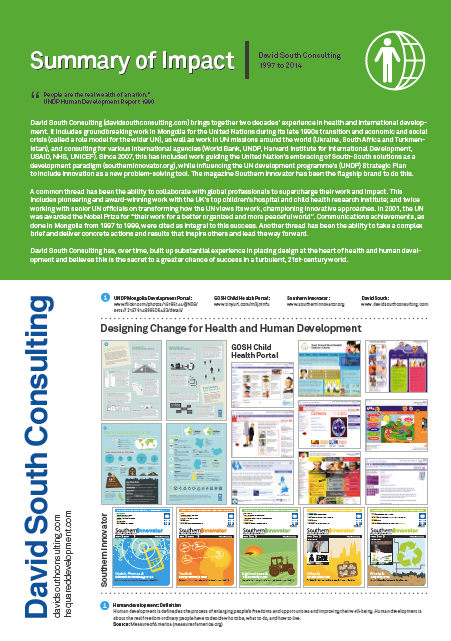
Development Challenges, South-South Solutions was launched as an e-newsletter in 2006 by UNDP’s South-South Cooperation Unit (now the United Nations Office for South-South Cooperation) based in New York, USA. It led on profiling the rise of the global South as an economic powerhouse and was one of the first regular publications to champion the global South’s innovators, entrepreneurs, and pioneers. It tracked the key trends that are now so profoundly reshaping how development is seen and done. This includes the rapid take-up of mobile phones and information technology in the global South (as profiled in the first issue of magazine Southern Innovator), the move to becoming a majority urban world, a growing global innovator culture, and the plethora of solutions being developed in the global South to tackle its problems and improve living conditions and boost human development. The success of the e-newsletter led to the launch of the magazine Southern Innovator.  

Creative Commons License

This work is licensed under a
Creative Commons Attribution-Noncommercial-No Derivative Works 3.0 License.

ORCID iD: https://orcid.org/0000-0001-5311-1052.

© David South Consulting 2023

Categories
Archive Development Challenges, South-South Solutions Newsletters Southern Innovator magazine

Chilean Eco-Buildings Pioneering Construction Methods

By David SouthDevelopment Challenges, South-South Solutions

SOUTH-SOUTH CASE STUDY

Across the global South, the search is on for new ways to build without extracting a high price from local environments.

More and more people are recognizing the advantages of energy-saving methods like prefabrication. Prefab building techniques involve assembling a structure from pre-assembled parts or modules made in a factory, or transporting a completed, factory-made structure to a site (http://en.wikipedia.org/wiki/Prefabricated_building). Pre-fabrication has many advantages, especially now that information technologies bring precision to the building process. Prefabrication means the construction process can be tightly controlled, helping to avoid waste, time delays, weather problems, or any of the other idiosyncrasies of a building site. It can also allow large numbers of dwellings to be built quickly by maximizing skills and efficiencies in an assembly-line model of production.

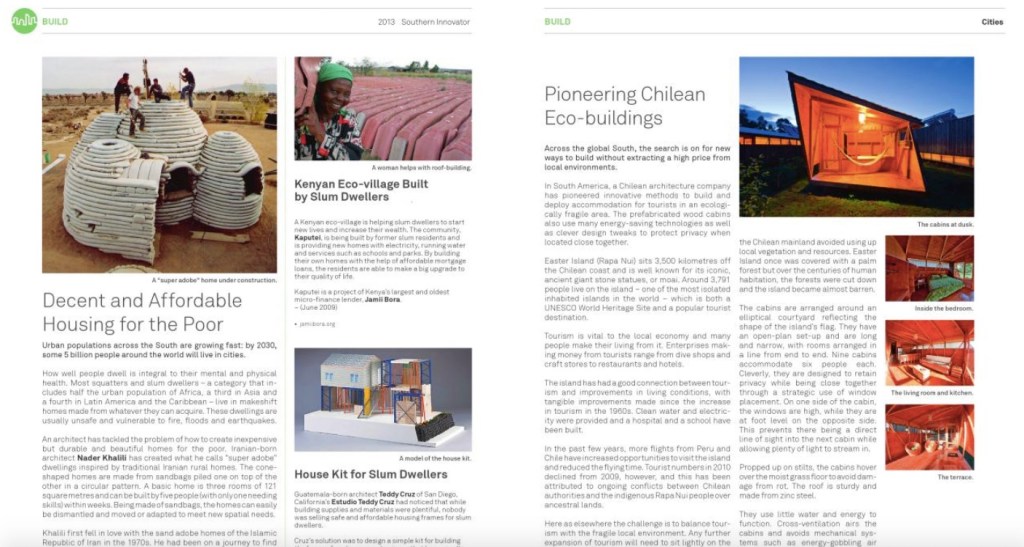
In South America, a Chilean architecture company has pioneered innovative methods to build and deploy accommodation for tourists in an ecologically fragile area. The prefabricated wood cabins also use many emerging saving technologies and clever design tweaks to protect privacy when located close together.

Easter Island (Rapa Nui) (http://en.wikipedia.org/wiki/Easter_Island) sits 3,500 kilometers off the Chilean coast and is well known for its iconic, giant head ancient stone statues, or moai (http://en.wikipedia.org/wiki/Moai). Around 3,791 people live on the island – one of the most isolated inhabited islands in the world – which is both a UNESCO World Heritage Site and a popular tourist destination.

Tourism is vital to the local economy and many people make their living from it. Enterprises making money from tourists range from dive shops and craft stores to restaurants and hotels.

The island has had a good connection between tourism and improvements in living conditions, with tangible improvements made since the increase in tourism in the 1960s. Clean water and electricity were provided and a hospital and a school built.

In the past few years, more flights from Peru and Chile have increased opportunities to visit the island and lowered flight times. The island’s only airport is being expanded to further increase the capacity of flights, a project due to be completed by 2015.

But tourist numbers in 2010 declined from 2009 and this has been attributed to ongoing conflicts between Chilean authorities and the indigenous Rapa Nui people over ancestral lands.

Here as elsewhere, the challenge is to balance tourism with the fragile local environment. Any further expansion of tourism will need to sit lightly on the land and respect the rights of the Rapa Nui people.

The brief for the Morerava eco cabins (http://www.morerava.com/) was to provide environmentally sensitive accommodation that uses few local resources. Built by Santiago-based Chilean architects AATA Associate Architects (http://aata.cl/), the cabins were prefabricated in a factory and shipped to the island during 2010.

The architects specialize in industrial, commercial, educational and institutional, residential and interior design. They pay attention to environmental conditions and the use of resources.

The cabins are arranged around an elliptical courtyard reflecting the shape of the island’s flag design. They have an open-plan set-up and are long and skinny, with rooms arranged in a line from end to end. Nine cabins accommodate six people each. Cleverly, they are designed to retain privacy while being close together. Privacy is maintained through a strategic use of window placement. On one side of the cabin, the windows are high, while they are low at foot level on the opposite side. This prevents there being a direct sight line into the next cabin, while allowing plenty of light to stream in.

Having the cabins built on the Chilean mainland avoided using up local vegetation and resources. Easter Island once was covered with a palm forest. But over the centuries of human habitation, the forests were cut down and the island became almost barren.

Propped up on stilts, the cabins hover over the moist grass floor to avoid damage from rot. The roof is sturdy and made from zinc steel.

They use little water and energy to function. Cross-ventilation airs the cabins and avoids mechanical systems like energy-gobbling air conditioners. Electricity on the island is generated from expensive petrol, so any means to avoid using it means a big savings.

With a mild climate, the cabins do not need insulation.

Water is captured from rainfall on the roof and is then drained into a storage tank below the cabins (http://en.wikipedia.org/wiki/Rainwater_harvesting), and hot water is provided by solar heaters placed on the rooftops. This system circulates the hot water without electricity by using a technology called thermosiphon (http://en.wikipedia.org/wiki/Thermosiphon) which exploits the natural phenomenon of heated water being less dense and rising while cooler water flows downward through the force of gravity.

At the other end of the construction spectrum, one of the most notoriously energy-wasting of structures – an office building – has been given a green makeover. Another Chilean pioneer in green architecture is the Santiago headquarters of Empresas Transoceanica (http://www.transoceanica.cl/), a private investment company in real estate, hotels and tourism, agro-industry and logistics. Its new campus HQ – part park, part office building – maximizes light through the building’s long and bulbous shape.

Designed to reduce energy demand while improving work spaces, it favours natural light while avoiding excess heat build up through wooden slats outside the building.

Geothermal energy comes from a well 75 metres below ground. This provides water cooled at 12 degrees Celsius, to cool the building. The building has been built following the strict environmental guidelines laid down in the LEED guidelines (Leadership in Energy & Environmental Design (LEED) – an internationally recognized green building certification system (http://en.wikipedia.org/wiki/Leadership_in_Energy_and_Environmental_Design).

Extensive planning and design work went into making sure the building’s structure, orientation, lighting, insulation and landscaping reduced energy use and need for energy-intensive mechanical solutions. Skylights bring natural light into the building’s public spaces. There are three stories above ground and two stories below providing underground parking.

The landscaped park around the building is actually the roof for the underground parking garage. The whole edifice creates a seamless connection between the building and the greenery and water features surrounding it.

Published: February 2011

Resources

1) Series of photographs and architectural renderings of the Transoceanica headquarters. Website: http://www.plataformaarquitectura.cl/2010/10/28/edificio-transoceanica-arquitectos-2/

2) World Hands Project: An NGO specialising in simple building techniques for the poor. Website: www.worldhandsproject.org

3)  Builders Without Borders: Is an international network of ecological builders who advocate the use of straw, earth and other local, affordable materials in construction. Website: http://builderswithoutborders.org/

4) An inspiring collection of prefabrication buildings and the techniques used to make them. Website: http://inhabitat.com/architecture/prefab-housing/

5)  Tiny House Design Blog: The blog is full of ideas and plans for making small homes cheaply. Website: http://www.tinyhousedesign.com/

6)  Building and Social Housing Foundation: The Building and Social Housing Foundation (BSHF) is an independent research organisation that promotes sustainable development and innovation in housing through collaborative research and knowledge transfer. Website: http://www.bshf.org/

Development Challenges, South-South Solutions was launched as an e-newsletter in 2006 by UNDP’s South-South Cooperation Unit (now the United Nations Office for South-South Cooperation) based in New York, USA. It led on profiling the rise of the global South as an economic powerhouse and was one of the first regular publications to champion the global South’s innovators, entrepreneurs, and pioneers. It tracked the key trends that are now so profoundly reshaping how development is seen and done. This includes the rapid take-up of mobile phones and information technology in the global South (as profiled in the first issue of magazine Southern Innovator), the move to becoming a majority urban world, a growing global innovator culture, and the plethora of solutions being developed in the global South to tackle its problems and improve living conditions and boost human development. The success of the e-newsletter led to the launch of the magazine Southern Innovator.  

Creative Commons License

This work is licensed under a
Creative Commons Attribution-Noncommercial-No Derivative Works 3.0 License.

ORCID iD: https://orcid.org/0000-0001-5311-1052.

© David South Consulting 2023

Categories
Archive Southern Innovator magazine

Press Release 2 | Southern Innovator

Press Release for General Distribution

Fourth Issue of UNDP Magazine Southern Innovator Launches at Expo

United Nations, Nairobi, Kenya, 31 October 2013

  • Fourth issue of Southern Innovator launched at Global South-South Development Expo 2013 in Nairobi, Kenya
  • 60-page color magazine gives snapshot of fast-changing world

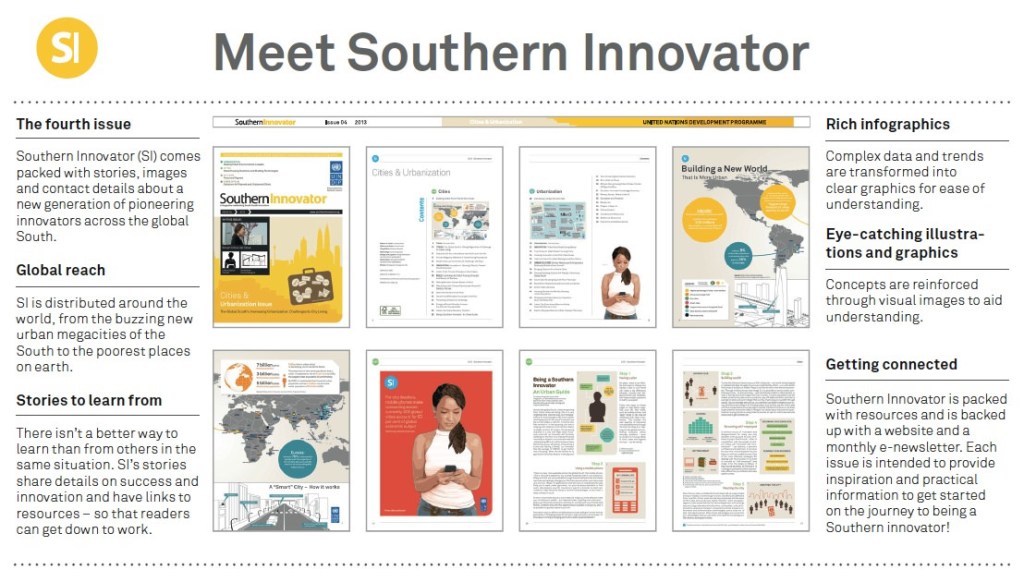
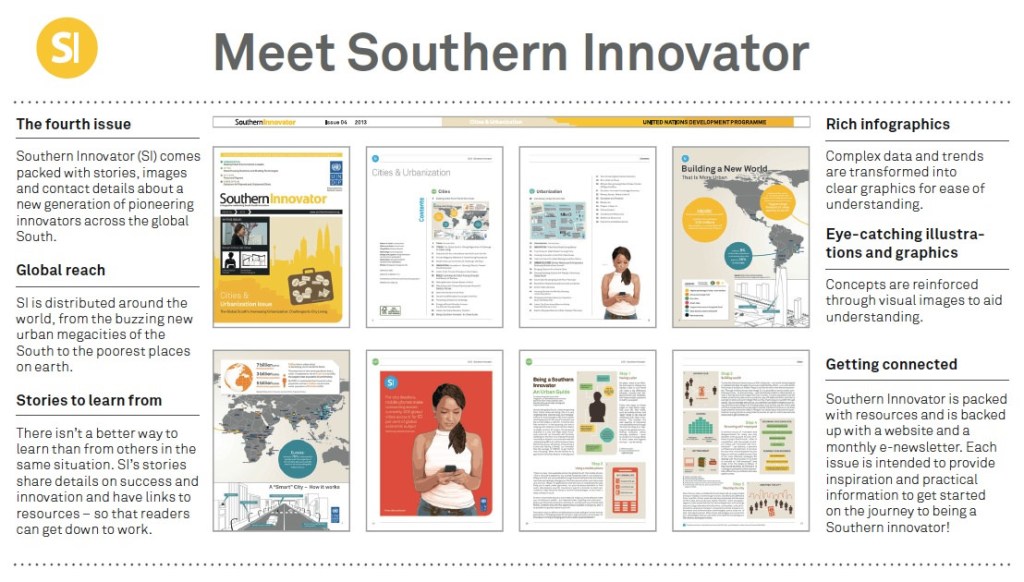
The fourth issue of Southern Innovator magazine has launched at the Global South-South Development Expo 2013 in Nairobi, Kenya. Southern Innovator Issue 4 visits the new cities being built to tackle the challenges of a rapidly urbanizing 21st-century world. The magazine also highlights some of the solutions being devised to the challenges people face as the world becomes a majority urban place.

Some innovators are building new cities from scratch, applying the latest thinking and hard-wiring in cutting-edge information technologies and innovative environmental measures to create ‘smart’ cities and eco-cities. Architects are designing and refining homes that are beautiful and functional, easy to build, affordable and conserve energy. Social entrepreneurs are innovating ways to create liveable and socially inclusive urban areas, often in places where planning has been scant and where incomes are very low. All those featured in the magazine were chosen for their focus on improving human development and their ingenuity and fresh thinking.

Southern Innovator champions a 21st-century global innovator culture. The magazine profiles and celebrates the innovators across the global South finding new ways to tackle poverty, create wealth and improve human development and achieve the Millennium Development Goals (MDGs). In its first issue in September 2011, Southern Innovator featured the people who are re-shaping new information technologies – from mobile phone apps to Internet technologies. Many of the innovators profiled in that first issue came from Kenya.

SI (southerninnovator.org) is based on intensive research and produced by the United Nations Office for South-South Cooperation in UNDP (UNOSSC) (formerly the Special Unit for South-South Cooperation in UNDP). UNOSSC organizes an annual Global South-South Development Expo (southsouthexpo.org), a roaming celebration and gathering of Southern innovators previously held in New York, Washington, D.C., Geneva, Rome and Vienna. This year’s Expo is being held in Nairobi, Kenya (28 October to 1 November 2013) and is hosted by the UN Environment Programme (unep.org).

SI is being distributed through the United Nations’ network and partners and reaches some of the world’s poorest and remotest places, as well as the vibrant but stressed growing global megacities. It is hoped the magazine will inspire budding innovators with its mix of stories, essential information, facts and figures, images and graphics.

We hope you enjoy the magazine and find its content interesting and illuminating: a snapshot of a fast-changing world awash, as we found out, with
innovators, creators and do-ers making their world a better place. It is possible to sponsor issues of the magazine, either through helping to fund its print run, or through sponsored inserts covering that issue’s theme with relevant content for our readers.

For more information on Southern Innovator, contact Cosmas Gitta at
cosmas.gitta@undp.org.

Press Release 1

Press Release 3

Online archives: southerninnovator.orghttp://www.scribd.com/SouthernInnovator. Follow @SouthSouth1

United Nations General Assembly: Sixty-ninth session, Item 24 (b) of the provisional agenda, Operational activities for development: South-South cooperation for development, 17 July 2014.
The research informing Southern Innovator Magazine played a part in the formulation of the UN’s post-2015 development agenda, including the Sustainable Development Goals (SDGs).

https://davidsouthconsulting.org/southern-innovator-scale-up-fundraiser/

ORCID iD: https://orcid.org/0000-0001-5311-1052.

© David South Consulting 2022

Categories
Archive Development Challenges, South-South Solutions Newsletters

2014: Development Challenges, South-South Solutions

By David SouthDevelopment Challenges, South-South Solutions

SOUTH-SOUTH CASE STUDY 

ISSN 2227-3905

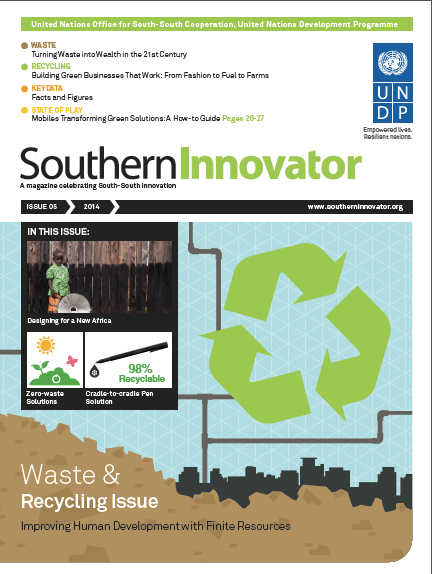
The fifth issue of Southern Innovator has launched online and in print. Order copies now for distribution. Email: southerninnovator@yahoo.co.uk.

Issue six will be on science, technology and innovation. This issue will be different from previous issues and will be including supplements and inserts to boost the impact of the magazine. Southern Innovator is seeking sponsors to fund this and also to help us expand the print run (currently 5,000 copies for global distribution).

July

3D Home Printing Landmark: 10 Houses in a Day Development Challenges: The global South is experiencing urban growth on a scale unprecedented in human history, far outstripping the great urbanization wave that swept across Europe and North America during the 19th and 20th centuries.

Old Boats Become New Furniture in Senegal Development Challenges: Every country has its fair share of waste and the remnants of past economic activity. Old cars nobody wants, discarded tins of food, old plastic bags, spare copper wire, cast-off clothing – all can have a new life in the right hands.

Innovative Solutions Celebrated in Ashden Awards Development Challenges: The world’s population is heading towards 9.6 billion by 2050 (UN). Combined with a growing middle class and rising living standards across the global South, that means ever-greater demand on the world’s finite resources. This raises a crucial question: Where will the energy to power rising living standards come from, and how much damage will be done to the planet’s environment by pollution created generating it (https://www.un.org/en/development/desa/news/population/un-report-world-population-projected-to-reach-9-6-billion-by-2050.html)?

Innovative Ways to Collect Water from Air Development Challenges: World water resources are being depleted quickly as populations grow, urbanize and demand better living standards. Many scientists believe we are reaching peak water – the point at which fresh water is consumed faster than it is replenished.

June

Caribbean Island St. Kitts Goes Green for Tourism Development Challenges: Going green may sound like the right thing to do but it can also be associated with being a costly burden and boring. But, as one island nation is proving, being green is a great selling point for attracting tourists and investors – especially in a world where many places are grappling with pollution and resource depletion.

Big Data Can Transform the Global South’s Growing Cities Development Challenges: The coming years will see a major new force dominating development: Big Data. The term refers to the vast quantities of digital data being generated as a result of the proliferation of mobile phones, the Internet and social media across the global South – a so-called ‘data deluge’ (UN Global Pulse). It is an historically unprecedented surge in data, much of it coming from some of the poorest places on the planet and being gathered in real time.

Indian Business Model Makes Green Energy Affordable Development Challenges: The technology already exists to provide renewable energy and electricity to all the world’s poor. The trick is finding a way to pay for it and to make it sustainable. Many innovators are experimenting with business models to reach the so-called Bottom of the Pyramid (BOP) cohort, and the 1.2 billion poorest people in the world who do not have access to electricity (World Bank) (http://tinyurl.com/n9p3f5x). A further 2.8 billion have to rely on wood or other biomass materials to cook and heat their homes.

South-South Trade Helping Countries During Economic Crisis Development Challenges: Weathering the global economic crisis is testing the stability of countries across the global South. But many countries are finding South-South trade and catering to their domestic middle classes can lift incomes and maintain growth rates despite the global turmoil.

May

3D Printing Gives Boy a New Arm in Sudan Development Challenges: 3D printing is rapidly going mainstream and is now starting to make a big impact in health care. One innovative solution is using the technology to manufacture artificial arms for amputees harmed by war in Africa.

African Hotel Boom Bringing in New Investment and Creating Jobs Development Challenges: Africa is experiencing a boom not seen for decades. The IMF forecasts economic growth in sub-Saharan Africa of 6 per cent in 2014, compared to global growth of 3.6 per cent.

China’s Outsourced Airliner Development Model Development Challenges: Many emerging-market countries in the global South have built up substantial foreign currency reserves. Much of this has been a response to past foreign currency crises, particularly the Asian Crisis in the late 1990s (http://en.wikipedia.org/wiki/1997_Asian_financial_crisis).

Brazilian Design for New Urban, Middle-Class World Development Challenges: Countries across the global South are experiencing rapid urbanization as people move to cities for better economic opportunities — and this massive social change is creating new business opportunities. Those who recognize how fundamentally people’s lifestyles are changing will be those who will benefit from this big shift in populations.

April

Cheap Paper Microscope to Boost Fight Against Diseases Development Challenges: To tackle diseases in the developing world, the most important first step is diagnosis. Without effective diagnosis, it is difficult to go to the next steps of either treatment or cure. While much attention is given to the high costs involved in treating and curing ailments, screening for diagnosis is also expensive, especially if it involves lots of people. Anything that can reduce the cost of diagnosis will free up resources to expand the number of people who can be checked, and help eradicate contagious diseases.

Asian Factories Starting to go Green Development Challenges: Media headlines have recently highlighted the growing air pollution crisis in Asia’s expanding cities. This is caused by a mix of factors – the growing number of vehicles, coal-powered factories, people burning dirty fuels to heat their homes, and poor enforcement of standards – and has severe consequences for human health. If it’s not tackled, more and more countries will see large rises in respiratory problems, cancers and early deaths from pollution-caused illnesses (http://www.nrdc.org/air/).

Reality Television Teaches Business Skills in Sudan Development Challenges: Learning how to thrive in a market economy does not necessarily come naturally. But for young people who have grown up under a different economic system or known nothing but economic chaos, learning business skills can give them the tools to get on in life.

Popular Chinese Social Media Chase New Markets Development Challenges: China has a vast and growing market for the Internet and mobile devices. Over the past decade that market has been largely confined to China –  most businesses have had enough domestic demand and opportunities inside the country to keep them busy.

The BRCK: Kenyan-Developed Solution to Boost Internet Access Development Challenges: Using the Internet in Africa has its challenges, as anyone who has worked there knows. Issues can include weak Wi-Fi signals, slow Internet service providers, electricity outages and power surges that can damage or destroy sensitive electronic devices.

March

Women Empowered by Fair Trade Manufacturer Development Challenges: There is sometimes a great deal of negativity surrounding the issue of manufacturing in Africa. Some claim the risks of doing business are too high or that the workers are not motivated enough. But one garment manufacturer is out to prove the skeptics wrong. It pays decent wages and gives its mostly female workforce a stake in the business in a bid to drive motivation and make it worthwhile to work hard.

Global South Trade Boosted with Increasing China-Africa Trade in 2013 Development Challenges: It was announced in January 2014 that China has surpassed the United States to become the world’s number one trading nation, as measured by the total value of exports and imports. This new economic behemoth also continued to grow its trade relationships with Africa.

India 2.0: Can the Country Make the Move to the Next Level? Development Challenges: With the global economic crisis threatening to cause turmoil in the emerging markets of the global South, it is becoming clear that what worked for the past two decades may not work for the next two.

“Pocket-Friendly” Solution to Help Farmers Go Organic Development Challenges: Interest in organic food and farming is high, and organics have become a growing global industry. The worldwide market for organic food grew by more than 25 per cent between 2008 and 2011, to US $63 billion, according to pro-organic group the Soil Association. That is an impressive accomplishment given the backdrop of the global economic crisis, and evidence that people value quality food, even in tough times.

Cheap Farming Kit Hopes to Help More Become Farmers Development Challenges: Food security is key to economic growth and human development. A secure and affordable food supply means people can meet their nutrition needs and direct their resources to improving other aspects of their lives, such as housing, clothing, health services or education.

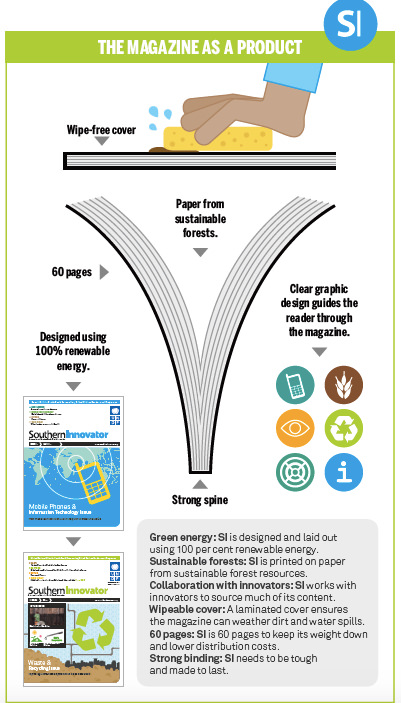
While Southern Innovator’s digital presence has been key to its success and global reach, the hard copy of the magazine was designed with special features. The magazine needed to be robust and able to stand a fair bit of abuse and hard wear. It needed to be easy to read in low light conditions. And it needed to look sharp and eye-catching to reach as wide an audience as possible.

Back Issues

Development Challenges, South-South Solutions Newsletter | 2011-2014

Development Challenges, South-South Solutions Newsletter | 2007-2010

2013

2012

2011

2010

2009

2008

2007

ISSN Portal.
South-South cooperation for development, SSC/17/3, High-level Committee on South-South Cooperation, 12 April 2012.

Development Challenges, South-South Solutions was launched as an e-newsletter in 2006 by UNDP’s South-South Cooperation Unit (now the United Nations Office for South-South Cooperation) based in New York, USA. It led on profiling the rise of the global South as an economic powerhouse and was one of the first regular publications to champion the global South’s innovators, entrepreneurs, and pioneers. It tracked the key trends that are now so profoundly reshaping how development is seen and done. This includes the rapid take-up of mobile phones and information technology in the global South (as profiled in the first issue of magazine Southern Innovator), the move to becoming a majority urban world, a growing global innovator culture, and the plethora of solutions being developed in the global South to tackle its problems and improve living conditions and boost human development. The success of the e-newsletter led to the launch of the magazine Southern Innovator.

Creative Commons License

This work is licensed under a
Creative Commons Attribution-Noncommercial-No Derivative Works 3.0 License.

ORCID iD: https://orcid.org/0000-0001-5311-1052.

© David South Consulting 2022