Tag: Issue 3

  • Small-scale Farmers Can Fight Malaria Battle

    Small-scale Farmers Can Fight Malaria Battle

    By David SouthDevelopment Challenges, South-South Solutions

    SOUTH-SOUTH CASE STUDY

    Malaria is one of Africa’s biggest killers. Each year globally 300 to 500 million people are infected, and around 1 million die from the disease (theglobalfund). Ninety percent of malaria deaths occur in sub-Saharan Africa – mostly to children under the age of five. The disease costs African countries US$12 billion a year in lost gross domestic product.

    Malaria is a parasitic disease – the parasite plasmodium – transmitted by mosquito bites. Symptoms include fever, headache and vomiting. Internal bleeding, kidney and liver failure may follow and can result in coma and death.

    The most common and effective treatment, recommended by the World Health Organization, is artemisinin-based combination therapies, known as ACTs. ACTs have low toxicity, few side effects and act rapidly against the parasite. Research shows that artemisinin remedies cure 90 percent of patients within three days.

    But there are far fewer doses available than people who need them. WHO has claimed the quantity made available by pharmaceutical companies falls far short of the more than 130 million doses required to combat malaria throughout the world.

    And ACTs are very expensive to deliver: in just one country, Tanzania, providing such therapy for three years would cost US $48.3 million. Every year, this would account for 9.5 percent of Tanzania’s health budget, and 28.7 percent of yearly spending on medical supplies: a six-fold increase in budget for malaria treatment (Malaria Journal 2008, 7:4).

    But a cheap alternative to the expensive pill form of the treatment is being piloted across Africa. It involves the drinking of a tea made from the bushes of the artemisia plant. Artemisia annua is an annual shrub and the active ingredient in the pills (artemisinin). It is native to China and Vietnam and has been used for 2,000 years to treat fevers.

    Bushes cultivated by farmers in Kenya, Malawi, Tanzania, Zambia, Zimbabwe and Mozambique under the supervision of the World Agroforestry Centre in Nairobi, Kenya, are helping to bring down malaria rates without the long wait for the pills to arrive.

    The leaves are boiled and made into a tea. Drinking the tea gives a high enough dose of artemisinin in the blood to cure malaria. Helen Meyer, a nurse operating nine mobile health clinics in rural Mozambique, is using the bitter tea made from the dried leaves. Even in treating drug resistant malaria, she has found the artemisia tea effective: “If you drink the tea, you feel better after the first day. Other medicines take a few days.”

    A special hybrid of artemisia, A-3, is used because it is adapted for warmer climates. The wild variety grows to only five centimetres in the tropics, but A-3 grows to three metres and packs 20 times more artemisinin. It is also highly economical: thousands of plants can come from a single stem.

    The daily adult dose of anti-malaria tea just needs five grams of dried A-3 leaves in one litre of water. The tea is drunk every six hours for seven days. Each plant produces 200 grams of dried leaves, and a thousand shrubs can cure 5,700 people. Since it is a cheap cure, money can be spent instead on other things. Farmers are also able to supplement their income by growing the bushes. And the dried leaves have long-lasting power: even after three years the leaves retain close to a 100 percent of their artemisinin.

    Access to authentic artemisinin is critical: it is estimated 16 percent of malaria medicines in Kenya are counterfeit. Elsewhere, the proliferation of counterfeit anti-malarials substantially raises the risk of the emergence of resistance to artemesinin combination therapy, the last truly effective treatment against malaria. Past misuse of other malaria drugs, such as chloroquine in the 1980s and sulphadoxine/pyrimethamine in the 1990s, resulted in the malaria parasite becoming resistant. Hundreds of thousands of people in malaria-prone areas may have died as a result.

    The World Agroforestry Centre, recognizing potential problems with artemesinin monotherapies, is working to combine it with indigenous herbal remedies made from other anti-malarial trees, producing a herbal combination therapy (HCT).

    “I used to grow fruits and beans here,” said Charles Kiruthi, a Kenyan farmer, to the IRIN news service. “but I will get a better return from this plant. No pests attack it, and until harvesting time it requires very little labour.”

    “I expect to get a good return, and I am also very happy to be helping fight malaria,” continued Kiruthi. “I recently lost two friends to the disease, and my child gets sick with malaria sometimes.”

    Published: July 2008

    Resources

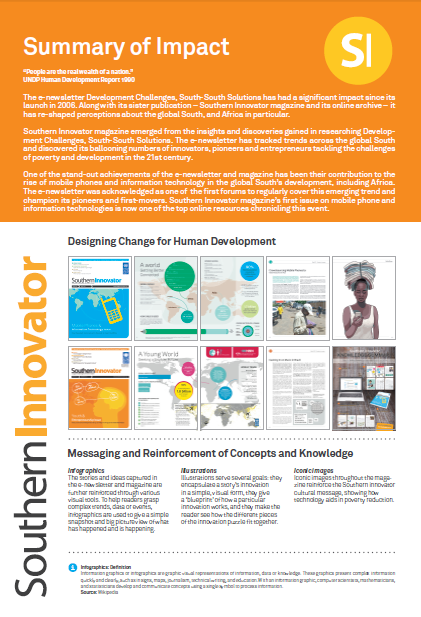
    Development Challenges, South-South Solutions was launched as an e-newsletter in 2006 by UNDP’s South-South Cooperation Unit (now the United Nations Office for South-South Cooperation) based in New York, USA. It led on profiling the rise of the global South as an economic powerhouse and was one of the first regular publications to champion the global South’s innovators, entrepreneurs, and pioneers. It tracked the key trends that are now so profoundly reshaping how development is seen and done. This includes the rapid take-up of mobile phones and information technology in the global South (as profiled in the first issue of magazine Southern Innovator), the move to becoming a majority urban world, a growing global innovator culture, and the plethora of solutions being developed in the global South to tackle its problems and improve living conditions and boost human development. The success of the e-newsletter led to the launch of the magazine Southern Innovator. 

    Creative Commons License

    This work is licensed under a
    Creative Commons Attribution-Noncommercial-No Derivative Works 3.0 License.

    ORCID iD: https://orcid.org/0000-0001-5311-1052.

    © David South Consulting 2023

  • Rwandan Coffee Brand Boost

    Rwandan Coffee Brand Boost

    By David SouthDevelopment Challenges, South-South Solutions

    SOUTH-SOUTH CASE STUDY

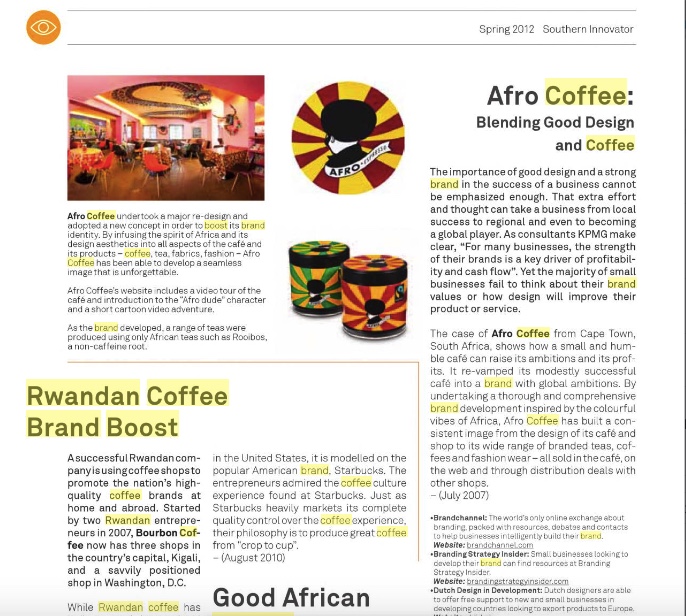
    A successful Rwandan company is using coffee shops to promote the nation’s high-quality coffee brands at home and abroad. Started by two Rwandan entrepreneurs three years ago, Bourbon Coffee (http://www.bourboncoffeeusa.com) now has three shops in the country’s capital, Kigali, and a savvily positioned shop in Washington DC.

    While Rwandan coffee has built a good international reputation, the country’s more than 500,000 coffee farmers (mostly small-scale) previously depended on the product’s reputation alone. But Bourbon Coffee joins several other initiatives changing this situation and starting to significantly raise the profile of Rwandan coffee and build the Rwanda brand.

    The East African nation experienced the horrific genocide of almost 1 million people in 1994. Ever since, the country has been on a journey to reconcile with the damage done during this time and move on to a more prosperous future for all its citizens. A key part of the country’s future success will be its economic prosperity. And historically, coffee has played a critical role in Rwanda’s economy.

    The Bourbon Coffee chain of shops (taking its name from the high quality Bourbon coffee varietal (http://en.wikipedia.org/wiki/List_of_coffee_varieties) which accounts for the majority of Rwandan coffee), started with its first shop in Kigali in 2007. Started by Emmanuel Murekezi and Arthur Karuletwa, two Rwandans living in the United States, it is modelled on the popular American brand Starbucks (http://www.starbucks.com). The entrepreneurs admired the coffee culture experience found at Starbucks. Just as Starbucks heavily markets its complete quality control over the coffee experience, their philosophy is to produce great coffee from “crop to cup.”

    “There are over 500,000 farmers that own 100 to 200 trees in the back of their yards, so the only way they can come up with a product is to come together in a cooperative sense,” Karuletwa told the Washington Post. It is a learning experience for the Rwandan coffee farmers: they learn to work together, trust each other and be accountable to each other. “Neighbours that once killed each other and communities that once floated in the same bloodbath are now hand in hand producing one of the most amazing products.”

    “If done right, it could be the platform to re-brand the country,” continued Karuletwa, a former chief executive and now a shareholder in the company. Coffee can “create awareness that there’s recovery, there’s trade, there’s investment opportunities, there’s tourism. There’s life after death.”

    The importance of good design and a strong brand in the success of a business cannot be emphasised enough. That extra effort and thought can take a business from local success to regional and even global success. As consultants KPMG make clear, “For many businesses, the strength of their brands is a key driver of profitability and cash flow.” Yet the majority of small businesses fail to think about their brand values or how design will improve their product or service.

    The shops have a very tasteful modern, African design and feel. African sculpture and furniture are surrounded by African artwork. The shop’s logo is an eye-catching orange and there is an overall recognizable brand identity for the entire Bourbon Coffee concept.

    The founders see it as an opportunity to educate people about the health benefits of coffee culture and the joys of the lifestyle. They proudly serve only Rwandan coffee and promote the national brands they serve, including Akagera, Kivu Lake, Kizi Rift, Muhazi and Virunga.

    Bourbon Coffee, in a clever move, opened the Washington branch in 2009 in a former Starbucks in a neighbourhood packed with aid organizations and NGOs, many of which work with Rwanda on projects.

    Karuletwa says Bourbon Coffee’s ambitious vision “is to stand as a symbol of a new era in African economic development, one in which African nations rise to participate directly in the global marketplace.”

    “Coffee is a very intimate, emotional product,” he said. “The preparation, the processes and the profiling of coffee is similar to wine.”

    The Rwandan branches can be found at the Union Trade Centre (UTC) in Kigali’s city centre, the MTN centre in Nyarutarama and Kigali airport.

    The business is funded by Rwandan investors Tristar (http://www.tri-starinvestments.com/index.html).

    Another initiative is the Rwandan Farmers Brand (http://www.rwandanfarmers.com). It also hopes to raise the profile of Rwandan coffee and drive more of the profits made into the hands of farmers. It is a joint venture between the foundations of former U.S. President Clinton and philanthropist Sir Tom Hunter. They fund all the brand’s creation and operation in partnership with 8,700 farmers. They have started selling Rwanda Medium Roast Ground in the United Kingdom’s Sainsbury’s supermarkets. Sixteen percent of sales are clear profit and returned to the farmers via their own Trust Fund.

    Karuletwa says he doesn’t want Rwandan coffee to be “a pity-driven mission”. It is all about the quality: “The value initiative here is because this coffee tastes great,” he says.

    And Bourbon Coffee is looking further afield to grow the brand: “We hope to expand even further,” Murekezi told Monocle magazine. “Congo, Burundi, Tanzania, but also Europe. We think the concept can work there too.”

    Published: August 2010

    Resources

    • East African Fine Coffees Association: All the latest news on events and initiatives for East Africa’s coffee producers. Website: http://www.eafca.org/
    • Brandchannel: The world’s only online exchange about branding, packed with resources, debates and contacts to help businesses intelligently build their brand. Website: www.brandchannel.com
    • Small businesses looking to develop their brand can find plenty of free advice and resources here. Website: www.brandingstrategyinsider.com
    • The red dot logo stands for belonging to the best in design and business. The red dot is an internationally recognized quality label for excellent design that is aimed at all those who would like to improve their business activities with the help of design. Website: http://www.red-dot.de
    • Dutch Design in Development: The Dutch NGO works with producers to develop skills and adapt producers’ products to present and future demands in Europe. By following this approach, Southern producers can reduce the risk of making products nobody wants, or that lack originality in the marketplace and thus won’t sell. Website: http://www.ddid.nl/english/index.html

    https://davidsouthconsulting.org/2021/03/12/afro-coffee-blending-good-design-and-coffee/

    https://davidsouthconsulting.org/2022/09/29/the-battle-for-indias-coffee-drinkers-in-buzzing-economy/

    https://davidsouthconsulting.org/2021/10/03/civet-cat-coffee-brews-filipino-opportunity/

    https://davidsouthconsulting.org/2021/01/08/haitian-coffee-becoming-a-hit-with-american-connoisseurs/

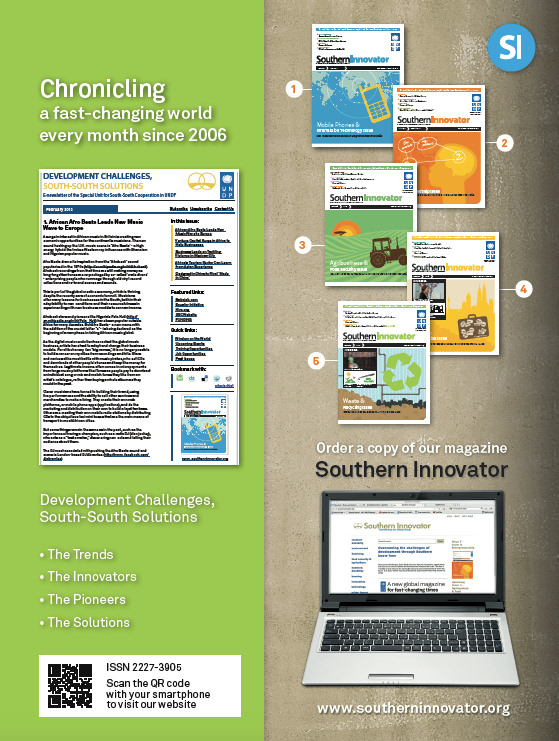
    Development Challenges, South-South Solutions was launched as an e-newsletter in 2006 by UNDP’s South-South Cooperation Unit (now the United Nations Office for South-South Cooperation) based in New York, USA. It led on profiling the rise of the global South as an economic powerhouse and was one of the first regular publications to champion the global South’s innovators, entrepreneurs, and pioneers. It tracked the key trends that are now so profoundly reshaping how development is seen and done. This includes the rapid take-up of mobile phones and information technology in the global South (as profiled in the first issue of magazine Southern Innovator), the move to becoming a majority urban world, a growing global innovator culture, and the plethora of solutions being developed in the global South to tackle its problems and improve living conditions and boost human development. The success of the e-newsletter led to the launch of the magazine Southern Innovator. 
    https://davidsouthconsulting.org/2021/03/05/southern-innovator-issue-2/

    Creative Commons License

    This work is licensed under a
    Creative Commons Attribution-Noncommercial-No Derivative Works 3.0 License.

    ORCID iD: https://orcid.org/0000-0001-5311-1052.

    © David South Consulting 2022

  • US $1 Trillion Opportunity for Africa’s Agribusinesses Says Report

    US $1 Trillion Opportunity for Africa’s Agribusinesses Says Report

    By David SouthDevelopment Challenges, South-South Solutions

    SOUTH-SOUTH CASE STUDY

    As the world’s population continues to grow – surpassing 9 billion people by 2050, the United Nations estimates – and more and more people move to urban areas, producing enough food to feed this population will be one of the biggest economic challenges and opportunities in the global South.

    Africa, a continent undergoing significant economic change, has yet to fully realize its potential as a producer of agricultural products to feed itself and the world. Africa currently has a labour-intensive but very inefficient agriculture system. While many Africans either make their living in agriculture or engage in subsistence farming for survival, much of the continent’s farming is inefficient and fails to make the most of the continent’s rich resources and potential.

    A new World Bank report, Growing Africa: Unlocking the Potential of Agribusiness (http://siteresources.worldbank.org/INTAFRICA/Resources/africa-agribusiness-report-2013.pdf), argues that Africa could have a trillion-dollar agriculture market by 2030.

    What will need to change to make this happen? African farms will need greater access to capital, as well as more investment in infrastructure and better irrigation. All of these elements will need to dramatically improve if Africa is going to compete effectively in global markets.

    The report urges greater cooperation between governments and agribusinesses, farmers and consumers and for all parties to recognize that the continent is being rapidly urbanized, changing the way food is grown, sourced and distributed.

    It says Africa’s farmers and agribusinesses require more capital, steady supplies of electricity, better technology and irrigated land. All these resources then need to be applied to the growing of high-value, nutritious foods.

    At present, agriculture, farmers and agribusinesses make up almost 50 per cent of Africa’s economic activity, and the continent’s food system is worth an estimated US $313 billion a year (World Bank). But the report believes this could triple if governments and business leaders adopted radically different policies.

    “The time has come for making African agriculture and agribusiness a catalyst for ending poverty,” said Makhtar Diop, the World Bank Vice President for Africa. “We cannot overstate the importance of agriculture to Africa’s determination to maintain and boost its high growth rates, create more jobs, significantly reduce poverty, and grow enough cheap, nutritious food to feed its families, export its surplus crops, while safeguarding the continent’s environment.”

    The report addresses the problems African agriculture is currently experiencing: slow yield growth for major food crops, slowing research spending, degraded land, water scarcity, and climate change. It looks at solutions to allow Africa to tackle these problems and seize the opportunity to significantly increase its food and agricultural exports.  Africa can more than meet its own needs and meet the world’s needs too, the report argues.

    But what can be done? At present, 50 per cent of the world’s uncultivated land suitable for growing food resides in Africa. This works out to 450 million hectares of land that is neither forested, protected nor densely populated – all could be available for growing food.

    The report also found Africa is using just 2 per cent of its renewable water resources while the rest of the world averages 5 per cent. African harvests currently do not yield anything close to what is possible. Another weakness is waste from post-harvest losses, averaging 15 to 20 per cent for cereals, and even more for perishable foods, because of poor storage and farm infrastructure.

    Areas the report recommends farmers and agribusinesses should focus on include fast-growing markets for rice, maize, soybeans, sugar, palm oil, biofuel and feedstock. In sub-Saharan Africa, the focus should be on rice, feed grains, poultry, dairy, vegetable oils, horticulture and processed foods for the domestic market. And there are also good examples to follow by studying the ways Latin America and Southeast Asia used world markets to boost income and profits.

    Agribusiness enterprises looking to purchase more land to expand the number of hectares under cultivation are urged to act ethically and not to threaten existing people’s livelihoods or violate local users’ rights. This includes consulting with locals and paying fair market price for land bought.

    Rice is one crop that needs attention. Significant quantities of rice are imported and consumed in Africa. Half the rice eaten is imported, costing around US $3.5 billion a year (World Bank). Big importers include Ghana and Senegal – both countries singled out in the report for needing to improve their domestic rice production and quality.

    Another food staple needing attention is maize (corn). A daily food staple for many Africans, it takes up 14 per cent of crop lands on the continent. While most Zambians get half their calories from maize, Zambia is currently unable to export maize at a cost comparable to market leader Thailand – Zambian maize costs one-third more. Zambia was singled out as needing to raise yields, reduce costs, and remove disincentives for the private sector in markets and trade.

    “Improving Africa’s agriculture and agribusiness sectors means higher incomes and more jobs. It also allows Africa to compete globally. Today, Brazil, Indonesia and Thailand each export more food products than all of sub-Saharan Africa combined.  This must change,” said Jamal Saghir, the World Bank’s Director for Sustainable Development in the Africa Region.

    How to make the most of this opportunity?

    One innovative idea coming out of Africa comes from the mega-brewer SABMiller (sabmiller.com). As a sign of confidence in the continent’s growing economies, the brewer has pledged to slash its beer prices and use more African-grown grains – a boost to local farmers – and to start a campaign of opening new breweries for the next three years. Countries targeted include Ghana, Nigeria, Mozambique and Zambia.

    “African farmers and businesses must be empowered through good policies, increased public and private investments and strong public-private partnerships,” according to Gaiv Tata, World Bank director for Financial and Private Sector Development in Africa.  “A strong agribusiness sector is vital for Africa’s economic future.”

    Published: May 2013

    Resources

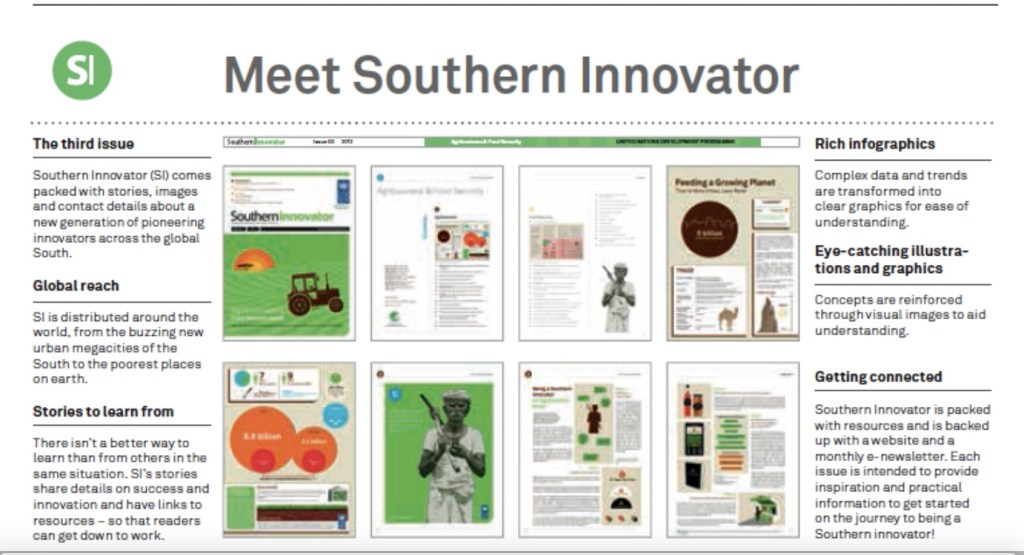
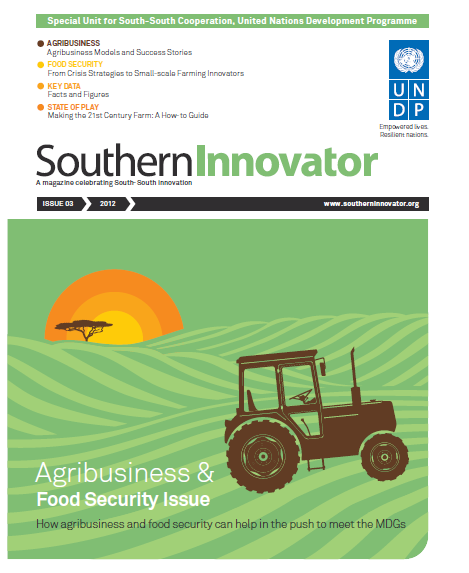
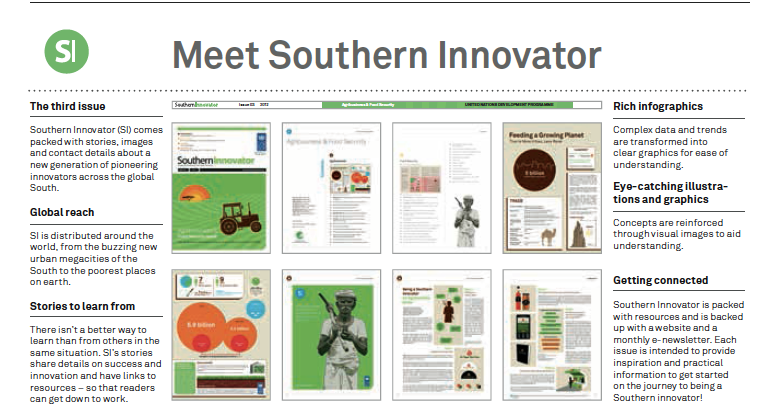
    1) Southern Innovator Magazine Issue 3: Agribusiness and Food Security: Southern Innovator’s third issue finds innovators transforming agribusiness and boosting food security. Website: http://www.scribd.com/doc/106055665/Southern-Innovator-Magazine-Issue-3-Agribusiness-and-Food-Security

    2) The New Harvest: Agricultural Innovation in Africa by Calestous Juma. Website: http://belfercenter.ksg.harvard.edu/publication/20504/new_harvest.html

    3) Growing Africa: Unlocking the Potential of Agribusiness. Website: http://siteresources.worldbank.org/INTAFRICA/Resources/africa-agribusiness-report-2013.pdf

    4) Edible Insects: future prospects for food and feed security, Publisher: FAO. Website: http://www.un.org/apps/news/story.asp?NewsID=44886

    5) Six-legged livestock: edible insect farming, collecting and marketing in Thailand, Publisher: FAO. Website: http://www.fao.org/asiapacific/rap/home/news/detail/en/?news_uid=176061

    Southern Innovator logo

    London Edit

    31 July 2013

    https://davidsouthconsulting.org/2020/12/14/african-farming-wisdom-now-scientifically-proven/

    https://davidsouthconsulting.org/2022/11/21/agribusiness-food-security/

    https://davidsouthconsulting.org/2022/08/14/brazil-preserves-family-farms-keeping-food-local/

    https://davidsouthconsulting.org/2022/10/10/cheap-farming-kit-hopes-to-help-more-become-farmers/

    https://davidsouthconsulting.org/2022/02/10/food-inflation-ways-to-fight-it/

    https://davidsouthconsulting.org/2021/03/04/growing-a-southern-brand-to-global-success-the-olam-story/

    https://davidsouthconsulting.org/2022/10/14/indias-modernizing-food-economy-unleashing-new-opportunities/

    https://davidsouthconsulting.org/2022/05/04/insects-can-help-in-food-crisis/

    https://davidsouthconsulting.org/2022/10/31/new-kenyan-services-to-innovate-mobile-health-and-farming/

    https://davidsouthconsulting.org/2022/11/23/putting-worms-to-work/

    https://davidsouthconsulting.org/2021/09/16/small-fish-farming-opportunity-can-wipe-out-malnutrition/

    https://davidsouthconsulting.org/2021/03/05/southern-innovator-issue-3/

    https://davidsouthconsulting.org/2022/10/14/staple-foods-are-becoming-more-secure-in-the-south/

    https://davidsouthconsulting.org/2021/03/20/texting-for-cheaper-marketplace-food-with-sokotext/

    https://davidsouthconsulting.org/2022/11/11/urban-farming-to-tackle-global-food-crisis/

    https://davidsouthconsulting.org/2022/10/18/woman-wants-african-farming-to-be-cool/

    Development Challenges, South-South Solutions was launched as an e-newsletter in 2006 by UNDP’s South-South Cooperation Unit (now the United Nations Office for South-South Cooperation) based in New York, USA. It led on profiling the rise of the global South as an economic powerhouse and was one of the first regular publications to champion the global South’s innovators, entrepreneurs, and pioneers. It tracked the key trends that are now so profoundly reshaping how development is seen and done. This includes the rapid take-up of mobile phones and information technology in the global South (as profiled in the first issue of magazine Southern Innovator), the move to becoming a majority urban world, a growing global innovator culture, and the plethora of solutions being developed in the global South to tackle its problems and improve living conditions and boost human development. The success of the e-newsletter led to the launch of the magazine Southern Innovator. 
    Creative Commons License

    This work is licensed under a
    Creative Commons Attribution-Noncommercial-No Derivative Works 3.0 License.

    ORCID iD: https://orcid.org/0000-0001-5311-1052.

    © David South Consulting 2023

  • Cheap Farming Kit Hopes to Help More Become Farmers

    Cheap Farming Kit Hopes to Help More Become Farmers

    By David SouthDevelopment Challenges, South-South Solutions

    SOUTH-SOUTH CASE STUDY

    Food security is key to economic growth and human development. A secure and affordable food supply means people can meet their nutrition needs and direct their resources to improving other aspects of their lives, such as housing, clothing, health services or education.

    One solution hopes to boost productivity for small-scale farmers and make agriculture a more attractive income source to the young and poor, by making it possible to grow food year-round. Kenyan social enterprise Amiran Kenya is selling the Amiran Foundation Kit (amirankenya.com), a simple-to-use greenhouse farming kit. As well as helping people grow both food and their agricultural business, Amiran Kenya hopes young people will also buy the kits at a discount and then sell them for a profit to others.

    The technology to grow food year-round is already available, but it is generally expensive to set up. This cost is usually prohibitive to the poor and young: two groups who could really benefit from the income. And if young people in Africa learn the basics of farming, in time they could expand and develop into agribusinesses and benefit from the growing food demand on the continent.

    Africa, a continent undergoing significant economic change, has yet to fully realize its potential as a producer of agricultural products to feed itself and the world. Africa currently has a labour-intensive but very inefficient agriculture system. While many Africans either make their living in agriculture or engage in subsistence farming for survival, much of Africa’s farming is inefficient and fails to make the most of the continent’s rich resources and potential.

    At present, agriculture, farmers and agribusinesses make up almost 50 per cent of Africa’s economic activity, and the continent’s food system is worth an estimated US $313 billion a year (World Bank). A World Bank report, Growing Africa: Unlocking the Potential of Agribusiness (http://siteresources.worldbank.org/INTAFRICA/Resources/africa-agribusiness-report-2013.pdf), argues that Africa could have a trillion-dollar agriculture market by 2030.

    While large-scale agribusinesses are increasing in Africa, it is still reliant on small-scale farmers to meet the daily food needs of most of the population.

    “The time has come for making African agriculture and agribusiness a catalyst for ending poverty,” said Makhtar Diop, World Bank Vice President for Africa. The continent needs to “boost its high growth rates, create more jobs, significantly reduce poverty, and grow enough cheap, nutritious food to feed its families, export its surplus crops, while safeguarding the continent’s environment.”

    Any country that has to import food will be vulnerable to currency fluctuations and the inflation in prices this can cause. A country that has many options for food, and reduces its dependency on imported food resources, will have greater resilience when crisis strikes.

    Greenhouses are a great way to expand the growing season, avoiding ups and downs in temperature. But they can be expensive to set up – something the kit hopes to resolve. A typical greenhouse kit will cost a Kenyan an estimated 10 times more than the Amiran Foundation Kit, which retails at Sh 14,500 (US $168).

    The package includes a drip-feed kit, a 250 liter water tank, a one liter sprayer, instructional growing guides, fertilizer, agro chemicals and high-quality seeds. Crops that can be grown include cabbage, watermelon, kale and spinach. The drip kit is highly durable and can last eight years, according to its manufacturer.

    The kit is being marketed as a “kick starter for the small scale farmers who want to adopt agribusiness” as their method for growing food.

    “The farmers will have a chance to start small and grow bit by bit until they are able to afford the modern greenhouses which will set the ball rolling for them to enjoy the benefits of modern agribusiness,” Yariv Kedar, Amiran Kenya’s Deputy Director, explains on the company’s website.

    The plan is to draw more people into agriculture by showing they do not need to be prisoners of weather patterns. Larger agribusiness enterprises already have the resources to benefit from technology such as greenhouses and avoid the worst effects of the weather.

    By transcending fickle weather patterns, it is possible to reduce the risk of crop failure and the resulting financial damage – one reason people shy away from farming.

    Amiran’s philosophy behind the kit is simple: knowledge and know-how matched with high-quality inputs that do not harm the environment. The idea is to introduce people to the concept of agribusiness, no matter how small their land size. Amiran estimates that by investing Sh 14,500 (US $168), a person could make Sh 25,000 (US $290) per season – making back in a season the initial investment cost.

    Urban farmers and home gardeners are among those who can benefit, along with small-scale farmers in arid and semi-arid areas of Kenya.

    Kedar said the kit’s drip pipes, which deliver water directly to the root of the plant, ensure that “every drop counts” and save between 30 to 60 per cent of water compared to other methods of irrigation.

    “Using the Amiran Foundation Kit, farmers are now able to grow all year round and experience high yields while still conserving the scarce resource, water,” he said.

    Published: March 2014

    Resources

    1) World Vegetable Center: The World Vegetable Center is the world’s leading international non-profit research and development institute committed to alleviating poverty and malnutrition in developing countries through vegetable research and development. Website: http://www.avrdc.org

    2) Songhai Centre: a Benin-based NGO that is a training, production, research, and development centre in sustainable agriculture. Website: http://www.songhai.org/english

    3) Marketing African Leafy Vegetables: Challenges and Opportunities in the Kenyan Context by Kennedy M. Shiundu and Ruth. K. Oniang. Website: http://www.ajfand.net/Issue15/PDFs/8%20Shiundu-IPGR2_8.pdf

    4) African Alliance for Capital Expansion: A management consultancy focused on private sector development and agribusiness in West Africa. Website: http://www.africanace.com/v3

    Development Challenges, South-South Solutions was launched as an e-newsletter in 2006 by UNDP’s South-South Cooperation Unit (now the United Nations Office for South-South Cooperation) based in New York, USA. It led on profiling the rise of the global South as an economic powerhouse and was one of the first regular publications to champion the global South’s innovators, entrepreneurs, and pioneers. It tracked the key trends that are now so profoundly reshaping how development is seen and done. This includes the rapid take-up of mobile phones and information technology in the global South (as profiled in the first issue of magazine Southern Innovator), the move to becoming a majority urban world, a growing global innovator culture, and the plethora of solutions being developed in the global South to tackle its problems and improve living conditions and boost human development. The success of the e-newsletter led to the launch of the magazine Southern Innovator. 

    Creative Commons License

    This work is licensed under a
    Creative Commons Attribution-Noncommercial-No Derivative Works 3.0 License.

    ORCID iD: https://orcid.org/0000-0001-5311-1052.

    © David South Consulting 2023