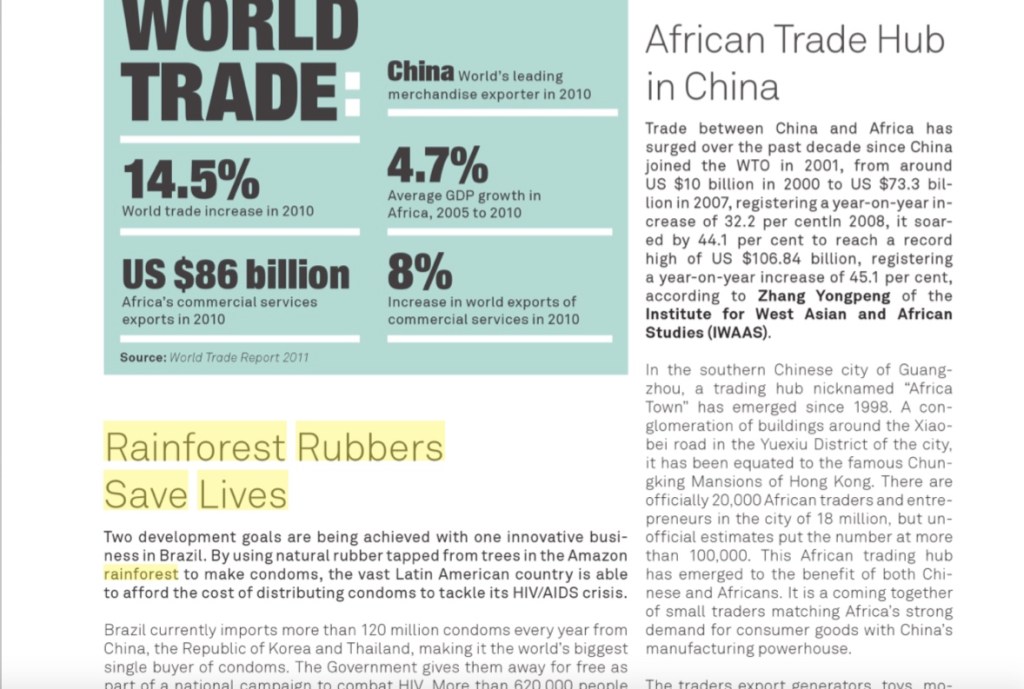
Two development goals are being achieved with one innovative business in Brazil. By using natural rubber tapped from trees in the Amazon rainforest to make condoms, Brazil is able to afford the cost of distributing condoms to tackle its HIV/AIDS crisis. Brazil currently imports more than 120 million condoms every year from China, Republic of Korea and Thailand, making it the world’s biggest single buyer of condoms. The government gives them away for free as part of a national campaign to combat HIV. More than 620,000 people in Brazil are living with HIV out of a population of more than 186 million (UNAIDS, 2005).
The Natex company, co-owned by the public health ministry and the north-western state government of Acre, has established a factory to turn rubber from the world’s biggest rainforest into condoms. The business has created 500 jobs at the factory and 150 jobs for the local indigenous population – the Xapuri – who are traditional rubber tappers.
The factory hopes to produce 100 million condoms a year from local rubber – just 20 million shy of all the condoms the country currently has to import – and could even reach 270 million at full capacity.
“This product will allow people to make love with security and to better plan their futures,” said Raimundo Barros, vice president of the local agricultural association.
The 15,000 Xapuri people who live on the Chico Mendes reserve – named after a conservationist and rubber tapper murdered by ranchers in 1988 – tap seringai trees, which produce rubber that is said to be a more effective barrier to the transmission of sexually transmitted diseases (STDs), than synthetic rubber condoms.
The factory’s 500 employees will earn a total of Reais $2.2 million (US $1.3 million) while the tappers will see their income increase by 250 per cent as demand goes up for the rubber, according to Natex.
“Because of this I’ve managed to buy a few cows and give my family a better life,” rubber tapper Hugo Paz de Souza, 43, told local newspaper Pagina 20. Paz de Souza said the factory will double his income to US $394 a month.
The fact the trees will be saved because of their value as sources of rubber is a great boon to the world’s environment. The trees in the Amazon rainforest – the “world’s lungs” as some call it – face the threat of being chopped down to make way for Brazil’s booming agricultural economy. Official figures released in January 2008 showed that between August and December 2007, about 2,700 square miles were chopped down illegally in the Amazon rainforest. It was the first increase in deforestation after three years of declines and coincided with a rise in global food prices.
Marina Silva, Brazil’s environment minister, told the Guardian newspaper the Natex condom would help create “a new pattern of production and a new process of inclusion that would value the forest being left standing”.
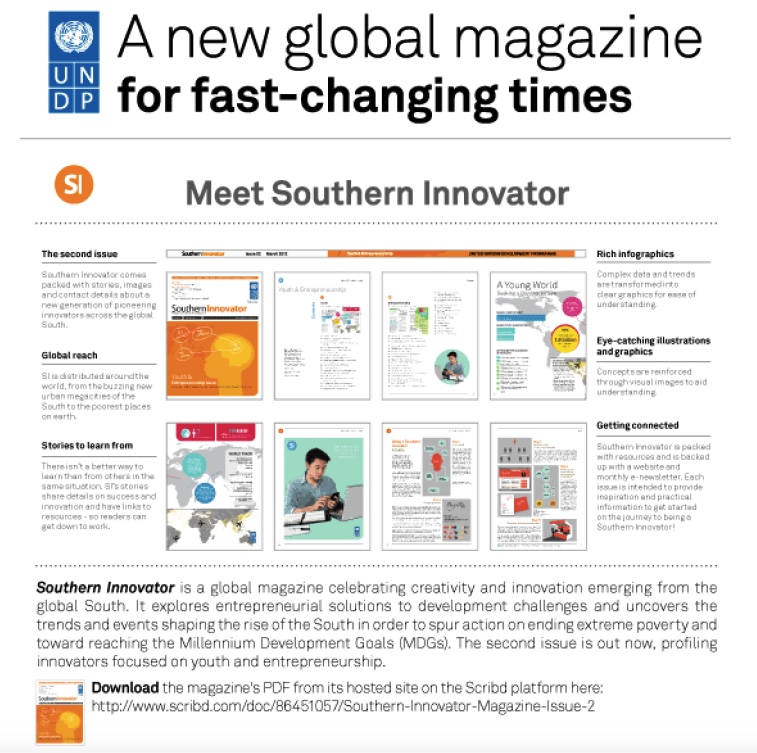
Development Challenges, South-South Solutions was launched as an e-newsletter in 2006 by UNDP’s South-South Cooperation Unit (now the United Nations Office for South-South Cooperation) based in New York, USA. It led on profiling the rise of the global South as an economic powerhouse and was one of the first regular publications to champion the global South’s innovators, entrepreneurs, and pioneers. It tracked the key trends that are now so profoundly reshaping how development is seen and done. This includes the rapid take-up of mobile phones and information technology in the global South (as profiled in the first issue of magazine Southern Innovator), the move to becoming a majority urban world, a growing global innovator culture, and the plethora of solutions being developed in the global South to tackle its problems and improve living conditions and boost human development. The success of the e-newsletter led to the launch of the magazine Southern Innovator.
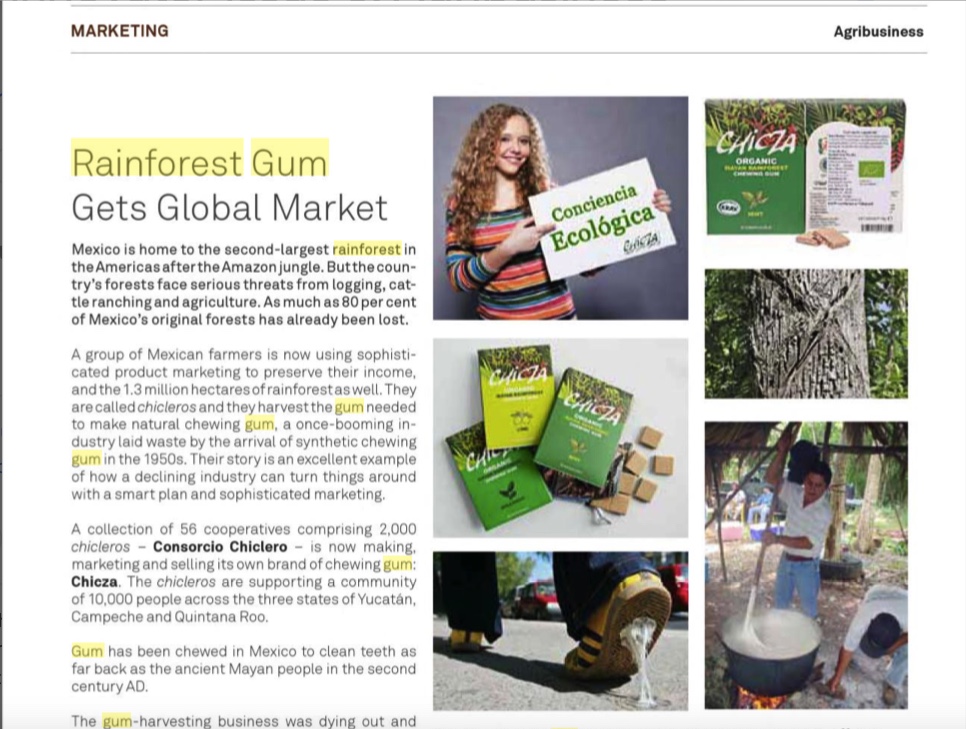
Mexico is home to the second largest rainforest in the Americas after the Amazon jungle. But the country’s forests face serious threats from logging, cattle ranching and agriculture. As much as 80 percent of Mexico’s original forests have already been lost.
A group of Mexican farmers is now using sophisticated product marketing to preserve their income, and the 1.3 million hectares of rainforest as well. They are called chicleros and they harvest the gum needed to make natural chewing gum, a once-booming industry laid waste by the arrival of synthetic chewing gum in the 1950s. Their story is an excellent example of how a declining industry can turn things around with a smart plan and sophisticated marketing.
A collection of 56 cooperatives comprising 2,000 chicleros – called Consorcio Chiclero – is now making, marketing and selling its own brand of chewing gum: Chicza (http://www.chicza.com/index.php). The chicleros are supporting a community of 10,000 people across the three states of Yucatán, Campeche and Quintana Roo.
Gum has been chewed in Mexico to clean teeth as far back as the ancient Mayan people in the second century AD.
The gum harvesting business was dying out and young people, put off by the low pay, were leaving for jobs elsewhere. The adminstrators of the chiclero co-operative created Chicza Rainforest Gum brand to save the industry. They made a deal with Britain’s Waitrose supermarket chain, which specializes in fair trade products, and the gum is being launched in 100 stores.
The brightly coloured packages of chewing gum are now being sold as organic and a way to preserve the forest. Frustrated by the decades of decline and attendant poverty and community decay, the chicleros decided to take matters into their own hands. Five years ago they decided to avoid the middlemen who would buy their raw gum products, and instead manufacture and market the chewing gum themselves. And it is paying off: by adding value to the raw product, each farmer’s income has grown six times higher than he would earn as a mere provider of raw material.
The gum comes in three flavours: wild mint, heirloom lime and spearmint. Future flavours will blend tropical fruits, herbs and spices.
The Consorcio Chiclero coordinates the production, the logistics, the trade and the finances for the manufacture of gum from the chicozapote tree (Manilkara zapota).
Certified organic, the Chicza gum is completely natural and free of synthetic ingredients and also biodegrades when it is discarded – a boon to city governments who hate the mess and cost of traditional gum left on sidewalks.
The farmers work in the rainforest at the southern end of Mexico’s Yucatan peninsula (http://en.wikipedia.org/wiki/Yucat%C3%A1n_Peninsula), bordering Guatemala and Belize. It is a place with one of the most bio diverse ecosystems in the world, and an environment the farmers are in harmony with. The chicle gum (http://en.wikipedia.org/wiki/Chicle) is harvested from chicozapote trees – some living for more than 300 years – by hacking z-shaped cuts into the bark of the 100 foot trees. The harmless cuts zig zag down the tree and a bucket is placed at the bottom to collect the dripping sap.
Once collected, the sap is boiled, dried and made into a sticky paste, which is then kneaded and shaped into bricks called marquetas. Each marqueta is carefully marked by its maker. Since the sustainable management of their rainforests is certified by FSC (Forest Stewardship Council) (http://www.fsc.org/), these marks contain relevant information that tells the name of the chiclero who harvested it, and the exact location of the harvested tree in the rainforest. Few products offer such perfect traceability.
“I started following my dad around the rainforest when I was 10 and working when I was 12,” farmer Porfirio Banos told The Guardian newspaper. “I am a chiclero to my core.”
Working in a remote area of rainforest jungle with just spider monkeys for company, the chicleros are paid by the amount of chicle harvested
“We don’t kill the trees like farmers do when they clear land to grow corn or graze cattle,” says Roberto Aguilar, 60. “We leave a wound, it’s true, but eight years after it is healed and producing chicle again.”
The chicleros face two main risks while doing the job: falling from the trees if their rope gives out; and being bitten by poisonous snakes.
Chicle was once the basis of all commercial chewing gum. Beginning in New York 141 years ago, it was the only source for chewing gum until the 1950s, when synthetic substitutes destroyed the industry.
It was the economic desperation of a Mexican general, Antonio Lopez de Santa Anna, living in exile in the United States in 1869, that gave birth to gum-chewing as a global practice. Working with a local inventor, Thomas Adams, he tried to use the chicle to make a rubber substitute. But when this failed, Adams added sugar and flavouring, making chewing gum.
Apart from being a great chew, the natural gum’s unique selling point is saving money: local governments tight for cash are looking for other ways to deal with the menace of chewing gum on pavements. A small fortune is spent every year trying to keep streets clean of gum. The British alone spend over UK £150 million every year trying to clean their streets of chewing gum.
And despite the global recession, the chicleros are optimistic they can do well: during the Great Depression of the 1930s, chewing gum was an affordable treat and sold well.
Published: April 2009
Resources
Design that Matters: Timothy Prestero, CEO (Cambridge, MA): Design that Matters (DtM) was founded to help social enterprises in developing countries scale up enterprises more quickly by providing them access to better products designed specifically for their business needs. Website:http://www.designthatmatters.org/
The Fairtrade Labelling Organization sets the standards for fair-trade and is the place to go to receive official certification. Website:www.fairtrade.org.uk
International Cooperative Agricultural Organisation: The ICAO is the democratic organisation representing agricultural co-operatives and farmers worldwide. Website:http://www.agricoop.org/
Waitrose Supermarket: It regularly sources fair trade and organic food products from the global South. Website:http://www.waitrose.com/index.aspx
Development Challenges, South-South Solutions was launched as an e-newsletter in 2006 by UNDP’s South-South Cooperation Unit (now the United Nations Office for South-South Cooperation) based in New York, USA. It led on profiling the rise of the global South as an economic powerhouse and was one of the first regular publications to champion the global South’s innovators, entrepreneurs, and pioneers. It tracked the key trends that are now so profoundly reshaping how development is seen and done. This includes the rapid take-up of mobile phones and information technology in the global South (as profiled in the first issue of magazine Southern Innovator), the move to becoming a majority urban world, a growing global innovator culture, and the plethora of solutions being developed in the global South to tackle its problems and improve living conditions and boost human development. The success of the e-newsletter led to the launch of the magazine Southern Innovator.
As cities in the global South grow ever larger, their often-chaotic evolution can create sprawling urban mazes that would confuse even the brightest brains.
Streets can be unnamed, unnumbered, twisty, full of dead ends and alleys. Informal settlements can pop up within weeks, whole neighbourhoods are razed to the ground and replaced by gleaming office buildings and apartments within months. Some countries experience political instability and conflict, disrupting daily life and making planning difficult. All this chaos makes business and travel more inefficient, especially to visiting businesspeople looking to trade or tourists simply wanting to look around.
When a city fails to communicate its treasures, something is lost for both parties: the city’s businesses lose valuable custom and the visitor or resident fails to grasp what is on offer. How will you find the restaurant you want, or that shop with the just-right fashions?
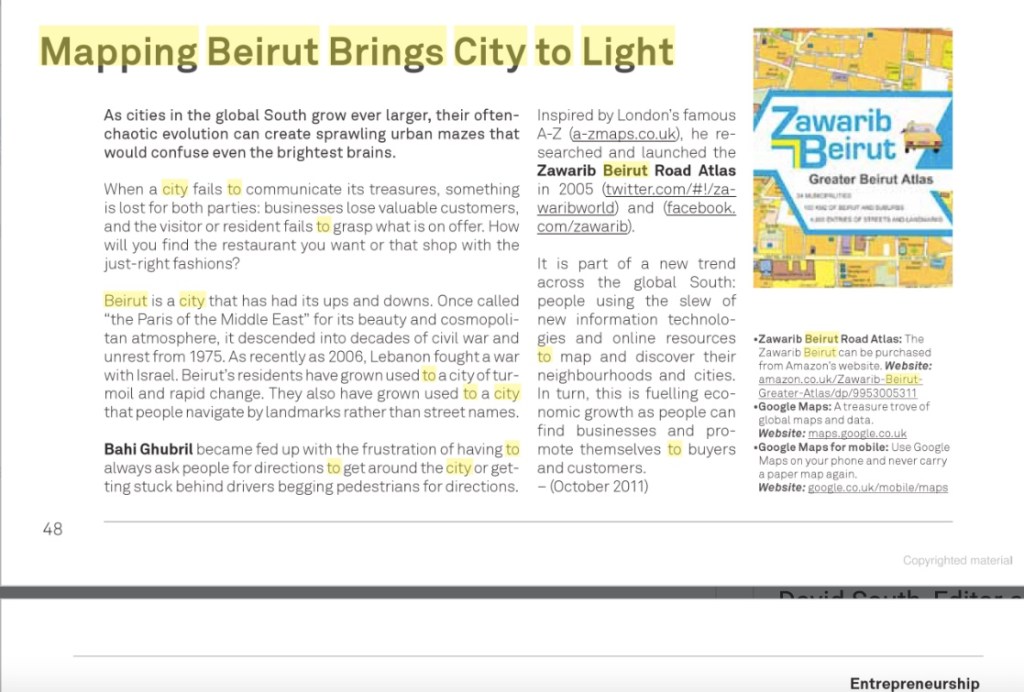
Beirut is a city that has had its ups and downs. Once called “the Paris of the Middle East” for its beauty and cosmopolitan atmosphere, it descended into decades of civil war and unrest from 1975, most recently in 2006 it had a war with Israel. Its residents have grown used to a city of turmoil and rapid change. They also have grown used to a city that people navigate by landmarks rather than street names.
Bahi Ghubril grew fed up with the frustration of having to always ask people for directions to get around the city, or getting stuck behind drivers begging pedestrians for directions.
It is part of a new trend across the global South: people using the slew of new information technologies and online resources to map and discover their neighbourhoods and cities. In turn, this is fuelling economic growth as people can find businesses and promote themselves to buyers and customers.
It took Ghubril two years to put together the first guide, gathering street images from satellite photos and then combining them with information collected on foot and from local mayors and cartographers.
“The project was born from a need to organise the city,” he told Monocle magazine, “but also as a socio-political project to open up the city to its residents and visitors.”
As an entrepreneur, Ghubril had no previous experience in publishing. He has been an actor and worked in finance.
During the research for the guide, Ghubril developed a rich knowledge of the city’s structure, its bureaucracy and how people really live their lives. His willingness to do this hard work is paying off.
Zawarib Beirut – which translates as Beirut Alleys – has successfully expanded into editions covering nearby cities, a pocket version, eight versions colourfully decorated by local artists, and the first Beirut bus map.
The service has a database including thousands of street names, landmarks, sectors and districts within the 34 municipal regions making up Greater Beirut. It includes useful phone numbers, car parks and a bus map. During holidays, like the Muslim holy month of Ramadan, it publishes a map of all of Beirut’s mosques.
Ghubril promotes the guide directly to the city’s residents. Wearing blue and black t-shirts asking “Lost? ask me,” young women help to distribute the guide on the streets of Beirut.
Other mapping projects depend on the mobile phones that are more and more part of daily life in the South’s slums – even for the poorest people. With the spread of mobile phones, it is becoming possible to develop a digital picture of a slum area and map its needs and population. It has become possible to undertake digital mapping initiatives to truly find out who is where and what is actually going on.
An NGO called Map Kibera (http://www.mapkibera.org) is working on an ambitious project to digitally map Africa’s largest slum, Kibera in Nairobi, Kenya.
The Map Kibera project uses an open-source software programme, OpenStreetMap (http://www.openstreetmap.org), to allow users to edit and add information as it is gathered. This information is then free to use by anybody wanting to grasp what is actually happening in Kibera: residents, NGOs, private companies and government officials.
The mappers physically travel around the favela and upload information on each individual landmark (restaurants, roads etc.) as they go. They use Nokia N95s mobile phones that are connected to Google Maps (http://www.maps.google.com). The project then uses Wikimapa (http://www.wikimapa.org.br), and Twitter (http://www.twitter.com) to log the information.
Published: October 2011
Resources
1) Zawarib Beirut Road Atlas: The Zawarib Beirut can be purchased from Amazon’s website. Website:http://www.amazon.co.uk/Zawarib-Beirut-Greater-Atlas/dp/9953005311
Development Challenges, South-South Solutions was launched as an e-newsletter in 2006 by UNDP’s South-South Cooperation Unit (now the United Nations Office for South-South Cooperation) based in New York, USA. It led on profiling the rise of the global South as an economic powerhouse and was one of the first regular publications to champion the global South’s innovators, entrepreneurs, and pioneers. It tracked the key trends that are now so profoundly reshaping how development is seen and done. This includes the rapid take-up of mobile phones and information technology in the global South (as profiled in the first issue of magazine Southern Innovator), the move to becoming a majority urban world, a growing global innovator culture, and the plethora of solutions being developed in the global South to tackle its problems and improve living conditions and boost human development. The success of the e-newsletter led to the launch of the magazine Southern Innovator.
African fashion brands have not always been the first place fashionistas turned to when shopping for new clothes or shoes in developed economies. While Africa has long been a source of inspiration in contemporary and traditional fashion, the continent has had a weak reputation for manufacturing and selling mass market global fashion brands.
There are initiatives, such as Origin Africa (http://originafrica.org/), an ongoing campaign working to improve African trade by increasing the trade of textiles and apparels, cut flowers, specialty foods, home décor, and fashion accessories. Origin Africa matches African designers and entrepreneurs with experienced industry leaders to “facilitate, coordinate and advance ‘trade, not aid’ efforts”.
While there are many places in Africa engaged in the global clothing manufacturing outsource industry – often paying very low wages – strong African fashion brands are often absent in most developed countries. Well, at least until now.
Two recent examples have joined the well-publicized success of Ethiopia’s soleRebels, maker of rubber-soled shoes (solerebelsfootwear.co). SoleRebels became an Internet success story, harnessing the power of web-based sales to reach customers around the world.
Now another Ethiopian shoe maker is also pushing its way into the global fashion scene. Ethiopian-made sneaker brand Sawa has just been picked up by the American retailer of preppy clothing J. Crew (jcrew.com). The successful catalogue and online clothing retailer has great clout when it comes to promoting a brand, and this should be a big boost to the reputation of African fashion labels.
Sawa’s headquarters is in Paris, France (the physical home of much of the world’s fashion scene) but all its shoes are sourced and made in Addis Ababa, Ethiopia’s capital, and the company’s website is run from there.
Sawa says the key to its success is to be a business first and foremost – not a charity.
“Sawa project does not have the so-called generosity of brands which use Africa just to glorify themselves,” said Wendesen Birhanu, on the company website.
“Sawa is a fashion brand which has taken the challenge to fabricate shoes in Africa. All the added value benefits the continent.”
The company’s shoe factory is modern and has the workers positioned at their desks making the shoes. The brand logo proudly states “Made in Africa” on all the brown cardboard shoe boxes in a bold, red roundel stamp.
Sawa also uses the slogan “vote with your feet” to show the connection between purchasing the shoes and supporting African business and manufacturing.
The footwear, currently available in the United Kingdom, France and through J. Crew in the United States, has a distinctive rubber sole with the African continent embossed on the bottom – a clever design tweak ensuring the wearers will leave an interesting footprint wherever they walk.
The styles available include Dr Bess, a vintage canvas and leather shoe in a low-cut silhouette. The Tsague is a vintage shoe with a mid cut like that used for basketball shoes.
They retail in Europe for between 75 euros and 115 euros a pair – a middle-market price – and come in eye-pleasing colours, from basic black to white to sand, dark blue, grey, brown, red and light blue.
Small and medium enterprises (SMEs) (http://en.wikipedia.org/wiki/Small_and_medium_enterprises) have been identified as an essential part of Africa’s future prosperity and key to its ability to reduce poverty and achieve development objectives like the Millennium Development Goals (MDGs) (www.un.org/millenniumgoals).
Obstacles to growth for SMEs include poor infrastructure, unreliable power supplies, unscaleable business models, low quality standards and poor quality branding and design.
Developing manufacturing in Africa is key to improving incomes and wealth. Creating unique, branded products for overseas markets makes it possible to earn foreign currency and be able to benefit from consumers in other countries. The math is simple: once you have saturated the local market for your product, the only way to boost sales and profits is to seek new customers elsewhere. By selling to people in a country with a higher national income, it is possible to charge more and in turn earn more money for each product. In time, this can lead to significant income rises and in turn, human development gains as the spare cash can be put to improving local living conditions, acquiring education or better health services and consuming better quality food.
Another important feature of selling to overseas customers is competition. Having to compete with the pick of the world’s top brands means a company must raise its game to stand a chance. The pressure forces the company to sharpen its product line, become more efficient, stick to strict quality control and embrace the latest thinking in design, marketing and information technologies.
In short, an African company that can weather a few years successfully selling to overseas customers is going to be a fierce competitor back home.
And, as has been forecast many times, the rise of Africa’s middle class consumers will be a big driver of economic growth in the next decade. If this middle-income consumer class buys lots of African-made consumer products, then the impact on job and wealth creation on the continent will be significant.
Another fashion initiative boosting brand Africa is a partnership between Italian fashion lifestyle clothing retailer Diesel (diesel.com) and the Edun ethical fashion label (edun.com), founded by Ali Hewson and her husband Bono, singer with rock band U2.
The collaboration offers a contemporary take on retro street wear from Africa’s past, while having all the garments made and sourced from Africa.
In March 2013, Diesel+EDUN launched a 25-piece denim collection drawing its inspiration from African creativity. The collection uses raw, untreated denim sourced and manufactured in Uganda. It mixes up Malian textile prints for linings, with outside embroidery drawing on traditional Zulu weaving patterns. It also includes a denim jacket inspired by street wear from 1970s South Africa.
Edun was originally set up to encourage greater trade with Africa as a way to address poverty and boost incomes. Begun in 2005, the brand has tried to overturn the perception that ethical and ecologically sound fashion can’t be fashionable and desirable too.
Edun has sought to be “a creative force in contemporary fashion”, according to its website. In 2007, it launched a line dedicated to making t-shirts entirely made in Africa called Edun Live. Edun Live t-shirts “are entirely ‘Grow to Sew’ African. From cotton to finished tee, all production takes place in Africa.”
Edun has the goal of producing 40 per cent of its fashion collection in Africa by 2013. It does this by “supporting manufacturers, infrastructure and community building initiatives”.
All of Edun’s cotton is harvested to CCIU cotton standards. The Conservation Cotton Initiative Uganda (CCIU) is a cotton-farming program that helps to build sustainable farming communities in Northern Uganda.
Edun is currently working in Kenya, Morocco, Madagascar, Uganda and Tunisia.
The Diesel+EDUN (http://www.diesel.com/diesel+edun/) collaboration had its start at the beginning of 2012. After trips to East and West Africa by Diesel founder Renzo Rosso and Edun founders Ali Hewson and Bono, the idea was hatched to work together to “further apparel trade and development in Africa”. The goal is “bringing business to the continent and highlighting to the fashion world the possibility for sustainable trade and creative opportunity in Africa.”
More than 5,000 farmers participated in the 2011/2012 CCIU program, and more than 8,000 have already enrolled in the 2012/2013 season, the website states.
Edun is also working with Mikono Knits (Mikonoknits.com) to promote traditional African knitting techniques. Founded in 2005 by Froydis Dybahl Archer, Mikono makes and sells hand-crocheted sweaters and tank tops from its Nairobi, Kenya workshop. The plan is to use the success of Mikono Knits to expand the number of underprivileged women the firm can hire to work for the business. The business currently employs 10 women and uses locally sourced organic cotton and wool, supporting the local economy.
Beyond the actual clothing partnership and African-inspired fashion, there is a clever promotion campaign to raise awareness for the Diesel+EDUN line. Called Studio Africa (http://studioafrica.tumblr.com/), it is a marketing and perception-shaping initiative, “celebrating and promoting creativity in Africa”. It is doing this by promoting nine African artists to better communicate the African vibe of the collection and give the artists’ careers a boost. It is curated and edited by Okay Africa (http://www.okayafrica.com/), a cultural guide to “all the latest music/culture/politics coming from Africa and the Diaspora”.
Published: March 2013
Resources
1) Africa Fashion International: African Fashion International (AFI) is the leading Fashion authority on the African continent and is committed to the promotion and development of the best South African design talent. Website:http://afi.za.com/
2) Origin Africa: Origin Africa is an ongoing campaign and initiative dedicated to improving African trade. Comprised of producers, designers, small businesses, exporters, buyers and retailers, it is working to develop, guide and promote African trade in the following sectors: textiles/apparel, cut flowers, specialty foods, home décor, and fashion accessories. Website:http://originafrica.org/
4) How we made it in Africa: A great website packed with inspirational people and stories on business success in Africa. Website:http://www.howwemadeitinafrica.com/
5) Nigerian shoe and garment maker Fut Conceptus has been taking raw Nigerian leather that was once just sent overseas for export, and instead is turning out high-quality shoes and bags made in Nigerian factories. Website: futconceptus.com
6) SME Toolkit South Africa: A website packed with resources and support for anyone starting a small business in Africa. Website:http://southafrica.smetoolkit.org/sa/en
8) Small and Medium Enterprise Support, East Africa: A blog promoting events and support for SMEs in East Africa. Website:http://smeseastafrica.blogspot.com/
Development Challenges, South-South Solutions was launched as an e-newsletter in 2006 by UNDP’s South-South Cooperation Unit (now the United Nations Office for South-South Cooperation) based in New York, USA. It led on profiling the rise of the global South as an economic powerhouse and was one of the first regular publications to champion the global South’s innovators, entrepreneurs, and pioneers. It tracked the key trends that are now so profoundly reshaping how development is seen and done. This includes the rapid take-up of mobile phones and information technology in the global South (as profiled in the first issue of magazine Southern Innovator), the move to becoming a majority urban world, a growing global innovator culture, and the plethora of solutions being developed in the global South to tackle its problems and improve living conditions and boost human development. The success of the e-newsletter led to the launch of the magazine Southern Innovator.












 David South Consulting
You must be logged in to post a comment.