Tag: Issue 1

  • Affordable Space Programmes Becoming Part Of South’s Development

    Affordable Space Programmes Becoming Part Of South’s Development

    By David SouthDevelopment Challenges, South-South Solutions

    SOUTH-SOUTH CASE STUDY

    Space: the final frontier. At least that was how heading off into the stars was portrayed in cult television and film series Star Trek. While many countries are working to raise living standards and eradicate poverty on earth, some are also looking to space for solutions to earth-bound problems.

    Traditional space programmes were government-led and state-financed. They involved enormous armies of technicians, engineers and scientists. Each launch and mission had to be overseen by a vast mission control centre with row upon row of technicians watching computer screens in real time. Space technology advanced rapidly in the 1950s and 1960s with so many bright brains hard at work and with brave people willing to put their lives at risk, leading to humans walking on the surface of the moon in 1969.

    All of this expensive expertise meant few governments had the resources to set up space programmes – and it was even out of the hands of most of the private sector. In time, these leviathan space efforts lost the financial support of governments and the pace of new developments and achievements slowed. Nobody has set foot on the moon in 40 years – or on any other planet, for that matter.

    But various developments are changing the space scene today and promising a bright future and a return to rapid innovation.

    Space programmes are playing a greater role in the economic and innovation strategies of countries in the global South. New technologies and trends are turning space exploration into more affordable, small-scale operations within the reach of many countries.

    New information technologies and innovations in miniaturization mean satellites can be very small and light. These developments bring down costs considerably, and also reduce the number of people needed to monitor space missions.

    For example, on 14 September 2013 Japan’s space agency, JAXA, proved a slimmed-down space launch can work when it fired off its Epsilon rocket with a small satellite onboard. What made this mission different was how little it took to monitor the mission: just two laptop computers  and a small team of eight people. Previously, similar missions required a team of 150 people.

    Fewer people meant the launch was much cheaper. One of the reasons for having many people involved in the launch of a rocket is the need to perform multiple systems checks to make sure the launch is successful. The Epsilon is a “smart” rocket and saves on the need for people to micro-manage the launch procedures by having its own on-board computer with artificial intelligence (AI) capable of doing the laborious checklists before launch.

    Billing itself as “The first Latin American space development company,” Colombia’s Sequoia Space (sequoiaspace.com) was established in 2008 to build miniature satellites (called nano or pico satellites) that are affordable to countries in the global South.

    Located in Bogota’s trendy neighbourhood of Chapinero, Sequoia has set itself up to exploit the technological trend towards making things smaller and smaller.

    The firm manufactures satellites that range in size from 1.3 kilograms to 16 kilograms and are custom built for the customer’s needs. One satellite it is working on for the Colombian air force weighs 4.5 kilograms. It can make satellites to conduct missions in earth observation, remote sensing, micro-gravity experiments and other scientific experiments.

    The company was launched in 2007 by a team of Colombian engineers, who turned their extensive experience in developing satellites for the aerospace industry into a start-up. Their dream is to further develop the aerospace industry in Latin America and grow its role in the global space industry. They hope to make it possible for more and more countries in Latin America to carry out space missions.

    The company currently has clients in Colombia, Chile, Ecuador and Peru.

    Other Latin American space programmes include Peru’s CONIDA (http://www.conida.gob.pe/). Its mission is to “To promote, to research, to develop and to disseminate science and space technology for national interests, in order to create unique and differentiated services driving national development.”

    Ecuador’s Ecuadorean Civilian Space Agency (EXA) (http://www.exa.ec/index-en.html) has had a rough ride with its space programme with the failure of the Pegasus nano-satellite. Ultra-small, Pegasus was a small cube measuring just 10 centimeters along its edge and weighing just 1.2 kilograms (BBC). It was launched on 25 April 2013 from the Chinese spaceport of Jiuquan (http://www.cgwic.com/LaunchServices/LaunchSite/JSLC.html) but collided with a cloud of particles from an old Soviet-era rocket. It was declared lost by August 2013, having cost the government US $700,000.

    A second satellite, Krysaor (http://www.exa.ec/nee-02-eng.htm), is set to be launched in November 2013. It is intended as a partner to Pegasus and is for educational uses and also to monitor space debris, its website states.

    Other trends in the space race include radical changes in how space missions can be funded and the range of players who can do it. Space entrepreneurs who are using their own private wealth to finance space missions and technology development are now driving innovation.

    Pioneers in this new frontier include two US-based private companies. SpaceX (spacex.com), headed by Internet entrepreneur Elon Musk, boasts of having “the world’s first reusable rockets.” Started in 2002, it now employs more than 3,000 people and has an ultimate goal of creating the technological capability for humans to live on other planets.

    The way SpaceX offers access to space as a service is also radical. The company website shows how the re-usable rockets work and then offers potential customers a price list and various options for delivering payloads to space (spacex.com/falcon9).

    Another pioneering company is run by the founder of the online shopping service Amazon (amazon.com). Jeff Bezos’ Blue Origin (blueorigin.com) seeks to lower the costs of getting humans into space.

    Inspired by the revolution in project funding brought about by the Internet, Denmark’s Copenhagen Suborbitals (http://www.copenhagensuborbitals.com/) is looking to crowd-fund space missions from donations and says it will use the money to launch peaceful-purpose suborbital spacecraft.

    “We aim to show the world that human space flight can be different from the usual expensive and government controlled project,” its website says.

    How are these companies relevant to countries coping with wide-scale poverty and economic underdevelopment? There are many space technology applications that can aid poor countries. They can improve communications technology and provide more sophisticated communications services. Satellites can monitor weather and agriculture and conduct sophisticated mapping activities. This can help with planning for fast-growing urban areas.

    The West African country of Nigeria is running one of Africa’s largest space programmes to boost its effectiveness as an agricultural economy. Nigeria announced its space programme in 2003 and launched its first satellite in 2007 with the Chinese. Unfortunately, this satellite failed and fell out of orbit.

    But Nigeria did not give up and now has three satellites in space.

    In 2011, President Goodluck Johnathan said the satellites would “substantially reduce the annual expenditure of over $1 billion arising from the use of foreign bandwidth for GSM Communications, cable television, e-commerce and e-government by both public and private users in the country” (allAfrica).

    The Nigerian government is using these satellites to help with its planning and monitoring of disaster-prone areas.

    Two countries of the global South, India and China, got involved in space programmes early on in the global space race. India started its space programme in the late 1960s and launched its first satellite in 1975. China began its space programme more than 50 years ago but did not launch its first satellite until the early 1970s. Since then, the country has also launched human beings into space.

    And their ambitions are rising: both India and China have their sights set on large-scale space voyages, including missions to the planet Mars.

    China is now working on a 60-ton space station to orbit around the earth which is planned to be finished by 2020. Ambitiously, the country is also working towards sending human beings to the planet Mars sometime around 2040 to 2060.

    Published: September 2013
    https://davidsouthconsulting.org/2021/01/14/from-special-report-nmm-new-media-markets-spotlight-on-the-emergence-of-satellite-porn-channels-in-the-uk/

    https://davidsouthconsulting.org/2021/03/24/frugal-innovation-trend-meets-global-souths-innovation-culture/

    https://davidsouthconsulting.org/2017/10/18/innovation-agenda-and-timeline-2007-2015/

    https://davidsouthconsulting.org/2020/04/27/innovation-from-the-global-south/

    https://davidsouthconsulting.org/2021/03/03/kommunikation-total-der-siebte-kontinent/

    https://davidsouthconsulting.org/2022/10/09/next-generation-of-innovation-for-the-grassroots/

    https://davidsouthconsulting.org/2022/04/21/nsd-partners-in-bitter-row-over-choice-of-satellite-as-brussels-deadline-nears/

    https://davidsouthconsulting.org/2016/04/14/southern-innovator-and-the-growing-global-innovation-culture-14-april-2016/

    https://davidsouthconsulting.org/2022/11/01/southern-innovator-magazine-2010-2014/

    https://davidsouthconsulting.org/2021/02/01/uk-laws-on-satellite-porn-among-toughest-in-europe/

    Development Challenges, South-South Solutions was launched as an e-newsletter in 2006 by UNDP’s South-South Cooperation Unit (now the United Nations Office for South-South Cooperation) based in New York, USA. It led on profiling the rise of the global South as an economic powerhouse and was one of the first regular publications to champion the global South’s innovators, entrepreneurs, and pioneers. It tracked the key trends that are now so profoundly reshaping how development is seen and done. This includes the rapid take-up of mobile phones and information technology in the global South (as profiled in the first issue of magazine Southern Innovator), the move to becoming a majority urban world, a growing global innovator culture, and the plethora of solutions being developed in the global South to tackle its problems and improve living conditions and boost human development. The success of the e-newsletter led to the launch of the magazine Southern Innovator.  

    Follow @SouthSouth1

    Google Books: https://books.google.co.uk/books?id=bfhcAwAAQBAJ&dq=development+challenges+september+2013&source=gbs_navlinks_s

    Slideshare: http://www.slideshare.net/DavidSouth1/september-2013-development-challenges

    Southern Innovator Issue 1: https://books.google.co.uk/books?id=Q1O54YSE2BgC&dq=southern+innovator&source=gbs_navlinks_s

    Southern Innovator Issue 2: https://books.google.co.uk/books?id=Ty0N969dcssC&dq=southern+innovator&source=gbs_navlinks_s

    Southern Innovator Issue 3: https://books.google.co.uk/books?id=AQNt4YmhZagC&dq=southern+innovator&source=gbs_navlinks_s

    Southern Innovator Issue 4: https://books.google.co.uk/books?id=9T_n2tA7l4EC&dq=southern+innovator&source=gbs_navlinks_s

    Southern Innovator Issue 5: https://books.google.co.uk/books?id=6ILdAgAAQBAJ&dq=southern+innovator&source=gbs_navlinks_s

    Creative Commons License
    This work is licensed under a
    Creative Commons Attribution-Noncommercial-No Derivative Works 3.0 License.

    ORCID iD: https://orcid.org/0000-0001-5311-1052.

    © David South Consulting 2023

  • Mobile Phones: Engineering South’s Next Generation of Entrepreneurs

    Mobile Phones: Engineering South’s Next Generation of Entrepreneurs

    By David SouthDevelopment Challenges, South-South Solutions

    SOUTH-SOUTH CASE STUDY

    Technology is fuelling unprecedented growth in productivity in Asia, with sub-Saharan Africa languishing behind (International Labour Organization). But the growth in mobile phones could help close this gap, as home-grown entrepreneurs are stepping up to exploit this new opportunity.

    Mobile phone applications are proving a boon to small businesses and entrepreneurs. They are now putting power in the hands of individuals, making it easier to invent new ways of doing things, transfer money, organise business accounts, provide services, sell things, and keep in touch and up-to-date.

    Technology has been the common factor in increases in productivity around the world, and with the rapid rise in mobile phone use, especially in Africa, it looks as if this handy device augers in the next wave of innovation.

    And technology and mobile phones in particular, are creating a whole new route to wealth: “The switch.. frees people from geography,” Gregory Clark, an economic historian at the University of California, Davis told The Christian Science Monitor. “Singapore can be as rich as Canada, even though Singapore has no land.”

    Technology is seen to be opening a new phase in economic competition in services, embracing a wide range of fields, from banking to tourism to healthcare. And it is entrepreneurs who will be at the forefront of making this happen. The majority (59 per cent) of the world’s 2.4 billion mobile phone users live in developing countries (MIT) – making it the first telecommunications technology in history to have more users there than in the developed world. The number of African mobile phone users passed 200 million at the beginning of this year (www.ovum.com), making it the fastest growing mobile phone market. It has increased at an annual rate of 65 per cent – twice the global average (MIT Media Laboratory).

    In Kenya in 2005, the government’s Economic Survey found the small business sector, which employs the majority of workers in the nation of 32 million people, created 437,900 jobs – mostly down to the boom in mobile phones. According to the Massachusetts Institute of Technology (MIT), adding an additional 10 mobile phones per 100 people boosts a typical developing country’s GDP growth by 0.6 per cent. The boost comes from the innovative use of mobile phone technology by local entrepreneurs.

    At the University of Nairobi, the SMS Boot Camp (SMS is the text messaging system on mobile phones) is breeding the next generation of African technology entrepreneurs. Working in partnership with MIT, the student entrepreneurs are working on an impressive list of projects, which can be found online at eprom.mit.edu. The projects are varied, and include perfecting prototype ways to collect medical data on mobiles, accurately tracking phone user’s profiles (habits, friend networks etc.), improving communication between Kenyan hospitals and the centralised blood banks in the country, and quick ways to install applications on all of Kenya’s mobile phone SIM cards.

    One graduate, Mohammed Temam Ali in Addis Ababa, is now working on a project for the Ethiopian Telecommunications Company. Another is working for Kenyan mobile phone download service, Cellulant.

    Nathan Eagle, a visiting lecturer at the University of Nairobi, has been working with the students on the projects: “Phones are starting to be used as a surrogate for all sorts of technology we take for granted in the West. Credit cards, TVs, radios, computers, etc… In the small Kenyan village where I’m writing this email, I can pay for the taxi ride home with my mobile — we’re even scheduled to be getting a Wimax network (wireless internet) here next year. Talk about leapfrog…”

    “I’m also advising a small group of newly graduated Rwandan hackers who are building an SMS-based payment system for electricity.”

    But Eagle says the obstacles can still be huge: “Government corruption and red-tape. SMS is illegal in Ethiopia… it is pretty frustrating when you go over to teach an ‘sms bootcamp’ class.”

    In India, where there are 185 million mobile phone subscribers, computer science doctoral student and founder of Ekgaon Technologies, Tapan Parikh, has founded a business specifically targeting developing mobile phone-based information systems for small businesses in the developing world. Working in rural India, the applications are designed to make it easier for business owners to manage their own operations in an efficient and transparent way, and also to build strong connections both with established financial institutions and their customers. By making it easier to access finance, and also to get a better price, these businesses will stand a better chance of flourishing, it is believed.

    One of his applications is called Cam (named after the phone’s camera). It is a toolkit that makes it simple to use phones to capture images and scan documents, enter and process data, and run interactive audio and video.

    Parikh is also using these applications to improve micro-finance. Targeting Indian self-help groups (15 to 20 people who pool their capital together, usually women), the application (called SHG MIS – self-help group management and information system) uses the phone’s camera to enter data, uploading it to online databases, and a package of Web-based software for managing data and reporting to the institution that lent the money.

    “In these groups, things are often done in a somewhat ad hoc manner, using informal documentation,” Parikh says, “which can lead to instability and impermanence and contribute to the kinds of tensions that lead small groups to fall apart.” The software gives groups a more systematic method of documenting decisions, tracking financial performance over time, and collecting information on loan effectiveness. Parikh has developed his applications around the needs and behaviour of the users.

    This next wave of entrepreneurs will be joining a growing list of made-in-the-South mobile phone innovators like ARYTYG-Cash and Smart Money in the Philippines; WIZZITand MTN Mobile Money in South Africa; M-Pesa in Kenya; Celpay in Zambia and the Democratic Republic of Congo.

    Published: September 2007

    Resources

    • Key Indicators of the Labour Market, 2007: www.ilo.org
    • Commission for Africa report on mobile phones and development: www.commissionforafrica.org
    • The Massachusetts Institute of Technology and the University of Nairobi are training the next generation of mobile phone entrepreneurs with their “SMS Boot Camp”, focused on developing applications for African phone users: eprom.mit.edu.
    • Entrepreneurs can track the growth of the mobile phones market here: www.wirelessintelligence.com

    Development Challenges, South-South Solutions was launched as an e-newsletter in 2006 by UNDP’s South-South Cooperation Unit (now the United Nations Office for South-South Cooperation) based in New York, USA. It led on profiling the rise of the global South as an economic powerhouse and was one of the first regular publications to champion the global South’s innovators, entrepreneurs, and pioneers. It tracked the key trends that are now so profoundly reshaping how development is seen and done. This includes the rapid take-up of mobile phones and information technology in the global South (as profiled in the first issue of magazine Southern Innovator), the move to becoming a majority urban world, a growing global innovator culture, and the plethora of solutions being developed in the global South to tackle its problems and improve living conditions and boost human development. The success of the e-newsletter led to the launch of the magazine Southern Innovator.

    Four issues of Southern Innovator Magazine.
    Creative Commons License

    This work is licensed under a
    Creative Commons Attribution-Noncommercial-No Derivative Works 3.0 License.

    ORCID iD: https://orcid.org/0000-0001-5311-1052.

    © David South Consulting 2022

  • Mobile Phones Bring the Next Wave of New Ideas from the South

    Mobile Phones Bring the Next Wave of New Ideas from the South

    By David SouthDevelopment Challenges, South-South Solutions

    SOUTH-SOUTH CASE STUDY

    Informa Telecoms and Media estimates mobile networks now cover 90 per cent of the world’s population – 40 per cent of whom are covered but not connected.

    The rapid growth in take-up has made mobile phones the big success story of the 21st century. With such reach, finding new applications for mobile phones that are relevant to the world’s poor and to developing countries is a huge growth area. It is estimated that by 2015, the global mobile phone content market could be worth over US $1 trillion: relegating basic voice phone calls to just 10 per cent of how people use mobile phones.

    Leonard Waverman of the London Business School has estimated that an extra 10 mobile phones per 100 people in a typical developing country, leads to an extra half a percentage point of growth in GDP per person.

    The experience of the US $100 laptops from the One Laptop Per Child Project (OLPC) offers an important lesson on making technology work for the poor: the business model has to come first. In the case of OLPC, the big computer manufacturers are already offering low-cost laptops with extensive software and other support: and out-selling OLPC. And it is mobile phones that are proving how fast take-up can be if users are willing to pay for the service on offer.

    A new report by the DIRSI (Regional Dialogue on the Information Society) on mobile phones and poverty in Latin America and the Caribbean, unearths the strategies the poor use to access and use mobile telephony, and the main barriers to increasing usage. It also looks at how mobile phones have improved the lives of the poor.

    The poor use them to strengthen social ties, increase personal security, and improve business and employment opportunities. Few share their phones and most own them. The only exceptions are Colombia and Peru, where the incentive is to share ownership. Most importantly, the study found that mobile phones are not a luxury good, but the most cost-effective solution to many problems.

    Some 250 million Indians today have mobile phones. Many of them are people who make just US $2 or US $3 a day. More and more are getting access to computers and the internet, even in villages.

    India’s Mapunity is pioneering ways to reduce the stress and anguish of the daily commute to work – something that seriously erodes people’s quality of life and affects their health. Owner Madhav Pai is using SMS technology to improve transportation in Bangalore by providing the Bangalore Traffic System’s information on bus routes, locations and congestion – all in real time – to mobile phones. The service is free for subscribers to Airtel, and at a small cost for others.

    The service works by collecting information on cell phone signal density to build up a map of congestion at different intersections in the city. Tracking congestion has had two benefits: it not only shows where the trouble spots are, it has also enabled mobile phone companies to know where to place extra relay towers to boost capacity and reduce network overload.

    This technology effectively turns the mobile phone into a GPS (global positioning system) mapper, with real-time updates.

    The company is incubated at the N S Raghavan Centre for Entrepreneurial Learning at the Indian Institute of Management, Bangalore.

    In Nairobi, Kenya computer science graduate Billy Odero’s MoSoko uses an SMS text bulletin board system for buying and selling via mobile phones. He got the idea when he had to move out of his university dormitory and needed to sell things to the other students. He was also interested in finding an apartment to share with other newly graduated students somewhere downtown. Tired of sifting through irrelevant ads on bulletin boards, Billy developed an SMS bulletin board system to help connect buyers and sellers in Nairobi. Sellers text into the MoSoko SMS gateway with information regarding the type of item they would like to sell (a bicycle, TV, couch), their location, and the asking price for the item. This information is stored in a database and can be easily accessed via SMS by potential buyers.

    More ingenuity can be found in Fultola, Bangladesh. A modest internet café with just four workstations it may be, but remarkably all four can access the internet: through just one mobile phone. This is all possible because of something called an EDGE-enabled (Enhanced Data Rates for GSM Evolution) mobile phone. One of the computers acts as a web server, while the other three workstations are connected to a small device no larger than a cigarette packet. All of this is wireless and possible because of the EDGE-enabled Motorola clamshell mobile phone using a USB cable connection to the server. The project is being supported by the Ndiyo ProjectGrameen Phone and Grameen Telecom.

    People use the internet centre to keep in touch with relatives, check market prices, and seek job opportunities or access government websites. The project was co-ordinated by a team working for the GSM Association, the global confederation of mobile phone operators. The aim was to explore the extent to which mobile networks could provide Internet connectivity in developing countries, and to demonstrate the extent to which mobile telephony can increase access to online resources.

    In Ghana, mPedigree uses mobiles to fight counterfeit drugs. The plague of counterfeit medicines in Africa kill thousands, and it is estimated between 10 and 25 per cent of all drugs sold in the developing world are fakes (BASCAP – Business Action to Stop Counterfeiting and Piracy). And in Africa, this may be over 50 per cent (USFDA).

    mPedigree founder Ashifi Gogo started his company to use mobile phones to protect people against counterfeit drugs and vaccines. “Buying medicine here is like Russian roulette,” said Gogo. “I don’t want people to have to choose between a drug that’s safe and more expensive and a drug that’s cheap and not genuine. Those choices shouldn’t be there.”

    Ghanaian Gogo (also a graduate of Dartmouth’s Thayer School of Engineering), lets consumers send an SMS to mPedigree to verify if a drug is legitimate while they are thinking about buying it in the drug store or the street market. The consumer types in the serial number found on the drug’s packet to a short code (a five-digit number similar to the ones used to top-up mobile phone credits). The consumer then receives an SMS response verifying the drug’s authenticity.

    To publicise the service, mPedigree advertises in parallel with existing drug promotion campaigns by legitimate pharmaceutical companies. It is also getting publicity help from the local mobile phone provider, Mobile Content in Ghana.

    Gogo hopes to expand the service to Nigeria and Mozambique – and eventually the rest of Africa.

    Gogo is really enjoying the whole experience of setting up this business: “It’s fun!” he said. “It just feels so good doing this work.”

    Published: December 2007

    Resources

    • IdeaMamaClub: This online invention and business start-up incubator connects inventors and social entrepreneurs with investors, creative support and global business networks.
    • Stockholm Challenge Awards 2008: An initiative of the Global Knowledge Partnership (GKP), it has four categories and looks for innovative projects in ICT.
    • Terranet: A Swedish company, it has developed a way to make calls between a network of cellphones in a geographically close area, free. A powerful development for entrepreneurs in the South looking for free calls. They are piloting this technology in Ecuador.
    • SME Toolkit: A free online resource aimed at the South to help entrepreneurs and small businesses access business information, tools, and training services to be able to implement sustainable business practices.
    • Entrepreneurial Programming and Research on Mobiles: EPROM, part of the Program for Developmental Entrepreneurship within the MIT Design Laboratory, aims to foster mobile phone-related research and entrepreneurship. Key activities include: development of new applications for mobile phone users worldwide.

    https://davidsouthconsulting.org/2022/10/09/a-new-mobile-phone-aimed-at-the-poor/

    https://davidsouthconsulting.org/2020/04/30/crowdsourcing-mobile-phones-to-make-the-poor-money/

    https://davidsouthconsulting.org/2020/05/01/diy-solution-charges-mobile-phones-with-batteries/

    https://davidsouthconsulting.org/2022/10/09/entrepreneurs-use-mobiles-and-it-to-tackle-indian-traffic-gridlock/

    https://davidsouthconsulting.org/2022/06/15/indian-mobile-phone-application-innovators-empower-citizens/

    https://davidsouthconsulting.org/2022/11/01/innovative-mobile-phone-applications-storm-south/

    https://davidsouthconsulting.org/2022/10/27/kenyan-mobile-phone-innovations/

    https://davidsouthconsulting.org/2022/10/10/mobile-applications-market-opportunities-for-south/

    https://davidsouthconsulting.org/2022/03/08/mobile-phone-microscopes-to-revolutionize-health-diagnostics/

    https://davidsouthconsulting.org/2022/04/06/mobile-phone-peacekeeping/

    https://davidsouthconsulting.org/2020/12/12/mobile-phone-shopping-to-create-efficient-markets-across-borders/

    https://davidsouthconsulting.org/2020/12/20/mobile-phones-engineering-souths-next-generation-of-entrepreneurs/

    https://davidsouthconsulting.org/2020/12/12/mobile-phones-new-market-tools-for-the-poor/

    https://davidsouthconsulting.org/2022/10/31/new-kenyan-services-to-innovate-mobile-health-and-farming/

    https://davidsouthconsulting.org/2021/11/09/ring-tones-and-mobile-phone-downloads-are-generating-income-for-local-musicians-in-africa/

    https://davidsouthconsulting.org/2021/03/24/solar-powered-mobile-clinics-to-boost-rural-healthcare-in-africa/

    David South Consulting first launched in Toronto, Canada in 1991. In 2010 it had a brand re-launch, with a new logo and website developed in Reykjavik, Iceland using 100% renewable energy.

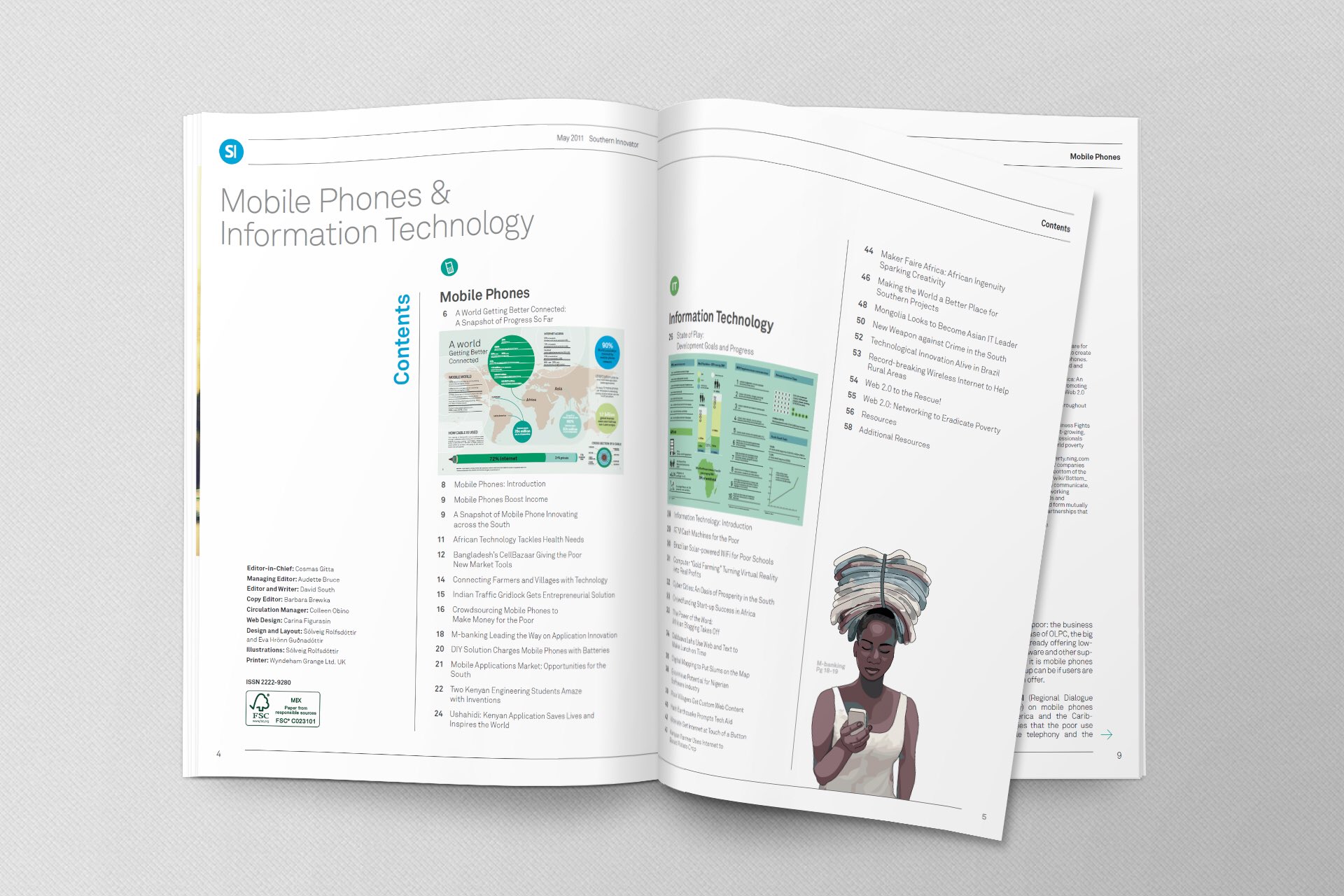
    Development Challenges, South-South Solutions was launched as an e-newsletter in 2006 by UNDP’s South-South Cooperation Unit (now the United Nations Office for South-South Cooperation) based in New York, USA. It led on profiling the rise of the global South as an economic powerhouse and was one of the first regular publications to champion the global South’s innovators, entrepreneurs, and pioneers. It tracked the key trends that are now so profoundly reshaping how development is seen and done. This includes the rapid take-up of mobile phones and information technology in the global South (as profiled in the first issue of magazine Southern Innovator), the move to becoming a majority urban world, a growing global innovator culture, and the plethora of solutions being developed in the global South to tackle its problems and improve living conditions and boost human development. The success of the e-newsletter led to the launch of the magazine Southern Innovator.  

    https://davidsouthconsulting.org/2021/03/05/southern-innovator-issue-1/

    Creative Commons License

    This work is licensed under a
    Creative Commons Attribution-Noncommercial-No Derivative Works 3.0 License.

    ORCID iD: https://orcid.org/0000-0001-5311-1052.

    © David South Consulting 2023

  • Mongolia Looks to Become Asian IT Leader

    Mongolia Looks to Become Asian IT Leader

    By David SouthDevelopment Challenges, South-South Solutions

    SOUTH-SOUTH CASE STUDY

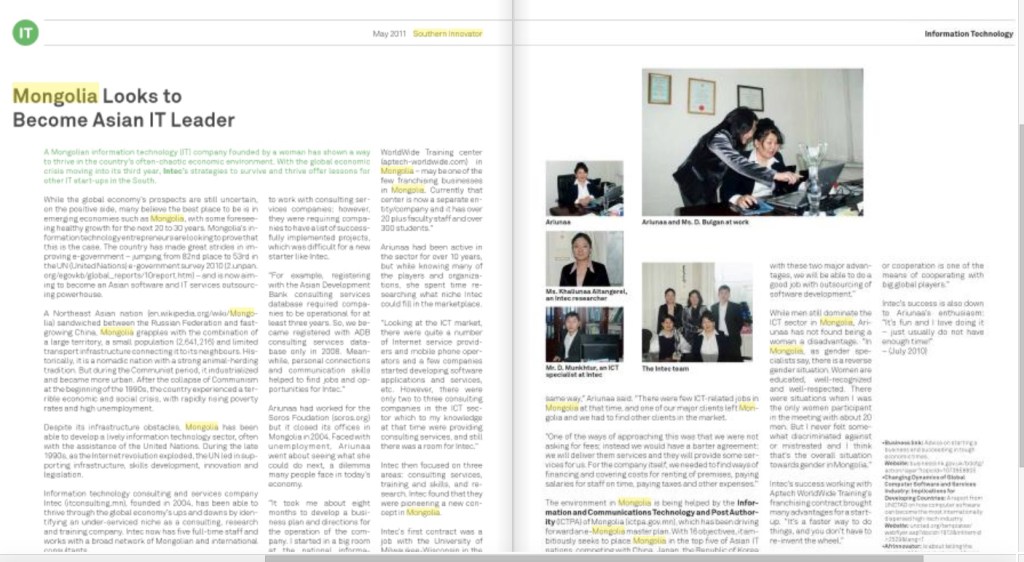
    A Mongolian information technology company founded by a woman has shown a way to thrive in the country’s often-chaotic economic environment. With the global economic crisis moving into its third year, Intec’s strategies to survive and thrive offer lessons for other IT start-ups in the South.

    While the global economy’s prospects are still uncertain, on the positive side, many believe the best place to be is in emerging economies like Mongolia, with some foreseeing healthy growth for the next 20 to 30 years. Mongolia’s information technology entrepreneurs are looking to prove this is the case. The country has made great strides in improving e-government – jumping from 82nd place to 53rd in the UN e-government survey 2010 (http://www2.unpan.org/egovkb/global_reports/10report.htm) – and is now aiming to become an Asian software and IT services outsourcing powerhouse.

    A Northeast Asian nation (http://en.wikipedia.org/wiki/Mongolia) sandwiched between Russia and fast-growing China, Mongolia grapples with the combination of a large territory, a small population (2,641,216) and limited transport infrastructure connecting it to its neighbours. Historically, it is a nomadic nation with a strong animal herding tradition. But during the Communist period, it industrialized and became more urban. After the collapse of Communism at the beginning of the 1990s, the country experienced a terrible economic and social crisis, with rapidly rising poverty rates and high unemployment.

    Despite its infrastructure obstacles, Mongolia has been able to develop a lively information technology sector, often with the assistance of the United Nations. During the late 1990s, as the internet revolution exploded, the UN led on supporting infrastructure, skills development, innovation and legislation.

    Information technology consulting and services company Intec (www.itconsulting.mn) , founded in 2004, has been able to thrive through the global economy’s ups and downs by identifying an under-serviced niche as a consulting, research and training company. Intec now has five full-time staff and works with a broad network of Mongolian and international consultants.

    As is often the case with new businesses, Intec initially found that many doors were closed to start-up enterprises.

    “The major challenges which I faced were to make people understand about the consulting services,” said Intec’s founder, Lkhagvasuren Ariunaa. “The consulting services concept was new to Mongolia and Mongolians at that time and not many organizations were willing to work with consulting services. The international and donor organizations were keen to work with consulting services companies; however, they were requiring companies to have a list of successfully implemented projects, which was difficult for a new starter like Intec.

    “For example, registering with the Asian Development Bank consulting services database required companies to be operational for at least three years. So, we got registered with ADB consulting services database only in 2008. Meanwhile, personal connections and communication skills helped to find jobs and opportunities for Intec.”

    Ariunaa had worked for the Soros Foundation (http://www.soros.org/) but it closed its offices in Mongolia in 2004. Faced with unemployment, Ariunaa went about seeing what she could do next: a dilemma many people face in today’s economy.

    “It took me about eight months to develop a business plan and directions of operation of the company. I started in a big room at the national information technology park building with one table, chair and computer.

    “It has been quite challenging years for bringing a company to the market and finding niches for us. We have franchised the Indian Aptech WorldWide Training center (http://www.aptech-worldwide.com) in Mongolia – may be one of the few franchising businesses in Mongolia. Currently that center is now a separate entity/company and it has over 20 plus faculty staff and over 300 students.”

    Ariunaa had been active in the sector for over 10 years, but while knowing many of the players and organizations, she spent time researching what niche Intec could fill in the marketplace.

    “Looking at the ICT market, there were quite a number of internet service providers, mobile phone operators, a few companies started developing software applications, and services etc. However, there were only two to three consulting companies in the ICT sector which to my knowledge at that time were providing consulting services, and still there was a room for Intec.”

    Intec then focused on three areas: consulting services, training and skills, and research. Intec found they were pioneering a new concept in Mongolia.

    Intec’s first contract was a job with the University of Milwaukee-Wisconsin in the United States to organize a three week course for American students to learn about the digital divide in Mongolia. But the global economic crisis hit Mongolia hard in 2009.

    “It was challenging to survive and continue working the same way,” Ariunaa said. “There were few ICT-related jobs in Mongolia at that time, and one of our major clients left Mongolia and we had to find other clients in the market.

    “One of the ways of approaching this was that we were not asking for fees, instead we would have a barter agreement – we will deliver them services and they will provide some services for us. For the company itself, we needed to find ways of financing and covering costs for renting of premises, paying salaries for staff on time, paying taxes and other expenses.”

    The environment in Mongolia is being helped by the Information and Communications Technology and Post Authority (ICTPA) of Mongolia (http://www.ictpa.gov.mn) , which has been driving forward an e-Mongolia master plan. With 16 objectives, it ambitiously seeks to place Mongolia in the top five of Asian IT nations, competing with South Korea, Singapore, Japan and China.

    Ariunaa believes Mongolia has many competitive advantages. “Mongolia is known for a high-literacy rate and math-oriented training and education, and ICT specialists are targeting to become a software outsourcing country for other countries. Another advantage of Mongolians is that they can easily learn other languages: we are fluent in Russian, English, Japanese, Korean, German and we believe that with these two major advantages, we will be able to do a good job with outsourcing of software development.”

    While men still dominate the ICT sector in Mongolia, Ariunaa has not found being a woman a disadvantage. “In Mongolia, as gender specialists say, there is a reverse gender situation. Women are educated, well-recognized and well-respected. There were situations, when I was the only women participant in the meeting with about 20 men. But I never felt somewhat discriminated or mis-treated and I think that’s the overall situation towards gender in Mongolia.”

    Intec’s success working with Aptech WorldWide Training’s franchising contract brought many advantages for a start-up. “It’s a faster way to do things, and you don’t have to re-invent the wheel.”

    As a Mongolian company, Intec has found it best to play to its local strengths. “National companies have knowledge, expertise and experience of local situations, know players and understand about legal, regulatory matters. … partnership or cooperation are one of the means of cooperating with big global players.”

    Intec’s success is also down to Ariunaa’s enthusiasm: “It’s fun and I love doing it – just usually do not have enough time!”

    Published: July 2010

    Resources

    1)  Advice on starting a business and succeeding in tough economic times. Website:http://www.businesslink.gov.uk/bdotg/action/layer?topicId=1073858805

    2) Changing Dynamics of Global Computer Software and Services Industry: Implications for Developing Countries: A report from UNCTAD on how computer software can become the most internationally dispersed high-tech industry. Website:http://www.unctad.org/templates/webflyer.asp?docid=1913&intitemid=2529&lang=1

    3) Afrinnovator: Is about telling the stories of African start-ups, African innovation, African made technology, African tech entrepreneurship and entrepreneurs. Their mission is to ‘Put Africa on the Map’ by covering these kinds of stories from all over Africa. As their website says, “if we don’t tell our own story, who will tell it for us?” Website:http://afrinnovator.com

    4) TechMasai: Pan-African start-up news and reviews. Website: www.techmasai.com

    5) Ger Magazine Project: Mongolia’s first online magazine pioneered communicating on the web. Website: http://en.wikipedia.org/wiki/Ger_magazine

    Development Challenges, South-South Solutions was launched as an e-newsletter in 2006 by UNDP’s South-South Cooperation Unit (now the United Nations Office for South-South Cooperation) based in New York, USA. It led on profiling the rise of the global South as an economic powerhouse and was one of the first regular publications to champion the global South’s innovators, entrepreneurs, and pioneers. It tracked the key trends that are now so profoundly reshaping how development is seen and done. This includes the rapid take-up of mobile phones and information technology in the global South (as profiled in the first issue of magazine Southern Innovator), the move to becoming a majority urban world, a growing global innovator culture, and the plethora of solutions being developed in the global South to tackle its problems and improve living conditions and boost human development. The success of the e-newsletter led to the launch of the magazine Southern Innovator. 

    Creative Commons License

    This work is licensed under a
    Creative Commons Attribution-Noncommercial-No Derivative Works 3.0 License.

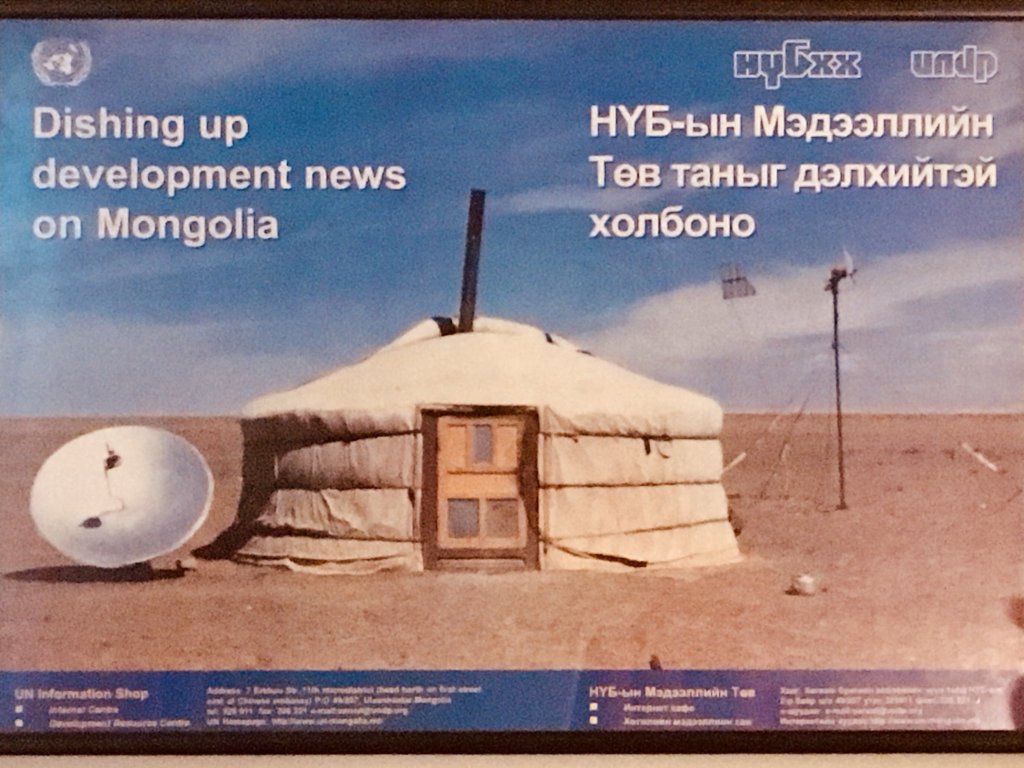
    Launched in 1997 in a major crisis, the UN Mongolia Development Portal (www.un-mongolia.mn) became the country’s largest online bilingual publisher and an award-winning pioneer of web content. It proved Mongolia had the potential to innovate in digital.
    Story featured in the UN E-Government Knowledgebase and E-Government Survey in Media.
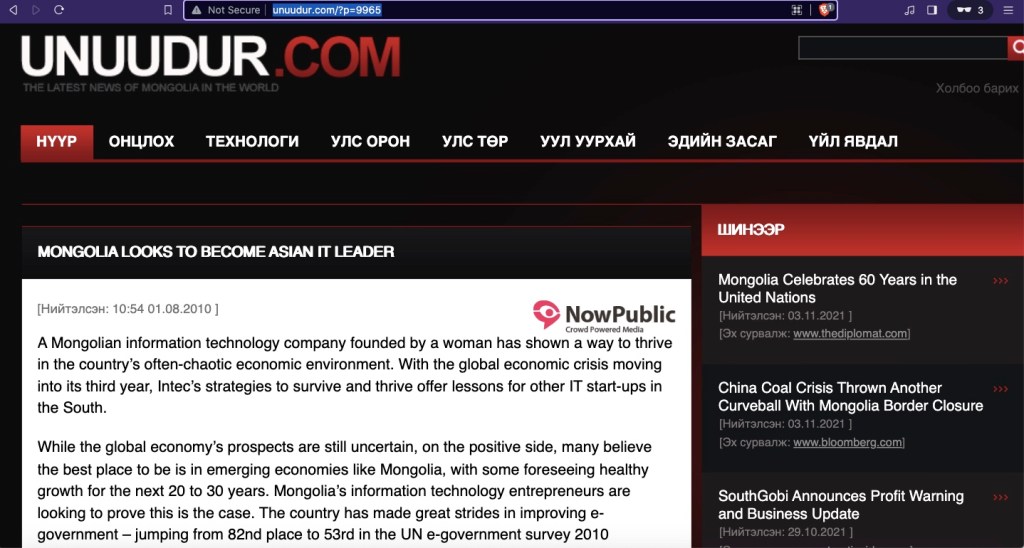
    Posted in 2010 on the Unuudur.com (“The latest news of Mongolia in the world”) website.
    Creative Commons License

    This work is licensed under a
    Creative Commons Attribution-Noncommercial-No Derivative Works 3.0 License.

    ORCID iD: https://orcid.org/0000-0001-5311-1052.

    © David South Consulting 2023