Tag: Issue 1

  • African Online Supermarket Set to Boost Trade

    African Online Supermarket Set to Boost Trade

    By David SouthDevelopment Challenges, South-South Solutions

    SOUTH-SOUTH CASE STUDY

    Online retailing and marketing strategies are revolutionizing how people around the world buy products and services – but so far they have not benefited most of Africa’s small businesses and traders. On a continent where trading for survival is the norm, very few people are reaping the benefits of selling on the Internet.

    Not only has limited access to the Internet and the lack of high bandwidth in Africa impeded communication within the continent, it has restricted African businesses from taking advantage of the most profound change in global business for decades: e-retailing (also known as e-tailing or e-commerce).

    But the African information technology pioneers of Ghana – a country that has already gained a reputation as an IT leader in West Africa (www.ghanaictawards.com) – are setting out to change this situation, and in turn to change the way people access African goods and services.

    Pledging in its motto to reach “every African nook and cranny,” ShopAfrica53 is an online shopping portal similar to famous brands like Amazon or eBay, but focused entirely on giving African traders the ability to sell across the continent and to the world online.

    The one-stop shopping site – taking its name from the 53 countries on the continent – can be accessed by Internet users, or better still, by the enormous number of mobile phone users not only in Africa but around the world.

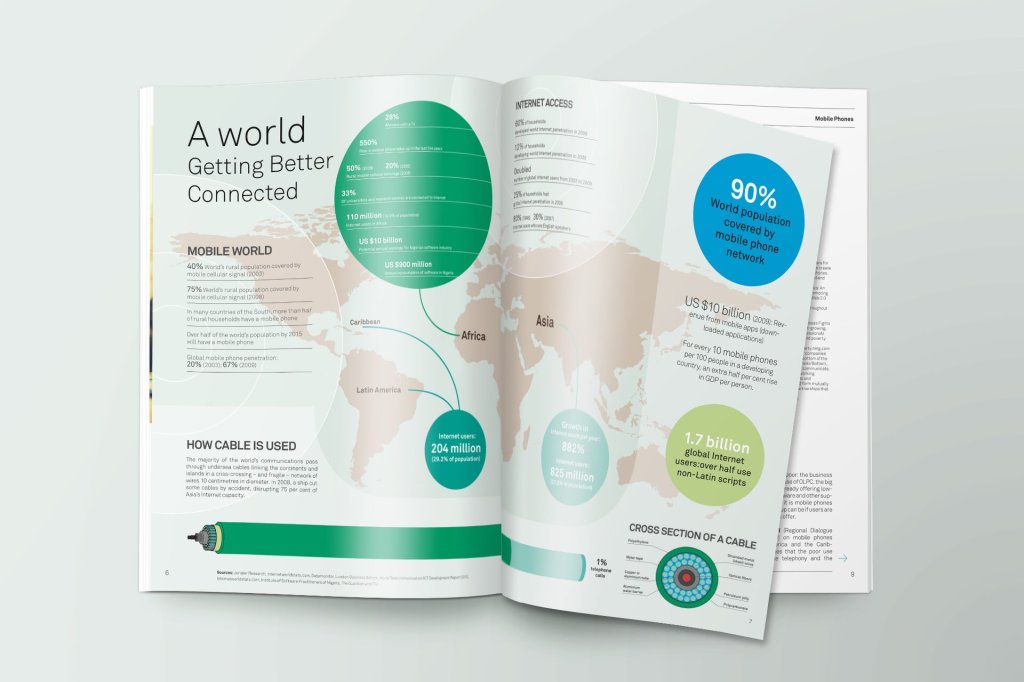
    The number of mobile phone subscribers in Africa surpassed 300 million in 2008 (ITU), representing a significant market in their own right. Research group Informa Telecoms and Media estimates mobile networks now cover 90 per cent of the world’s population – 40 per cent of whom are covered but not connected.

    ShopAfrica53 works like this: merchants first fill out an online form on the ShopAfrica53 website. They are then contacted by ShopAfrica, and an account is set up.

    People wanting to buy goods and services on the website use the African Liberty Card to ensure the transactions are safe and not at risk from hackers and fraudsters. The disposable pre-paid scratch card can be used on mobile phones and the Internet and is purchased from store outlets.

    ShopAfrica handles the logistical hassles of shipping to customers around the world, facilitates payment transfers, and helps with record keeping for merchants.

    ShopAfrica offers an eclectic selection of goods: apparel and accessories, books and stationery, groceries, handicraft, health and personal care, home and garden, machinery and tools, technology and entertainment. It promises to offer the “best selection of African products, anywhere, worldwide” – everything from building supplies, household items and electronics to processed foods and fabrics.

    One Ghanaian merchant, Mohammed Salifu, promises to deliver in two days a “large brown cow for delivery or collection. The size, colour and weight of animal will vary. This merchant provides live goats, sheep, cattle for special occasions and festivities and can also provide a slaughtering service for clients.”

    Then there is Vera Ami Kpogli, who is selling a ‘Beyonce’ Electric Blue necklace. Tse-Lee Fashions offers Batik/Tie and Dye Print Shirt in aqua and navy. And for the ‘king’ of the house, Ama Afrique Designs is selling Men’s Royal Rulers, sandals “worn many centuries ago by African kings.”

    The potential of this service to boost incomes is considerable: in the United Kingdom, online sales now make up 15 percent of all retail spending, reaching £43.8 billion (US $66.12 billion) in 2008 (IMRG).

    As has been seen with other countries of the Global South, trade in high quality goods boosts incomes. South-South trade grew by an average of 13 percent per year between 1995 and 2007. By 2007, South-South trade made up 20 percent of world trade. And over a third of South-South commerce is in high-skill manufacturing. Making finished goods, rather than just selling raw materials, improves workers’ skill levels and increases the return on trade.

    The rapid changes to African countries – the tilt to being more urban than rural, and being home to a larger urban population than North America, with 25 of the world’s fastest growing cities (International Institute for Environment and Development) – means there is an urgent need to boost incomes and better connect traders and manufacturers to the global economy.

    ShopAfrica53 could be the start of a very big thing for African trade.

    Published: May 2009

    Resources

    • The red dot logo stands for belonging to the best in design and business. The red dot is an internationally recognised quality label for excellent design that is aimed at all those who would like to improve their business activities with the help of design.
      Website: www.red-dot.de
    • BOP Source is a platform for companies and individuals at the BOP (bottom of the pyramid) to directly communicate, ultimately fostering close working relationships, and for NGOs and companies to dialogue and form mutually valuable public-private partnerships that serve the BOP.
      Website: http://bopsource.ning.com/
    • Business Fights Poverty: Business Fights Poverty is the free-to-join, fast-growing, international network for professionals passionate about fighting world poverty through good business.
      Website: businessfightspoverty.ning.com
    • Dutch Design in Development: As a matchmaker, DDiD puts together European clients, Dutch designers and small and medium-sized enterprises in developing countries. The designers share their knowledge of European consumer tastes, product development, design and quality standards
      Website: www.ddid.nl
    • Afriville is a Web 2.0 service and an African Caribbean social network. Afriville is a community website along the lines of the famous MySpace. Users are free to message and post profiles. The difference is that the user is able to choose how closed or open the networks are. The site features a state of the art music management system which allows African and Caribbean artists to get straight in touch with their fans.
      Website: www.afriville.com
    • Business Action for Africa: Business Action for Africa is an international network of businesses and business organisations from Africa and elsewhere, coming together in support of three objectives: to positively influence policies for growth and poverty reduction, to promote a more balanced view of Africa, and to develop and showcase good business practice in Africa
      Website: www.businessactionforafrica.org
    • Interactive Media in Retail Group (IMRG) is a membership community for the e-retail industry, whose vision is to maximise the commercial potential of online shopping
      Website: www.imrg.org

    https://davidsouthconsulting.org/2021/03/20/accessing-global-markets-via-design-solutions/

    https://davidsouthconsulting.org/2022/06/02/afghanistans-juicy-solution-to-drug-trade/

    https://davidsouthconsulting.org/2022/10/26/african-trade-hub-in-china-brings-mutual-profits-2/

    https://davidsouthconsulting.org/2021/03/20/carbon-markets-need-to-help-the-poor/

    https://davidsouthconsulting.org/2022/11/21/chinese-trade-in-angola-helps-recovery/

    https://davidsouthconsulting.org/2021/03/20/computer-gold-farming-turning-virtual-reality-into-real-profits/

    https://davidsouthconsulting.org/2022/04/12/djibouti-re-shapes-itself-as-african-trade-hub/

    https://davidsouthconsulting.org/2021/07/19/global-south-trade-boosted-with-increasing-china-africa-trade-in-2013/

    https://davidsouthconsulting.org/2020/12/12/mobile-phone-shopping-to-create-efficient-markets-across-borders/

    https://davidsouthconsulting.org/2021/12/08/new-media-markets-and-screen-finance/

    https://davidsouthconsulting.org/2022/10/26/perfume-of-peace-helps-farmers-switch-from-drug-trade/

    https://davidsouthconsulting.org/2022/10/04/popular-chinese-social-media-chase-new-markets/

    https://davidsouthconsulting.org/2021/07/19/south-south-trade-helping-countries-during-economic-crisis/

    https://davidsouthconsulting.org/2022/11/17/sos-shops-keep-food-affordable-for-poor-unemployed/

    https://davidsouthconsulting.org/2022/11/16/thai-organic-supermarkets-seek-to-improve-health/

    https://davidsouthconsulting.org/2022/10/20/trade-to-benefit-the-poor-up-in-2006-and-to-grow-in-2007/

    https://davidsouthconsulting.org/2020/04/17/virtual-supermarket-shopping-takes-off-in-china/

    https://davidsouthconsulting.org/2022/10/05/women-empowered-by-fair-trade-manufacturer/

    https://davidsouthconsulting.org/2022/06/16/women-mastering-trade-rules/

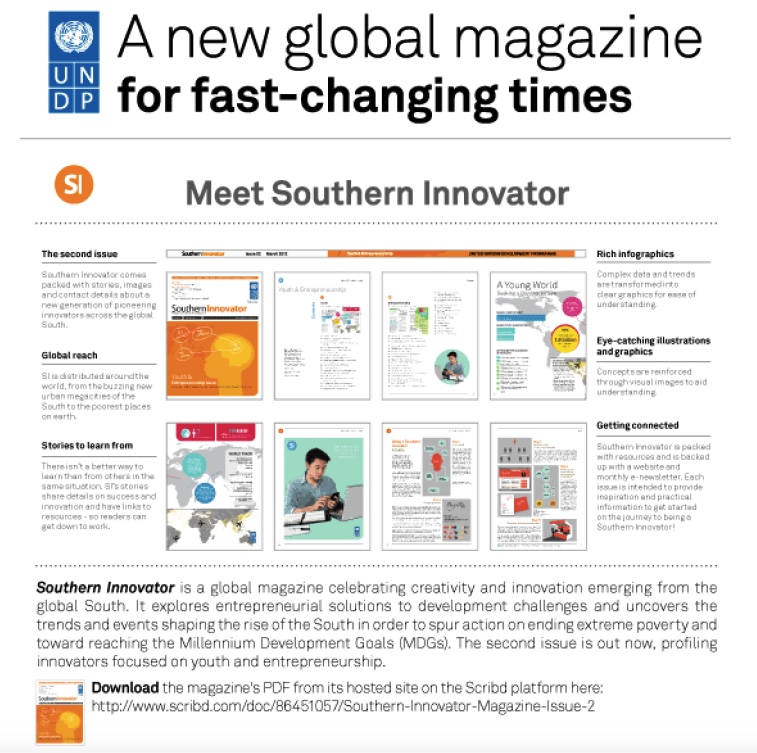
    Development Challenges, South-South Solutions was launched as an e-newsletter in 2006 by UNDP’s South-South Cooperation Unit (now the United Nations Office for South-South Cooperation) based in New York, USA. It led on profiling the rise of the global South as an economic powerhouse and was one of the first regular publications to champion the global South’s innovators, entrepreneurs, and pioneers. It tracked the key trends that are now so profoundly reshaping how development is seen and done. This includes the rapid take-up of mobile phones and information technology in the global South (as profiled in the first issue of magazine Southern Innovator), the move to becoming a majority urban world, a growing global innovator culture, and the plethora of solutions being developed in the global South to tackle its problems and improve living conditions and boost human development. The success of the e-newsletter led to the launch of the magazine Southern Innovator. 
    https://davidsouthconsulting.org/2021/03/05/southern-innovator-issue-2/

    Creative Commons License

    This work is licensed under a
    Creative Commons Attribution-Noncommercial-No Derivative Works 3.0 License.

    ORCID iD: https://orcid.org/0000-0001-5311-1052.

    © David South Consulting 2023

  • New Journal Celebrates Vibrancy of Modern Africa

    New Journal Celebrates Vibrancy of Modern Africa

    By David SouthDevelopment Challenges, South-South Solutions

    SOUTH-SOUTH CASE STUDY

    Africa has seen huge changes to its communications and media in the past five years. The rise and rise of mobile phones, the expansion of the Internet and the explosion in African blogging and social media, on top of flourishing print and broadcast media, all bring an increasing range of options for telling African stories and increasing dialogue.

    With all this new media creating new communications channels – and all the turmoil and change affecting millions as economies and countries change – people need the ability to make sense of it all. One magazine is trying to play that role.

    An entrepreneur and multimedia innovator has created a unique publication that is capturing the spirit, ideas and stories of modern Africa. It is a high-quality product, has gathered together talented writers and photographers and is gaining a growing global audience. Chimurenga Magazine (http://www.chimurenga.co.za/) based in Cape Town, South Africa, calls itself a “pan African publication of writing, art and politics.” Named for the Zimbabwean Shona word for “revolutionary struggle,” it is published three times a year. Editor Ntone Edjabe is from Cameroon and came to Cape Town in the 1990s after the end of South Africa’s racist Apartheid regime.

    With more than 100 contributors, the magazine offers insight into contemporary Africa, what occupies people’s thoughts and how their lives are actually lived.

    It is involved in a wide range of other activities, including co-curating a Global South Dialogue Series. And its readership is truly diverse.

    “We have readers who are long-term prisoners at Pretoria Central Prison, who have subscriptions that they get to us in coins, and readers who are successful businessmen,” Edjabe said to The Financial Times Magazine.

    Chimurenga is out to challenge perceptions of Africa. Practicing the art of long-form journalism more associated with established high-end publications like The New Yorker (newyorker.com), the magazine sets out to challenge perceptions about Africa.

    “Discourse on Africa is geared towards simplicity,” Edjabe told CNN. “Everything must be simple – ‘he’s a poor black man, he’s a victim’ – like there has to be a simple story, in a way this is what signifies Africa and global consciousness.

    “The moment you bring a degree of complexity to it, it kind of throws people off, they just don’t know where to look anymore. It’s like, ‘what’s going on?’ So Chimurenga in a way does not try to maintain the superficiality of this narrative – we engage with life, we try to present life as complex as it really is.”

    Stories in the journal include Billy Kahora writing on the decay of a neighbourhood in Nairobi, Kenya, Michael Abrahams writing about his time in the Cape Town mental hospital after a suicide attempt, and Sean O’Toole following a Zimbabwean immigrant on his journey into South Africa.

    The magazine’s website carries back issues of the journal, along with a shop selling magazines, books and t-shirts and the “Chimurenga Library,” an archive of pan-African, independent periodicals. There’s also live online streaming of music – “from ancient techno to future roots” – through the Pan African Space Station radio station, there is a biennial publication of urban life it calls “Africa-style,” and the writings of 14 African writers who visited 14 African cities to check-up on life in urban areas.

    As an example of the creativity of Chimurenga’s talent, a special issue of the magazine tried to better understand the impact of violence in South Africa in May 2008 that led to the deaths of 62 people. It did this by creating a fictitious newspaper called The Chimurenga Chronic (http://www.chimurenga.co.za/chimurenga-magazine/current-issue) set during the violence.

    The writers are a mix of Anglophones and Francophones, all based in Africa. Common subjects focus on the world of lower-middle class Africa. Examples of past issues show the variety of its content: Conversations With Poets Who Refuse To Speak, Futbol, Politricks & Ostentatious Cripples, Conversations in Luanda and Other Graphic Stories, *We’re all Nigerian!

    Well-travelled editor Edjabe has studied and lived in Lagos, Nigeria and Johannesburg, South Africa. He has worked as a disc jockey, music writer and basketball coach. He launched Chimurenga in 2002. He told The Financial Times Magazine “I printed 1,000 copies, which I carried around in my bag. I sold it mainly to friends.”

    It was supposed to be a one-off publication but became a journal, initially written mostly by his friends.

    “I found out later that this is how most journals actually begin,” he said. “At the time I thought it was unique.”

    He aspired to get Africans writing about the Africa they saw and lived in. The challenge was changing the dynamic he found of writers only considering something worth writing about if it had been featured in non-African media.

    Edjabe had already made his mark with an innovative initiative to show the diversity of what Africa has to offer. Three years after arriving in South Africa he started the Pan African Market (PAM) in Cape Town. An African cultural centre, it began as a craft market with various traders able to run their individual businesses and leasing stall space from the market. PAM became very successful because it brought together Africans from across the continent and offered a vibrant mix of artists, small businesses and food. It now has 33 stores and stalls from 14 countries of Africa. Shoppers can find arts and crafts, hair dressing, tailoring, holistic healing and catering.

    Hard copies of Chimurenga are distributed around Africa and sent to Europe, the United States and India.

    “There’s a feeling about writing something, sharing something that is beautiful and truthful from one’s perspective,” Edjabe told CNN.

    Published: June 2012

    Resources

    1) How to Start a Magazine: Simple online advice on starting and running a magazine. Website: http://www.ehow.com/how_16579_start-magazine.html

    2) Venture Capital for Africa: VC4Africa is the largest online community of investors, angels and entrepreneurs working to build businesses on the continent. Website: http://vc4africa.biz/landing/?redir_to=%2F

    https://davidsouthconsulting.org/2022/10/21/african-media-changing-to-reach-growing-middle-class/

    https://davidsouthconsulting.org/2021/01/05/development-challenges-south-south-solutions-newsletter/

    https://davidsouthconsulting.org/2021/07/14/freedom-of-expression-introducing-investigative-journalism-to-local-media-in-mongolia-1999-25-january-2016/

    https://davidsouthconsulting.org/2021/05/25/ger-mongolias-first-web-magazine-and-a-pioneering-web-project-for-the-united-nations-12-january-2016/

    https://davidsouthconsulting.org/2022/11/01/indian-newspapers-thrive-with-economy/

    https://davidsouthconsulting.org/2022/10/04/popular-chinese-social-media-chase-new-markets/

    https://davidsouthconsulting.org/2022/11/01/southern-innovator-magazine-2010-2014/

    Development Challenges, South-South Solutions was launched as an e-newsletter in 2006 by UNDP’s South-South Cooperation Unit (now the United Nations Office for South-South Cooperation) based in New York, USA. It led on profiling the rise of the global South as an economic powerhouse and was one of the first regular publications to champion the global South’s innovators, entrepreneurs, and pioneers. It tracked the key trends that are now so profoundly reshaping how development is seen and done. This includes the rapid take-up of mobile phones and information technology in the global South (as profiled in the first issue of magazine Southern Innovator), the move to becoming a majority urban world, a growing global innovator culture, and the plethora of solutions being developed in the global South to tackle its problems and improve living conditions and boost human development. The success of the e-newsletter led to the launch of the magazine Southern Innovator. 

    https://davidsouthconsulting.org/2021/03/05/southern-innovator-issue-1/

    Creative Commons License

    This work is licensed under a
    Creative Commons Attribution-Noncommercial-No Derivative Works 3.0 License.

    ORCID iD: https://orcid.org/0000-0001-5311-1052.

    © David South Consulting 2022

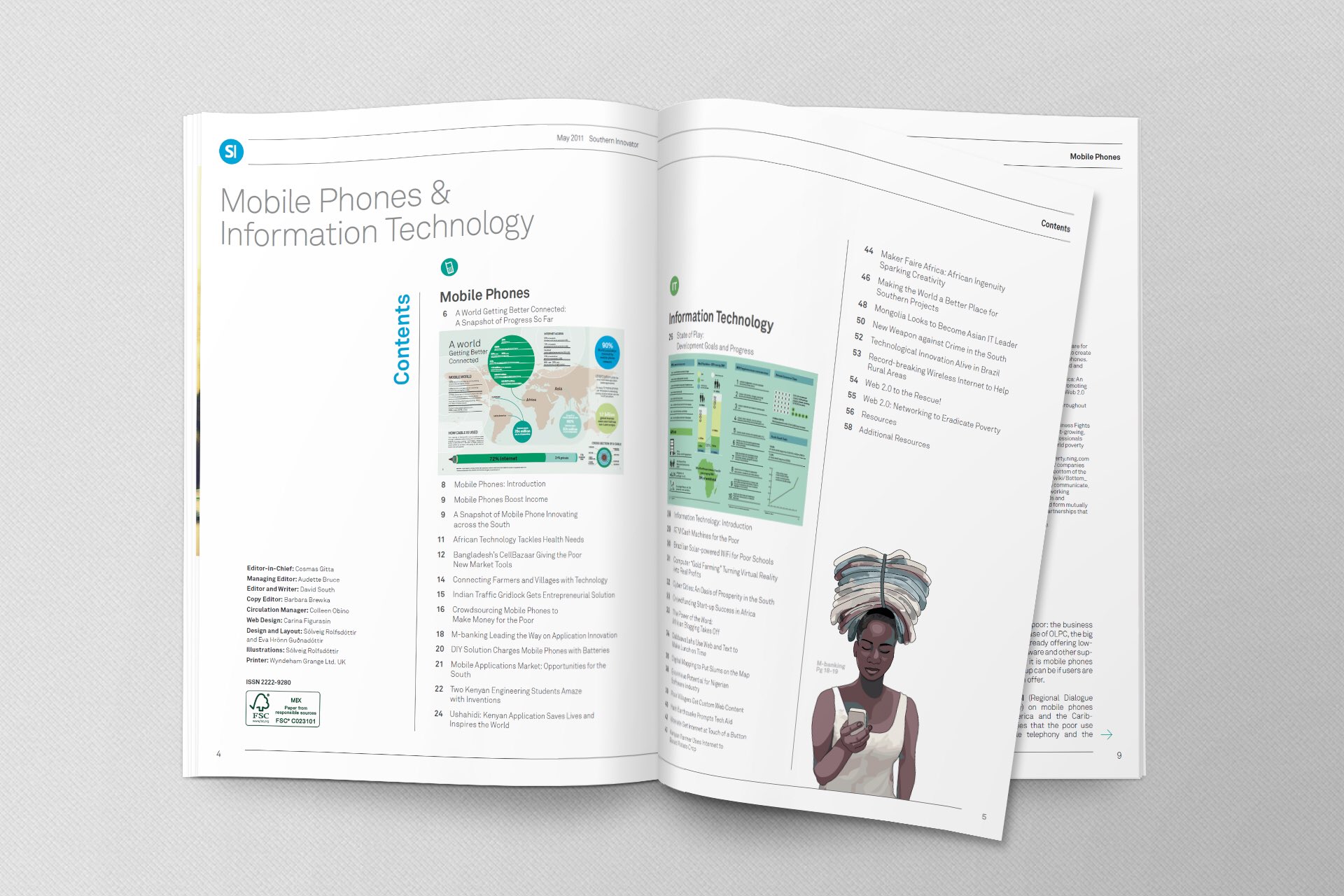
  • Southern Innovator Magazine | 2010 – 2014 

    Southern Innovator Magazine | 2010 – 2014 

    By David South

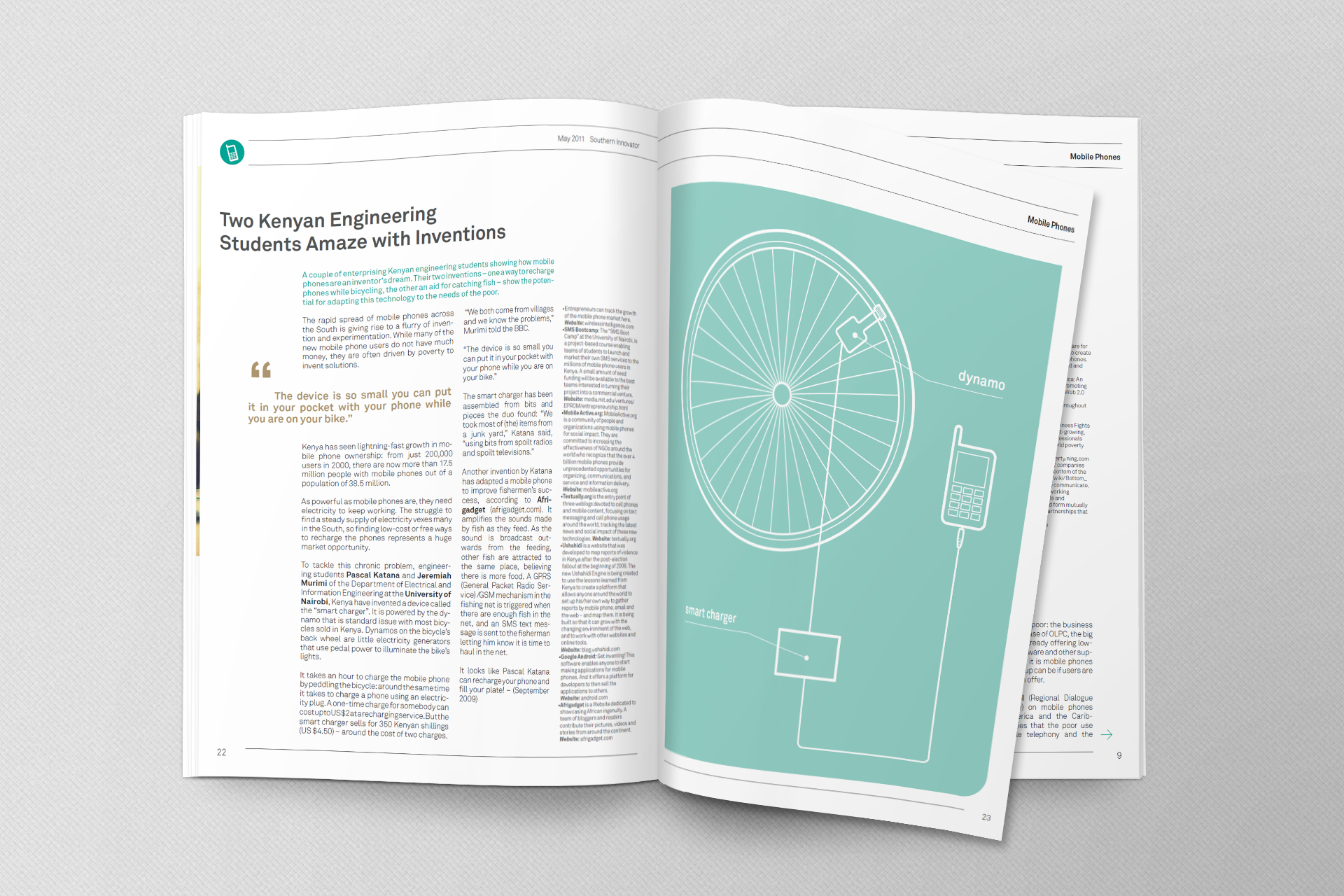
    “I think you [David South] and the designer [Solveig Rolfsdottir] do great work and I enjoy Southern Innovator very much!” 

    Ines Tofalo, Programme Specialist, United Nations Office for South-South Cooperation
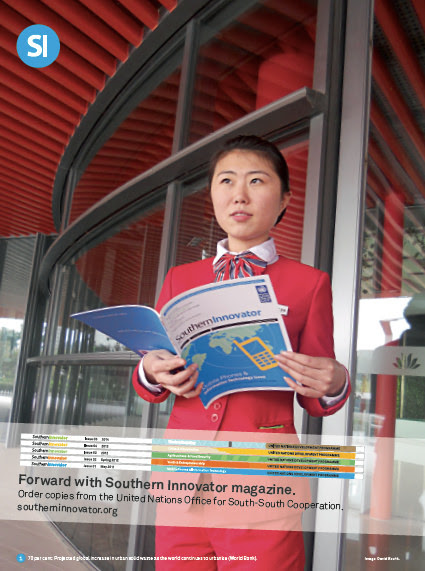
    Southern Innovator in Tianjin, China.
    Issue 5 of Southern Innovator at the Global South-South Development Expo (GSSD Expo) 2014 held in Washington, D.C.
    Volunteers in Nairobi, Kenya pose with Southern Innovator Issue 4 at the Global South-South Development Expo (GSSD Expo) in 2013.
    Southern Innovator Editor and Writer David South in Australia.
    Southern Innovator Graphic Designer and Illustrator Sólveig Rolfsdóttir in Iceland.

    Some comments that have come in so far about SI’s first issue:

    “What a tremendous magazine your team has produced! It’s a terrific tour de force of what is interesting, cutting edge and relevant in the global mobile/ICT space… Really looking forward to what you produce in issues #2 and #3. This is great, engaging, relevant and topical stuff.”, to “Looks great. Congratulations. It’s Brill’s Content for the 21st century!”

    What they are saying about SI on Twitter: From @CapacityPlus Nice job RT @ActevisCGroup: RT @UNDP: Great looking informative @SouthSouth1 mag on South-South Innovation; @UNDP Great looking informative @SouthSouth1 mag on South-South Innovation; @JeannineLemaireGraphically beautiful & informative @UNDP Southern Innovator mag on South-South Innov. 

    And on Pinterest:

    Peggy Lee • 1 year ago 

    “Beautiful, inspiring magazine from UNDP on South-South innovation. Heart is pumping adrenaline and admiration just reading it”

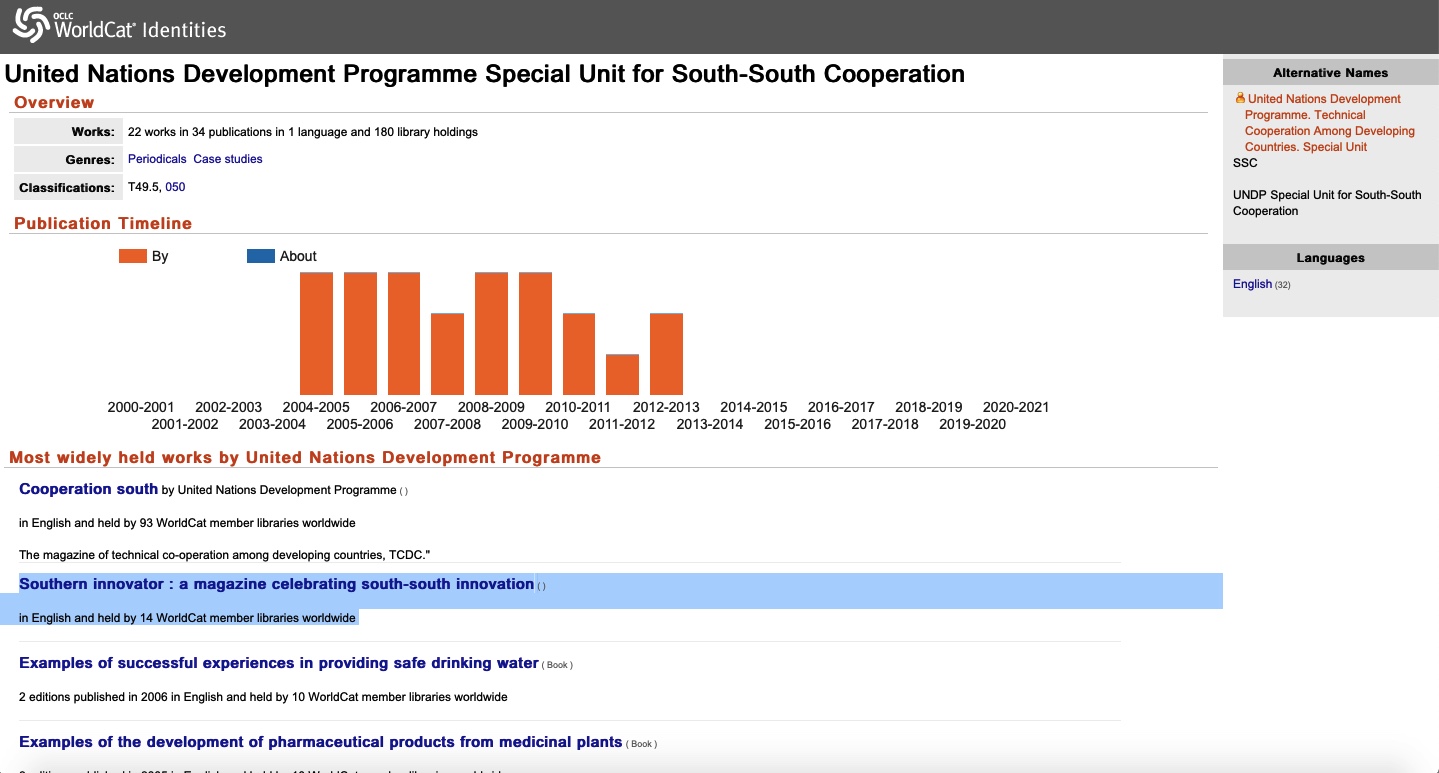
    Southern Innovator Magazine can be found in libraries around the world.

    Development Challenges, South-South Solutions was launched as an e-newsletter in 2006 by UNDP’s South-South Cooperation Unit (now the United Nations Office for South-South Cooperation) based in New York, USA. It led on profiling the rise of the global South as an economic powerhouse and was one of the first regular publications to champion the global South’s innovators, entrepreneurs, and pioneers. It tracked the key trends that are now so profoundly reshaping how development is seen and done. This includes the rapid take-up of mobile phones and information technology in the global South (as profiled in the first issue of magazine Southern Innovator), the move to becoming a majority urban world, a growing global innovator culture, and the plethora of solutions being developed in the global South to tackle its problems and improve living conditions and boost human development. The success of the e-newsletter led to the launch of the magazine Southern Innovator. 
    https://davidsouthconsulting.org/southern-innovator-scale-up-fundraiser/

    Creative Commons License

    This work is licensed under a
    Creative Commons Attribution-Noncommercial-No Derivative Works 3.0 License.

    ORCID iD: https://orcid.org/0000-0001-5311-1052.

    © David South Consulting 2022

  • Arab World Domain Name Opportunity Huge Economic Help

    Arab World Domain Name Opportunity Huge Economic Help

    By David SouthDevelopment Challenges, South-South Solutions

    SOUTH-SOUTH CASE STUDY

    With the so-called Arab Spring still unfolding across much of the Arabic-speaking world, it is easy to miss a rising new economic opportunity: The introduction of an Arabic domain name system for the Internet.

    The explosion in mobile phones in the Arab world has dramatically increased the number of people who can now access the Internet. One Arabic financial website put the number of people who can now access the Internet in one way or another in the Arab world as 75 million (www.nuqudy.com). As highlighted in the 2003 Arab Human Development Report (AHDR), Arabic-speaking countries have been at a knowledge disadvantage for some time: more than 270 million citizens have access to fewer books than other languages, slower growth economies, and greater illiteracy than the faster-growing emerging economies. At the time, the AHDR found there were just 18 computers per 1,000 people compared to a global average of 78. And just 1.6 percent of Arabs had Internet access, one of the lowest ratios in the world (AHDR 2003).

    Since the dawn of the Internet, Latin script has been used exclusively for top-level web domain names, the addresses that end .com, .org and so on. That has been a big obstacle for users of non-Latin script languages like Arabic. It is estimated just 10 percent of people in the Arab world speak English. Many of the resources on the Internet and its utility have been lost to these people. But by using Arabic domain names, there will be a consistency and no more guesswork.

    A typical problem in Latin transliterations of Arabic is the conundrum as to either using El or Al as the prefix to a word. This problem is eliminated when Arabic is used.

    The Arab world is also very mixed, including the resource-rich, cash-rich Gulf States – Kuwait, Qatar, United Arab Emirates, Saudi Arabia, Oman and Bahrain – and states with high rates of poverty such as Egypt, Djibouti and Yemen.

    The protests and uprisings this year in Tunisia, Egypt and elsewhere – with their Facebook pages and Twitter streams – have shown that a growing group of highly Internet-savvy young people is emerging in the Arab world. But for many without the education or the resources, access to knowledge still remains weak. But armed with Internet-capable mobile phones and Arabic language domain names, rapid change is now possible.

    The number of books published in Arabic is notoriously relatively low, and print runs are small. Arabic language books make up just 1.1 percent of world production.

    The AHDR reports have called this knowledge deficit a direct obstacle to human development in Arab countries.

    But things are changing and the rise of Arabic domain names offers the potential for an explosion in Arabic language Internet content.

    In May 2010 ICANN, the world’s Internet domain authority, decided to allow top-level domains in non-Latin script. For Arabic speakers, it started this program in Egypt, Saudi Arabia and the United Arab Emirates.

    As a sign of the importance of Arabic participation in future growth of the Internet, this year’s World Summit for the Information Society (WSIS) held in Geneva, Switzerland in May 2011 was sponsored by the United Arab Emirates (UAE).

    A catchy domain name has many advantages. For Arabic speakers, this means they can type in Arabic domain names for websites and even do it right to left, as they do in print.

    In 2009, the first Arabic domain name was grabbed by Egypt. As the Internet naming authority, the Internet Corporation for Assigned Names and Numbers (ICANN) (www.icann.org), started to allow the registering of non-Latin script names. The domain was for the Arabic word for Egypt or “.masr”.

    As an early adopter, Egypt sees it as an important part of bringing more Arabic speakers online. George Victor, from the Egyptian National Telecom Regulatory Authority, told the BBC: “We believe that this is a great step that will open new horizons for many e-services in Egypt, and it will have its direct impact, enlarging the number of online users.”

    Victor believes using Arabic builds trust.

    “Having a domain name in your own language is a point of having a local identity,” he said.

    “When talking about Arabic domain names, we are talking about having users which are not online now. People with languages disabilities – people who are having language as a barrier to connect online.”

    From now on Internet address names will be able to end with almost any word in any language, offering organizations around the world the opportunity to market their brand, products, community or cause in new and innovative ways.

    The advantages of registering an Arabic domain name are numerous. They include clear improvements to business and trade: an ability to protect a trademark, better communication with Arabic customers, better Arabic-language advertising opportunities, better memorability for Arabic domain names because they will be in the Arabic language, and greater access to Arabic customers.

    But there are also significant improvements to how the Internet functions in the Arabic world. Search results on Arabic search engines will be more precise with Arabic domain names; catchy, memorable domain names will be a spur to the advertising and marketing industries; and a more Arab-friendly Internet will draw in more Arabic-speaking Internet users, helping them to enjoy the fruits of this great technological advance just as speakers of other languages have.

    In March 2011, the Gulf state of Qatar enthusiastically started to offer Arabic domain names.

    “The launch of Qatar’s Arabic top-level domain names is a major milestone as we work to build a more digitally inclusive society,” said Dr. Hessa Al Jaber, Secretary General of the Supreme Council of Information and Communication Technology, which will manage Qatar’s Internet domain names through the Qatar Domains Registry.

    “As more organizations and individuals begin adopting Arabic domain names, the Internet will literally be opened up to broad new audiences. The Arab world represents a region with enormous potential for growth both in terms of usage and the creation of new digital content, especially Arabic content.”

    ICANN’s President and Chief Executive, Rod Beckstrom, sees this as a new phase for the Internet: “ICANN has opened the Internet’s naming system to unleash the global human imagination. Today’s decision respects the rights of groups to create new Top Level Domains in any language or script. We hope this allows the domain system to better serve all of mankind.”

    Published: July 2011

    Resources

    1) Watch the ICANN educational video “Get Ready for the Next Big Thing”, explaining how domain names work and what the changes mean. Website: http://www.icann.org

    https://davidsouthconsulting.org/2022/10/26/africa-to-get-own-internet-domain/

    https://davidsouthconsulting.org/2022/11/11/berber-hip-hop-helps-re-ignite-culture-and-economy/

    https://davidsouthconsulting.org/2020/12/04/data-surge-across-global-south-promises-to-re-shape-the-internet/

    https://davidsouthconsulting.org/2022/02/11/egyptian-youth-turns-plastic-waste-into-fuel/

    https://davidsouthconsulting.org/2022/11/11/innovation-cairos-green-technology-pioneers/

    https://davidsouthconsulting.org/2022/10/29/new-apps-make-driving-and-travelling-in-egypt-easier-safer/

    https://davidsouthconsulting.org/2022/10/21/preserving-beekeeping-livelihoods-in-morocco/

    https://davidsouthconsulting.org/2022/10/21/social-networking-websites-a-way-out-of-poverty/

    Development Challenges, South-South Solutions was launched as an e-newsletter in 2006 by UNDP’s South-South Cooperation Unit (now the United Nations Office for South-South Cooperation) based in New York, USA. It led on profiling the rise of the global South as an economic powerhouse and was one of the first regular publications to champion the global South’s innovators, entrepreneurs, and pioneers. It tracked the key trends that are now so profoundly reshaping how development is seen and done. This includes the rapid take-up of mobile phones and information technology in the global South (as profiled in the first issue of magazine Southern Innovator), the move to becoming a majority urban world, a growing global innovator culture, and the plethora of solutions being developed in the global South to tackle its problems and improve living conditions and boost human development. The success of the e-newsletter led to the launch of the magazine Southern Innovator. 
    Creative Commons License

    This work is licensed under a
    Creative Commons Attribution-Noncommercial-No Derivative Works 3.0 License.

    ORCID iD: https://orcid.org/0000-0001-5311-1052.

    © David South Consulting 2023