Tag: Issue 1

  • Happy Nigeria: West African Nation Has Good Attitude

    Happy Nigeria: West African Nation Has Good Attitude

    By David SouthDevelopment Challenges, South-South Solutions

    SOUTH-SOUTH CASE STUDY

    In the last 10 years, an increasing amount of attention has been paid to the concept of national happiness. The notion was first developed in the tiny Asian Kingdom of Bhutan (http://en.wikipedia.org/wiki/Bhutan), whose advocacy of ‘gross national happiness’ (http://www.grossnationalhappiness.com/) as a measure of national achievement just as important as Gross National Product (GNP), has been met with equal parts ridicule, respect and research.

    Recently it has moved from being the realm of philosophers, therapists and self-help gurus to a growing academic discipline.

    One country to consistently clock high results in polls and studies of national happiness is the West African nation of Nigeria. Africa’s most-populous country – and one of the continent’s economic powerhouses and fast-growers – its positive outlook has left many perplexed because it is a country of extremes of poverty and wealth.

    In the World Values Survey (http://www.worldvaluessurvey.org) Nigeria came top for happiness in 2003, followed by Mexico.

    Nigerians also scored highly for optimism in a Gallup International poll of economic prospects, optimism and personal well-being for 2011, which found the largest number of optimists to be in emerging market countries like China, India and Brazil. The most pessimistic country in the survey of 64,000 people in 53 countries was the United Kingdom.

    Gallup’s global polling identified the qualities of a good, productive life: a highly engaging job, spending six to seven hours a day socialising, and exercising five to six days a week.

    It also found another factor: the more a person rates their country as positive, the better they feel. This was an especially important factor for the poor and people in poor countries.

    In a related factor, researchers of the World Values Survey found that the desire for material goods is “a happiness suppressant.”

    Nigeria takes pride in its status in these surveys: airports proudly boast on signboards about the country being “The Happiest Place in the World!”.

    But how does Nigeria’s optimism square with its well-documented problems, from endemic corruption and sectarian violence to civil unrest and poverty?

    In the Guardian newspaper, Bim Adewunmi tried to nail it down: “Daily life is hardly one glorious Technicolor dance sequence, but I have never lived in such a happy place – and I once lived in hippyville California. I can’t give a definite answer, but I think the joy comes from seeing and living through the worst that life can offer; it is an optimism born of hope.

    “There’s a spirit of entrepreneurship – people seem bewildered if you admit a lack of ambition. Nigerians want to go places and believe – rightly or wrongly – that they can. That drive and ambition fuels their optimism; they’re working towards happiness, so they’re happy.”

    Nigerian writer T. C. Ubochi made an attempt in an essay to get to grips with why Nigerians are the happiest people in the world, writing:

    “I’ve come to learn to basically have hope … The best thing about living in Nigeria is the abiding knowledge and expectation of a Miracle – even if it doesn’t happen in this lifetime.” 

    And despite its woes, Nigeria has many things to be positive about: a fast-growing economy that saw gross domestic product rise by 7.85 percent in 2010; a big influence in Africa and its fate; and a powerful cultural reach, from musicians like Fela Kuti to writers like Chinua Achebe, Chris Abani and Wole Soyinka, to its celebrated art. And of course oil, a blessing of wealth and a curse.

    While arguments abound over what constitutes true happiness, academics are honing in on which lifestyle choices best lead to happiness and which should be avoided. It is a scientific approach akin to the one taken by the medical profession on human health.

    Nigeria consistently ranks top in happiness but just middle for life satisfaction. But surveys are notorious for people’s values skewing results. In Latin America, it is better to be upbeat about life. In Asian cultures, there is no shame attached to being unhappy and collective well-being is more valued.

    Shinobu Kitayama at Kyoto University in Japan and Hazel Rose Markus at Stanford University, California, told the New Scientist that an individual’s level of life satisfaction depends largely on how successfully they adhere to their particular cultural “standard”. Americans tend to value personal achievement, while Japan places greater emphasis on meeting family expectations, social responsibilities, self-discipline, cooperation and friendliness.

    And single-minded pursuit of personal happiness – something that tends to lead to a high score on surveys – also comes from societies with high levels of suicide.

    “There are some real downsides to individualistic cultures,” Ed Diener of the University of Illinois at Urbana-Champaign told the New Scientist. “People with mental illness are in real trouble with no extended family to watch over them.”

    And a good attitude just may be the thing that gives Southern economies that extra edge in the years ahead.

    Published: March 2011

    Resources

    1) Journal of Happiness Studies: The peer-reviewed Journal of Happiness Studies is devoted to scientific understanding of subjective well-being. Website:http://www.springer.com/social+sciences/well-being/journal/10902

    https://davidsouthconsulting.org/2022/11/21/africa/

    https://davidsouthconsulting.org/2022/11/11/african-breakthroughs-to-make-life-better/

    https://davidsouthconsulting.org/2022/11/20/african-bus-to-tackle-african-roads/

    https://davidsouthconsulting.org/2022/10/20/african-countries-re-branding-for-new-economic-role/

    https://davidsouthconsulting.org/2022/11/19/african-culture-as-big-business/

    https://davidsouthconsulting.org/2022/10/20/african-hotel-boom-bringing-in-new-investment-and-creating-jobs/

    https://davidsouthconsulting.org/2022/11/17/african-ingenuity-attracting-interest/

    https://davidsouthconsulting.org/2022/10/21/african-media-changing-to-reach-growing-middle-class/

    https://davidsouthconsulting.org/2022/11/02/african-online-supermarket-set-to-boost-trade/

    https://davidsouthconsulting.org/2022/10/20/african-tourism-leads-the-world-and-brings-new-opportunities/

    https://davidsouthconsulting.org/2022/04/01/new-african-film-proving-power-of-creative-economy/

    https://davidsouthconsulting.org/2020/11/30/nollywood-booming-nigerian-film-industry/

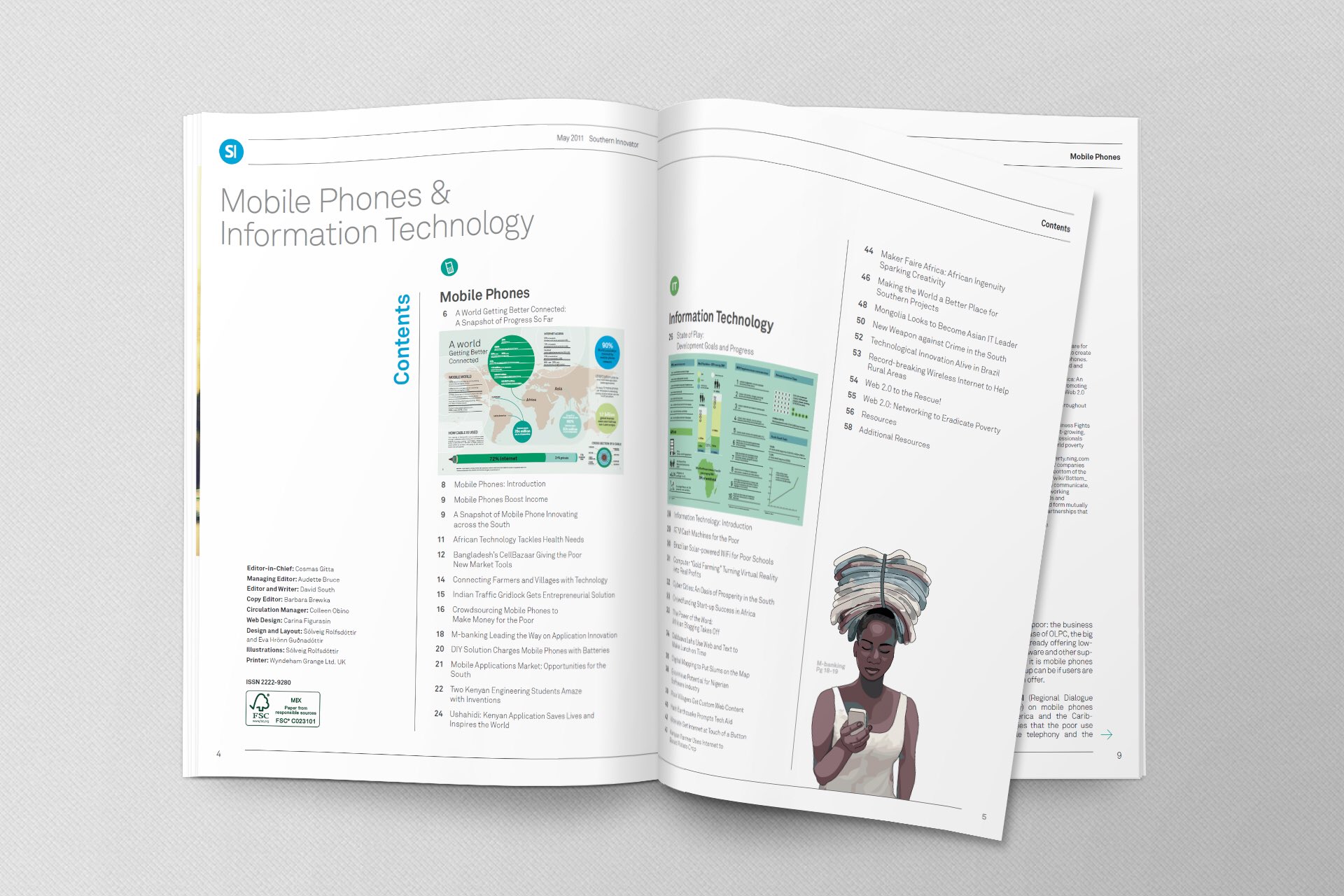
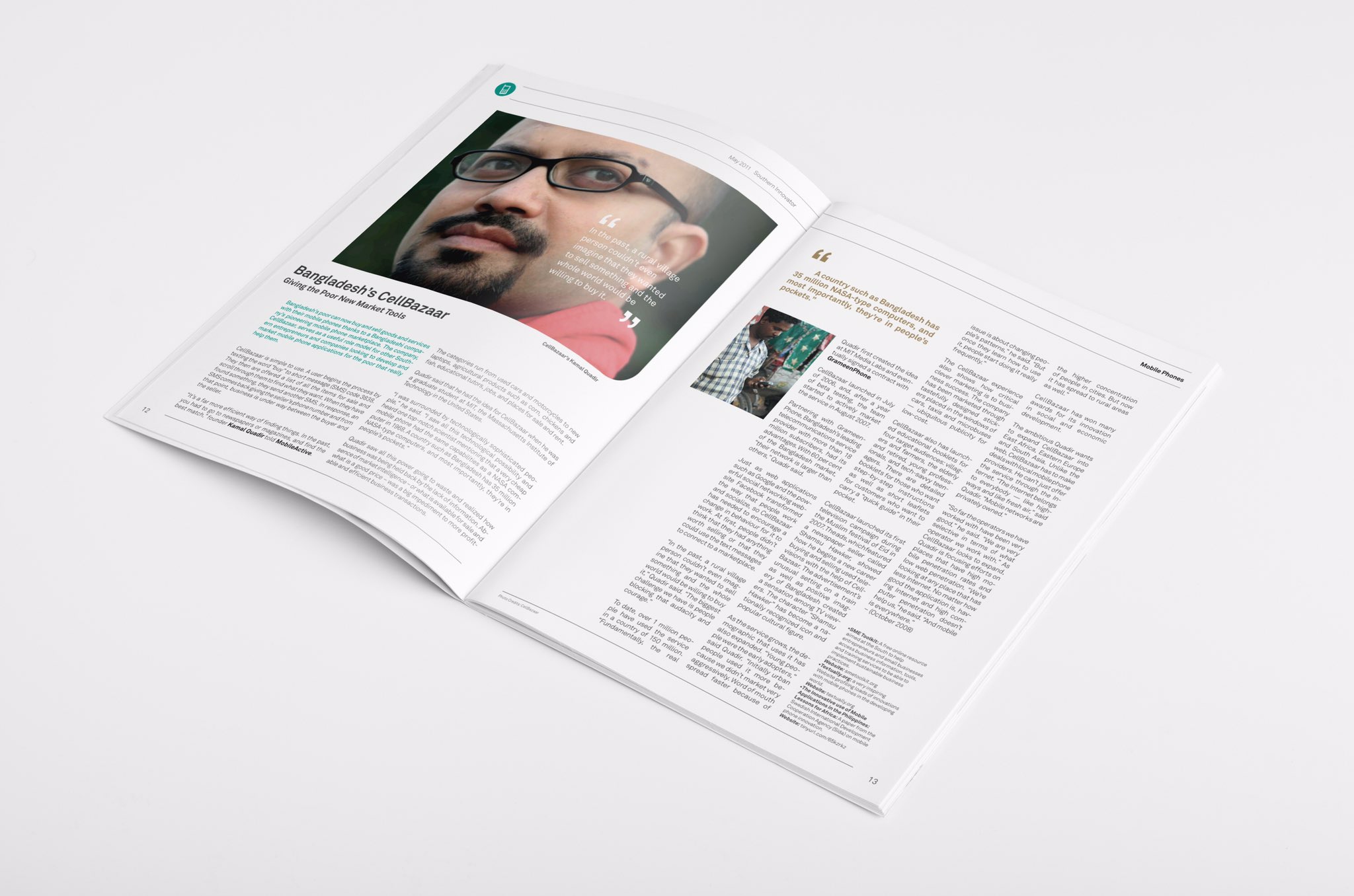
    Development Challenges, South-South Solutions was launched as an e-newsletter in 2006 by UNDP’s South-South Cooperation Unit (now the United Nations Office for South-South Cooperation) based in New York, USA. It led on profiling the rise of the global South as an economic powerhouse and was one of the first regular publications to champion the global South’s innovators, entrepreneurs, and pioneers. It tracked the key trends that are now so profoundly reshaping how development is seen and done. This includes the rapid take-up of mobile phones and information technology in the global South (as profiled in the first issue of magazine Southern Innovator), the move to becoming a majority urban world, a growing global innovator culture, and the plethora of solutions being developed in the global South to tackle its problems and improve living conditions and boost human development. The success of the e-newsletter led to the launch of the magazine Southern Innovator.

    https://davidsouthconsulting.org/2021/03/05/southern-innovator-issue-1/

    https://davidsouthconsulting.org/2021/03/05/southern-innovator-issue-2/

    Creative Commons License

    This work is licensed under a
    Creative Commons Attribution-Noncommercial-No Derivative Works 3.0 License.

    ORCID iD: https://orcid.org/0000-0001-5311-1052.

    © David South Consulting 2023

  • Venezuela’s Currencies Promote Cooperation Not Competition

    Venezuela’s Currencies Promote Cooperation Not Competition

    By David SouthDevelopment Challenges, South-South Solutions

    SOUTH-SOUTH CASE STUDY

    The global economic crisis has spread around the world and is bringing many problems in its wake.  As global currency markets gyrate wildly, and people find they can go from having wealth to being poor almost overnight, the question is being asked: “is there another way?”

    The global economy is slowing rapidly. Even Iceland – a country recently named as having the best quality of life in the world (Human Development Index) (HDI) – has gone broke, and many other nations around the world will face serious economic crises. People will need to protect themselves from the worst effects of the fallout from various economic bubbles bursting.

    Runaway inflation, as is occurring in Zimbabwe – reaching 231 million percent in October, 2008 according to official sources – shows faith in a country’s currency can be sorely tested. But do people and the poor in particular, need to be prisoners of the economy managed by a national currency?

    The ‘prosumer’ movement (http://en.wikipedia.org/wiki/Prosumer), where consumers take an active role in re-shaping markets and economies to their benefit, around the world is looking for ways to bypass national currencies and make food, goods and services more affordable and stable, improving the lives of the poor. One way this is done is through alternative currencies (http://en.wikipedia.org/wiki/Alternative_currency).

    Cimarrones, or the Cimarron, joins 10 other alternative currencies currently in operation across Venezuela. They are circular cardboard tokens with a picture of a runaway slave on them.

    Supported by Hugo Chavez, the country’s president, the new currencies are aimed at tackling poverty and establishing new economies. The currencies can’t be exchanged for the Venezuelan currency, the bolivar.

    It works like this: to be a prosumer, you must first bring something to sell before you can buy anything. The range of products for sale at prosumer markets is not vast, but that isn’t the point.

    “It’s magic,” Pablo Mayayo, an Argentinian advising Venezuela on prosumer schemes, told The Economist. “ When you take away money, which is the cause of almost all the great evils in the world, people relate to each other in a different way, by cooperating, not competing.”

    Argentina pioneered so-called “barter markets” in response to its economic crises, helping people avoid starvation, looting and perhaps a revolution. By the end of 2002, there were 4,500 barter markets being used by half a million people producing 600 million credits.

    “They were organized geographically around church halls, car parks and baseball courts,” recalled Peter North, a Liverpool University geographer. “They offered a wide range of products and services, supplied by professionals, trades people and farmers, as well as housewives and the unemployed. Stalls attracted ‘prosumers’ in their thousands, who paid with credit coupons issued by one or more barter markets. Everyone involved was both a prosumer and a producer, since you couldn’t purchase credits or exchange them for pesos.”

    In Rio Chico, a small town in the Venezuelan coastal region of Barlovento, the prosumer currency market has people happy with the prices.

    “I grow coconuts,” said Angenia Hernandez. “In the shops they cost 3.5 bolivares each (US $1.63) at the official exchange rate), but we we’re going to sell them at [the equivalent of] 1.5.” She calls it an end to “commercial fascism.”

    Because of global currency speculation and investment flows, national currencies are not entirely at the control of national governments. High inflation seriously hurts the poor and low-waged, and national currencies can hurt the rural poor, who become prisoners to high interest rates charged by urban lenders.

    Turning to a local, alternative currency has many advantages: it stops currency speculation, stops the flow of wealth to urban areas, preserves purchasing power, keeps trading local. Avoiding the draining away of wealth to middlemen, it addresses currency scarcity, and fosters greater awareness of how economies function and the mechanisms of trade

    Criticism of these schemes say it is just a re-run of regressive company currencies and feudal tokens that were used in the past to control people and force them to only buy products from the landowner or boss.

    In Papua New Guinea , shells are used for money and are called Tabu.  It is an ancient currency system used by the Tolai people of East New Britain Island . Stephen Demeulenaere (www.network-economies.com), who has worked on alternative currencies around the world and helped with the re-introduction of the Tabu in Papua New Guinea , sees it playing a key role in the local economy.

    “Tabu was very effective at addressing poverty,” he said, “because anything could be purchased with it, from a handful of peanuts up to a piece of land or even a car, without needing national currency.  Tabu is produced traditionally by women, so theoretically nobody would suffer from a lack of it.  The advantage over the national currency is that it has a very long history of use, and people trust it more than the national currency.

    “Tabu builds wealth by facilitating the exchange of locally-produced goods and services which may not circulate in a ‘national-currency only’ economy, and values activities that may not be considered to be economically viable if the use of national currency was the only option.  In the west we see this where ‘mother’s work’, hobbies, mutual-aid and other traditional under-valued but economically important activities are not valued monetarily.

    “By encouraging the exchange of locally-produced goods and services, wealth is built in the community from the ground up.”

    Over 75,000 people now use the shells, usually traded in great rings.

    Getting the introduction of an alternative currency right is critical. In Argentina, such currencies were criticised for being manipulated by criminal gangs and political forces.

    “The main advice I have is to study the community closely, and our website at http://www.complementarycurrency.org, provides free resources for people wishing to start their system,” Demeulenaere said.

    “The system must be transparent so that people trust it and participate in maintaining its health and stability; democratic, so that it can not be abused by those in power; appropriate, so that it achieves general social and economic goals and aspirations of the community; and to be complementary to the regular economy so that the system helps its members to improve their lives economically.”

    At the Jai Marketplace in Thailand , all of the goods in the market can be bought entirely in the local currency called “Jai’. Jai is convertible to Thai Baht or to organic, locally made cow fertilizer, and is designed to improve the local economy and the climate for micro, small and medium enterprises through the local exchange network.

    Published: January 2009

    Resources

    https://davidsouthconsulting.org/2022/10/26/african-trade-hub-in-china-brings-mutual-profits-2/

    https://davidsouthconsulting.org/2022/10/14/cash-machines-for-the-poor/

    https://davidsouthconsulting.org/2020/12/15/development-challenges-south-south-solutions-newsletter-2007-2010-2/

    https://davidsouthconsulting.org/2020/12/15/development-challenges-south-south-solutions-newsletter-2011-2014-2/

    https://davidsouthconsulting.org/2022/04/12/djibouti-re-shapes-itself-as-african-trade-hub/

    https://davidsouthconsulting.org/2022/02/10/food-inflation-ways-to-fight-it/

    https://davidsouthconsulting.org/2022/10/20/global-souths-rising-economies-gain-investor-spotlight-2/

    https://davidsouthconsulting.org/2021/07/19/global-south-trade-boosted-with-increasing-china-africa-trade-in-2013/

    https://davidsouthconsulting.org/2022/07/01/poorest-countries-being-harmed-by-euro-currency-crisis/

    https://davidsouthconsulting.org/2022/11/17/sos-shops-keep-food-affordable-for-poor-unemployed/

    https://davidsouthconsulting.org/2021/07/19/south-south-trade-helping-countries-during-economic-crisis/

    https://davidsouthconsulting.org/2021/01/23/the-sweet-smell-of-failure-the-world-bank-and-the-persistence-of-poverty/

    https://davidsouthconsulting.org/2022/10/20/trade-to-benefit-the-poor-up-in-2006-and-to-grow-in-2007/

    https://davidsouthconsulting.org/2022/10/05/women-empowered-by-fair-trade-manufacturer/

    https://davidsouthconsulting.org/2022/06/16/women-mastering-trade-rules/

    Development Challenges, South-South Solutions was launched as an e-newsletter in 2006 by UNDP’s South-South Cooperation Unit (now the United Nations Office for South-South Cooperation) based in New York, USA. It led on profiling the rise of the global South as an economic powerhouse and was one of the first regular publications to champion the global South’s innovators, entrepreneurs, and pioneers. It tracked the key trends that are now so profoundly reshaping how development is seen and done. This includes the rapid take-up of mobile phones and information technology in the global South (as profiled in the first issue of magazine Southern Innovator), the move to becoming a majority urban world, a growing global innovator culture, and the plethora of solutions being developed in the global South to tackle its problems and improve living conditions and boost human development. The success of the e-newsletter led to the launch of the magazine Southern Innovator.

    https://davidsouthconsulting.org/2021/03/05/southern-innovator-issue-2/

    Creative Commons License

    This work is licensed under a
    Creative Commons Attribution-Noncommercial-No Derivative Works 3.0 License.

    ORCID iD: https://orcid.org/0000-0001-5311-1052.

    © David South Consulting 2023

  • Web 2.0: Networking to Eradicate Poverty

    Web 2.0: Networking to Eradicate Poverty

    By David SouthDevelopment Challenges, South-South Solutions

    SOUTH-SOUTH CASE STUDY

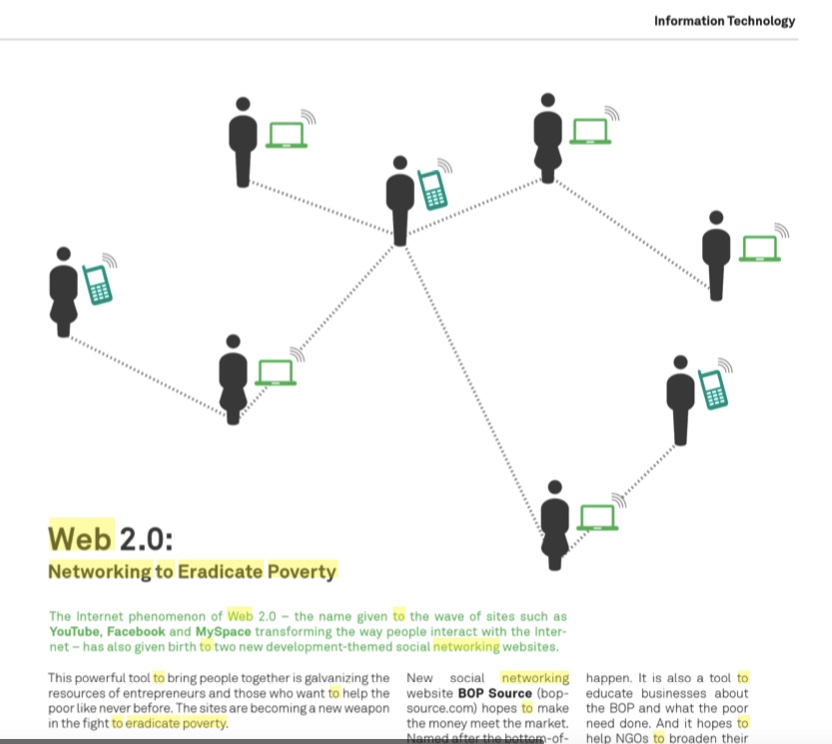
    The internet phenomenon of Web 2.0 (http://en.wikipedia.org/wiki/Web_2.0) – the name given to the wave of internet businesses and websites such as YouTube (www.youtube.com), Facebook and MySpace transforming the way people interact with the ‘Net – has also given birth to two new development-themed social networking websites.

    This powerful tool to bring people together is galvanizing the resources of entrepreneurs and those who want to help the poor like never before. The sites are becoming a new weapon in the fight to eradicate poverty.

    Social networking websites use various tools and applications (or ‘apps’ for short) to enhance the ability of users to connect and get things done. By bringing together a community of like-minded people, they are able to shorten the time it takes to organize and kick-start events. Web 2.0 can be used to build communities and social and business networks. By being able to store vast quantities of information online, it becomes faster to work and reduces the painful delays brought on by slow connections.

    All these new tools are making it easier and easier for entrepreneurs to work from home, in internet centres, or anywhere there is a wireless connection – and it is slashing the costs of managing a business. All the applications are online so there is no need to be hidebound by one operating system or hardware capability.

    Two newly launched social networking sites are targetting the poverty-eradication community.

    One is named after the Bottom of the Pyramid (BOP) concept as conceived by C.K. Prahalad. The BOP is the 4 billion people at the base of the global economic pyramid. As Prahalad sees it, they represent a vast market of unmet needs for entrepreneurs to tackle.

    New social networking website BOP Source hopes to make the money meet the market. Started by Jenara Nerenberg, BOP Source wants to put social networking tools into the hands of the world’s poor. It is a place to post business ideas and collaborate with others to make them happen. It is also a tool to educate businesses about the BOP and what the poor need done. And it hopes to help NGOs broaden their relationships with their constituencies and companies.

    While marketers can learn about the needs of the BOP, individuals can directly express their needs on the website and seek out the right people to solve problems.

    Another social networking website is Business Fights Poverty. Already at 1,000 members, it is a multimedia offering, with podcasts, videos, interviews and discussions about the role of business in addressing development goals.

    Published: November 2008

    Resources

    • BOP Source is a platform for companies and individuals at the BOP to directly communicate, ultimately fostering close working relationships, and for NGOs and companies to dialogue and form mutually valuable public-private partnerships that serve the BOP. Website: http://bopsource.ning.com/
    • Business Fights Poverty: Business Fights Poverty is the free-to-join, fast-growing, international network for professionals passionate about fighting world poverty through good business. Website: http://businessfightspoverty.ning.com/
    • Afriville is a Web 2.0 service and an African Caribbean social network. Afriville is a community website along the lines of the famous MySpace. Users are free to message and post profiles. The difference is that the user is able to choose how closed or open the networks are. The site features a state of the art music management system which allows African and Caribbean artists to get straight in touch with their fans.
    • Both Yahoo! And Google offer extensive free online tools for entrepreneurs and businesses that integrate seamlessly with their email services.
    • Kabissa: Space for Change in Africa: An online African web community promoting and supporting the transition to Web 2.0 services in Africa. Offers lots of opportunities to meet people throughout Africa and learn more.
    • Global Voices: An initiative from the Reuters news agency to aggregate the global conversation online from countries outside the US and Western Europe.
    • Information, Knowledge and Communication: Web 2.0 in Development Cooperation Bonn, Germany, 27-28 November 2008, Gustav Heinemann Haus. Website: http://www.eadi.org/index.php?id=994
    • 3rd IEEE/ACM International Conference on Information and Communication Technologies and Development (ICTD2009). Website: http://www.ictd2009.org

    https://davidsouthconsulting.org/2022/10/14/anti-bribery-website-in-india-inspires-others/

    https://davidsouthconsulting.org/2022/06/24/dabbawallahs-use-web-and-text-to-make-lunch-on-time/

    https://davidsouthconsulting.org/2022/03/07/david-south-consulting-ranked-in-the-top-10-million-websites/

    https://davidsouthconsulting.org/2021/05/25/ger-mongolias-first-web-magazine-and-a-pioneering-web-project-for-the-united-nations-12-january-2016/

    https://davidsouthconsulting.org/2022/06/25/shoes-with-sole-ethiopian-web-success-story/

    https://davidsouthconsulting.org/2022/10/21/social-networking-websites-a-way-out-of-poverty/

    https://davidsouthconsulting.org/2021/05/14/un-ukraine-web-development-experience-2000/

    https://davidsouthconsulting.org/2022/06/16/web-2-0-to-the-rescue-using-web-and-text-to-beat-shortages-in-africa/

    Development Challenges, South-South Solutions was launched as an e-newsletter in 2006 by UNDP’s South-South Cooperation Unit (now the United Nations Office for South-South Cooperation) based in New York, USA. It led on profiling the rise of the global South as an economic powerhouse and was one of the first regular publications to champion the global South’s innovators, entrepreneurs, and pioneers. It tracked the key trends that are now so profoundly reshaping how development is seen and done. This includes the rapid take-up of mobile phones and information technology in the global South (as profiled in the first issue of magazine Southern Innovator), the move to becoming a majority urban world, a growing global innovator culture, and the plethora of solutions being developed in the global South to tackle its problems and improve living conditions and boost human development. The success of the e-newsletter led to the launch of the magazine Southern Innovator. 

    Southern Innovator’s online archive portal was launched in New York City, U.S.A. (home to the UN’s headquarters) in 2011 (southerninnovator.org).
    Creative Commons License

    This work is licensed under a
    Creative Commons Attribution-Noncommercial-No Derivative Works 3.0 License.

    ORCID iD: https://orcid.org/0000-0001-5311-1052.

    © David South Consulting 2023
  • Maker Faire and the R & D Rise in the South

    Maker Faire and the R & D Rise in the South

    By David SouthDevelopment Challenges, South-South Solutions

    SOUTH-SOUTH CASE STUDY

    The majority of the world’s research and development (R & D) in science and technology is now shifting to the global South. Powerhouses like China boast vast numbers of published papers in peer-reviewed journals and hefty cash inputs into research and development.

    China increased its R & D spending in 2009 to US $25.7 billion, a 25.6 percent increase over 2008, according to Du Zhanyuan, vice minister of the Ministry of Science and Technology. China is rapidly closing the science funding gap with Japan: in 2009 it allotted US $37.1 billion for R & D.

    The times have never been better for those with new ideas in the global South.

    And it’s not just big companies that are involved. There is R & D going on at ground level as well. African inventors, innovators and creatives met in Nairobi, Kenya in August as part of the Maker Faire Africa 2010 (http://makerfaireafrica.com). This is research and development on a shoestring, and done in a very practical, problem-solving way. While Africa’s inventors and innovators lack the big budgets of other economies, they are not short on ideas and drive.

    The Maker Faire Africa is a family-friendly gathering where the inventors can showcase their work and connect with others. It is a mix of workshops, tips on business skills, awards and a party.

    The global economy thrives on innovation and so-called ‘creative destruction’ – as economist Joseph Schumpeter called it (http://en.wikipedia.org/wiki/Creative_destruction) – that takes place as out-of-date technologies and ways of doing are surpassed by better ideas and more efficient methods. The power to innovate is the deciding factor for sustained economic growth.

    The philosophy behind Maker Faire Africa 2010 – the brainchild of ‘venture catalyst’ and entrepreneur Emeka Okafor (http://timbuktuchronicles.blogspot.com) – is to prove that innovation doesn’t just happen with computers.

    As its website says, “The aim of a Maker Faire-like event is to create a space on the continent where Afrigadget-type innovations (http://www.afrigadget.com), inventions and initiatives can be sought, identified, brought to life, supported, amplified, propagated, etc.”

    Maker Faire Africa is working with research organizations like Ghana’s Ashesi University (http://www.ashesi.edu.gh/index.html) and Kwame Nkrumah University of Science and Technology (http://www.knust.edu.gh/pages) “to sharpen focus on locally-generated, bottom-up prototypes of technologies that solve immediate challenges to development.”

    In the end, the goal of engaging all this creative and inventive energy is to spur Africans towards building “a manufacturing base that supplies innovative products in response to market needs.”

    This initiative stands out in several ways: it is truly inspiring, it gets to the core of how wealth is created, and helps build communities of innovators and inventors to tackle the problems facing Africa – and humanity.

    “We have a broader variety of makers this time around,” says Emeka Okafor of the 2010 Maker Faire. He notes makers are bringing more complex systems to the Faire, rather than just single devices. And that they “have more makers who are actually from the region.”

    “Maker Faire Africa is essentially a platform whereby innovators, inventers, creative types, across all disciplines, share ideas, showcase their products, interact with attendees and other makers,” he continues. They “begin the process of building what we think is an essential community of what I like to term the productive class. That is essentially where we see ourselves playing a key role. A productive class whose foundation is laid upon building problem-solving systems.”

    Okafor believes Africa just doesn’t “have enough wealth creation as we should.”

    “We have things backwards. … One of the essential steps is that you had productive systems that allowed those countries (Asia and Europe) to create wealth. And they had to draw those resources from within.

    “We see Maker Fair Africa celebrating resources that we already have, with knowledge from within and outside.

    “In many ways the Makers as we see them, epitomise the very sense of problem-solving that as a society acquires more of it, it begins to deal with its challenges very differently. And not look elsewhere in terms of dealing with its challenges. We want to make our Makers sexy, we want to make inventors sexy, innovators celebrities.”

    Some of the inspiring inventors from this year’s Faire include Norbert Okec from Uganda. His prototype for a solar powered street lighting system comes straight from his frustration with the traffic lights of Kampala, Uganda. Many don’t work and so he has developed a prototype solar-powered traffic light using a mix of recycled local parts and some LEDs (http://en.wikipedia.org/wiki/Light-emitting_diode) brought by a friend from China.

    He hopes to produce an e-book on his invention to share with other inventors. He was joined by fellow inventors working on a dashboard for managing wireless networks, how to recycle plastic parts, solar-power torches, water and sanitation products, junk art, community cookers, sculptures, eye glasses, bicycles, and an automatic lighting system for homes.

    Okafor is a passionate advocate of the Maker philosophy and how it changes the game: “…building is equivalent to making and making is a joyful thing, it is an interesting thing. It is a very satisfactory thing. It is not work. Most of the individuals around here have the biggest smiles on their faces. They don’t see what they are doing as work.

    “The fact they are sitting next to other people like them if anything is one of the biggest take-aways for them. Because for some of them they were toiling away on their own. Now they see others like them. And they realise they aren’t crazy.

    “When you build a community and the community begins to get stronger and sustain itself, all the other things come naturally: businesses get formed, partnerships happen: and then everything else people look for first…actually begins to happen.”

    And Africa’s future prosperity is what is at stake at the Faire: “There is a market for the products. And we believe as more individuals – Africans and otherwise – come into contact with what is on display, they will come to see their own societies differently. ”

    Published: September 2010

    Resources

    • Flickr photo gallery: A clickable archive of the Maker Faire inventors and their inventions. Website: http://www.flickr.com/groups/makerfaireafrica/pool/
    • Afrigadget: ‘Solving everyday problems with African ingenuity’: This blog never ceases to amaze and fascinate. Website: http://www.afrigadget.com/
    • Afrobotics: A competition for African engineering students to develop robots. Website: http://www.afrobotics.com/
    • International Development Design Summit: The Summit is an intense, hands-on design experience that brings together people from all over the world and all walks of life to create technologies and enterprises that improve the lives of people living in poverty. Website: http://iddsummit.org/
    • Butterflyworks: A social design studio using design to make social change. They use media, social branding and experiential learning to share knowledge, trigger creativity and build sustainable businesses. Website: http://www.butterflyworks.org
    • AshokaTECH: AshokaTECH is a blog about technology and invention within the realm of social entrepreneurship. It aims to find, support, and celebrate social innovators whose technologies offer fresh, effective approaches to advancing social change. Website: http://tech.ashoka.org/

    Development Challenges, South-South Solutions was launched as an e-newsletter in 2006 by UNDP’s South-South Cooperation Unit (now the United Nations Office for South-South Cooperation) based in New York, USA. It led on profiling the rise of the global South as an economic powerhouse and was one of the first regular publications to champion the global South’s innovators, entrepreneurs, and pioneers. It tracked the key trends that are now so profoundly reshaping how development is seen and done. This includes the rapid take-up of mobile phones and information technology in the global South (as profiled in the first issue of magazine Southern Innovator), the move to becoming a majority urban world, a growing global innovator culture, and the plethora of solutions being developed in the global South to tackle its problems and improve living conditions and boost human development. The success of the e-newsletter led to the launch of the magazine Southern Innovator. 

    Creative Commons License

    This work is licensed under a
    Creative Commons Attribution-Noncommercial-No Derivative Works 3.0 License.

    ORCID iD: https://orcid.org/0000-0001-5311-1052.

    © David South Consulting 2022