The world crossed the threshold from being a majority rural world to a majority urban one at the end of the first decade of the 21st century. The reason for this is the fast-growing urban areas of the global South. And this is having a profound affect on how the world’s people live.
Across the global South, there are many examples of unchecked growth leading to squalor and poor housing conditions, and in turn to poor health and high rates of crime and disorder. Yet, the urbanization happening today across the global South is unprecedented for both its speed and its scale.
And, unlike previous surges in urbanization, it is this quality that is far more challenging for governments and policymakers.
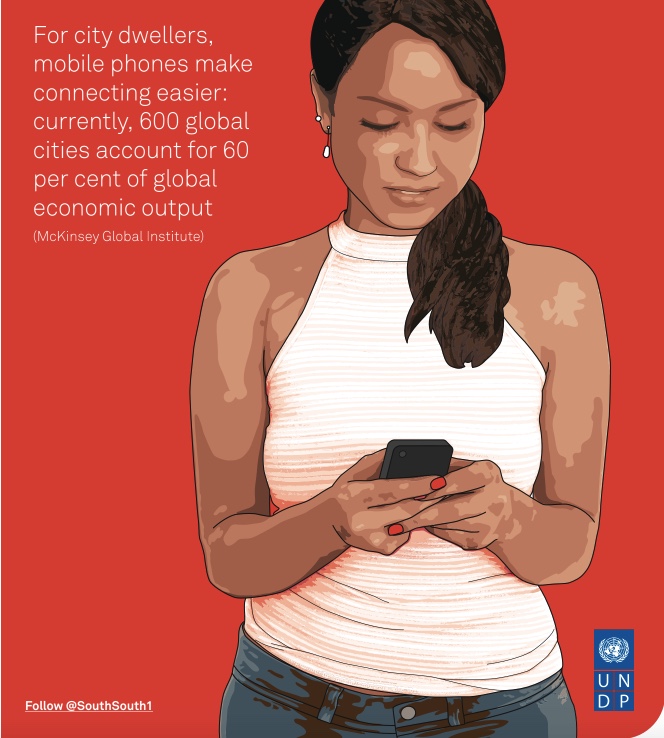
Many countries and regions are experiencing highly stressed environmental conditions, with poor access to water and rising air pollution damaging human health, for example. But on the other side, there is also unprecedented change in technology and communications taking place. Every year, more and more of the world’s population gain access to 21st century communications such as smart phones and the Internet or ‘apps’ (applications), allowing the exchange of solutions and ideas at a rapid pace.
Many are weighing up the benefits and downsides of such an urban, dense world. Denser cities make it easier and more efficient to deliver services, and proponents see a rapid rise in living standards in these megacities. Others see wide-scale poverty and vicious fights over resources in crime-ridden, unhealthy packed megacities. These pessimists point to current conditions in many megacities across the global South.
No matter what perspective, many agree there has to be a cultural change in how people live and behave to make the megacities work.
The contrasting approaches taken by two giants of the global South – India and China – provides lessons and ideas.
The first big push from rural to urban took place in Europe in the 19th century. In 1800, just three per cent of the world’s population lived in cities. All the cities now seen as cosmopolitan hubs of economic and creative energy were just shadows of themselves prior to the 19th-century industrial revolution.
Lessons were learned from hard experience and one of the most important lessons was this: if a city is to grow – and grow quickly – then it must plan for this growth and put the well-being of people at the centre of this plan. This is critical to ensure public health is improved and that the transition to more dense living conditions improves human well-being, rather than making it worse.
A megacity is a city with a population greater than 10 million people (http://en.wikipedia.org/wiki/Megacity). The number of such cities will double over the next 10 to 20 years and many of these cities are in south and east Asia. By 2025, seven of the world’s top 10 megacities will be in Asia. Whole new cities are rising up that most people across the world have never heard about – yet.
One of the most rapidly urbanizing countries in the world is China. At the beginning of 2012, Chinese authorities announced the country was now a majority urban place, with most citizens living in cities. This population of 690.79 million people outpaced the rural population of 656.56 million people.
China is exploring a variety of solutions to making high-density city living work. Some of these solutions include creating multiplexes containing modern shopping, leisure, recreational and housing in one location. One example of this is The New Century Global Centre (http://cd.qq.com/a/20101018/000099.htm) in Chengdu, the capital of Sichuan. It is being called the world’s largest standalone complex. Chengdu is now a city of 14 million people and projected to be heading to 20 million people.
It includes design by noted Iraqi architect Zaha Hadid (zaha-hadid.com).
There are 1.5 million square metres of floor plans, two 1,000-room five-star hotels, an ice-skating rink, a 20,000 capacity marine park with 400 meters of artificial coastline and 5,000 square metres of artificial beach, including hot springs.
In contrast, the more chaotic and unplanned approach taken in India – also a country experiencing rapid growth in its cities – has come under intense criticism. Dr Rumi Aijaz of the Delhi-based Observer Research Foundation (observerindia.com) told The Guardian that Indian infrastructure improvements will be difficult to achieve: “Our urban areas are in a raw form.
All the basics are at a very low level. And the Indian state has been trying for a very long time to address this but a lack of capacity and endemic corruption has meant not much success.”
In 2001, India had 290 million people living in cities. By 2008, this reached 340 million. It is predicted this will reach 590 million people – 40 per cent of the population – by 2030. McKinsey and Company (mckinsey.com) believe by 2030 India will have 68 cities of more than one million people, 13 will have four million people and six megacities will be greater than 10 million people.
India faces an urban infrastructure crisis of epic proportions, McKinsey believes. Many millions will not have access to clean drinking water, adequate sewage, and will have to cope with poor transport.
China, on the other hand, has invested seven times more in urban infrastructure than India. And one example of how this investment pays off is Chengdu.
The fast-growing city of Chengdu’s mayor is trying to manage growth directly through the city’s policies. This involves managing the push and pull incentives driving people to cities and lifting the standard of living in the surrounding countryside.
Chengdu’s mayor Ge Honglin told The Guardian: “The first thing I did was to improve the conditions – schools, shops, garbage collection, the sewage system. We had to cut the gap between rural and urban areas. If people could have a brighter future in the countryside, they’d stay there. So we’re not seeing people swarm into the city= Instead there are people in the city considering moving to the country.”
“Chengdu is the only super-large central city that has narrowed the urbanrural income gap alongside rapid economic growth in China,” Ge said.
Hundreds of schools have been built surrounding Chengdu and partnerships made between rural and urban schools to help raise standards.
Chengdu is also pioneering new ways to address urban squalor with new information technologies. Patrols use mobile phones and cameras to document broken infrastructure and health and safety problems, and to locate and assist the homeless.
“You can barely see a begger in Chengdu,” said Gu. “We have a special system for monitoring them, and it works. Beggars are taken to the assistance centre, where they are given food and shelter and money to take them back to their home. If I say there are no more than 10 beggars on the street you will think there’s some sort of tyranny, but there isn’t. We’re trying to solve their problems.”
Published: May 2012
Resources
1) Endless City and Living in the Endless City: LSE Cities is an international centre at the London School of Economics and Political Science that carries out research, education and outreach activities in London and abroad. Its mission is to study how people and cities interact in a rapidly urbanizing world, focussing on how the design of cities impacts on society, culture and the environment. Website: http://lsecities.net/publications/books/the-endless-city/
2) Planet of Slums by Mike Davis: According to the United Nations, more than one billion people now live in the slums of the cities of the South. Mike Davis explores the future of a radically unequal and explosively unstable urban world. Website: http://books.google.co.uk/books/about/Planet_Of_Slums.html?id=FToaDLPB2jAC
4) Arrival City by Doug Saunders: A third of humanity is on the move. History’s largest migration is creating new urban spaces that are this century’s focal points of conflict and change — unseen districts of rapid transformation and febrile activity that will reshape our cities and reconfigure our economies.Website: http://arrivalcity.net/
5) Global Urbanist: The Global Urbanist is an online magazine reviewing urban affairs and urban development issues in cities throughout the developed and developing world. Website: http://globalurbanist.com/
6) The Spirit of Cities: Why the Identity of a City Matters in a Global Age by Daniel A. Bell and Avner de-Shalit. Website: amazon.com
Across the global South, new cities are being dreamed up by architects, city planners and governments, or are already under construction. Two new urban areas being built offer lessons for others in the global South. They both deploy intelligent solutions to the combined demands of urbanization, growing populations and rising expectations.
An eco city in China and a smart city in the Republic of Korea are tackling today’s – and tomorrow’s – challenges.
A joint initiative between China and Singapore, the Sino-Singapore Tianjin Eco-City project (tianjinecocity.gov.sg) – located on reclaimed land some 45 kilometres from the booming Chinese city of Tianjin and 150 kilometres from Beijing – is an attempt to create a replicable model for other cities in China and the global South. Already well underway, with the first phase of construction nearly complete, the Eco-City’s hallmarks include encouraging walking, reducing reliance on private vehicles and aiming to generate 20 per cent of the city’s energy from renewable sources. It is run from the Chinese end by Tianjin TEDA Investment Holding Co., Ltd and in Singapore by the Keppel Group.
It is located 10 kilometres from the Tianjin Economic Technological Development Area (TEDA), a fast-growing high-tech business hub in its own right.
Called an “integrated work, live, play and learn environment,” it is a mix of public and private housing based on the highly successful model developed in Singapore.
The concept of an “eco city” was first raised by Richard Register in his 1987 book Ecocity Berkeley: Building Cities for a Healthy Future. It was to be a place that minimizes inputs of energy, water, and food and outputs of waste heat, air pollution, carbon dioxide, methane and water pollution. Like smart cities, eco cities are taking shape in various forms around the world. Some are applying the concept and principles of an eco city to an existing place, while others are being built from scratch.
The Tianjin Eco-City is a mix of elements designed to make it sustainable in the long-term. It includes an “EcoValley” running through the development as its centrepiece green space to encourage walking and cycling between the major centres of the city. It has the usual urban services – from schools to shops and restaurants – but also, critically, a growing range of business parks to support employment.
Unlike green initiatives in wealthy, developed countries, it is hoped the Tianjin Eco-City will prove a more relevant model for the global South. It has factored in the need to make an eco city pay its way and generate new business and innovations. It is trying to address the pressing urgency of China’s growing population and rapid urbanization, while balancing people’s expectations of rising living standards. As in other countries in the global South, people aspire to a higher standard of living and this needs to be taken into consideration when planning eco cities.
Ho Tong Yen, Chief Executive Officer of Sino-Singapore Tianjin Eco-City, says its aim is “sustainable development packaged in a way that is uniquely Asian.”
He says the project is intended to be “practical, replicable and scalable.”
“Practical at its core is building something that the market can support, something that is affordable given the economic development of the region,” he said. “The idea is that this model must be one that is replicable and scalable in other parts of China. Now, strictly speaking, there is no reason it needs to be just for China – it really might be replicable in other developing countries as well. Our starting point, however, is to find a model that might work for China.
“I think it is still a work in progress – a bold experiment – and it is a long-term experiment. The idea is to create an eco city that can support a population of 350,000 over a 10 to 15 year horizon.
“In some ways it is a city that does not look all that much different from other Chinese cities. But if you look at the subtleties – the building orientation, the renewable energy, the transit oriented developments, the walkability concepts – these are all the elements we built into this project.
“An eco city is not necessarily a science-fiction-like concept; it is something that is very real, very do-able. It looks a lot like a normal city – it is not a special city in a glass dome.”
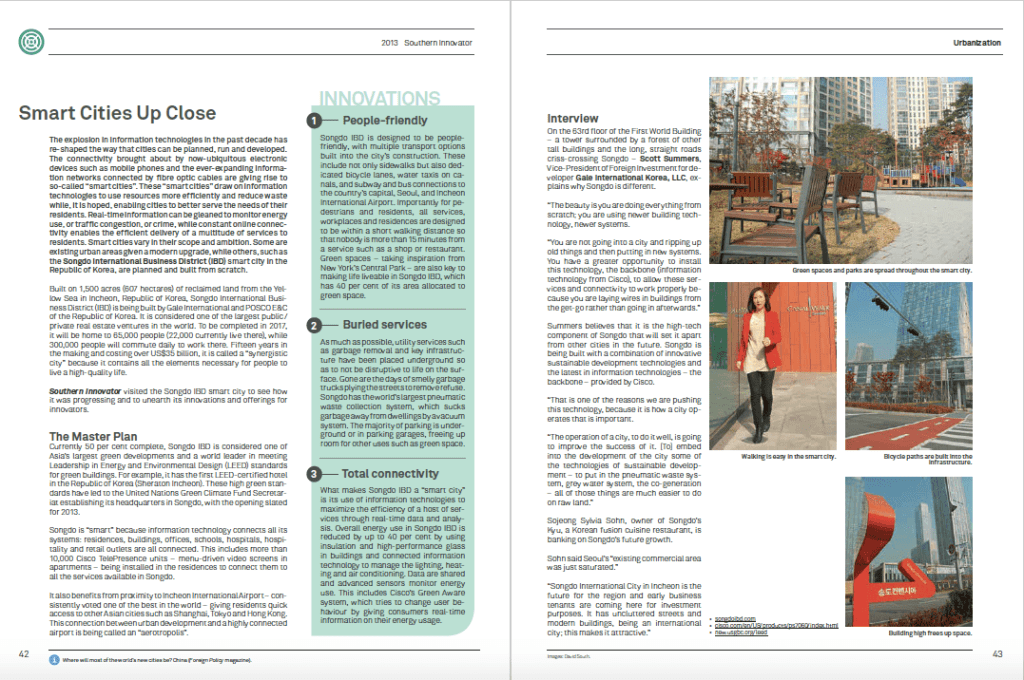
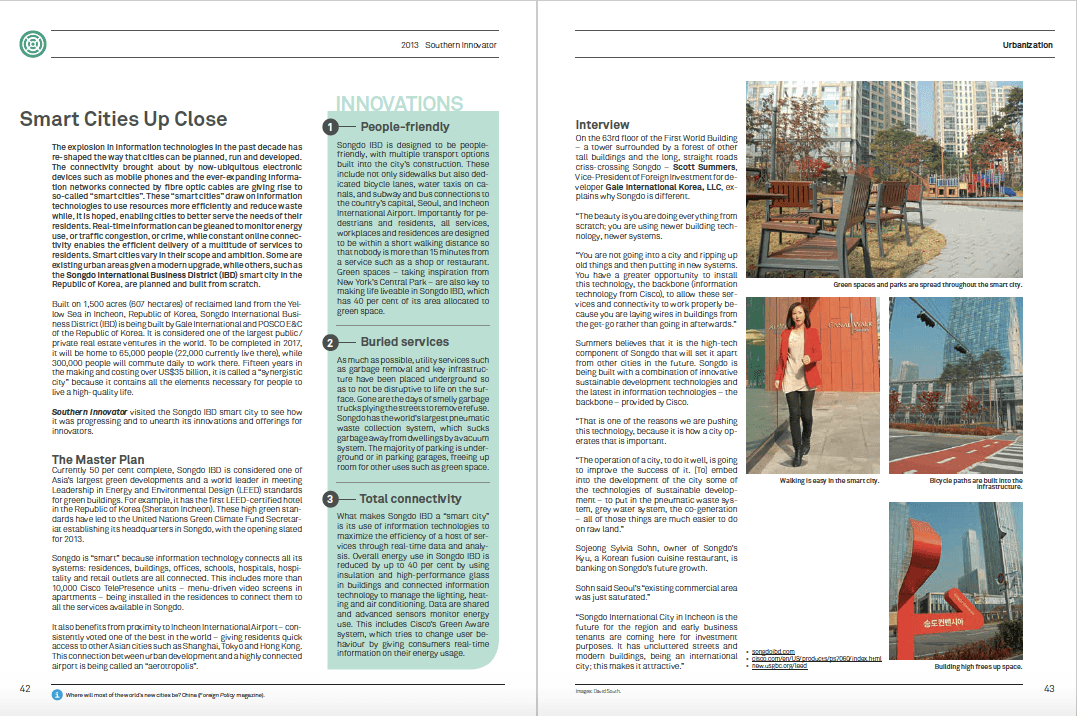
The explosion in information technologies in the past decade has re-shaped the way cities can be planned, run and developed. The connectivity brought about by now-ubiquitous electronic devices such as mobile phones and the ever-expanding information networks connected by fibre optic cables is giving rise to so-called “smart cities.” These urban areas draw on information technologies to use resources more efficiently and reduce waste, while – it is hoped – better serving the needs of residents. Real-time information can be gleaned to monitor energy use, or traffic congestion, or crime, while constant online connectivity enables the efficient delivery of a multitude of services to residents.
Smart cities vary in their scope and ambition. Some are existing urban areas given a modern upgrade, while others, such as the Songdo International Business District (IBD) (songdoibd.com) smart city in the Republic of Korea, are planned and built from scratch.
Built on 1,500 acres (607 hectares) of reclaimed land from the Yellow Sea in Incheon, Songdo International Business District is being built by Gale International and POSCO E&C of Korea. It is considered one of the largest public/private real estate ventures in the world. Due to be completed in 2017, it will be home to 65,000 people (22,000 currently live there), while 300,000 people will commute in daily to work. Fifteen years in the making and costing over US $35 billion, it is called a “synergistic city” because it contains all the elements necessary for people to live a high-quality life.
Currently 50 percent complete, Songdo IBD is considered one of Asia’s largest green developments and a world leader in meeting LEED (Leadership in Energy and Environmental Design) (https://new.usgbc.org/leed) standards for green buildings. For example, it has the first LEED-certified hotel in Korea, the Sheraton Incheon. These high green standards have led to the United Nations Green Climate Fund Secretariat establishing its headquarters in Songdo, with a slated opening in 2013.
Songdo is “smart” because information technology connects all its systems – residences, buildings, offices, schools, hospitals, hospitality and retail outlets. This includes more than 10,000 Cisco TelePresence units (http://www.cisco.com/en/US/products/ps7060/index.html)– menu-driven video screens – being installed in the residences to connect them to all the services available in Songdo.
It also benefits from proximity to Incheon International Airport – consistently voted one of the best in the world – giving residents quick access to other Asian cities such as Shanghai, Tokyo and Hong Kong. This connection between urban development and a highly connected airport is being called an “aerotropolis.”
Songdo smart city is just one part of a massive regional development plan, using reclaimed land from the sea and marshlands. The residential and business developments are all being linked to IncheonInternationalAirport, which is being positioned as a transport hub and gateway to Northeast Asia – it boasts of being a three-and-a-half hour flight to one-third of the world’s population. The idea is to create a thriving international business hub that is a short flight away from Asia’s booming and fast-growing economic centres.
“The beauty is you are doing everything from scratch – you are using newer building technology, newer systems,” said Scott Summers, Vice President of Foreign Investment for developers Gale International Korea LLC.
“You are not going into a city and ripping up old things and then put in new systems. You have a greater opportunity to install this technology, the backbone (information technology from Cisco), to allow these services and connectivity to work properly because you are laying wires in buildings from the get-go rather than going in afterwards.”
Summers believes it is the high-tech component of Songdo that will set it apart from other cities in the future. Songdo is being built with a combination of innovative sustainable development technologies and the latest in information technologies provided by Cisco.
“That is one of the reasons we are pushing this technology, because it is how a city operates that is important,” Summers said.
“The operation of a city, to do it well, is going to improve the success of it. (To) embed into the development of the city some of the technologies of sustainable development – to put in the pneumatic waste system, grey water system, the co-generation – all of those things are much easier to do on raw land.”
Sojeong Sylvia Sohn, owner of Songdo’s Kyu, a Korean fusion cuisine restaurant, was attracted to Songdo and is banking on its future growth.
Sohn said Seoul’s “existing commercial area was just saturated.”
“Songdo International City in Incheon is the future for the region and early business tenants are coming here for investment purposes. It has uncluttered streets and modern buildings, being an international city – this makes it attractive.”
Published: December 2012
Resources
1) Eco Cities World Summit: The International Ecocity Conference Series brings together the key innovators, decision makers, technologists, businesses and organizations shaping the conversation around ecological and sustainable city, town and village design, planning and development. Website:http://www.ecocityworldsummit.org/
2) Richard Florida: The Creative Class Group is a boutique advisory services firm composed of leading next-generation researchers, academics, and strategists. Website:http://www.creativeclass.com/richard_florida
3) Global Urbanist:The Global Urbanist is an online magazine reviewing urban affairs and urban development issues in cities throughout the developed and developing world. Website:http://globalurbanist.com/
4) UN-Habitat: The United Nations Human Settlements Programme, UN-HABITAT, is the United Nations agency for human settlements. It is mandated by the UN General Assembly to promote socially and environmentally sustainable towns and cities with the goal of providing adequate shelter for all. Website:http://www.unhabitat.org
Expertise: Innovation, innovators, human development, South-South development, United Nations, policy and policy innovation, South-South cooperation, South-South trade, global trends, strategy, online content, global memes, Internet, mobile phones, information technology, global South, resilience strategies, crisis response.
Locations: London, UK and New York, U.S.A. 2007 to 2016
Since the start of 2007, global international development and media consultancy David South Consulting (DSC)/David South International (DSI) has been working with the UNDP-associated United Nations Office for South-South Cooperation (UNOSSC) (formerly the Special Unit for South-South Cooperation) to raise the profile of South-South cooperation and the global South in global development through its innovators, as well as influencing the switch to an innovation-led approach to how development is delivered at the United Nations and at the country level. Based in London, UK and with a design studio in Reykjavik, Iceland, DSC/DSI did this with two highly influential media: the monthly e-newsletter Development Challenges, South-South Solutions, and its sister magazine Southern Innovator.
About
With the global economic crisis unfolding in 2007, we asked “what would inspire people?” What is going on in the global South that would improve human development under these circumstances and make people more resilient?
In 2007, discussing the global South, or solutions from the South, had a far lower profile in international development, the media and with the general public. Being one of the first sources to regularly chronicle the 21st-century world emerging from the crisis, the two publications (e-newsletter Development Challenges, South-South Solutions and its sister magazine Southern Innovator) were able to open up a space for greater coverage of the global South, while drawing attention to a new generation of development innovators.
“Great economic and business reporting! Very helpful for us.” Africa Renewal, Africa Section, Strategic Communications Division, United Nations Department of Public Information
“I just went over your June newsletter. It’s very well done and far reaching. Congratulations!” Violette Ruppanner, Director, 3D -> Trade – Human Rights – Equitable Economy, Geneva, Switzerland
“Just to let you know I enjoyed the newsletter a lot – it was interesting to learn about things going on that I would never otherwise find out about, and also the listing of future conferences and events proved very useful.” Ian Sanderson, Deloitte, Geneva, Switzerland
“Congratulations on another great newsletter that’s packed with fascinating information! I really enjoy getting it each month.” Whitney Harrelson, Making Cents, Washington D.C.
By adopting a strategy to exploit developments in online and digital media (and the space opened up by the global economic crisis), the reach of the e-newsletter and magazine was far greater than would have been possible just a year prior, back in 2006. This proved useful for reaching the growing number of people in the global South who were being digitally connected either through mobile phones or the Internet, or both.
The e-newsletter was not only distributed every month to subscribers, it was also simultaneously posted online in many platforms to reach as wide an audience as possible. It was kept simple in its design so as to be easy to access by readers with low bandwidth or high data costs. It exploited new online services to reach an as wide as possible audience.
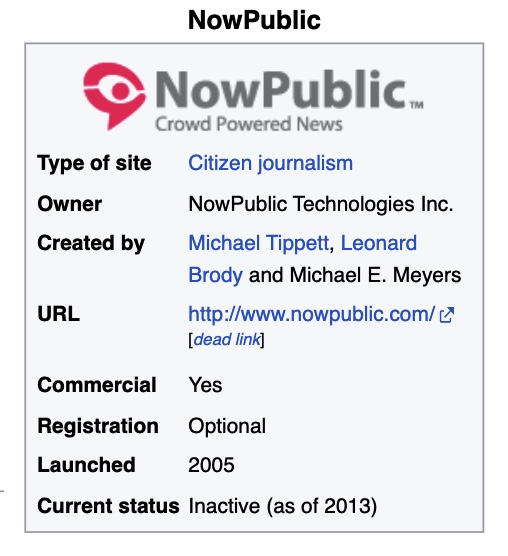
As an example, the arrival of ‘crowd-powered’ media in 2007 allowed for posting of stories to a global audience to test responses and reactions in real time. An experiment from 2008 to 2010 on the innovative Vancouver, Canada-based NowPublic platform proved very effective in developing the right tone for the stories. Many of these stories have been cited in publications and online (please see below for citations).
With 201 Development Challenges, South-South Solutions stories posted on the NowPublic platform, a total of 336,289 views by 2012 had occurred, according to the NowPublic counter.
Various websites offering publishing and archiving services (Scribd for example) meant it was easy to access the stories from any place, device or platform, bypassing firewalls and censors – a very serious concern in many countries of the global South. And social media such as Twitter made it easy to spread the word to the right people.
The two publications proved influential on a number of fronts, being early to draw attention to the following: the rising use of mobile phones and information technology in development, the world becoming an urban place, innovative food solutions including the nascent insect food sector (now a big thing), altering perspectives on what is possible in Africa, the use of data science to innovate development, and tracking the growing number of technology hubs and the fast-growing start-up culture in the global South. The publications were cited for shaping the new strategic direction adopted by the United Nations Development Programme (UNDP) (the UN’s leading development organisation) and its first youth strategy, and the development of the Sustainable Development Goals (SDGs). As the world’s first global innovator magazine, Southern Innovator’s design had to be appropriate for a diverse audience. It has drawn praise for being both “beautiful” and “inspiring”, while its use of sharp, modern graphic design and infographics inspired others in the UN to up their game when it comes to design.
Today, there are many sources for sharing stories on solutions from the global South; in fact, it could be called ‘cool’. South-South cooperation and innovation have now become the key methodology for the UN’s delivery of its programmes and projects. In 2015, China pledged US $2 billion to “support South-South cooperation” and called for the international community to “deepen South-South and tripartite cooperation”. In development parlance, they have been “Mainstreaming South-South and Triangular Cooperation” in their plans.
The current policy vogue for innovation in developing and developed countries can trace its roots back to some of the early work done by these two publications (and which was further amplified by the annual Global South-South Development Expo, which often would feature innovators from the two publications, spreading the innovation message around the world). Both publications had set out to inspire and “champion a global 21st century innovator culture”. And they have done this, as can be seen from concrete evidence and anecdotal responses from individuals and organizations alike.
Crucial to success has been integrity. As was disclosed in arrests made by the Federal Bureau of Investigation (FBI) in October 2015, a news service claiming to be associated with the United Nations (South-South News) had not followed either the letter or the spirit of the UN’s Global Compact. It had received substantial funding from a Macau casino owner featured in a 2010 investigation by International Risk Ltd., which found he “is characterized in the media as a ‘Macau Crime Lord’ and a kingpin of the international slave prostitution trade”. To date, a number of his co-conspirators have been found guilty of various charges and sentenced. He was convicted 28 July 2017 on six counts “for his role in a scheme to bribe United Nations ambassadors to obtain support to build a conference center in Macau that would host, among other events, the annual United Nations Global South-South Development Expo“. He used the news service as a “conduit for bribery and money laundering” at the United Nations, according to the FBI, something admitted to by the various co-conspirators in court and under oath. Read more on this case here: http://www.reuters.com/article/us-un-corruption-idUSKCN0XH2DL. And the conviction here: Chairman of a Macau Real Estate Development Company Convicted on All Counts for Role in Scheme to Bribe United Nations Ambassadors to Build a Multi-Billion Dollar Conference Center
The case of South-South News points to the dangers of cutting corners and the importance of approach and methodology; to not just mouth support for the UN Global Compact but to embrace its letter and spirit as well. As can be seen from this particular case, the reputational damage can be severe if the wrong strategy is pursued. Clients need to be very aware of whom they are working with and conduct due diligence for service provider credentials and also investigate the credentials of potential donors and funders.
Southern Innovator needed to be true to its ethos of championing genuine innovation that improves human development in the global South. It had to be free to pursue its search without interference.
To avoid censorship and interference, its editorial operations were based in London, UK and its design studio was based in Reykjavik, Iceland (a high-ranking country in the World Press Freedom rankings and a former top place holder in the UNDP Human Development Index). Using a women-led design studio, it developed a design vision that could communicate across borders using clear graphic design and high-quality images. For example, when it launched in 2011, infographics were rare in development publications and at the UN; now they are commonplace. It also tried to be as a ‘green’ as possible. The studio was powered on 100 per cent renewable energy (in particular, geothermal energy); the hard copy of the magazine is printed on paper from renewable forests.
To date, five issues of Southern Innovator have been published on key themes identified by the United Nations: mobile phones and information technology, youth and entrepreneurship, agribusiness and food security, cities and urbanization and waste and recycling.
All of the issues collate and explain the trends, innovations and innovators for a large, global audience spanning many countries and regions.
Timeline
2007: David South Consulting begins work on the e-newsletter Development Challenges, South-South Solutions for the Special Unit for South-South Cooperation at the United Nations.
2009: Adjust e-newsletter content based on reader responses. Begin posting content on Twitter platform.
2010: Begin development of initial concepts for innovator magazine and assemble creative team with Icelandic graphic designer and illustrator Solveig Rolfsdottir and graphic designer Eva Hronn Gudnadottir.
2011: Attend Global South-South Development Expo in Rome, Italy. Launch first issue of Southern Innovator magazine on mobile phones and information technology. It is called “a terrific tour de force of what is interesting, cutting edge and relevant in the global mobile/ICT space…”. Launch www.southerninnovator.org website and social media including Twitter account @SouthSouth1.
2012: Attend Global South-South Development Expo in Vienna, Austria. Launch issues 2 (youth and entrepreneurship) and 3 (agribusiness and food security) of Southern Innovator magazine. Called a “Beautiful, inspiring magazine from UNDP on South-South innovation.”
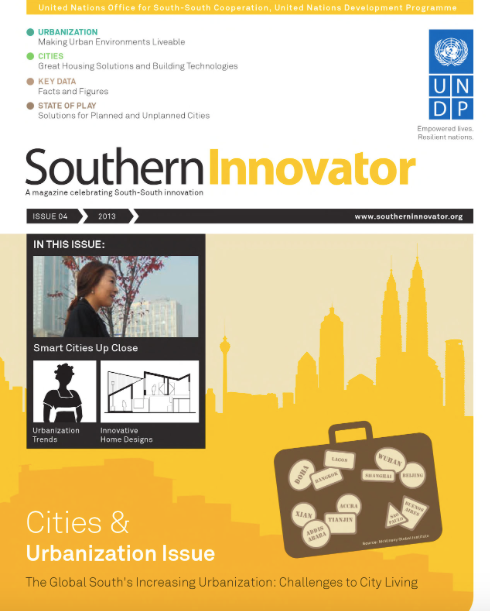
2013: Attend Global South-South Development Expo in Nairobi, Kenya. Launch issue 4 of Southern Innovator magazine (cities and urbanization). Called “fantastic, great content and a beautiful design!” and “Always inspiring.”.
2014: Attend Global South-South Development Expo in Washington, D.C., U.S.A. Launch issue 5 of Southern Innovator magazine (waste and recycling). The Twitter account @SouthSouth1 called “ one of the best sources out there for news and info on #solutions to #SouthSouth challenges.” Final issues of e-newsletter Development Challenges, South-South Solutions published.
Testimonials
“The e-newsletter Development Challenges, South-South Solutions proved to be a timely and prescient resource on the fast-changing global South, tracking the rise of an innovator culture driven by the rapid adoption of mobile phones and information technology …
“In 2010, work began on the development of the world’s first magazine dedicated to the 21st-century innovator culture of the global South. My goal was to create a magazine that would reach across countries and cultures, meet the UN’s standards, and inspire action. Southern Innovator was the result. Mr. [David] South played a vital role in the magazine’s development from its early conception, through its various design prototypes, to its final global launch and distribution.
“Both the e-newsletter and magazine raised the profile of South-South cooperation and have been cited by readers for inspiring innovators, academics, policy makers and development practitioners in the United Nations and beyond.
“I highly recommend Mr. [David] South as a thoughtful, insightful, analytical, creative and very amicable person who has the unique ability to not only grasp complex problems but also to formulate a vision and strategy that gets things done. … ” Cosmas Gitta, Former Assistant Director, Policy and United Nations Affairs at United Nations Office for South-South Cooperation (UNOSSC) in UNDP
“I think you [David South] and the designer [Solveig Rolfsdottir] do great work and I enjoy Southern Innovator very much!” Ines Tofalo, Programme Specialist, United Nations Office for South-South Cooperation
Southern Innovator Issue 5
“@SouthSouth1 is one of the best sources out there for news and info on #solutions to #SouthSouth challenges.” Adam Rogers, Assistant Director, Regional Representative, Europe, United Nations Office for South-South Cooperation (UNOSSC)
“Btw, I really enjoyed reading them, impressive work & a great resource. Looking forward to Issue 6. My best wishes to you & your team at SI.”
“The magazine looks fantastic, great content and a beautiful design!”
Southern Innovator Issue 2
“Thank you David – Your insight into the issues facing us a[s] [a] “global Village” is made real in the detail of your article – 10 out of 10 from the moladi team.” Moladi, South Africa (http://www.moladi.net/index.htm)
Southern Innovator Issue 1
“What a tremendous magazine your team has produced! It’s a terrific tour de force of what is interesting, cutting edge and relevant in the global mobile/ICT space… Really looking forward to what you produce in issues #2 and #3. This is great, engaging, relevant and topical stuff.” Rose Shuman, Founder & CEO, Open Mind and Question Box
“Looks great. Congratulations. It’s Brill’s Content for the 21st century!” Conan Tobias, Managing Editor, Canadian Business
What they are saying about SI on Twitter: From @CapacityPlus Nice job RT @ActevisCGroup: RT @UNDP: Great looking informative @SouthSouth1 mag on South-South Innovation; @UNDP Great looking informative @SouthSouth1 mag on South-South Innovation; @JeannineLemaireGraphically beautiful & informative @UNDP Southern Innovator mag on South-South Innov.
“Beautiful, inspiring magazine from UNDP on South-South innovation. Heart is pumping adrenaline and admiration just reading it”
Impact
Micro
developed content for highly influential UN e-newsletter Development Challenges, South-South Solutions from 2007 to 2014. The monthly briefing is distributed across the UN and to subscribers
developed and launched world’s first global innovator magazine for the United Nations, Southern Innovator
contacted and networked with innovators around the world to raise the profile of their work
attended global events to champion power of 21st century global innovator culture. Visited United Nations agency headquarters around the world to share the innovator message and distribute the publications
cited as a key resource on trends in the global South
Macro
significantly raised profile of global South innovators and 21st century global innovator culture
cited as contributor to new strategic plans for UNDP and its switch to an innovation and South-South focus
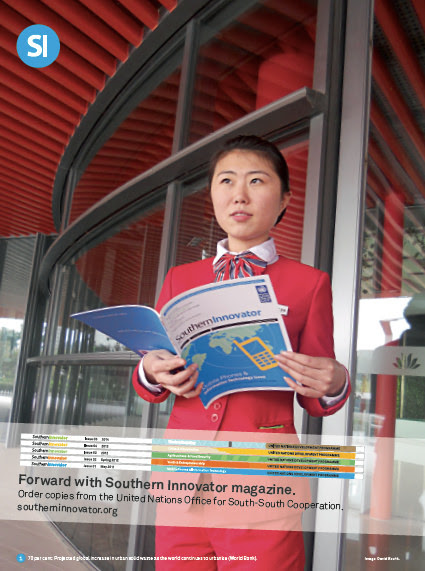
Launched in May 2011, the new global magazine Southern Innovator (ISSN 2222-9280) is about the people across the global South shaping our new world, eradicating poverty and working towards the achievement of the Millennium Development Goals (MDGs).











 David South Consulting

You must be logged in to post a comment.