Categories
Archive Development Challenges, South-South Solutions Newsletters

Chinese Trade in Angola Helps Recovery

By David SouthDevelopment Challenges, South-South Solutions

SOUTH-SOUTH CASE STUDY

Two-way trade between Africa and China has been an outstanding success story of the past decade. It has led to significant new investment in the continent and brought many new job opportunities. The Chinese community in Africa comprises a mix of entrepreneurs and workers. In formerly war-torn Angola, Chinese workers and investors have led an economic boom as the country recovers from decades of conflict.

The Chinese are generally young, well-educated, English-speaking, ambitious and hard-working. Estimates put the number of Chinese people in Angola at 100,000, and about 1 million across Africa.

The reason these bright young things need to come to Africa goes back to the essential reality of modern China: despite rapid economic growth, per capita incomes classify it as a poor country. While the outside world sees the glitzy, go-go progress of China’s cities, the country’s rural poor go unseen. Around 400 million of China’s 1.3 billion people have annual per-capita income equivalent to US $8,000, while the remaining 900 million have per-capita incomes as little as one-tenth that amount.

Some 6.3 million people in China will graduate this year from university, and it is still very hard for a well-educated Chinese person to get a good job right away. More than a quarter of these graduates will be unemployed, according to the Education Ministry.

There has also been disquiet in parts of Angola over China’s role, with some calling it “neo-colonialism”. But clearly, both Africa and China have much to gain by increasing cooperation.

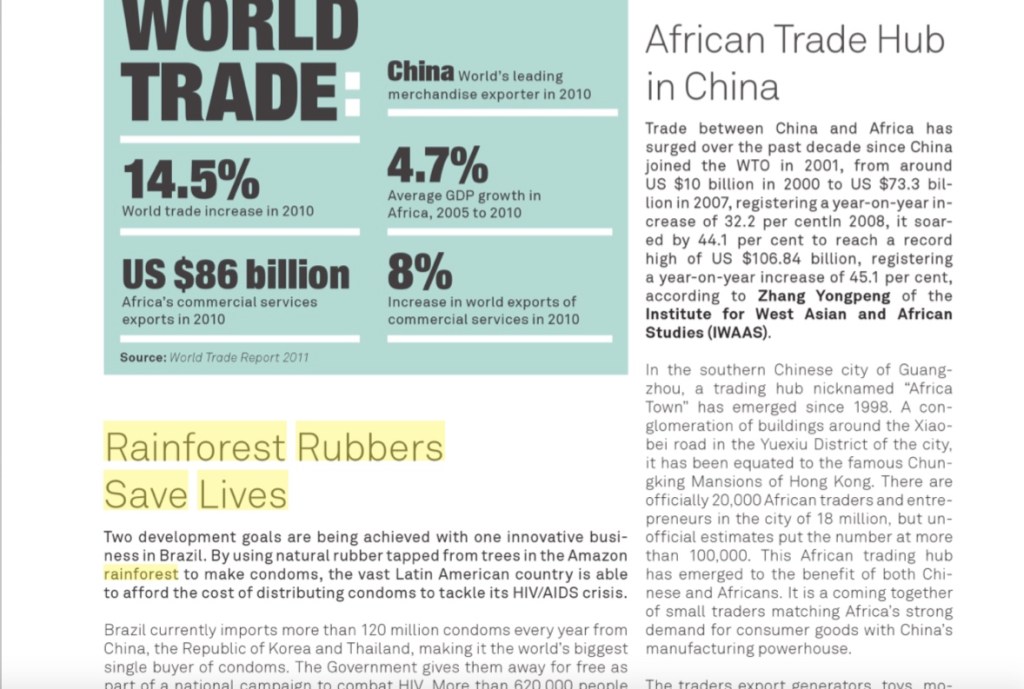
In the southern Chinese city of Guangzhou (http://en.wikipedia.org/wiki/Guangzhou), a trading hub nicknamed “Africa Town” has emerged since 1998. There are officially 20,000 African traders and entrepreneurs in the city of 18 million, but unofficial estimates put the number at more than 100,000. This African trading hub has emerged to the benefit of both the Chinese and Africans. It is a coming together of small traders matching Africa’s strong demand for consumer goods with China’s manufacturing powerhouse.

In Angola, the mix of entrepreneurs and workers is having a big impact on the country’s development.

Betty, a 22-year-old Chinese woman who has various projects in Angola, including the local Chinese language newspaper, is a typical go-getter.

“I am doing much better here than if I had stayed in China,” she told the BBC.

Another beneficiary of the two-way trade is Deng, a construction a worker: “I earn twice as much as I would at home and I have got a better job,” he said.

For most Chinese, foreign travel is still rare and the excitement of going to Africa to work both attracts and repels because of the continent’s reputation.

“At first I found it frightening, “said Wang. “You hear lots of stories of Chinese people being robbed by the locals.” But he found “there are great opportunities here.”

Another, Jet, who runs an air conditioning business, came to Angola five years ago.

“Everything had been destroyed,” he recalled. “There were no roads, railways, shops, nothing. Some Western companies were already here selling their products but I knew I could import things cheaper from China.”

The large infrastructure projects being undertaken by major Chinese companies are also creating new opportunities. Many Chinese labourers are working on building roads, railways, hospitals and vast housing complexes.

One of the more visible symbols of Chinese investment in Angola is the restoration of the Benguela Railway (http://en.wikipedia.org/wiki/Benguela_railway), considered one of the great routes of Africa and built by British contractors. An engineering triumph, its 1,344 kilometres (835 miles) of track stretch up the Angolan coast, right into southern Congo. The railway took almost 30 years to build in the late 19th and early 20th centuries, but little remained. Until very recently all but a tiny stretch of the line was closed. Now Chinese investment is rebuilding the railway and bringing economic improvement in its wake.

“I couldn’t do this before the railway was fixed,” a woman using the train to get to the market to sell her plump red tomatoes told the BBC. “Before, I had to travel by car which was much more expensive.”

And her income has improved along with the refurbished railway. “I am not rich, but a bit richer,” she said.

And unlike the British, who used the railway to export copper without paying for the resource, the Chinese labourers are getting paid and the Angolan government is paying back the Chinese loan for the railway repairs by selling oil overseas for a market rate.

Published: October 2010

Resources

https://davidsouthconsulting.org/2022/06/02/afghanistans-juicy-solution-to-drug-trade/

https://davidsouthconsulting.org/2022/11/02/african-online-supermarket-set-to-boost-trade/

https://davidsouthconsulting.org/2022/10/26/african-trade-hub-in-china-brings-mutual-profits-2/

https://davidsouthconsulting.org/2022/04/12/djibouti-re-shapes-itself-as-african-trade-hub/

https://davidsouthconsulting.org/2021/07/19/global-south-trade-boosted-with-increasing-china-africa-trade-in-2013/

https://davidsouthconsulting.org/2022/10/26/perfume-of-peace-helps-farmers-switch-from-drug-trade/

https://davidsouthconsulting.org/2021/07/19/south-south-trade-helping-countries-during-economic-crisis/

https://davidsouthconsulting.org/2021/03/05/southern-innovator-issue-2/

https://davidsouthconsulting.org/2022/11/01/southern-innovator-magazine-2010-2014/

https://davidsouthconsulting.org/2022/10/20/trade-to-benefit-the-poor-up-in-2006-and-to-grow-in-2007/

https://davidsouthconsulting.org/2022/10/05/women-empowered-by-fair-trade-manufacturer/

https://davidsouthconsulting.org/2022/06/16/women-mastering-trade-rules/

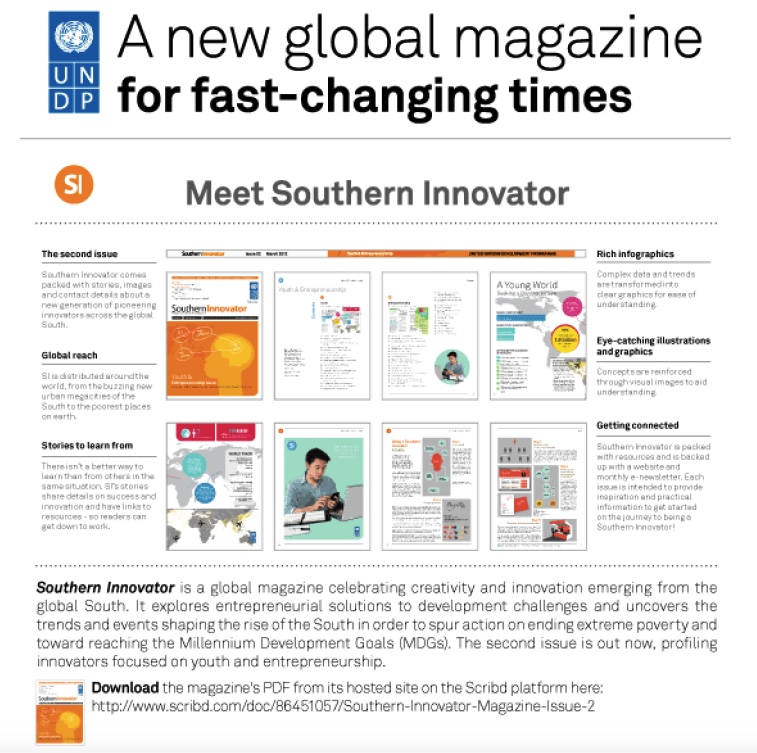
Development Challenges, South-South Solutions was launched as an e-newsletter in 2006 by UNDP’s South-South Cooperation Unit (now the United Nations Office for South-South Cooperation) based in New York, USA. It led on profiling the rise of the global South as an economic powerhouse and was one of the first regular publications to champion the global South’s innovators, entrepreneurs, and pioneers. It tracked the key trends that are now so profoundly reshaping how development is seen and done. This includes the rapid take-up of mobile phones and information technology in the global South (as profiled in the first issue of magazine Southern Innovator), the move to becoming a majority urban world, a growing global innovator culture, and the plethora of solutions being developed in the global South to tackle its problems and improve living conditions and boost human development. The success of the e-newsletter led to the launch of the magazine Southern Innovator.

Creative Commons License

This work is licensed under a
Creative Commons Attribution-Noncommercial-No Derivative Works 3.0 License.

ORCID iD: https://orcid.org/0000-0001-5311-1052.

© David South Consulting 2023

Categories
Archive Development Challenges, South-South Solutions Newsletters

African Hotel Boom Bringing in New Investment and Creating Jobs

By David SouthDevelopment Challenges, South-South Solutions

SOUTH-SOUTH CASE STUDY

Africa is experiencing a boom not seen for decades. The IMF forecasts economic growth in sub-Saharan Africa of 6 per cent in 2014, compared to global growth of 3.6 per cent.

And this boom is getting an additional jolt of support from the world’s multinational hotel chains. January 2014 saw Africa’s largest hotel chain bought by global giant Marriott (marriott.com). For decades major global multinationals shied away from Africa, but today they are battling to get a place in Africa’s fast-growing economies and to serve the growing middle classes.

Marriott is leading the way by investing US $1.5 billion in 25 new hotels equalling 5,000 rooms. To boost capacity further, Marriott is taking over South Africa’s Protea group (proteahotels.com) and its 116 African hotels.

“We have 25 Marriott brand hotels under construction in seven countries in Africa that will come on stream over the next four years,” Alex Kyriakidis, the chain’s president for the Middle East and Africa, told Bloomberg (bloomberg.com).

The new hotels “are going to bring us into Benin, Gabon, Ghana, Ethiopia and Mauritius. With our existing hotels plus those in the pipeline and those Protea operates today, we will be in 16 countries in Africa by 2017.”

Bloomberg calls what Africa is experiencing the “fastest pace of hotel development in the world”.
“Our mission here is to grow, grow, grow,” according to Kyriakidis.

Meanwhile, a further boost is coming from the US $5 billion Angolan sovereign wealth fund, Fundo Soberano de Angola (fundosoberano.ao/language/en/). It will be investing in hotels and commercial infrastructure in sub-Saharan Africa, according to Bloomberg. This could include 50 sub-Saharan African hotels in the next three years.

“We believe there’s a lot of investment interest in Africa,” said Chairman Jose Filomeno dos Santos. “It has a lot of mineral potential, almost a commodity hub. We believe this interest will remain there for the coming years.”

Little thought is given to the role hotels play in development, yet they are a critical development tool for any country wishing to move up the economic ladder. As the quality of hotels improves, they tend to become key gathering and meeting places. Conferences and seminars can act as catalysts for change, attracting people from around the world. When quality hotels are in place, then the top-drawer global conferences will come to town, in turn bringing new tourist income for local businesses.

Anyone who has stayed in a hotel in Africa knows that standards are variable: the pool with dirty water, the power cuts, the food hygiene standards that might not match what people are used to at home. This is what international hotel chains can change. Not only do they demand the highest standards in their own establishments, they also push up standards at local competitors, as all of them battle for the attention of visitors.

Africa has been overlooked by the large global hotel chains and brands since the end of the colonial period in the 1960s and 70s. Africa was considered too poor, too chaotic, too dangerous and too much hard work for it to be worth the effort.

But now the tune has changed. With Africa’s population over a billion, and many of the continent’s economies experiencing rapid growth while also urbanizing, conditions are fortuitous for the hotel trade.

The situation has changed in the last decade, for a variety of reasons: debt relief, a rise in commodity prices, expanding trade and investment with China and the global South, and a growing middle class — all slowing the growth of poverty. Africa is still notorious for under-investment in infrastructure and has a long way to go to catch up to the fast-moving economies of Asia. But greater optimism is leading to greater real investment. And the world’s large hotel brands are the latest to join in the rush to Africa.

Large chains including Four Seasons, Ritz-Carlton, Hyatt and Kempinski hope to open 300 new hotels in Africa over the next five years. The number of hotel beds is set to increase by 30 per cent by 2018.

Four Seasons Safari Lodge Serengeti in Tanzania (http://www.fourseasons.com/serengeti/) is the first investment in Africa by the Canadian brand. Four Seasons is known for its luxury, upmarket city hotels and has kept with this tradition by building the largest and most luxurious safari lodge ever built in Africa.

This is having a knock-on effect on African hotel operators. The surge in investment is giving these local operators the right incentives to create African brands and to raise their game.

Nairobi in Kenya has become something of a test market for high-end boutique hotels. Already a city benefiting from its status as an international development hub, home to many agencies including the UN Environment Programme’s sprawling and verdant headquarters (unep.org), it has also become a corporate headquarters for Africa and has a large U.S. presence (nairobi.usembassy.gov). This means lots of people coming to the city to do business and attend events, creating a market for better quality accommodation.

The Kenyan-owned, 156-room Sankara Nairobi Hotel (sankara.com) boasts of having the best wine list in Africa and claims to be a five-star hotel. It also capitalizes on being close to the international airport and the UN’s Nairobi headquarters.

“There’s an appetite for something local that’s different and, for the first time, there’s the confidence and funding to bankroll new developments,” said Sankara Hotel Group director Rohan Patel to Wallpaper Magazine. “Africans don’t want a theme-park African hotel, with prints of ‘the big five’ on the wall. That’s condescending. Nor do they want a New York-style hotel. They’ve probably been to New York. They want modern, connected Africa.”

Elsewhere in Nairobi, the Kenyan-owned Tribe Hotel (tribe-hotel.com) is looking to expand to meet growing market demand.

“The market for new, authentic, yet modern African hotels is growing,” manager Michael Flint, who previously ran New York’s Ritz-Carlton, told Wallpaper.

“We’ve been so successful here we are building a new 187-room hotel in Nairobi. We’ve taken over a boutique hotel called Westhouse (westhouse.co.ke). And we’re looking to expand further, with properties at the airport and on the coast. Who knows what will be next? Tribe will be a mini empire.”

In Rwanda’s capital Kigali, the Rwanda Marriott has ambitious plans. Rwanda was ripped apart by ethnic genocide in the 1990s that killed an estimated 500,000 to 1 million people (http://en.wikipedia.org/wiki/Rwandan_Genocide). Now, the country’s economy is booming and its hotels are getting an upgrade.

The Akilah Institute for Women (akilahinstitute.org) in Kigali has been helping in training women for the hotel sector. They sent trainees to Dubai and Doha to learn how to do hotel service the Marriott way.

Starwood (starwoodhotels.com), a competitor to Marriott, is hoping to grow its African hotel investment by 30 per cent as well. It will be done through the Sheraton, Aloft, Le Meridien, St Regis and Four Points brands. The first St Regis has already opened in Mauritius.

Neil George, Starwood’s head of African development, believes “Africa is the final frontier. It’s adventurous.

“I would rather arrive in Kinshasa and work out how to do a hotel there than do it in Frankfurt,” he told Wallpaper.

The Hyatt (hyatt.com) brand is now running the Hyatt Kilimanjaro Hotel in Dar es Salaam (http://daressalaam.kilimanjaro.hyatt.com/en/hotel/home.html), Tanzania. Peter Norman, Hyatt’s African head, is working on opening a Park Hyatt in Zanzibar (http://zanzibar.park.hyatt.com/en/hotel/home.html) and another Hyatt Regency (http://investors.hyatt.com/phoenix.zhtml?c=228969&p=irol-newsArticle&ID=1863203&highlight=) will open in Arusha and a further 140-room Hyatt in Senegal (http://investors.hyatt.com/phoenix.zhtml?c=228969&p=irol-newsArticle&ID=1863204&highlight=).

The 200-room Villa Rosa Kempinski in Nairobi (http://www.kempinski.com/en/nairobi/hotel-villa-rosa/welcome/), boasting an outdoor heated pool, and the Olare Mara Kempinski (http://www.kempinski.com/en/masai-mara/olare-mara/welcome/) luxury camp in the Maasai Mara will also be joined by projects in Ghana and Equatorial Guinea.

Kempinski also has properties in Chad and the Congo, has bought the Hotel des Mille Collines (https://www.millecollines.net/) in Kigali and aims to operate 20 hotels across sub-Saharan Africa.

British entrepreneur Richard Branson has the Mahali Mzuri in the Maasai Mara and it is seen as a stylish role model for other hotels. The local landowners and herdsmen have been included in the business, benefiting from the hotel and helping to preserve the local ecosystem.

EasyHotel (http://www.easyhotel.com/news/2011/africa0.html), a low budget hotelier, is also rapidly expanding across southern Africa.

Published: May 2014

Resources

1) Catererglobal.com: Catererglobal.com offers a unique service that provides an easy-to-use, specific recruitment website for vacancies in the world’s best hotels and cruise ships. Website: http://www.catererglobal.com/jobs/africa/hotel/

2) South African hotel jobs: HotelJobs South Africa is an industry specific job website for the hotel, hospitality and catering industry. Website: http://www.hoteljobs.co.za/

3) Hotel Staff Africa: Many hotel jobs across Africa. Website: http://www.hotelstaff.co.za/

4) Hotel Career: Many hotel jobs for the Middle East and Africa. Website: http://www.hotelcareer.com/jobs/middle-east-africa

Development Challenges, South-South Solutions was launched as an e-newsletter in 2006 by UNDP’s South-South Cooperation Unit (now the United Nations Office for South-South Cooperation) based in New York, USA. It led on profiling the rise of the global South as an economic powerhouse and was one of the first regular publications to champion the global South’s innovators, entrepreneurs, and pioneers. It tracked the key trends that are now so profoundly reshaping how development is seen and done. This includes the rapid take-up of mobile phones and information technology in the global South (as profiled in the first issue of magazine Southern Innovator), the move to becoming a majority urban world, a growing global innovator culture, and the plethora of solutions being developed in the global South to tackle its problems and improve living conditions and boost human development. The success of the e-newsletter led to the launch of the magazine Southern Innovator. 

Creative Commons License

This work is licensed under a
Creative Commons Attribution-Noncommercial-No Derivative Works 3.0 License.

ORCID iD: https://orcid.org/0000-0001-5311-1052.

© David South Consulting 2023

Categories
Archive Development Challenges, South-South Solutions Newsletters

Global South’s Rising Economies Gain Investor Spotlight

By David SouthDevelopment Challenges, South-South Solutions

SOUTH-SOUTH CASE STUDY

A new book is arguing that the world’s attention should switch away from BRICS countries – Brazil, Russia, India, China and South Africa – and take another look at nations and regions elsewhere across the global South. It argues many are lodestones of future growth and prosperity in the making and will see dramatic changes over the next decade.

The story of the BRIC and BRICS countries is an impressive one. In just eight years from 2000 to 2008, the BRIC countries’ combined share of total world economic output rose from 16 to 22 per cent. This led to a 30 per cent increase in global output during the period, showing how key these countries were to global prosperity in the 2000s. BRIC countries make up nearly half the world’s population and are regional leaders. Taken together, their gross domestic products (GDPs) are not far behind the United States.

Ruchir Sharma’s Breakout Nations: In Pursuit of the Next Economic Miracles (http://www.amazon.com/Breakout-Nations-Pursuit-Economic-Miracles/dp/0393080269) argues that the BRICS are now entering a more stable growth path and thus will not see the rapid-fire expansion and quick profits investors have become used to in the past decade.

“The BRICs,” Sharma told Forbes magazine, “were last decade’s team.”

The BRIC acronym (http://en.wikipedia.org/wiki/BRIC) was coined in 2001 by Goldman Sachs managing director Jim O’Neill, in a 2001 paper titled “Building Better Global Economic BRICs” (http://www.goldmansachs.com/ourthinking/brics/building-better.html). O’Neill predicted that this handful of countries would dominate the growth and economic development story for the years 2000 to 2010. This was because they all shared a similar stage of advanced economic development.

The BRIC states first began meeting together in 2006. South Africa was added in 2010 to form the BRICS acronym.

The buzz surrounding the BRICS countries over the past decade has been justified by their impressive growth rates, declining poverty levels,modernizing economies and societies and growing middle class populations.

China alone had seen its gross domestic product grow by US $5 trillion between 2001 and 2011.

Now, Sharma argues, it is someone else’s turn.

Sharma is head of emerging markets with Morgan Stanley Investment Management in New York, and Breakout Nations looks at where the next economic surprise stories will take place.

“A breakout nation is a nation that will grow above expectations, and will grow more than nations with similar per capita income,” Sharma told Forbes. “You can’t bunch all of the emerging markets together anymore. The last decade saw these countries behaving the same economically, but I think that is behind us now. Investors today will really have to pick their spots.”

He points out that Indonesia was the best performing emerging market in 2011 and has an economy that will surpass a trillion dollars in the coming years.

He also believes Sri Lanka and Nigeria are economies to watch.

Sharma says funds flowing into emerging market stocks grew by 478 per cent from 2005 to 2010, a massive jump compared to 2000 to 2005, when they grew by 92 per cent.

As he sees it, China has now reached middle-income status and its growth rates will not be as high as they have been for the past two decades. In his research, he found that countries like Japan, South Korea and Taiwan all slowed down once their per capita income went past US $5,000.

Investors who watch the emerging markets predict the hot growth areas for the next decade will be around energy, technology, and agricultural resources.

Sharma picks out Indonesia, Turkey, the Philippines, Poland and the Czech Republic for future investment interest, but urges caution with thinking all emerging economies are on course to boom.

“You’ve got to pick your spots, rather than just assume that because you put a tag of emerging on a particular nation, it’s going to boom,” Sharma told The Globe and Mail newspaper.

To make sense of the complexity of fast-emerging economies, a flurry of new investor acronyms has popped up. One of the country clusters is called the CIVETS: Colombia, Indonesia, Vietnam, Egypt, Turkey, South Africa (http://en.wikipedia.org/wiki/CIVETS).

The MINTS (Mexico, Indonesia, Nigeria and Turkey) are also set for great growth in the next decade, many investors believe.

Then there is the N-11 or Next 11. This is the MINTS plus Bangladesh, Egypt,Iran, Pakistan, the Philippines, South Korea and Vietnam.

And after that there is VISTA (Vietnam, Indonesia, South Africa, Turkey and Argentina). While clearly the creative juices are flowing at investment houses as they come up with ever-catchier acronyms, a more serious point is being made: many countries in the global South, for the first time in history, are no longer solely dependent on the Western economic system for demand.

These countries, investors note, now have an unprecedented range of options uncoupled from the political, financial and economic legacy of Western developed nations. They say that many nations in the global South are set for a runaway investment boom because they are making changes and modernizing their economies faster than many expect.

As the BRICS economies mature and slow down and take on different priorities based around improving the quality of life of their citizens, those seeking faster profits will look elsewhere. This trend is even happening within the BRICS, as Chinese and Brazilian companies offshore work to Vietnam and Colombia.

There are many new centres of economic activity and rising prosperity across the emerging markets that often fail to gain wider attention. Few would probably know that the Northeast Asian nation of Mongolia – mired in the 1990s in the worst peacetime economic collapse in half a century (http://www.scribd.com/doc/20864541/Mongolia-Update-1998-Book) – is now the world’s fastest-growing economy (http://www.worldbank.org/en/news/2012/02/28/what-behind-mongoliaeconomic-boom) and one of the top places for mobile phone usage and penetration (http://www.businessmongolia.com/mongolia/2012/03/19/mongolia-ringing-the-changes/).

Then there is Myanmar (formerly Burma), where many are hoping recent moves toward democracy and improvements in diplomatic relations will lead to an economic boon for the region. Investors are also targeting Kazakhstan in Central Asia.

Reflecting these changing realities, Standard Bank, Africa’s largest bank, has been documenting the rising role played by the Chinese currency in international trade. A recent report forecast US $100 billion (R768 billion) in Sino-African trade would be settled in the Chinese currency, the renminbi, by 2015. This would be double the trade between China and Africa in 2010. It also found 70,000 Chinese companies are using the renminbi in international trade transactions.

Published: April 2012

Resources 

1) Beyondbrics blog: A blog by the Financial Times calling itself “The Ft’s emerging markets hub”. Website: http://blogs.ft.com/beyond-brics/

2) BRICS Summit: The Fourth BRICS Summit was hosted in New Delhi on 29 March 2012 under the overarching theme of “BRICS Partnership for Global Stability, Security and Prosperity.” The Summit has imparted further momentum to the BRICS process. Website: bricsindia.in

3) Market Oracle: A good source for updates on investor sentiment about the emerging market economies. Website: marketoracle.co.uk

4) Monocle magazine: “A briefing on global affairs, business, culture and design” often featuring trends in the emerging market countries. Website: monocle.com

5) BRICS Information Centre, University of Toronto. Website: brics.utoronto.ca

https://davidsouthconsulting.org/2022/04/15/african-youth-want-to-do-business-in-fast-growing-economy/

https://davidsouthconsulting.org/2022/03/20/global-south-eco-cities-show-how-the-future-can-be/

https://davidsouthconsulting.org/2021/07/19/global-south-trade-boosted-with-increasing-china-africa-trade-in-2013/

https://davidsouthconsulting.org/2022/10/20/global-souths-middle-class-is-increasing-prosperity/

https://davidsouthconsulting.org/2022/10/20/global-souths-rising-economies-gain-investor-spotlight-2/

https://davidsouthconsulting.org/2021/11/12/global-souths-rising-megacities-challenge-idea-of-urban-living/

https://davidsouthconsulting.org/2022/11/15/indonesian-middle-class-recycle-wealth-back-into-domestic-economy/

https://davidsouthconsulting.org/2022/10/20/trade-to-benefit-the-poor-up-in-2006-and-to-grow-in-2007/

https://davidsouthconsulting.org/2022/11/20/venezuelas-currencies-promote-cooperation-not-competition/

https://davidsouthconsulting.org/2022/10/10/wireless-internet-culture-helping-zimbabwe-economy-recover/

Development Challenges, South-South Solutions was launched as an e-newsletter in 2006 by UNDP’s South-South Cooperation Unit (now the United Nations Office for South-South Cooperation) based in New York, USA. It led on profiling the rise of the global South as an economic powerhouse and was one of the first regular publications to champion the global South’s innovators, entrepreneurs, and pioneers. It tracked the key trends that are now so profoundly reshaping how development is seen and done. This includes the rapid take-up of mobile phones and information technology in the global South (as profiled in the first issue of magazine Southern Innovator), the move to becoming a majority urban world, a growing global innovator culture, and the plethora of solutions being developed in the global South to tackle its problems and improve living conditions and boost human development. The success of the e-newsletter led to the launch of the magazine Southern Innovator. 

https://davidsouthconsulting.org/2021/03/05/southern-innovator-issue-2/

Creative Commons License

This work is licensed under a
Creative Commons Attribution-Noncommercial-No Derivative Works 3.0 License.

ORCID iD: https://orcid.org/0000-0001-5311-1052.

© David South Consulting 2022

Categories
Archive Blogroll Development Challenges, South-South Solutions Newsletters

US $450 Million Pledged for Green Economy Investments at Kenyan GSSD Expo

By David SouthDevelopment Challenges, South-South Solutions

SOUTH-SOUTH CASE STUDY

Innovators working in the global green economy could benefit from over US $450 million in investment recently pledged at the UN’s Global South-South Development Expo (GSSD Expo) held in Nairobi, Kenya.

A combination of green investors, businesses, governments and others came together at the UN Environment Programme’s (UNEP) headquarters in the Kenyan capital from 28 October to 1 November 2013 to share solutions and strike deals and partnerships.

The event represented a significant turning point in awareness of the role played by the global South’s innovators in global development and growing economies. The quantity of pledges and investment deals struck at the Expo bodes well for the future of south-south solution sharing.

Organized by the UN’s Office for South-South Cooperation in UNDP (UNOSSC) (southsouthexpo.org) and hosted by UNEP (unep.org) under the theme “Building inclusive green economies”, the Global South-South Development Expo (GSSD Expo) is the world’s biggest event for development solutions created in the South for the South.

“The theme of this year’s Expo is fitting in that Southern countries have both the opportunity and the obligation to pursue a ‘smarter’ development course than their predecessors,” said General Assembly President John Ashe.

Examples of the investment deals struck include helping to build organic fertilizer factories and constructing solar power plants in Kenya, and growing green business ventures for women in Egypt.

South-South cooperation is the exchange of resources, technology and knowledge between developing countries. Today, over US $5 trillion in currency reserves are held by countries of the global South. They also make up 47 per cent of global trade.

Tapping this rich resource is an unparalleled economic development opportunity and could be one of the main engines of growth in the years ahead, the Expo organizers believe.

“As so many stories that we have heard this week demonstrate, South-South Cooperation is playing a vital role in facilitating this global transition,” said UN Under-Secretary-General and UNEP Executive Director Achim Steiner.

“Not only are these local, national and regional efforts producing positive results, but they are overcoming barriers, building new partnerships, creating new finance mechanisms, generating knowledge, sharing information, providing training and capacity building in areas and sectors that are critical for a global transition to a low carbon, resource efficient and inclusive economy,” he added.

As an example of how solutions are shared and deals are struck, more than 40 companies were successfully matched and held business negotiations using the Expo’s South-South Global Assets and Technology Exchange (SS-GATE). An online match-making service bringing together innovative companies with the knowledge and funding they need to grow, the SS-GATE was able to get 148 companies to list their projects on the SS-GATE web-platform during an Expo event.

For the first time in its history, the Expo garnered a strong online presence with the help of volunteers who collaborated remotely around the world on social media. The event was so popular that it trended on Twitter in Kenya, meaning that the message of the value and growing scope of South-South cooperation reached the next generation of development practitioners, entrepreneurs, environmentalists, thinkers and leaders.

Also at the Expo, the fourth issue of Southern Innovator magazine (southerninnovator.org) had its official launch. Southern Innovator Issue 4 visits the new cities being built to tackle the challenges of a rapidly urbanizing 21st-century world. The magazine also highlights some of the solutions being devised to the challenges people face as the world becomes a majority urban place.

Some innovators are building new cities from scratch, applying the latest thinking and hard-wiring in cutting-edge information technologies and innovative environmental measures to create “smart” cities and eco-cities. Architects are designing and refining homes that are beautiful and functional, easy to build, affordable and conserve energy. Social entrepreneurs are innovating ways to create liveable and socially inclusive urban areas, often in places where planning has been scant and where incomes are very low. All the stories featured in the magazine were chosen for their focus on improving human development and for their ingenuity and fresh thinking.

Southern Innovator champions a 21st-century global innovator culture. It is being distributed through the United Nations’ network and partners and reaches some of the world’s poorest and remotest places, as well as the vibrant but stressed growing global megacities. It is hoped the magazine will inspire budding innovators with its mix of stories, essential information, facts and figures, images and graphics.

Published: November 2013

Resources

1) Global South-South Development Expo: The Global South-South Development Expo (GSSD Expo) is the FIRST EVER Expo solely from the South and for the South. It showcases successful Southern-grown development solutions (SDSs) to address the need to meet the Millennium Development Goals (MDGs). Website: http://www.southsouthexpo.org/

2) Southern Innovator online story archive: Organized by theme, the story archive is a treasure trove of innovation stories and resources from the global South stretching back to 2006. Website: southerninnovator.org

3) Southern Innovator on Scribd: Archived copies of the full-color, 60-page magazine can be downloaded here. Website: http://www.scribd.com/SouthernInnovator.

4) Southern Innovator on Twitter: Catch Southern Innovator’s Tweets and keep on top of a growing global network of innovators. Follow @SouthSouth1

Development Challenges, South-South Solutions was launched as an e-newsletter in 2006 by UNDP’s South-South Cooperation Unit (now the United Nations Office for South-South Cooperation) based in New York, USA. It led on profiling the rise of the global South as an economic powerhouse and was one of the first regular publications to champion the global South’s innovators, entrepreneurs, and pioneers. It tracked the key trends that are now so profoundly reshaping how development is seen and done. This includes the rapid take-up of mobile phones and information technology in the global South (as profiled in the first issue of magazine Southern Innovator), the move to becoming a majority urban world, a growing global innovator culture, and the plethora of solutions being developed in the global South to tackle its problems and improve living conditions and boost human development. The success of the e-newsletter led to the launch of the magazine Southern Innovator.

Creative Commons License

This work is licensed under a
Creative Commons Attribution-Noncommercial-No Derivative Works 3.0 License.

ORCID iD: https://orcid.org/0000-0001-5311-1052.

© David South Consulting 2021