Tag: investigative journalism

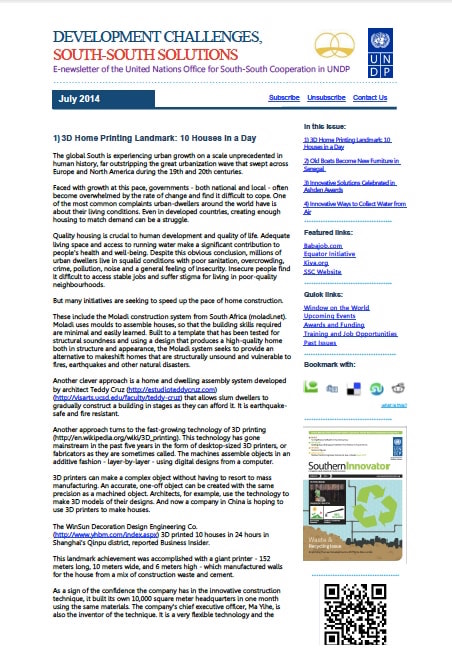
  • Development Challenges, South-South Solutions Newsletter

    Development Challenges, South-South Solutions Newsletter
    By David SouthDevelopment Challenges, South-South Solutions
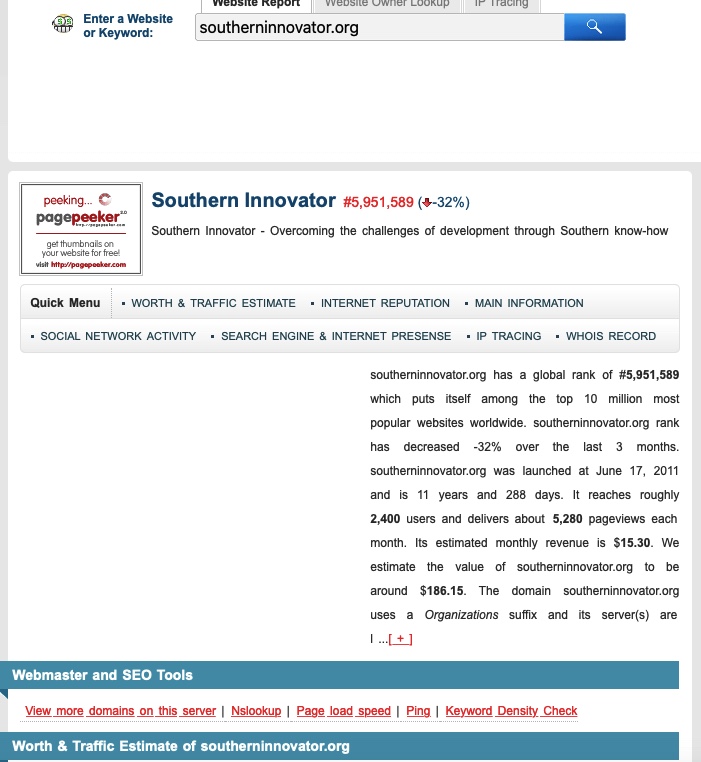
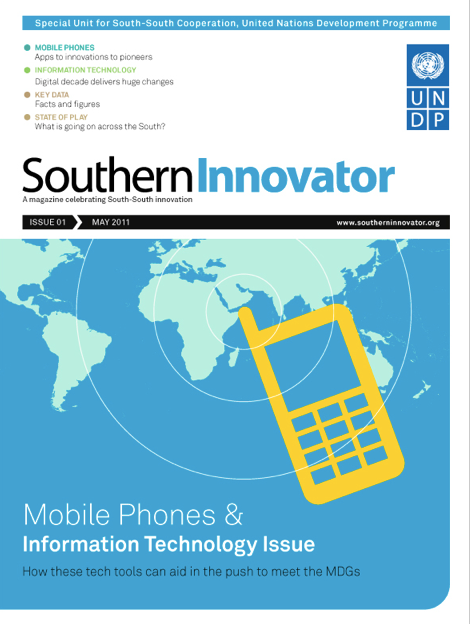
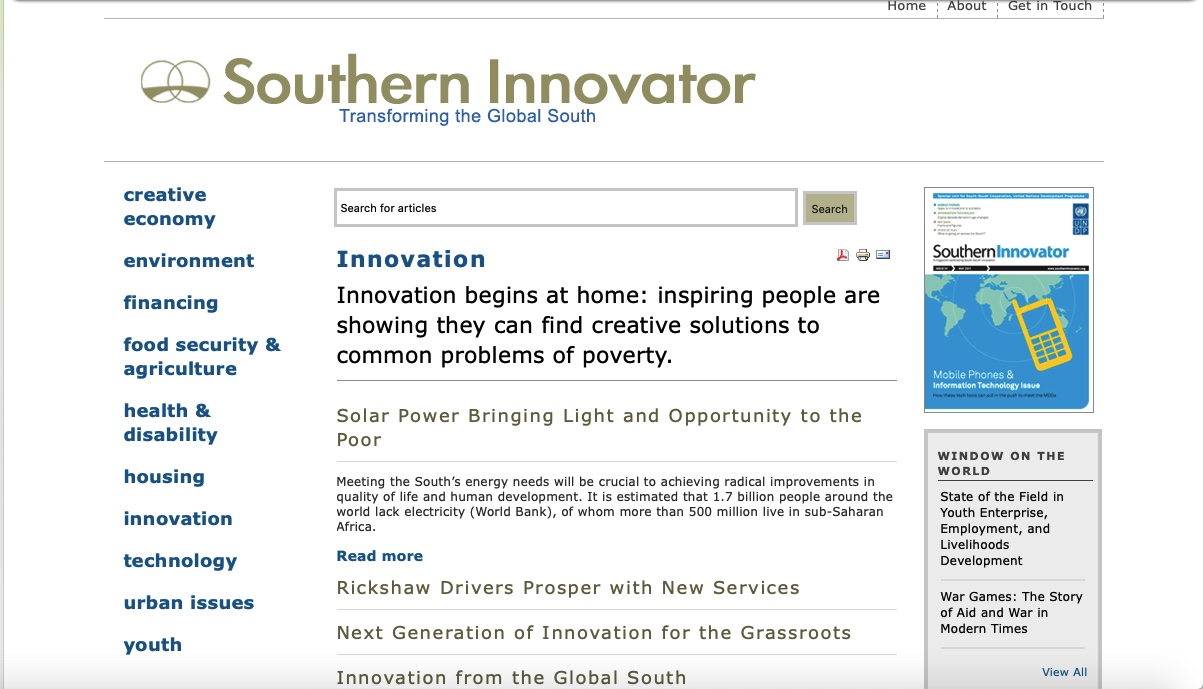
    The original southerninnovator.org website launched in 2011, in tandem with the first issue of Southern Innovator Magazine, and ranked midway in the top 10 million most popular websites in the world. Its content has been cited in books, scholarship and strategic plans.

    ISSN 2227-3905

    Development Challenges, South-South Solutions is the monthly e-newsletter for the United Nations Office for South-South Cooperation in UNDP (formerly the United Nations Development Programme’s South-South Cooperation Unit). I research and write all stories (since January 2007). You can view the original website here. The stories are in English, French and Spanish.

    The original WordPress website for Development Challenges, South-South Solutions (southsouthnews.wordpress.com). It was launched in 2006 and eventually became southerninnovator.org in 2011. The magazine Southern Innovator was also launched in New York in 2011.
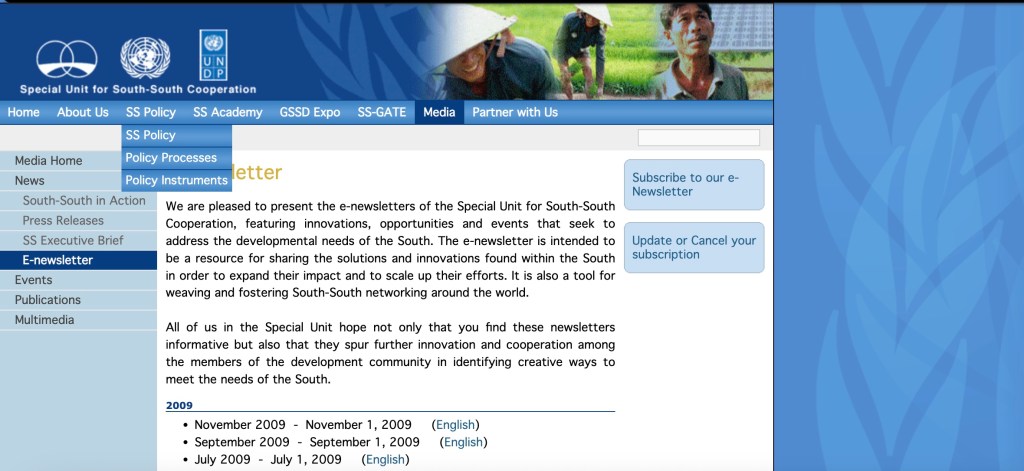
    The newsletter archive on the website for UNDP’s Special Unit for South-South Cooperation circa 2011 (including issues in English, French and Spanish). 2011 was an important year as the e-newsletter Development Challenges, South-South Solutions scaled into a dedicated web archive, http://southerninnovator.org, a sister magazine, Southern Innovator (https://unsouthsouth.org/2014/12/25/southern-innovator-magazine/), and pollinated its content across multiple platforms, capitalising on the platform and social media explosion of the time.

    Here is a good background article on the rise of South-South cooperation, how it is altering global trade and power relationships, and what the future holds: South-South Cooperation Defies the North. And here is some historical background from Wikipedia: South-South Cooperation.

    Development Challenges, South-South Solutions reaches a global audience of influential decision-makers on the frontlines of international development in the South. More than 2,000 subscribers read the newsletter every month (academic institutions, UN agencies, private sector companies, UNDP Country Offices, financial institutions including the IMF and World Bank, inter-governmental organisations, UNDP knowledge networks around the world, and all South-South focal points in West Africa).

    Remember to think of Development Challenges, South-South Solutions when you have a Southern innovation to share with the world. You can read our archive of stories online here: http://ssc.undp.org/index.php?id=66

    From Special Unit for South-South Cooperation: 2008 Reflections: “As part of the strategy to foster South‐South cooperation within and across regions, the Division has continued to invigorate and re‐enforce a South‐South cooperation focal point system. These efforts included the publication and distribution of a monthly e‐newsletter, Development Challenges: South-South Solutions, which presents a briefing for South‐South focal points, Southern academics and development professionals on practical solutions to development challenges found throughout the South. Over the course of 2008, twelve e‐newsletters were released via e‐mail and published on the website of the Special Unit.”

    What are people saying about Development Challenges, South-South Solutions? Read some comments here.

    Contact me by email about the newsletter here: developmentchallenges@googlemail.com.

    Contact me by email about the new global magazine Southern Innovator here: southerninnovator@yahoo.co.uk

    July 2014 issue of Development Challenges, South-South Solutions: The last issue is available online for download. Support the e-newsletter for 2017: we are seeking additional funding so we can improve the reader experience and frequency of the e-newsletter. Since first launching in 2006, we often heard from readers how they valued the stories in the e-newsletter and how it has helped in raising the profile of innovators across the global South (“Congratulations on another great newsletter that’s packed with fascinating information! I really enjoy getting it each month.”). Additional resources would enable us to improve the way readers can access and receive the e-newsletter, enable the e-newsletter’s contributors to travel and report on developments, and allow us to offer daily and weekly updates and a wider range of resources online and on mobile platforms. Additional funds help in maintaining the quality of the e-newsletter, something that has been appreciated by readers (“Great economic and business reporting! Very helpful for us.” Africa Renewal). It will also allow the e-newsletter to spin-off quality resources for innovators, such as the influential magazine Southern Innovator. Contact the United Nations Office for South-South Cooperation if you wish to support the e-newsletter for 2017: UNOSSC.

    “What a tremendous magazine your team has produced! It’s a terrific tour de force of what is interesting, cutting edge and relevant in the global mobile/ICT space… This is great, engaging, relevant and topical stuff.” Rose Shuman, Founder & CEO, Open Mind and Question Box, Santa Monica, CA, U.S.A.

    “Great economic and business reporting! Very helpful for us.” Africa Renewal, Africa Section, Strategic Communications Division, United Nations Department of Public Information

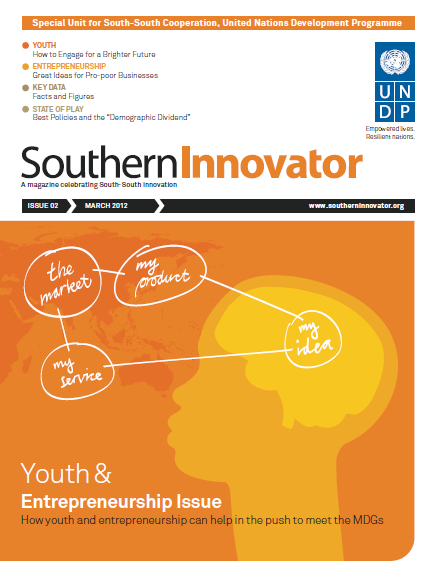
    “The reviewer observed that, although the Policy and UN Coordination Unit had produced all of the reports requested by intergovernmental bodies, especially for the High-level Committee, it had not been able to produce many of the publications (evidence-based analytical reports) that had previously been within its purview. Such publications included Southern Innovator magazine and the monthly e-newsletter “Development Challenges, South-South Solutions”. In the case of Southern Innovator, one issue (No. 5 on waste and recycling) was published during the four-year period of the framework but did not have wide online distribution, and issue No. 6 was awaiting funds for publication. The e-newsletter was last issued in July 2014 even though the reviewer found it a good way to communicate with focal points at the national and inter-agency levels. In fact, the shortage of funds for those knowledge products was the main reason that they had ceased being produced during the evaluation period.”  Final evaluation of the performance of the United Nations Office for South-South Cooperation  under its strategic framework, 2014-2017, in light of the adoption of the 2030 Agenda for Sustainable Development

    Note: Unfortunately, the reason for “the shortage of funds” was down to suspension of funding to the UNOSSC in 2015 and 2016 pending two internal UN audit investigations after arrests made in 2015 by the Federal Bureau of Investigation (FBI) revealed a bribery and money laundering network targeting the United Nations via various NGOs, including the UN-based news organisation South-South News. The case eventually made its way to the Supreme Court of the United States.

    Back Issues

    Development Challenges, South-South Solutions Newsletter | 2011-2014

    2014

    Development Challenges, South-South Solutions Newsletter | 2007-2010

    2013

    https://www.slideshare.net/DavidSouth1/development-challenges-july-2013-issue

    2012

    https://www.slideshare.net/DavidSouth1/development-challenges-july-2012-issue

    2011

    https://www.slideshare.net/DavidSouth1/development-challengessouthsouthsolutionsdecember2011issue

    2010

    2009

    2008

    https://www.slideshare.net/DavidSouth1/development-challenges-may-2008-issue

    2007

    “Beautiful, inspiring magazine from UNDP on South-South innovation. Heart is pumping adrenaline and admiration just reading it.”

    This work is licensed under a Creative Commons Attribution 4.0 International License.

    ORCID iD: https://orcid.org/0000-0001-5311-1052.

    © David South Consulting 2025

  • Top Reporters Offer Military Media Handling Tips

    Top Reporters Offer Military Media Handling Tips

    Ryerson’s course on handling media has raised eyebrows

    By David South

    Now Magazine (Toronto, Canada), November 12-18, 1992

    The whimsical Certificate of Military Achievement hanging in the offices of the Ryersonian newspaper at Ryerson journalism school is testament to the warm relationship between the armed forces and one of Canada’s top journalism schools.

    But a two-month crash course in journalism for military public affairs officers hosted by Ryerson this summer has left a bad taste in the mouths of some participants and critics.

    The course, which involved 18 soldiers, included two weeks of classes in each of print, radio and TV journalism, wrapping up with two weeks of “crisis management” training. The 60 instructures included such prominent journalists as Ann Medina and Pamela Wallin.

    According to an administration newsletter, the course netted Ryerson more than $350,000. Organizers say the course was merely an exercise in familiarizing soldiers with the needs of working journalists. But given the often conflicting roles of the military and the media, some fear journalistic ethics may have taken some collateral damage.

    “The course had nothing to do with national defence or the armed forces,” says course teacher and organizer Shelley Robertson. “They just wanted to understand the roles of journalists from the other side. The military didn’t ask us to teach what we teach our students.”

    Robertson says the course also benefited the participating journalists by giving them contacts in the military.

    But according to media critic Barrie Zwicker, the exercise blurs what should be the distinctly different interests of journalists and the military. “It’s similar to press and politicians. By getting close to the politician, journalists can get information they couldn’t normally obtain. The negative side is that the media can get sucked in and lose a larger perspective. The same tensions exist with covering the military.

    Managing media

    “It’s up to the media to break the rules and try and get the story. The military always wants to hide its victims. If a Ryerson journalist strikes up a friendship with a public affairs officer, will the reporter be true to their journalistic tradition?”

    Colloquially known as spin doctors, hype-meisters and flak catchers, public affairs officers perform much the same tasks in the military as their civilian counterparts in industry and government – including managing information that gets to the public or media.

    In the past, Canadian soldiers had to go to the US for special training at the Defense Information School at Fort Benjamin Harrison. But, according to Robertson, the armed forces were looking for a Canadian spin.

    With 4,600 Canadian peacekeepers now stationed around the world, including a contingent in the dangerous and volatile former Yugoslav republics, the chances for conflict – and casualties – have increased.

    Lieutenant-commander Glen Chamberlain, who helped coordinate the course, says the military’s increased profile means that the forces have to become more adept at media relations. “There is a great desire among Canadians to know what troops on peacekeeping duties are up to. We have a wonderful story to tell.”

    Chamberlain says he works on journalists’ behalf with stubborn military commanders. “The armed forces are finding there is a real benefit to having specialized PA officers. We want to help journalists to tell our story well.”

    The crisis management section of the course offered participants a hands-on approach to managing journalists. The officers were presented with two scenarios – a murder at Moss Park armoury and a highway helicopter crash – and then practised handling a group of journalists investigating the events.

    Course lecturer Kevin Donovan, who covered the Gulf war for the Toronto Star, remembers the effectiveness and sophistication of PA officers in the field.

    “When I was in Riyadh, Saudi Arabia, I walked into a hotel and on the wall were pool reports – news briefs written by US military public affairs officers – that journalists were encouraged to use for stories. There were some journalists going out into the field to cover stories, but a huge number just sat in this beautiful hotel.”

    “Canadian journalists are ignorant of the military and could do with getting closer. You almost never find a full-time journalist in Canada who knows anything about them. The more you know about the military, the less you will be manipulated.”

    Stop information

    Donovan feels uncomfortable about teaching on the course.

    “I was asked by Ryerson to give a talk on my experiences in Saudi Arabia, Kuwait and Iraq,” he says. “My initial reaction was no. I hate the existance of public affairs people with a passion. Their job is to stop information.

    “I’m uncomfortable with Ryerson being hired by the department of national defence. One officer in the course got very upset when I told them to make contacts with the media and leak stories.”

    Course organizer Clive Vanderburgh admits organizers had concerns about conflicts between the role of journalists and military officers. “There was a lot of discussion concerning the potential for conflict – especially that the people hired to teach might think they were there to help the department of national defence to avoid the media

    “But we were trying to give a general understanding of the media’s needs. We didn’t sell the country down the drain.”

    Another teacher was Robert Fulford, the well-known writer and lecturer on journalistic ethics. “I don’t have a problem with Ryerson teaching the military,” says Fulford. “It’s a way of spreading journalistic technique to people in the DND. It seems to be a natural extension of the work of Ryerson.

    “Canadian journalists are ignorant of the military and could do with getting closer. You almost never find a full-time journalist in Canada who knows anything about them. The more you know about the military, the less you will be manipulated.”

    But Gideon Forman, coordinator of the Canadian Peace Alliance, fears Ryerson may be helping the military mislead the public.

    “Why do these guys practise handling the media so much of there’s nothing to hide? This is just better packaging for the military so they can get what they want from the public.

    “I have problems with public money being spent teaching the military to be more effective with the media, while other organizations have their budgets cut or eliminated.

    “Is there a similar program for food banks or women’s shelters?”

    Note on story context: This story was researched and written after two key events involving Canada’s military: the first Gulf War from 1990-1991; and the Oka Crisis in 1990, where the Canadian Armed Forces confronted an armed group of Mohawk “Warriors” in Oka, Quebec.

    More investigative journalism here: 

    Peaceniks Questioning Air-Raid Strategy In Bosnia

    Somali Killings Reveal Ugly Side Of Elite Regiment

    Study Says Jetliner Air Quality Poses Health Risks: CUPE Takes On Airline Industry With Findings Of Survey

    Creative Commons License

    This work is licensed under a
    Creative Commons Attribution-Noncommercial-No Derivative Works 3.0 License.

    ORCID iD: https://orcid.org/0000-0001-5311-1052.

    © David South Consulting 2023

  • False Data Makes Border Screening Corruptible

    False Data Makes Border Screening Corruptible

    “Big Brother” system could violate rights of Canada’s visitors

    By David South

    Now Magazine (Toronto, Canada), May 21-27, 1992

    New technology that can spew out a person’s life history in less than six seconds is now available to Canada’s customs and immigration officials.

    And while Canada customs and immigration officers say this toy is a boon – replacing the need to memorize names of so-called undesirables – civil rights workers and refugee activists point out that the gizmo could have serious consequences, with little recourse.

    The technology is called PALS, or primary automated look out system, and is already in operation at airports in Toronto, Montreal, Calgary, Winnipeg, Ottawa and Vancouver.

    PALS’ operation is based on the use of computer-readable passports. Canada is one of several countries that have started including computer strips on passports and identity cards. Officers use PALS by either keying in a special number printed on the passport or identity card or using a scanning machine to read the strip.

    The system went into effect at Toronto’s Pearson airport on January 20, after a three-year pilot project in Vancouver, adding Canada to the 11 countries that have machine readers for passports. Under the old system, customs officers combined judgement, questioning and the most-wanted list to decide if a passenger required further interrogation and search.

    During a demonstration of the system, customs officials at Pearson airport boast about the system’s role in apprehending a drug smuggler in PALS’ first week of operation.

    Sinister sign

    But to civil libertarians with experience of such systems in other countries, PALS hasa sinister implication. Many say that PALS spews out what is fed into it. And depending on the country involved, what is fed into it may not necessarily be true.

    While customs emphasizes PALS’ role in apprehending popular targets like drug smugglers, terrorists and child kidnappers, its reach also includes people who have smuggled in too many cigarettes or bottles of alcohol, convicted criminals who have finished serving their time, immigrants, refugees and a range of petty offenders.

    All of these face a second interrogation and detention based on what their governments have decided to incorporate into the computer strip. And it is this that worries civil libertarians and refugee workers.

    Consider the case of a legally sponsored Portuguese immigrant who arrived at Pearson just after PALS had been introduced. He was detained based on information stored in PALS. His immigration lawyer Ali Mohideen recalls how the man was held because of a cheque that he bounced in his native Portugal about eight years ago.

    Ed Lam, director of research for the Canadian Ethnocultural Council, feels customs and immigration already have “too many powers.” He regularly receives complaints from visible minorities and immigrants who feel they are singled out for harassment at the airport.

    “This is big brother. Legal protection is not enough,” he argues. “It leads to costly court battles with the government. I would like to see an ombudsperson or complaints bureau set up. As for refugees turned back at the border, we will never hear from them.”

    False data

    Other critics, especially those in the US, where a PALS-type system has been in operation for more than a decade, worry that the system will simply accept information given by tyrannical governments.

    “It is hard to trace false information to a foreign government,” says Jeanne Woods, legislative counsel to the American Civil Liberties Union, which monitors abuse under the United States system.

    “People have been accused of being communists or terrorists who have denied it. The El Salvadoran government is one example of a regime which has called prominent human rights activists and lawyers terrorists.”

    She would like the Canadian Parliament to pass a law similar to one passed last November in the US requiring the state department to report to Congress when somebody is denied access because they have been called a terrorist, so that the origin of the information can be tracked.

    “People have been accused of being communists or terrorists who have denied it. The El Salvadoran government is one example of a regime which has called prominent human rights activists and lawyers terrorists.”

    The Canadian database draws its information from several sources, according to customs spokesperson Suzanne Bray. The sources include immigration records and the Police Information Retrieval System, which is a database shared between customs and the RCMP.

    Bray refuses to divulge any other sources, citing security, but both RCMP and customs operate their own intelligence services, sharing information with their counterparts all over the world, especially the US. Information is also drawn from the Canadian Security Intelligence Service (CSIS) and its sister organizations such as the CIA. However, CSIS spokesperson Ray Boisvert says they have adequate safeguards against false information provided by countries known to be human rights abusers.

    “CSIS does look at bias in intelligence reports,” he says.

    The US equivalent of PALS has been criticized after several cases of abuse were detected. Gara LaMarche, executive director of the Fund for Free Expression, a project of US-based Human Rights Watch, has documented abuse on political and ideological grounds.

    “The US public has a right to hear dissenting views under the first amendment of the Constitution,” he says. “I don’t think improving the technology of border control violates civil liberties, but keeping a massive database of information which includes people’s political associations is bad.”

    Similar concerns are expressed by John Tackaberry of Amnesty International in Ottawa, which is only now beginning its own analysis of PALS. “We have concerns over data input, who controls information and basic civil liberties.”

    Even as Canadian civil rights activists take stock of PALS, Canada customs is planning to use it to check cross-border shopping by expanding the system to all land entry points.

    As for those visitors who feel wronged by PALS, they may have a problem seeking redress from such organizations as the Canadian Human Rights Commission. A spokesperson says the CHRC can only help those who have been admitted to Canada. And visitors turned back at the border are not considered admitted.

    Sherry Gerstl, a customs superintendent responsible for the implementation of PALS at Pearson, says that people can also appeal to the Privacy Act to see information that is kept on them. But two fact sheets explaining how this can be done are located in a corner, pretty much out of public view.

    Bray acknowledges that “honest” passengers could face the prospect of a search with PALS, but given its positive attributes, she says, passengers involved in such delays should simply “grin and bear it.”

    Facial recognition AI software triangulates facial features to produce a recognition match.
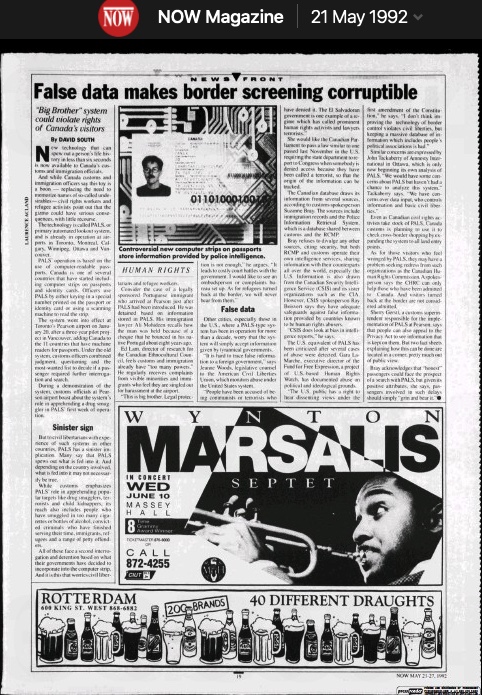
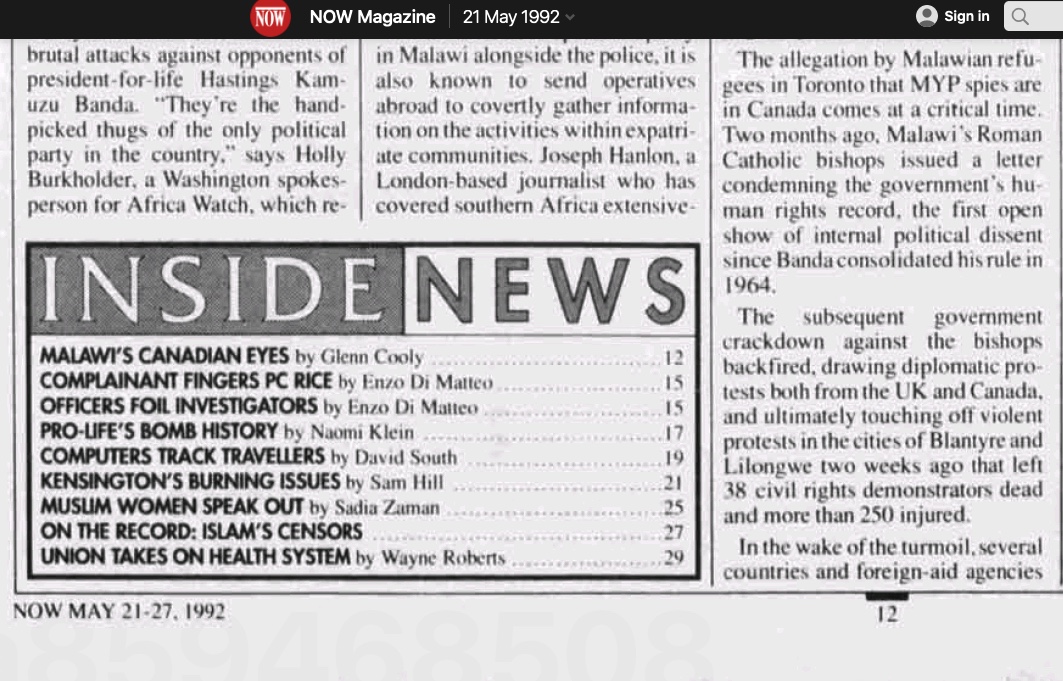
    “Computers Track Travellers” by David South. Now Magazine published investigative journalism from David South, Naomi Klein and others in the early 1990s.

    More on biometrics:

    https://davidsouthconsulting.org/2022/02/09/african-health-data-revolution/

    https://davidsouthconsulting.org/2020/12/04/big-data-can-transform-the-global-souths-growing-cities/

    https://davidsouthconsulting.org/2020/12/04/data-surge-across-global-south-promises-to-re-shape-the-internet/

    https://davidsouthconsulting.org/2021/03/04/indian-id-project-is-foundation-for-future-economic-progress/

    https://davidsouthconsulting.org/2021/03/31/new-weapon-against-crime-in-the-south/

    Creative Commons License

    This work is licensed under a
    Creative Commons Attribution-Noncommercial-No Derivative Works 3.0 License.

     ORCID iD: https://orcid.org/0000-0001-5311-1052.

    © David South Consulting 2023

  • Casino Calamity: One Gambling Guru Thinks The Province Is Going Too Far

    Casino Calamity: One Gambling Guru Thinks The Province Is Going Too Far

    By David South

    Id Magazine (Canada), May 16-29, 1996

    Will Ontario become saturated with gambling? It is a question being asked more and more as the provincial government moves to allow unprecedented choice for gamblers.

    Bars and hotels will soon have video one-armed bandits (known as video lottery terminals and slammed by the Addiction Research Foundation as video crack) and permanent charity casinos will be set up throughout the province.

    Finance minister Ernie Eves’ budget may have brought joy to the hearts of the province’s gambling fanatics, but whether this is sound economic policy is less certain. Eves hopes to reap $60 million this year from the VLTs, or fruit machines.

    Speaking to id under anonymity due to the sensitivity of his work, a private gambling consultant to the provincial government says the extended gambling could monkey-wrench the government’s on-going plans to build casinos to attract American tourists.

    He says, “There is a maximum to any market area, to the number of people who will come. In Ontario, the idea was to have monopoly markets to create jobs and revenue for government. Spreading casinos out on the border areas would maximize jobs. But the introduction of VLT machines and permanent charity casinos means there will be a narrowing of the market. As soon as you set up the VLTs, there will be a permanent impact.”

    He believes littering the province with casinos – both large and small – and VLTs, will be the equivalent of pissing in the wind for the government, arguing tourists will only be attracted to Ontario casinos if they consist of only a few, flashy must-see attractions based on the Las Vegas model.

    Tourist temptation

    The focus on tourists is key. Research has shown that gambling aimed at residents living near casinos can actually harm other local businesses like restaurants and movie theatres, as people spend more of their entertainment budgets on gambling. Add to this equation the fact that most of the profits go out of the community to Queen’s Park, and a casino can hurt local economies.

    Knowing this, the government has instead focused on attracting tourists. In the case of the Windsor casino, it has worked – 80 per cent of gamblers there come from the US. The economic equation is simple: every dollar sucked in by the casino is a net gain for Canada that doesn’t hurt any other Canadian businesses (as for Detroit, that is anther story).

    If the government keeps on its current course, Ontario could have 10 working government-owned casinos in the near future. By year’s end, the Windsor casino will be joined by Niagara Falls and the Rama First Nations casino near Orillia.

    According to Anne Rappe of the government-owned Ontario Casino Corporation public outrage could change plans. “The government has been clear in its commitment to letting voters voice their view on casinos for other sites.”

    Just a fad

    Governments, like people, follow fads. The trend towards harder forms of gambling, like casinos and VLTs, as opposed to softer gambling like lotteries, represents a desperate move by local governments to hang on to tax revenues.

    Even more than flashy schemes to build theme parks, art galleries and museums, casinos are seen as a sure-fire way to revive ailing communities by attracting tourists. Throughout North America, consultants and casino companies are telling government to turn to gambling if they hope to boost public treasuries and generate jobs. The pitch in these hard economic times goes down a treat with governments beseiged by voters to, on the one hand, reduce debt and deficits, and on the other be seen to be creating economic opportunity in the age of downsizing.

    Casinos also serve another purpose. While taxes seem punitive, making money off of gamblers appears on the surface to be a win-win situation. The government gets the money it wants,while gamblers get the adrenaline rush they crave, and maybe some cash. The whole arrangement seems to be victimless – if you want to gamble, you pay the price.

    For their part, gambling advocates envision Ontario as a Mecca for American gamblers chasing our low dollar, low crime, no tax casinos. They say we can have it both ways: a safe, low-crime Ontario in which islands of gambling fever suck in much-needed American dollars to prop up the provincial government treasury.

    Gambling has been legal in Canada since 1969 (though the oldest casino is the gold rush-era Diamond Gerties in Dawson City, Yukon), but it wasn’t until the New Democrat government of Bob Rae that the idea of government-run or sanctioned permanent casinos became an option in Ontario.

    The gambling consultant says the appeal of casinos is that they offer a sure-fire anchor to a local economy. He criticizes other developments like theme parks for being “too risky.” To make the most money, he says, casinos should avoid any pretensions to be slick, high-society affairs and instead go after the folks with “the family restaurant-style dress code.”

    While the casino in Windsor is a lucrative success for the government – taking in a “win” of $500 million – local businesses have yet to report any of that money coming their way. Gambling experts say that isn’t about to change. With $400 million going directly to the government, and the rest covering expenses and the management fee paid to an American consortium running the casino, there will be little left for anyone else.

    The Windsor casino is also drawing criticism for being a social parasite on Detroit, which supplies 80 per cent of the casino users. The influx of $1 million into Windsor means between 2,000 and 3,000 jobs are lost in Detroit, according to gambling expert William Thompson of the University of Nevada. Because of this, it is believed Detroit will soon set up a casino if voters say so.

    A 1993 Coopers and Lybrand study commissioned by the government estimated Windsor’s win would be reduced by 60 per cent if Detroit were to open a casino.

    That same study strangely found comfort in its findings that the average “pathological gambler” is male, under 30, non-Caucasian, unmarried and without a high school diploma.

    It then goes on to say, “The typical US casino gaming patron earns thirty per cent more than the average of the US population, is between the ages of 40-64, is college educated and lives in a household of two or more members.” Just the kind of market that sends corporations into ecstasy.

    Quebec example

    The Quebec experience offers some valuable lessons for Ontario. Quebec’s three casinos were also looking to be a success until recently. The Quebec government and gambling advocates maintained the casinos (located in Montreal, Pointe-au-Pic and Ottawa’s sin-bin, Hull) were squeaky clean. Just like in Ontario, they remarked upon the impressive revenues – $1 million a day – and the huge influx of tourists. But closer scrutiny reveals the three casinos have not come without a cost.

    Both Montreal and Pointe-au-Pic casinos have been criticized for preying on poor locals who spend the pittance out of their entertainment budgets on gambling. The casinos have also been involved in high-profile drug busts, money laundering scams and even murders committed by gambling addicts trying to extort money from relatives. At the Montreal casino, enterprising youth gangs targeted winners as they left the casino when it closed at three am. The robberies worked like this: A confidant would spot winners in the casino and then use a cellphone to tell accomplices waiting outside to mug the unsuspecting “lucky” ones still intoxicated by their good fortune.

    All the rosy projections about casinos reviving the Ontario economy are based on several key assumptions: Americans will be the main users of the casinos, casinos in Ontario will not compete with each other or other sectors of the economy (restaurants, movie theatres, etc.), the social costs will be low and crime will not increase significantly, and most importantly, American casinos won’t lure away gamblers.

    As for the gambling consultant, he doesn’t think the casinos slated to open later this year in Niagara Falls will drag the city down any farther. “Niagara Falls isn’t the nicest place now. The casino will finally give an economic reason to upgrade these places (hotels, motels and restaurants).”

    And while the Niagara Falls casino will most certainly be popular, it will not be able to operate free of competition for long. Across the Rainbow Bridge at Niagara Falls, New York, preparations are being made to open a casino by 1997.

    Windsor will also face competition from the American side. Voters in the state of Michigan will be asked to vote on whether to allow casinos at the next state elections. Several groups, including a local Indian band, have been pushing for a casino to be located in downtown Detroit. Canadian casinos must also compete with river boats from Illinois and Indiana.

    The government has reached a watershed in its gambling policy, leaving it with few choices. It can either allow unfettered growth in casinos as more and more communities scramble to find any means necessary to generate jobs and tax revenues, or it can recognize there is a limit to gambling as a solution to economic woes.

    As the source says, “The government is in a quandry: they like the revenue but hate the way it is raised.”

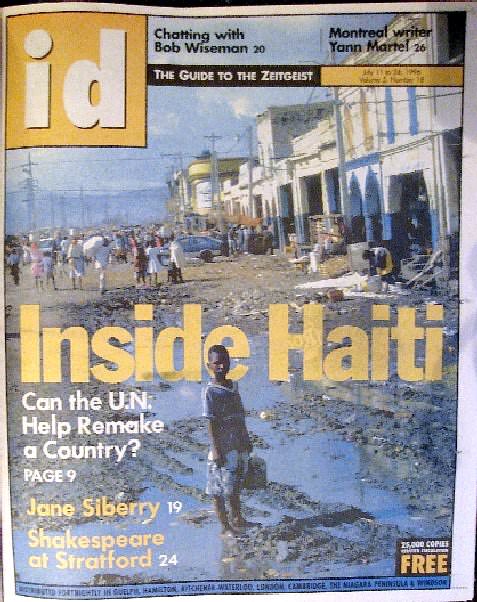
    Id Magazine was published in the mid to late 1990s in Canada.

    https://davidsouthconsulting.org/2021/07/20/case-study-3-id-magazine-1996-1997-2/

    Citations

    Story cited in Schizophrenia: A Patient’s Perspective by Abu Sayed Zahiduzzaman (Author House), 2013. 

    https://davidsouthconsulting.org/2020/11/17/land-of-the-free-home-of-the-bored/

    https://davidsouthconsulting.org/2020/12/22/man-out-of-time-the-world-once-turned-on-the-ideas-of-this-guelph-grad-but-does-the-economist-john-kenneth-galbraith-know-the-way-forward/

    https://davidsouthconsulting.org/2022/06/24/professor-puts-chronic-fatigue-into-historical-perspective/

    https://davidsouthconsulting.org/2021/03/17/province-for-sale-step-right-up-for-an-opportunity-to-buy-what-you-already-paid-for/

    https://davidsouthconsulting.org/2020/06/14/psychiatric-care-lacking-for-institutionalised-seniors/

    https://davidsouthconsulting.org/2021/01/20/pulling-the-plug-on-hate-rock-1996/

    https://davidsouthconsulting.org/2021/01/16/redneck-renaissance-a-coterie-of-journalists-turn-cracker-culture-into-a-leisure-lifestyle/

    https://davidsouthconsulting.org/2021/01/14/from-special-report-sexual-dealing-todays-sex-toys-are-credit-cards-cash-a-report-on-the-sex-for-money-revolution/

    https://davidsouthconsulting.org/2020/04/22/state-of-decay-haiti-turns-to-free-market-economics-and-the-un-to-save-itself/

    https://davidsouthconsulting.org/2021/02/03/swing-shift-sexual-liberation-is-back-in-style/

    https://davidsouthconsulting.org/2022/08/13/truckus-maximus-the-big-boys-with-the-big-toys-do-some-hardcore-pogo-at-monster-truck-show/

    https://davidsouthconsulting.org/2020/12/11/tvs-moral-guide-in-question-again/

    https://davidsouthconsulting.org/2021/09/13/will-niagara-falls-become-the-northern-vegas/

    Creative Commons License

    This work is licensed under a
    Creative Commons Attribution-Noncommercial-No Derivative Works 3.0 License.

    ORCID iD: https://orcid.org/0000-0001-5311-1052.

    © David South Consulting 2023